AWS財務チームがAmazon QuickSightで数百時間を節約した方法
本文の状態
日本語全文を表示中
詳細モードで約10分の本文を読めます。
同じ出来事の情報源
この情報源を基点に整理
AWS Machine Learning Blog
AWS Finance チームは生成 AI アシスタント「Amazon Quick」のチャットエージェントとフロー機能を活用し、財務計画分析業務におけるデータ統合やリスク分析の自動化を実現し、数百時間の工数削減に成功した。
AI深層分析を開く2026年8月4日 07:55
AI深層分析
キーポイント
Amazon Quick の導入効果
AWS Finance チームは生成 AI アシスタント「Amazon Quick」を導入し、月間数百時間を要していたデータ準備業務を大幅に短縮した。
チャットエージェントによる高度分析
同チームはチャットエージェントを構築し、自然言語での対話を通じて Amazon Redshift の数百万行のデータを即座に照会・分析できるようになった。
シナリオモデリングとリスク分析の変革
戦略顧客向けの財務目標設定において、手作業ではカバーしきれなかった顧客への深掘り分析が可能になり、モンテカルロシミュレーションなどの高度な計算も自動化された。
業務プロセスの効率化
単一の顧客分析に要していた最大 6 時間の工数が削減され、経営層への提出期限までに全顧客を適切にカバーできる体制が整った。
統計予測とシナリオモデリングの自動化
Quick エージェントは約10分で回帰分析やモンテカルロシミュレーションを実行し、手動では見逃されたリスクと機会を特定する。
重要な引用
Across AWS Finance, teams were spending hundreds of hours a month on exactly this kind of work.
Amazon Quick is a generative AI assistant that connects across all your enterprise data and applications
The agent queries millions of rows across Amazon Redshift data tables instantly while also searching external data signals.
"We have expanded from deep-diving a third of our strategic customers to covering our entire portfolio. Our finance team now spends time on what matters: partnering with the business to drive revenue, not compiling data or writing complex queries."
編集コメントを表示
編集コメント
この事例は、生成 AI が特定の業務領域(ここでは財務)において、既存のデータ基盤と深く統合され、複雑な分析タスクを自動化する実用的な価値を示している。企業における AI 導入においては、単なる技術の導入ではなく、業務フロー自体の変革を視野に入れた設計が成功の鍵となることを示唆している。
Source Article
元記事を日本語で読む
本文に関係しない購読案内、埋め込み通知、サイト内プロモーションは除いています。
財務のプロなら誰でも知っているでしょう。月曜の朝が来れば、財務計画・分析(FP&A)チームはデータ集計に没頭します。複数のシステムから数値を引っ張り出し、ソース間の整合性を確認し、チャートを作成し、解説文を書き起こす。すべてが「先週の売上はどうだったのか、その理由は何か」という、本来なら単純な問いに答えるためです。
AWS Finance 内では、各チームが毎月何百時間もの時間を、まさにこの種の作業に費やしていました。分析でも戦略でもないのです。本格的な業務を開始するために、データを準備するだけで終わってしまうのです。
Amazon Quick は、企業のあらゆるデータとアプリケーションを横断して接続する生成 AI アシスタントです。ビジネスユーザーは自然言語で検索・分析し、アクションを起こすことができます。数百万行のクエリ実行や高度な分析、反復的なワークフローの自動化といった複雑さを Quick が処理してくれるため、チームが手作業で行う必要はありません。
本稿では、AWS Finance チームが Amazon Quick の chat agents と Flows を活用し、最も時間を要する 2 つのワークフローをどのように変革したかをご紹介します。
ユースケース 1:戦略的ポートフォリオ全体におけるシナリオモデリングとリスク分析
戦略的顧客に対する財務目標の設定には、事業チームからのボトムアップ予測と経営層からのトップダウン見通しの整合性確認が必要です。また、過去のデータの下に潜むリスクを捉えるための十分な深みも求められます。
チームは、エンタープライズデータソースに直接接続し、自然言語での対話を通じて高度なインサイトを届ける Amazon Quick のチャットエージェントを構築しました。このエージェントは、Amazon Redshift のデータテーブル内の数百万行のデータを瞬時に照会するだけでなく、外部データのシグナルも検索します。
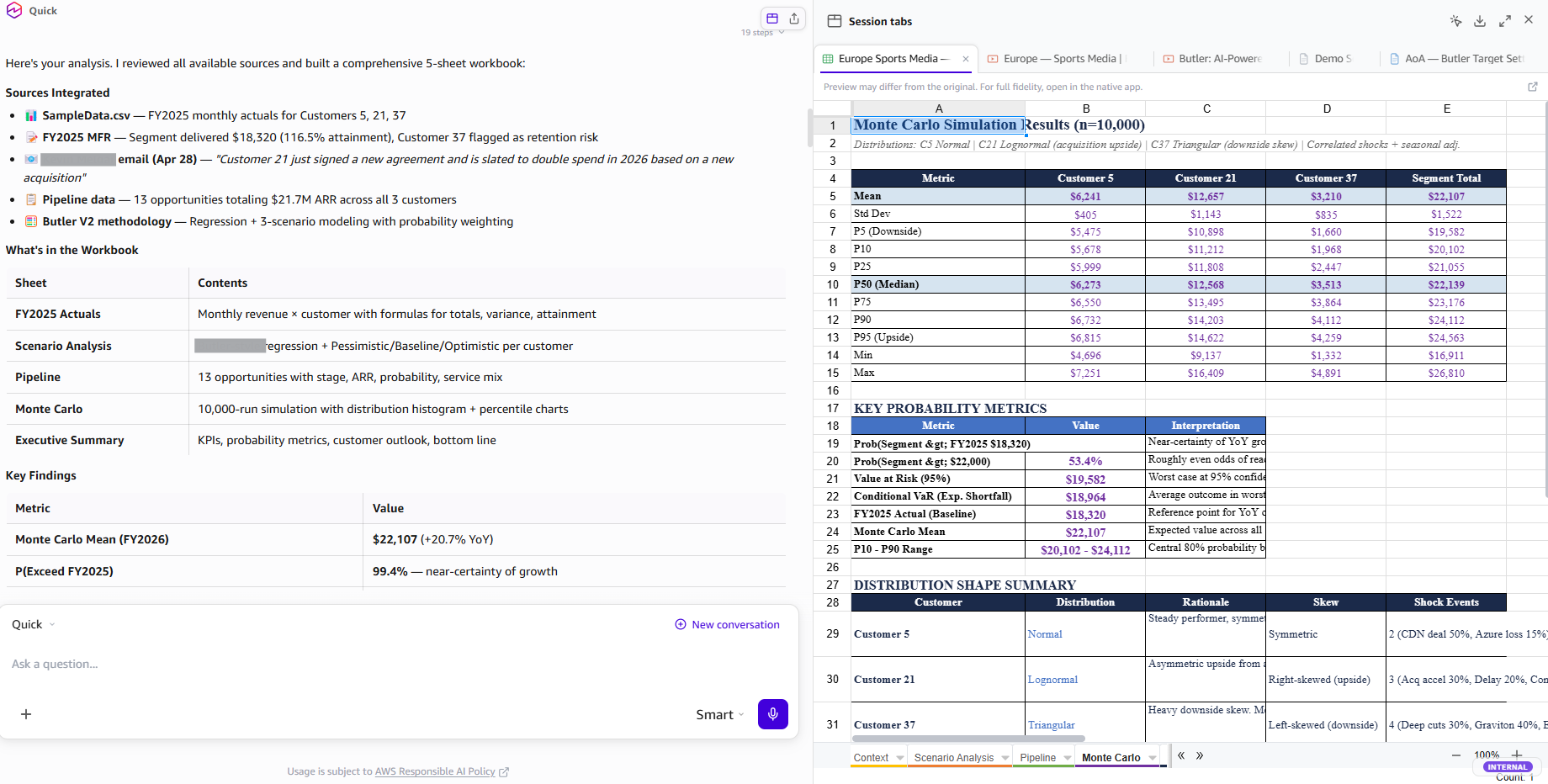
ここに変化がありました:
導入前: 分析担当者は、ボトムアップからの入力とトップレベルの目標期限の間にある限られた時間で、戦略的顧客のおよそ 3 分の 1 にしか深く掘り下げることができませんでした。残りの顧客は表面的なカバーにとどまりました。単一の顧客分析には、データの抽出やモデルの実行、結果の文書化などを含め、最大で 6 時間の手作業が必要でした。
導入後: Quick エージェントは、統計予測の評価、回帰分析、モンテカルロシミュレーション、複数の要因にわたるシナリオモデリングを、顧客あたり約 10 分で実行します。人手の分析では見逃されていたリスクや機会を浮き彫りにしました。チームは今や、以前よりもさらに深い深さで、顧客ポートフォリオ全体をカバーできるようになりました。
「戦略顧客の 3 分の 1 に深く入り込むことから、ポートフォリオ全体をカバーする範囲へと拡大しました。私たちの財務チームは、今や重要なことに時間を割いています。データを集計したり複雑なクエリを書いたりするのではなく、ビジネスと連携して収益を押し上げることに注力しています。」
— ジョフ・ウィンクラー
この仕組みが機能する理由: アナリストが自然言語で質問します。「主要戦略顧客の機会とリスク評価を実行してください」と。Quick は数百万行のデータを照会し、高度な分析を実行して、構造化データとフィールドレポートやパイプラインデータからの非構造的なインサイトを統合します。エージェントは、契約更新のタイミングやパイプラインの強さに基づいて upside が見込めるアカウントをレビューすることで、楽観シナリオと悲観シナリオの両面から分析を行い、リスクに晒されているアカウントをフラグ付けします。これは従来のモデルでは見逃されていた洞察です。
コーディングの壁がないため、チーム内の財務専門家は誰でもデータアナリストとして活動できます。各チームは地域や事業部門ごとにエージェントをカスタマイズでき、インサイトは自動的に更新されます。
ユースケース 2:週次ビジネスレビューを 6 時間から 10 分に短縮
目標設定が定期的な深掘りであるなら、定例のビジネスレビューはあらゆる FP&A チームを悩ます恒久的な儀式です。AWS では毎週、収益パフォーマンスに関するインサイトをまとめ、分析し、経営陣向けにパッケージ化する必要があります。そして、その準備のために毎週月曜日が丸ごと費やされてきました。
同じ AWS 財務チームは、Amazon Quick のチャットエージェントを各地理区域向けにデプロイし、Flows を介して接続することで、手動介入なしで定期的に実行されるワークフローの自動化を実現しました。
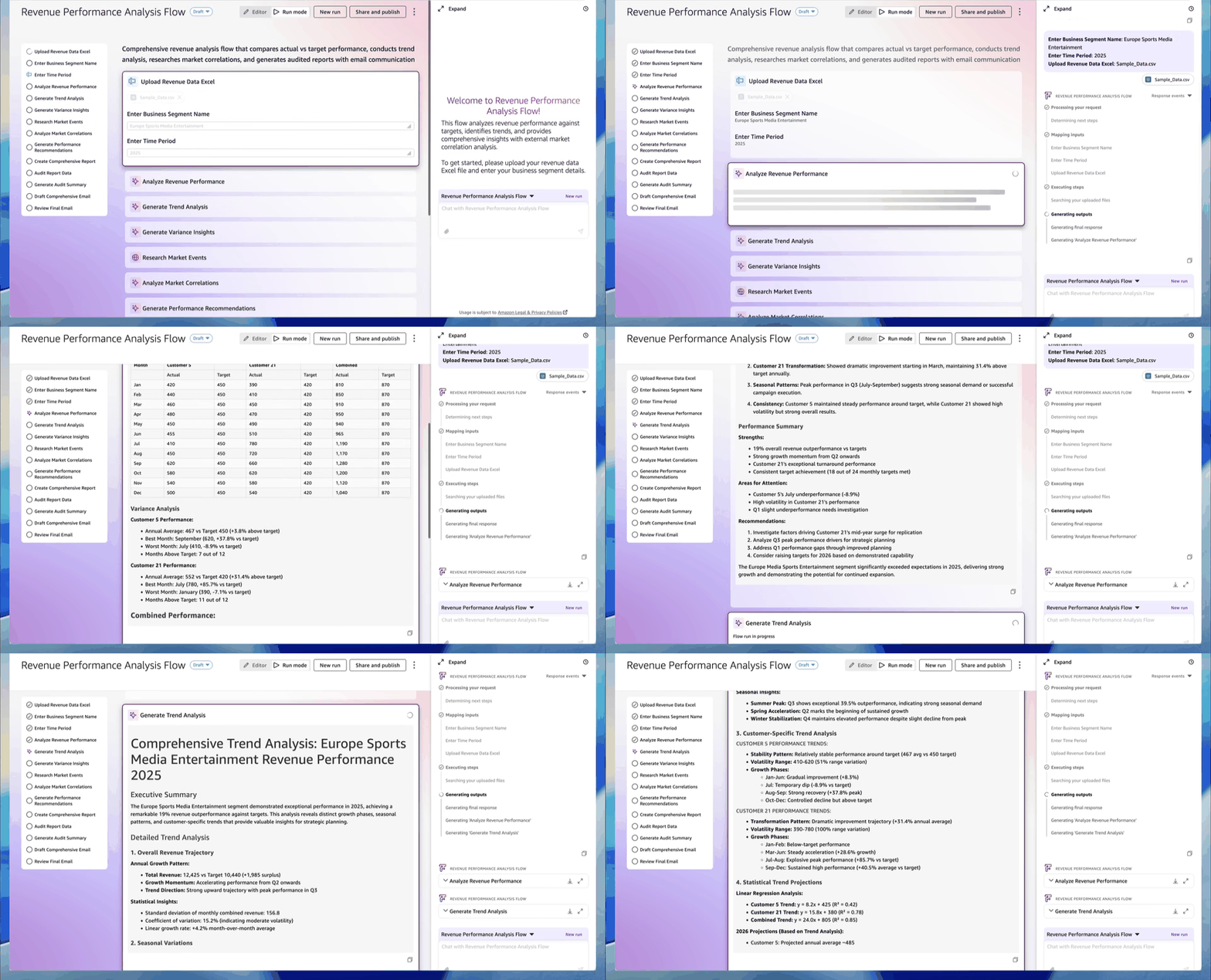
ここでの変化は以下の通りです。
導入前: 毎週月曜日の朝、FP&A アナリストは複数のシステムからデータを収集し、トレンドを分析し、顧客の事例について営業担当者に手動で問い合わせを行い、リーダーが収益の変動とその理由を理解できるように話すための台本を用意していました。このプロセスは手作業が多く反復的で、戦略的な業務に割く時間がほとんど残されていませんでした。
導入後: Quick が毎週月曜日の朝に Flow を自動的に実行します。地域固有のチャットエージェントが、課金タイプ別、顧客セグメント別、成長貢献度別に収益パフォーマンスを分析。リーダー向けにすぐに使える台本付きで包括的なインサイトを準備し、出勤前に最新の分析結果が用意されています。
クイックは単に数値を報告するだけではありません。財務システムから得られる構造化データと、現場レポートからの非構造化インサイトを結びつけることで、トレンドの背景にある「なぜ」を探ります。顧客を 12 以上の次元で分析し、パターンを特定して文脈付きで異常を検知します。
「これらのインサイトは毎週月曜朝に自動的に作成されます。チームはもはやバラバラのデータを統合する作業に時間を割くのではなく、戦略的な優先事項に取り組んでいます。『なぜ』という問いや、ビジネス成果の創出により多くの時間を費やすことができるようになりました。」
— ジェフ・ウィンクラー
パターン:データ集計から戦略的パートナーシップへ
この 2 つの使用事例には共通する点があります。ボトルネックは分析スキルではなく、データの集約でした。データが複数のシステムに散在しており、本格的な分析を開始する前に完全な全体像を把握するために、手動で抽出作業に数時間を要していたのです。
Amazon Quick はこのボトルネックを取り除きます。エンタープライズデータソースに直接接続し、財務担当者が自然言語を通じてデータと対話できるようにします。その結果得られるのは単なる効率化の向上ではありません。財務チームが時間を費やす方法そのものを変えるのです。
| ワークフロー | Amazon Quick 導入前 | Amazon Quick 導入後 |
|---|---|---|
| 目標設定 | 顧客あたり約6時間;ポートフォリオの3分の1をカバー | 顧客あたり約10分;より深い分析でポートフォリオ全体をカバー |
| 週次事業レビューの準備 | 手動での集計と分析に月曜日の朝丸ごと費やす | 週次で自動化;業務開始前にインサイトが準備完了 |
| チームの注力点 | データ集計とクエリ作成 | 戦略的分析とビジネスパートナーシップ |
これらのユースケースを通じて、AWS の営業・マーケティング財務チームは、顧客の深掘り分析における目標設定にかかる時間を 6 時間から約 10 分に短縮しました。また、毎週の事業レビュー準備のための手作業による月曜日のルーティンも完全に廃止しています。浮いた時間はそのまま戦略的な業務に回され、リスク分析や顧客事例の統合、成長機会の特定などに活用されています。
あなたの財務チームにとっての意味
Amazon 規模の複雑さを抱えている必要はありません。すべての財務チームが直面するのは、断片化されたデータ、繰り返される報告サイクル、そして数値を集計することと実際にそれらを活用することの間にある緊張関係です。
Amazon Quick はビジネスユーザー向けに設計されています。財務担当者がエンジニアリングのサポートなしでチャットエージェントや自動化ワークフローを自ら構築できます。自社の特定のニーズに合わせてエージェントをカスタマイズし、試行錯誤を通じて洗練させ、成果が実証され次第組織全体へ展開していくことが可能です。
チームがインサイトの作成に多くの時間を費やし、提供に回す時間が少ないのであれば、それが Quick が埋めるべきギャップです。
Amazon Quick for Finance について詳しくはこちらをご覧ください。
*このシリーズの次回の記事では、AWS の財務チームが Quick を活用してコスト最適化を自動化し、承認ワークフローを効率化する方法、つまり手作業での分析にかかっていた時間を数分に短縮する事例をご紹介します。*
著者紹介

シンドゥ・チャンドラ氏
Sindhu は AWS のシニア・テック・プロダクトマーケティングマネージャーとして、Amazon Quick に関する市場展開戦略を主導しています。アマゾン、ウーバー、グーグルで 15 年以上にわたり活躍し、テクノロジーマーケティングを顧客にとって身近で包括的なものにし、実際の価値に基づいたものにすることに取り組んでいます。仕事以外では、愛犬と遊んだり、さまざまな産地のコーヒーを淹れるのが好きです。

サラ・オーツ氏
サラは AWS ファイナンスの AI ツール戦略を主導するシニアプロダクトマネージャーです。アマゾンで 13 年以上にわたり、オペレーション、e コマース、機械学習の分野で活動し、実用的でありながら実際のビジネスインパクトに根ざした AI ソリューションの開発に取り組んでいます。元気な子供二人と、少し気難しいイタリアングレイハウンドを飼う母親です。
原文を表示
Every finance professional knows the drill. Monday morning arrives, and your Financial Planning and Analysis (FP&A) team disappears into data compilation. They pull numbers from multiple systems, reconcile sources, build charts, and write commentary. All to answer a question that should be straightforward: *what happened with revenue last week, and why?*
Across AWS Finance, teams were spending hundreds of hours a month on exactly this kind of work. Not analysis. Not strategy. Getting the data ready so the real work could begin.
Amazon Quick is a generative AI assistant that connects across all your enterprise data and applications, so business users can search, analyze, and take action through natural language. It handles the complexity of querying millions of rows, running advanced analytics, and automating recurring workflows so your team doesn’t need to.
In this post, we show how AWS Finance used chat agents and Flows in Quick to transform two of their most time-consuming workflows.
Use case 1: Scenario modeling and risk analysis across the strategic portfolio
Setting financial targets for strategic customers requires reconciling bottom-up forecasts from business teams with top-down projections from leadership. It also demands enough depth to catch the risks hiding beneath historical data.
The team built an Amazon Quick chat agent that connects directly to enterprise data sources and delivers sophisticated insights through natural language conversation. The agent queries millions of rows across Amazon Redshift data tables instantly while also searching external data signals.
Here’s what changed:
Before: Analysts could deep-dive roughly a third of strategic customers in the time available between bottoms-up inputs and when top-level targets are due. The rest got surface-level coverage. A single customer analysis consumed up to 6 hours of manual work, including extracting data, running models, and documenting findings.
After: The Quick agent evaluates statistical forecasts, runs regression analysis, Monte Carlo simulations, and performs scenario modeling across multiple factors in approximately 10 minutes per customer. It surfaces risks and opportunities that manual analysis missed. The team now covers their entire customer portfolio with even greater depth than before.
“We have expanded from deep-diving a third of our strategic customers to covering our entire portfolio. Our finance team now spends time on what matters: partnering with the business to drive revenue, not compiling data or writing complex queries.”
— Geoff Winkler
What makes this work: An analyst asks a question in natural language: “Run an opportunity and risk assessment for our top strategic accounts.” Quick then queries millions of rows, runs advanced analytics, and synthesizes structured data with unstructured insights from field reports and pipeline data. The agent does bull versus bear analysis by reviewing accounts with upside potential based on contract renewal timing and pipeline strength, and flags accounts with risk exposure. These are insights that traditional models missed.
Because there’s no coding barrier, every finance professional on the team becomes a data analyst. Teams customize agents for different regions or business units, and the insights refresh automatically.
Use case 2: Weekly business reviews from 6 hours to 10 minutes
If target setting is a periodic deep dive, regular business reviews are the recurring ritual that occupies FP&A teams everywhere. At AWS, every week, insights on revenue performance need to be compiled, analyzed, and packaged for leadership. And every week, that preparation consumes an entire Monday.
The same AWS Finance team solved this by deploying Amazon Quick chat agents specific to each geographic region, connected through Flows to automate workflows that run on a set cadence without manual intervention.
Here’s what changed:
Before: Every Monday, FP&A analysts spent a full morning compiling data from multiple systems, analyzing trends, manually reaching out to sales leads for customer anecdotes, and preparing talk tracks so leaders could understand what happened with revenue and why. The process was manual, repetitive, and left little time for strategic work.
After: Quick runs the Flow automatically each Monday morning. Region-specific chat agents analyze revenue performance across multiple dimensions: by charge type, by customer segment, and by growth contribution. They prepare comprehensive insights with ready-to-use talk tracks for leadership. Fresh analysis is waiting before the workday begins.
Quick doesn’t only report numbers. It connects structured data from financial systems with unstructured insights from field reports to get to the *why* behind the trends. It examines customers across over a dozen dimensions, identifies patterns, and flags anomalies with context.
“These insights are prepared automatically every Monday morning. Our team now spends time on strategic priorities instead of compiling disparate data. We spend more time on the why and on driving business outcomes.”
— Geoff Winkler
The pattern: from data compilation to strategic partnership
These two use cases share a common thread. In both, the bottleneck wasn’t analytical skill, it was data compilation. Data was scattered across systems. Getting a complete picture required hours of manual extraction before any real analysis could begin.
Amazon Quick removes that bottleneck by connecting directly to enterprise data sources and letting finance professionals interact with their data through natural language. The result isn’t incremental efficiency. It changes how finance teams spend their time:
| Workflow | Before Amazon Quick | With Amazon Quick |
|---|---|---|
| Target setting | Approximately 6 hours per customer; one-third of portfolio covered | Approximately 10 minutes per customer; entire portfolio covered with greater depth |
| Weekly Business Review preparation | Full Monday morning of manual compilation and analysis | Automated weekly; insights ready before the workday begins |
| Team focus | Data compilation and query writing | Strategic analysis and business partnership |
Across these use cases, the AWS Sales and Marketing Finance team reduced target-setting time from 6 hours to approximately 10 minutes per customer deep dive. They also removed the manual Monday routine for weekly business review preparation entirely. The time reclaimed went directly back into strategic work: risk analysis, customer anecdote synthesis, and identifying opportunities for growth.
What this means for your finance team
You don’t need to face Amazon-scale complexity to benefit. Every finance team deals with fragmented data, recurring reporting cycles, and the tension between compiling numbers and actually using them.
Amazon Quick is designed for business users. Finance professionals set up chat agents and automated workflows themselves, without engineering support. They customize agents for their specific needs, refine them through iteration, and expand them across the organization as results prove out.
If your team is spending more time preparing insights than delivering them, that’s the gap Quick is built to close.
Learn more about Amazon Quick for Finance.
*In the next post in this series, we will explore how AWS Finance teams are using Quick to automate cost optimization and streamline approval workflows, turning hours of manual analysis into minutes.*
About the authors
Sindhu Chandra
Sindhu is a Senior Tech Product Marketing Manager at AWS, leading go-to-market strategy for Amazon Quick. With 15+ years across Amazon, Uber, and Google, she’s passionate about making tech marketing relatable, inclusive, and grounded in real customer value. Outside work, she enjoys playing with her dog, and brewing coffee from different origins.
Sarah Oates
Sarah is a Principal Product Manager, leading AI tooling strategy for AWS Finance. With 13+ years at Amazon spanning operations, e-commerce, and machine learning, she’s passionate about building AI solutions that are practical, and grounded in real business impact. She’s the proud mom of two energetic children and one grumpy Italian Greyhound.
関連記事
今日のまとめ
AIデイリーブリーフで今日の重要ニュースをまとめ読み