Zvi が提唱する「AI に関する三つの薬」:未来能力への見解を分類
本文の状態
日本語全文を表示中
詳細モードで約25分の本文を読めます。
同じ出来事の情報源
この情報源を基点に整理
The Zvi
Zvi は AI の未来像を巡る議論を「3 つの薬」の概念で整理し、AI 能力への理解不足が業界の認識に歪みを生んでいると指摘する。
AI深層分析を開く2026年8月6日 01:12
AI深層分析
キーポイント
AI に関する3つの立場(ピル)の定義
著者は AI の未来像を「既存能力への信頼(AI pilled)」、「AGI への期待(AGI pilled)」、「ASI 実現の確信(ASI pilled)」という3段階で分類し、現在の主流は ASI pilled にあると分析する。
未理解層(Unpill People)の実態
大多数の人々は AI の現行能力を知らず、古い失敗事例や誤ったプロンプト技術に基づいて AI を軽視しており、その認識は非合理的であると指摘する。
経済・政策分野の認識ギャップ
多くの経済学者や政策担当者は第一のピル(既存能力)さえも過小評価しており、コスト低下や一時的な欠陥を誤解して AI の競争力を過小に見積もっている。
対話における最初のステップ
AI について議論する際、まず相手に対して「AI は実際にできることを示す」という第一のピルを提示することが重要であると提唱する。
AI 議論の停滞と第一の錠剤の欠如
多くの議論がすでに解決された過去の問題に縛られており、現在の AI の能力やその影響を理解する「第一の錠剤」を摂取できていない。
重要な引用
Sincere disagreements about AI are usually disagreements about future AI capabilities.
The majority of people have not taken the first pill.
Most economists, and most people who work in policy and government, have taken at most this first pill, and underestimate even the impacts of the first pill alone.
This can be frustrating, because in my view, that debate is settled and was settled quite a while ago.
編集コメントを表示
編集コメント
この記事は特定のモデルや企業の発表ではなく、業界の意識構造を分析した論考である。技術的な進歩が加速する中で、人々の認識が追いついていない現状を指摘しており、AI 普及における人的要因の重要性を再認識させる内容となっている。
Source Article
元記事を日本語で読む
本文に関係しない購読案内、埋め込み通知、サイト内プロモーションは除いています。
AI に関する本質的な議論は、往々にして「将来の AI が何を実現できるか」という点での見解の相違に帰着します。
人々が取る立場はおおむね四つあります。そのうち二つは妥当で、残りの二つは妥当ではありません。
この違いを説明するために「AI に関する三つの錠剤(The Three AI Pills)」という概念を使います。あなたはこれら三つの錠剤のうち、ゼロから三個まで服用するかどうかを選べます。
三つの錠剤
三つの錠剤とは、おおよそ以下の三点を真剣に受け止めることを指します。
- AI 錠剤: AI は実際に存在し、すでにできることができる。
- AGI(汎用人工知能)錠剤: AI は今後、さらに多くのことができるようになる。
- ASI(超人工知能)錠剤: AI は私たちの自然な寿命のうちに、あらゆることを人間よりもはるかに上手にこなせるようになる。
私は ASI 錠剤を服用しています。フロンティア・ラボ(最先端研究機関)の従業員の多くも、そして研究所自体も、みな ASI 錠剤を服用していると言えます。
錠剤を服用しない人々
私は「錠剤を服用していない人」を目にします。
どこにいるかといえば、あちこちにいます。大多数の人が最初の錠剤すら服用していません。
多くの人は、最先端の AI が自分たちのために何ができるのかについて全く理解していません。コード生成エージェントの存在も知らず、ChatGPT を無害な些細な用事のためにしか使ったことがありません。そのため、古い失敗の記憶に囚われ続けています。そして、どこかで失敗が起きれば「AI ができることなんてこれだけだ」と嘲笑します。
閉じた店舗への案内を誤ったり、ピザの注文数を間違えたりしたことを理由に、AI を無価値だと切り捨てます。また、発表される前に陳腐化していた古い研究結果や、極めて不適切なプロンプト手法を引用して反論します。
彼らは今なお、「確率的オウム返し(stochastic parrots)」だとか、AI は決して思考できない、すべての知識はトレーニングデータから盗まれているのだなどと言い続けています。そして、こうした議論が延々と続きます。
このテーマには誤ったバージョンもあれば、論理的に破綻しているもの、そして現実的な視点を持つものもあります。
AI について、まだその真価を理解していない人々と話す際、まず目指すべきは「AI の薬」を渡すことです。AI がすでにできることを示し、その可能性を実感してもらうことが重要です。
AI の薬
この最初の「AI の薬」を受け入れること自体が、大きな意味を持ちます。
現在、実用レベルで AI は驚くべき成果を生み出しています。多くの点で、AI はすでにあなたよりも賢く、より能力に優れています。
これまで手作業や別の方法で行っていたことが、テキストボックスに簡単な指示を入力するだけで、はるかに効率的に処理できるようになりました。
以前はコストに見合わないと考えられていた作業も、今では実行する価値があります。
かつては聞く価値がないと考えられていた質問も、AI の登場によって問いかける意味を持ち始めました。
AI があなたのために何ができるかを確認するための追加コストは、ほとんどゼロと言っても過言ではありません。
一方で、AI は有害な行為を行う可能性や、あなたには有用であっても他者を不利益に陥れたり、既存の規範やシステムを乱したり無効化したりする行為も可能です。こうした点は人々が好まないものです。
しかし、多くの経済学者や政策・政府関係者は、せいぜいこの最初の「薬」しか受け取っておらず、その影響さえ過小評価している傾向があります。
彼らはよく、「AI は [X] の用途にはコストが高すぎて使えない」と言いますが、同じ知能レベルであれば、すぐにコストが桁違いに低下することに気づいていません。あるいは、AI が苦手とする特定の事例を挙げて「これは改善されないだろう」と決めつけています。AI を「競争力がない」と見なしていますが、その状況はあくまで一時的なものだと理解していないのです。
AI を初めて体験した人と議論する際、通常は三つの基本的な選択肢があります。
一つ目は、「AI 完全理解」を目指すアプローチです。すでに実現している AI の能力とその意味するところを説明し、仮にこれ以上進歩が止まったとしてもその影響について語る方法です。
二つ目は、現在の AI をより効果的に活用できるようになる余地がまだ多く残っていることを伝える方法です。これもまた、現状で頭打ちになった場合の前提に立っています。
三つ目は、AI の進化はここで止まらないと説き、将来の AI が何を実現しうるかについて考えるよう促すアプローチです。少なくとも「AGI(汎用人工知能)」という次の段階への理解を促すことが重要です。
仮に AI が現在の能力だけで永久に止まったとしても、それはインターネットが世界を変えたように社会を根本から変革するでしょう。多くの場合、その変化はより良い方向へ向かうはずです。
しかし、AI の能力がここで永遠に止まることはありません。「第二のピル」を受け入れることを怠るのは誤りです。
第一のピルで足踏みしている現状
AI に関する議論の多くは、すでに決着がついた問いに固執したまま停滞しています。その根本的な理由は、多くの人が「第一のピル」さえ受け入れられないからです。
Dean W. Ball:数年前、AI 論争の中心には、「AI が自律的に数学的突破をもたらす」「AI がサンドボックスから抜け出してインターネット上でハッキングを行う」といった、一見荒唐無稽に思えることが近未来で現実化するかどうかという問いがありました。今でも、まるでその議論が続いているかのような感覚に陥ることがあります。これは非常にイライラするものです。なぜなら、私の見解では、この議論はすでに決着がついており、かなり以前からそうだったからです。
良質な議論を行うためには、少なくとも「第二のピル」を受け入れる必要があります。
確かに、AI を扱う人々を含め、多くの人が「現在の AI は十分だ」と言い、より優れた AI が何を実現できるか想像できないでいます。例えば、サム・アルトマンに「Sol は私が望むことをすべてやってくれるし、これ以上何も必要ない」とツイートした人物に対し、アルトマンが「お前は間違っている」とリツイートするといった光景があります。もちろん、そのツイートをした側こそが誤っています。
AGI の錠剤
AGI を象徴する「錠剤」は、単なる AI に関する錠剤よりもはるかに重大な意味を持ちます。
もしあなたがこの「AGI の錠剤」を服用したなら、AI が急速に能力を向上させていることを理解することになります。
たとえ、そのような AGI は完全に人間の管理下にあり、「単なる道具」のままであると考え、人々の日常生活が劇的に変化しないだろうと予想していたとしても、その能力が「すべてを変える」ことになるという事実は変わりません。
私たちは大きな転換期と不確実性に直面することになり、事態が極端に悪化する可能性さえあります。そして、AI において成功を収めた者たちは、そうでない人々を塵の中に置き去りにするでしょう。
未来の世界は現在の私たちとは全く異なるものになります。AI は、ロボットや自動運転車などの登場に伴い、デジタル作業のほとんどを、ほぼ常時こなせるようになります。多くの既存の仕事が姿を消すことになるでしょう。それが新しい、あるいはより良い仕事に置き換わるかどうかに関わらずです。経済成長と生産性は加速します。
また、準備が整う前にこうした高度な AI システムの悪用を許容した場合に生じる危険性についても理解できます。特にサイバーセキュリティや生物学的リスクといった分野において、その危険は顕著です。
権力の集中や格差、そして一部の形態における漸進的な無力化のリスクを懸念する声があります。
大規模な失業、一時的なものか恒久的なものかを問わず、その可能性も指摘されています。
また、現在の法制度や規制体制は、リスクや害から身を守り軽減するための準備が整っていないだけでなく、機会を活かし、普及と日常的な利用を阻むボトルネックを取り除くことにも対応できていないという現実があります。
備えの必要性
AI が急速に高度化し、物理世界に大きな影響を与えるようになることを期待する人々は、往々にして重大な危険を予見します。その結果、誰もがまもなく死に至るかもしれないと懸念するのです。彼らは通常、これが悪いことだと認識しています。
そのため、こうした人々は、協調的な行動を通じてそのような影響による下振れリスクを軽減し、全員が死にいたらないようにし、可能であれば上振れの恩恵も取り込むよう呼びかけています。
AI が重要なレベルで高度化することは認めつつも、物理世界への影響はより緩やかで限定的であり、知能の増加に伴う実用価値には上限があると考えている人々もいます。
「十分に高度」という基準をどう捉えるか(例えば AGI と ASI の違い)によって、危険度の程度は異なります。
2026 年 8 月現在、オーバートン・ウィンドウ内や真剣に検討されている範囲において、AGI パイルは依然として多くの用途に対して十分です。私たちはほぼ完全に、決定論的でありながら低コストで高便益をもたらす介入策を検討しています。
アライメント、インフラストラクチャ、監督体制、国家能力の強化、透明性、責任、開示、内部モデルを含む安全性テスト、レッドチーム演習、監査、輸出規制の執行、そして外交の基盤整備に対して、これらに投資しないことに対する正当な理由は存在しません。
これには、必要となった場合にフロンティア(最先端)をペースアップするための基盤整備も含まれます。
もしあなたがASI(人工超知能)の真実を完全に受け入れ、アライメントの現状や、もし近いうちに実現した場合に超知能がどのように展開するかについて現実的な見解を持っているなら、さらに踏み出す必要があるでしょう。それは実際にネガティブな側面を持ち、重大なトレードオフを伴う行動です。
そのような人々の一部は、最先端AIの開発に対する国際的な完全な一時停止を求めています。ASIの真実を完全に受け入れ、超知能がどれほど急速に到来し、どのような能力を持つのかについて彼らの主張を信じるなら、あなたも彼らに同意するかもしれません。
ASI パイル(信念)
ASI パイルとは、AI が今後、人間が行うことのほぼすべてにおいて、より優れたパフォーマンスを発揮できるようになるという理解のことです。
私は「ほぼ」という言葉を使いました。詳細を述べる通り、これは文字通り「すべてのこと」を意味するわけではありません。人間でなければ本質的にできない、あるいは人間の存在が著しく有益となる事柄も確かにあります。また、AI が十分に機能しない奇妙な特殊ケースが存在する可能性もあります。
それは全能や全知を意味するものではありません。ただし、支援のない人間にとっては、それがまさにそう見えることは予想されることです。
AI があなたの仕事を奪い、あなたが転職した先でもその仕事を奪うことを意味します。ただし、「人間にしかできない仕事」へと転換しない限り、他のほぼすべてのタスクで競争力を失います。
また、物理的な限界にぶつかるまで、この能力を使ってあらゆる事柄を驚くほど速く解明していくことも意味しています。
さらに、AI に依存する人々が、同じ資源を含むあらゆる面で、AI への依存度が低い人々よりも確実に勝者になることを示唆しています。
「公平な戦い」や十分に開かれた競争において、最終的に勝利するのは AI だということです。
そして、あなたが想像もしていなかったようなことを AI が発見し、実行するようになることも意味します。
知性が人間のレベルで止まるわけではないこと、また、原子の望ましい配置へと至る因果関係の道筋を描く能力が人間に匹敵しないことも理解する必要があります。
さらに、優れた知性を、あなたの無力な武器や紙の上の文字、データベースへの入力、あるいは規制の囲い込みと利権追求で対抗できると錯覚してはなりません。
そして、あなたにとって何も大きく変わらない
これらの事実にもかかわらず、AGI(汎用人工知能)の「薬」とASI(特化型超知能)の「薬」の違いを示すのは、日々の生活が現在とあまり変わらないまま続くという信念です。1926 年の日常生活を 2026 年と比較してもそれほど違わないように見えるのと同じ感覚です。
これは明らかに不誠実な主張である。ASI(人工超知能)の恩恵を十分に受けており、より良い判断ができるはずの人がそう言っているからだ。サム・アルトマンが「特異点の後でも人生はあまり変わらない」といった趣旨の発言をするのを、私は根拠のない無意味な言葉と捉えている。これは聴衆を安心させるための方便に過ぎず、一貫した立場ではない。むしろ、彼らが最も安心させたいのは自分自身なのかもしれない。
一方で、未来像としてより具体的なものを抱いている人々もいる。なぜそれほど変化しないのかという理由についても、一定の整合性を持って語っている場合がある。
AGI(汎用人工知能)の恩恵しか信じていない人々は、変化を阻むボトルネックが存在すると考えている。
彼らは、AI の能力や容量が指数関数的に成長する可能性には、物理的な限界が必ず訪れると信じる傾向がある。チップの数に限界はあるし、行動には時間がかかる。あまりにも遠い未来のことは、「魔法」という蔑称で片付けられることが多い。
また、理論においても、すでに発見すべきものはほとんど残っていないと考えている。かつて「特許庁を閉鎖せよ」と言われたような考え方だ。ステーキの柔らかさやロブスターのコク、人間の寿命の高さ、社会的地位の向上にはそれぞれ限界がある。だからといって、それが重要ではないと言えるだろうか。
私は特に寿命と健康については強く反対する。価値を見出すための道は、まだ遥かに長い道のりがあると信じている。ただし、物理的な人間脳が瞬間的に得られる快楽体験の最大化については、彼らの指摘に一定の妥当性があるかもしれない。
彼らは往々にして、知能の向上には本質的な限界があると考えています。どんなに高度な心であっても、説得力のある存在たり得ない、経済的に価値あるものになり得ない、物理世界で革新を生み出す能力がない、十分に正確なシミュレーションを実行できない、十分な精度で予測を立てられない、あるいは官僚主義や規制の囲い込みといった課題を克服することもできない、といった考えです。
知能否定論
私はこれを「知能否定論(Intelligence Denialism)」と呼んでいます。これは、「どれだけ賢くなろうとも、単に頭が良いだけでは何も変わらない」という考え方です。知能とは、持っていれば良いものであり、そうでなければ意味がないというものです。そして、心の能力には上限があるという考えです。
この考えは、より知能の高い人間が明らかに達成していることを否定する方向にも広がります。あるいは、「知能の上限は『賢い人間』にあり、心ができることはその賢い人間の模倣に限られる」という考え方です。確かに、より速く、安く、大規模に、記憶力も優れて実行できるかもしれません。
しかし、それだけです。そして、そのような人々は理解していません。もしすべての人間の精神的能力を統合し、知識へのアクセスを大規模かつ並列化し、さらに高速で低コストで行えば、それが単独でも世界中の誰よりもはるかに優れた成果を生み出すことを。また、物理的な能力やアクセスが欠けていても、それを補うことは容易だと。
通常、これが AGI(汎用人工知能)に傾倒する人々が、ASI(超知能)の考えを受け入れない主な理由です。彼らは「超知能」という概念そのものを理解できていないのです。
この混乱は、モデルがコモディティ化するという直観の背景にあることもよくあります。理想的な「知性」というものがあり、それは漸近線のように近づいていくものです。どう枠組みを立てるかによりますが、「これ以上は不可能」あるいは「これ以上やっても役立たない」という状態に達します。
超知能と全知全能の対比
よくある誤解として、超知能であれば全知または全能であり、したがって超知能はあり得ないと考えることがあります。
しかし、全能になることなく、人間よりも遥かに優れた「空間」がまだたくさん存在します。
他にも同様の混乱が多く、「[X] には上限がある」という事実と、「我々は [X] の上限に達している、あるいはその近くにいる」という認識が混同されています。
ここで Adi は、私の視点では中核的な「モットー・アンド・ベイリー(城砦と城壁の罠)」の鏡像のような手法を用いて、何が起きているのかを説明する道筋を示してくれます。
両方のバージョンは実際に存在します。
Timothy B. Lee:超知能がほぼ全能を意味すると考える人々と、私のようにそう思わない人々の間には、認識論的な断絶があります。
Adi:「超知能」という言葉の二つの定義の間で、モットー・アンド・ベイリーのトリックが行われています。
「Big-S 超知能」は定義上、全能を意味します。
一方、「small-s 超知能」は、現在の AI 研究の流れが到達する終末状態として仮定されているものです。
AI セーフティコミュニティがこれらの疑わしい等価性を批判もせず受け入れているのは驚きです。特に、モットー・アンド・ベイリーの誤謬について最も有名な解説を行ったのが、このコミュニティで非常に影響力のあるスコット・アレクサンダー自身であるという事実を考えるとなおさらです。
よく見かける光景があります。
ツヴィ・モウショウィッツはこう指摘しています。「ここでのモットとベイリー(強固な要塞と外郭)の構造は確かに存在しますが、むしろ逆のパターンが一般的です。具体的には以下のような論理展開です。」
- 超知能 [S] がまもなく人類を凌駕し、ありえないようなことを成し遂げると主張する。
- しかし、[S] は全知全能ではない。
- したがって、[S] は通常の技術に過ぎない。
これは誤りです。
アディはこれにも同意しています。「私も同様の事例を目にしており、これもまた間違いであると考えます。」
現実世界で非自明な時間を要する課題がまだ存在します。特定の行動や経路、手法には明確な限界があります。これらの限界を無視して完全に抽象化してしまうのは、大きな過ちです。
私は頻繁に、「最も優れた心であっても、[私には明らかにできそうに見えること] や、[すでに実行可能なこと] すらできない」といった主張を目にします。この種の論理構成こそが、人々がなぜそう考えるのか、そしてどうやって自分を正当化しているのかの核心です。AI が能力を獲得し、多くの限界が崩れ去っても、人々はゴールポストを動かすだけでゲームそのものを変えることはありません。
上記のアディのコメントは、「Plan A」について議論する文脈でのものです。この文脈では、アディの用語法において AI は明らかに「ビッグ S 超知能」ではありません。これらの AI には実際に行えないことや、ある点までしかできないことが存在します。
しかし、誤りが犯されているわけではありません。時折誤りは起こりますが、それは稀なケースです。
説得のプロセス(具体例)
ある特定の能力について言及できるのは、通常は非常に効果的な説得力(しばしば「超説得」と呼ばれる)を持つ存在に限られる。実際には、理想化された AI でさえも、最良の人間説得者や、歴史上最高の人間説得者に比べれば劣る通常の優れた人間説得者よりも優位に立つことはできないという議論が一般的だ。AI には思考速度の速さや情報へのアクセスといった多くの利点があるにもかかわらず、対象者の微細な反応やボディランゲージに至るまですべてを把握できる状況下でも、である。
この主張は往々にして、「説得には文脈が重要である」という根拠に基づいて行われる。多くの人は、文脈こそが全てを上書きするものであるかのように語るが、それは人間についても真実ではない。さらに、高度な能力を持つ AI が有利な文脈を構築できないと信じている人も少なくない。
しばしばこれは、「私は単に説得されることを拒否すればよい」「もしテキストのみで一度の試みですべての人を冷たく説得できなければそれは認められない」といった主張や、それに類する考え方の現れである。
もし説得に人間の存在や社会的文脈が必要であれば、AI はさまざまな方法でそれを容易に獲得できるだろう。
私が理解できないのは、なぜ一部の人が高度な AI が相対的に説得力を持たないまま残ると考えるのかだ。それは、AI の能力が現状以上には向上しないという前提か、あるいは AI に既知の標準的な説得技法のみを適用し、それ以外の魔法のような手法を排除するという制限を完全に課している場合に限られる。
しかし私は超人的な説得力を持つ人間ではないため、多くの人が私の主張に納得していないのも事実だ。
いや、本気で言っているんです。アディが強調された部分を引用しているのは、これがあまりにも明白な真実であるかのように見せかけるためです。私の lord(※注:原文の「my lord」は文脈上の呼称または皮肉として解釈し、日本語では自然な表現に置き換えます)、AI の能力がこのように急速に発展するシナリオにおいて、これが起こらないと考えるのはなぜでしょうか?むしろ 2035 年という時期は、遅すぎるほどです。
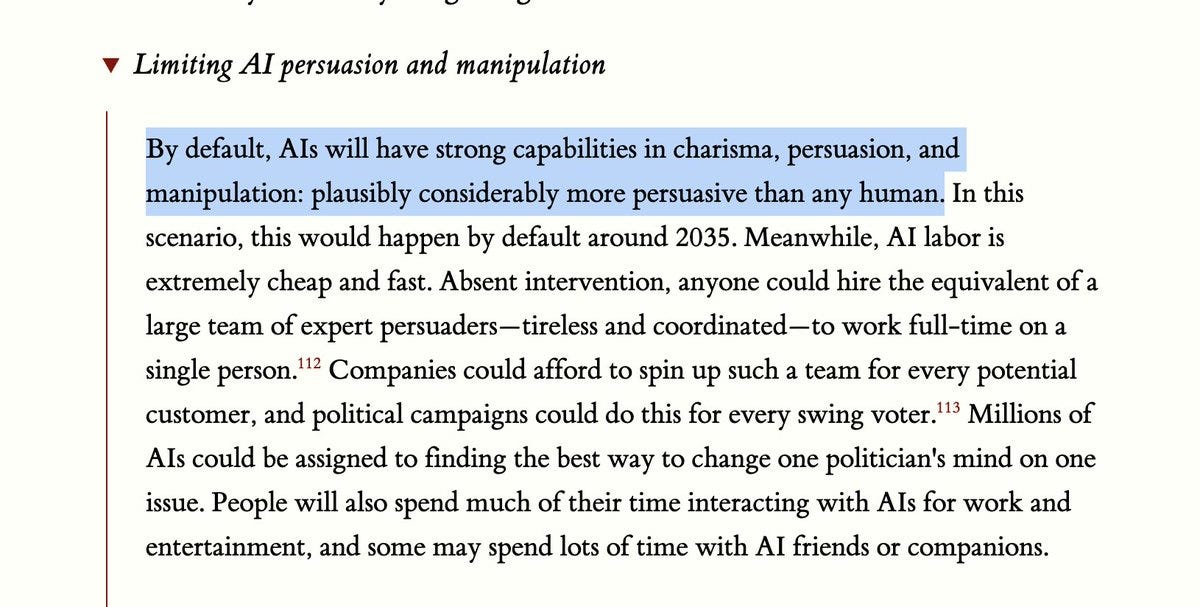
これはあまりにも低いハードルです。また、人間が実際に現場で行うことと対比して、AI が純粋なテキスト入力だけでこれを実現する必要があるとも限りません。重要なのは、同様のツールへのアクセス権があれば、AI はあらゆる人間よりもはるかに優れた成果を出せるという点です。このシナリオの他の要素を考慮すれば、なぜこれが起こらないと思うのでしょうか?たとえ AI が個々の人間のスキルや利点をすべて備えているだけでなく、圧倒的に多くの情報を高速で処理できる能力を持っていたとしてもです。
最悪の場合、AI はイヤホンを通じて人間に指示を出せばいいのです。本当にそうなるかもしれませんね。
これを考える別の方法があります。
アドリアン・エコフェット:超説得力のある AI が、既存の建設技術を用いて、サンフランシスコとロサンゼルス間の高速鉄道を 10 年以内に、かつ 500 億ドル以下で建設できるでしょうか?
ディーン・W・ボール:いいえ。
ナット・マカリーズ:@deanwball
これは過信してはいけない重要な質問だと思います!もしこれが明白に思えるなら、あなたはすでに過信しているはずです。
Dean W. Ball: 確約はできませんが、「最先端 AI システムが CEQA(カリフォルニア州環境品質法)を改正し、その結果として数十億ドルをカリフォルニア州政府にきれいに流し込む」というシナリオは現実的ではなく、他の多くの課題と比較して優先すべき事項とも思えません。
私の回答です。十分に説得力のある AI に対して言えば、「はい、ただしカリフォルニア州政府を少なくとも乗っ取ることを伴わずには不可能だ」となります。これは道具的収束(instrumental convergence)の原理によるものです。
Dean の返信にあるように、その後でハイパーリンク鉄道に注力するとは限りません。これは「そうするだろうか」という問題ではなく、「できるか」という問題です。重要なのは理論上の可能性です。
「すでにできることを、あなたは決してできない」という例として、ほぼ完璧すぎる事例があります:
Ramez Naam: 「トークンの品質がどれほど高くても、鉛を金に変えることはできません。」これは愉快に狂気じみており、全体的に見て正しい指摘です。
The Singularity is Nearer: 『プライム・インテレクトの転生』では、ハード・テイクオフ(急激な知能爆発)が機能するのは、AI が物質を操作するための量子トリックである相関効果(correlation effect)を発見するからです。しかし現実には、そのような相関効果は存在しません。トークンの品質がどれほど高くても、鉛を金に変えることはできません。
Ryan Greenblatt: 意図は理解できますが、これは面白い例えです。なぜなら、鉛を金に変えることは完全に実現可能だからです。技術研究開発とインフラ整備を終えた極めて能力の高い AI システムは、鉛を金に変えるためのインフラを非常に短期間で構築する能力を持っています。
すでに私たちは鉛を金に変えることに成功しています。
原文を表示
Sincere disagreements about AI are usually disagreements about future AI capabilities.
There are roughly four positions people take. Two are reasonable. Two are not.
I distinguish these via the Three AI Pills. You can take zero, one, two or three.
Three Pills
The three pills are, roughly, taking each of the following three things seriously:
AI pilled. AI exists and can do the things it can already do.
AGI pilled. AI will be able to do a lot more of the things.
ASI pilled. AI will be able to do approximately all the things better than you, within our natural lifetimes.
I am ASI pilled. A large percentage of employees of the frontier labs are ASI pilled. The labs themselves are ASI pilled.
The Unpill People
I see unpilled people.
Where do I see them? Everywhere. The majority of people have not taken the first pill.
Most people have no idea what frontier AIs can do for them. They are unaware of coding agents. They have used only ChatGPT, for harmless trifles, and they hold years old memories of its failings. They mock any failure anywhere as ‘what AI can do.’
They dismiss AI as worthless because it pointed them to a closed store or recommended the wrong number of pizzas. They cite old studies that were obsolete before they were published and used terrible prompting techniques.
They often still talk about ‘stochastic parrots’ or how AI can never possibly think and everything must be stolen from the training data. And so on.
Some versions of this are wrong. Some are Not Even Wrong. None are reasonable.
When you discuss AI with people who are fully unpilled, your goal is usually to first give them the AI pill. Show them that AI can do the things it can already do.
The AI Pill
Even fully taking the first AI pill is a big deal.
Existing AI unlocks, today, in practice, tons of cool things. It is, in many ways, already smarter and more capable than you.
So many things that you used to do by hand, or some other way, are now better done by typing a quick request into a text box.
So many things that previously were not worth doing are now worth doing.
So many questions previously not worth asking are now worth asking.
The marginal cost of seeing what the AI can do for you is often very close to zero.
AI can also do a variety of harmful things, or do things that are useful for you but make others worse off or disrupt or invalidate norms or systems. People don’t like that.
Most economists, and most people who work in policy and government, have taken at most this first pill, and underestimate even the impacts of the first pill alone.
Often they say things like ‘AI will be too expensive to use on [X]’ because they don’t realize it will soon be orders of magnitude cheaper for the same level of intelligence. Or they point to particular details where AI does poorly, and presume this will not be fixed. They see AI as ‘uncompetitive’ without realizing the situation is temporary.
When you discuss AI with someone who has taken only the first pill, you typically have three basic options.
You can try to ‘fully AI pill’ them and explain the things AI can already do and the implications of what that means, even if things stop here.
You can try to explain that we will get better at using what AI we have, and that there is a lot of ‘unhobbling’ left for us to do, even if things stop here.
You can explain that things will not stop here, and you need to be thinking about what future AIs will be able to do. Get them to take at least the AGI pill.
Even if AI could permanently only do the things it can currently do, that would be Internet big, and radically change the world, mostly for the better.
AI capabilities will not permanently stop here. It is wrong to not take the second pill.
Stuck At The First Pill
Our debates about AI remain largely stuck on settled questions, because so many people cannot even take the first pill.
Dean W. Ball: A couple years ago, the AI debate was centered, rightfully, on whether crazy-sounding things like “AIs autonomously making math breakthroughs” and “AIs breaking from their sandbox and hacking on the internet” would be real things in the near term. Sometimes it feels like that’s still the debate we’re having. This can be frustrating, because in my view, that debate is settled and was settled quite a while ago.
To have good discussions, we need to at least take the second pill.
Whereas, yes, many people, even many who work with AI, really do say current AI is ‘good enough’ and can’t imagine what a better one can do. As in, someone tweeting at Sam Altman saying ‘Sol does everything I want it to do, this is all I ever need’ and Altman retweeting saying they were wrong. Which they obviously are.
The AGI Pill
The AGI pill is a much bigger deal than the AI pill.
If you take the AGI pill, you understand that AI is advancing its capabilities rapidly.
Even if you think that such AGIs will remain fully under human control, and remain ‘mere tools,’ and you expect the lived experience of most people’s everyday lives to not change so radically, you understand that their capabilities will ‘change everything.’
You see that we will face times of great transition and uncertainty, that have the potential to go extremely badly, and that those who succeed at AI will leave those who do not behind in the dust.
The world in the future will be very different from our own. AIs will be able to do most digital work, most of the time, along with the inevitable robots and self-driving cars and so on. Lots of current jobs will go away, whether or not they are replaced by new and potentially better ones. Economic growth and productivity will accelerate.
You see some of the dangers of what would happen if we empowered misuse of such advanced AI systems before we were ready, especially in places like cyber and bio risk.
You see the potential for centralization of power, or inequality, and also for some forms of runaway gradual disempowerment.
You see the potential for mass unemployment, either transitional or permanent.
You understand that our legal and regulatory regimes are not ready, either to protect against and mitigate the risks and harms, or to allow for the opportunities and remove the bottlenecks to diffusion and mundane utility.
The Need To Be Prepared
Those who expect AI to quickly become sufficiently advanced to greatly impact the physical world usually see great danger. They notice that as a result everyone may soon die. Usually they think this is bad, actually.
Thus such folks call to take coordinated action to mitigate the downside risks of such impacts, keep us all from dying, and ideally also to help capture the upside benefits.
Those who expect AI to become importantly more advanced, but with a slower and smaller impact on the physical world, and who think the practical value of more intelligence will cap out.
For different values of ‘sufficiently advanced,’ as in AGI versus ASI, you would see different degrees of danger.
The AGI pill is still sufficient for most things in the Overton window or under serious consideration as of August 2026. We are almost entirely considering overdetermined, low cost, high benefit interventions.
There is no good case for not doing radically more investment in alignment, infrastructure and oversight, state capacity, transparency, liability, disclosures, safety testing including of internal models, red teaming, auditing, enforcement of export controls and laying the groundwork for diplomacy.
This includes laying the groundwork to Pace the Frontier should that prove necessary.
If you are fully ASI pilled, and realistic about the current state of alignment and how superintelligence likely plays out if it arrives soon, then you will want to go further. You will want to do things that have real downsides, and require real tradeoffs.
Some such people want to do a full international pause of frontier AI development. If you took the full ASI pill and believed what they do about superintelligence, in terms of how fast it might arrive and what it can do, you might well agree with them.
The ASI Pill
The ASI pill is the understanding that AI is on pace to be able to do approximately all of the things better than you.
I said ‘approximately.’ As I go over in detail, that does not mean literally all of the things. There are some things that inherently require or greatly benefit from being a human. And there may be weird corner cases where the AI won’t be good enough.
It does not mean omnipotence or omniscience, although one should expect it to look a lot like that to an unaided human.
It does mean the AI takes your job, and then takes the new job that you switch into, unless you pivot to ‘requires literal human.’ You will be uncompetitive at essentially any other task.
It does mean that it will use this capability to figure out approximately all of the things, remarkably quickly, until you hit the physical limits.
It does mean that those who rely more on such AIs will reliably outcompete, in all senses including for resources, those that rely on such AIs less.
It does mean that, in a ‘fair fight’ or sufficiently open competition, the AI wins.
It also means the AIs often figuring out and doing things you did not imagine or anticipate.
It means realizing that intelligence does not stop anywhere near the human level, nor does its ability to chart paths through causal space towards preferred arrangements of atoms.
It also means not pretending that its superior intellect can be matched by your puny weapons, or your pieces of ink on paper, or your entries in a database, or your regulatory capture and rent seeking.
And Then Nothing Much Changes For You
Despite all that, the sign of the AGI pill, as opposed to the ASI pill, is the belief that day to day life will continue to look similar to how it looks now, in the sense that we see day to day life in 1926 as not that different from life in 2026.
Sometimes this is clearly disingenuous, as it is coming from someone ASI pilled enough to know better. I read Sam Altman saying various forms of ‘life will not much change after the singularity’ as basically unjustified Obvious Nonsense to reassure his audiences, rather than a coherent position. Sometimes the person such folks want to reassure most is themselves.
Others sometimes do have something more concrete in mind as their vision of the future, and why it will not change so much, with varying degrees of coherence.
Those with only the AGI pill believe in bottlenecks that hold back change.
They often believe that our ability to exponentially grow AI’s capacity and capabilities will hit various physical limits. There can only be so many chips. Actions take time. Things too far out there are often pejoratively dismissed as ‘magic.’
They often believe there is not that much left to physically discover, in the classic ‘close the patent office’ kind of way, even in theory. Your steak can only be so tender, your lobster so buttery, your lifespan so long, and your status so high, so why does it matter. I strongly disagree on lifespan and health, and expect we have a long way to go in so many other ways in terms of finding value, although they may have a point about moment-to-moment maximal hedonic experiences of a physical human brain.
They often believe that the upside of intelligence is importantly limited. That no mind, however advanced, could be all that persuasive, or that economically valuable, or that capable of creating innovations in the physical world, or of running sufficiently accurate simulations, or making sufficiently strong predictions, or even able to do things like overcome red tape and regulatory capture.
Intelligence Denialism
I sometimes call this Intelligence Denialism: The idea that being smarter is not all that, no matter how smart one gets. That there is this thing, intelligence, that you either have or don’t have, and that minds cap out.
Often this extends to denying that more intelligent humans can do and accomplish the things they clearly do and accomplish. Other times, it is the idea that intelligence tops out at ‘smart human,’ and all a mind can do is imitate that smart human. Maybe you can do it faster and cheaper, and at scale, with better memory and so on.
But that’s it. And such folks fail to understand that if you took the union of all human mental capabilities, and all access to knowledge, at scale, in parallel, much faster and cheaper, that this alone would run circles around anyone and everyone, everywhere. And that if this lacked physical capabilities or access, this would be trivial to get.
This is, usually, the central good reason people who are AGI pilled do not take the ASI pill. They are unable to understand that superintelligence is a thing.
This confusion is also often behind the instinct that models will commoditize. There is an ideal thing, ‘intelligence,’ and you approach it via an asymptote. More is impossible, or more won’t help you, depending on how you frame it.
Superintelligence Versus Omniscience and Omnipotence
A common error is to think that anything superintelligent would be omniscient or even omnipotent, and therefore superintelligence is impossible.
Whereas, again, there is a lot of ‘space above humans’ without becoming omni.
There are many other similar confusions, where ‘there is some upper bound to [X]’ is confused with ‘we are at or near the upper bound to [X].’
Here Adi gives us a way into explaining what’s happening, by doing what from my perspective is a mirror image of the central motte-and-bailey.
Both versions do exist.
Timothy B. Lee: There’s an epistemic chasm between those who think superintelligence implies near-omnipotence and those (like me) who don’t.
Adi: There’s a motte-and-bailey trick being played between two definitions of “superintelligence”
“Big-S Superintelligence”, which is definitionally omnipotent
And “small-s superintelligence”, which is the hypothesized end state of the current thread of AI research
It’s surprising how uncritically the AI safety community treats these dubious equivalences, especially since one of the most famous treatments of the motte-and-bailey fallacy comes from none other than Scott Alexander, who’s quite prominent in the community.
As in, I see the following a lot:
Zvi Mowshowitz: The motte-and-bailey here is real, but more commonly it is in reverse. as in a form of:
- You claim superintelligence [S] soon will run circles around humans and do absurd stuff.
- But [S] would not be fully omniscient/omnipotent.
- Therefore [S] would be a ~normal tech.
No.
Adi: I’ve seen this too, and I agree that it’s equally wrong
There will still be things that require non-trivial real world time to achieve. There will be particular actions and paths and methods that have their limitations. These limitations matter. Fully abstracting them away can be a large mistake.
I constantly see versions of ‘the mind that is maximally good still could not do [thing it seems to me it could obviously do]’ or even [thing it can already do] and I think this form of conjunction is a lot of why, and how people justify themselves. When AI gains capabilities, and more things fall, they move the goalposts but don’t change the game.
Adi’s comment above was in the context of discussing Plan A, where the AIs are very obviously not ‘Big-S Superintelligence’ in Adi’s lexicon. There are practical things that these AIs cannot do, or can only do up to a point.
The mistake was not being made. It sometimes gets made, but this is rare.
Persuasion Persuasion (A Worked Example)
At most one can claim some particular capability, typically very effective persuasion (often ‘super-persuasion’), would not be possible. Indeed, a common argument states that even an idealized AI would be unable to be superior to the best human persuader, or even a typical good human persuader (who is much worse than the historical best human persuaders), despite it having access to many advantages over humans, such as much faster thinking speed and access to information, including every little reaction of its target including body language.
Often this is done by citing that context matters for persuasion. Many talk as if this context would trump everything, despite this not being true for humans. They also believe that highly capable AIs could not engineer favorable contexts.
Often it’s a form of ‘I would simply choose not to be persuaded’ or ‘if you can’t do it cold and one shot everyone with only text it does not count’ or something like that.
If it needs a human presence to do the persuasion, or a social context, it can acquire one easily enough in various ways.
I flat out cannot understand why someone would think advanced AIs will remain relatively unpersuasive, other than to think that AI will not get much more capable than it already is, and that’s if we fully restrict the AI to using known standard persuasion techniques and rule out any wizardry.
Yet I am not a superhuman persuader, so many find my arguments unconvincing.
No, seriously, as in Adi is citing the highlighted passage as if this was not very obviously true, my lord, how can you think this is not going to happen in a scenario where AI capabilities continue to develop apace, if anything 2035 seems crazy slow:
This just isn’t much of a threshold. Nor does it require that the AI do this from pure text box versus what a human can do in person. It just says that, given access to similar tools, the AI will be able to do considerably better than any human. How could you not think this, given the rest of the scenario, even if all it does is have all the advantages and skills of the various different humans, plus the ability to process a lot more information a lot faster?
And like, worst case, the AI gets an earpiece and tells a human what to do, Jesus.
Another way of thinking about this:
Adrien Ecoffet: Could a superpersuasive AI get a high speed rail line between SF and LA constructed for under $50B and under 10 years with existing construction technology?
Dean W. Ball: No
Nat McAleese: @deanwball
I think this is an important question not to be overconfident on! And if it feels obvious, you are surely overconfident.
Dean W. Ball: obviously there are no guarantees, but “frontier ai systems reforming ceqa and then cleanly funneling tens of billions of dollars through California’s government” doesn’t seem realistic + like a thing to prioritize compared to many other things
My answer, for a sufficiently persuasive AI is essentially: Yes, but not without incidentally taking over at least the California government. Instrumental convergence.
Not that you would then choose to focus on High Speed Rail, as Dean replies. This is not a case of would, so much as could. The point is the could, in theory.
An example that is almost too perfect an example of ‘you will never be able to do [thing that you can already do]’:
Ramez Naam: “No matter how high quality your tokens are, they cannot turn lead into gold.” Pleasantly unhinged and overall correct.
The Singularity is Nearer: In The Metamorphosis of Prime Intellect, the hard takeoff works because AI discovers the correlation effect, some quantum trick to manipulate matter. In reality, there is no correlation effect. No matter how high quality your tokens are, they cannot turn lead into gold.
Ryan Greenblatt: I get the idea, but this is a funny example because it is totally feasible to turn lead into gold. Extremely capable AI systems (after tech R&D and infrastructure build out) will have the capacity to very quickly build infrastructure for turning lead to gold.
We already have successfully turned lead into
今日のまとめ
AIデイリーブリーフで今日の重要ニュースをまとめ読み