Anthropic事例から見る、AI計算資源の資金調達ボトルネック
本文の状態
日本語全文を表示中
詳細モードで約17分の本文を読めます。
同じ出来事の情報源
この情報源を基点に整理
TLDR AI
Anthropic が年間収益90億ドル未満の状況で500億ドル規模のインフラ投資を発表し、機関投資家が将来の成長を担保に巨額の融資を行う事例から、AI コンピュートの資金調達が当面のボトルネックではない可能性が示される。
AI深層分析を開く2026年8月17日 21:46
AI深層分析
キーポイント
収益対投資の乖離と大規模計画
2025年11月時点で年間収益90億ドル未満だった Anthropic が、500億ドルの米国コンピュートインフラ投資を発表し、約480億ドルの債務融資を組んだ。
Google と Broadcom の金融支援構造
TPU システムのリース資金として約350億ドルの債務が組まれ、Anthropic の支払い停止時に Broadcom が条件付きで支払う仕組みが構築された。
データセンター建設における Google の関与
Fluidstack による5つのデータセンター建設のために約152億ドルの融資が行われ、賃料支払い停止時に Google が条件付きで支援する構造が採用された。
資金調達の限界に関する示唆
機関投資家が Anthropic の将来収益成長を担保に巨額の資本を供給した事実から、コンピュート拡張の直近のボトルネックは資金調達ではないとの見方が示される。
長期リースによる資金調達の仕組み
計算システムやデータセンター容量への長期リース契約は、予測可能な支払いの約束となり、インフラ投資家に対して債務供与を促す。
重要な引用
The largest frontier labs are now planning infrastructure deployments that cost tens to hundreds of billions of dollars, substantially beyond their current profits and potentially beyond what they can fundraise themselves.
In November 2025... the company announced plans to invest $50 billion in American compute infrastructure.
Anthropic’s buildout therefore suggests that financing is unlikely to be the immediate limit on frontier compute growth.
By agreeing to absorb part of the losses if Anthropic or Fluidstack stops paying, Broadcom and Google can make the debt cheaper and more attractive to a wider range of investors without supplying the money themselves.
Source Article
元記事を日本語で読む
本文に関係しない購読案内、埋め込み通知、サイト内プロモーションは除いています。
本記事は、Epoch AI のニュースレター「Gradient Updates」の一部です。同ニュースレターでは、AI 進展における重要な問いに対して、より意見が明確でカジュアルな視点を提供しています。なお、本記事の意見は著者個人のものであり、必ずしも Epoch AI 全体の見解を反映するものではありません。
これまでの AI の進歩には、計算資源(compute)のスケーリングが大きく寄与してきました。しかし、直近のような成長率を維持するためには、莫大な資金が指数関数的に必要となります。現在、最先端のラボは数十億ドルから数百億ドル規模のインフラ導入を計画しており、これは現在の利益水準をはるかに超え、自らの調達能力の限界を超える可能性すらあります。そこで浮かび上がる疑問があります。AI の将来において、資金調達が計算資源のスケーリングを制約するのでしょうか?
Anthropic のインフラ構築事例は、この問いを検証するための有用なケーススタディとなります。2025 年 11 月、Anthropic は年間収益が 90 億ドルに満たない状況で、米国における計算インフラへの 500 億ドル投資を発表しました。その後の開示情報から、この構築に伴う約 500 億ドルの債務融資が特定できます。これらの資金調達の多くは、Anthropic の収益が急増する前の 2026 年初頭に組まれました。これは、投資家が AI 企業の将来の収益成長を担保に貸し出す意志があるかどうかを試す格好のケースと言えます。
このケースでは、Anthropic は計算システムそのものと、それらを稼働させる場所の両方を必要としています。同社は Google から 1 GW 以上の TPU システム more than 1 GW of TPU systems と、Fluidstack からデータセンター 5 施設 five datacenters をリースするための資金を債務として確保しました。それぞれの側面には独自の資金調達が組み込まれています。
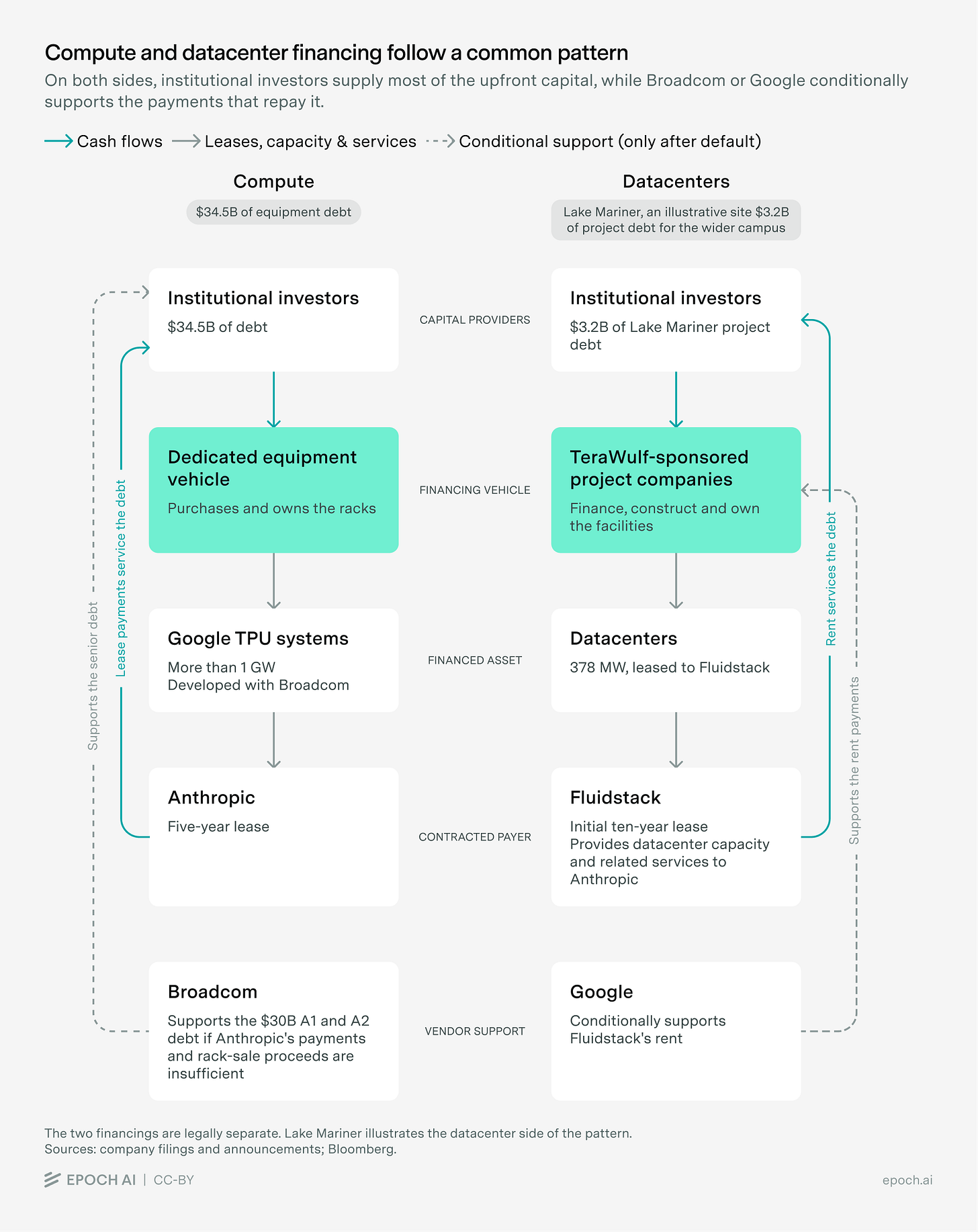
TPU システム購入については約 350 億ドルの債務が組まれており、Anthropic の支払い停止時には Broadcom がその多くを条件付きで支援する体制です。一方データセンター側では、1.43 GW の重要 IT 容量を建設するために 5 社が合計約 152 億ドルの融資を実施しており、Fluidstack の家賃支払い停止時には Google が条件付きで支援します。
どちらの構造でも、機関投資家が事前に資金を提供し、Broadcom と Google が将来の支払いフローをより確実なものにすることでリスクを軽減しています。
つまり、Anthropic の構築計画から見て、資金調達が最先端計算能力の成長に対する即時的なボトルネックになるとは考えにくいです。機関投資家は、少なくともより確立された組織(すなわち展開によって恩恵を受けるサプライヤー)が一部リスクを引き受ける限り、同社の長期的な支払いコミットメントを担保に資本を提供する用意があるようです。
以下のセクションでは、この仕組みが一般論としてどう機能するか、そして Anthropic の TPU システムやそれらを収容するデータセンターにおいて具体的にどう適用されるかを追跡します。
銀行、保険会社、プライベート・クレジットファンドは、比較的一定したリターンを追求する機関投資家向けの資金プールを管理しています。計算システムやデータセンターの容量を長期リースするというコミットメントは、支払いを保証する約束となり、これが資金提供者に債務供与を促すインセンティブとなります。同時に、基盤となる TPU ラックや完成した施設が担保として機能します。これにより、外部投資家がインフラへの先行投資を行い、その返済を時系列で受け取るという仕組みが可能になります。
長期リース契約によって Anthropic の支払い額とタイミングは予測可能になりますが、投資家側は実際にその支払いが行われるかを判断する必要があります。Anthropic の収益は驚くほど急速に成長しましたが、急成長が安定したキャッシュフローの長期的な実績を意味するわけではありません。貸し手側には、技術の変化や競争環境、規制対応といった局面で同社がどう振る舞うかを示す証拠が不足しており、通常であればその不確実性を負担する見返りとしてより高い利回りを要求することになります。
ブロードコムとグーグルはこの格差を埋める役割を果たしています。両社は TPU システムの導入が進むことで商業的な利益を得ており、さらに Anthropic に比べて事業運営の歴史が長く、キャッシュフロー源も多様化されています。そのため、投資家にとっては、ビジネス環境の変化の中でも契約履行が可能であるという根拠がより明確になります。
もし Anthropic や Fluidstack が支払いを停止した場合に損失の一部を負担することで、ブロードコムとグーグルは自社の資金を直接投入することなく、債務コストを引き下げ、より幅広い投資家層にとって魅力的な条件を実現できます。これはベンダー支援型ファイナンスと呼ばれる仕組みです。サプライヤーが自らの信用力を活用し、自分たちにも利益をもたらす導入プロジェクトの資金調達を支援するのです。
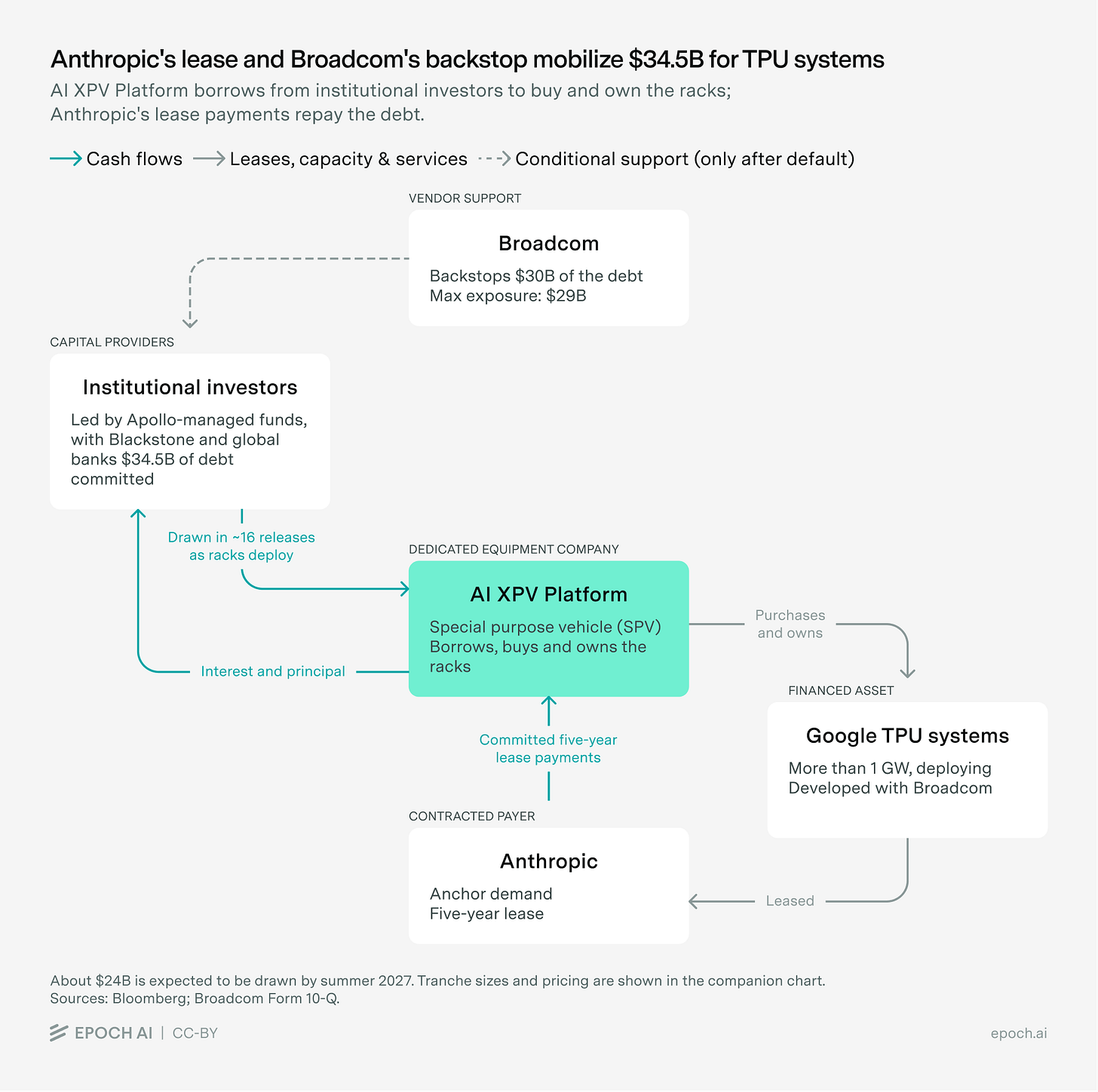
この計算リソースの資金調達状況は、機関投資家が最先端ラボが求める規模で資本を供給する意欲を強めていることを最も明確に示す証拠です。Apollo が管理するファンドを中心に、ブラックストーンや世界的な銀行などが参加し、投資家は Anthropic に対して Google TPU システム 1 GW 以上を資金調達するための債務として 345 億ドルをコミットしました。
この金額のうち 300 億ドルは Broadcom の支援を受けており、残りの 45 億ドルは支援の対象外です。この無担保部分の存在が重要なのは、投資家が Anthropic に対してより直接的なリスクを負う覚悟を示したことを意味しているからです。Broadcom の支援があったおかげで、資金調達の大部分を低金利で行うことができました。
この資金調達はまず、Anthropic が TPU システムを 5 年間リースするというコミットメントから始まります。専用の設備会社「AI XPV Platform」が投資家から借入を行い、その資金を使ってラックを購入し、それを Anthropic にリースします。Anthropic から支払われるリース料は、利子の支払いや債務の返済に充てられ、万が一 Anthropic が支払いを停止した場合には、これらのラックが担保として機能します。
この設備会社は、特定の取引のために設立された特別目的会社(SPV)です。リース契約、ラック、そして債務を一つの企業に統合することで、各関係者がリスクを把握しやすくなります。
投資家は、明確に定義された支払いプールと担保に基づいて資金を提供します。一方、Broadcom は、自らが購入価格の全額を借り入れることなく、支援を開始するタイミングや負担可能な最大金額を具体的に指定できます。SPV によって、リスクがどこにあるか、誰が優先的に支払われるか、そして Broadcom が介入すべき時期が明確になります。
貸し手は、システムが到着した段階で資金を提供します。ラックの設置は既に開始されており、資本の供与は約 16 の段階に分けて行われます。このプロセスには 1 年弱を要し、2027 年の夏までに約 240 億ドルが支払われる見込みです。
これにより、デフォルト発生時に担保として利用可能な設備の量と、資金化された債務の量がほぼ一致した状態が維持されます。Broadcom の潜在的な負担額は、Anthropic が支払いを行うにつれて増大し、その後減少していきます。
この債務は、車両の支払いや資産に対する請求権が異なる 3 つのグループ(トランシェ)に分割されています。設備会社が損失を被った場合、B トランシェ(45 億ドル)よりも先に A1 トランシェ(60 億ドル)と A2 トランシェ(240 億ドル)が返済されます。これにより、A1 と A2 は優先債務、B は劣後債務となります。
金利は、A1 が米国国債利回りに 1 ポイント上乗せされたレート、A2 が年利 5.75%、B が年利 8.5% です。
ブロードコムが A1 と A2 の投資家を守るバックストップを提供する一方、B の投資家には適用されません。もしアンソロピックが債務不履行に陥れば、ブロードコムはリース権を行使するか、ラックの売却を手配できます。売却益はまず投資家の返済に充てられ、その後、契約に基づきブロードコムが残りの A1 と A2 の不足分を補填します(最大で 290 億ドルが暴露リスクとして報告されています)。B の投資家が返済を受けるのは、A1 と A2 が完済された後であり、彼らはアンソロピックからの支払いとラックから回収できる価値に、より大きく依存することになります。これはベンダー支援型ファイナンスの一例です。ブロードコムは 300 億ドルを前払いするのではなく、もしアンソロピックの支払いやラックの価値が不十分となった場合に損失の一部を負担すると約束しているのです。
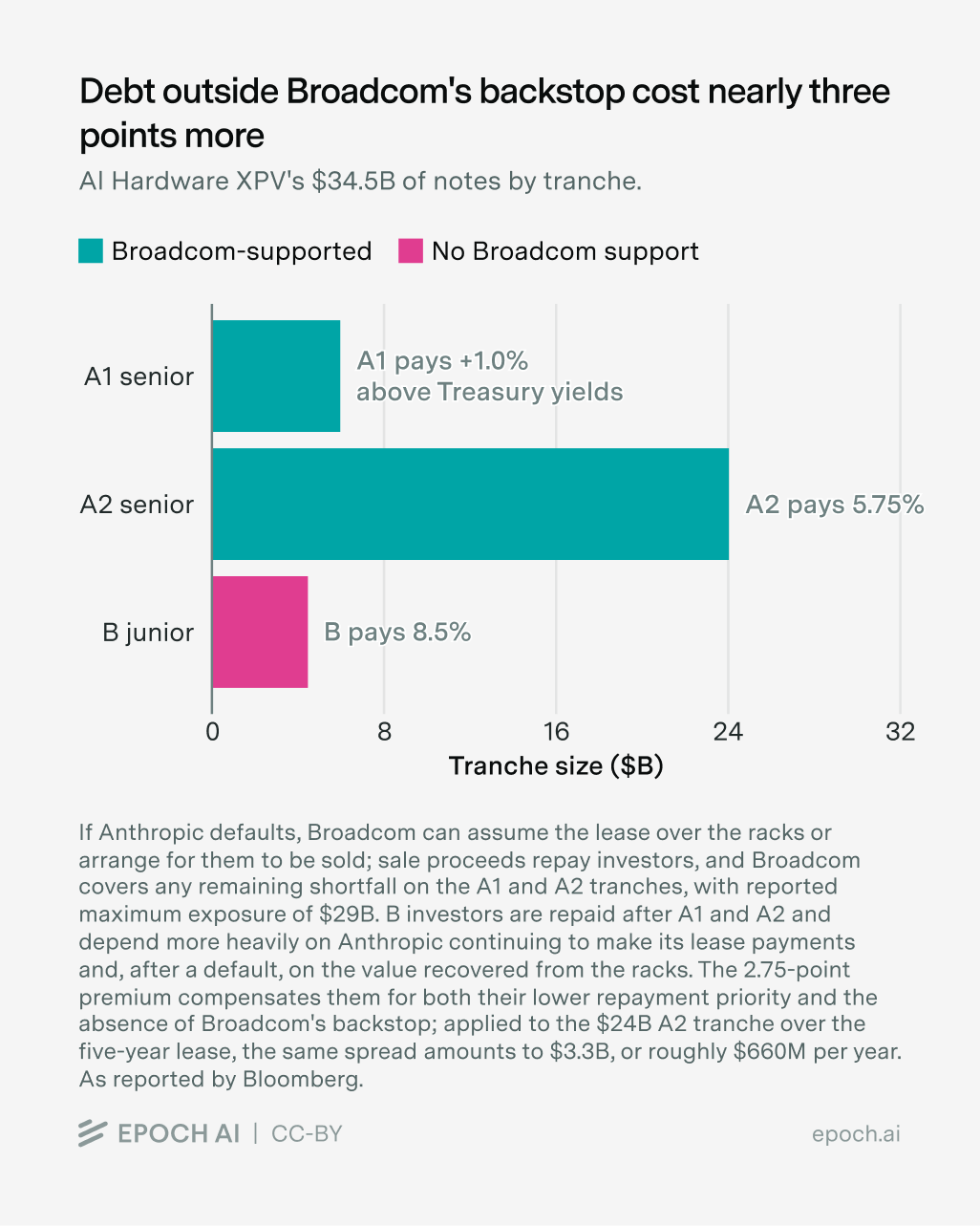
A2 と B の対比から、経済的な効果が明確に見て取れます。Broadcom の支援なしでは投資家は 45 億ドルを供給しましたが、その際 8.5% の金利を要求しました。一方、A2 では 5.75% です。この 2.75 ポイントの差は、二重の保護機能を示しています。つまり、A2 は Broadcom の支援を受けており、かつ B よりも優先的に返済されるからです。したがって、この比較は Broadcom のバックストップが投資家にとってどれほどの価値があるかという上限値を示すものであり、正確な見積もりではありません。
これらの階層(tranches)を合わせると、記事の核心的な問いに対する答えが見えてきます。機関投資家は Anthropic への直接エクスポージャーと TPU ラックの価値を引き受ける用意がありました。一方、Broadcom の支援があったからこそ、より有利な条件で大幅に大きな資金調達が可能になったのです。Anthropic が自ら 350 億ドル分のシステムを購入するために十分な現金を保有する必要はありませんでした。将来のリース支払いが資本を呼び寄せ、かつその展開によって恩恵を受けるサプライヤーが存在したことで、資金調達の大部分をより低コストで行うことができたのです。
投資家たちは、同様のスキームのもとでデータセンター建設資金の貸し出しにも積極的でした。5か所のサイトにおいて、専用プロジェクト会社が約152億ドルの債務を発行し、FluidstackがAnthropicの展開のためにリースする1.43 GWの重要IT容量を構築しました。この債務は施設建設が始まる前に調達されています。投資家は、完成後に発生すると見込まれる家賃や施設の価値に基づき、建設資金を前倒しで供給したのです。
各サイトは同じ基本構造を持っています。開発業者が用地、電力アクセス、許認可、そして建設管理能力を持ち込みます。専用プロジェクト会社は機関投資家から借入を行い、その資金を使ってデータセンターを建設・所有します。完成した容量はFluidstackにリースされます。Fluidstackは容量の納品に応じて家賃を支払い始め、通常はその家賃で投資家に支払うべき利子と元本が賄われます。AnthropicはFluidstackからリースを行います。施設が完備されれば、支払い停止時に担保として機能します。これはプロジェクトファイナンスの一例です。将来の家賃収入を建設資本に変換し、各プロジェクトの資産、契約、債務を専用会社内で一体的に管理する仕組みです。
Google は、将来の賃料収入をより確実なものにしています。具体的な契約内容はプロジェクトごとに異なりますが、Fluidstack が支払いを停止した場合に生じる損失の一部から投資家を守っています。
Lake Mariner はこの取引の一環として開発中のプロジェクトサイトの一つですが、Google は未払いの賃料を支払うか、リースを引き継ぐか、あるいはプロジェクト債務に充当される解約金を拠出する ことができます。これは、Broadcom が計算資源の資金調達で果たす役割とデータセンター版の関係です。Google は自社の信用力を、商業的に恩恵を受ける設備投資の裏付けとして提供し、機関投資家が資金の大部分を負担します。この支援により利用可能な資本額が増え、投資家が求めるリターン率も低下します。
複数の開発業者を活用することで、建設をより迅速に進められ、すでに各社が保有する限られた資源も活用できます。電源が供給されたデータセンター用地は、未整備の土地とは交換不可能です。価値ある要素には、大規模な電力接続、完了した相互接続工事、許認可、設備、そして確立された建設パイプラインが含まれます。複数の開発業者や電力市場にまたがって協力することで、Anthropic と Fluidstack は、1 社がすべての用地を取得・開発するのを待つのではなく、並行してキャパシティを構築することが可能になります。
これら5つのプロジェクトを総合すると、異なる開発者や地域で同じ資金調達の仕組みが繰り返されていることがわかります。これは単に1件の超大型取引として現れたものではなく、建設の物理的な側面も明確に浮き彫りにしています。機関投資家は、電力の確保、施設の建設、そして複数のタイムラインにおける容量供給を同時に実行するために資本を活用しています。プロジェクト会社は、立地、建物、賃貸契約、建設義務などを明確なパッケージとして整理し、投資家が融資を行う際の担保とします。
Lake Mariner は、これらの要素がどのように連携するかを最も明確に示す事例です。Lake Mariner では TeraWulf が開発者として事業を進め、データセンター建物の完成に必要な資金を自ら拠出することを約束しています。各棟の引き渡しに応じて、Fluidstack は 10 年間の初期リース契約に基づき家賃を支払います。この契約には 5 年ごとの延長オプションが 2 つ含まれています(詳細はこちら)。この家賃収入が、投資家に対する返済の主要な原資となります。一方、Anthropic は Fluidstack に対してデータセンター容量および関連する展開・運用サービス料金を支払います。
Google のリースに付随するバックストップ条項は、対応するリース契約が始まった時点で発効します。その見返りとして、Google は TeraWulf の株式を取得する権利を得ています(詳細はこちら)。つまり、投資家は以下の 4 つの要素に依存しています。TeraWulf が施設を完成させること、Fluidstack が引き渡し後に家賃を支払うこと、Fluidstack のデフォルト発生時に Google が支援を提供すること、そして施設自体が担保として機能することです。
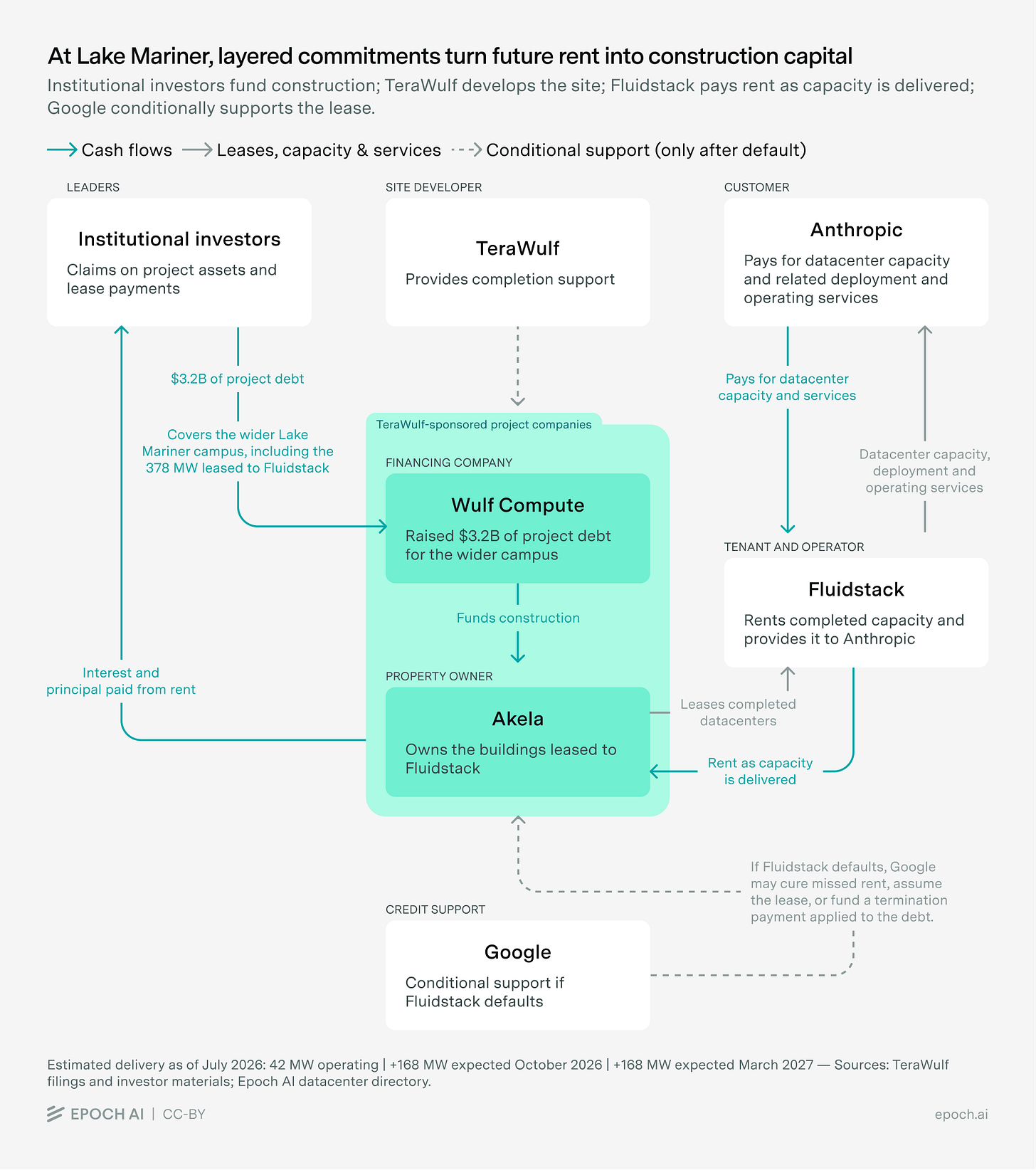
計算資源の資金調達については、Google の支援がない場合、Lake Mariner に同等の条件を持つ他の証券が存在しないため、バックストップが金利をどの程度引き下げたかを正確に切り分けることはできません。それでも、この 32 億ドル規模の債務は年利 7.75% で発行されています(詳細はこちら)。これは、投資家がいまだに建設遅延のリスクや、Google の支援に伴う条件・制限といった意味のあるリスクを織り込んでいることを示唆しています。これらのリスクには、建設の遅れや契約条件が含まれます。
TeraWulf の完成保証と Google のバックストップは、取引の異なる側面に対応しています。前者は施設の引き渡しを保証する役割を果たし、後者は賃貸借契約が開始された後の家賃収入の安定性を高めるものです。
この資金調達の仕組みが達成しようとしているのは、以下の通りです。機関投資家が施設稼働前に資金の大部分を提供し、デベロッパーが希少な土地・電力・建設能力を供給します。Fluidstack が長期的な家賃を支払う役割を担い、Google がその家賃収入の信頼性をさらに高めます。結果として、将来の計算資源需要が建設資本へと変換され、最終的にデータセンターとしての稼働容量として実現されるのです。
少なくとも近未来において、資金調達が最先端計算資源の成長に対するボトルネックになる可能性は低い。Anthropic は年間収益が 90 億ドルに満たない段階でインフラプログラムを発表し、その構築費用として約 500 億ドル規模の債務調達を行った。しかし Anthropic が全額を調達する必要はなく、他の AI 企業も同様に全額を調達する必要はないだろう。
これらの取引を支える市場は極めて急速に拡大している。Anthropic の年間収益は 2025 年末の約 90 億ドルから、2026 年 5 月には 470 億ドルを超えた と見られる一方、OpenAI は 2026 年 2 月までに 250 億ドルを突破 している。この成長はラボが将来の計算資源購入にコミットする能力を高め、投資家にとって資金調達の信頼性を向上させる。規模の小さい Anthropic を中心に構築されたこの構造は、最先端ラボと市場が引き続き成長すれば、より大規模なインフラ構築も十分に資金調達可能であることを示唆している。
参加企業らはすでに、この構造をより大規模な市場へと拡大させようとしています。ブロードコム、アポロ・グローバル・マネジメント、ブラックストーンは、350億ドル規模の計算資源調達を、2028 年までにアンソロピックや OpenAI といった最先端ラボ向けに 20 GW を超える展開を支えるプラットフォームの第一弾取引と位置付けています。
最初の取引によって契約が結ばれ、市場価格が形成され、投資家プールも構築されます。システムが稼働し支払いが開始されると、それらは後続の取引を評価しやすくするための実績記録としても機能します。これらの資金調達が期待通りに進めば、より多くの機関がこの資産クラスに安心感を抱き、結果として後の展開は規模を拡大しつつ、調達コストも低下していくでしょう。
*原稿のレビューと有益なコメント・提案を提供してくださった Isabel Juniewicz 氏、Josh You 氏、Ben Cottier 氏、Lynette Bye 氏に感謝します。*
原文を表示
*This post is part of Epoch AI’s Gradient Updates newsletter, which shares more opinionated or informal takes on big questions in AI progress. These posts solely represent the views of the authors, and do not necessarily reflect the views of Epoch AI as a whole.*
Compute scaling has driven much of the progress in AI so far. But maintaining recent growth rates requires exponentially increasing amounts of capital: The largest frontier labs are now planning infrastructure deployments that cost tens to hundreds of billions of dollars, substantially beyond their current profits and potentially beyond what they can fundraise themselves. This raises a question for the future of AI: Will financing constrain continued compute scaling?
Anthropic’s infrastructure buildout provides a useful test case. In November 2025, when Anthropic had less than $9 billion in annualized revenue, the company announced plans to invest $50 billion in American compute infrastructure. Subsequent disclosures allow us to identify nearly $50 billion of debt financing associated with the buildout. Much of this financing was assembled in early 2026 before Anthropic’s revenue spiked, making it a good test of investors’ willingness to lend against AI companies’ future revenue growth.
In this case, Anthropic needs both computing systems and places to run them. They have secured debt to fund the leases for more than 1 GW of TPU systems from Google and five datacenters from Fluidstack. Each side has its own financing. Roughly $35 billion in debt to purchase the TPU systems, with Broadcom conditionally supporting much of the financing if Anthropic stops paying. On the data center side, five companies have issued approximately $15.2 billion of loans to construct 1.43 GW of critical IT capacity, with Google providing conditional support if Fluidstack stops paying rent. In both structures, institutional investors lend the capital upfront, while Broadcom and Google make the future payment streams more dependable.
Anthropic’s buildout therefore suggests that financing is unlikely to be the immediate limit on frontier compute growth. Institutional investors appear willing to lend capital against the lab’s commitment to long-term payments, at least if more established organizations (i.e., the suppliers that benefit from the deployment) are willing to back part of the risk. The following sections trace how this works in general, then for Anthropic’s TPU systems and for the datacenters that will house them.
Banks, insurers, and private-credit funds manage large pools of institutional capital that seek relatively predictable returns. A long-term commitment to lease computing systems or datacenter capacity creates a promise of payments that can incentivize those funders to provide debt while the underlying TPU racks and completed facilities provide collateral. This allows outside investors to pay for infrastructure upfront and be repaid over time.
A long-term lease makes the amount and timing of Anthropic’s payments predictable, but investors must still judge whether Anthropic will actually make them. Anthropic’s revenue has grown extraordinarily quickly, but rapid growth is not the same as a long record of stable cash flows. Lenders have less evidence about how the company would perform through changes in technology, competition, or regulation, and would ordinarily demand a higher return to bear that uncertainty.
Broadcom and Google help bridge this gap. Both companies benefit commercially as more TPU systems are deployed, and both have longer operating histories and more diversified sources of cash flow than Anthropic. Investors therefore have more evidence that they can honor their commitments through changing business conditions. By agreeing to absorb part of the losses if Anthropic or Fluidstack stops paying, Broadcom and Google can make the debt cheaper and more attractive to a wider range of investors without supplying the money themselves. This is vendor-supported financing: Suppliers use their credit to help finance deployments from which they benefit.
The compute financing provides the clearest evidence that institutional capital is increasingly available at the scale frontier labs require. Led by Apollo-managed funds, with Blackstone and global banks, investors committed $34.5 billion of debt to finance more than 1 GW of Google TPU systems for Anthropic. Of this amount, $30 billion benefits from Broadcom’s support, while $4.5 billion does not. The unbackstopped portion matters because it shows that investors were willing to take more direct exposure to Anthropic; Broadcom’s support allowed most of the financing to be raised at a lower interest rate.
The financing begins with Anthropic’s commitment to lease the TPU systems for five years. A dedicated equipment company, AI XPV Platform, borrows from investors, uses the money to purchase the racks and lease them to Anthropic. Anthropic’s lease payments are then used to pay interest and repay the debt, while the racks provide collateral if Anthropic stops paying.
The equipment company is a special purpose vehicle, or SPV: a company created for a particular transaction. Keeping the lease, the racks, and the debt in one company makes the risks easier for every party to understand. Investors lend against a clearly defined pool of payments and collateral, while Broadcom can specify exactly when its support begins and the maximum amount it can owe without borrowing the full purchase price itself. The SPV makes clear where the risk sits, who gets paid first, and when Broadcom has to step in.
The lenders provide the funding as the systems arrive rather than all at once. The racks have begun deploying, with capital expected to be released in approximately 16 stages over a little more than a year and around $24 billion expected to be paid out by summer 2027. This keeps the amount of funded debt roughly aligned with the amount of equipment available as collateral following a default. Broadcom’s potential exposure grows at the same time and then declines as Anthropic makes payments.
The debt is divided into three tranches, or groups of investors with different claims on the vehicle’s payments and assets. If the equipment company suffers losses, the $6 billion A1 and $24 billion A2 tranches are repaid before the $4.5 billion B tranche. This makes A1 and A2 senior debt and B junior debt. The A1 tranche pays 1 percentage point above Treasury yields, A2 pays 5.75%, and B pays 8.5%.
Broadcom’s backstop protects the A1 and A2 investors, but not the B investors. If Anthropic defaults, Broadcom can take over the lease or arrange for the racks to be sold. The sale proceeds are used to repay investors, after which Broadcom covers remaining A1 and A2 shortfalls under the agreement, subject to a reported maximum exposure of $29 billion. B investors are repaid only after A1 and A2 and must rely more heavily on Anthropic’s payments and the value recovered from the racks. This is vendor-supported financing: Broadcom does not supply the $30 billion upfront, but promises to absorb part of the loss if Anthropic’s payments and the racks prove insufficient.
The contrast between A2 and B makes the economic effect visible. Investors supplied $4.5 billion without Broadcom’s support, but required an 8.5% interest rate, compared with 5.75% for A2. The 2.75-percentage-point difference reflects two protections at once: A2 is supported by Broadcom and is repaid before B. The comparison is therefore an upper bound on how much Broadcom’s backstop is worth to the investors, rather than a precise estimate.
Together, the tranches answer the article’s central question. Institutional investors were willing to take direct exposure to Anthropic and the value of the TPU racks, while Broadcom’s support helped make a much larger amount available on better terms. Anthropic did not need enough cash on hand to purchase $35 billion of systems itself: Its future lease payments attracted the capital, while a supplier that benefits from the deployment helped make most of that financing cheaper.
Investors were also willing to lend money for constructing datacenters under a similar scheme. Across five sites, dedicated project companies have issued approximately $15.2 billion of debt to construct 1.43 GW of critical IT capacity that Fluidstack will lease for Anthropic’s deployment. This debt was raised before the facilities began being built: Investors supplied the construction capital upfront based on the facilities and the rent they are expected to generate once delivered.
Each site follows the same basic structure. A developer brings a site, access to power, permits, and the ability to manage construction. A dedicated project company borrows from institutional investors, uses the money to construct and own the datacenter, and leases the completed capacity to Fluidstack. Fluidstack begins paying rent as the capacity is delivered, and that rent ordinarily pays the interest and principal owed to investors. Anthropic leases from Fluidstack. The completed facility provides collateral if the payments stop. This is an example of project finance: future rent is converted into construction capital, with each project’s assets, contracts, and debts kept together in a dedicated company.
Google makes the future rent more dependable. The precise arrangements differ across the projects, but Google protects investors against part of the losses that could result if Fluidstack stops paying. At Lake Mariner, one of the project sites being developed as part of the deal, Google can pay missed rent and assume the lease, or fund a termination payment that is applied to the project debt. This is the datacenter equivalent of Broadcom’s role in the compute financing: Google places its credit behind a deployment from which it benefits commercially, while institutional investors provide most of the cash. This support increases the amount of capital available and reduces the return investors demand.
Using several developers allows the buildout to proceed faster and draws on scarce resources already controlled by different companies. A powered datacenter site is not interchangeable with an empty parcel of land: The valuable inputs include a large power connection, completed interconnection work, permits, equipment, and an established construction pipeline. By working across several developers and power markets, Anthropic and Fluidstack can assemble capacity in parallel rather than waiting for one company to acquire and develop every site.
Taken together, the five projects show the same financing mechanism being repeated across different developers and locations rather than appearing in one exceptionally large transaction. They also make the physical side of the buildout visible: Institutional capital is being used to secure power, construct facilities, and deliver capacity on several timelines at once. The project companies place the site, buildings, leases, and construction obligations into a clearly defined package against which investors can lend.
Lake Mariner provides the clearest example of how these pieces fit together. At Lake Mariner, TeraWulf is the developer and has committed to fund the completion of the data center buildings. As each building is delivered, Fluidstack begins paying rent under an initial ten-year lease, with two five-year extension options. This rent becomes the ordinary source of repayment for investors, while Anthropic pays Fluidstack for the datacenter capacity and related deployment and operating services. Google’s lease-related backstop becomes effective when the corresponding lease begins, and Google received rights to acquire TeraWulf shares in exchange for providing its support. Investors therefore rely on TeraWulf to complete the facilities, Fluidstack to pay rent after delivery, Google to provide support if Fluidstack defaults, and the facilities themselves as collateral.
Unlike the compute financing, Lake Mariner does not contain an otherwise comparable tranche without Google’s support, so I cannot isolate precisely how much the backstop reduced the interest rate. The$3.2 billion of debt nevertheless pays 7.75%, suggesting that investors are still pricing meaningful risks. I think these include the possibility of construction delays and the conditions and limits attached to Google’s support. TeraWulf’s completion commitment and Google’s backstop address different parts of the transaction: One helps ensure that the facilities are delivered, while the other makes the rent more dependable once the leases begin.
The sequence illustrates what the financing accomplishes: Institutional investors provide most of the money before the facilities are operating; the developer supplies the scarce site, power, and construction capability; Fluidstack supplies the long-term rent; and Google makes that rent more dependable. Future demand for compute is thereby converted into construction capital and, ultimately, delivered datacenter capacity.
At least in the near term, financing is unlikely to be the binding constraint on frontier compute growth. Nearly $50 billion of debt has been raised for an infrastructure program announced when Anthropic had less than $9 billion in annualized revenue. Anthropic did not need to raise the full cost of the buildout, and it’s unlikely other AI companies will either.
The market supporting these transactions is expanding extremely quickly. Anthropic’s annualized revenue rose from approximately $9 billion at the end of 2025 to more than $47 billion by May 2026, while OpenAI had passed $25 billion by February 2026. This growth gives the labs greater capacity to commit to future compute purchases and gives investors greater confidence in financing them. A structure assembled around a much smaller Anthropic therefore supports the proposition that labs should be able to finance substantially larger buildouts if the frontier labs and market continue to grow.
The participants are already attempting to turn this structure into a much larger market. Broadcom, Apollo, and Blackstone describe the $35 billion compute financing as the initial transaction in a platform designed to support more than 20 GW of deployments for frontier labs, including Anthropic and OpenAI, through 2028. The first transactions establish contracts, market prices, and a pool of investors. As the systems are deployed and payments arrive, they will also create a performance record that makes subsequent deals easier to evaluate. If these financings perform as expected, more institutions should become comfortable with the asset class, allowing later deployments to become larger and cheaper to finance.
*Thanks to Isabel Juniewicz, Josh You, Ben Cottier, and Lynette Bye for reviewing my draft and providing helpful comments and suggestions.*
関連記事
今日のまとめ
AIデイリーブリーフで今日の重要ニュースをまとめ読み