コーディングエージェント開発における技術的負債のリスクを警告
本文の状態
日本語全文を表示中
詳細モードで約11分の本文を読めます。
同じ出来事の情報源
この情報源を基点に整理
OpenHands Engineering
OpenHands Engineering は、主要なコードエージェント製品のデータ分析を通じて、開発者がプロダクション環境で維持する技術的負債と継続的な保守コストの現実を浮き彫りにしている。
AI深層分析を開く2026年8月4日 14:05
AI深層分析
キーポイント
技術的負債の蓄積実態
過去12ヶ月間のデータ分析により、主要なコードエージェント製品はすべて数千件のPRと100万行以上のコードを有し、その多くがバグ修正に費やされていることが示された。
保守コストの継続性
デモ段階を超えた後でも、チームは新モデルやアーキテクチャの変化を追跡し続ける必要があり、これは無限に近い開発負荷を意味する。
プラットフォーム分裂のリスク
異なるチームが独自のプロジェクトをフォークして構築した場合、組織内に複数のプラットフォームとユーザーベースが存在し、どちらを支援すべきかという新たな対立が生じる可能性が高い。
コーディングエージェントは単一のコードベースではない
実務上の「コーディングエージェント」は一つのプログラムではなく、プラットフォームとして機能する。
OpenHands の多様なコンポーネント構成
OpenHands はアプリケーション、サーバー、SDK、UI、CLI など複数の独立したコードベースで構成されている。
重要な引用
Maintenance and technical debt always come due.
The team having fun building the agent today will be fielding bug reports from grumpy developers in six months.
Every week brings new models, new ideas, and new features to build.
"A coding agent" sounds like one program. In practice, it is a platform.
編集コメントを表示
編集コメント
この分析は、昨今のコードエージェントブームに対する冷静な視点を提供しており、実装後の現実的な課題を可視化している。企業は短期的な導入効果だけでなく、長期的なメンテナンスコストの試算を慎重に行う必要があるだろう。
Source Article
元記事を日本語で読む
本文に関係しない購読案内、埋め込み通知、サイト内プロモーションは除いています。
現在、多くの企業が自社向けコーディングエージェントプラットフォームの構築に乗り出しています。その魅力は理解できます。コーディングエージェントを使えば、プロトタイプを低コストで立ち上げられるからです。また、ソフトウェアエンジニアリングのあり方そのものを再定義する製品を作る楽しさもあります。
しかし、長期的な影響についても考慮する必要があります。これは多くのイノベーションに見られる現象です。かつて、あらゆる企業が独自の GPT を学習させると計画していたことを覚えているでしょうか。
メンテナンスと技術的負債は、必ずやってくるものです。今日エージェント構築に夢中になっているチームが、6 ヶ月後には怒った開発者からのバグ報告に対応することになるでしょう。別のチームが異なるプロジェクトをフォークして、より優れたものを構築する可能性もあります。その結果、組織内には二つのプラットフォームと二組のユーザーが存在し、「どちらを支援すべきか」という新たな議論が始まります。
幸いなことに、これらの作業の多くは公開されているため、データを議論に持ち込むことができます。私は 4 つのコーディングエージェント製品について、過去 12 ヶ月の公開活動を調査しました。私が勤務する OpenHands、OpenAI Codex、OpenCode、そして Hermes です。マージされた PR、バグ修正の割合、変更行数、現在のコードサイズを確認しました。デモが動作した後に、コーディングエージェントをどのように構築・維持していくべきかを理解するためです。
全体像
OpenHands は、アプリ、Agent Canvas、SDK、CLI の 4 つの公開リポジトリにまたがって展開されています。私はこれらすべてのリポジトリを合計しました。一方、他の製品は単一の主力リポジトリに作業を集約しているため、比較のためにそれぞれの主力リポジトリを使用しています。この比較に異議を唱えたり、自分で実行したりするのは自由です。ただし、私の主張の妥当性は確信しています。
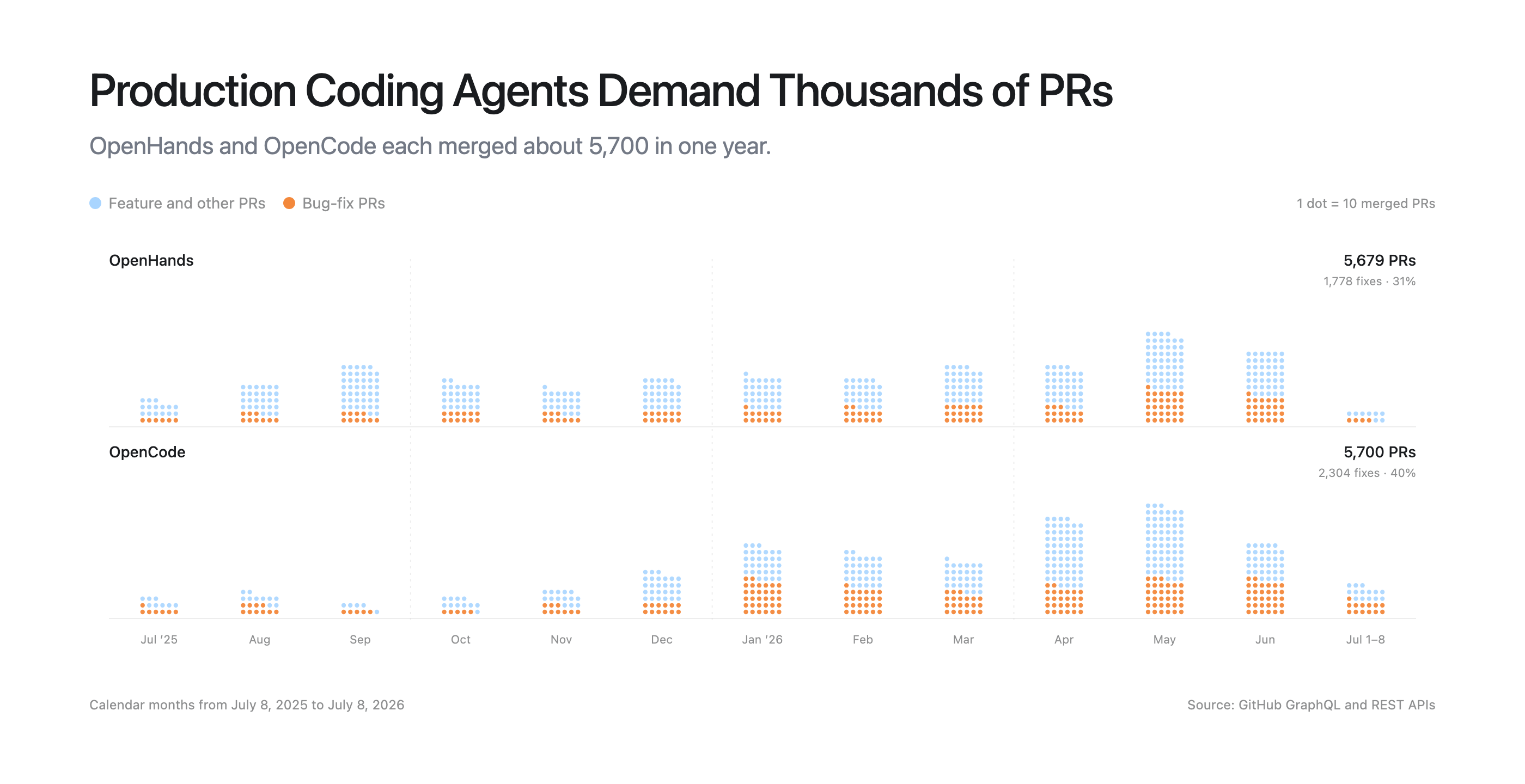
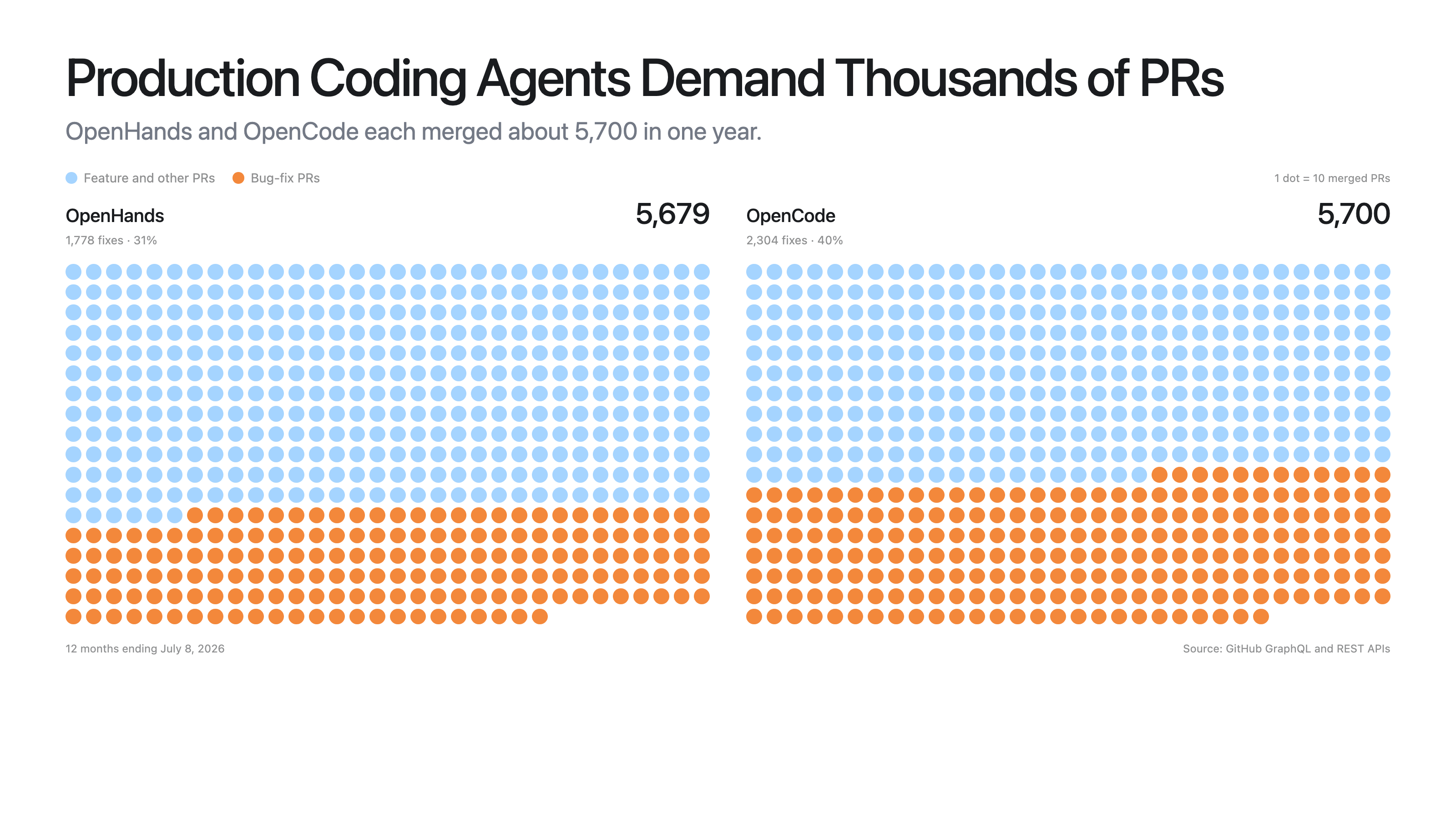
過去 1 年間で各製品は数千件の PR をマージし、コード行数は 100 万行を超えています。作業の大きな割合を占めるのはバグ修正で、Codex では 16% から OpenCode では 40% に及びます。OpenHands は 31% です。Hermes は 68% と高い数値ですが、これはラベリング規約の違いによるものかもしれません。
バグ修正以外にも、コーディングエージェントにおけるイノベーションは止まりません。毎週のように新しいモデルやアイデア、新機能が登場します。つまり、チームはすべてのモデルリリースやエージェント設計の変更を、先送りすることなく追跡し続けることを意味しています。
OpenHands と OpenCode は特に興味深いです。異なるチームが異なる言語とアーキテクチャで開発しましたが、活動内容は非常に似ています。マージされた PR の数は 5,679 件対 5,700 件、コード行数はどちらも約 105 万行です。これが、本番環境のコーディングエージェントを支える作業量の確かな目安と言えるでしょう。
| 製品 | マージされた PR(過去 12 ヶ月) | バグ修正 PR | 変更行数 | 現在のコードサイズ |
|---|---|---|---|---|
| OpenHands, 4 リポジトリ | 5,679 | 1,778, 31% | ~2.4M | ~1.05M 行 |
| OpenAI Codex | 7,688 | 1,202, 16% | ~3.8M | ~1.32M 行 |
| OpenCode | 5,700 | 2,304, 40% | ~2.9M | ~1.05M 行 |
| Hermes | 7,736 | 5,288, 68% | ~3.0M | ~1.75M 行 |
コーディングエージェントは単一のコードベースではない
「コーディングエージェント」という言葉は、一つのプログラムを連想させがちです。しかし実際には、それはプラットフォームそのものです。
OpenHands はこの構造を明確に示しています。アプリ自体にはエージェントアプリケーションとサーバーが含まれています。その下層では Software Agent SDK がランタイムを提供し、Agent Canvas が開発者向けの UI を提供します。また CLI によって、同じ作業をターミナル上で行うことも可能です。これら各コンポーネントはすべて独立したコードベースであり、それぞれが独自の更新履歴を持っています。
.png)
| 構成要素 | 概要 | コードサイズ | マージされた PR(過去 12 ヶ月) |
|---|---|---|---|
| OpenHands アプリ | エージェントアプリケーションおよびサーバー | 404K ライン | 2,600 |
| Software Agent SDK | エージェントランタイム | 333K ライン | 2,036 |
| Agent Canvas | エージェント操作用 UI | 246K ライン | 719 |
| OpenHands CLI | ターミナルインターフェース | 67K ライン | 324 |
他の製品も同様の構成になっています。Codex リポジトリには、CLI、数十の基盤ランタイムクレート、アプリサーバー、MCP サポート、そして Python および TypeScript の SDK が含まれています。
OpenCode の packages/ ディレクトリには、core、server、cli、desktop、tui、web、2 つの SDK、そしてプラグインシステムが含まれています。
ペースも加速しています。Codex は 2025 年半ばには月間約 124 の PR がマージされていたのが、1 年後には月間約 1,000 に増加しました。Hermes も本格的に動き出した直後からほぼ空の状態だったリポジトリが、数ヶ月で月間約 2,000 の PR をマージするまでに成長しています。
フォークは始まりであって終わりではない
チームが既存のプロダクトをフォークすることから始めることを検討しているかもしれません。フォークすることで、ゼロからのスタートを避けられます。また、自社のコードと、その後にアップストリーム側でリリースされるすべての変更との間に、明確な隔たりを生み出すことができます。
12 ヶ月前に OpenHands アプリのフォークを作成し、その後もアップストリームからのマージを行わなかったと仮定してください。現在、あなたは 2,600 件のマージ済み PR に遅れており、その中には 866 のバグ修正も含まれていません。これらの修正には、179 名のコントリビューターがあなたのチームが独自機能の開発に注力している間に発見したクラッシュの解消、回帰現象への対応、セキュリティパッチ、モデル互換性の修復などが含まれています。
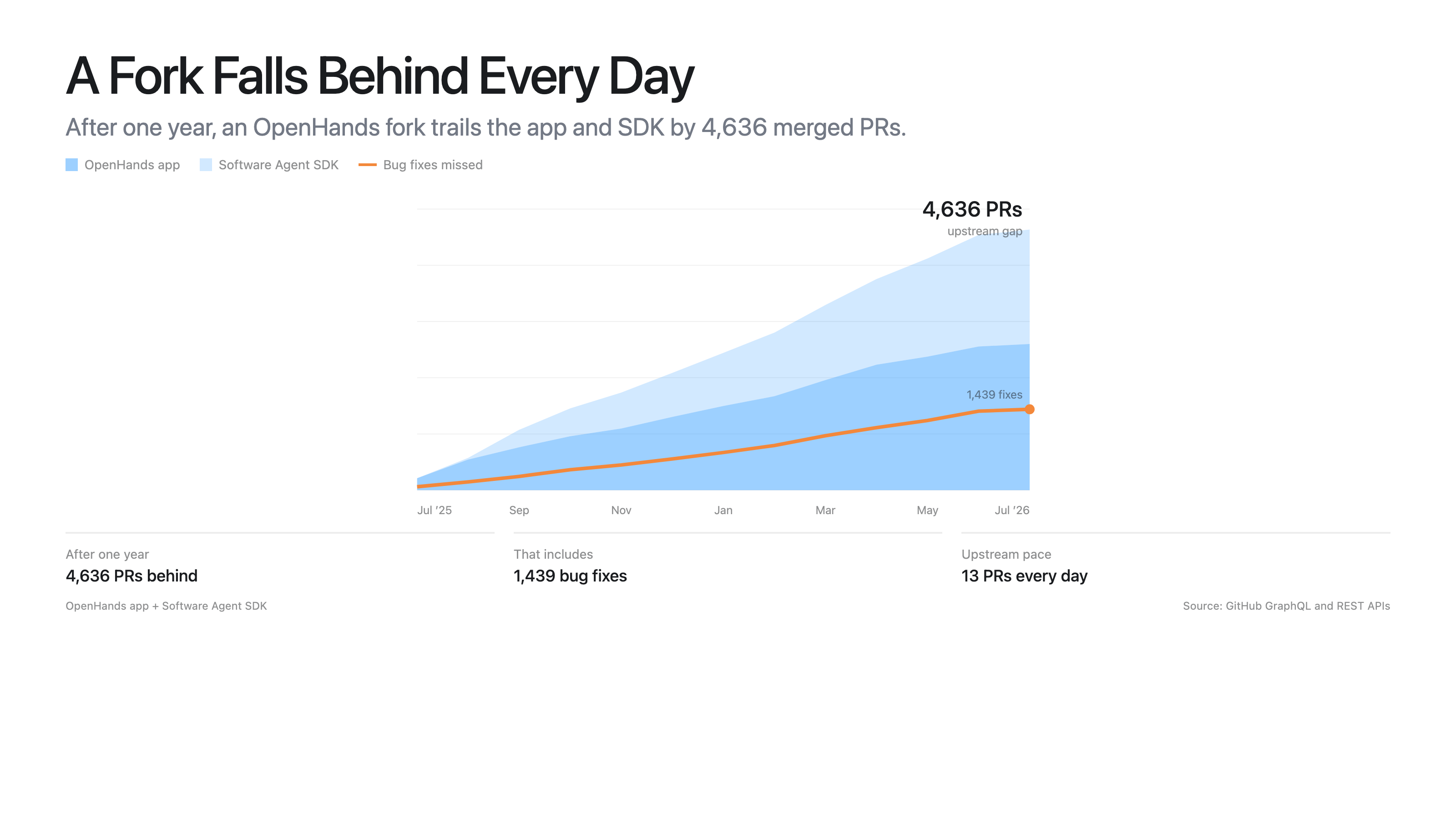
これはアプリだけの話です。その下層にある SDK も、同じ期間にさらに 2,036 の PR を更新しています。あなたのフォークと現在のアップストリームの間のギャップは 4,600 件を超える PR に達し、1 年間毎日平均約 13 件の差が開いている計算になります。
この時点で考えられる選択肢はすべて、いずれも最悪のものとなります:
「上位ブランチにリベースする」方法では、チームはカスタマイズ対象の核心ファイルに対して 1 年間にわたる変更との競合を解決しなければなりません。これには数週間かかることもあり、作業結果が次のリベースで反映されるまで待たねばなりません。
「必要な修正だけをチェリーピックする」方法では、誰かが毎日 12 件以上の上位ブランチの PR を読み込み、自社に適したものを選別する必要があります。これは常設業務となります。
「自力で維持する」方法では、チームがコーディングエージェントプラットフォーム自体を管理することになります。最初の表にある概算コストを見ると、年間 5,000〜8,000 件の PR がマージされ、コード量は 100 万行を超え、そのうち相当部分が修正に充てられています。内部バージョンでは必要な範囲が狭い場合もありますが、それでも膨大な作業量です。
少数のカスタマイズを施したフォークがまさに必要となるケースもあります。しかし、コーディングエージェントの進化は速く、最新の状態を保つにはドメイン知識と新モデルとの継続的な連携、そして絶え間ないメンテナンスが必要です。
既存のコーディングエージェントをベースに始める
コーディングエージェントのカスタマイズが必要な場合、以下の選択肢があります:
設定やシステムプロンプトから始める。 「独自のエージェントが必要」という要望の多くは、実は「独自のプロンプト、ツール、デフォルト値が必要」であることに過ぎません。ほとんどのエージェントでは、コアコードに触れずにこれら 3 つをすべて変更できます。
MCP サーバーを使って社内システムと連携する。 エージェントが社内ツールと通信する必要がある場合、ツールサーバーを構築します。こうすれば、フォークにその統合を再適用することなく、エージェント自体の更新を継続できます。
反復的な作業は、スキルやプラグインとしてパッケージ化しましょう。これにより、エージェントに組織の専門知識を提供できますが、永続的なフォーク差分を生み出すことはありません。
異なるエージェントが必要になった場合は、SDK を活用してください。OpenHands SDK や Claude Agent SDK は、まさにそのようなケースのために存在します。チームは製品固有のレイヤーを所有し、アップストリーム側はその下のランタイムを維持管理します。OpenHands の場合、年間 2,036 件の SDK プルリクエストがバックログ化されるのではなく、引き続きアップストリームで発生し続けます。
それでも独自のコーディングエージェントプラットフォームの維持を選択する場合は、複数のエンジニアを割り当て、アップストリームの追跡を業務の一部として組み込んでください。これは製品として扱うべきです。なぜなら、それが最終的にそうなるからです。
方法論に関する注記と注意点
- データは 2026 年 7 月 8 日に GitHub の GraphQL および REST API を通じて取得しました。貢献の単位はマージされた PR です。コントリビューター数にはボットは含まれません。
- コントリビューター数は各リポジトリごとの値であり、重複カウントを避けるためにリポジトリ間で単純に合算することはできません。そのため、ここではリポジトリレベルでの数値のみを引用しています。
- 比較は製品単位で行っています。OpenHands は 4 つの公開リポジトリの合計です。Codex、OpenCode、Hermes はそれぞれ主力リポジトリを使用しているため、プライベートまたは追加のリポジトリで作業が行われる場合、これらの総数は実際より少なく見積もられています。
- バグ修正の分類はヒューリスティックなものです。バグ、回帰、欠陥スタイルのラベルに加え、
fix:やhotfix:のタイトルをカウントしました。ただし、ラベル未付けの修正は見逃され、誤検出も一部含まれます。また、プロジェクトによってラベルの管理状況が異なるため、比較は傾向として捉えてください。
コードサイズには、浅いクローンから取得した追跡対象のコード、設定ファイル、テストコードが含まれます。ただし、ロックファイル、生成されたコード、バンドルされた依存ライブラリ、バイナリ資産は除外されます。
これらの製品は、その範囲や歴史、非公開での開発状況が異なります。これは順位付けではなく、単なる妥当性の確認です。重要なのは、これらすべてのプロジェクトが、カジュアルなフォーク操作で追いつくスピードよりも速く進化しているという点です。
ソースコード
- OpenHands アプリ: https://github.com/OpenHands/OpenHands
- OpenHands ソフトウェアエージェント SDK: https://github.com/OpenHands/software-agent-sdk
- OpenHands エージェントキャンバス: https://github.com/OpenHands/agent-canvas
- OpenHands CLI: https://github.com/OpenHands/OpenHands-CLI
- OpenAI Codex: https://github.com/openai/codex
- OpenCode: https://github.com/anomalyco/opencode
- Hermes: https://github.com/NousResearch/hermes-agent
原文を表示
Everyone seems to be building an in-house coding agent platform. I understand the appeal. Coding agents make it cheap to get a prototype running. It’s fun to build a product that is redefining software engineering. However, consider the long term implications. This happens with lots of innovations, remember when every company planned to train its own GPT?
Maintenance and technical debt always come due. The team having fun building the agent today will be fielding bug reports from grumpy developers in six months. Another team may fork a different project and build something better. Then the organization has two platforms, two sets of users, and a new debate over which one deserves support.
Luckily, much of this work happens in public, so we can bring data into the discussion. I pulled twelve months of public activity from four coding agent products: OpenHands, where I work, OpenAI Codex, OpenCode, and Hermes. I looked at merged PRs, bug-fix share, lines changed, and current code size. I wanted to understand what it takes to build and maintain a coding agent after the demo works.
The big picture
OpenHands ships across four public repos: the app, Agent Canvas, the SDK, and the CLI. I summed those repos. The other products concentrate their work in one flagship repo, so I used that repo for each. Feel free to quibble with the comparison or run it yourself. I am confident the point will hold.
Every product merged thousands of PRs over the past year and carries more than a million lines of code. A large share of the work is bug fixes, from 16% at Codex to 40% at OpenCode, with OpenHands at 31%. Hermes comes in at 68%, although its labeling conventions may explain some of that difference.
Beyond bug fixes, there is non-stop innovation in coding agents. Every week brings new models, new ideas, and new features to build. This means your team is signing up to track every model release and agent design shift, indefinitely.
OpenHands and OpenCode are especially interesting. Different teams built them in different languages, with different architectures, yet the activity is very similar. 5,679 versus 5,700 merged PRs, and about 1.05 million lines of code each. That is a solid estimate of the work behind a production coding agent.
| Product | Merged PRs, 12 months | Bug-fix PRs | Changed lines | Current code size |
|---|---|---|---|---|
| OpenHands, 4 repos | 5,679 | 1,778, 31% | ~2.4M | ~1.05M lines |
| OpenAI Codex | 7,688 | 1,202, 16% | ~3.8M | ~1.32M lines |
| OpenCode | 5,700 | 2,304, 40% | ~2.9M | ~1.05M lines |
| Hermes | 7,736 | 5,288, 68% | ~3.0M | ~1.75M lines |
A coding agent is never one codebase
"A coding agent" sounds like one program. In practice, it is a platform.
OpenHands makes the split easy to see. The app contains the agent application and server. The Software Agent SDK provides the runtime underneath it. Agent Canvas gives developers a UI for working with agents, while the CLI brings the same work into the terminal. Each piece is a substantial codebase with its own stream of changes.
.png)
| Piece | What it is | Code size | Merged PRs, 12 months |
|---|---|---|---|
| OpenHands app | Agent application and server | 404K lines | 2,600 |
| Software Agent SDK | Agent runtime | 333K lines | 2,036 |
| Agent Canvas | UI for working with agents | 246K lines | 719 |
| OpenHands CLI | Terminal interface | 67K lines | 324 |
The other products have similar divisions. The Codex repo holds the CLI, dozens of core runtime crates, an app server, MCP support, and Python and TypeScript SDKs. OpenCode's packages/ directory includes core, server, cli, desktop, tui, web, two SDKs, and a plugin system.
The pace is also accelerating. Codex grew from about 124 merged PRs a month in mid-2025 to around 1,000 a month a year later. Hermes went from a nearly empty repo to roughly 2,000 merged PRs a month within months of getting serious.
Forking is a start, not an end
Your team might want to start with a fork of an existing product. A fork saves you from starting at zero. It also creates a gap between your code and everything upstream ships next.
Say you forked the OpenHands app twelve months ago and never merged from upstream. You would now be 2,600 merged PRs behind, including 866 bug fixes you do not have. Those fixes cover crashes, regressions, security patches, and model-compatibility repairs found by 179 contributors while your team worked on custom features.
That is only the app. The SDK underneath it moved another 2,036 PRs during the same period. The gap between your fork and current upstream would be more than 4,600 PRs, about thirteen a day, every day, for a year.
Your options at that point are all bad:
- Rebase onto upstream. Your team resolves conflicts against a year of changes to the same core files your customizations touch. That can take weeks, and the work returns with the next rebase.
- Cherry-pick the fixes you need. Someone reads a dozen-plus upstream PRs every day and decides which ones apply. That is a standing job.
- Go it alone. Your team now maintains a coding agent platform. The first table gives a rough price: 5,000 to 8,000 merged PRs a year across more than a million lines of code, with a substantial share devoted to fixes. Your internal version may need only a fraction of that surface area, but even then it’s still a lot of work.
Sometimes a fork with a few customizations is exactly what you need. But coding agents are moving fast. Keeping one current takes domain knowledge, ongoing work with new models, and continual upkeep.
Start by building on the existing coding agents
If you need to customize a coding agent, here are some options:
Start with configuration and system prompts. A surprising amount of "we need our own agent" turns out to mean "we need our own prompt, tools, and defaults." Most agents let you change all three without touching the core code.
Use MCP servers for internal systems. If the agent needs to talk to your internal tools, build a tool server. You can keep updating the agent without reapplying that integration to a fork.
Package repeatable work as skills or plugins. These give the agent your organization's expertise without creating a permanent fork delta.
Build on the SDK when you need a different agent. The OpenHands SDK and Claude Agent SDK exist for this case. Your team owns the product-specific layer while upstream keeps maintaining the runtime underneath it. For OpenHands, that means the 2,036 annual SDK PRs keep happening upstream instead of becoming your backlog.
If you still decide to maintain your own coding agent platform, assign several engineers to it and make upstream tracking part of their job. Treat it as a product, because that is what it becomes.
Method notes and caveats
- I pulled the data on 2026-07-08 through the GitHub GraphQL and REST APIs. Merged PRs are the unit of contribution. Contributor counts exclude bots.
- Contributor counts are per repo and cannot be summed across repos without double counting, so I quote them only at the repo level.
- I compare products at the product level. OpenHands is the sum of four public repos. Codex, OpenCode, and Hermes use their flagship repo, so their totals are understated when work happens in private or additional repos.
- Bug-fix classification is heuristic. I counted bug, regression, and defect-style labels, plus fix: and hotfix: titles. This misses unlabeled fixes and catches some false positives. Label hygiene also varies by project, so compare the shares directionally.
- Code size includes tracked code, config, and test lines from shallow clones. It excludes lockfiles, generated code, vendored dependencies, and binary assets.
- These products differ in scope, age, and private development. This is a sanity check, not a ranking. The point is that all of them move faster than a casual fork can track.
Sources
- OpenHands app: https://github.com/OpenHands/OpenHands
- OpenHands Software Agent SDK: https://github.com/OpenHands/software-agent-sdk
- OpenHands Agent Canvas: https://github.com/OpenHands/agent-canvas
- OpenHands CLI: https://github.com/OpenHands/OpenHands-CLI
- OpenAI Codex: https://github.com/openai/codex
- OpenCode: https://github.com/anomalyco/opencode
- Hermes: https://github.com/NousResearch/hermes-agent
AI算出
技術分析ainew評価高い
AI エージェントの開発と保守に関する具体的なデータ分析を提供しており、新規性のある洞察を含んでいるが、日本固有の情報や企業事例は含まれていない。
6つの評価軸を見る
- AI関連度
- 90
- 情報源の信頼性
- 100
- 新規性
- 75
- 調べる価値
- 75
- 重複の少なさ
- 100
- 日本での有用性
- 25
News to Guide
ニュースの次に確認する
発表内容を、現在の料金や仕様と照らし合わせられる関連ガイドです。
今日のまとめ
AIデイリーブリーフで今日の重要ニュースをまとめ読み