Axonius、Bedrock AgentCore でセキュアなマルチテナント AI エージェントを構築
本文の状態
日本語全文を表示中
詳細モードで約20分の本文を読めます。
同じ出来事の情報源
この情報源を基点に整理
AWS Machine Learning Blog
Axonius は AWS の Amazon Bedrock AgentCore を活用し、ISV が直面するセキュリティやスケーラビリティの課題に対し、テナントレベルでの分離と管理を実現するアーキテクチャ戦略を公開した。
AI深層分析を開く2026年8月19日 01:46
AI深層分析
キーポイント
ISV 特有のマルチテナンシー課題
ISV は顧客ごとに孤立した環境(Silo)、リソース共有型(Pool)、またはその組み合わせ(Bridge)という3つのアーキテクチャパターンから選択する必要があり、各テナントレベルでのセキュリティとコスト管理が重要となる。
Amazon Bedrock AgentCore の機能
このプラットフォームはあらゆるフレームワークやモデルに対応し、セッションIDの割り当てによりユーザーセッションを論理的に分離することで、マルチテナント環境でのアイソレーションを実現する。
Axonius の実装事例と戦略
セキュリティおよび IT チーム向けの資産インテリジェンスプラットフォームである Axonius は、1,400 以上のシステムからのデータを統合し、AWS 上で数百の孤立した顧客環境を管理する際にこのアーキテクチャを採用した。
SaaS プロバイダ向けのデプロイ戦略
本記事はプラットフォームエンジニアやアーキテクト向けに、既存の手法とアジェンシーワークロードを統合し、安全でスケーラブルな AI エージェント展開を行うための具体的な戦略を提示している。
AgentCoreの運用パターンとセッション分離
Siloモデルではテナントごとに専用エージェントを使用するが、Poolモデルではリソースを共有し、Bridgeモデルは両者を組み合わせる。AgentCore Runtimeでは各ユーザーセッションに一意のセッションIDを割り当てることで、リソース共有下でもセッションレベルでの完全な分離を実現できる。
重要な引用
ISVs have another dimension, they provide services to other organizations and need to manage agentic workloads for each customer.
The silo model refers to an architecture where tenants are provided dedicated resources. Looking into AgentCore runtime, it means using a dedicated agent per tenant.
With the pool model, tenants share resources, one agent serves multiple tenants.
Axonius needed to address several key requirements: Tenant isolation – Axonius handles sensitive customer data. An agent serving one customer must be scoped exclusively to that customer's data.
編集コメントを表示
編集コメント
本記事は、単なるツールの紹介に留まらず、ISV が直面する複雑なマルチテナンシー課題に対する具体的な解決策を提示している点で実務的な価値が高い。Axonius の事例を通じて、セキュリティ要件の高い環境でも AI エージェントを安全に運用するための設計思想が明確になっている。
Source Article
元記事を日本語で読む
本文に関係しない購読案内、埋め込み通知、サイト内プロモーションは除いています。
独立系ソフトウェアベンダー(ISV)は、提供サービスの幅を広げ、AI エージェントの導入を進めています。組織がエージェントワークロードを追加する際に検討すべき共通の課題には、セキュリティ、スケーラビリティ、市場投入までの時間、コスト管理などがあります。ISV にとってさらに重要なのは、他社に対してサービスを提供し、各顧客ごとにエージェントワークロードを管理しなければならない点です。つまり、ISV はこれらの共通課題を組織全体としてだけでなく、テナント単位でも適切に管理する必要があります。
Axonius は、セキュリティおよび IT チームがリスクの優先順位付けと修正作業の調整を支援する資産インテリジェンスプラットフォームです。1,400 以上のシステムからデータを統合し、単一の信頼できる情報源(ソース・オブ・トゥルース)として管理することで、セキュリティチームとそのサポート対象チームが効果的に連携できるようになります。これにより、セキュリティ、監査、コンプライアンスに関する手作業の負担を最大 50% 削減できます。Axonius は AWS 上で SaaS インフラストラクチャを運用し、数百の孤立した顧客環境を管理しています。
Amazon Bedrock AgentCore は、あらゆるフレームワークやモデルに対応して、大規模なエージェントの構築・接続・最適化を実現するプラットフォームです。本稿では、SaaS プロバイダーが AI エージェントを展開するための戦略について解説し、Amazon Bedrock AgentCore がこれらのオプションをどのようにサポートするかを説明します。さらに、Axonius の検討事項と選定したアーキテクチャについても紹介します。また、Axonius が既存の手法にエージェントワークロードをどう統合したかも解説します。本稿は、AWS 上でセキュアでマルチテナント対応の AI エージェント展開を構築するプラットフォームエンジニアやアーキテクトを対象としています。
AI エージェントにおけるマルチテナンシーのパターン
独立ソフトウェアベンダー(ISV)は、SaaS モデルを用いてサービスを提供することが一般的です。アーキテクチャを選択する際、ISV は 3 つの一般的なパターン:サイロ型、ブリッジ型、プール型 を検討します。以下では、Amazon Bedrock AgentCore におけるエージェント AI の文脈で、各モデルが何を意味するのかを詳しく解説します。
*サイロ型*とは、テナントごとに専用リソースを提供するアーキテクチャです。AgentCore ランタイムの観点から見ると、これは「テナントごとに専用のエージェント」を使用することを意味します。一方、*プール型*ではテナント間でリソースを共有し、1 つのエージェントが複数のテナントを担当します。AgentCore ランタイムを利用すれば、各ユーザーセッションに一意のセッション ID を割り当てることで 各セッションを分離 することが可能です。
3 つ目のパターンは*ブリッジ型*です。これは一部のコンポーネントがサイロモードで、他のコンポーネントがプールモードとなるハイブリッドな構成です。例えば、AWS が管理する検索拡張生成(RAG)サービスである Amazon Bedrock Knowledge Bases を共有しながらも、AgentCore ランタイム内には専用エージェントをデプロイするという組み合わせが可能です。
課題
Axonius は、自社の製品に AI エージェントの機能を追加することを目指していました。最初の AI エージェントは、大規模なエンタープライズ環境の状態を解釈し、数十もの並列統合ソースから収集した数百万のデータポイントを AI で分析・解析することで、ギャップやリスクを特定します。この取り組みにより、ジュニアアナリストがシニアアナリストに長時間の手作業を任せることなく、複雑な分析を実行できるようになりました。Axonius は、既存のテナント管理手法を維持することを選択しました。
Axonius の SaaS デプロイメントモデルは「サイロ型」です。各顧客のワークロードは、専用の Amazon Virtual Private Cloud (Amazon VPC) に配置されます。VPC 内には、Application Load Balancer (ALB)、Network Load Balancer (NLB)、データベース、および一般的なコンピューティングインフラストラクチャが含まれています。
Axonius は、サイロ型のデプロイメントモデルを維持したまま AI エージェントを導入したいと考えていました。そのため、以下の主要な要件に対応する必要がありました。
- テナントの分離 – Axonius は機密性の高い顧客データを扱っています。ある顧客にサービスを提供するエージェントは、その顧客のデータのみを対象範囲とすべきです。
- アイデンティティ管理 – 既存のサービスには、各テナントに割り当てられた Amazon Elastic Compute Cloud (Amazon EC2) 上に認証・認可モジュールが設置されています。Axonius は、この既存モジュールを中断させることなく、エージェントのアイデンティティフローと統合する必要がありました。
コスト管理 – エージェント型サービスの利用料は容易に膨れ上がるため、各テナントごとのモデル利用コストを把握することが極めて重要です。エージェント型サービスを提供する際の価格設定を検討する際にも、自社のコスト構造を理解しておくことは不可欠です。
サービス連携 – 各テナントに関連付けられたエージェントインスタンスが、そのテナントのワークロード API に安全にアクセスできる必要があります。
ライフサイクル管理 – エージェント型ワークロードを既存のサイロ化された継続的デリバリー(CD)ワークフローへ統合します。
観測性 – サイロ型モデルを採用する場合、Axonius は多数のエージェントを運用することになります。DevOps チームは、大規模なエージェント群を追跡し、異常発生時にアラートを発報し、問題のデバッグに必要なトレーシング機能を提供できる、高品質で統合が容易な観測性ソリューションを必要としていました。
以下のセクションでは、Axonius が検討した選択肢と最終的に選定されたアプローチについて解説します。
考えられる解決策
テナント展開モードを検討する際、Axonius は以下のオプションを検討しました。
オプション 1:プール型 – JWT ベースのテナントルーティングを備えた共有ランタイム
AgentCore のランタイムは、セッションごとに専用のマイクロ VM を割り当てることで構造的な分離を強制します。単一のランタイムが複数のテナントに対応しながらも、アプリケーションレベルの制御によって完全なテナント分離を維持します。
仕組み
テナントは、一意のテナントクレーム(例:custom:tenant_id)を含む JWT を使用して、OAuth 2.0 ID プロバイダー(Amazon Cognito など)を通じて認証されます。ランタイムには組み込みの JWT オーザライザーがあり、設定されたディスカバリー URL を使って公開鍵を取得し、トークンの発行者を検証します。その後、エージェントコードがクレームを読み取り、ツール呼び出しやデータアクセスを正しいテナント環境へルーティングします。
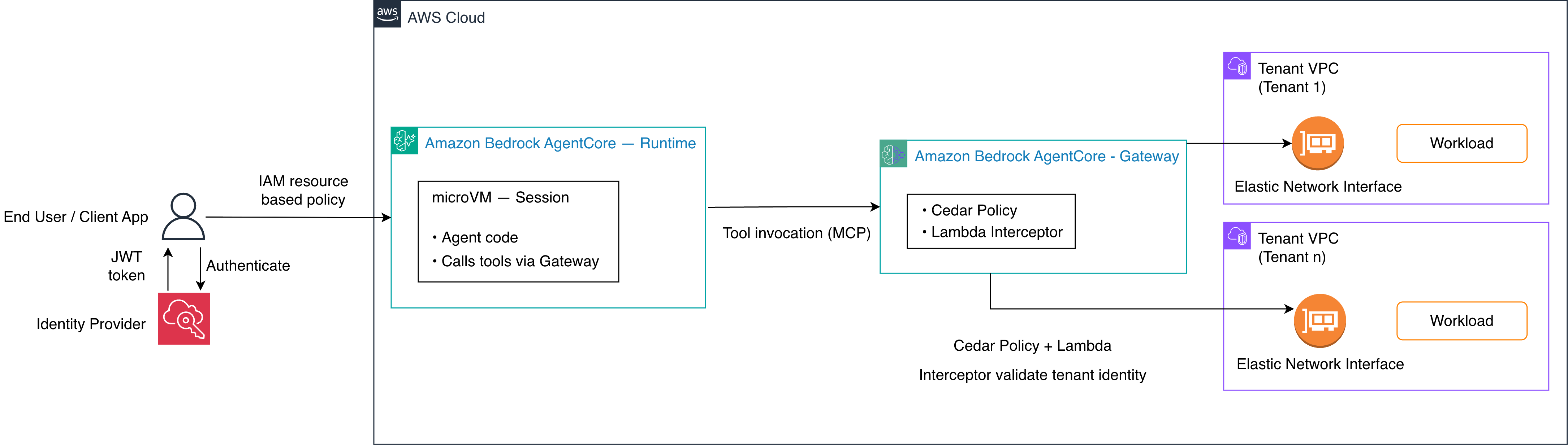
図 1:単一の共有ランタイムと JWT ベースのテナントルーティングを用いたプールモデル
メリット
- 運用の簡素化:デプロイ、監視、更新の対象となるランタイムは 1 つのみで済みます。
- 迅速なオンボーディング:新規顧客はインフラを準備する必要なく即座に利用開始でき、価値提供までの時間を短縮できます。
デメリット
- アプリケーション依存の分離:テナント間の分離は、完全にアプリケーションコードに依存します。
- 均質なデプロイ:テナントごとのカスタマイズには、追加の条件分岐ロジックが必要になります。
オプション 2:ブリッジ方式 — 共有ランタイムにゲートウェイによるツール隔離を追加
ハイブリッドアプローチでは、単一の共有ランタイムが持つ運用の簡便さと、AgentCore Gateway を通じたツール層でのインフラレベルのテナント分離を組み合わせます。テナントは 1 つのランタイムを共有しますが、すべての外部ツール呼び出しは、ツールのコードを実行する前にテナント境界を強制する Gateway を経由します。
仕組み
テナントは同じ AgentCore ランタイムに接続し、セッションごとに専用のマイクロ VM を使用して計算リソースを隔離します。これは「オプション 1」と同じです。異なる点は、すべてのツール呼び出しが共有の AgentCore Gateway を経由し、2 つの強制メカニズムを持つ点です。
- Amazon Bedrock AgentCore でのポリシー – 決定論的なアクセス制御。Cedar ルールは、各ツール呼び出しを呼び出し元のアイデンティティ属性(例:Cognito グループクレーム)に対して評価し、許可または拒否の判断を下します。特定のテナントグループが制限されたツールを呼び出すことを防ぐ「forbid」ルールも設定可能です。
- AWS Lambda Interceptor (REQUEST) – 動的な検証とコンテキストの拡張。ツールの呼び出しがターゲットに到達する前に実行され、JWT を抽出してテナントコンテキストを検索し、STS AssumeRole("act-on-behalf" パターン)を通じてトークンを短期間でテナントスコープ付きの IAM クレデンシャルへ交換します。下流のツールは、元の JWT ではなく、最小権限を持つこれらのクレデンシャルを受け取ります。
Gateway は Cedar ポリシーを評価する *前に* インターセプターを評価し、インターセプターがリクエストコンテキストを拡張した上で、ポリシーがその内容を評価します。
レスポンスインターセプターでは、テナントIDに基づいてツールの検出をフィルタリングすることも可能です。
これは、エージェントコードの外側でインフラストラクチャ層において、2 つの独立したメカニズムがテナント分離を強制していることを意味します。
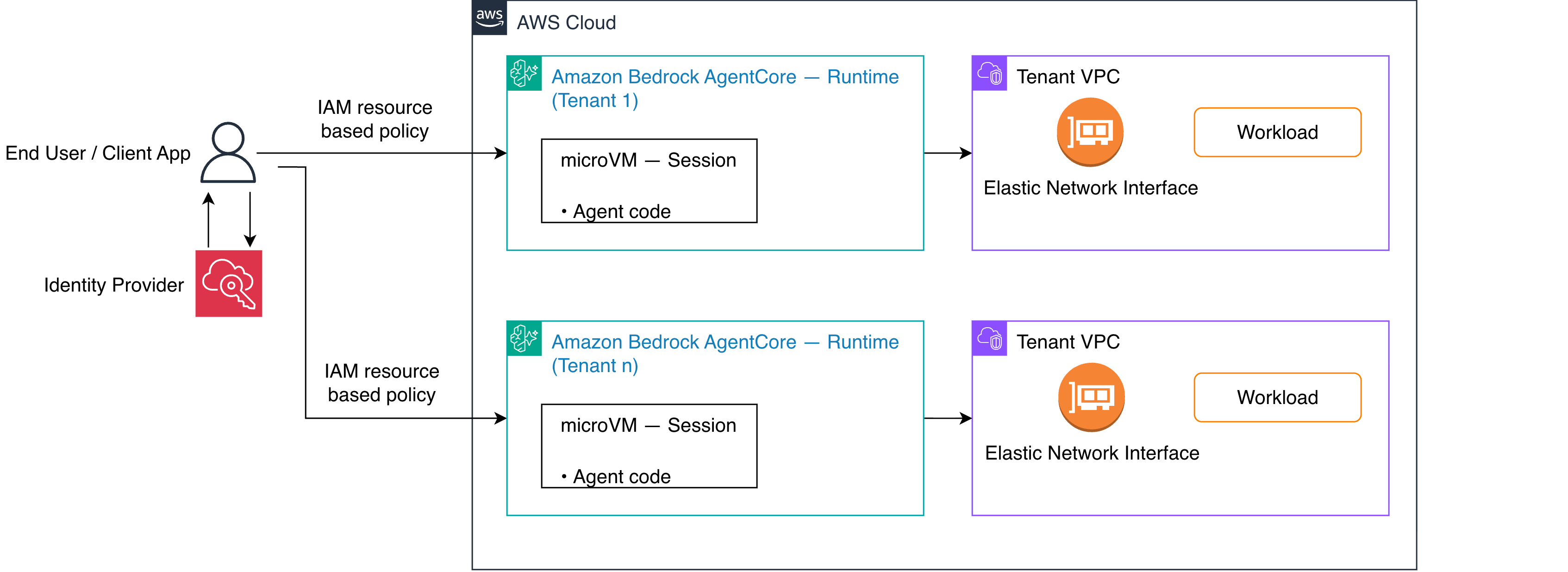
図 2:共有ランタイムとゲートウェイによるツール分離を備えたブリッジモデル
メリット
- 階層的なインフラストラクチャの強制: エージェントコードにルーティングバグがあったとしても、ゲートウェイがテナント間でのツール呼び出しをブロックします。決定論的な Cedar ポリシーと動的な Lambda インターセプターにより、多層防御を実現しています。
- 集中管理によるガバナンス: すべてのツール呼び出しに対してテナントポリシーを検証・監査する単一のゲートウェイが存在し、すべての意思決定は Amazon CloudWatch にログとして記録されます。
- 共有による効率化: ランタイム、ナレッジベース、観測インフラストラクチャを中央で管理しながらも、セキュリティリスクを共有することはありません。
デメリット
- セットアップの複雑さ: ゲートウェイの設定、リクエスト/レスポンスインターセプター用 Lambda の構築、テナントマッピング、Cedar ポリシー、STS ロール信頼関係の設定が必要です。これはオプション 1 や 3 に比べて、管理すべき要素が大幅に増加します。
- VPC 接続の問題: バックエンドのツールは通常 VPC 内に存在するため、プライベートなゲートウェイ接続には VPC エンドポイントが必要となり、ネットワークの複雑さが増し、潜在的な障害点も生じます。
オプション 3: シロ(テナントごとの専用ランタイム)
サイロモデルでは、各テナントは専用の AgentCore ランタイム上で動作します。アクセス制御は AWS Identity and Access Management (IAM) によって完全に実施されます。ランタイムとそのエンドポイントの両方に設定されたリソースベースのポリシーにより、同じアカウント内のロールや他アカウントからのアイデンティティなど、どのプリンシパルがエージェントを呼び出せるかが決定されます。各テナントのワークロードは別々のインフラ上で実行されるため、テナント間で計算リソースが共有されることはありません。
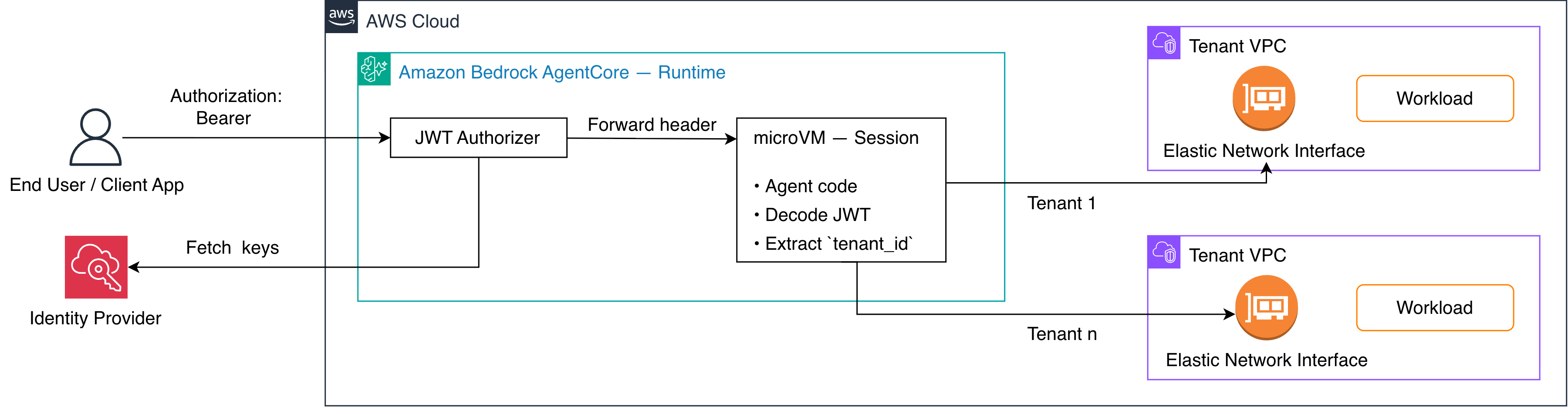
図 3: テナントごとに専用ランタイムを備えたサイロモデル
仕組み
各テナントには、新しい顧客がオンボーディングされた際に AWS CloudFormation や CDK を使って自動的にプロビジョニングされる専用の AgentCore ランタイムが付与されます。このランタイム内では、各ユーザーセッションは独立したマイクロ VM で実行され、同じテナント内のユーザー間であってもプロセス状態は一切共有されません。アクセス制御は、AgentCore ランタイムとそのエンドポイントに紐付けられた IAM のリソースベースポリシーによって実施されます。呼び出し元には、自テナントの特定のランタイムに対する明示的な権限が必要です。
利点
- 最大限の分離: テナントごとに専用の計算リソースが割り当てられ、プロセス状態は共有されません。各セッションは独立したマイクロ VM で実行されるため、テナント同士が互いのインフラにアクセスすることはできません。
シンプルな認可モデル:IAM のリソースベースポリシーを、ランタイムとそのエンドポイントの両方に適用するだけで、これが唯一の強制ポイントとなります。アプリケーションレベルでのルーティングロジックは不要です。
独立した設定:各ランタイムは、他のテナントに影響を与えることなく、異なるエージェントバージョンやモデル、エンドポイント構成を実行できます。
欠点
- スケーラビリティの制限:デフォルトのクォータは AWS アカウントあたり 1,000 エージェントです(Service Quotas を通じて調整可能)。大規模な顧客基盤に対応するには、容量計画が不可欠となります。
- プロビジョニングの遅延:新しいテナントごとに専用のランタイムとエンドポイントを作成する必要があり、共有型ランタイムモデルと比較してオンボーディングに時間がかかります。
- 運用オーバーヘッド:数百ものランタイムの監視、更新、管理は運用上の複雑さを増大させます。これに対処するには、CDK や CloudFormation パイプラインによる堅牢な自動化や、集約された観測性(observability)が求められます。
ソリューション概要
Axonius は現在、サイロ化されたモードで稼働しており、エージェントを追加する際にもこのアプローチを継続しています。各顧客には専用のエージェントが割り当てられています。Axonius は Amazon Bedrock と AgentCore を活用し、以下の主要コンポーネントを持つマルチテナント型エージェント AI アーキテクチャを設計しました。
- AgentCore ランタイム:Axonius は各顧客のために専用エージェントを展開します。各ユーザーセッションは、AgentCore ランタイム上で動作する隔離されたマイクロ VM で実行されます。
- Amazon Elastic Container Registry (Amazon ECR):テナントごとのエージェントコンテナイメージを保存します。
Amazon Bedrock は、基盤となるファウンデーションモデル(FMs)を駆動し、コスト配分のために IAM ロールタグを活用します。
Amazon Bedrock Knowledge Bases (KB) では、Axonius がコスト効率とスケーラビリティの高さを理由に採用しています。S3 ベクトルとの連携により、メタデータフィルタリングでテナントごとのデータを厳密に分離しています。
Amazon Bedrock Guardrails は、コンテンツのフィルタリングやトピック拒否ポリシーを提供します。すべてのモデル応答に対して適用され、ユーザーへ共有される前に安全性と範囲内であることを保証します。
Amazon CloudWatch は全体のワークロードを監視し、コスト管理に不可欠な役割を果たしています。トークン消費量(入力・出力)を追跡し、アラートを発行。IAM による拒否ポリシーでコストガバナンスを実現します。顧客がトークン予算を超えた場合、自動的に IAM ポリシーが発動して追加の呼び出しをブロックします。
Amazon VPC Lattice は、Axonius が AgentCore ランタイム、顧客の VPC、AWS サービスエンドポイントを接続する際のコスト効率の高いプライベート接続を可能にします。
このアーキテクチャでは AWS CloudFormation を活用し、顧客ごとのプロビジョニングとテardown を自動化。これにより、Axonius は顧客ベース全体でエージェント展開をスケーリングできます。
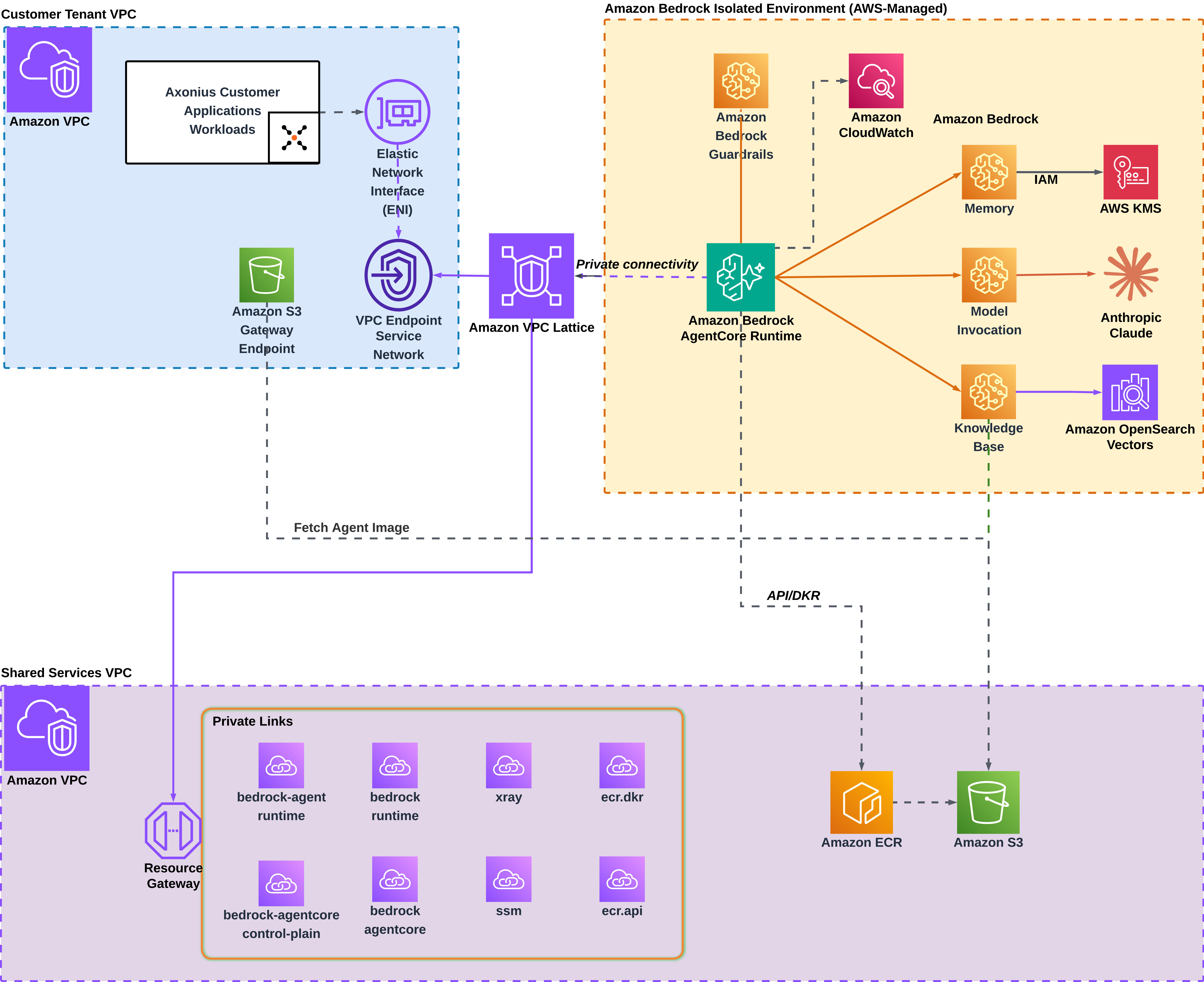
図 4: Amazon Bedrock AgentCore 上の Axonius マルチテナント・エージェントアーキテクチャ
なぜ Amazon Bedrock AgentCore ランタイムなのか?
Axonius は、既存の EC2 インスタンス内に追加コンテナとしてエージェントを実行するなどの複数のアプローチを検討した結果、Amazon Bedrock AgentCore ランタイムを採用しました。このランタイムは、多テナント型 SaaS の要件に直接対応するように設計された機能を提供しています。
- マイクロ VM によるセッションの分離 – AgentCore ランタイムのセッション分離機能が決定打となりました。各ユーザーセッションは、CPU、メモリ、ファイルシステムのリソースが完全に隔離された *専用マイクロ VM* で実行されます。セッション完了後は、該当するマイクロ VM がすべて終了され、メモリも消去処理されます。この予測可能なセキュリティモデルは、Axonius にとって極めて重要でした。同社では、機密性の高いサイバーセキュリティ資産インベントリを含む各顧客のデータが、完全に隔離された状態で保持される必要があるからです。
- フレームワークの柔軟性と VPC 統合 – AgentCore ランタイムはフレームワークに依存しない設計となっているため、Axonius は好みのツールリングを使用してエージェントをデプロイしつつ、既存の VPC インフラストラクチャと安全に接続できます。各エージェントは ENI を経由して顧客の VPC に接続し、隔離された EC2 インスタンス内で動作する Axonius アプリケーション API と直接やり取りすることが可能です。
- 組み込みの観測機能 – 組み込まれた観測機能により、Axonius は独自に監視インフラを構築することなく必要な可視性を確保できました。具体的には、ログ記録のための CloudWatch 統合、分散トレーシング用の AWS X-Ray、そして推論ステップやツール呼び出しをキャプチャするエージェント固有のトレーシングが含まれています。
ユーザーセッションフロー
各顧客は、独自の VPC 内に設けられた専用ワークロード上で Axonius のデプロイメントを個別に運用しています。さらに、すべての顧客には専用の AgentCore ランタイムが割り当てられています。これは、Claude と対話して推論を行い、Amazon Bedrock Knowledge Base から製品知識を取得し、顧客自身の Axonius API を参照してデータに関する質問に答えるための、顧客ごとのエージェントです。
顧客はチャットボックスを通じて質問を入力できます。以下では、顧客からの一例の質問——「先週と比較して資産数に大きな変更はありますか?」——がどのように処理されるかを追跡します。
認証:ユーザーはすでに自身のインスタンス上で Axonius にログイン済みです。チャットメッセージを送信すると、Axonius アプリケーションがリクエストを認証し、ユーザーの ID、テナント ID、セッション ID、アクター ID を含む、短期間のインパーソネーション JWT を発行します。このトークンは静的な資格情報ではなく、以降のすべての処理を権限付与する役割を果たします。
ランタイムの呼び出し:Axonius アプリケーションのコントロールプレーンが呼び出しペイロードを組み立て、顧客専用の AgentCore ランタイムに対して InvokeAgentRuntime を実行します。このペイロードにはテナント設定のみが含まれます。具体的には、AgentCore のメモリ ID、Knowledge Base とデータソースの ID、AWS リージョン、現在の Axonius バージョン、および顧客自身のインスタンスへのコールバックアドレスです。
JWT は本文ではなく、カスタムの AgentCore ヘッダーを介して渡されます。これにより、認証情報がエージェントの保存状態に記録されるのを防ぎます。また、セッション ID とアクター ID によって、呼び出しが特定のユーザーの会話に限定されます。
専用で隔離されたランタイム: 各顧客には独立した AgentCore ランタイムが用意され、そのランタイムは顧客自身の VPC およびサブネット内に配置された専用弹性ネットワークインターフェース(ENI)に接続されます。AgentCore は隔離されたセッションを作成し、JWT を再度検証します。
原文を表示
Independent Software Vendors (ISVs) are expanding their offerings and adding AI agents. Common considerations for organizations when adding agentic workloads include security, scalability, time to market, and cost tracking. ISVs have another dimension, they provide services to other organizations and need to manage agentic workloads for each customer. As such, ISVs need to manage those common challenges not only broadly but at the tenant level.
Axonius is the asset intelligence platform that helps Security and IT teams prioritize risks and coordinate fixes. By reconciling data from over 1,400 systems into one authoritative source of truth, Axonius enables security teams and the teams they support to collaborate effectively, reducing the manual burden of security, audit, and compliance by up to 50%. Axonius runs its software as a service (SaaS) infrastructure on AWS, managing hundreds of isolated customer environments.
Amazon Bedrock AgentCore is a platform to build, connect, and optimize agents at scale, with any framework or model. In this post, we cover strategies available for SaaS providers to deploy AI agents, describe how Amazon Bedrock AgentCore supports those options, look into Axonius’s considerations, and share Axonius’s chosen architecture. We also describe how Axonius integrated agentic workloads with its existing methodology. This post is for platform engineers and architects building secure, multi-tenant AI agent deployments on AWS.
Multi-tenancy patterns for AI agents
Independent Software Vendors (ISVs) tend to provide services using the SaaS model. When choosing an architecture, ISVs have three common architectural patterns: silo, bridge, and pool. The following sections elaborate on what each model means when we look into agentic AI with Amazon Bedrock AgentCore.
The *silo model* refers to an architecture where tenants are provided dedicated resources. Looking into AgentCore runtime, it means using a dedicated agent per tenant. With the *pool model*, tenants share resources, one agent serves multiple tenants. With AgentCore runtim, you can isolate each user session by allocating a unique session ID for each user session. The third pattern is the *bridge model* in which some components are in silo mode while others are in pool mode. For example, we can have a dedicated agent deployed into AgentCore runtime using shared Amazon Bedrock Knowledge Bases, an AWS managed Retrieval Augmented Generation (RAG) service.
The challenge
Axonius was looking to add AI agents to their offering. Their first AI agent interprets the state of large enterprise environments and identifies gaps and risks, using AI to analyze and make sense of millions of data points from dozens of concurrent integration sources. This initiative allows junior analysts to run complex analyses without tying up senior analysts in hours of manual work. Axonius opted to maintain their current tenant management methodology.
Axonius’s SaaS deployment model is silo. Each customer workload resides in a dedicated Amazon Virtual Private Cloud (Amazon VPC). The VPC contains an Application Load Balancer (ALB), Network Load Balancer (NLB), databases, and general compute infrastructure.
Axonius wanted to introduce AI agents while keeping a silo deployment model. Axonius needed to address several key requirements:
- Tenant isolation – Axonius handles sensitive customer data. An agent serving one customer must be scoped exclusively to that customer’s data.
- Identity – The existing service has an authentication and authorization module in place, residing on the Amazon Elastic Compute Cloud (Amazon EC2) allocated to the tenant. Axonius needed to integrate the agent’s identity flow with the existing module without disruption.
- Cost tracking – Agentic costs can spiral. Most of the cost is in model invocation, thus it’s critical to track model cost per tenant. Knowing your cost is essential when considering pricing options for agentic offerings.
- Integration with the service – The agent instance associated with a tenant needs to have secure access to that tenant workload’s APIs.
- Lifecycle management – Adding the agentic workload to the current silo Continuous Delivery (CD) workflow.
- Observability – With a silo model, Axonius will have a large number of agents. The DevOps team needed high quality, straightforward to integrate observability that can track large fleets of agents, issue alarms when things go wrong, and provide tracing capabilities to debug issues.
The following sections cover the options Axonius evaluated and what they chose.
Possible solutions
Looking into tenant deployment modes, Axonius considered the following options.
Option 1: Pool — shared runtime with JWT-based tenant routing
AgentCore runtime enforces structural separation by allocating a dedicated microVM for each session. A single runtime serves tenants while maintaining full tenant separation through application-level controls.
How it works
Tenants authenticate through an OAuth 2.0 identity provider (for example, Amazon Cognito) with JWTs carrying a unique tenant claim (for example, custom:tenant_id). The runtime’s built-in JWT authorizer uses the configured discovery URL to fetch public keys and validate the token’s issuer. The agent code then reads the claim to route tool calls and data access to the correct tenant environment.
Figure 1: Pool model with a single shared runtime and JWT-based tenant routing
Advantages
- Operational simplicity: Only one runtime to deploy, monitor, and update.
- Rapid onboarding: New customers onboard immediately without infrastructure provisioning, reducing time-to-value.
Disadvantages
- Application-dependent isolation: Tenant separation relies entirely on application code.
- Homogeneous deployment: Per-tenant customization requires additional conditional logic.
Option 2: Bridge — shared runtime plus gateway-enforced tool isolation
A hybrid approach combines the operational simplicity of a single shared Runtime with infrastructure-level tenant enforcement at the tool layer through AgentCore Gateway. Tenants share one Runtime, but every outbound tool call passes through a Gateway that enforces tenant boundaries before the tool code executes.
How it works
Tenants connect to the same AgentCore runtime, which uses dedicated microVMs per session for compute isolation, identical to Option 1. The difference is that every tool invocation routes through a shared AgentCore Gateway with two enforcement mechanisms:
- Policy in Amazon Bedrock AgentCore – Deterministic access control. Cedar rules evaluate each tool call against the caller’s identity attributes (for example, Cognito group claims) and produce an allow/deny decision. A forbid rule can block specific tenant groups from invoking restricted tools.
- AWS Lambda Interceptor (REQUEST) – Dynamic validation and context enrichment. Runs before the tool call reaches the target extracts the JWT, looks up tenant context, and exchanges the token for short-lived, tenant-scoped IAM credentials through STS AssumeRole (“act-on-behalf” pattern). The downstream tool receives these least-privilege credentials instead of the original JWT.
The Gateway evaluates the interceptor *before* the Cedar policy, enabling the interceptor to enrich the request context that the policy then evaluates.
A RESPONSE interceptor can additionally filter tool discovery based on tenant identity.
This means two independent mechanisms enforce tenant isolation at the infrastructure layer, outside agent code.
Figure 2: Bridge model with a shared runtime and gateway-enforced tool isolation
Advantages
- Layered infrastructure enforcement: Even if the agent code has a routing bug, the Gateway blocks cross-tenant tool calls. Cedar policy (deterministic) and a Lambda interceptor (dynamic) provide defense in depth.
- Centralized governance: A single Gateway to audit and enforce tenant policies across all tool invocations, with every decision logged to Amazon CloudWatch.
- Shared efficiency: Runtime, knowledge bases, and observability infrastructure are managed centrally without sharing security risk.
Disadvantages
- Setup complexity: Requires configuring a Gateway, REQUEST/RESPONSE interceptor Lambdas, tenant mappings, Cedar policies, and STS role trust relationships. This adds significantly more moving parts than Option 1 or 3.
- VPC connectivity: Backend tools typically reside in a VPC, requiring VPC endpoints for private Gateway connectivity, which adds networking complexity and potential points of failure.
Option 3: Silo — dedicated runtime per tenant
In the silo model, every tenant operates on a dedicated AgentCore runtime. Access control is enforced entirely through AWS Identity and Access Management (IAM). Resource-based policies on both the Runtime and its endpoint determine which principals, whether same-account roles or cross-account identities, are allowed to invoke the agent. Because each tenant’s workload runs on separate infrastructure, there is no shared compute between tenants.
Figure 3: Silo model with a dedicated runtime per tenant
How it works
Each tenant gets a dedicated AgentCore runtime, provisioned automatically (for example, with AWS CloudFormation or CDK) when a new customer is onboarded. Within that runtime, each user session runs in its own isolated microVM, so no process state is shared even between users of the same tenant. Access control is enforced through IAM resource-based policies attached to both the AgentCore runtime and its endpoint. The caller must hold explicit permission for their tenant’s specific runtime.
Advantages
- Maximum isolation: Dedicated compute per tenant with no shared process state. Each session runs in its own microVM, and tenants cannot reach each other’s infrastructure.
- Simple authorization model: IAM resource-based policies, applied to both the Runtime and its endpoint, are the sole enforcement point. No application-level routing logic required.
- Independent configuration: Each runtime can run a different agent version, model, or endpoint configuration without affecting other tenants.
Disadvantages
- Scale limitations: The default quota is 1,000 agents per AWS account (adjustable through Service Quotas), which requires capacity planning for large customer bases.
- Provisioning latency: Each new tenant requires creating a dedicated Runtime and endpoint, introducing onboarding delays compared to a shared-runtime model.
- Operational overhead: Monitoring, updating, and managing hundreds of runtimes adds operational complexity that demands robust automation (for example, CDK/CloudFormation pipelines, centralized observability).
Solution overview
Axonius operates today in a siloed mode and chooses to continue with that approach when adding agents. Each customer has a dedicated agent. Axonius designed a multi-tenant agentic AI architecture using Amazon Bedrock and AgentCore with the following key components:
- AgentCore runtime – Axonius deploys a dedicated agent for each customer, and each user session runs on an isolated microVM, using AgentCore runtime.
- Amazon Elastic Container Registry (Amazon ECR) – Stores per-tenant agent container images.
- Amazon Bedrock – Powers the underlying foundation models (FMs), with IAM role tagging for cost allocation.
- Amazon Bedrock Knowledge Bases (KB) – Axonius uses Amazon Bedrock Knowledge Bases (KB) with Amazon S3 Vectors because of their cost efficiency and ability to scale. Axonius uses metadata filtering to isolate tenant-specific data.
- Amazon Bedrock Guardrails – Provides content filtering and topic denial policies. Guardrails are applied to every model response, keeping responses safe and in scope before they are shared with the user.
- Amazon CloudWatch – Monitors the overall workload and is instrumental in cost control. It tracks token consumption metrics (input/output), issuing alerts and using IAM-deny enforcement for cost governance. If a customer exceeds their token budget, an automated IAM policy blocks further invocations.
- Amazon VPC Lattice – Allows Axonius to manage cost-efficient private connectivity, connecting AgentCore runtime, customer VPCs, and AWS service endpoints.
The architecture uses AWS CloudFormation for automated per-customer provisioning and teardown, allowing Axonius to scale agent deployments across their customer base.
Figure 4: Axonius multi-tenant agentic architecture on Amazon Bedrock AgentCore
Why Amazon Bedrock AgentCore runtime?
After evaluating multiple approaches, including running agents as additional containers within their existing EC2 instances, Axonius chose Amazon Bedrock AgentCore runtime. Its purpose-built capabilities directly addressed their multi-tenant SaaS requirements.
- Session isolation with microVMs – AgentCore runtime’s session isolation was the decisive factor. Each user session runs in a dedicated microVM with isolated CPU, memory, and filesystem resources. After session completion, the entire microVM is terminated and memory is sanitized. This deterministic security model was critical for Axonius, where each customer’s data, including sensitive cybersecurity asset inventories, must remain completely isolated.
- Framework flexibility and VPC integration – AgentCore runtime’s framework-agnostic design allowed Axonius to deploy agents using their preferred tooling while connecting securely to their existing VPC infrastructure. Each agent connects through an ENI to the customer’s VPC, allowing direct interaction with the Axonius application APIs running inside the isolated EC2 instances.
- Built-in observability – The built-in observability capabilities gave Axonius the visibility they needed without building custom monitoring infrastructure. These capabilities include CloudWatch integration for logging, AWS X-Ray for distributed tracing, and agent-specific tracing that captures reasoning steps and tool invocations.
User session flow
Each customer runs their own Axonius deployment on a dedicated workload inside their own VPC. Every customer also gets a dedicated AgentCore runtime: a per-customer agent that reasons with Claude, pulls product knowledge from an Amazon Bedrock Knowledge Base, and reaches back into that customer’s Axonius API to answer data questions. Customers have a chat box that allows them to write questions. The following flow traces a customer question, for example, *“Are there any major changes in my asset count compared to last week?*”
- Authentication: The user is already signed in to Axonius on their own instance. When they send a chat message, the Axonius application authenticates the request and mints a short-lived impersonation JWT carrying the user’s identity, tenant ID, session ID, and actor ID. This token, rather than a static credential, authorizes everything downstream.
- Runtime invocation: The Axonius application control plane assembles the invocation payload and calls InvokeAgentRuntime on the customer’s dedicated AgentCore runtime. The payload carries only tenant configuration: the AgentCore Memory ID, Knowledge Base and data-source IDs, AWS Region, current Axonius version, and the callback address for the customer’s own instance. The JWT rides in a custom AgentCore header rather than in the body, so authentication material does not land in the agent’s saved state, and the session and actor IDs scope the call to one user’s conversation.
Dedicated, isolated runtime: Each customer has its own AgentCore runtime, and that runtime is attached to a dedicated elastic network interface (ENI) placed inside the customer’s own VPC and subnet. AgentCore creates an isolated session, validates the JWT back agai
今日のまとめ
AIデイリーブリーフで今日の重要ニュースをまとめ読み