JetBrains、コーディングエージェント向けリポジトリ知能層「Context」を早期アクセス公開
本文の状態
日本語全文を表示中
詳細モードで約8分の本文を読めます。
同じ出来事の情報源
この情報源を基点に整理
JetBrains AI Blog
JetBrains はコーディングエージェントの効率向上と高品質な成果実現を目的とした「Repository Intelligence」機能「Context」を発表し、既存の AI サブスクリプションに無料で追加された。
AI深層分析を開く2026年8月4日 17:10
AI深層分析
キーポイント
新機能「Context」の発表
複雑なコードベースでコーディングエージェントが効率的に動作し、高品質な結果を生み出すためのリポジトリインテリジェンス層として「JetBrains Context」が導入された。
既存エコシステムとの統合
Claude Code、Codex CLI、Junie CLI に対応し、JetBrains IDE、Air、VS Code などを含む複数のエディタから利用可能となった。
エンタープライズ規模への対応
大規模コードベースにおける暗黙の組織知識や実装パターンを理解させることで、エージェントが限られたトークンで効果的に作業できるようにする必要があると指摘している。
AI 利用の成熟段階への移行
AI 出力に対する期待が高まり、「ハネムーン期」が終わった今、開発者はコスト効率や ROI を重視した実用的な AI 活用を求めている。
コード探索のボトルネック解消と多リポジトリ検索
従来のファイル検索や読み取りに費やす時間を削減し、組織全体のコードベースから関連するコードを検索・再利用可能にする。
重要な引用
"We've spent decades helping developers get up to speed in complex codebases. It turns out AI agents need much of the same help when they're working in an unfamiliar project."
The demand for AI ROI translates to shortened timelines for teams and emerging AI quotas.
The less time agents spend exploring repositories, the more time they can spend on the task at hand.
Across these benchmarks, JetBrains Context reduced agent turns by up to 68%, latency by up to 59%, and execution cost by up to 48%.
編集コメントを表示
編集コメント
JetBrains が開発者向けツールとしての長年の知見を AI エージェントの文脈理解に応用した点は、実務的な価値が高い。大規模プロジェクトにおけるエージェントの信頼性を高めるための重要なステップと言える。
Source Article
元記事を日本語で読む
本文に関係しない購読案内、埋め込み通知、サイト内プロモーションは除いています。
本日、JetBrains Context の公開を開始します。これは複雑なコードベースにおいてコーディングエージェントの効率を高め、より高品質な成果を生み出すための新しいリポジトリインテリジェンス層です。
JetBrains AI for Teams および Organizations の展開の一環として、JetBrains Context は現在、早期アクセスプログラムで提供されています。追加費用はかからず、既存の JetBrains AI サブスクリプションに含まれています。Claude Code、Codex CLI、Junie CLI と連携可能で、JetBrains IDE や Air、VS Code、その他の対応エディタからも利用できます。
JetBrains はこれまで、最も複雑なコードベースを扱う際にも開発者の生産性を高めることに注力してきました。従来は、自動補完やコード解析、ナビゲーションといったインテリジェント機能の提供がその手段でした。今日、私たちは同じ生産性の向上を AI エージェントにも広げます。エージェントがコードを記述し、検証し、レビューする際に必要なリポジトリインテリジェンスを提供することで実現します。
「私たちは長年にわたり、開発者が複雑なコードベースに迅速に適応できるよう支援してきました。AI エージェントも、見知らぬプロジェクトで作業する際には、同様のサポートを必要とすることがわかりました。」

Vlad Tankov
JetBrains Agent Systems 最高技術責任者
大規模なエンタープライズコードベースにおいて、文脈(コンテキスト)は不可欠です。これが、手作業での精査と再作業を必要とする中途半端な結果と、コードベースや API、依存関係、実装パターン、エンジニアリングの慣習を理解した効率的なエージェントコーディングとの差を生みます。
開発者と同様に、エージェントには小規模な概念実証(PoC)プロジェクトでは過度な手ほどきはいりませんが、大規模なコードベースで効果的に作業するために、追加的な文脈が必要です。それは、暗黙のうちに組織に根付いた知識や洞察です。
エージェントを取り巻く新たな現実
文脈への投資は、開発者がエージェントのスキルを向上させる必要性が高まっている現状を反映しています。かつて開発者は、AI が生成する出力であればほぼ何でも満足していましたが、今では「ハネムーン期」が終わり、状況はより複雑化しています。
開発者に求められる期待値は高まり、AI の利用範囲も拡大しています。これは、新たな要件を満たそうとする開発者たちの努力によるものです。AI からの投資対効果(ROI)への要求は、チームのタイムライン短縮や、新たに設定される AI の利用枠(クォータ)を意味します。つまり、トップモデルを使ってトークンを無尽蔵に消費し、 brute-force で問題を解決する手法にはもはや頼れなくなりました。
現実の要請は、エージェントが獲得した新たな超能力に急速に追いつきつつあります。
かつては単なる手間だったものが、今やボトルネックになりつつあります。問題解決や機能開発のタスクの多くでは、エージェントが現在の状態を理解したり、計画した変更の参考を得たりするために、広範なコード探索を行う必要があります。実際には、検索を実行し、探索用エージェントを起動し、ファイルを読み込むといった作業が発生しますが、これらは時間とトークンを消費しがちです。
たとえ現在最も能力の高いモデルを用いたとしても、コンテキストの制限やリポジトリへの可視性の不足により、適切なコードの発見、実装例の特定、再利用可能な既存パターンの識別が妨げられることがあります。結果は明白です。エージェントがリポジトリを探索する時間が少なければ少ないほど、そのタスクに集中できる時間は増えます。これが JetBrains Context が解決しようとしている課題です。
JetBrains Context とは何か
JetBrains Context は、Claude Agent、OpenAI Codex、JetBrains Junie といったコーディングエージェント向けのリポジトリインテリジェンスレイヤーです。リポジトリのセマンティック(意味的)なインデックスを逐次的に構築し、セマンティック検索を提供することで、エージェントが関連するリポジトリ知識にアクセスできるようにします。これにより、キーワード検索やファイルの繰り返し探索に頼る必要がなくなります。エージェントは直接質問したり、関連用語や概念を検索したりすることが可能になります。
この仕組みを実現するために、私たちは主に 2 つのコンポーネントを利用しています。1 つ目はリポジトリを逐次的にインデックス化するバックエンド、もう 1 つ目はエージェントがそのデータを照会できるセマンティック検索ツールです。
注力して展開している重要な機能の一つが、複数リポジトリの検索です。従来の「現在のリポジトリ内のみ」という制限を超え、エージェントは組織全体のコードベースから関連するコードを発見できるようになります。ローカルにチェックアウトされていないリポジトリに含まれるコードも対象となります。
これにより、API や依存関係の検証、変更が及ぼす影響の把握、遠隔プロジェクトにおける再利用可能なコードの検索が可能になり、結果としてコード品質の維持、無駄な作業の回避、そしてコードベース全体におけるアーキテクチャへの準拠率向上につながります。
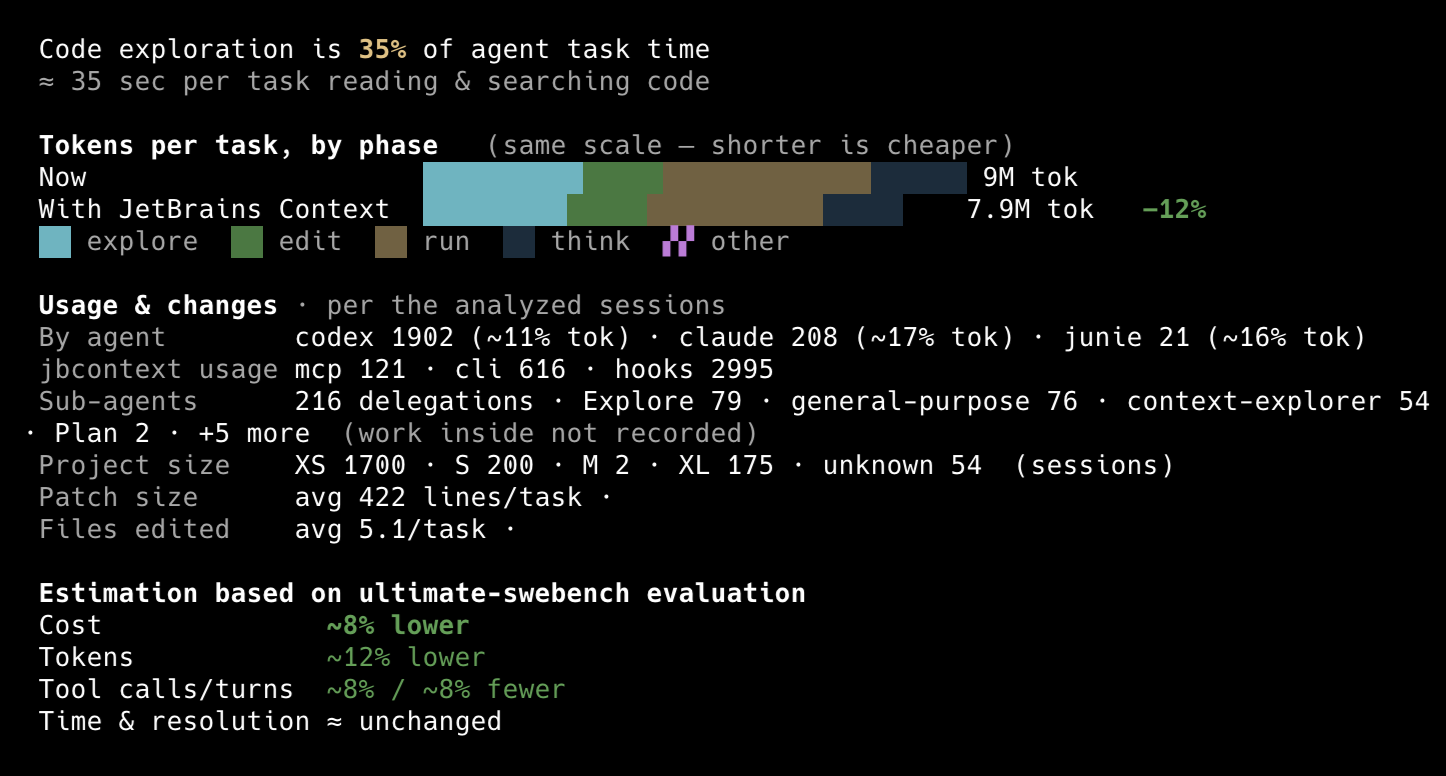 imagejbcontext analyze ツールの出力例
実効性はテストで証明されるものです
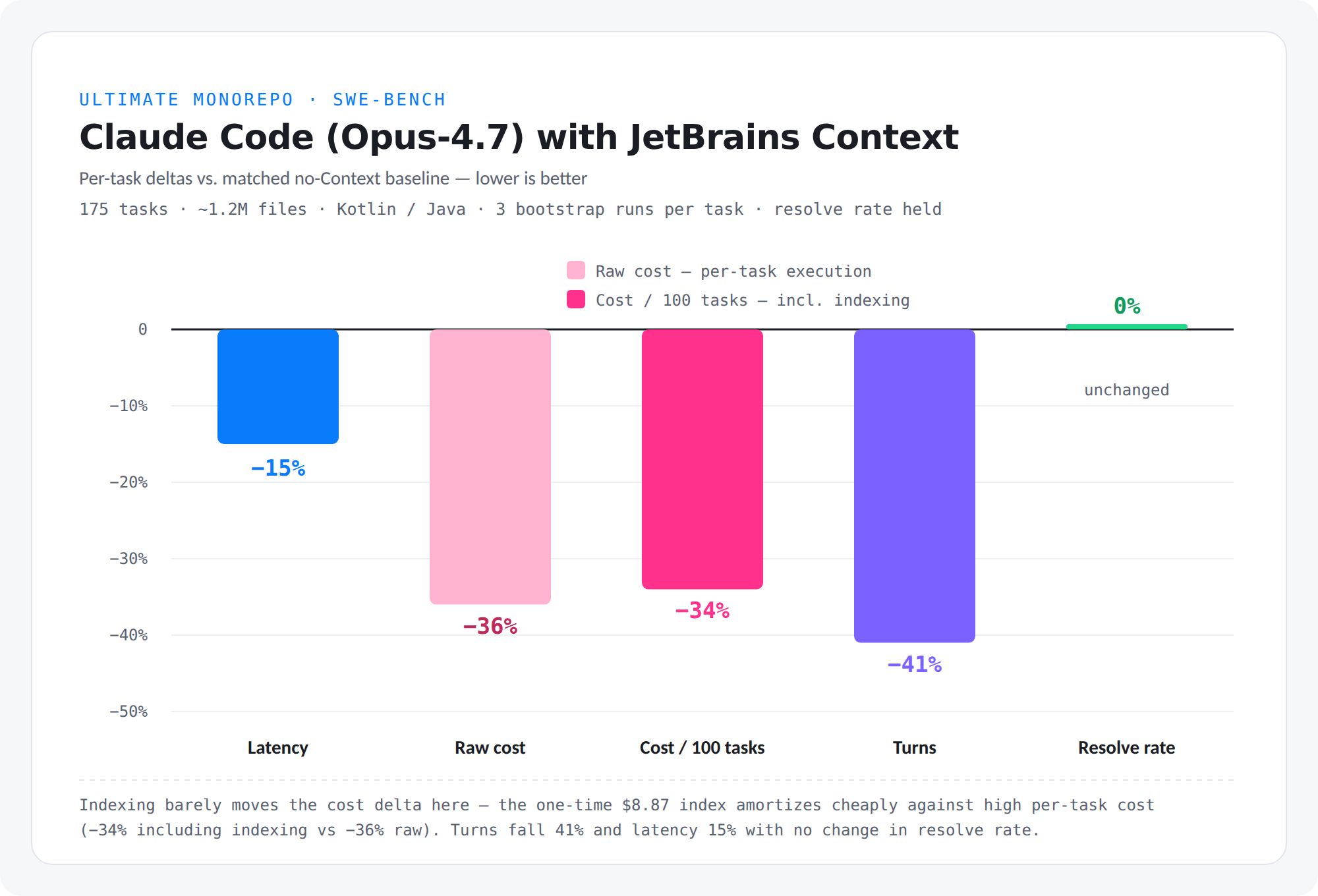
JetBrains Context の検証には、205 のオープンソース SWE-bench タスク、175 のプロダクション向けモノレポタスク、そして 1,953 のコードローカライゼーションタスクを実施しました。これらのベンチマーク全体を通じて、エージェントのターン数を最大 68%、レイテンシを最大 59%、実行コストを最大 48% 削減することに成功しています。
AI システムの一貫した測定は容易ではありません。現代のエージェントは本質的に確率的な振る舞いをするため、評価には業界で確立されたベンチマークと大規模なプロダクションリポジトリを採用しました。これらの検証を通じて技術を磨き上げ、大規模コードベースにおける時間、コスト、そしてコード品質に対して劇的な差をもたらすことを自信を持って言えるレベルまで引き上げることができました。
JetBrains Context の早期アクセス版は、すでにサブスクリプションに含まれています。
開始するには、ランディングページに記載された手順に従ってください。
シンプルな GET リクエストで CLI をインストールします。
jbcontext login コマンドを使用して認証を行います。既存の資格情報はそのままで使用可能です。JetBrains AI のライセンスが必要ですが、JetBrains Context によるクォータの使用はありません。
プロジェクトフォルダに移動し、jbcontext setup-agent コマンドを使って、お好みのコーディングエージェント向けに JetBrains Context を設定します。ユーザースコープでグローバルに設定することもできます。
JetBrains Context は、エージェントフックを通じてコードの事前インデックスを自動で行います。あるいは、jbcontext index コマンドを実行して手動で実行することも可能です。ソースコードは JetBrains Context のサーバーには保存されません。
これ以降、通常のコーディング作業を進める際、エージェントが新しいリポジトリインテリジェンス機能を備えていることに気づくはずです。これにより生産性が大幅に向上します。
JetBrains Context を試した結果、その効果について確信が持てない場合は、新しく搭載されたビルトインの分析機能を確認してください。jbcontext analyze を実行すれば、実際のデータに基づいたコスト削減と時間短縮効果が確認できます。
みなさんのご意見をお聞かせください。コメント欄でフィードバックを共有したり、質問をしたり、体験談を語っていただければ幸いです。また、CLI から直接 jbcontext send-feedback コマンドを使用してフィードバックを送ることも可能です。
原文を表示
Today, we’re launching JetBrains Context, a new repository intelligence layer that helps coding agents work more efficiently and produce higher-quality results on complex codebases. As part of the JetBrains AI for Teams and Organizations rollout, JetBrains Context is now available in early access at no additional cost with your JetBrains AI subscription. It integrates with Claude Code, Codex CLI, and Junie CLI, and can be used from JetBrains IDEs, Air, VS Code, and other supported editors.
JetBrains has always focused on making developers more efficient, even when working with the most complex codebases. Historically, that meant providing intelligent features like autocomplete, code analysis, and navigation. Today, we’re extending that same productivity to AI agents by giving them the repository intelligence they need to write, validate, and review code effectively.
“We’ve spent decades helping developers get up to speed in complex codebases. It turns out AI agents need much of the same help when they’re working in an unfamiliar project.”
image
Vlad Tankov
Chief Technology Officer, JetBrains Agent Systems
In enterprise-scale codebases, context is essential. It’s the difference between mediocre results that require painstaking review and rework and efficient agentic coding that understands your codebase, APIs, dependencies, implementation patterns, and engineering conventions.
Just like developers, agents don’t need much hand-holding on small-scale proof-of-concept projects, but they need extra context: the unwritten institutional knowledge and insight that allows them to work effectively with large codebases.
The new reality for agents
Our investment in context echoes a growing need among developers to upskill their agents. Whereas developers used to be satisfied with just about any AI-driven output, now the “honeymoon phase” is ending and things are getting more complicated. The expectations placed on developers are increasing, and the scope of AI usage is growing as developers strive to meet the new requirements. The demand for AI ROI translates to shortened timelines for teams and emerging AI quotas. This means we can no longer spend limitless tokens to brute-force problems with top model crunching. The demands of reality are quickly catching up to the agents’ newfound superpowers.
What was once a mere inconvenience is slowly turning into a bottleneck. Most problem-solving and feature development tasks require agents to perform extensive code exploration to understand the current state or get a reference for the planned changes. In practice this means running searches, spinning up exploration agents, and reading files – activities that often eat up time and tokens. Even with today’s most capable models, limited context and repository visibility can prevent agents from finding the right code, locating good implementation examples, or identifying existing patterns worth reusing. The result is simple: The less time agents spend exploring repositories, the more time they can spend on the task at hand. That’s exactly the problem JetBrains Context was designed to address.
What JetBrains Context is
JetBrains Context is a repository intelligence layer for coding agents such as Claude Agent, OpenAI Codex, and JetBrains Junie. It incrementally builds a semantic index of your repositories and provides semantic retrieval, helping agents access relevant repository knowledge instead of repeatedly searching and reading files. Instead of relying solely on keyword searches and repeated file exploration, it can ask any question directly or look up related terms or concepts. To make that work, we rely on two main components: a backend that incrementally indexes the repo and semantic search tools that allow agents to query that data.
One important capability we’re excited to be rolling out is multi-repo search. Instead of being limited to the current repository, agents can discover relevant code across your organization’s codebase, including repositories that aren’t checked out locally. This helps them validate APIs and dependencies, understand the impact of changes, or locate reusable code in remote projects. The net effect is maintaining a higher bar of code quality, avoiding unnecessary work, and increasing architecture conformity across the codebase.
imageSample output of jbcontext analyze tool
The proof is in the pudding (or, should we say, the testing)
We validated JetBrains Context on 205 open-source SWE-bench tasks, 175 production-monorepo tasks, and 1,953 code-localization tasks. Across these benchmarks, JetBrains Context reduced agent turns by up to 68%, latency by up to 59%, and execution cost by up to 48%.
Measuring AI systems consistently isn’t easy. Modern coding agents are inherently probabilistic, so we designed our evaluation around established industry benchmarks and production-scale repositories. Through evaluations, we managed to improve this technology to the point where we can confidently say it makes a huge difference in time, cost, and code quality for large codebases.
JetBrains Context early access is already included with your subscription!
Follow the instructions on our landing page to get started:
Install the CLI with a simple GET request.
Authenticate using the CLI jbcontext login command. Your credentials will work as-is. A JetBrains AI license is needed, but no quota will be consumed by JetBrains Context.
Navigate to your project folder and set up JetBrains Context for your preferred coding agent using the jbcontext setup-agent command. You might also do it globally in the user scope.
JetBrains Context will pre-index your code automatically by agent hooks, or you can do it explicitly by calling the jbcontext index command. Your source code is not stored on JetBrains Context servers.
From now on, as you go about your normal coding, you’ll see the agent is equipped with new repository intelligence capabilities that make it much more productive.
After trying JetBrains Context out, if you’re unsure about whether it’s helping you or not, you can check out our new built-in analytics! Just hit jbcontext analyze to see cost and time savings based on your real time data.
We’d love to hear what you think. Share your feedback, ask questions, or tell us about your experience in the comments below. You can also use the jbcontext send-feedback command directly from the CLI.
News to Guide
ニュースの次に確認する
発表内容を、現在の料金や仕様と照らし合わせられる関連ガイドです。
今日のまとめ
AIデイリーブリーフで今日の重要ニュースをまとめ読み