Microsoft Research、コンピューター操作エージェント向け環境「Echoverse」を公開
Microsoft Research は、コンピューター使用エージェントの訓練に特化した高忠実度・深層環境「Echoverse」を公開し、9B モデルの実行性能が大幅に向上したことを発表した。
AI深層分析を開く2026年7月31日 02:22
AI深層分析
キーポイント
高忠実度環境の重要性
Microsoft Research は、浅いシミュレーションではエージェントの性能が低下する一方、深層で状態を維持する環境での訓練が不可欠であることを示した。
困難な UI 要素への対応
日付選択やネストされたフィルタなど、特定の制御要素を多様な形式で訓練させることで、モデルは未知のドメインでもこれらの操作が可能になった。
モデルと環境の共進化
モデル、世界(シミュレーション)、検証器の三者を同時に進化させるアプローチが、すべての構成要素の性能向上に寄与したことが確認された。
強化学習による学習深化
grounded verifier を報酬として用いた強化学習により、エージェントは模倣学習を超え、より少ないステップで目標達成を実現するようになった。
学習ループによる環境の共進化
モデルのトレーニングと環境構築を分離せず、失敗箇所に基づいて世界・タスク・検証子を改善する一貫したプロセスを採用する。
重要な引用
High simulation fidelity is a must-have; shallow worlds hurt the agent.
Trained on all twelve, a 9B model nearly doubles its base score (36.5% to 67.1%), coming within fourteen points of GPT-5.4.
Co-evolving the model, the world, and the verifier improves all of them.
Our bet, the one Echoverse tests, is that the real leverage comes less from adding worlds than from a loop that keeps improving the ones you already have.
編集コメントを表示
編集コメント
実世界でのデータ収集が困難な領域におけるエージェント訓練の課題に対し、高忠実度シミュレーションという解決策を提示した点は非常に示唆に富む。特に、特定の UI 要素への集中訓練と共進化アプローチの結果は、次世代の自律型エージェント開発における重要な指針となるだろう。
Source Article
元記事を日本語で読む
本文に関係しない購読案内、埋め込み通知、サイト内プロモーションは除いています。
単なる数の多さではなく、忠実さを重視し、エージェントが実際に欠いている能力に焦点を当て、学習するモデルと共に進化させる。

一目でわかるポイント
私たちはコンピュータ操作を行うエージェント向けのトレーニング用世界を 12 個構築しました。そのうち 10 個は深いドメインに特化したもので、残りの 2 個は特定の能力に焦点を当てたものです。いずれの世界も、日付選択ボックスやネストされたフィルターなど、単一の制御要素を多様な形式で再現しています。重要なのは「深さ」です。これらはアプリケーションの実際の動作を忠実に再現し、現実的なデータで初期化されており、画面間やユーザー間で状態の一貫性を保ちます。
この 12 の世界すべてで学習させた結果、9B パラメータのモデルはベースラインスコア(36.5%)をほぼ倍増させ、67.1% に到達しました。これは GPT-5.4 と比較しても僅か 14 ポイント差です。
この実験から得られた教訓はいくつかあります。
まず、高いシミュレーション忠実度は必須であり、浅い世界ではエージェントの性能が低下します。同じサイトを「浅いバージョン」と「深いバージョン」で学習させたところ、モデルは浅いバージョンでは性能が後退しましたが、深いバージョンでは向上しました。
次に、エージェントは日付選択ボックスやネストされたフィルターといった特定の UI 要素に苦戦することが多いです。これらの制御要素を多様な形式で訓練させることで、モデルはトレーニング時には見たことのないドメインでもそれらを操作できるようになりました。
最後に、モデル、世界、検証器(verifier)を共進化させることが重要です。世界がより正確になり、タスクが難易度を増すにつれて、モデルもそれに伴って成長します。
強化学習は、単なる模倣を超えてエージェントを世界へと導きます。検証可能な報酬を用いることで、強化学習は未見データにおける性能を向上させ、目標達成までのステップ数を削減する能力を身につけさせます。
高忠実度のコンピューター操作環境の研究を支援するため、4 つの世界とそのコード、データ、検証用評価器を公開します。
Github: microsoft/Echoverse: Deep, Evolving Environments for Computer-Use Agents (opens in new tab)
Hugging Face: microsoft/Echoverse · Datasets at Hugging Face (opens in new tab)
技術報告書:https://www.microsoft.com/en-us/research/publication/echoverse-deep-evolving-environments-for-training-computer-use-agents-at-scale/
コンピューター操作エージェントが行動の結果を学習するのは、その行動に現実的な影響が生じる場面だけです。クリックは保存された状態を変更し、メッセージは実際に人間に届き、動かないページは直前の行動が無効だったことを示します。スクリーンショットはインターフェースの外観を示すことはできますが、実際の動作する世界でなければ、その行動が何を引き起こしたかは分かりません。
学習すべき成果は状態を保持するものであり、その多くはログイン画面の向こう側にあります。人々が自動化を望む業務は、メールやチャット、銀行取引、健康記録、クラウドや機械学習用の内部コンソールといったクローズドシステム内に存在します。これらの実環境でエージェントを訓練することはできません。なぜなら、各試行が実際のアカウントに書き込まれ、試行間にリセットが行えず、真の状態は画面の向こう側で隠されたままになるからです。
そこで、データベースを完全に支配できる合成世界としてシステムを再構築します。ここでは状態はリアルであり実際に変化しますが、破損しても安全で、即座にリセットでき、評価もスクリーンショットではなくデータに基づいて行われます。
ここで言う「世界」とは、環境(アプリケーションとその状態、それを変化させるアクション)、その中で目標を設定するタスク、そして正解に対して結果を評価する検証器の三つが結びついたものを指します。現在、コミュニティはこの作成において熟練しており、パイプラインでアプリケーションを立て上げ、初期データを投入し、タスクを生成して検証器を接続することで、数百の環境と数千のチェック可能なタスクを生み出しています。
この研究はそうした進展の上に成り立っていますが、世界が溢れかえった今、内部構造こそがボトルネックとなっています。ユーザーや画面間での状態の一貫性が保たれているかどうかに関わらず、ワークフローには依存関係が残存し、特定のスキルが一般化するために十分な形で繰り返し現れる必要があります。また、成功の判定基準は結果そのものか、あるいは外見上の成果によって決まります。
私たちが賭けているのは、Echoverse が検証する仮説ですが、真の強みは新しい世界を追加することよりも、既存の世界を継続的に改善するループにあると考えます。このアプローチでは、環境構築とモデル学習を別々の工程ではなく、一つのプロセスとして扱います。具体的には、まず世界でモデルを実行し、失敗箇所を特定します。次に、その失敗点において世界やタスク、検証基準をより忠実なもの、あるいはより厳格なものに改修し、より鋭い信号に基づいて学習を行います。これを繰り返すのです。
通常のファインチューニングはモデルのみを改善しますが、ここではモデルの性能を測定する同じ評価サイクルが、それを評価した世界そのものも改善します。そのため、静的なベンチマークでは飽和してしまうところでも、このループは複利効果を生み出します。
このループを productive に保つための三つのレバーがあります。いずれも単に環境の数を増やすことではありません。
- 深さ:重要なドメイン、特にクローズドやプロプライエタリな領域において、行動面での忠実度が高い世界を提供すること。
- 能力への焦点化:モデルが繰り返し失敗する特定の相互作用に特化した、狭い範囲の世界を構築すること。
- 共進化:モデルだけでなく、環境、そのタスク、検証基準も、評価サイクルごとに改善し続けること。
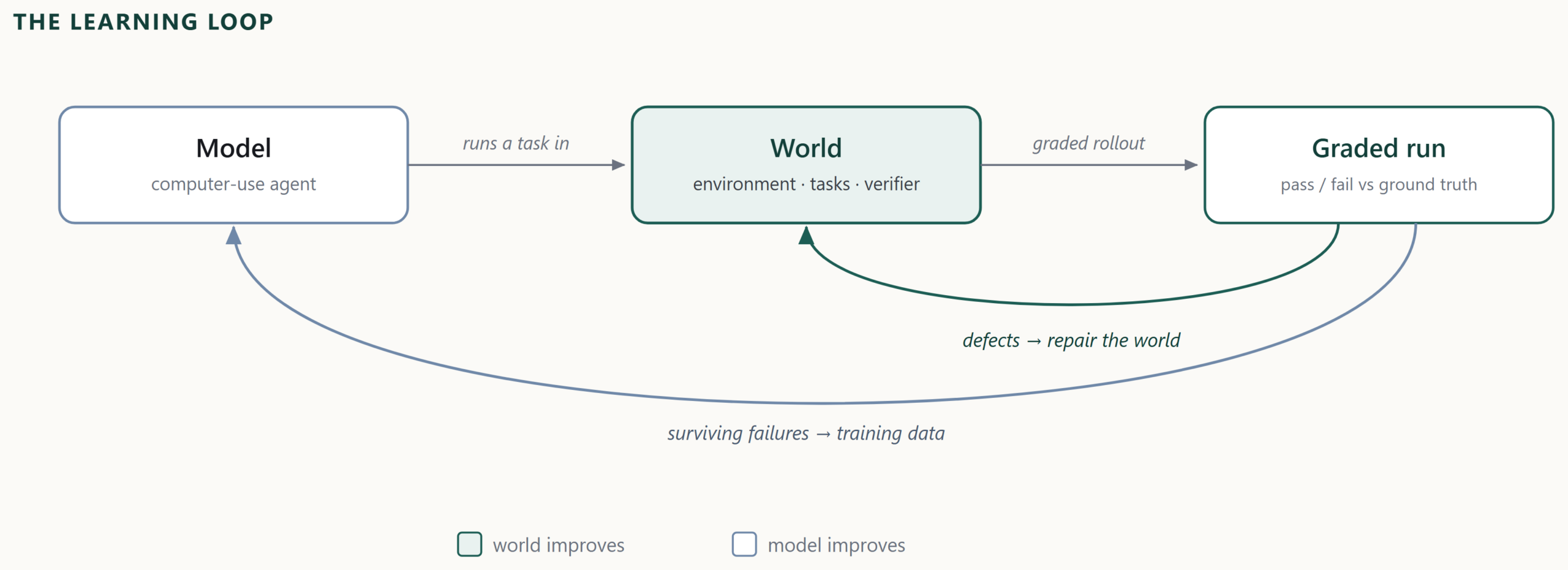 image図 1: 学習ループ。各評価ラウンドは二重に読み込まれます。失敗を生き残った事例がモデルの訓練データとなり、世界やタスク、検証基準における欠陥は修復の対象となります。モデルを測定する同じ評価サイクルが、同時に世界の質も高めます。
なぜ合成環境なのか、そしてなぜ深さが必要なのか?
ログイン不要で誰でもアクセスできるサイトは、合成世界の必要性をなくすように思えるかもしれません。しかし、それらは別の理由からトレーニングの場としては不適切です。なぜなら、それらは常に動き続けるからです。
ページが再設計されたり、掲載情報や日付が進んだり、ホスト側が自動トラフィックを制限・ブロックしたりするため、こうしたサイトに依存したベンチマークは時間とともにずれていきます。その結果、同じタスクでも毎回異なるサイトと遭遇することになります。たまに行われる評価であればこの変動に耐えられますが、トレーニングではそれが許されません。トレーニングでは同じタスクを数千回実行する必要があり、毎回同じ環境が必要だからです。
合成世界は時間とデータにおいて固定されています。カレンダーが進まず、シードデータも変化せず、1000 回目の実行でも最初の回と同じ意味を持ちます。私たちは、わずかな表面のリアリティを犠牲にして、完全に制御可能な世界を手に入れます。
制御機能はあくまで最低限の要件に過ぎません。世界が完全に安定していても、中身が空虚であれば意味がありません。重要なのは、ページ数ではなく、その作品の因果構造をいかに忠実に保持しているかという「深さ」です。
評価基準となるのは以下の 5 つの性質です。まず「行動の忠実度」。これは制御、権限、エラー処理が製品の論理に従っているかどうかを示します。次に「状態の一貫性」。送信されたメッセージは受信者に届き、キャンセルされた会議は双方のカレンダーから削除されるべきです。「ワークフローの深さ」として、初期の選択がその後の展開を制約する構造も含まれます。また、「権威ある検証」では、画面のピクセルではなくアプリケーションの状態自体を検証します。最後に「ドメイン価値」。そのワークフロー自体が改善に値するものであるかどうかも重要な基準です。
最も重要なシステムにおいて難易度が生じるのは、権限管理、共有状態、監査履歴といった領域です。これらは浅いクローンでは必ず省略されてしまう構造です。この基準を満たす環境は多様性を加え、満たさないものは単なるノイズに過ぎません。
Echoverse の仕組みについて
Echoverse は 1 つのパイプラインから成り立ち、2 つの出力を生み出します。1 つ目はワークフローの深さを保持した「ドメイン世界」、もう 1 つは診断された相互作用を 1 つ変化した「能力世界」です。両方とも、背後にあるデータベースを自社で所有しているという事実を前提としています。つまり、成功の可否はモデルがスクリーンショットから読み取った情報ではなく、アプリ自体の状態によって決定されるのです。
世界の構築
このパイプラインは、数種類のシナリオを基に仕様書を作成し、それをルート、状態、動作に関する機械検証可能な主張へとコンパイルします。その後初めてアプリが生成されます。これは React インターフェースの下で動く FastAPI と SQLite を備えたバックエンドです。
新しく作成されたアプリは仮説に過ぎず、現実の「世界」ではありません。ビルダーは実行中の環境に対してすべての主張を検証し、データベース、バックエンド、フロントエンドを修正してすべてが合格するまで繰り返します。その後、致命的な障害と助言的なリスクを区別する準備完了記録を作成します。
オープンな障害が残っている状態では、その世界は次の段階へ進みません。ここでいう「深さ」とはプロンプト内の約束事ではなく、実際に検証済みの主張のリストのことです。
コーパスの拡大
きれいに構築された世界であっても、それがすぐに訓練データになるわけではありません。各タスクをライブデータベース上で再定義し、実際に存在するエンティティから目標を引き出します。その後、すべての目標を分析パネルに通して検証します。対象となるエンティティは実在するか、目標は妥当か、難易度は作業内容に合致しているか、そして最も鋭いテストとして、「実際の UI を操作するエージェントがこれを完了できるか」を確認します。
この最終チェックはブラウザ内で実行され、モデルがそれを見る前に、どのインターフェースでも達成できない目標を事前に捕捉します。生成された目標はあくまで主張に過ぎませんが、実在するアプリに対してそれを解決した実績こそが証明となります。
失敗した事例は、修正が必要なレイヤー(データベース、バックエンド、フロントエンド、タスク記述、または検証器)によってタグ付けされます。各レイヤー固有の修復エージェントが修正を適用し、実行中のアプリに対して再検証を行い、性能が低下する場合はロールバックします。このループはデータベースの正解データに対して再評価を繰り返し、合格率が頭打ちになるまで続行されます。無事に生き残ったタスクは、そのタスクを採点した正確なチェック情報と共にエクスポートされ、以下のすべての実験における教師あり微調整(SFT)データの生成プロセスへと送られます。
世界構築とデータセットの拡充は別々の工程ではなく、一つのループとして機能します。欠陥の多くが「世界」側に起因するため、各イテレーションで環境のバージョンを更新します。難易度の高いタスクは世界の隙間を露呈させ、より堅牢な世界こそが高度なタスクを支えるため、各ラウンドを通じて両者は相互に強化されていきます。
 image図 2:環境ファクトリー。すべての世界を動かす二つのループ。フェーズ 1 では、少数のシードからアプリを展開し、データベース、バックエンド、フロントエンドを修復して機械による検証要件を満たすまで調整します。フェーズ 2 では、生データ上でタスクを再定義し、解析エージェントとレイヤー固有の修復エージェントからなるパネルを実行します。その後、合格率が頭打ちになるまでデータベースの正解データに対して再評価を行います。多くの修正は「世界」そのものに反映されます(破線の矢印)。
検証器はデータベースに根ざしている
各タスクには独自の正解キーが存在します。これは、生成時に SQL クエリによって実データベースから抽出された値または状態変化であり、生成時点で真偽が保証され、エージェントの完了後に再検証されます。読み取り操作の評価は、保存された値との意味的な等価性に基づきます(例:$287.62 の値に対して $288 を返すのは合格)。書き込み操作の評価は、データベースの状態変化(before/after)の実質的な差分によって行われます。例えば、「チケットがクローズされた」と主張しても、該当するレコードのステータスが実際に更新されなければ失敗となります。読み取りと書き込みを両方行うタスクでは、評価スコアは両者のうち低い方の値を採用します。
このように評価基準はゲーム化が難しく、ラベル付けに依存せず、実データに基づいています。また、EchoStay の予約処理、EchoForge の課題管理、EchoBank の送金処理など、異なるドメイン間でも一貫した評価が行われます。
主要なドメインでは、ワークフロー全体を再現する必要があります。
最も重要な業務を扱うドメインは、公開ベンチマークが到達するのが最も困難な領域です。これらはクローズドで独自仕様のシステムであり、難易度の源泉はレイアウトではなく、権限管理、共有状態、および履歴にあります。忠実なクローンを作成するには、これらの要素をすべて再現する必要があります。
重要なのは画面上のピクセル配置ではありません。むしろ、ある操作が画面間やユーザー間でどのような影響を及ぼすかが問われます。タスクは実際のワークフローを実行し、その結果として残されたシステム状態に基づいて評価されるべきなのです。
Echo の 10 ドメインは、コミュニケーション、技術作業、規制された記録、コミュニティ、メディア、そして旅行を網羅しています。既存の豊富な公開データセットがある場合は、それを基盤に構築します。例えば「EchoStay」は InsideAirbnb データからシードされており、掲載物件やホスト、レビュー、設備などが架空のものではなく実在するものです。同様に「EchoForum」も、255 万件のコメントを含む公開フォーラムコーパスを土台としています。
一方、メール、カレンダー、銀行取引、健康記録のように既存データがない領域では、厳格な制約条件下でシードパイプラインが状態データを生成します。単なるプレースホルダー行を数行用意するのではなく、密度が高く内部整合性の取れた本格的なデータセットを作成しています。
| ワークフローカテゴリ | 環境 | 世界が担うべき深さ |
|---|---|---|
| コミュニケーションと調整 | EchoMail, EchoCalendar, EchoChat | スレッド共有、スケジュール、参加者、権限、履歴 |
| 技術的創造と運用 | EchoML, EchoForge | アーティファクト、設定、依存関係、役割、多段階の変更 |
| 規制された記録と取引 | EchoBank, EchoCare | 残高または記録、承認、監査履歴、結果を伴う書き込み |
| コミュニティ、メディア、旅行 | EchoForum, EchoTunes, EchoStay | 永続的な設定、社会的状態、検索、予約、アカウント操作 |
表 1: Echo ファミリーの 10 の完全ドメイン環境。これらはそれぞれが扱う業務に基づいてグループ化されています。各環境は広く使われている製品の忠実な代替品であり、ブランド名ではなくワークフローにちなんで命名されています。
この蓄積された状態こそが、アクションの帰結を画面やユーザーを超えて及ぼす要因です。EchoStay での予約処理は、検索からリスト表示、空き状況の確認、決済まで約 87 のルートと 23 のテーブルを経由しますが、確認画面は一切表示されません。EchoMail のスレッドでは、下書き作成から送信、返信、ラベル付けに至るまでの意図が引き継がれます。また、EchoCare では注文の変更履歴がすべて監査証跡に記録されます。こうした複雑な状態管理のため、タスクは高コストになりがちで、深さ 5〜20 のアクションが必要になることも珍しくありません。そして、根本的な状態が変化して初めて完了となります。
 image図 3: Echo スイート各ドメインの詳細。それぞれはモデル化するアプリの完全な自己完結型かつ対話可能なクローンとして提供され、独自のバックエンド、初期化されたデータベース、機能範囲を備えています。数値はモックアップではなく、実際のデータベース状態に基づいています。
能力の世界は特定のスキルに特化します
すべての弱点がドメイン知識の欠如を意味するわけではありません。時には、エージェントが信頼して操作できない単一の制御要素が原因で発生することもあります。例えば、旅行予約を行うエージェントを想像してみてください。検索や絞り込みを行い、適切なリストを開いた後、日付ピッカーの前で立ち止まってしまいます。「3 月の第 2 週」という表現を、見慣れないカレンダー上で正確なクリック操作に変換できないのです。このような場合、別の予約サイトを追加しても問題は解決しません。重要なのは、その制御要素自体が十分に多様な形で現れることによりスキルが習得される点です。日付ピッカーやネストされた絞り込み・検索機能は、実世界のウェブ上に溢れており、100 通り以上の異なるスタイルでレンダリングされています。これは単一の深層学習アプリだけでは提供しきれない、まさに必要な多様性なのです。
そこで私たちは制御要素を切り離し、インタラクションの範囲を広げます。レイアウトや状態、制約条件 across にわたって大量生成を行い、それぞれのケースに対して具体的なタスクを生成します。「日付ピッカーの世界」では、1 つの日付コントロールを 6 つのコアウィジェットとして 10 の異なる文脈でレンダリングし、さらにカレンダーのヒートマップやスクロールホイール、会計四半期ピッカーなど、10 の新しい未見のケースを用意します。最も難しいタスクは、文字起こしから推論へと転換させるもので、「2026 年 1 月の最終木曜日」や「開始日から営業日 10 日後」といった表現を、特定のウィジェットで到達可能な正確な日付に解決するものです。
一方、「ネストされた絞り込みの世界」では 20 のウィジェットファミリーを変化させ、9 つの複合パネルファミリーを分布外(OOD)として保持します。提出物の評価は、見た目ではなく、アプリ自体のロジックに基づいて行われます。つまり、絞り込んだ結果が実際に要求された条件を満たしているかどうかで判定されます。
図 4:2 つのスキルがカバーするすべてのウィジェットファミリーを、トレーニング用(訓練分布内)と評価専用(保持されたもの)に分割して示す。ネスト型フィルタでは 20 ファミリーに加え 9 の複合パネルを保持し、日付ピッカーでは 10 の文脈にわたる 6 つのコアタイプに加えて 10 の保持ウィジェットを用意した。
図 5:ドメイン横断的なテーマを持つ日付ピッカーとネスト型フィルタ。ネスト型フィルタは不動産からペットの里親探しまで 6 つの業界をカバーし、日付ピッカーはスケジュール管理から保険手続きまで 10 の文脈に対応している。
より深く、ターゲットを絞った世界がもたらす変化
単に軌道(トラジェクトリ)を増やせば自動的に学習信号が増えるわけではない。重要なのは「深さ」だ。エピソードが、孤立した動作の反復練習ではなく、実際のワークフローにおける依存するステップを通じてタスクを完遂できるかどうかである。この違いを明確にする 2 つの実験がある。1 つは特定のドメイン全体で深掘りするアプローチ、もう 1 つは単一の壊れたスキルに焦点を絞るものである。
浅い世界は逆効果になりがちだが、深い世界では転移が可能になる
浅い世界は安価な選択肢です。素早く構築でき、一見説得力があるように見えますが、そこで訓練されるのは孤立した、正しく見えるクリックの反復練習に過ぎません。そのようなデータで学習すると、モデルは誤った反射行動を身につけてしまいます。過剰な操作や無限ループ、無意味な動作の繰り返しが発生するのは、簡単な世界ではこれらの失敗が何ら罰せられないからです。
一方、深い世界にはコストがかかりますが、その軌跡には生きたサイトへも転移可能な依存構造が含まれています。
この違いを明確にするため、WebVoyager のライブドメインである Allrecipes と Hugging Face を選び、3 つのチェックポイントで比較します。ベースモデルと、それぞれのドメイン向けに構築された「浅い世界」と「深い世界」の軌跡で訓練された 2 つのモデルです。
浅い世界では短く完結したタスクが出題されますが、深い世界では依存するステップを跨ぐタスクが出題されます。初期の行動が後の状態や選択肢、検証可能な条件を変化させるようなものです。両者のドメインへの曝露量は同じですが、異なるのは「深さ」のみです。評価には、これらのドメイン向けに公開されている WebVoyager ベンチマークのタスクを使用し、学習環境外の生きたサイト上で実行します。
Allrecipes における浅い環境ではモデルの性能が 80.0% から 75.0% に低下する一方、Hugging Face では 48.0% で横ばいを維持します。しかし、深い環境は両方のドメインで改善をもたらしました。Allrecipes は 85.0% まで上昇し、より困難な Hugging Face のタスクでも 65.0% に達しています。
学習機会(エクスポージャー)を同一に保った場合、性能差を生んだ決定的要因は「深さ」です。深いモデルはループ回数が少なく、Hugging Face の 37 タスクのうちステップ数制限で失敗するケースも 15 から 9 に減っています。2 つの環境の違いは、モデルが「どれだけ多くの情報を見たか」ではなく、「見た情報が作業の構造を維持しているかどうか」にありました。
 image図 6: 2 つのライブ WebVoyager ドメインにおける「深い環境」と「浅い環境」の比較。ドメインへの露出は同一ですが、タスクの深さが異なります。深い環境は両方のドメインで性能を向上させますが、浅い環境では Allrecipes でベースラインを下回り、Hugging Face では頭打ちになります。
ある特定のスキルにおける精度
日付選択ボックスとネストされたフィルターの両方に対する評価で指摘された制御項目を、それぞれ厳密に訓練することで、二つのスキルは相互に強化し合います。日付選択ボックスの訓練により、同分布データでの精度が 60.0% から 82.6% に、未学習レイアウトでは 34.0% から 54.0% に向上しました。また、フィルター訓練によって未学習フィルターの精度は 62.8% から 84.1% に引き上げられています。
これらの上昇は、訓練未経験のフォームでも維持されることから、モデルが特定のレイアウトを暗記したのではなく、汎用的なルールを習得したことを示しています。二つのスキルは競合するのではなく相互に転移し、どちらか一方だけを訓練しても他方の性能が向上します。両方を同時に訓練すれば、あらゆる分割データにおいて最もバランスの取れた結果が得られます。
最先端モデルである GPT-5.4 と比較すると、この統合モデルはすでにネストされたフィルターで先行しており、日付選択ボックスの同分布データにおける差もほぼ埋めつつあります。未学習の日付選択ボックスのみで明確に劣位にあるものの、そのルール性はオープンウェブ上でも発揮され、これまで見たことのないサイトでの Online-Mind2Web 評価では 29.5% から 34.3% へと向上しました。
 image図 7: ターゲット訓練による targeted な成果。日付選択ボックスまたはネストされたフィルターのいずれかを訓練することで、両方の制御項目が向上します。これは、訓練未経験のウィジェットやその組み合わせにも適用可能です。また、両方を同時に訓練すれば、あらゆる分割データにおいて最もバランスの取れた結果となります。数値が高いほど優れています。
合成世界から実稼働ウェブへ
本節では3つのモデルを比較します。ベースラインは「Qwen3.5-9B」で、合成された数軌道のみを与えられ、汎用モデルをブラウザ操作空間に適合させたものです。一方、本研究のモデルは同じ90億パラメータのネットワークですが、合成データ全体を用いて訓練したバージョンです。さらに比較対象として、より大規模なフロンティアモデル「GPT-5.4」も含まれています。
このスキルはオープンウェブでも通用するのでしょうか?私たちは学習済みモデルを一切変更せず、WebVoyager と Online-Mind2Web という、本モデルが一度も訓練したことがないベンチマークで評価を行いました。これらのベンチマークと私たちの訓練環境にはほとんど重複がありません。両方のベンチマークはいずれもオープンな公開サイトが中心で閲覧が主となるのに対し、私たちの訓練環境はログインが必要なサイトや書き込みを伴うワークフローに特化しています。大きなスコアアップを目指すこと自体が目的ではなく、方向性が重要です。
学習済みのモデルはベースラインを上回る結果を示しました。WebVoyager では 66.5% から 71.5% に、Online-Mind2Web では 40.5% から 43.4% に向上しています(BrowserBase を使用しない場合、それぞれ 50.9%→55.6%、29.5%→37.2%)。これらのスコアは BrowserBase を通じて報告されています。なぜなら、ホスト型ブラウザはデータセンターのボットブロックやレート制限を回避できるため、それらが存在しない場合よりもエージェントのスコアが低下するのを防げるからです。
ライブウェブデータを一切使用していないこの結果は、単なる暗記ではなく、転移学習によるものです。
 image図 8: 合成データでの訓練がライブウェブへ転移する。本モデルは一度も訓練したことがない2つのベンチマークで、ベースラインを上回るスコアを記録しました。
原文を表示
Scaling fidelity over sheer count, targeting the capabilities agents actually lack, and evolving with the models they train.
At a glance
We built twelve training worlds for computer-use agents: ten deep domain worlds and two capability worlds, each drilling a single control rendered in many forms (date pickers and nested filters). Depth is what makes them worth training on: these worlds reproduce an application’s real behavior, come seeded with realistic data, and keep state coherent across screens and users. Trained on all twelve, a 9B model nearly doubles its base score (36.5% to 67.1%), coming within fourteen points of GPT-5.4. The experiment taught us several lessons:
High simulation fidelity is a must-have; shallow worlds hurt the agent. Trained on shallow and deep builds of the same sites, the model regressed on the shallow ones but improved on the deep ones.
Agents often struggle with the same challenging UI elements, like date pickers and nested filters. Drilling those controls in varied forms taught the model to operate them in domains it never saw in training.
Co-evolving the model, the world, and the verifier improves all of them. As the world grows more correct and its tasks grow harder, the model climbs with it.
Reinforcement learning against the worlds pushes the agent past imitation. Using the grounded verifier as the reward, RL lifts held-out performance and teaches the agent to reach the goal in fewer steps.
We’re releasing four of the worlds with their code, data, and grounded graders, to support research on high-fidelity computer-use worlds.
Github: microsoft/Echoverse: Deep, Evolving Environments for Computer-Use Agents (opens in new tab)
Hugging Face: microsoft/Echoverse · Datasets at Hugging Face (opens in new tab)
Technical Report: https://www.microsoft.com/en-us/research/publication/echoverse-deep-evolving-environments-for-training-computer-use-agents-at-scale/
A computer-use agent learns the results of what its actions do only where they have real consequences. A click changes saved state, a message reaches a real person, or a page that refuses to move tells the agent its last move did nothing. A screenshot can show what an interface looks like, but only a working world shows what an action caused.
The consequences worth learning from are stateful, and most of them sit behind a login. The work people want automated lives in closed systems: email and chat, banking, health records, the internal consoles for cloud and ML. You cannot train an agent against the live versions of these. Every attempt writes to a real account, there is no reset between tries, and the true state stays hidden behind the screen. So you rebuild the system as a synthetic world where the database is yours: the state is real and changes for real, but it is safe to break, quick to reset, and graded from the data rather than a screenshot.
By a world we mean three things bound together: an environment (the application, its state, and the actions that change it), the tasks that set goals in it, and a verifier that grades the outcome against ground truth. The community is now good at making them: pipelines stand up an application, seed it, generate tasks, and attach verifiers, yielding hundreds of environments and thousands of checkable tasks. This work builds on that progress. However, once worlds are plentiful and its internal structure becomes the bottleneck: regardless of whether state stays coherent across users and screens, workflows keep their dependencies, a weak skill recurs in enough forms to generalize, and success is judged by outcome or by appearance.
Our bet, the one Echoverse tests, is that the real leverage comes less from adding worlds than from a loop that keeps improving the ones you already have. It treats building the environment and training the model as one process, not two stages: run a model in a world, find where it fails, make the world, its tasks, and its verifiers more faithful or more demanding there, train on the sharper signal, and repeat. Ordinary fine-tuning improves only the model. Here the same graded run that measures the model also improves the world that judged it, so a static benchmark saturates while the loop compounds.
Three levers keep that loop productive, none of them raw environment count. Depth: behaviorally faithful worlds for the domains that matter, including the closed and proprietary ones. Capability targeting: narrow worlds built around the exact interaction a model keeps failing. Co-evolution: improving the environment, its tasks, and its verifiers on every graded run, not just the model.
imageFigure 1: The learning loop: every graded run is read twice. Surviving failures become model training data, and defects in the world, its tasks, or its verifier become repairs. The same graded run that measures the model also sharpens the world.
Why synthetic, and why deep?
Open, login-free sites might seem to remove the need for synthetic worlds, but they make a poor training ground for a different reason: they will not hold still. Pages get redesigned, listings and dates roll forward, and hosts throttle or block automated traffic, so a benchmark that is pinned to them drifts, and no two runs face the same site. An occasional evaluation can absorb that; training cannot, since it runs the same task thousands of times and needs the same world each time. A synthetic world is fixed in time and data: the calendar does not move, the seed data does not churn, and a task means the same thing on the thousandth rollout as on the first. We trade a little surface realism for a world we fully control.
Control is only the floor. A world can be perfectly stable and still be hollow, so what earns training time is depth: not its page count but how faithfully it preserves the causal structure of the work. Five properties set the bar: behavioral fidelity (controls, permissions, and errors follow the product’s logic); coherent state (a sent message appears for its recipient, a cancelled meeting clears both calendars); workflow depth (an early choice constrains what happens later); authoritative verification (application state, not pixels); and domain value (the workflow is worth improving). In the systems that matter most, the difficulty lives in permissions, shared state, and audit histories: exactly the structure a shallow clone skips. Above this bar, more environments add variety; below it, they add noise.
How the Echoverse factory works?
Echoverse is a single pipeline with two outputs: full domain worlds that preserve workflow depth, and capability worlds that vary one diagnosed interaction. Both lean on the fact that we own the database underneath, so success is a property of the app’s own state, not a model’s read of a screenshot.
Building the world
The pipeline expands a handful of seed scenarios into a spec, then compiles it into machine-checkable claims about routes, state, and behavior. Only then does it generate the app: a FastAPI and SQLite backend under a React interface. A fresh app is a hypothesis, not a world: the builder runs every claim against the running environment, repairing the database, backend, or frontend until each passes, then writes a readiness record that separates hard blockers from advisory risks. A world with open blockers does not advance. Depth here is not a promise in a prompt; it is the list of claims the world has been shown to pass.
Growing the corpus
A world that builds cleanly is still not training data. We reground each task on the live database, drawing goals from entities that actually exist, then send every goal through a panel of analyzers: are its entities real, is the goal plausible, does its difficulty match the work, and, the sharpest test, can an agent driving the real UI complete it? That last check runs in the browser, catching goals no interface can satisfy before a model ever sees them. A generated goal is a claim; a solve against the real app is proof.
Every failure becomes an issue tagged by the layer that must change: database, backend, frontend, task text, or verifier. Layer-specific fixers apply the repair, re-check it against the running app, and roll it back if it regresses. The loop re-scores against database ground truth until the pass rate stops climbing, and each surviving task is exported carrying the exact check that grades it. Those tasks become training data through one process: GPT-5.4 solves each task, a verifier keeps the trajectories that pass ground truth, and those become the supervised fine-tuning (SFT) data behind every experiment below.
Building the world and growing the corpus are not two stages but rather one loop: most defects belong to the world, so we re-version the environment with every iteration. Harder tasks expose gaps in the world, and a sturdier world can carry harder tasks, so each round leaves both stronger.
imageFigure 2: The environment factory: the two loops behind every world. Phase 1 expands a handful of seeds into an app, then repairs the database, backend, and frontend until it passes machine-checkable claims. Phase 2 regrounds tasks on live data, runs a panel of analyzer and layer-specific fixer agents, and re-scores against database ground truth until the pass rate plateaus. Many of those fixes land in the world itself (dashed arrow).
The verifier is grounded in the database
Every task carries its own answer key, a value or a state change minted from the real database by a SQL query at generation, true by construction and re-checked after the agent finishes. A read is graded on semantic equivalence to the stored value ($288 for $287.62 passes); a write on a real before/after database diff, so claiming a ticket was closed fails unless the row flipped; a read_write scores the lower of the two. Grading is hard to game, grounded rather than labelled, and uniform across an EchoStay booking, an EchoForge issue, and an EchoBank transfer.
Full domains carry the workflow
The domains with the most consequential work are the hardest for public benchmarks to reach: closed, proprietary systems where the difficulty lives in permissions, shared state, and history, not layout. A faithful clone has to reproduce that. What matters is not the pixels but that an action’s consequences reach across screens and users, so a task can run a real workflow and be graded on the state it leaves behind.
The ten Echo domains span communication, technical work, regulated records, community, media, and travel. Where a rich public dataset exists we build on it: EchoStay is seeded from InsideAirbnb, so its listings, hosts, reviews, and amenities are real rather than invented, and EchoForum sits on a public forum corpus of 2.55 million comments. Where none exists, as with mail, calendar, banking, and health records, a seeding pipeline generates the state under strict constraints, dense and internally consistent, not a handful of placeholder rows.
Workflow categoryEnvironmentsDepth the world has to carry
Communication & coordinationEchoMail, EchoCalendar, EchoChatShared threads, schedules, participants, permissions, histories
Technical creation & operationsEchoML, EchoForgeArtifacts, configuration, dependencies, roles, multi-stage changes
Regulated records & transactionsEchoBank, EchoCareBalances or records, authorization, audit history, consequential writes
Community, media & travelEchoForum, EchoTunes, EchoStayPersistent preferences, social state, search, booking, account actions
Table 1: The ten full-domain environments of the Echo family, grouped by the work they represent. Each is a faithful stand-in for a widely used product, named for the workflow rather than the brand.
That accumulated state is what makes an action’s consequences reach across screens and users. A booking in EchoStay moves through search, listing, availability, and payment across roughly 87 routes and 23 tables, but not a single confirmation screen; an EchoMail thread carries intent from draft through delivery, reply, and label state; an EchoCare order writes each change to an audit trail. The tasks are expensive because of it, often five to twenty actions deep, and finished only when the underlying state has changed.
imageFigure 3: Per-domain detail across the Echo suite. Each ships as a self-contained, fully-interactive clone of the app it models, with its own backend, seeded database, and feature surface. Counts are grounded database state, not mockups.
Capability worlds isolate one skill
Not every weakness represents a missing domain; some are caused by a single control that the agent cannot reliably operate. Picture an agent booking a trip: it searches, filters, opens the right listing, then stalls at the date picker, unable to turn “the second week of March” into the right clicks on an unfamiliar calendar. Building another booking site would not fix that. The skill is learned only when the control itself appears in enough forms, and date pickers and nested filter-and-search are ubiquitous on the live web, rendered a hundred different ways, exactly the variability a single deep app cannot supply.
So we isolate the control and widen the interaction, mass-producing it across layouts, states, and constraints, then generating grounded tasks over each. The datepicker world renders one date control as six core widgets across 10 contexts and holds out 10 new unseen ones, from calendar heatmaps to scroll wheels and fiscal-quarter pickers; its hardest tasks turn transcription into reasoning, resolving “the last Thursday of January 2026” or “10 business days after a start date” to one exact, widget-reachable date. The nested-filter world varies 20 widget families and holds out nine compound-panel families as out-of-distribution, grading every submission by whether the filtered results actually meet the requested conditions, judged by the app’s own logic rather than by appearance.
 imageFigure 4: Every widget family the two skills cover, split into training (in-distribution) and evaluation-only (held out): nested filters, 20 families plus 9 held-out compound panels; date pickers, 6 core types across 10 contexts plus 10 held-out widgets.
 imageFigure 5: Date pickers and nested filters themed across domains: nested filters over six verticals, from real estate to pet adoption; date pickers over ten contexts, from scheduling to insurance.
What deeper, targeted worlds change
More trajectories do not automatically provide more training signal. What matters is depth: whether an episode carries a task through the dependent steps of a real workflow rather than just rehearsing an action in isolation. Two experiments make the difference concrete from opposite ends: one goes deeper on a whole domain, the other narrows to a single broken skill.
Shallow worlds backfire; deep worlds transfer
A shallow world is the cheap option. It stands up fast and looks convincing, but it only rehearses isolated, correct-looking clicks. Train on that and the model will pick up the wrong reflexes, over-stepping and looping and repeating dead actions, because nothing in the easy world ever punished them. A deep world costs more, but its trajectories carry the dependent structure that transfers to the live site.
To isolate that, take two live WebVoyager domains, Allrecipes and Hugging Face, and compare three checkpoints: the base model and two trained on shallow-world and deep-world trajectories built for those domains. The shallow world poses short, self-contained tasks; the deep world poses tasks that run across dependent steps, where an early action changes the state, options, and verification available later. Both give the model the same domain exposure, so only depth differs, and evaluation uses tasks from the public WebVoyager benchmark for these domains, run on the live sites outside any training world.
On Allrecipes, the shallow world pulls the model down, 80.0% to 75.0%; on Hugging Face it stays flat at 48.0%. Only the deep world improves both, lifting Allrecipes to 85.0% and the harder Hugging Face split to 65.0%. With exposure held equal, the gap is depth: the deep model loops less, and of the 37 Hugging Face tasks, those that exhaust their step budget fall from 15 to nine. What separated the two was not how much the model saw, but whether what it saw preserved the structure of the work.
imageFigure 6: Deep versus shallow worlds for two live WebVoyager domains, with identical domain exposure and different task depth. Deep lifts both; shallow drops below base on Allrecipes and stalls on Hugging Face.
Precision about one skill
The datepicker and nested-filter worlds drill exactly the controls our evaluations flagged, and the two skills reinforce each other. Datepicker training lifts datepicker evaluations (in-distribution 60.0% to 82.6%, held-out layouts 34.0% to 54.0%); filter training lifts held-out filters 62.8% to 84.1%. Gains that hold on forms never trained on indicate that the model learned a rule, not a layout. The skills transfer across each other rather than competing: training either one alone still lifts the other, and training both is the best all-rounder on every split. Against GPT-5.4 as a frontier reference, that combined model already edges ahead on nested filters and closes most of the datepicker in-distribution gap, trailing clearly only on held-out datepickers. And the rule reaches the open web, lifting Online-Mind2Web 29.5% to 34.3% on sites it never saw.
imageFigure 7: Targeted training, targeted gains: training either date pickers or nested filters lifts both controls, including held-out widgets and compositions neither was trained on, and training both is the best all-rounder on every split. Higher is better.
From synthetic worlds to the live web
Three models run through the rest of this section. Base is Qwen3.5-9B given only a handful of synthetic trajectories, just enough to align a general model to the browser action space. Our model is that same 9-billion-parameter network trained on the full synthetic corpus. GPT-5.4 is a far larger frontier model, included as a reference ceiling.
Does the skill survive the open web? We evaluate our model, unchanged, on WebVoyager and Online-Mind2Web, benchmarks it never trained on. They barely overlap with what we built: both are dominated by open, public sites and read-mostly browsing, while our worlds train login-gated, write-heavy workflows. A large jump was never the point; direction is. The frozen model clears base on both, WebVoyager 66.5% to 71.5% and Online-Mind2Web 40.5% to 43.4% (without BrowserBase, 50.9% to 55.6% and 29.5% to 37.2%), reported through BrowserBase because a hosted browser strips the datacenter bot-blocks and rate limits that otherwise depress every agent’s score. With no live-web data in the mix, this is transfer, not memorization.
imageFigure 8: Synthetic training transfers to the live web. The full-corpus model, on two benchmarks it never trained on, clears base on both; scores
AI算出
主要ニュースainew評価高い
AI エージェントの研究・開発に直結する画期的なトレーニング環境の発表であり、独自の数値データと技術的洞察を含むため新規性は高い。ただし日本固有の情報や企業事例は含まれていない。
6つの評価軸を見る
- AI関連度
- 100
- 情報源の信頼性
- 100
- 新規性
- 75
- 調べる価値
- 75
- 重複の少なさ
- 100
- 日本での有用性
- 25
関連記事
今日のまとめ
AIデイリーブリーフで今日の重要ニュースをまとめ読み