Stable Video 4D 2.0:単一動画からの高忠実度新視点および4D生成の新アップグレード
本文の状態
日本語全文を表示中
詳細モードで約4分の本文を読めます。
同じ出来事の情報源
この情報源を基点に整理
Stability AI
Stability AIは、動画から高品質な4D生成と新視点合成を実現する「Stable Video 4D 2.0」を公開した。同モデルは最新技術を実現し、商業利用を含むStability AIコミュニティライセンスの下でHugging FaceおよびGitHubからダウンロード可能となった。
Continue in AI NEW LAB
このニュースを、実務の判断につなげる
AI NEW LABで、試したことや先に確認したい条件を共有できます。まずはログインなしで読めます。
AI NEW LABで論点を見るSource Article
元記事を日本語で読む
本文に関係しない購読案内、埋め込み通知、サイト内プロモーションは除いています。
主なポイント:
Stable Video Diffusion 4D (SV4D) を Stable Video 4D 2.0 (SV4D 2.0) にアップグレードし、実世界動画においてより高品質な出力を実現しました。
当社の分析によると、SV4D 2.0 は 4D 生成および新視点合成の両方で最先端の結果を達成しています。
Stable Video 4D 2.0 は、寛容な Stability AI コミュニティライセンスの下で、商用・非商用のいずれにも利用可能になりました。
マルチビュー生成モデルは Hugging Face でダウンロードでき、コードは GitHub で確認できます。また、4D アセット再構築プロセスについては arXiv で読むことができます。
モデルをダウンロード
モデルをダウンロード
Stable Video 4D 2.0
Stable Video Diffusion 4D (SV4D) を Stable Video 4D 2.0 (SV4D 2.0) にアップグレードし、実世界動画においてより高品質な出力を実現しました。このマルチビュー動画拡散モデルは、単一のオブジェクト中心の動画から動的な 4D アセットを生成する際に理想的です。これらのアップグレードにより、ゲームキャラクターのスプライトシート生成から、映画やバーチャルワールドのためのアセットサポートまで、プロフェッショナルな制作ワークフロー向けに動的な 4D アセットを作成しやすくなりました。
3D オブジェクトを未見の視点から可視化する際の本質的な曖昧さのため、マルチビュー生成は依然として複雑です。これは特に被写体が動いている場合に困難となります。SV4D 2.0 は、大規模データセットやマルチカメラ設定、前処理に依存することなく、一貫性のある多角度の出力を生成することで、この課題への解決に向けた漸進的な進展を示しています。これは前進の一歩ですが、動的な動きにおいては依然として偶発的なアーティファクト(ノイズ)が発生する可能性があります。
何が変わったか
SV4D 2.0 には複数のアップグレードが施されました。具体的には以下の通りです:
より鮮明で一貫性のある 4D 出力:モデルは段階的にトレーニングされ、まず静止した 3D アセットから始め、その後動きを追加することで、より明確で一貫性のある 4D 結果を実現しました。
参照ビュー不要:単一の動画から直接動作するため、マルチビューの参照画像を必要としません。
再設計されたネットワークアーキテクチャ:3D スパテシャル(空間)と時間的特徴を融合させるメカニズムである 3D アテンション(注意機構)を活用し、参照ビューに依存することなく時空間的一貫性を向上させました。
実世界における汎化性能の向上:実世界の動画においてより一貫して動作します。合成データでトレーニングされていますが、事前学習済みビデオモデルから得た世界知識を保持しています。
研究とベンチマーク
分析によると、SV4D 2.0 は 4D 生成において最先端の結果を達成しています。LPIPS(画像忠実度)、FVD-V(多視点一貫性)、FVD-F(時間的整合性)、および FV4D(4D 一貫性)という主要なベンチマークすべてで首位を獲得しました。DreamGaussian4D、L4GM、SV4D と比較して、このバージョンはよりシャープで一貫性の高い 4D 出力を生成します。
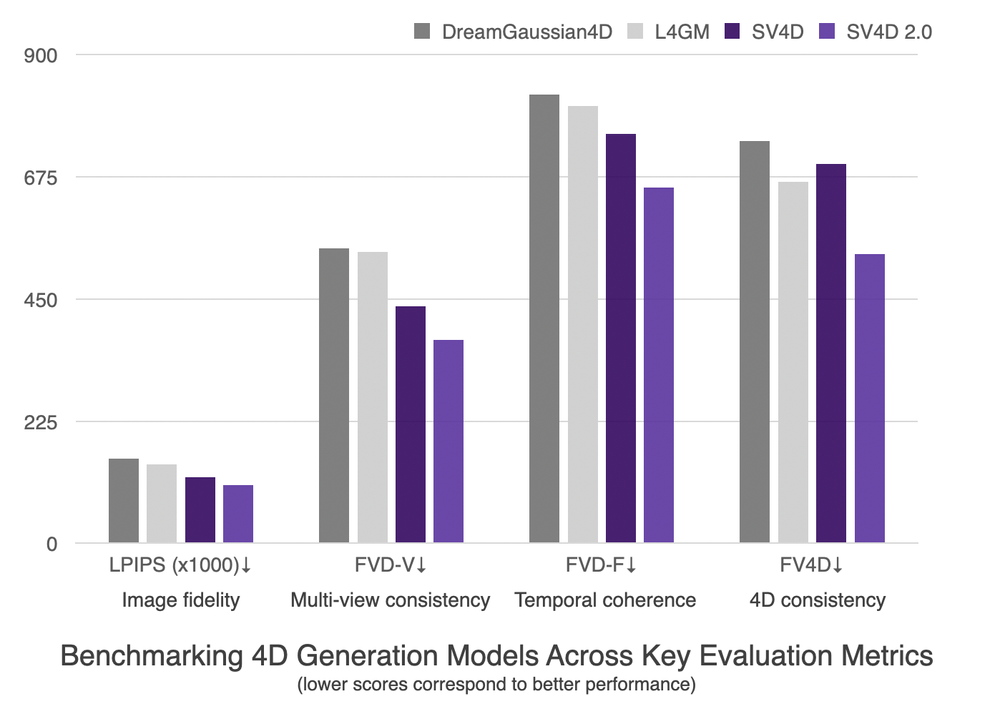
分析によると、SV4D 2.0 は Novel-view synthesis(新規視点合成)においても Diffusion^2、SV3D、SV4D を上回る性能を示します。このモデルは多視点一貫性(FVD-V)と時間的整合性(FVD-F)を大幅に改善し、視点の変化や時間の経過に関わらず高品質な出力を維持しています。モデルの技術的な進展の詳細については、研究論文をご覧ください。

Getting started
Stable Video 4D 2.0 は、寛容な Stability AI コミュニティライセンスの下で、商用・非商用の両方の利用が可能になりました。
マルチビュー生成モデルは Hugging Face でダウンロードでき、コードは GitHub で確認できます。また、arXiv では 4D アセット再構築のプロセスについて詳しく読むことができます。
当社の進捗を最新の状態に保つには、X、LinkedIn、Instagram でフォローするか、Discord コミュニティに参加してください。
原文を表示
Key Takeaways:
We’ve upgraded Stable Video Diffusion 4D (SV4D) to Stable Video 4D 2.0 (SV4D 2.0), delivering higher-quality outputs on real-world video.
Our analysis shows that SV4D 2.0 achieves state-of-the-art results in both 4D generations and novel-view synthesis.
Stable Video 4D 2.0 is now available for both commercial and non-commercial use under the permissive Stability AI Community License.
You can download the multi-view generation models on Hugging Face, find the code on GitHub, and read about the 4D asset reconstruction process on arXiv.
Download model
Download model
Stable Video 4D 2.0
We’ve upgraded Stable Video Diffusion 4D (SV4D) to Stable Video 4D 2.0 (SV4D 2.0), delivering higher-quality outputs on real-world video. This multi-view video diffusion model is ideal for dynamic 4D asset generation from a single object-centric video. These upgrades make it easier to create dynamic 4D assets for professional production workflows, from generating sprite sheets for in-game characters, to supporting assets for film and virtual worlds.
Multi-view generation remains complex due to the inherent ambiguity of visualizing 3D objects from unseen views. This is especially difficult when subjects are in motion. SV4D 2.0 makes incremental progress toward addressing this challenge by producing consistent, multi-angle outputs without relying on large datasets, multi-camera setups, or preprocessing. While this represents a step forward, occasional artifacts may still appear with dynamic motion.
What’s new
We’ve made multiple upgrades to SV4D 2.0, including:
Sharper and Coherent 4D Outputs: The model was trained in phases, starting with static 3D assets and then adding motion, resulting in clearer and more consistent 4D results.
No Reference Views Required: Works directly from a single video, eliminating the need for multi-view reference images.
Redesigned Network Architecture: Utilizes 3D attention, a mechanism that fuses 3D spatial and temporal features, improving spatio-temporal consistency without relying on reference views.
Improved Real-World Generalization: Performs more consistently on real-world videos. While trained on synthetic data, the model retains world knowledge from pre-trained video models.
Research and benchmarking
Our analysis shows that SV4D 2.0 achieves state-of-the-art results in 4D generation. It ranks first across all major benchmarks: LPIPS (Image fidelity), FVD-V (Multi-view consistency), FVD-F (Temporal coherence), and FV4D (4D consistency). Compared to DreamGaussian4D, L4GM, and SV4D, this version generates sharper and more consistent 4D outputs.
image
Our analysis also shows that SV4D 2.0 outperforms Diffusion^2, SV3D, and SV4D on novel-view synthesis.The model significantly improves multi-view consistency (FVD-V) and temporal coherence (FVD-F), maintaining high-quality outputs across both changing viewpoints and time. You can read more about the technical advancements of the model in the research paper.
image
Getting started
Stable Video 4D 2.0 is now available for both commercial and non-commercial use under the permissive Stability AI Community License.
You can download the multi-view generation models on Hugging Face, find the code on GitHub, and read about the 4D asset reconstruction process on arXiv.
To stay updated on our progress, follow us on X, LinkedIn, Instagram, and join our Discord Community.
今日のまとめ
AIデイリーブリーフで今日の重要ニュースをまとめ読み