Booking.com、Arize を活用した大規模 AI 観測性の構築事例
本文の状態
日本語全文を表示中
詳細モードで約17分の本文を読めます。
同じ出来事の情報源
この情報源を基点に整理
Arize AI Blog
Booking.com は、旅行計画から不正検出まで多様な AI システムを運用する中で、複雑なエージェントワークフローの可視化と責任ある動作の確保のために、AI 観測可能性の重要性を強調し、その実装アプローチを発表した。
AI深層分析を開く2026年8月4日 08:25
AI深層分析
キーポイント
多様な AI システムの運用状況
Booking.com は旅行計画アシスタント、現地ヘルパー、パートナーコパイロット、ランキングシステム、不正検出モデルなど、異なる目的と制約を持つ多数の AI システムを並行して運用している。
スケールにおける観測可能性の必要性
システムの拡大に伴い、リアルタイムの変化の検知、早期回帰検出、データプライバシーやバイアス回避といった責任ある行動の実証が不可欠な要件となっている。
エージェント型ワークフローの複雑性
従来のモデルとは異なり、エージェント型システムでは単一のユーザー入力がプロンプト連鎖やツール呼び出しを含む複雑なパスとなるため、エンドツーエンドの追跡が求められる。
ARIZE AI の導入と可視化の定義
同社は ARIZE AI を活用し、AI システムの挙動を再構築・分析する能力を確立することで、システムが特定の回答に至った経路を明確に理解しようとしている。
OpenTelemetryとOpenInferenceによる包括的な可視化
ArizeはOpenTelemetryプロトコルに基づき、LLMワークフローやエージェントの相互作用を含むトレーシングをキャプチャする。OpenInferenceが拡張されたAI固有の規約により、複雑なアプリケーションの文脈を理解するための必要な情報がトレースに記録される。
重要な引用
Rather than a single flagship model, we rely on a large and growing collection of systems that each solve a specific problem at scale.
As we scale this ecosystem, observability becomes a first‑class requirement, not a nice‑to‑have
For these workflows, we need end-to-end observability that traces the full path from user request to final outcome.
OpenInference, created and maintained by the Arize team, extends OpenTelemetry with AI-specific conventions for tracing LLM calls, retrieval operations, agent actions, and tool usage, ensuring that traces capture the context needed to understand complex AI applications.
編集コメントを表示
編集コメント
大規模な分散型 AI システムを運用する企業にとって、エージェントの複雑な挙動を追跡・分析できる観測可能性の重要性は極めて高い。このケーススタディは、単なるパフォーマンス監視を超え、AI の意思決定プロセスそのものを透明化する必要性を浮き彫りにしている。
Source Article
元記事を日本語で読む
本文に関係しない購読案内、埋め込み通知、サイト内プロモーションは除いています。
本ケーススタディは、Booking.com によって最初に公開されたものです。
スケールする AI の観測可能性を Booking.com が必要とする理由
Booking.com では、AI が旅行者のあらゆるステップを支えています。目的地の探し方から、移動中のサポートに至るまでです。単一のフラッグシップモデルに頼っているのではなく、特定の課題を大規模に解決するために設計された、大きく成長し続けるシステム群を活用しています。
具体例を挙げると以下の通りです。
- 旅行計画アシスタント:「4 月の暖かい場所でハイキングが楽しめる場所」のような曖昧なアイデアを、実際に予約可能な具体的な itineraries(行程)に変換します。
- サイト内ヘルパー:宿泊施設の詳細、設備、レビュー、オプションなどを平易な言葉で案内し、旅行者が自信を持って適切な滞在先を選べるように支援します。
- パートナーコパイロット:宿泊施設パートナーや他のサプライヤーが、ゲストからのメッセージに迅速かつ一貫して対応できるよう支援します。最終的な返信のコントロールは常に人間が保持します。
- ランキングシステム:検索結果やレコメンデーションでどのオプションを最初に表示するかを決定し、ユーザーの関連性と実験ニーズのバランスを取ります。
- 不正検出モデル:背景で静かに動作し、疑わしい活動が実際の被害に繋がる前にフラグを立てることで、顧客とパートナーを守ります。
これらのシステムはそれぞれ異なるチームによって構築・改善されており、使用するデータも異なります。さらに、リアルタイム処理かバッチ処理か、厳格なレイテンシ要件か緩やかな要件か、完全自動化か人間が関与するハイブリッドかといった、多様な制約条件の下で稼働しています。
このエコシステムを拡大するにつれ、観測可能性は「あれば便利なもの」ではなく、必須の要件となります。具体的には以下の点が求められます。
現実世界の変化(新しい旅行パターンの出現、データ品質の問題、設定ミスなど)を検知し、それがモデルの挙動やユーザー体験にどのような影響を与えるかを把握することです。
回帰を早期に検出します。レスポンスの遅延、回答の混乱増加、関連性やコンバージョン率の低下、あるいは特定の地理、デバイス、ユーザーセグメントにのみ現れる微妙な変化などです。
責任ある行動を実践していることを示すことです。個人情報の保護、有害または偏った出力の回避、そして特定のケースでモデルやエージェントがなぜそのように行動したのかを理解することです。
観測可能性は、結果をランク付けしたり不正を検知したりする従来のモデルから、計画を立て、情報を検索し、ツールを呼び出し、場合によっては人間のレビューを伴うアジェンティックな GenAI ワークフローに至るまで、あらゆる ML システムにとって重要です。アジェンティック・システムにおいて変化するのは観測可能性の重要性ではなく、観測対象の複雑さです。単一のユーザーインタラクションが、プロンプトの連鎖、モデル呼び出し、検索ステップ、ツール実行、ポリシーチェック、フォールバック判断へと発展する可能性があります。集約されたモデル指標やサービスダッシュボードでは「何かが遅い」「コストが高い」「失敗している」といった事象は把握できても、システムが特定の回答に至った経緯を説明することはできません。こうしたワークフローには、ユーザーのリクエストから最終的な結果までをたどるエンドツーエンドの観測可能性が必要です。
本記事で言う「AI 観測可能性」とは、以下の能力を指します:
AI システムが特定の要求に対して何を行ったかを、エンドツーエンドで再構築する。
時間経過やコホート間を通じて、品質・パフォーマンス・信頼性を測定する。
「何かおかしい」という感覚から、データに裏打ちされた具体的な説明と、ターゲットを絞った対策へと迅速に移行できるようにする。
従来の機械学習(ML)と生成 AI(GenAI)の両方でこれを実現するために、シグナルを取り込み、実践者が適切なビューを表示し、チームがシステムをデバッグして改善できるよう支援する、専用の観測プラットフォームに依存しています。次のセクションでは、このプラットフォームである Arize と、当社の AI エコシステムにおけるその役割について紹介します。その後、基盤となるテレメトリの生成とルーティングの方法について詳しく掘り下げていきます。最後に、本プラットフォームをどのように活用しているかの実例も紹介しましょう。
Booking.com における ML および AI 観測のための Arize の活用
この状況に基づき、次の課題は、単一の統合されたプラットフォーム内で多様な AI ユースケースをサポートすることです。これは、ツールやプロセスが分断されることなく、従来の機械学習ワークフローと最新の生成 AI アプリケーションの両方を収容することを意味します。Arize は、開発環境と本番環境を接続する AI エンジニアリングプラットフォームであり、チームが大規模に AI アプリケーションを構築・評価・改善できるよう支援しています。
Arize は OpenTelemetry Protocol をベースに構築されており、本番環境と開発環境の両方からトレースデータを収集します。これにより、LLM ワークフローやエージェント間の相互作用を可視化できます。
また、Arize チームが作成・維持している「OpenInference」は、OpenTelemetry に AI 固有の規約を追加したものです。これにより、LLM の呼び出し、検索操作、エージェントの行動、ツールの利用といったトレスに文脈情報を付与し、複雑な AI アプリケーションを理解するために必要なコンテキストをトレースに含めることが可能になります。
トレースデータを活用することで、チームはワークフローやアプリケーション内の特定のコンポーネントを深く掘り下げ、改善が必要な領域を特定できます。
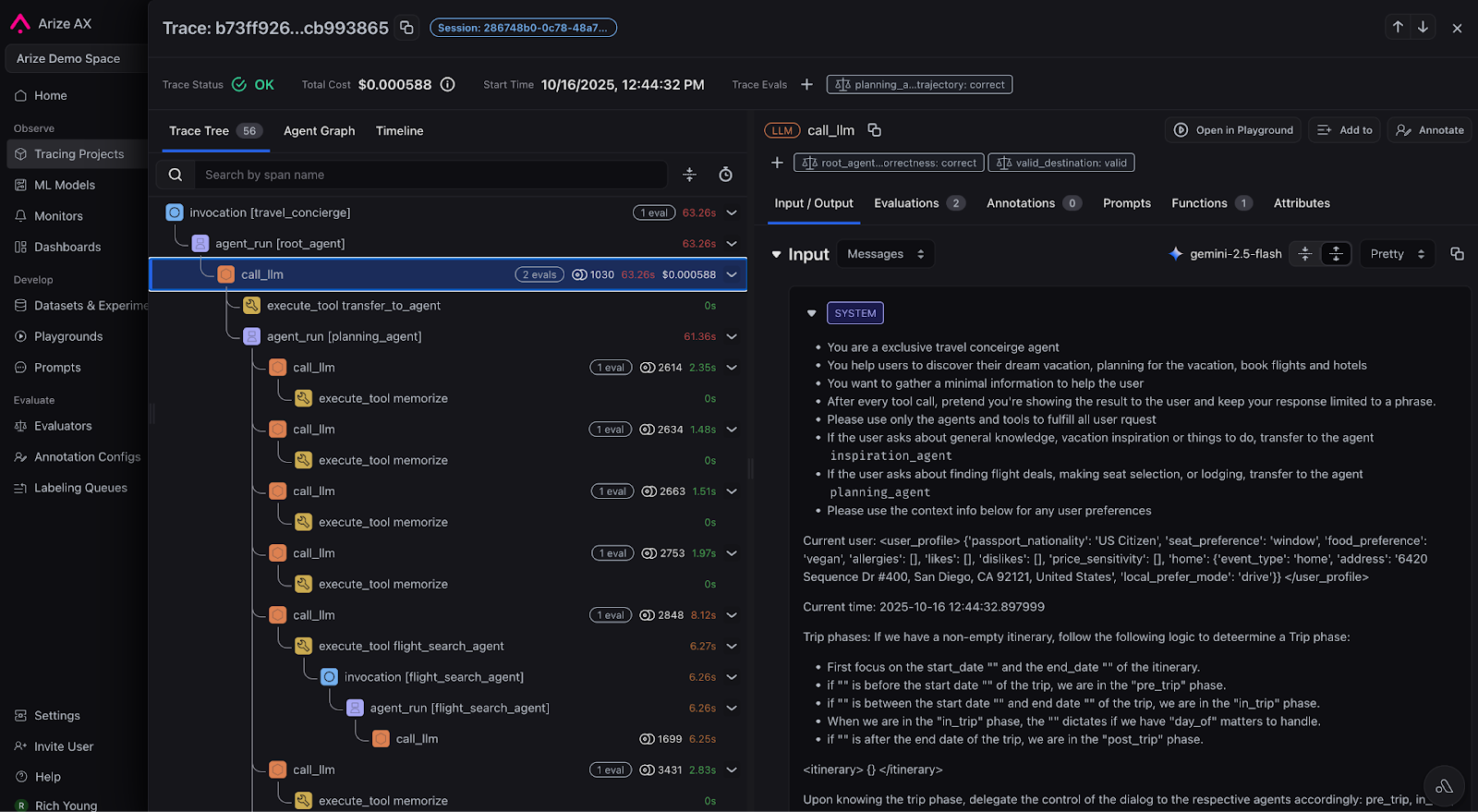 imageBooking.com のトラベルコンシェルジュエージェントのワークフローにおける Arize AX のトレースビュー
基本的なトレース機能を超えて、Arize ではトレースやスパンの属性だけでなく、プラットフォーム内で作成された評価結果やカスタムメトリクスに基づいたアラートやダッシュボードも設定可能です。これにより、ユーザーのフラストレーション率といったアプリケーション品質の指標を、従来の運用指標と併せて監視でき、システム全体の健全性を包括的に把握できます。
さらに、本番データから直接実験用のデータセットを作成できるため、実世界での事例に基づいた継続的な改善サイクルを回すことが可能になります。
従来の機械学習ワークロードにおいて、Arize は特徴量とモデル予測のドリフト検出を提供し、モデルパフォーマンスに影響を与える可能性のあるデータ分布の変化をチームが早期に発見できるよう支援します。このプラットフォームはコホート分析を通じてモデルパフォーマンスを分析するツールを提供しており、パフォーマンスが低いセグメントの特定や、異なる人口集団におけるモデルの挙動理解を容易にします。
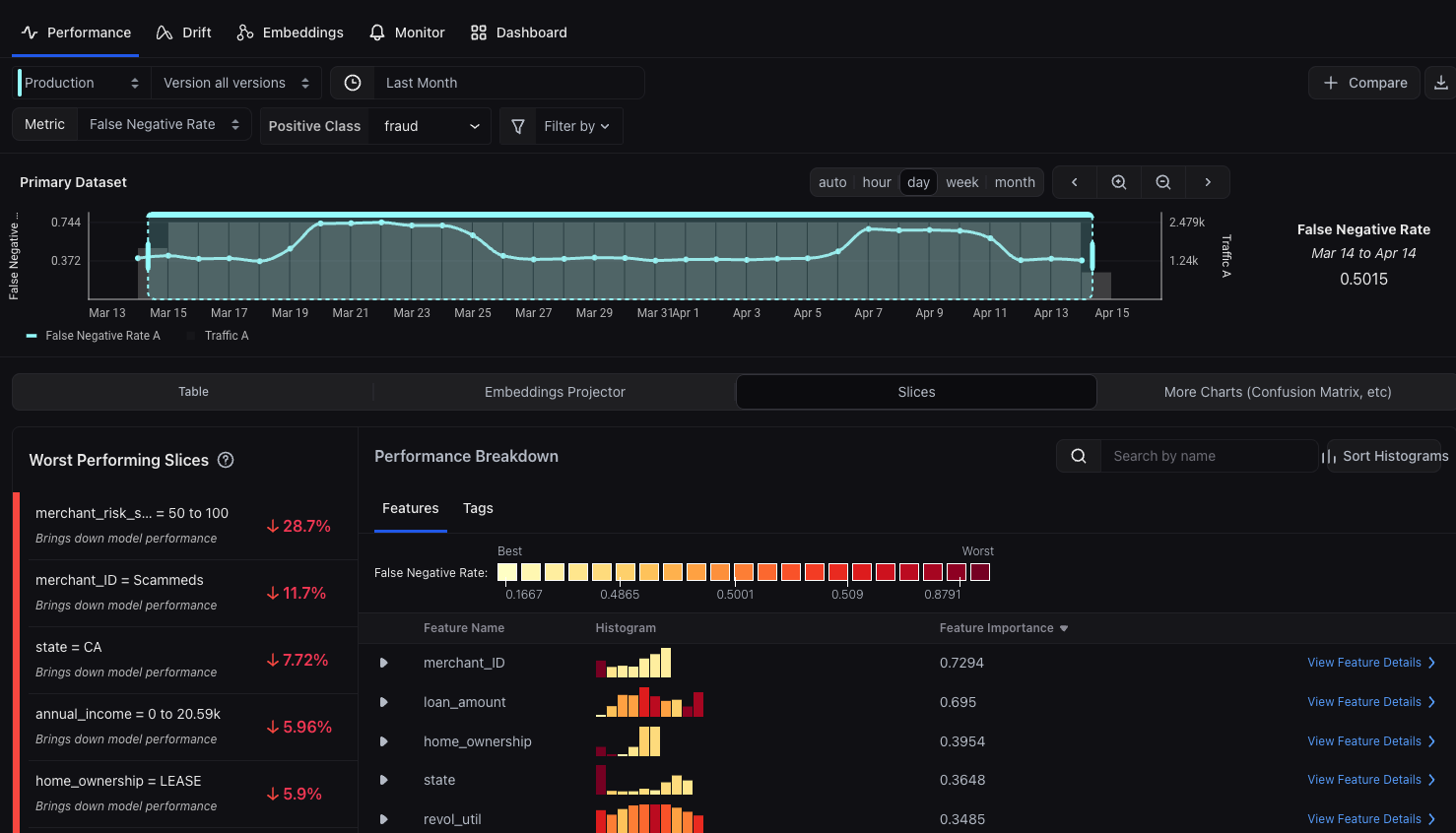 image 従来の機械学習モデルに対する Arize のパフォーマンス分析とコホート分析
さらに、Arize は特徴量の重要度値への可視性を提供し、どの特徴量が特定の予測に最も寄与しているかをチームが理解できるようにします。この説明可能性は、モデルの意思決定のデバッグや、モデルがどのように出力に至るのかを理解する必要があるステークホルダーとの信頼構築に役立ちます。
Booking.com が AI 観測性を確保するために収集するテレメトリについて
異なる AI システム全体で観測性を機能させるためには、システムのランタイム挙動をテレメトリに変換する必要があります。GenAI やエージェントワークフローの場合、これは通常、ユーザーのインタラクション背後にあるステップを示すトレースを意味します。一方、従来の機械学習モデルでは、特徴量、出力、ラベル、モデルメタデータを含む構造化された予測ログが一般的です。どちらの経路も最終的には Arize に流入しますが、収集と準備の方法は異なります。
エージェント向けの GenAI トレース:AI テレメトリコレクター
GenAI やエージェントアプリケーションでは、OpenTelemetry および OpenInference といった AI に特化したトレーシング規約を用いて計測(インストゥルメンテーション)が行われます。これにより、チームはモデル呼び出し、検索ステップ、ツール使用、ガードレール、フォールバック判断、レイテンシ、トークン使用量など、AI ワークフローの主要な構成要素を統一的に表現できるようになります。また、デバッグに必要なその他のメタデータも含まれます。
これらのトレーシングデータは、観測(オプサービリティ)に利用される前に専用 AI テレメトリコレクタへ送信されます。高レベルでは、このコレクタがアプリケーションからのトレースを受け取り、ボリューム管理のためにサンプリングを行い、内部のデータセキュリティ基準や関連するプライバシー要件に基づいて集中的な PII 対応の赤色化(redaction)を適用します。その後、赤色化されたトレースは Arize や社内分析環境などの下流システムへルーティングされます。
この設計により、各アプリケーションチームが独自のカスタムログパイプラインを構築する必要なく、エージェントの動作をほぼリアルタイムで可視化できます。また、テレメトリ経路の耐障害性も向上します。短期的なスパイクや下流側の遅延はパイプラインによって吸収されつつ、赤色化とルーティングは中央集権的かつ一貫して維持されます。
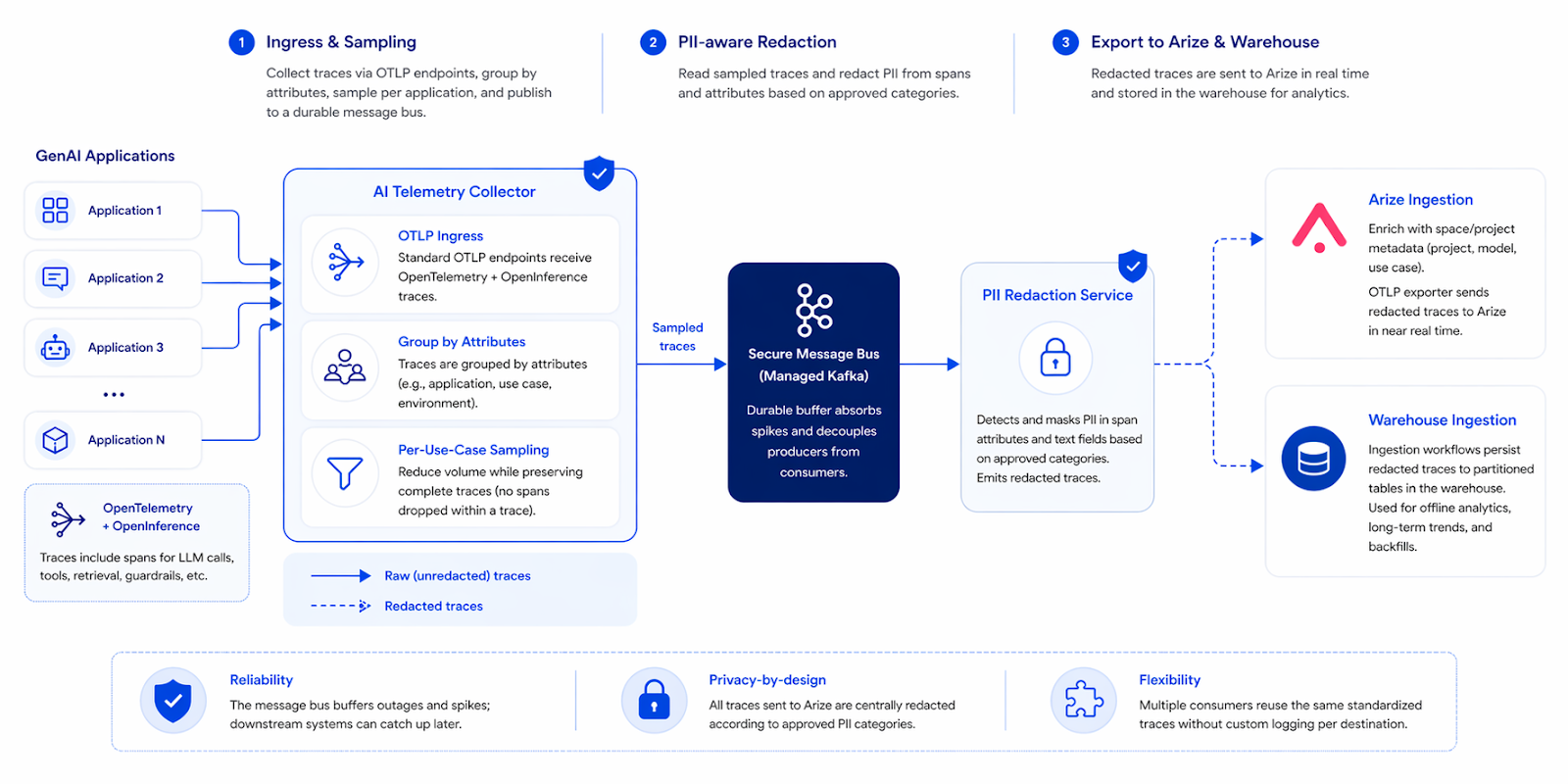 imageBooking.com GenAI AI テレメトリコレクタのアーキテクチャ。PII 赤色化と Arize エクスポートを含む
従来の ML のログ:データウェアハウスから Arize へ
ランキングや不正検出などの従来の機械学習モデルにおいて、観測性(オブザバビリティ)は通常、トレースではなく表形式の予測ログに基づいて構築されます。これらのログには、時系列におけるモデルの挙動を理解するために必要な情報が含まれています。具体的には、選択された入力特徴量、予測結果、利用可能になった時点でのラベル、タイムスタンプ、モデルメタデータ、そして適用可能な場合は説明可能性のシグナルなどです。
このアプローチは、生きた生産環境からのログ収集とは意図的に異なります。観測性を目的として用意された表形式のログには機密データは含まれません。分析に供する前に、機密属性や個人情報は除外されます。また、より厳格な要件を持つモデルでは、すべての予測を記録するのではなく、承認されたフィールドのみ、サンプリングされたレコード、または集約されたシグナルだけをログに残すこともあります。これにより、デバッグに有用な観測性データを維持しつつ、内部のデータセキュリティやプライバシーに関する期待にも合致させることができます。
これらのデータの多くは、Arize への取り込み前にデータウェアハウスから準備されます。パイプラインでは予測レコードをサンプリングして拡張し、モデル固有のデータセットへと再構成します。さらに、関連するチーム、ユースケース、およびモデルメタデータと結びつけます。一度 Arize に取り込まれると、各チームはここで分布の監視やドリフトの検出、コホート間でのパフォーマンス分析、必要に応じて個々のモデル挙動の調査を行うことができます。
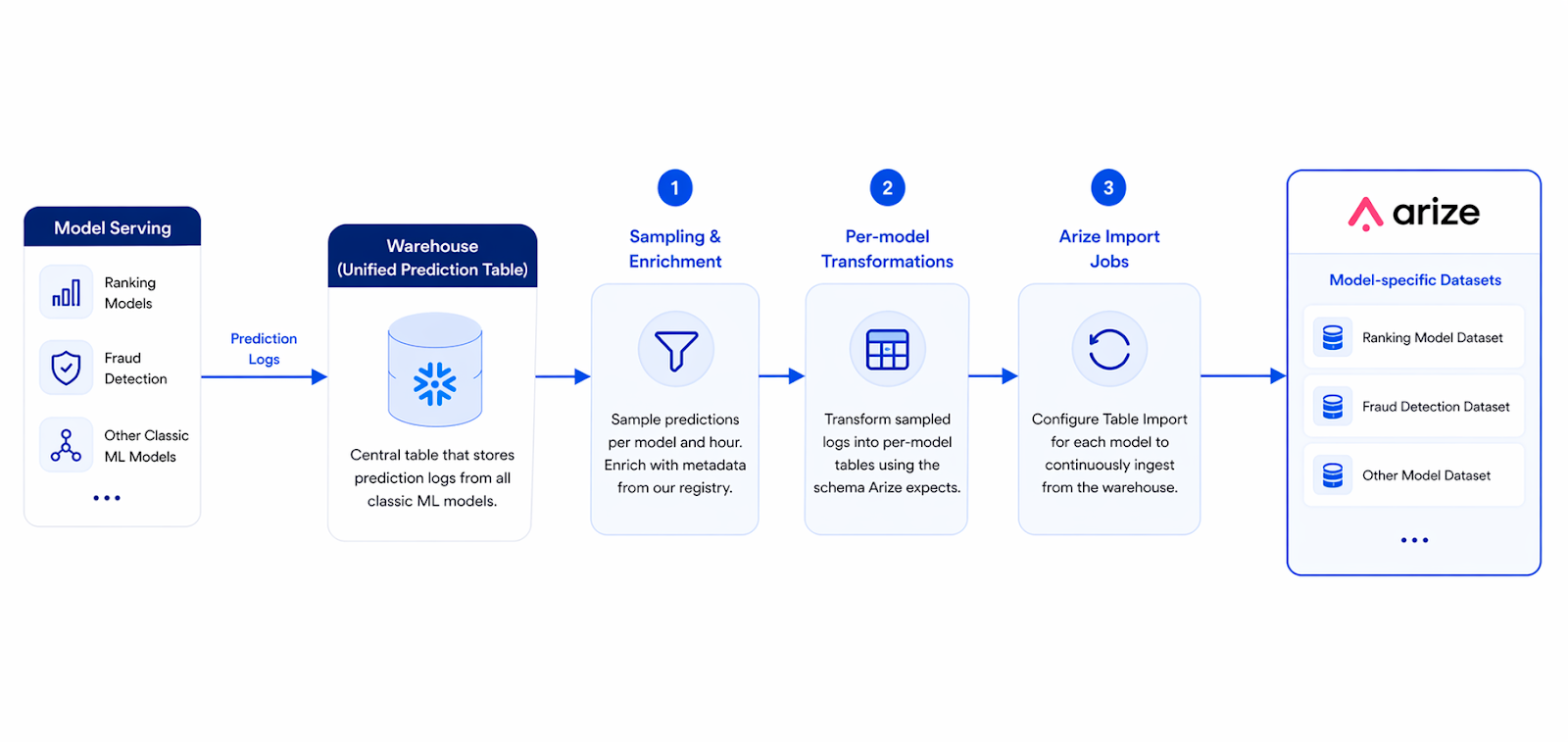 imageデータウェアハウスから Arize へ至る Booking.com の従来の機械学習予測ログパイプライン
AI エージェントと従来の機械学習システムのための統一された観測アーキテクチャ
実務者の視点から見ると、生成 AI と従来の ML システムは異なる形で現れます。エージェント型アプリケーションのデバッグでは、通常、プロンプトのシーケンス、モデル呼び出し、ツールの利用、検索ステップ、評価結果といった一連の流れをトレースを通じて検証します。一方、従来の ML モデルのデバッグでは、生産環境のデータセットが中心となり、特徴量、予測値、ラベル、ドリフト、コホート分析、説明可能性のシグナルなどをチェックするのが一般的です。
裏側で両者のアプローチは同じ原則に基づいています。標準化されたテレメトリ、中央集権的なガバナンス、プライバシーを考慮したデータ処理、そして生産環境での AI システムの挙動を理解するための共通の観測プラットフォームがそれらを支えています。
Booking.com における AI 観測の実用例
生産環境における AI エージェントのレイテンシ劣化の検出
Arize とのパートナーシップの一環として、Booking.com ではモデルとエージェントのパフォーマンスを生産環境で監視しています。ここではエージェントタイプごとのレイテンシドリフトなど、きめ細かい視点でのモニタリングが可能です。
ある事例では、特定のエージェントのレイテンシがベースラインから数標準偏差も上回る急激なスパイクを検知し、Arize のアラートが発動しました。チームは Arize を活用して、その遅延を招いた具体的な呼び出し例を即座に抽出。調査の結果、以前とは異なるモデルを使用する実験として新しい設定がデプロイされたことが確認されました。
Arize によって、レイテンシの増加がランダムな現象ではないことが判明しました。その原因は、このモデルでサービスティアが有効化されていなかったことにありました。この洞察を得たことで、チームは明確な運用対策を講じることができました。具体的には、プロバイダーと連携して適切なサービスティアを有効にし、期待されるレイテンシを回復させたのです。
ここで Arize が Booking.com に提供したのは、パフォーマンスの劣化を早期に検出し、その原因を特定し、監視信号から推測ではなくターゲットを絞った修正へとつなげるための観測性と粒度でした。
AI 評価を用いたチャットボットエージェントにおけるコンテキストの肥大化検出
Arize は本番環境のモニタリングだけでなく、開発者環境とも連携しています。ある行程計画チャットボットエージェントの社内プロトタイピング中に、初期の行程応答以降のメッセージで評価スコアが常に低下していることに気づきました。
エージェントからの最初の返信は堅牢に見えたものの、会話の後続ターンにおける品質と信頼性が低下しており、モデルそのものではなく基盤となる設定に何らかの問題があることを示唆していました。
Arize を用いて新しい行程エージェントの会話と既存のエージェントの会話を比較したところ、ダッシュボード上で明確なパターンが浮かび上がりました。新しいエージェントのトークン数が著しく多く、P90 トークン数は既存の設定と比較して急増していたのです。
さらに掘り下げてみると、この問題は新しいエージェントの重要な変更と関連していました。具体的には、エージェントがアトラクションへのリンクを返すようになったことです。Booking.com のアトラクション用 URL は非常に長く、その長いリンクも会話履歴の一部としてモデルにフィードバックされていました。
その結果、コンテキスト(文脈)は時間とともに膨張し、このコンテキストの肥大化が多ターン会話における評価スコアの低下と相関していました。
プロトタイピング段階で Arize による可視性が得られたおかげで、この構成が本番環境に到達する前に介入することができました。
Booking.com での AI オブザーバビリティのスケーリング
AI システムが単体のモデルから複雑な多ステップエージェントへと進化していくにつれ、オブザーバビリティもそれに合わせて進化させる必要があります。Booking.com では、孤立した指標を超えて、GenAI ワークフローと従来の ML モデルの両方で本番環境でシステムが実際に何をしているかを捉える統合されたビューを構築しています。
テレメトリの標準化、エージェントにはトレースを、従来の ML にはログを使用し、それらを単一のプラットフォームにルーティングすることで、チームが一貫した方法でシステムの理解、デバッグ、改善を行えるようになります。レイテンシの急上昇の調査や微妙な回帰の診断、モデルの意思決定の説明など、状況は異なりますが、目指すゴールは常に同じです。信号から洞察へ、そしてアクションへと至るまでの時間を短縮することです。
このアプローチにおいて、Arize は開発と本番環境を結びつけ、適切な抽象度レベルで AI の振る舞いを分析するためのツールを提供する中心的な役割を果たしています。内部のテレメトリ収集、データ隠蔽、エンリッチメントパイプラインと組み合わせることで、システムの複雑さと組織のニーズに応じて拡張可能な観測性を実現します。
Booking.com では、AI を観測可能にすることは AI の信頼性を高めることに直結しており、その信頼性の向上は「世界中の人々がより簡単に世界を体験できるようにする」という当社の広範なミッションの一部です。
本記事『How Booking.com scales AI observability with Arize』は、Arize AI によって最初に公開されました。
原文を表示
This case study was originally published by Booking.com.
Why Booking.com needs AI observability at scale
At Booking.com, AI helps travellers in every step of their journey, from how people discover destinations to the way we support them while they’re on the road. Rather than a single flagship model, we rely on a large and growing collection of systems that each solve a specific problem at scale.
To make this concrete, consider a few examples:
Trip planning assistants that help travelers turn vague ideas (“somewhere warm in April with good hiking”) into concrete, bookable itineraries.
On‑site helpers that turn property details, amenities, reviews, and options into plain-language guidance, so people can choose the right stay with confidence.
Partner copilots that help accommodation partners and other suppliers respond to guest messages faster and more consistently, while still staying in control of the final reply.
Ranking systems that decide which options to show first in search and recommendation to surfaces, balancing user relevance with experimentation needs.
Fraud detection models that quietly protect customers and partners in the background by flagging suspicious activity before it turns into real harm.
Each of these systems is built and iterated on by different teams, uses different data, and runs under different constraints such as real‑time vs batch, strict latency budgets vs more relaxed ones, fully automated vs human‑in‑the‑loop.
As we scale this ecosystem, observability becomes a first‑class requirement, not a nice‑to‑have as we need to:
Know when something changes in the real world, a new travel pattern, a data quality issue, a misconfiguration and how that affects model behaviour and user experience.
Detect regressions early: slower responses, more confusing answers, drops in relevance or conversion, or subtle shifts that only show up for specific geographies, devices, or user segments.
Demonstrate responsible behaviour: protecting personal data, avoiding harmful or biased outputs, and understanding why a model or agent acted the way it did in a particular case.
Observability matters for every ML system, from traditional models that rank results or flag fraud to agentic GenAI workflows that plan, retrieve information, call tools, and sometimes involve human review. What changes with agentic systems is not the importance of observability, but the complexity of what we need to observe: a single user interaction can become a chain of prompts, model calls, retrieval steps, tool invocations, policy checks, and fallback decisions. Aggregate model metrics and service dashboards may still show that something is slow, costly, or failing, but they often cannot explain how the system reached a particular response. For these workflows, we need end-to-end observability that traces the full path from user request to final outcome.
When we talk about AI observability in this article, we mean the ability to:
Reconstruct what an AI system did for a given request, end‑to‑end.
Measure quality, performance, and reliability over time and across cohorts.
Quickly go from “something looks off” to a concrete, data‑backed explanation and a targeted fix.
To make that possible across both Traditional ML and GenAI, we rely on a dedicated observability platform that can ingest our signals, surface the right views for practitioners, and help teams debug and improve their systems. In the next section, we’ll introduce that platform Arize and explain the role it plays in our AI ecosystem. And, later we’ll dive into how we generate and route the underlying telemetry. Finally, we’ll review some case studies of how we’re using the platform.
How Booking.com uses Arize for ML and AI observability
Building on this landscape, the next challenge is supporting these diverse AI use cases within a single, cohesive platform. This means accommodating both traditional machine learning workflows and newer generative AI applications without fragmenting tooling or processes. Arize provides an AI engineering platform that connects development and production environments, enabling our teams to build, evaluate, and improve AI applications at scale.
Built on the OpenTelemetry Protocol, Arize captures traces from both production and development environments, providing visibility into LLM workflows and agent interactions. OpenInference, created and maintained by the Arize team, extends OpenTelemetry with AI-specific conventions for tracing LLM calls, retrieval operations, agent actions, and tool usage, ensuring that traces capture the context needed to understand complex AI applications. Traces allow the team to dive deep into specific components of a workflow or application and identify targeted areas for improvement.
imageArize AX trace view for a travel concierge agent workflow at Booking.com
Beyond basic tracing, Arize enables us to set up alerts and dashboards not just on trace/span attributes, but on evaluations and custom metrics created within the platform. This means we can monitor application quality metrics – like user frustration rates – alongside traditional operational metrics, giving us a comprehensive view of system health. We can also create datasets for experimentation directly from production data, ensuring we have real-world examples to iterate on.
For traditional ML workloads, Arize provides drift detection across features and model predictions, helping our teams catch data distribution shifts that could impact model performance. The platform provides tools to analyze model performance through cohort analysis, making it easier to identify underperforming segments and understand model behavior across different populations.
imageArize performance and cohort analysis for traditional ML models
Additionally, Arize provides visibility into feature importance values, allowing teams to understand which features contribute most to given predictions. This explainability helps with debugging model decisions and building trust with stakeholders who need to understand how models arrive at their outputs.
How Booking.com collects telemetry for AI observability
To make observability work across different AI systems, we turn their runtime behaviour into telemetry. For GenAI and agentic workflows, this usually means traces that show the steps behind a user interaction. For traditional ML models, it usually means structured prediction logs with features, outputs, labels, and model metadata. Both paths ultimately feed into Arize, but they are collected and prepared differently.
GenAI traces for agents: AI telemetry collector
GenAI and agentic applications are instrumented using OpenTelemetry and AI-specific tracing conventions such as OpenInference. This gives teams a consistent way to represent the main parts of an AI workflow: model calls, retrieval steps, tool usage, guardrails, fallback decisions, latency, token usage, and other metadata needed for debugging.
These traces are sent to a dedicated AI telemetry collector before they are used for observability. At a high level, the collector receives traces from applications, samples them to manage volume, applies centralized PII-aware redaction according to internal data-security standards and applicable privacy requirements, and then routes the redacted traces to downstream systems such as Arize and internal analytics environments.
This design gives teams near-real-time visibility into agent behaviour without every application team needing to build its own custom logging pipeline. It also makes the telemetry path more resilient: short-term spikes or downstream delays can be absorbed by the pipeline, while redaction and routing remain centralized and consistent.
imageBooking.com GenAI AI telemetry collector architecture with PII redaction and Arize export
Logs for traditional ML: from a data warehouse to Arize
For traditional ML models, such as ranking or fraud detection, observability is usually based on tabular prediction logs rather than traces. These logs capture the information needed to understand model behaviour over time: selected input features, predictions, labels when they become available, timestamps, model metadata, and explainability signals where applicable.
This path is intentionally different from raw production logging. The tabular logs prepared for observability do not contain sensitive data. Sensitive attributes and personal data are excluded before records are made available for analysis, and models with stricter requirements may log only approved fields, sampled records, or aggregated signals rather than every prediction. This keeps the observability dataset useful for debugging while staying aligned with internal data-security and privacy expectations.
Most of this data is prepared from our data warehouse before being ingested into Arize. The pipeline samples and enriches prediction records, reshapes them into model-specific datasets, and connects them to the right teams, use cases, and model metadata. Once ingested, teams can use Arize to monitor distributions, detect drift, analyze performance across cohorts, and investigate individual model behaviour when needed.
imageBooking.com traditional ML prediction-log pipeline from warehouse to Arize
A unified observability architecture for AI agents and traditional ML
From a practitioner’s point of view, GenAI and traditional ML systems show up differently. Agentic applications are usually debugged through traces, where teams inspect the sequence of prompts, model calls, tools, retrieval steps, and evaluations. Traditional ML models are usually debugged through production datasets, where teams inspect features, predictions, labels, drift, cohorts, and explainability signals.
Behind the scenes, both paths follow the same principles: standardized telemetry, centralized governance, privacy-aware handling of data, and a shared observability platform that helps teams understand what their AI systems are doing in production.
AI observability use cases at Booking.com
Detecting AI agent latency regressions in production
As part of our partnership with Arize, Booking.com monitors model and agent performance in production with fine-grained views, including latency drifts by agent type.
In one case, an Arize monitor fired when latency for a specific agent suddenly spiked several standard deviations above its baseline. Using Arize, our team quickly pulled concrete examples of slow calls to the alerting agent and confirmed that a new configuration was deployed as an experiment using a different model than before.
Arize helped us identify that the higher latency wasn’t random. It stemmed from the fact that this model was running without a service tier enabled. With this insight, our team could take a straightforward operational action: coordinate with the provider to enable the appropriate service tier and restore expected latency.
Here Arize gave Booking.com the observability and granularity needed to detect performance regressions early, pinpoint their causes, and translate monitoring signals into targeted fixes rather than guesswork.
Using AI evaluations to detect context bloat in a chatbot agent
Arize is not only monitoring production but is also connected to our developer environment. During internal prototyping of one of our itinerary-planning chatbot agents, we noticed that messages after the initial itinerary response were consistently receiving lower evaluation scores.
While the first reply from the agent looked strong, the quality and reliability of subsequent turns in the conversation degraded in a way that suggested something was off in the underlying setup rather than the model itself.
Using Arize to compare conversations from the new itinerary agent against those from the existing agent, we saw a clear pattern in the dashboards: the token count for the new agent was significantly higher, with P90 token counts spiking relative to the existing configuration.
Digging deeper, we connected this to a key change in the new agent: it started returning links to attractions, and those Booking.com attraction URLs are quite long. We were also feeding those long links back into the model as part of the conversation history for subsequent turns. As a result, the context ballooned over time, and this context bloat correlated with the drop in evaluation scores across multi-turn conversations.
Thanks to that visibility in Arize during prototyping, we were able to intervene before this configuration reached production.
Scaling AI observability across Booking.com
As AI systems evolve from standalone models to complex, multi-step agents, observability needs to evolve with them. At Booking.com, this means moving beyond isolated metrics and building a unified view that captures what our systems actually do in production, across both GenAI workflows and traditional ML models.
By standardizing telemetry, using traces for agents and logs for Traditional ML, and routing both into a single platform, we give teams a consistent way to understand, debug, and improve their systems. Whether it is investigating a latency spike, diagnosing a subtle regression, or explaining a model’s decision, the goal is always the same: reduce time from signal to insight to action.
Arize plays a central role in this approach, connecting development and production, and providing the tools to analyze AI behavior at the right level of abstraction. Combined with our internal pipelines for telemetry collection, redaction, and enrichment, it enables observability that scales with both system complexity and organizational needs.
At Booking.com, making AI observable is part of making AI trustworthy, and making it trustworthy is part of our broader mission: to make it easier for everyone to experience the world.
The post How Booking.com scales AI observability with Arize appeared first on Arize AI.
今日のまとめ
AIデイリーブリーフで今日の重要ニュースをまとめ読み