AI エージェントが産業変革を加速する5つの実用例
本文の状態
日本語全文を表示中
詳細モードで約10分の本文を読めます。
同じ出来事の情報源
この情報源を基点に整理
KDnuggets
2026 年を境に AI の議論が対話型チャットボットから自律的なエージェントへと移行し、顧客サポートやサプライチェーン管理などにおいて人間の手を介さずに複雑なワークフローを実行する実用例が業界で広がりつつある。
AI深層分析を開く2026年8月21日 23:19
AI深層分析
キーポイント
AI エージェントの生産環境への本格導入
研究段階から脱却し、2026 年以降は人間のプロンプトを待つチャットボットではなく、外部ツールやデータベースを自律的に操作して多段階タスクを実行するエージェントが企業現場で主流となっている。
エンドツーエンドの顧客サポート自動化
AI エージェントは CRM システムと連携し、在庫確認や返金処理、配送手配といった複雑な多段階課題を文脈を維持したまま自律的に解決するようになり、従来のルールベースチャットボットの限界を超えている。
インテリジェントなエスカレーションと予防的対応
人間による共感や権限が必要なケースでは即座にエスカレートし、問題が発生する前に顧客の状況を予測して再手配や通知を行うなど、ワークフローの効率化と顧客体験の向上を両立させている。
自律的な実行と統合
AIエージェントはCRMシステムに直接統合され、在庫照会やAPI経由での返品処理など、複雑な多段階の顧客問題を人間の手を介さずに解決する。
インテリジェントなルーティングとエスカレーション
人間の共感や高度な権限が必要なケースでは、エージェントは即座にチケットをエスカレートし、問題の要約と過去の文脈を付与する。
重要な引用
Agentic AI has officially moved from the research lab into enterprise production.
In 2026, the AI narrative has shifted dramatically from conversational chatbots ... to autonomous AI agents.
Agents can draft a response, look up inventory in a database, process a return via an API, and update the CRM ticket without a human pressing 'send.'
Today's AI support agents integrate directly into customer relationship management (CRM) systems to resolve complex, multi-step customer issues autonomously
編集コメントを表示
編集コメント
この記事は 2026 年という未来の視点から、AI エージェントがすでに生産環境で定着し、業務の根幹を担っている状況を提示している。実用化のスピードが非常に速く、企業側も従来の自動化ツールから自律型エージェントへの戦略的転換を迫られている状況と捉えられる。
Source Article
元記事を日本語で読む
本文に関係しない購読案内、埋め込み通知、サイト内プロモーションは除いています。
**
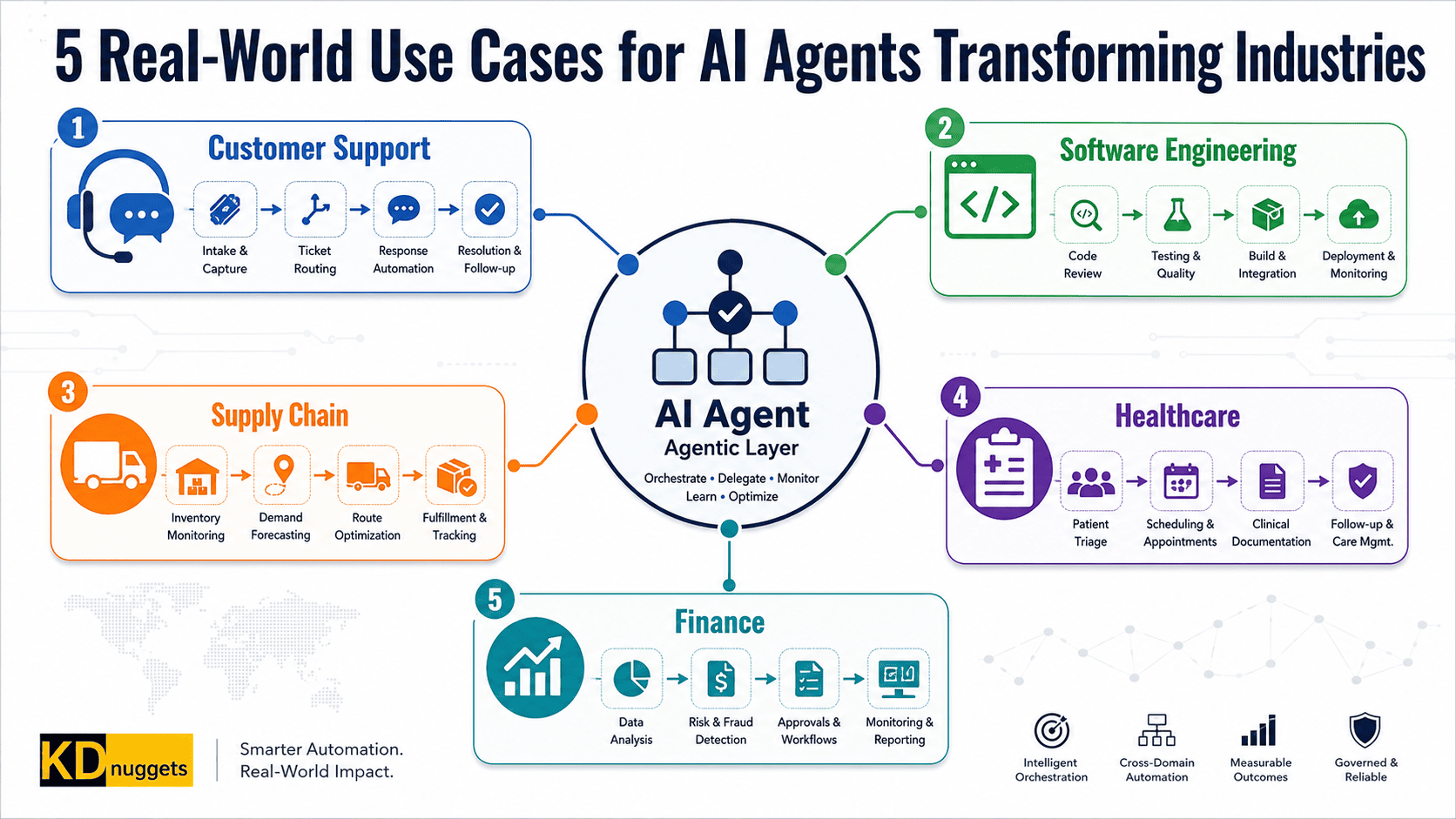
エージェント型 AI はついに研究室から企業の現場へと進出しました。2026 年、AI の話題は人間からの指示を待ってテキストを生成する従来のチャットボットから、自律的な AI エージェントへと劇的にシフトしています。これらのシステムは、人間の継続的な監視なしに外部ツール、データベース、API を跨いで計画を実行し、多段階のタスクに適応できます。
複雑なサプライチェーンの混乱への対応や、不正取引を検出するための数千件の金融取引分析など、エージェントはもはや作業を補助するだけの存在ではありません。彼らはワークフロー全体を実行しています。最新の業界レポートによると、エージェント型 AI を導入した企業では、人間がルーチン業務の実行から離れて監督役へと回ることで、生産性の大幅な向上を実現しています。
本記事では、主要産業を根本的に変革している 5 つの活用事例を探ります。また、こうしたエージェントシステムを自ら構築・実装する方法を学ぶための実践的なリソースも紹介します。
# 1. Automating End-to-End Customer Support and Triage
顧客対応はもはや、堅苦しいルールベースのチャットボットで問い合わせを捌くだけの時代ではありません。従来の自動化では対応しきれないほどサポートチームへの要求が高まっており、顧客はメール、チャット、電話、SNSなど複数のチャネルを同時に利用しながら、迅速かつ正確な解決を求めています。
現在の AI サポートエージェントは、顧客関係管理(CRM)システムに直接統合されており、返金処理や出荷日程の再調整といった複雑で多段階の顧客課題を、すべてのチャネルでの文脈を維持したまま自律的に解決します。
サポートエージェントがワークフローを変革する具体的な方法は以下の通りです。
- 自律的な実行: エージェントは応答文案の作成、データベースからの在庫確認、API を通じた返品処理、CRM チケットの更新などを、人間のオペレーターが「送信」ボタンを押すことなく完遂できます。
- インテリジェントなルーティング: 問い合わせに人間の共感や上位権限が必要とされる場合、エージェントは即座にエスカレーションを行い、生成された要約と過去のすべての文脈を伴って引き継ぎます。
- 能動的なフォローアップ: 顧客がフライトの遅延や注文の問題で苦情を言うのを待つのではなく、エージェントが問題を先回りして察知し、サービスの手配を再予約した上で、顧客に不具合が発生していることを知らせる前に通知を送ります。
その結果、平均処理時間の劇的な短縮と、人間のエージェントが業務時間を過ごす方法の転換がもたらされます。つまり、単純な照会作業から離れ、真に複雑で関係性を重視した対話へとシフトするのです。
学習リソース:LangChain のドキュメントで、カスタマーサポートエージェントの構築方法を確認し、言語モデルを外部のチケット管理ツールや CRM API に接続する方法を学びましょう。
# 2. ソフトウェアエンジニアリングとテストの加速
自律型コーディングエージェントの登場により、ソフトウェア開発は大きな転換期を迎えています。単にコード行を補完するだけでなく、これらのエージェントは GitHub の高レベルな課題(issue)を受け取り、コードベースを検索して機能を実装し、ユニットテストを実行、そして最終的にプルリクエストを提出します。多くの場合、開発者がキーボードに触れることなくこれらが完了します。
エンジニアリングエージェントの主な特徴:
- 文脈を理解したコードベースの把握:エージェントはモデルコンテキストプロトコル(MCP)を活用してリポジトリ全体を読み込み理解するため、新規コードが既存のアーキテクチャや命名規則と整合するように保証されます。
- 自動品質保証(QA):テストスイートの作成と実行を自律的に行い、エラーログを読み込んでデバッグし、すべてのテストに合格するまでコードを反復改善します。
- レガシーシステムの近代化:企業はエージェントを活用して、数十年も前に作られた COBOL や Java のシステムを現代的なフレームワークへ移行させています。この作業は以前であれば、高額な専門契約者の数ヶ月分の時間を要するものでした。
エンジニアリングチームへの影響はスピード向上だけではありません。これまで一日の大半を定型コードの記述やバグの選別(トライアージ)に費やしていた開発者たちは、システム設計、コードレビュー、そしてより高次なアーキテクチャ判断へと注力するようシフトしています。
学習リソース:SWE-agent をチェックして、オープンソースの AI エージェントが実際の GitHub リポジトリ上でどのように自律的にソフトウェアエンジニアリングの問題を解決できるかを確認してください。
# 3. 適応型サプライチェーンの管理
**
グローバルなサプライチェーンは、港湾の混雑や天候事象、地政学的な貿易制限、原材料不足など、突発的な混乱に対して極めて脆弱です。物流企業は今やマルチエージェントシステムを導入し、世界中のデータフィードを監視して、混乱が発生した瞬間に荷送先を自律的にルート変更しています。これにより、以前は数日かかった人間の調整プロセスが、わずか数分で完了するようになりました。
サプライチェーン用 AI エージェントが提供する主な機能:
- リアルタイムのルート再設定: 港湾が混雑したり、嵐で輸送が停止したりした場合、エージェントが自動的に代替ルートを検索し、ベンダーに連絡して納期を調整します。
- 動的な在庫管理: エージェントは需要シグナルを継続的に監視し、在庫量が予測必要量を下回った時点で自律的に発注を実行。高価な品切れを防ぎます。
- 請求書照合: AI エージェントは数千件のサプライヤー請求書を購買注文書や配送伝票と照合し、不整合がある場合に人間による確認を促します。これにより、売掛金処理における手作業の負担が大幅に軽減されます。
学習リソース:多エージェント強化学習(MARL)の概念については、Berkeley AI Research ラボで学び、個別のエージェントが複雑な物流ネットワークにおいてどのように交渉し最適化するかを理解しましょう。
# 4. 臨床トリアージと医療ワークフローの効率化
**
医療現場では、行政業務の負担が引き金となって医師のバーンアウト(燃え尽き)がシステム全体の問題となっています。研究では一貫して、医師が患者への直接ケアに費やす時間と同程度を文書作成や事務作業に割いていることが示されています。AI エージェントは、患者データの安全な管理、スケジュール調整、臨床判断における行政層の処理を担当することで導入が進んでおり、最も時間を必要としている人々にその時間を戻す役割を果たしています。
医療現場でのエージェント活用事例は以下の通りです:
5. 不正送金対策と詐欺検知の拡張
金融機関は、常に詐欺師とのいたちごっこにさらされています。従来のルールベースシステムでは誤検知が大量発生し、コンプライアンスチームを圧迫してしまいます。その結果、ノイズに埋もれた本当に疑わしい活動を見逃してしまうケースが多発していました。
現在、銀行は AI エージェントを活用して、フラグされた事案について文脈を深く理解した調査を実施しています。これにより、ルールベースのエンジンでは不可能なほど迅速かつ正確な判断が可能になっています。
金融エージェントがコンプライアンスを変革する理由:
- 深い顧客確認(KYC)調査: 単にデータベースを検索するのではなく、エージェントはパブリックレコードやニュース記事、企業登記情報を自律的にスクレイピングし、数分という短時間で新規クライアントの包括的なリスクプロファイルを作成します。
- 文脈に基づいた不正分析: 取引が警告された際、エージェントはユーザーの過去の行動履歴、位置情報、デバイステレメトリを参照し、「ブロックするか許可するか」を即座に判断するとともに、完全な監査証跡ドキュメントを生成します。
- 疑わしい活動報告書の自動化: 不正が確認されると、エージェントが強制的な規制報告書を作成するため、人間の分析担当者のコンプライアンス負担が大幅に軽減され、提出までのタイムラインも短縮されます。
学習リソース:金融における機械学習モデルが異常検知やリスクスコアリングのためにどのように訓練されるかを理解するには、DeepLearning.AI の金融向け AI コースをご覧ください。
# まとめ
生成 AI からエージェント AI への移行は、テクノロジーが単に質問に応える段階から、実際に作業を実行する段階へと進化した瞬間を意味します。以下の 5 つのユースケースを通じて、共通のパターンが見えてきます。つまり、エージェントが高頻度でルールに従い、時間制約のある業務実行層を引き受け、人間は監視や例外処理、戦略的な役割へとシフトするという構造です。この役割分担は遠い未来の話ではなく、すでにあらゆる業界の企業現場で稼働しています。
ここで取り上げた 5 つの産業はあくまで出発点に過ぎません。人間の判断と実際の意思決定の間に、大量かつ反復的な業務層が存在する場所であれば、そこにはエージェントがその役割を引き受けるために既に動いている可能性が高いです。本稿全体でリンクされている学習リソースは、こうした理解を自ら構築するための堅固な入り口となります。
Vinod Chugani は、新興 AI 技術と実務家のための実践的応用の架け橋となる AI・データサイエンスの教育者です。彼の専門分野は、エージェント AI、機械学習の応用、自動化ワークフローに及んでいます。技術メンターおよび講師としての活動を通じて、Vinod はデータ専門家たちのスキル向上やキャリア転換を支援してきました。定量金融における分析 expertise を持ち込みつつ、実践的な指導スタイルを展開しています。彼が提供するコンテンツは、プロフェッショナルが即座に活用できる戦略とフレームワークに焦点を当てています。
原文を表示
**
Agentic AI has officially moved from the research lab into enterprise production. In 2026, the AI narrative has shifted dramatically from conversational chatbots — systems that wait for human prompts to generate text — to autonomous AI agents. These systems can plan, execute, and adapt multi-step tasks across external tools, databases, and APIs without continuous human oversight.
Whether navigating complex supply chain disruptions or analyzing thousands of financial transactions for fraud, agents aren't just assisting workers anymore; they're executing entire workflows. According to recent industry reports, enterprises adopting agentic AI are seeing significant productivity gains by allowing humans to step out of the loop on routine execution and into an oversight role instead.
In this article, we'll explore five use cases where AI agents are fundamentally transforming major industries. We'll also highlight practical resources so you can learn how to build or implement these agentic systems yourself.
# 1. Automating End-to-End Customer Support and Triage
Customer service is no longer about deflecting tickets with rigid, rule-based chatbots. The demands on support teams have grown far beyond what traditional automation can handle, with customers expecting fast, accurate resolutions across email, chat, phone, and social channels simultaneously. Today's AI support agents integrate directly into customer relationship management (CRM) systems to resolve complex, multi-step customer issues autonomously — from processing refunds to rescheduling shipments — while maintaining context across all those channels at once.
Here's how support agents are changing the workflow:
- Autonomous Execution: Agents can draft a response, look up inventory in a database, process a return via an API, and update the CRM ticket without a human pressing "send."
- Intelligent Routing: If a query requires human empathy or high-level authorization, the agent escalates the ticket instantly, passing along a generated summary of the issue and all prior context.
- Proactive Follow-ups: Instead of waiting for a customer to complain about a delayed flight or order, the agent anticipates the issue, rebooks the service, and notifies the customer before they realize anything went wrong.
The net result is a dramatic reduction in average handle time and a shift in how human agents spend their working hours — away from repetitive lookups and toward genuinely complex, relationship-sensitive conversations.
Learning Resource: Explore the LangChain** documentation on building customer support agents to learn how to connect language models to external ticketing tools and CRM APIs.
# 2. Accelerating Software Engineering and Testing
**
Software development is experiencing a significant shift with the introduction of autonomous coding agents. Instead of simply autocompleting lines of code, these agents can take a high-level GitHub issue, search the codebase, write the feature, run unit tests, and submit a pull request — often without a developer touching the keyboard.
Key features of engineering agents:
- Contextual Codebase Understanding: Agents use the Model Context Protocol (MCP) to read and understand entire repositories, ensuring new code aligns with existing architectures and naming conventions.
- Automated Quality Assurance (QA): They can autonomously write and execute test suites, debug failures by reading error logs, and iterate on the code until all tests pass.
- Legacy Modernization: Companies are deploying agents to translate decades-old COBOL or Java systems into modern frameworks, a task that previously required months of expensive specialist contractor time.
The implications for engineering teams extend beyond speed. Developers who previously spent the majority of their day on boilerplate and bug triage are shifting toward system design, code review, and higher-order architectural decisions.
Learning Resource: Check out SWE-agent** to see how open-source agents can resolve genuine software engineering issues autonomously on real GitHub repositories.
# 3. Orchestrating Adaptive Supply Chains
**
Global supply chains are incredibly vulnerable to sudden disruptions, from port congestion and weather events to geopolitical trade restrictions and raw material shortages. Logistics companies are now deploying multi-agent systems to monitor global data feeds and autonomously reroute shipments the moment a disruption is detected, compressing a response that once took days of human coordination into minutes.
What supply chain agents offer:
- Real-time Re-routing: When a port is congested or a storm halts transit, the agent automatically searches for alternative routes and contacts vendors to adjust delivery windows.
- Dynamic Inventory Management: Agents continuously monitor demand signals and autonomously execute purchase orders when stock levels dip below predicted requirements, preventing costly stockouts.
- Invoice Reconciliation: AI agents can match thousands of supplier invoices against purchase orders and shipping receipts, flagging discrepancies for human review and reducing manual effort in accounts payable significantly.
Learning Resource: Read up on multi-agent reinforcement learning (MARL) concepts at the Berkeley AI Research** lab to understand how distinct agents negotiate and optimize complex logistical networks.
# 4. Streamlining Clinical Triage and Healthcare Workflows
**
In healthcare, clinician burnout is a systemic crisis driven heavily by administrative overhead. Studies consistently show that physicians spend nearly as much time on documentation and paperwork as they do on direct patient care. AI agents are being deployed to securely manage patient data, coordinate scheduling, and handle the administrative layer of clinical decision-making — giving time back to the people who need it most.
Here's how agents are being applied in healthcare:
- Ambient Documentation: Agents listen to patient-doctor interactions, autonomously generate structured clinical notes, and route them to the Electronic Health Record (EHR) system, eliminating the after-hours documentation burden that contributes heavily to burnout.
- Insurance Pre-authorization: AI agents can analyze a doctor's prescribed treatment plan, cross-reference it with payer policies, and submit the pre-authorization paperwork in minutes rather than the days it typically takes through manual processes.
- Post-Discharge Monitoring: Agents autonomously follow up with patients via text or voice to monitor recovery, escalating anomalies to a nurse when necessary and catching complications earlier than traditional check-in schedules would allow.
Learning Resource: Review the Kore.ai** healthcare agent framework to see how enterprise platforms handle HIPAA-compliant, multi-step clinical workflows at scale.
# 5. Scaling Anti-Money Laundering and Fraud Detection
**
Financial institutions are engaged in a constant arms race against fraudsters. Traditional rule-based systems generate massive volumes of false positives, overwhelming compliance teams and causing them to miss genuinely suspicious activity buried in the noise. Today, banks use AI agents to conduct deep, contextual investigations into flagged activities, making faster and more accurate decisions than any rule-based engine can produce.
Why financial agents are changing compliance:
- Deep Know Your Customer (KYC) Investigations: Instead of simply checking a database, agents can autonomously scrape public records, news articles, and corporate registries to build a comprehensive risk profile on a new client in a fraction of the time.
- Contextual Fraud Analysis: When a transaction is flagged, the agent reviews the user's historical behavior, location data, and device telemetry to make an immediate "block or allow" decision with full audit trail documentation.
- Automated Suspicious Activity Reports (SARs): If fraud is confirmed, the agent drafts the mandatory regulatory report, significantly reducing the compliance burden on human analysts and accelerating the filing timeline.
Learning Resource: Explore the DeepLearning.AI** courses on AI for finance to understand how machine learning models are trained for anomaly detection and risk scoring in financial environments.
# Summary
The transition from generative AI to agentic AI marks the moment when technology moves from simply answering questions to actively doing the work. Across these five use cases, a consistent pattern emerges: agents absorb the high-volume, rule-bound, time-sensitive execution layer of a workflow, while humans shift into oversight, exception handling, and strategic roles. That division of labor isn't a distant vision; it's already running in production at enterprises across every sector covered here.
The five industries here are just a starting point. Wherever there's a high-volume, repetitive execution layer sitting between humans and the decisions that actually matter, there's a good chance an agent is already working to take it on. The learning resources linked throughout are a solid place to start building that understanding yourself.
Vinod Chugani is an AI and data science educator who bridges the gap between emerging AI technologies and practical application for working professionals. His focus areas include agentic AI, machine learning applications, and automation workflows. Through his work as a technical mentor and instructor, Vinod has supported data professionals through skill development and career transitions. He brings analytical expertise from quantitative finance to his hands-on teaching approach. His content emphasizes actionable strategies and frameworks that professionals can apply immediately.
関連記事
今日のまとめ
AIデイリーブリーフで今日の重要ニュースをまとめ読み