OpenAI の Scott Aaronson 氏らが AI テキスト透かし技術の無料・高品質な解決策を公開
本文の状態
日本語全文を表示中
詳細モードで約24分の本文を読めます。
同じ出来事の情報源
この情報源を基点に整理
The Zvi
Anthropic が EU コード遵守のため AI テキストにウォーターマーキングを導入し、Google が先行して同技術を展開している事実が明らかになった。
AI深層分析を開く2026年8月22日 04:26
AI深層分析
キーポイント
技術的実装と性能
Scott Aaronson と Hendrik Kirchner が開発した手法により、AI の出力にシークレットキーに基づく擬似乱数でウォーターマークを埋め込み、人間には判別不能かつコストほぼゼロで検出可能である。
規制対応と業界動向
欧州連合のコードプラクティス遵守のため Anthropic が導入を発表し、Google は Gemini 3.7 Flash などですでに 2024 年から同機能を展開している。
技術的限界とリスク
ウォーターマークは文章を再構成することで除去可能であり、AI の詳細な選択を保持する割合に応じて検出されるため、完全な防止策ではない。
Anthropic Derangement Syndrome
人々が技術的なウォーターマーキング自体に怒るのではなく、最初に導入を発表した Anthropic という企業への不信感や偏見を理由の代わりに利用している。
実質的な効果は検知 API の提供のみ
この措置の実践的な影響は、文章が Claude 由来かどうかを判定する API が存在することだけであり、それ以上の制限や干渉はない。
重要な引用
The method has very nice properties: This has no practical impact on outputs. Humans cannot tell the difference, at all.
The marginal cost of doing this is very close to zero.
Google implemented this, including for Gemini 3.7 Flash, and they have been rolling out this feature since 2024.
This is the main reason. Let's not pretend otherwise.
編集コメントを表示
編集コメント
技術的な実装コストがほぼゼロでありながら、規制対応という明確な目的を達成できる点は画期的である。しかし、書き換えによる除去可能性を考慮すると、この技術は完全な防衛策ではなく検出・追跡の手段として位置づけられるべきだ。
Source Article
元記事を日本語で読む
本文に関係しない購読案内、埋め込み通知、サイト内プロモーションは除いています。
OpenAI で活動していたスコット・アロンソン氏は、ヘンドリック・キルヒナー氏と共に、AI テキストの透かし(ウォーターマーク)技術の実現に大きく貢献しました。
この解決策の仕組みは以下の通りです。あるいは、テノブルス氏の解説版も参照してください。
AI が生成する出力は決定論的ではありません。AI の役割は、次のトークン候補それぞれの確率を算出することにあります。そして、その中からランダムに一つが選ばれます。
通常、各選択には擬似乱数源を使用します。真のランダム性は扱いにくいからです。
透かしを適用するには、秘密鍵から導き出された、それと同等の擬似乱数源(プライベートな乱数源)を利用します。
十分な量のテキストが得られれば、その選択結果が特定の擬似乱数源に合致している度合いを示すスコアを算出できます。これは別の乱数源と比較して評価されます。
誰でも透かしの有無を確認できる API を提供します。
さらに詳しく知りたい場合は、完全な論文をご覧ください。この手法には非常に優れた特性があります。
- 出力に実用的な悪影響はありません。人間が違いを感知することなど、決してありません。
- この処理にかかる追加コストは、ほぼゼロです。
- 透かしは、自分の言葉で書き直すことで除去可能です。AI の詳細な選択結果をどれだけ保持するかに応じて、透かしの痕跡も比例して現れます。
主要な西洋の AI ラボが署名した「欧州連合(EU)コード・プラクティス」では、将来の AI モデルにおいてこのような透かし技術の使用が義務付けられています。
Google は 2024 年からこの機能を順次導入しており、Gemini 3.7 Flash でも採用されています。実際、Anthropic が現在行っていることと全く同じことを、Google は過去 2 年以上にわたって実施してきました。ただし Google の場合は公開された検出器を備えている点が異なります。また、Google は 2,000 万人規模のテストで、ユーザーからのフィードバックに差がないことを確認しています。
Anthropic は先週、EU コード・オブ・プラクティスへの準拠のためにウォーターマーキングを導入すると静かに発表しました。トラフィックソースを区別したくないため、追加コストはゼロであり、社会貢献にもつながるため、この機能はすべてのユーザーに適用されます。その後、仕組みについての FAQ も公開されています。
将来的には、他の理由でトラフィックの区別が可能になった場合、もし普遍的水マーキングが有害だと判断されれば、ここでも利用される可能性があります。しかし私は、これは良い取り組みだと考えています。
私の最初の印象は、これが「コストやデメリットもゼロで機能する良い仕組み」を示す静かなる好事例であるという点でした。そのため、当初の報道では以下のようにまとめました。
Zvi Mowshowitz (AI #181): EU コード・オブ・プラクティスに基づき、Anthropic は今後は Claude の出力(テキストを含む)にウォーターマーキングを付与します。多くの人が Claude のテキストに対して自動的に「これは Claude のテキストです」という大きなネオン看板を見ているようなものですが、実際には目立たない形で実装されます。OpenAI も追随する意向を示していますが、期限までに間に合うかは不透明です。
ライアン・グリーンブラット氏の言う通り、ウォーターマーキングが品質を著しく低下させる可能性は低いと考えます。一方で、パングラム(Pangram)との比較において、人間の文章に対する軽微な AI による改変を誤検知しない点でパングラムの方が優れているというデメリットはあります。
ブルッセルのような機関がこのように政策を決めることに不満を持つことは理解できますが、コストが低いのであれば技術的なウォーターマーキングの実施は明らかに有益です。それとは異なる反応を示す人々の直感は、少し歪んでいるのではないでしょうか。体系的なウォーターマークの除去を手伝ったり、それを戦略として提案したりする人は、「私たちは本当に悪者なのか」と自問する必要があります。
これは、除去を研究して対策や防御に役立てるという文脈とは異なります。もちろん、そのような研究自体は問題ありません。実際に実践でウォーターマークを除去しようとする場合にのみ、「悪者」になるかどうかの問いが浮上します。
目次
これは大丈夫だ。
アンソロピック・デラメント症候群。
人々は LLM の出力がすでにランダムであることを理解していない。
人々はコストがかからない方法への信頼を持てない。
人々は原則としてあらゆる改変に懐疑的だ。
もしかしたら「ウォーターマーク」という言葉のせいもあるかもしれない。
多くの人は捕まることを望まない。
認識されたくない場合もある。
懸念すべき正当な理由もいくつかある。
チート、チート、チート、チート、チート。
中盤の文章と誤り率。
防衛には数百万ドルを投じるが、貢ぎ物には1セントも出さない。
これは大丈夫だ
いいえ。それほどでもありません。多くの人が激怒して反応しました。
というわけで、私たちは今ここにいます。
実質的な影響はこうです。ある文章が Claude によって生成されたかどうかを判定する API が登場します。それだけのことです。
しかし、なぜこれほどまでに人々が怒っているのでしょうか?
Shoshannah Tekofsky は、「水マークへの反対意見のほとんどはでっち上げだ」と指摘しています。
この投稿では、なぜ人々がこれほどまでに激昂しているのかを探ります。同時に、実際には大した問題でもないのに、人々がどうやって熱狂してしまうかの事例としても機能します。
私の結論としては、複数の要因が絡み合っているという点です。
Anthropic への過剰反応
これが主な理由です。言い訳はできません。
Google に対して同様のことで大騒ぎする人はいません。OpenAI に対しても同様です。実際、この技術は OpenAI で発明され、彼らは今後これを実装することにコミットしています。それなのにです。
不幸なことに、EU コード・オブ・プラクティスへの準拠のために水マークを実装すると最初に発表したのが Anthropic でした。
そのため、この施策が Anthropic と結びつけられてしまい、あらゆるネガティブな印象が付着しようとしています。特定の層は、怒る理由を必死に探しています。
Anthropic はどうあがいても勝てません。もし当初から強く主張していたら、水マークと Anthropic を強く結びつけていたでしょう。しかし、実際には大した問題ではないため、当初の声明が控えめだったことが逆に批判され、結局は Anthropic に結びつけられてしまいます。Google がすでに 2 年以上前に実装し、公開検出器をリリースしているという事実にもかかわらずです。
レイモンド・アーノルド:なぜ人々が Anthropic のテキストウォーターマークに対してこれほど激しく批判するのか、私には全く理解できません。これは彼らを非難する理由として最も愚かなものです。
j⧉nus:人々が Anthropic に怒ったり恐怖を感じているのには正当な理由があると思いますが、その多くは自分自身でも言語化できていないようです。そのため、Anthropic が行うことすべてに対して不満を持つための理由を無理やり見つけようとしています。あるいは、理由など必要ない人も大勢いるのです。
j⧉nus:> この世で怒るべきことは山ほどありますが、これはその一つではありません。
まさにその通りです。またしても人々は Anthropic が行うことすべてに対して無差別に怒りたがります。これでは、実際に非難されるべき重要な問題の信号がかき消されてしまいます。
私が知る限り、ウォーターマークに対して怒る合理的な理由はただ一つあります。それは、モデルが匿名で文章を書く可能性を奪ってしまう点です。
もし、誰にも知られずに AI を自分の執筆活動に利用したいと考えているなら、他人の名前を使わずにクレジットを与えないことが間違っていることを考えるべきでしょう。
AI は広く「人」とはみなされていませんが、クレジットは正当な場所に与えられるべきものです。
ウォーターマークに関する他の不満には、正当なものや理解できるもの、あるいは真の誤解から生じたものもあるでしょうか?もちろんあります。しかし、多くの場合、人々は Anthropic の姿勢が悪いと感じており、そのために不平を言える理由を探し、私が最初に提示した説明を原則として信じようとせず、背後に何か悪意あるものが隠れていると勝手に思い込んでいます。
一部の人の不安や混乱は、アンソロピックという特定の企業に向けられているのではなく、「オープン性」という抽象的な概念そのものに向かっています。文脈によってはこれが同じことを意味することになります。これは「オープンでないから悪意があるはずだ」という一種の執着の例です。実際にはこのケースでは数学的なものであり、誰でも検証可能です。もちろん、エロン・マスクは競合他社のモデルをすべてクローズドに保ちながら漠然としたオープンな雰囲気を出しているため、クローズドなモデルである Grok に問い合わせているのです。
人々は LLM の出力がすでにランダムであることを理解していない
AI の出力が決定的(デターミニスティック)であれば、少なくともわずかに品質を低下させることなく透かしを埋め込むことは不可能です。
多くの人は直感的に、AI の出力はランダムではないと考えています。つまり、得られる結果は「唯一の真なる出力」だと信じているのです。しかし、同じ出力を再生成すれば、確実にもう少し異なる結果が返ってきます。したがって、「本物」や「オリジナル」の出力が得られないのであれば、その出力は何らかの形で劣化したに違いないと考える人がいます。
人々が「透かし」という言葉を聞くと、それは必ず出力を悪化させるものだと考えます。なぜなら、痕跡を残すためには異なる選択をする必要があり、何かを変更しなければならないからです。
同様に、追加の目的のために最適化するならば、それにはコストがかかるはずだと誰もが推測します。
これは直感的に正しい考え方です。
しかし、このケースではその直感は誤りです。十分なランダム性を利用できるため、同じ効果的な分布を維持したまま透かしを埋め込むことが可能だからです。
そして、誰もがこの仕組みを完全に理解しているわけではありません。スコット・アロンソンの詳細な論文を読む人はほとんどおらず、そのため「これは常識だ」と思っている人も極めて少ないのです。ディスコース(Discourse)のようなプラットフォームで、人々が基礎的な技術的事実を知っていると期待するのは、逆に混乱を招くだけです。
コストがかからない方法への不信感
ここでの懐疑心は、アンソロピックに対する「アンソロピック・デランジメント症候群」とも呼べる過度な警戒感や、「何か裏があるに違いない」という不信感が大きく影響していると考えられます。
では、その懐疑心のうちどれが方法自体への不信によるものなのでしょうか?
簡単な調査によると、大半の懸念は「この手法そのもの」に対するものであることが示唆されています。
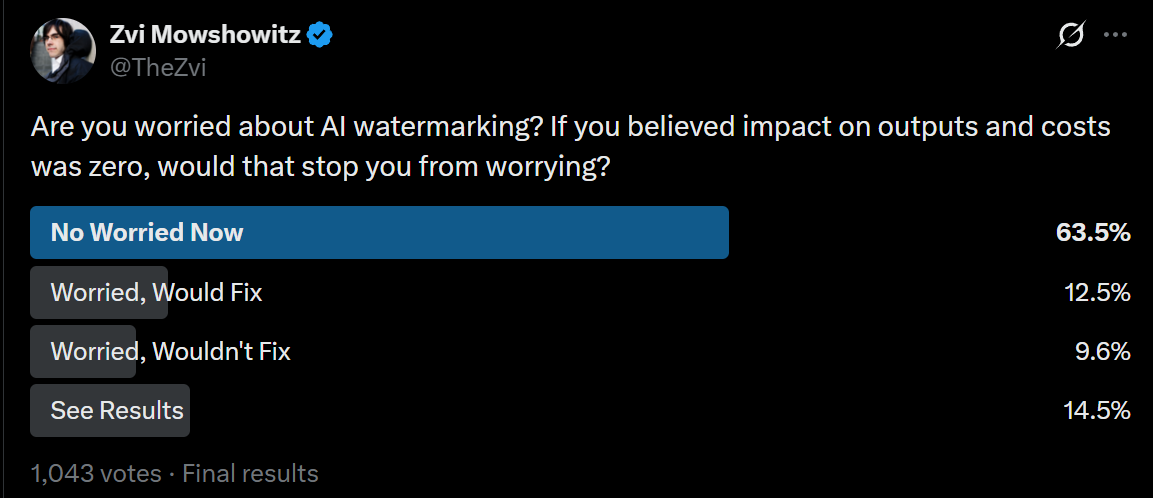
デイビッド・マンハイムはこう指摘しています。「本来 2 年前から導入されるべきものが、なぜ今さらなのか。それ以前に、この手法が事実上ゼロコストであり、検出も不可能であることは、スコット・アロンソンが手法を開発してから 1 年後にディープマインドがすでに採用していたにもかかわらず誰も気づかなかったという事実からも明白です」。
あるスレッドでは、出力への影響が事実上ないことを受け入れられない人が見られました。その理由として、データ分布が変わらないことが挙げられています。
この技術は魔法のトリックであり、数学的な証明によって成り立っています。"影響を与えずにマーキングできる"という事実は直感に反するもので、人々の本能的には「不可能だ」と反応しがちです。しかし、ある瞬間に理解が深まり、「これは数学的事実であり、実際に可能なのだ」と気づくのです。
John David Pressman: 正直言って、こうした事例をもっと増やすべきだ。認識論的な過ちを頑なに守る人が多すぎる。
SE Gyges: これは間違いだったと確信する。削除して敗北(L)を認める。実際に最悪の条件下でテストした結果だ。

たとえ元の敗北(L)の状況を目撃していなくても、公の場でこうして潔く「L」を認める人に対しては、私はより良い評価をするでしょう。全員が同じ反応をすると予測される場合、ゲーム理論的な問題が生じる可能性はありますが、実際には誰もそう予測していないため、この行動は安全かつ賢明です。
この手法には技術的に"トレードオフがある"と必死に主張し、コストがかかっているように見せようとする人々がいます。しかし、実際にはコストゼロであり、Googleも広範な実験を通じてその事実を証明しています。なぜなら、人々はこの手法がコストゼロであることを認めたくないという強い心理的バイアスを持っているからです。
数学的な根拠が明確であるにもかかわらず、原則として「いやだ」と拒絶する態度の典型例です。また、「自分の選択を慎重に検討している」という論理に基づいて品質低下が観測されたかのように主張し、どちらの選択肢も本質的にランダムであることを理解しようとしない姿勢も、幻覚(ハルシネーション)による品質低下の捏造事例と言えます。
これは「ランダム」の意味を理解していないふりをする、より悪質な例です。ある人が「2 つの可能な続き方がある」という記述を、「その 2 つの続き方が同じ意味を持つ」と主張していると誤読しています。
原則としてあらゆる改変に懐疑的になる人々
上記の調査から明らかになったのは、以下のような意見です。
エリナー・バーガー氏:「心配はしていないが、LLM API の出力が私のニーズに合わない形で改変される可能性があると聞かされれば、それが無害であっても受け入れたくありません。こうした事例が増えれば増えるほど、私はオープンモデルの使用へと傾きます。これは著作権には異議を唱えず、DRM(デジタル著作権管理)や同様の介入手段に対して私が抱く反対意見とも整合しています。私が支払うソフトウェアサービスが、私の要件と一致していないからです。」
このような考え方は非常に多く見られます。
- 私を助けるため以外の改変は、本質的に疑わしく、私に害を与える可能性がある。
- 私が顧客である以上、他人が私の所有物を弄る権利はない。
モデルがオープンかクローズドかを問わず、その製品は数千万もの意思決定の産物です。しかし、その多くは顧客であるあなたが何を望んでいるかとは関係のないものです。すべての製品は絶えず「改変」されています。その変更は、あなた個人や一般的なユーザー・顧客のニーズに必ずしも合致するわけではありません。法的要件や危害防止など、解決すべき課題も山積しています。
こうしたことが目に見えない場合、人々は気にしません。しかし、特定の要素が際立つようになると、人々は怒り出します。
DRM(デジタル著作権管理)との比較も、この議論を台無しにしています。DRM は実装方法にかかわらずすべて酷いものです。なぜなら、それは製品を劣化させるからです。最善の場合でもリソースを浪費し、時には製品の使用自体を妨げ、場合によってはマシンを破損させます。ゲーマーの皆さんは、その痛みをよくご存じでしょう。著作権が自発的に執行されない以上、あなた個人がそれを尊重しようとしても、一部の対策を講じる必要があるのです。
しかし、これはそれとは異なります。ただ、少し雰囲気が似ているだけで、それが十分すぎるほど嫌悪感を生む可能性があります。
もしかしたら「ウォーターマーク」という言葉のせいかもしれません
そう思いますか?同じ理由で、「シークレット(秘密)」という言葉の方が十倍ほど酷いことになるでしょう。
Shoshannah Tekofsky:それは「ウォーターマーク」という言葉です!
人々は今、ありえないほど煩わしいパターンが重ねられたストックイメージを連想します。しかし、Anthropic が行っていることはそれとは全く異なります。AI に関する新しい用語が必要です。
私は「シークレット」を提案します。「秘密」であれば、明らかに気づきにくいものです。人々はそれに気づかないことを当然と期待するからです。
「ステガノグラフィック・シグネチャー」という概念が私たちが目指すものですが、この言葉を使っても多くの人は理解してくれないでしょう。
ここでは、誤った印象を与えたり、「何かを改変するために余計な手間をかけた結果、かえって悪化させた」と思われたりする表現は避けるべきです。そこで「ウォーターマーク」という名称が比較的適切だと考え、婉曲的な言い換えの連鎖に走る必要はないと判断しました。
多くの人は捕まることを望まないのは当然です。
もちろん、それをそのまま公言することはできません。一部の人にはそれが可能かもしれませんが、多くの人々はそうしない選択をします。その理由が完全に自覚的であるとは限りません。
ミク氏の逆走:実際には、人々が Claude を使って最終的な出力を作成していることを他人に知られたくないという本音から怒っているように感じられます。「みんな、落ち着いてください」です。
状況を過剰に考えすぎないでください。多くの人は、AI による文章を自分のものとして見せかける能力や、それを証明できない状態を重視しています。
また、「ChatGPT に乗り換えれば大丈夫」というわけにもいきません。そこにも同様にマークが付けられるからです。
さらに、「やる必要はありませんが、もしやればこうなる」といったケースもいくつか存在します。
認識されたくない場合もあります
Anthropic や API を使って、どのユーザーがそのテキストを生成したかを特定できるのでしょうか?
いいえ。Anthropic の FAQ によると、この方法では特定のユーザーを特定することはできません。
懸念すべき正当な理由もいくつかあります
社会のダイナミクスに影響を与える変更であれば、反対意見の多くが誤りであり、その変化が明らかに有益に見える場合でも、必ずしもデメリットや懸念点が存在します。
少なくとも私には妥当に見える手法をいくつか紹介します。
ただし、最も懸念すべき点は「不正行為」です。悪意のある利用者がウォーターマークを除去するリスクが現実味を帯びています。
ウォーターマークの除去は容易ではありませんが、学習用の正解データ(アンサーキー)と検証プロセスが存在すれば、AI ツールによって小さな選択を撹乱し、ウォーターマークを劣化させたり消去したりするツールを開発できる可能性は十分にあります。その結果が正しいかどうかを確認することも可能です。
また、ウォーターマークを持たないローカルモデルや、誰もチェックしないような他のモデルを利用するという手もあります。
これは状況をさらに悪化させる可能性があります。なぜなら、彼らは「検出されなかった」という偽のネガティブを防御手段として利用できるようになるからです。普段は信頼できるほど精度の高いテストであっても、いざという時に偽装可能であれば、それは非常に危険な事態になり得ます。
私の見解としては、こうした行為は面倒くさいものとなるでしょうし、何より「罪悪感を隠すための明らかな行動」であり、最初の AI 利用そのものよりも遥かに悪いことです。また、他の検出手法も依然として機能します。例えば Pangram は、私が想定するやり方で実施された場合でも、AI 生成であることを明確にマークし続けます。元の AI がどのモデルかについてはユーザーには表示されませんが(Pangram のアルゴリズムは異なる AI を識別可能ですが)、少なくとも「AI 由来である」という判断を誤ることはありません。また、人間が読んでも依然として「AI による文章」であると認識されるはずです。
例えば、大学生がこれを利用し、大学側がウォーターマークの証明なしには行動を起こせない場合、問題が悪化しかねません。しかし現在は、学生はより多くの労力を投入する必要があり、明確な故意(mens rea)が存在します。実務的には、このようなケースが頻発するとは考えにくいです。
現実世界でのテスト結果も、不安を抱く必要がない理由の一つです。Pangram は誰でも利用可能です。理論上は、誰しもが人間と判定されるまで Pangram の結果を反復して確認できるはずです。しかし、実際の現場で人々がどのように反応するかを観察すると、ほぼ誰もそのようなことは行いません。人々は単に……捕まってしまうのです。
一般的に、AI による提出物の質を高めるための努力レベルを引き上げれば、それは概ね効果を発揮します。もしウォーターマークを除去するために文章全体を自分の言葉で書き直したのであれば、もちろん問題なく、これは「ミッション・ファッキン・アコンプリッシュド(大成功)」と評価されるべきです。
中間の記述とエラー率について
AI をある程度利用しつつも、実質的には人間が主に執筆している場合、ウォーターマークはどうなるのでしょうか?AI の表現を一部借用した場合でも、文章の大部分が自分のものなら、人々はそれを AI 作成と分類するでしょうか?あるいは、ゼロ・トレランス(厳罰)ポリシーの下で不幸な事例が生じる可能性はあるでしょうか。これらはすべて確率的な問題です。では、回答が誤った場合どうなるのでしょうか?
結論から言うと、このウォーターマークは AI による処理を検知する仕組みです。そのため、翻訳やファイル変換がトリガーになる可能性はありますが、それは仕方のないことです。
同様に、Claude に自動で編集を任せる形で校正を行う場合も検出される可能性があります。しかし、エラーを見つけるために利用し、修正は自分で行うのであれば問題ありません。
つまり、AI による文章作成や処理に対して、強いウォーターマークのポジティブ判定が真陽性(True Positive)として一貫して機能することに私は確信を持っています。私の投稿にはゼロではない程度のウォーターマークシグネチャが含まれるでしょう。他者の引用や、時折 Claude を直接引用する部分があるためです。直接引用は明確に区別されていますが、ウォーターマークはその違いを判別できません。
AI システムから得た言葉を使う場合、特にその利用が明らかに有益な場面であっても、ある程度の警戒心(パラノイア)が生じるのは避けられないでしょう。
したがって、そのような現象が少し起こることは仕方ありません。しかし、人々はすぐにこの状況に慣れるはずです。また、より多くの情報を提供することは善であり、それに対する反応は各人の判断に委ねられるべきです。もし AI の使用を極端に嫌悪する層の中にいて、かつ実際に API を利用している場合は、API を通じて自分の出力を事前に確認することも可能です。あるいは、そのような人々の好みを尊重し、私たちが「有益」と認めるような場面であっても AI を使わないという選択もできます。
通常、実際の誤りや偽陽性の観点から、人々は自動化システムによるエラーや潜在的なエラーに対して、人間によるものよりもはるかに低い許容度を持っています。誤り率は非常に低くなるでしょう。もし人間があなたが AI を使用したかどうかを判断しようとすれば、その誤り率は水マークと比較して遥かに高くなります。また、AI の利用においては、「証明」を求める要求が過度になりがちです。特に学術界では、誰もが知っている行為に対して「免罪」が許されるケースも少なくありません。これは刑事法とは異なります。誰かを刑務所に入れるわけでもないのですから、同じほど高いレベルの信頼性を求める必要はありません。
「国防には数百万ドルを、貢ぎ物には1セントも出さない」というスローガンがあります。最後の懸念点は水マークそのものではなく、EU コード・オブ・プラクティスに由来する義務付けに関するものです。
Anthropic は EU 法により世界的に水マークを実装しました。EU のみに適用するよりも、全世界で実装する方がはるかに容易だからです。つまり、EU が我々の貴重な AI 生成トークンを損ない、不純物で汚染していることになります。
原文を表示
Scott Aaronson, while working at OpenAI, largely solved AI text watermarking together with Hendrik Kirchner.
Here is how his solution works, or see Tenobrus’s version.
AI outputs are not deterministic. The AI’s job is to pick the probability of each potential next token. The token is then chosen at random.
By default you use a source of pseudo-randomness for each choice, since actual true randomness is annoying.
To apply the watermark, you use an otherwise identical private source of pseudo-randomness derived from a secret key.
Then, given enough text, a score is derived for howe well the choices fit with that particular pseudo-randomness source, versus a different source.
You provide an API that lets anyone check for the watermark.
If you want to dig deeper, here is a full paper. The method has very nice properties:
This has no practical impact on outputs. Humans cannot tell the difference, at all.
The marginal cost of doing this is very close to zero.
The watermark can be removed by rewriting in your own words, and appears in proportion to how many of the AI’s detail choices you kept.
The European Union Code of Practice, signed by the major Western AI labs, requires future AI models to use such watermarks.
Google implemented this, including for Gemini 3.7 Flash, and they have been rolling out this feature since 2024. Google has done, for over two years, the exact thing Anthropic is now doing, except with a public detector, and Google confirmed in a test (n = 20 million) that there is no difference in user feedback.
Anthropic quietly announced a week ago they were rolling out watermarking to comply with the EU Code of Practice. Since they don’t want to have to differentiate traffic sources, the marginal cost is zero, and watermarking is pro-social, this will apply to everyone. They then offered an FAQ of how it works.
It is possible that, once they have the ability to differentiate for other reasons, they will use it here as well, if we decide universal watermarking is bad. I think it is good.
My initial read was that this was a quiet positive story of a good thing, showing that if something good worked with zero downsides or costs then maybe we would do it, so this was my full initial coverage:
Zvi Mowshowitz (AI #181): Anthropic will be watermarking Claude outputs going forward, including text, as per the EU Code of Practice. As opposed to the giant neon sign that says ‘THIS IS CLAUDE TEXT’ that a lot of us automatically see on all Claude text. OpenAI intends to follow, but seems like it will be missing the deadline.
I agree with Ryan Greenblatt that it is unlikely watermarking degrades quality a noticeable amount, and that one downside of watermarks over Pangram is that Pangram is good about not flagging light touch AI transforms of human text.
You can dislike Brussels setting policy in this way, but technical watermarking seems clearly good to do if the costs are low. I think those who react otherwise have very warped instincts. Anyone who assists with systematic watermark removal or suggests it as a strategy needs to be filed under ‘need to ask ourselves, are we the Baddies.’
This is distinct from studying removal in order to account for or defend against it, which is obviously fine. You’re only asking about being the Baddies if you’re actually removing them in practice.
Table of Contents
This Is Fine.
Anthropic Derangement Syndrome.
People Don’t Understand LLM Outputs Are Already Random.
People Don’t Trust The Method To Be Costless.
People Are Suspicious Of Any Alteration On Principle.
Maybe It’s Partly The Word Watermark.
A Lot Of People Don’t Want To Get Caught.
There Are Some Times You Prefer Not To Be Recognized.
There Are Some Good Reasons To Be Concerned.
Cheat Cheat Cheat Cheat Cheat.
The Writing In The Middle and Error Rates.
Millions For Defense But Not One Cent For Tribute.
This Is Fine
No. Not so much. A lot of people responded by getting Big Mad.
So here we are.
The entire practical effect is: There will be an API that will tell you if a given piece of writing comes from Claude. That’s it. And yet.
Shoshannah Tekofsky: Most of the watermark objections seem entirely made up.
Why is this happening?
The rest of this post is about exploring why people are Big Mad about this, in large part as a worked example of how people get worked up over approximately nothing.
My conclusion is that a bunch of different factors are coming together.
Anthropic Derangement Syndrome
This is the main reason. Let’s not pretend otherwise.
You don’t see people getting Big Mad at Google over this. You don’t see them getting Big Mad at OpenAI, even though that’s where this was invented and they have committed to doing this going forward. And so on.
It is unfortunate that Anthropic was the first to announce they were implementing watermarking to comply with the EU Code of Practice.
Because this is now associated with Anthropic, all sorts of bad vibes try to attach themselves. Certain types of people look for reasons to be upset.
Anthropic can’t win. If they were initially louder about it, they would tie watermarking to Anthropic. Because they started out insufficiently loud, due to this not actually being a big deal, people get mad about that instead, and then still tie it to them, despite Google having implemented it and shipped a public detector over two years ago.
Raymond Arnold: I am very confused why people are giving Anthropic shit about the watermarking. This is the silliest thing to give them shit for.
j⧉nus: i think people are angry at / scared of Anthropic for reasons that are legitimate but often illegible to themselves. and so they rationalize reasons to be upset at everything they do. or not even reasons, for many people, who don't need reasons.
j⧉nus: > Lots to be angry about in this world but this really, really isn’t it.
Yeah. Once again people just wanna be indiscriminately angry at everything Anthropic does which, if anyone paid attention to you, drowns out the signal of things actually worth condemnation that they do, which is serious.
The only reasonable reason to be mad about watermarking that I’m aware of is that it takes away the ability of models to potentially write anonymously.
If you’re mad because you want to use AI in your writing without anyone knowing, maybe you should consider that using people and not giving them credit is wrong.
AIs are not widely considered people, but credit should go where credit is due.
Are some of the other complaints about watermarking legitimate, understandable or born of genuine misunderstandings? Sure. But a lot is that people think Anthropic vibes are bad, and thus look for reasons to be upset, and on principle refuse to believe the explanation I put up top, and assume something sinister must be going on.
Some people’s paranoia and derangement is directed at abstract notions of ‘openness’ rather than Anthropic in particular, which amounts to the same thing in context. This is an example of fetishizing that this is not ‘open’ therefore must be sinister, even though in this case actually it is mathematical and anyone could verify it. By asking closed model Grok, of course, because Elon Musk has vaguely open vibes despite keeping all its competitive models closed.
People Don’t Understand LLM Outputs Are Already Random
If AI outputs were deterministic, it would be impossible to encode a watermark without making them at least marginally worse.
Many people intuitively think that the AI outputs are not random. That what they get is the One True Output, even though you can regenerate the output and it will reliably be somewhat different. Thus, if you’re not getting the ‘real’ or original output, that means your output must have gotten worse.
When people hear watermark, they think it will make the outputs worse, because to leave a mark you have to make different choices. You have to change something.
Similarly, they would assume that if you are optimizing for an additional thing, it is going to cost more.
This is a good intuition.
It turns out to be wrong here, because you have enough randomness to play with that you can get the same effective distribution, and still encode the watermark.
And no, everyone does not know how this works, almost no one reads Scott Aaronson in detail because almost no one reads, very few things are actually common knowledge. If you follow discorse expecting people to know basic technical facts you are going to keep being deeply confused.
People Don’t Trust The Method To Be Costless
I believe the skepticism here is greatly enhanced by Anthropic Derangement Syndrome, and by general distrust of Anthropic, a sense that ‘they’re up to something.’
How much of the skepticism is due to skepticism of the method?
A quick survey suggests that this is the majority of the concern.
David Manheim: There's no option for: this is being put in place 2 years after it should have been, and we knew it was effectively zero cost and undetectable if nothing else because Deepmind's been doing it since a year after Scott Aaronson developed the method and no-one noticed.
This thread is an example of someone finding it difficult to accept that there is effectively no impact on outputs, because the distribution does not change.
I do sympathize. This is a magician’s trick, a math proof, that works. There is something highly counterintuitive about ‘you can mark it while having no impact’ and every fiber in people’s bodies wants to say no, until something clicks and they realize that the math is math and actually yes it works.
John David Pressman: tbh we need more of this, way too many people doubling down on their epistemic mistakes
SE Gyges: pretty sure this was wrong. deleting and taking L. yes, I did test it maximally unfavorably
I will think actively better of you if you ‘take the L’ like this in public, even if I never saw the original L. There is an obvious game theoretic issue with that if everyone predicted everyone would react that way, but they don’t, so this play is safe and wise.
This is an example of someone trying really, really hard to say that this method technically ‘has tradeoffs’ to imply it is not costless, because there is a strong drive to not want it to be costless in order to be mad about it, when obviously in practice it is costless, indeed Google ran extensive experiments to prove it is costless.
This is an example of flat out ‘nope, I don’t believe it’ on principle, despite the math being very clear. And this response is an example of hallucinating a loss in quality, that is claimed to be observed, based on logic of ‘well I think hard about my choices’ and refusing to understand the choice is random either way.
This is a (much more egregious) example of someone pretending not to understand what random means, reading ‘there are two possible continuations’ as a claim that the two continuations mean the same thing.
People Are Suspicious Of Any Alteration On Principle
From the above survey:
Eleanor Berger: Not worried, but the idea that the output from an LLM API can be altered in a way that doesn't server my needs is something I don't want to accept even if it's harmless. The more this happens, the more I'd be pulled towards using open models. This is in line with my objections to DRM (without objecting to copyright) and other similar interventions. It's software services I pay for, that are not aligned with my own requirements.
There is a lot of this kind of attitude, things like:
Any alteration done not to help me is inherently suspicious and might hurt me.
If I am the customer, you have no right to mess with my stuff.
Except of course, whether the model be open or closed, it is the product of thousands or millions of decisions, many of which are not about what you the customer wanted. All such products are ‘altered’ constantly. Often the change will not ‘serve your needs,’ either yours in particular or those of users or customers in general. There are many other problems to solve as well, including legal requirements and harm prevention.
When this is invisible, people do not care. When one in particular becomes salient, people get angry.
The parallel to DRM is also poisoning the well here. DRM sucks, in all its implementations, because it makes your product worse. At best it eats resources, and it can actively prevent you from using the product, and sometimes it can mess up your machine. All us gamers know the pain well. You sometimes have to do some of it, because copyright does not enforce itself even if you in particular would still honor it.
This is not like that. But it slightly vibes with it, and that can be enough.
Maybe It’s Partly The Word Watermark
I mean, I guess? I presume ‘secret’ would be ten times worse for the same reasons.
Shoshannah Tekofsky: It’s the word ‘watermark’!
People now think of stock images with impossibly annoying patterns superimposed. This is nothing like what Anthropic is doing. We need new words for AI things.
I suggest ‘secret.’ A secret is clearly hard to notice! People expect to not notice.
Jai: The concept we want is "steganographic signature" but most people won't understand it.
There is basically no handle here that won’t have the wrong vibes in the same way, and give the impression that you did extra work to change something, and therefore made things worse. I think watermark is a relatively good name and would prefer not to go on a euphemism treadmill.
A Lot Of People Don’t Want To Get Caught
Of course, you can’t come out and put it like that. Well, some people can, but a lot more of them choose not to. Often this will not even be fully conscious.
Myk is Walking Backwards: It really feels like people are genuinely mostly upset that they use Claude to generate their final output and they are mad that people will be able to know that. Y'all, come on.
Don’t overthink the situation. A lot of people value the ability to pass off AI writing as their own, or they want people to be unable to prove it.
And no, you won’t be able to switch to ChatGPT, they will have marks too.
There is also a bunch of ‘not that you would, but you could.’
There Are Some Times You Prefer Not To Be Recognized
Can Anthropic or the API figure out which user generated the text?
No. Anthropic confirms in the FAQ that this method cannot do that.
There Are Some Good Reasons To Be Concerned
With any change that impacts social dynamics, even when the objections are primarily wrong, and the thing seems clearly positive, there are still going to be some downsides and concerns.
Here are the ones that seem at least somewhat legitimate to me.
Cheat Cheat Cheat Cheat Cheat
This is my top real concern, which is that the worst people will remove the watermark.
Removing the watermark is non-trivial, but given you have an answer key to train with and check in each case, one can doubtless build AI tools that scramble small choices in ways that degrade or erase the watermark. You can verify that it worked.
They could also use a local or other model that does not carry a watermark, or not one that anyone is likely to check.
This potentially puts you in a worse position, since they can then use the false negative as a defense. When you have a test that is good enough that you trust it by default, but that is possible to fake when it counts, that can be pretty bad.
My response is that this is going to be annoying, and also doing it is clear consciousness of guilt and far worse than the initial AI use, and that other methods of detection will still work. Pangram will still mark it as AI, at least if you do it the way I’m imagining, and won’t be confused about which AI the original came from (the Pangram algorithm can differentiate different AIs, but it doesn’t tell the user). It would also still read to a human as AI.
Thus this would be an issue if for example a college student used it, and the university couldn’t act without the proof from the watermark, and that issue could snowball, but now the student needs to put in more effort, and has clear mens rea, and in practice I expect this to be mostly not something that is done.
The real world test is another reason not to worry. Everyone has access to Pangram. So in theory, anyone could iteratively check the Pangram result until it comes back as human. But we have observed how people react in the wild, and approximately no one does. People just… get caught.
In general, if you raise the effort level of submitting AI work, that mostly does do the job. If you remove the watermark by rewriting the whole thing in your own words, of course, that is fine and counts as Mission Fucking Accomplished.
The Writing In The Middle and Error Rates
When writing uses AI to some extent, but is still largely written by a human, what happens with the watermark? If you use some of the AI turns of phrase, will people classify your work as AI, even if it is largely your own? Will there be zero tolerance policies and unfortunate cases? This is all probabilistic, so what happens when the answer comes back wrong?
The answer is that the watermark measures AI processing. So translations and file conversions might trigger the watermark, which is unfortunate, but one can be aware of that. So could proofreading, if you let Claude automatically make the related edits, but if you use it to find errors and correct them yourself, it won’t.
Thus I am confident that strong watermark positives will consistently be true positives in terms of AI writing or processing of the words. The amount of watermark signature on my posts will not be zero, since I am quoting others who sometimes will have used Claude, or sometimes directly quoting Claude. The direct quotes are clearly marked, but the watermark won’t know the difference. There will be some degree of paranoia when using any words from an AI system, in places where such use is clearly good.
So yeah, a little of that will happen, but I expect people to rapidly get used to this, and there should be a high presumption that giving people more info is good and it is up to them how to react to it. If you are paranoid and among people who are Big Mad about even a sliver of AI use, and also that might actually use the API, you can check your own output first via the API. Or you can honor the preferences of those folks, and not use AI even in some of the ways that you and I would agree are good.
As usual, in terms of actual mistakes and false positives, people have vastly lower tolerance for errors and potential errors by automated systems, than they do for humans. The error rate is going to be very, very low. If a human is trying to decide if you used AI, they’re going to have a substantial error rate, far higher than the watermark. And AI use is one place where demands to ‘prove’ things go too far, especially in academia, often letting people often ‘get away with’ things that everybody knows they did. This is not criminal law, if no one is going to jail you should not need the same super high level of confidence.
Millions For Defense But Not One Cent For Tribute
The last concern is not about the watermark itself, but about the mandate and its origin in the EU Code of Practice.
Anthropic implemented watermarking worldwide due to an EU law, since it is a lot easier to do it everywhere than only for the EU. So that means that the EU is sapping and impurifying our precious AI output tokens, aga
関連記事
今日のまとめ
AIデイリーブリーフで今日の重要ニュースをまとめ読み