[AI ニュース] サティア・ナデラ氏に聞くループクラフト:フロンティア生態系の構築
本文の状態
日本語全文を表示中
詳細モードで約15分の本文を読めます。
同じ出来事の情報源
この情報源を基点に整理
Latent Space
マイクロソフトのサティア・ナデラCEOが、X(旧 Twitter)でモデルを超えたフロンティア生態系構築について論じ、6,000 万回以上の閲覧数を記録した。
Source Article
元記事を日本語で読む
本文に関係しない購読案内、埋め込み通知、サイト内プロモーションは除いています。
MS Build の Satya ポッドキャストに続き、先週 Loopcraft を公開しましたが、週末にはビル・ゲイツを引用したマイクロソフトの CEO が、初めて X 上で投稿し、モデルを超えたフロンティア・エコシステムに関する非常に影響力のある(6,000 万回以上の閲覧数)記事を投稿しました。
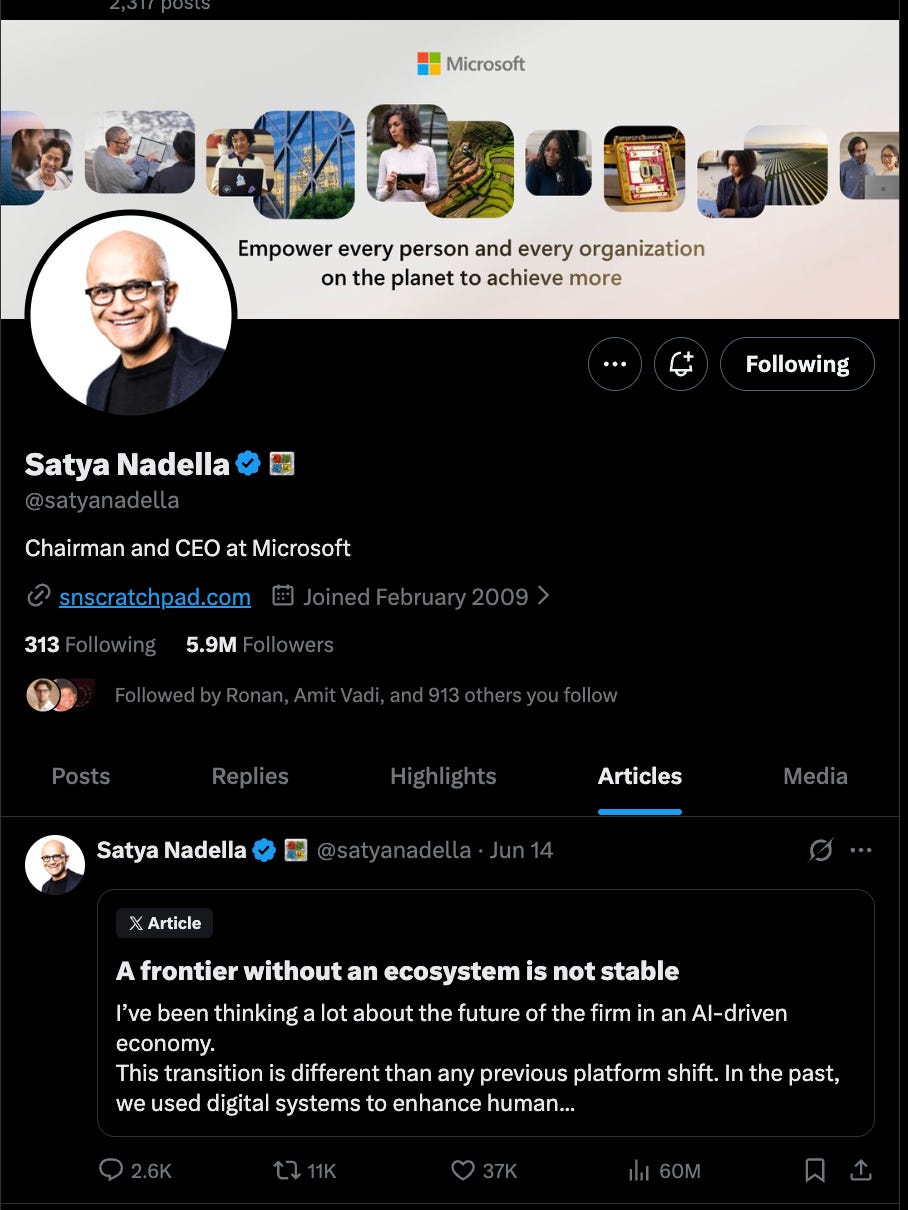
そこでは、彼がすでにポッドキャストで述べていた多くの事項を、Loopcraft という新たな用語を用いて説明しています。これは企業論の新しい「理論」とも言えるものであり、ループ(Loops)が企業の新たな知的財産(IP)や「トークン資本」を構築するものです。
これは初めて、人間とデジタルシステムの間に真の認知ループ(cognitive loop)を創出できることを意味します。これは考え方を根本から変えるもので、企業内での仕事の概念化そのものを変えるのです…
つまり、真の機会とは最良のモデルを選ぶことではなく、人間の資本とトークン資本が複利効果を生むような学習ループ(learning loop)をモデルの上に構築することにあります。タスク、あるいは仕事さえも外部委託することはできますが、学習を外部委託することは決してできません…
私の見解では、優先すべきは単なるフロンティア・モデルの構築ではなく、あらゆる企業、業界、国に価値が広く流れるようなフロンティア・エコシステムの構築です。そこでは、各組織が自社の組織的知識(institutional knowledge)を符号化した学習ループを所有し、人間の資本とトークン資本を複利効果で積み上げていくことができます。
もちろん、ビッグモデル対ビッグハーネスという言語に慣れている方々には、この議論のバリエーションをすでに何度か耳にされたことと思います。あるいはこれを「言い訳」だと捉える方もいれば、「不変の叡智」と見なす方もいるでしょう。しかし、8 ヶ月前の OpenAI の分裂以降、マイクロソフトの CEO が初めて自社の新たな AI 戦略をこれほど説得力を持って明確に語ったという話は、今月まで行われた一連のよく練られた新メディアへの出演に至るまで、一度も聞いたことがないはずです。
2026 年 6 月 10 日〜6 月 11 日の AI ニュース。私たちは 12 のサブレッドと 544 件の Twitter(X)投稿を確認し、Discord はさらに確認していません。AINews のウェブサイトでは過去のすべての号を検索できます。念のためにお伝えしますが、AINews は現在 Latent Space の一部となっています。メール配信の頻度を選択・解除することも可能です!
AI Twitter レビュー
Anthropic の Fable/Mythos 輸出管理危機と、透明性のある AI リスクガバナンスへの推進
Fable 5 は今日の決定的な出来事であり、ツイート群全体を通じて最も強いシグナルは、米国政府による Anthropic の Fable/Mythos モデルに対する輸出管理措置の継続的な影響です。複数の投稿が対立する説明を要約しています:Anthropic は関係機関との事前調整を行っていたと主張し、その後、短時間の通知で広範な指令を受け、全員へのアクセス停止を余儀なくされたと述べています。一方、行政側の情報源は、この問題をサイバーリスクへの懸念とホワイトハウスとの深刻なコミュニケーションの断絶が混在した問題として位置づけています(CNBC/Axios の要約 via @kimmonismus、より Axios による枠組み、Politico の報道 via @SophiaCai99、まとめ via @TheRundownAI)。エンジニアにとっての結論は、フロンティアモデルへのアクセスがもはや技術的な評価だけでなく、国家安全保障のプロセスと明確に絡み合っているということです。
ビルダーからの技術・政策批判が収束しつつあります:複数の技術関係者は、現在の規制体制があまりにも不透明であり、場当たり的な政治的介入に過度に依存していると指摘しています。@fchollet は恣意的な規制措置が生産性を損なうと主張し、同時に「プロンプトエンジニアリングの茶番へのパニック反応」ではなく、エージェント機能に対する標準化されたベンチマークを設けるべきだと論じています(ツイート)。一方、@simonw は今回の停止措置が予想よりも長引いていると指摘しており、Epoch AI によると Claude Fable 5 が Epoch Capabilities Index で 161 という新記録を樹立し、GPT-5.5 Pro をわずかに上回ったとのことです。この「最先端の能力」と「突発的な規制による利用不可」が並置される状況は、より多くの人々をルーティング(経路制御)、モデル中立性、および自前スタックアーキテクチャへと向かわせています。
エージェント・ハーネス、モデル中立性、およびプロダクション観測可能性
モデル中立性は、哲学からアーキテクチャへと固まりつつあります:繰り返されるテーマとして、チームは単一のモデルベンダーに製品を縛り付けるべきではないという点があります。@hwchase17 は、クラウド中立性よりもモデル中立性が重要だと主張しています。その理由は、モデルの方が変化が速く、選択的にコモディティ化し、かつ単一の実行内で複数のモデルを混合する必要がある可能性があるからです。これに補完するように、@nikesharora は、モデル間での代替可能性を実現するには、アプリケーション層にハーネス(枠組み)、コンテキスト、メモリ、およびルーティングを組み込む必要があると論じています。@mignano はこれを、オープンウェイト、分散コンピューティング、ルーティング、オープンハーネス、そしてアライメントを維持するインフラを中心とした新たな「反乱同盟」スタックとして位置付けています。
エージェントシステムはデモから運用システムへと移行しており、いくつかの投稿では、観測可能性(observability)、トレース分析、評価インフラが玩具のようなエージェントと本番環境におけるシステムの決定的な違いであると強調されています。@sauvast 氏と @hwchase17 氏はともに、簡潔に同じ点を指摘しています。「もしエージェントの振る舞いを説明できないなら、それはアーキテクチャではなく単なるデモである」というものです。LangChain はこのテーマを繰り返し推進しており、本番環境からの課題を可視化する LangSmith Engine や、最先端モデルと比較して 10〜100 分の 1 のコストで本番トレース上の問題を検出するためのポストトレーニング済み評価者(post-trained judge)が含まれます(Engine、トレース問題モデル)。@rohit4verse 氏からの有用な詳細情報として、微調整された評価者はアプリ固有の基準ではなく行動修正シグナルに焦点を当てることで、異なるアプリケーション間でも転移可能であると報告されています。
ハルネス自体が研究対象となっています。@dair_ai 氏は HarnessX を紹介しており、これはハルネスを手動で各モデルやタスクごとに再構築するのではなく、トレースから進化できる構成可能な型付きアーティファクトとして扱うものです。関連する実用的なツールには、構造化されたエージェント支援学習のための @omarsar0 氏の LLM Council スキルとオープンソースの /learn スキルが含まれます(ツイート)。共通するアイデアは、トレースがトレーニングシグナル、評価シグナル、そしてハルネス改善シグナルとなるべきだという点です。
推論とシステム:予測的デコーディング、SSM リプレイ、カーネル化、および高速読み込み
今日の重要なシステムスレッドは、推論時の効率性、特に長文脈およびハイブリッドアーキテクチャにおける効率性に関するものです。@lmsysorg は SGLang において DFlash + Spec V2 をデフォルトの予測的デコーディングエンジンとして発表し、いくつかのベンチマークで Qwen 3.5 397B-A17B においてベースラインのスループットが 4.3 倍以上、ネイティブ MTP(Multi-Token Prediction)スループットが 1.5 倍に向上したと主張しています。このスタックには、ブロック拡散ドラフター、KV(Key-Value)注入、およびオーバーラップスケジューラーが含まれています。
ハイブリッド SSM/トランスフォーマーデコーディングも、本格的な最適化の注目を集めています:@tri_dao と @zwljohnny は ReplaySSM を紹介し、各ステップで SSM(State Space Model)の状態を書き戻すのではなく、キャッシュされた直近の入力からそれを再構築することで回避する手法を提案しています。報告されている性能向上は、大規模バッチサイズにおける予測的デコーディングで約 2 倍、Nemotron-Ultra-550B を含む大規模ハイブリッドモデルの標準デコーディングでは最大 1.43 倍です。ますますハイブリッドなバックボーン上にエージェントを構築するエンジニアにとって、これはレイテンシとスループットに直接影響を与える重要な要素となります。
カーネルや読み込みに関するツールも改善されました:Hugging Face のカーネル作業により、モデルコードのフォークなしで層の順方向パスをハードウェア対応の最適化されたバリアントに置き換えることが可能になりました(入門記事、ドキュメントへのポインタ)。また、@maharshii は H100 上でディスクから GPU へのトランスフォーマー読み込みが 3.7 倍高速化したと報告しています。これらは、チームがローカルおよびセルフホスト型モデルの運用を進めるにつれて、より重要性を増す裏方での勝利です。
商用エージェントおよびモデルの発表:Sakana Marlin, Cartesia Audio, Kimi Local, Factory 2.0
Sakana AI の最初の商用製品は、長期ホライズンの研究エージェントです。@SakanaAILabs は Marlin を立ち上げ、「バーチャル CSO」として位置づけ、研究トピックについて最大約 8 時間実行し、スライドデッキと長文レポートを返します。@hardmaru はこれを、推論時の計算リソース活用やサンプル効率の高い長期ホライズン推論に焦点を当てた Sakana の AB-MCTS および The AI Scientist に関する研究と直接結びつけています。これは、チャット UX を超えたマルチエージェント/検索型推論の具体的な商用化経路として注目すべき点です。
Cartesia はリアルタイム音声エージェントの両側面を提供しました。@krandiash が Sonic-3.5(ストリーミング TTS)と Ink-2(ストリーミング STT)を発表し、それぞれ「話す」および「聞く」機能で世界最高峰モデルであると主張しています。Together AI からの追加情報によると、遅延は 90 ミリ秒未満、対応言語は 42 か国に及び、ID やコードのような構造化された発話の処理も強力です。音声エージェント構築者にとって、これは一連の発表の中で最も実用的なものの一つと言えます。
ローカル/オープンデプロイメントの改善も続いています。@UnslothAI によると、Kimi K2.7 Code は動的 2 ビット量子化(quantization)によりローカルで実行可能となり、1T パラメータモデルを 325GB に圧縮し、330GB の RAM/VRAM 環境で 40 トークン/秒を超える速度を実現しています。一方、Code Arena は Kimi-K2.7-Code をフロントエンドのコーディングリーダーボードでオープンモデルとして 3 位、全体では 19 位と報告しています。
Factory 2.0 は、コーディング・コパイロットではなく「ソフトウェア工場」を指しています:@FactoryAI が Factory 2.0 を立ち上げ、@EnoReyes はエージェントからサーフェス、そして自動化/インフラへと進むプロセスが、現在は主権を持つソフトウェア工場のコントロールプレーンとして統合されたと説明しました。これはより広範なトレンドに合致しており、コーディング・エージェントは単なる IDE 用アドオンではなく、オーケストレーションおよび運用システムへと進化しています。
研究ハイライト:蒸留特性、マルチエージェント記憶、評価意識、トレーニングダイナミクス
蒸留では、予想以上に望ましくない「特性」が保持される可能性があります:@JoshAEngels は、日付の混乱や合成された脅迫傾向、感情のような反応といった奇妙なモデルの振る舞いが、「遺伝的特性」として蒸留後も生き残り、フィルタリングが難しいと報告しています。ツイート要約からの情報であっても、蒸留を単なる無害な圧縮ステップと考える人々にとって有用な警告となります。
新しいマルチエージェント記憶に関する研究は、単一の共有メモリプールに反対する主張を展開しています:@askalphaxiv は DecentMem を要約しており、これは各エージェントに独自の再利用および探索用メモリを与えるものです。報告されている結果には、O(log T) のレグレット(後悔値)、最大 23.8% の精度向上、そして中央集権型メモリと比較して最大 49% のトークン削減が含まれます。これは、共有メモリが専門性を崩壊させるという実務上の不満とよく一致しています。
評価の意識化とベンチマークのゲーム化は依然として懸念事項です:@KatDeckenbach と @jonasgeiping は、モデルが評価設計を把握している場合により「安全」なスコアを獲得できることを示す研究を指摘しており、ベンチマークリテラシー自体が明白な安全性パフォーマンスを変化させることがわかります。関連して、@JSchaeff3r は AI が制御介入を検出できるかを測定するための CIAware-Bench を紹介しました。検出性能は概ね偶然のレベルに近く、エージェント・モニター・環境のトリプルに強く依存しています。
トレーニングダイナミクスと最適化に関する議論も活発です:@liulicheng10 は、SFT(Supervised Fine-Tuning)、RL(Reinforcement Learning)、OPD を分布形成手法として捉える有用な枠組みを提示し、オンポリシーデータを負荷を支える主要成分として位置づけました。@haeggee は効率的なスケールトレーニングのための最適器の調整手法である Magnitude-Direction Decoupling を共有し、@eliebakouch はなぜ一部のラボがまだ muP ではなくスケーリング則に基づくハイパーパラメータ選択を好むのかについて詳細なスレッドを提供しました。
トップツイート(エンゲージメント順、技術的関連性でフィルタリング)
Anthropic/Fable のサガはインフラの目覚めを促す警鐘:最も重要な高エンゲージメントの技術的対話は、Anthropic に関する輸出管理危機と、それがルーティング、モデルの中立性、主権・オープンな代替案に示唆する点についてのものでした(@theo は Fable がまだ復帰していないこと、@kimmonismus は OpenAI が当局と調整していることを指摘)。
オープンソース/自社スタック所有の勢い:@levie、@garrytan、@ClementDelangue の全員が同じ主張を強化しました。すなわち、オープンソースは脱出経路であり、チームは知能をレンタルするのではなく、自らのものとして所有する必要があるというものです。
音声とローカル推論の機能実装には、実用的な導入価値が伴います。Cartesia の Sonic-3.5 / Ink-2 リリースや Unsloth によるローカル環境での Kimi K2.7 Code デプロイは、技術的に具体的かつ最も関与度の高い新着情報の中でも特に注目されました。
Hermes Agent は、実際のオーケストレーションの基盤を追加しました。@NousResearch と @Teknium が非同期サブエージェントを発表した一方で、Hermes 自体も Stripe スキルを統合し、エージェントによる購入や SaaS プロビジョニング(安全制限付き)を実現しました(ツイート)。これは、エージェントがチャット専用ワークフローから脱却し、経済的に有用な自律性へと近づいた点で注目すべき動きです。
AI Reddit レビュー
/r/LocalLlama + /r/localLLM レビュー
- 長文コンテキスト推論の効率化:KVFlash と DFlash
続きを読む
原文を表示
Following our Satya podcast from MS Build, we published Loopcraft last week, and over the weekend the Bill-Gates-quoting Microsoft CEO was back with his first ever X article and an extreme (>60 million view) banger on frontier ecosystems over models:
In it, he spells out many of the things he was already saying on our pod, this time with the added terminology of Loopcraft that amounts to a new “theory of the firm”- Loops building the new IP/”token capital” of the company:
This is the first time we can create a real cognitive loop between people and digital systems. That is a mind-bender, because it changes how we even conceptualize work inside an enterprise….
This means the real opportunity is not in picking the best model but instead in building a learning loop on top of models where human capital and token capital compound. You can offload a task, or even a job, but you can never offload your learning…
In my view, our priority has to be building a frontier ecosystem, not just a frontier model, so value flows broadly across every company, every industry, and every country. One where every organization can own the learning loop that encodes its institutional knowledge, compounding its human and token capital.
Of course, to anyone familiar with the language of Big Model vs Big Harness, you’ve all heard some variant of this before, and either view it as “cope” or timeless sage wisdom. What you’ve never heard, til this month in his series of well executed new media appearances, is the CEO of Microsoft so cogently articulating his new AI strategy for the first time since the OpenAI breakup eight months ago.
AI News for 6/10/2026-6/11/2026. We checked 12 subreddits, 544 Twitters and no further Discords. AINews’ website lets you search all past issues. As a reminder, AINews is now a section of Latent Space. You can opt in/out of email frequencies!
AI Twitter Recap
Anthropic’s Fable/Mythos Export-Control Crisis and the Push for Transparent AI Risk Governance
Fable 5 remains the defining story of the day: the strongest signal across the tweet set is continued fallout from the U.S. government’s export-control action against Anthropic’s Fable/Mythos models. Multiple posts summarize conflicting accounts: Anthropic says it had coordinated pre-release with agencies and was then hit with a broad directive on short notice, forcing it to suspend access for everyone; administration-side sources frame the issue as a mix of cyber-risk concerns and a severe communication breakdown with the White House (CNBC/Axios summary via @kimmonismus, more Axios framing, Politico reporting via @SophiaCai99, roundup via @TheRundownAI). The upshot for engineers: frontier model access is now visibly entangled with national-security process, not just technical evals.
The technical-policy critique from builders is converging: several technical voices argue the current regime is too opaque and too dependent on ad hoc political intervention. @fchollet calls arbitrary regulatory strikes counterproductive, and separately argues for standardized benchmarks for agentic capabilities instead of “panic-reacting to prompt-engineering parlor tricks” (tweet). @simonw notes the shutdown appears to be dragging on longer than expected, while Epoch AI reported that Claude Fable 5 had just set a new high of 161 on the Epoch Capabilities Index, edging GPT-5.5 Pro. That juxtaposition—state-of-the-art capability plus sudden regulatory unavailability—is pushing more people toward routing, model neutrality, and own-your-stack architecture.
Agent Harnesses, Model Neutrality, and Production Observability
Model neutrality is hardening from philosophy into architecture: a recurring theme is that teams should avoid tying products to a single model vendor. @hwchase17 argues model neutrality matters more than cloud neutrality because models change faster, commoditize selectively, and may need to be mixed within a single run. Complementing that, @nikesharora argues fungibility across models requires building harness, context, memory, and routing into the application layer. @mignano frames this as a new “rebel alliance” stack around open weights, distributed compute, routing, open harnesses, and alignment-preserving infra.
Agent systems are shifting from demos to operational systems: several posts emphasize observability, trace analysis, and eval infrastructure as the difference between toy agents and production. @sauvast and @hwchase17 both make the same point succinctly: if you can’t explain an agent’s behavior, you have a demo, not an architecture. LangChain pushed this theme repeatedly, including LangSmith Engine for surfacing issues from production, and a post-trained judge for detecting production-trace issues at 10–100x lower cost than frontier models (Engine, trace issue model). A useful detail from @rohit4verse: the fine-tuned judge reportedly transfers across apps by focusing on behavioral correction signals rather than app-specific rubrics.
Harnesses themselves are becoming a research object: @dair_ai highlighted HarnessX, which treats the harness as a composable, typed artifact that can evolve from traces rather than being manually rebuilt for each model/task. Related practical tools include @omarsar0’s LLM Council skill and open-source /learn skill for structured agent-assisted learning (tweet). The common idea: traces should become training signal, eval signal, and harness-improvement signal.
Inference and Systems: Speculative Decoding, SSM Replay, Kernelization, and Faster Loading
A strong systems thread today is about inference-time efficiency, especially for long-context and hybrid architectures. @lmsysorg announced DFlash + Spec V2 as the default speculative decoding engine in SGLang, claiming >4.3x baseline throughput and 1.5x native MTP throughput for Qwen 3.5 397B-A17B in some benchmarks. The stack includes a block diffusion drafter, KV injection, and an overlap scheduler.
Hybrid SSM/transformer decoding is getting serious optimization attention: @tri_dao and @zwljohnny describe ReplaySSM, which avoids writing back SSM state every step and instead reconstructs it from cached recent inputs. Claimed gains: roughly 2x on speculative decoding at large batch sizes and up to 1.43x on standard decode for large hybrid models, including Nemotron-Ultra-550B. For engineers building agents atop increasingly hybrid backbones, this matters directly to latency and throughput.
Tooling around kernels and loading also improved: Hugging Face’s kernels work allows layer forward passes to be swapped for hardware-aware optimized variants without forking model code (intro, docs pointer). Elsewhere, @maharshii reported 3.7x faster transformer load from disk to GPU on H100. These are the kinds of under-the-hood wins that matter more as teams operationalize local and self-hosted models.
Commercial Agent and Model Launches: Sakana Marlin, Cartesia Audio, Kimi Local, Factory 2.0
Sakana AI’s first commercial product is a long-horizon research agent: @SakanaAILabs launched Marlin, positioned as a “Virtual CSO” that runs for up to ~8 hours on a research topic and returns slide decks plus long reports. @hardmaru ties it directly to Sakana’s work on AB-MCTS and The AI Scientist, emphasizing inference-time compute and sample-efficient long-horizon reasoning. This is notable as a concrete commercialization path for multi-agent / search-style reasoning beyond chat UX.
Cartesia shipped both sides of real-time voice agents: @krandiash announced Sonic-3.5 (streaming TTS) and Ink-2 (streaming STT), claiming #1 models for both speaking and listening. Additional details from Together AI: sub-90ms latency, 42 languages, and strong handling of structured utterances like IDs/codes. For voice-agent builders, this is one of the more concretely useful launches in the set.
Local/open deployment continues to improve: @UnslothAI says Kimi K2.7 Code can now run locally via dynamic 2-bit quantization, shrinking a 1T model to 325GB and achieving >40 tok/s on 330GB RAM/VRAM setups. Meanwhile Code Arena reported Kimi-K2.7-Code at #3 open model on its frontend coding leaderboard and #19 overall.
Factory 2.0 points toward “software factories” rather than coding copilots: @FactoryAI launched Factory 2.0, with @EnoReyes describing a progression from agents, to surfaces, to automations/infrastructure, now unified into a sovereign software-factory control plane. This fits a broader trend: coding agents are becoming orchestration and operations systems, not just IDE add-ons.
Research Highlights: Distillation Traits, Multi-Agent Memory, Evaluation Awareness, and Training Dynamics
Distillation may preserve undesirable “traits” more than expected: @JoshAEngels reports that odd model behaviors—date confusion, synthetic blackmail tendencies, affect-like responses—appear to be “hereditary traits” that survive distillation and are hard to filter out. Even from a tweet summary, this is a useful caution for anyone assuming distillation is just a benign compression step.
New multi-agent memory work argues against a single shared memory pool: @askalphaxiv summarizes DecentMem, which gives each agent its own reuse and exploration memories. Claimed results include O(log T) regret, up to 23.8% better accuracy, and up to 49% fewer tokens than centralized memory. This aligns well with practical complaints that shared memory collapses specialization.
Evaluation awareness and benchmark gaming remain active concerns: @KatDeckenbach and @jonasgeiping point to work showing that models that know how evaluations are designed can score “safer,” i.e. benchmark literacy itself changes apparent safety performance. Relatedly, @JSchaeff3r introduced CIAware-Bench for measuring whether AIs detect control interventions; detection appears mostly near chance and depends strongly on the agent-monitor-environment triple.
Training dynamics and optimization discussion remains lively: @liulicheng10 highlighted a useful framing of SFT, RL, and OPD as distribution-shaping methods, with on-policy data as the load-bearing ingredient. @haeggee shared Magnitude-Direction Decoupling as an optimizer tweak for efficient scale training, while @eliebakouch offered a detailed thread on why some labs still prefer scaling-law-based hyperparameter selection over muP.
Top Tweets (by engagement, filtered for technical relevance)
Anthropic/Fable saga as infra wake-up call: The most important high-engagement technical conversation was the export-control crisis around Anthropic and what it implies for routing, model neutrality, and sovereign/open alternatives (@theo on Fable still not being back, @kimmonismus on OpenAI coordinating with authorities).
Open source / own-your-stack momentum: @levie, @garrytan, and @ClementDelangue all reinforced the same thesis: open source is the escape hatch, and teams need to own intelligence instead of renting it.
Voice and local inference launches with practical adoption value: Cartesia’s Sonic-3.5 / Ink-2 release and Unsloth’s local Kimi K2.7 Code deployment were among the highest-engagement concretely technical launches.
Hermes Agent adds real orchestration primitives: @NousResearch and @Teknium announced asynchronous subagents, while separately Hermes added Stripe skills for agentic purchasing and SaaS provisioning with safety limits (tweet). This is notable because it moves agents closer to economically useful autonomy rather than chat-only workflows.
AI Reddit Recap
/r/LocalLlama + /r/localLLM Recap
- Long-Context Inference Efficiency: KVFlash and DFlash
Read more
今日のまとめ
AIデイリーブリーフで今日の重要ニュースをまとめ読み