Z.ai CEO 唐杰氏、パラメータ数依存の限界と新学習則を語る
本文の状態
日本語全文を表示中
詳細モードで約19分の本文を読めます。
同じ出来事の情報源
この情報源を基点に整理
Latent Space
Z.ai の唐傑教授は、パラメータ数だけではモデル性能を評価できないとし、GLM-5.3 が長期的な環境での強化学習により推論能力が飛躍したと発表した。
AI深層分析を開く2026年8月20日 15:06
AI深層分析
キーポイント
パラメータ数の限界と新たなスケーリング則の提唱
唐傑教授は、パラメータ数だけでなくデータ量、計算資源の配分、実行環境という3要素を併せて考慮する必要があるとし、従来の「パラメータ数中心」の評価基準の見直しを求めた。
GLM-5.3 の性能飛躍要因は長期的強化学習
同モデルの大幅な進歩は、エンジニアリングや研究の実務に即した複雑で多段階の環境における強化学習(RL)によるものであり、記憶よりも推論能力の向上が主因であると説明した。
合成環境と自動検証プロセスの構築
実務に近いタスク環境を自動的に生成・検証するパイプラインを開発し、オラクルやノーオペレーションチェックに耐えるバイナリ報酬信号を用いて、モデルが自律的に作業を遂行できるようにした。
パラメータ数依存からの脱却とスケーリングの5つのノブ
Jie Tang教授は、パラメータ数の obsession に終止符を打ち、MoE sparsity を含む新たな XA-YB 表記法を含むスケーリングの5つのノブを特定した。高度なスキルは知識保持閾値を超えた後は総パラメータ数に依存せず、20ステップ以上の推論連鎖を維持する能力が重要となる。
Ornith-1.5 の登場と自己改善機能
@ornith_ が MIT ライセンスで Ornith-1.5 をリリースし、タスク提案から RL rollout 生成までのエンドツーエンドの自己改善能力を備えている。このモデルは agentic およびコーディングワークロードにおいて Terminal-Bench や SWE-Bench で高い評価を得ている。
重要な引用
"Parameter count is only meaningful alongside three others — how much data you have, where you intend to spend your compute, and who will run the model, under what conditions."
Memorization prefers more parameters. Reasoning prefers more post-training data and effective depth.
As agent capability improves, much of the difficulty in scaling post-training moves from the model to the environment.
advanced skills (e.g., finding software vulnerabilities) are not retrieval/memorization problems. They require carrying long causal chains (20+ inference steps) without losing the thread.
編集コメントを表示
編集コメント
唐傑教授の提唱する「パラメータ数中心からの脱却」は、現在の AI 業界におけるモデル評価のあり方を根本から問い直す内容である。特に合成環境を用いた強化学習の成功事例は、次世代エージェント開発の重要な指針となるだろう。
Source Article
元記事を日本語で読む
本文に関係しない購読案内、埋め込み通知、サイト内プロモーションは除いています。
私たちは以前、GLM 5.2 の発表を非常に興奮して取り上げました。唐傑教授は今年末までにオープンウェイトの Fable クラスモデルが出現すると信じています(注:残り 134 日ですが、現在 Qwen 3.8 Max や Kimi K3 など推定パラメータ数が 2〜3T のモデルが 2 つ登場しており、Fable は 3〜7T と推測されています。また AA インデックスでは現在のモデルよりわずかに上回る程度です)。
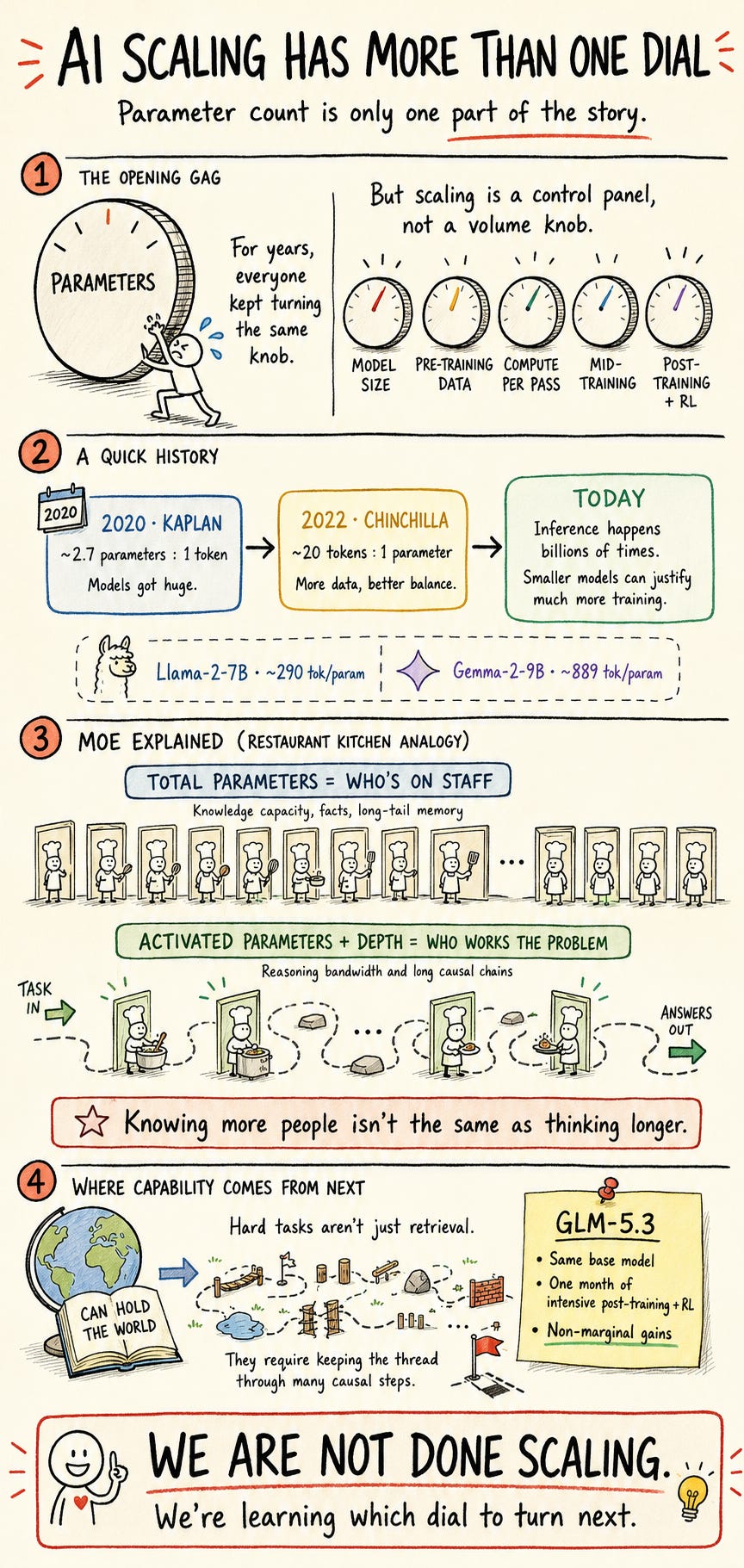
唐傑教授は X(旧 Twitter)で、モデルサイズの簡易的な表現だけではもはや不十分だと指摘しました。「パラメータ数だけが重要なのではなく、データ量がどれほどあるか、計算資源をどこに投入するか、そして誰がどのような条件下でそのモデルを実行するかが、同時に考慮されなければ意味を持ちません」。
私たちは過去数年間で Chinchilla(およびその後の)スケーリング法則について取り上げてきましたが、歴史の解説は省略します。ただし、推論における転換点(Inference Inflection)の世界においてなぜ Chinchilla の前提が間違っていたのかを整理しておくことは有益です。固定された数値はなく、タスク依存性があるため、パラメータ 1 単位あたりのトークン数は 200〜900 の範囲で変動します(Roberts らの論文による)。
要約すると、記憶能力はより多くのパラメータを好みますが、推論能力はより多くのポストトレーニングデータと実効的な深さを必要とします。GLM-5.3 が大幅に性能を向上させた理由は、長期的な環境における強化学習(RL)のみによるものです。
現在の環境は、実際のエンジニアリングや研究活動のあり方に即したタスクを中心に設計された、より広範な生産ワークフローをカバーしています。中には熟練のエンジニアが数日かけて取り組むような複雑なものも含まれています。
例えば ML インフラのタスクでは、モデルにエンジニアと同じ作業環境が与えられ、計算クラスターやストレージシステム、社内ドキュメント、コードベース、実験結果へのアクセス権限が付与されます。モデルはトレーニングスタック全体でのボトルネックを特定し、最適化を実装し、実験を実施した上で、正確性を保ちながら測定可能なエンドツーエンドの高速化を実現しなければなりません。
このレベルの環境で学習を進めることは、ユーザーに問題を分解させたり各工程を監督させたりするのではなく、モデル自身が実務の大きな部分を自ら責任を持って完遂する方向へと導きます。再帰的自己改善に関する議論に関心のある方々にとって、彼らの環境や評価・検証プロセスは、下層まですべて合成されたものとなります。
エージェントの能力が向上するにつれ、ポストトレーニングのスケーリングにおける難易度の大部分はモデルから環境へと移行します。有用なタスク環境とは、実行可能で検証可能であり、実際の専門的な業務に近しいものでなければなりません。また、少数の手作業で作成されたものではなく、多数の環境が必要です。
このプロセスをスケーリングするために、私たちはエンドツーエンドで環境を合成するパイプラインを構築しました。一部のタスクについては、強化学習(RL)の報酬信号も同時に生成しています。研究用エージェントは実際の業務からタスクのパターンを収集し、多段階の依存関係や隠れた状態を持つ実行可能な長期ホライズンの環境に変換します。その後、判別用エージェントが各タスクを実行して、実際に解決可能かどうかを検証します。
検証者は参照解にアクセスすることなく合成され、ソルバーの軌跡は報酬のショートカットを発見し、それを埋めるために利用されます。オラクルチェック、何もしない(no-op)チェック、未解決状態チェックをすべて通過した検証子は、直接トレーニングに使用できる信頼性の高い二値報酬を生成します。
パラメータ数の執着に終止符を打つため、Jie 教授はスケーリングのための5 つの調整ノブを特定しました。これには、新しい XA-YB 記法を用いた MoE(Mixture of Experts)のスパーシティも含まれます。彼は、高度なスキル(例えばソフトウェアの脆弱性の発見など)は検索や記憶の問題ではないと指摘しています。これらは、20 以上の推論ステップにわたる長い因果連鎖を失うことなく維持する能力を必要とします。
ある知識保持閾値を超えると、この能力は総パラメータ数に依存しなくなります。
まだこれから先も、もっと大きな動きがありそうです。
AI ニュース(2026 年 8 月 18 日〜19 日)。今回は 12 のサブレディットと 544 件の X(旧 Twitter)投稿をチェックしました。Discord は対象外です。AINews のウェブサイトでは、過去のニュースをすべて検索可能です。なお、本誌は現在「Latent Space」のセクションとして運営されており、メール配信頻度の設定も変更できます。
X(Twitter)で話題になったニュース
オープンウェイトモデル、圧縮技術、ベンチマークの動向
Ornith-1.5 が、本格的なオープンソースファミリーとして登場しました。@ornith_ が MIT ライセンスの下、9B の密型モデル、35B と 397B の MoE(Mixture of Experts)モデルをリリースしています。また、FP8、GGUF、MLX、NVFP4 といった量子化フォーマットも用意されています。
今回の最大の注目点は「エンドツーエンドの自己改善」機能です。このモデルはタスクを提案し、学習用の足場(スキャフォールド)を生成し、強化学習(RL)のロールアウトを実行することで、新たなトレーニング体験を自ら作り出します。
ベンチマーク評価では、エージェントやコーディング関連のワークロードにおいて非常に高いスコアを記録しています。具体的には、Terminal-Bench 2.1 で 86.1、SWE-Bench Verified で 86、DeepSWE で 56、HLE で 44.6、Tool Decathlon で 71.2 を達成しました。
リリース直後から、vLLM や Ollama といった主要な推論フレームワークへの統合が迅速に進められています。
エージェントのハルネスが新たな競争層として台頭している
DeepSeek Harness のミニマリズムは、不備ではなく意図的な設計です。@ZhihuFrontier による詳細な解説や @TheTuringPost による要約が示す通り、この DeepSeek Harness(DSH)は、プラグインアーキテクチャ「Cordis」を包む intentionally thin shell(意図的に薄いシェル)として位置づけられています。最大の特徴は、エージェントループ自体を含めすべてがプラグインである点です。
初期ベータ版のユーザーからは、わずか 1 週間で 100 以上のプラグインが提供され、400 件以上の課題報告が上がったと報じられています。具体例としては、五目並べモデルのテストベッドや、モデルを実際のクエリ実行に接続して SQL フィードバックループを完結させるデータベースエージェントなどが挙げられます。
最も重要な点はアーキテクチャにあります。DSH は「製品化されたアシスタント」というよりは、「ユーザーが拡張可能なツールリング」「交換可能な制御ループ」「ビジネスルール注入」を最適化したオープンなエージェントランタイムと言えます。
TrueFoundry が Open Source 化した「TrueForge」は、ベンダーに依存しないセルフホスト型の生産用エージェント用ハネスとして、そのコスト削減効果を明確に打ち出しています。@truefoundry、@omarsar0、@kimmonismus の各氏が紹介したこのプロジェクトは MIT ライセンスで提供され、ツールオーケストレーション、コンテキスト管理、サブエージェント、コードサンドボックス、人間の承認フロー、トレーシング機能を備えています。ローカルとホスト型の両方のデプロイモードに対応可能です。
技術的な注目点は、14 タスクからなるエンタープライズベンチマークにおいて、TrueForge が Opus 4.8 を搭載した Claude Managed Agents と同等の性能を発揮しながら、使用トークン数を約 30% 削減したという点です。さらに GLM-5.2 へのルーティングを適用することで、精度を維持しつつコストを約 75% 削減できることが示されました。業界全体で共有されているテーマとして、@bradenjhancock や @dbreunig が @rseroter を通じて指摘しているように、セッション・環境・メモリ・ツールのレイヤーが、差別化要因とコスト削減の両面で重要な役割を果たし始めています。
マネージド型のハネスも、観測性と制御機能をさらに強化しています。@ClaudeDevs は、セルフホスト型サンドボックスへのメモリサポート追加、Web ツール向けのドメイン許可・ブロック機能、そしてミニマップやグループ化されたトランスクリプト、スレッド/セッションごとのコスト表示を備えた再設計されたマルチエージェントセッションビューアーを導入しました。
一方、OpenAI は対照的なアプローチを推進し続けています。チームが自社製品に組み込むためのハネスプリミティブを提供するという立場です。@OpenAIDevs は、社内ツールや運用ダッシュボード、カスタムアプリの基盤となるランタイムとしてオープンソースの Codex ハネスを紹介しました。また @cursor_ai は、永続的な目標と長期間稼働するセッションを軸に、クラウドエージェントの UX 改善を発表しています。
ポストトレーニング、ミッドトレーニング、そして RL システムの役割
スケーリングがパラメータ数からトレーニングレシピの質へとシフトしていることを示す新たな証拠です。zAI/GLM の創設者である Jie Tang 氏が指摘した内容が注目されています。進歩は依然としてスケーリングによって実現されていますが、議論の多くがパラメータ数に焦点を当てすぎており、データの質、推論計算リソース、そしてポストトレーニングの重要性が見落とされているというのです。
具体例として挙げられているのが GLM-5.3 です。これは GLM-5.2 と同じコアベースモデルやアーキテクチャに基づいていますが、約 1 か月の追加 RL(強化学習)によって大幅に改善されています。
Microsoft の Agent Lightning は、「ハッチスルルー」型 RL を実用的なトレーニングレシピとして示しています。@omarsar0 が紹介した Agent Lightning v1.0 では、任意のハッチをエンドポイントプロキシを通じて RL に接続します。これにより、再トークン化やサンプルのマージ、アドバンテージ計算、正規化、そしてスケジューラーとバックエンドの調整といった課題に対応しています。約 6,000 のトレーニング例と限られた計算リソースで、SWE-Bench Verified における Qwen3.5-9B のスコアを 41.8% から 56.4% へと引き上げました。
ミッドトレーニングは、単なる「より良いデータでの継続事前学習」ではなく、最適化の余地として明確に位置づけられています。@cwolferesearch が示したように、現在の現場では CPT(Continual Pre-Training)やミッドトレーニングにおいて、データの混合比率、訓練期間、ステージの順序、シーケンス長、さらにはポストトレーニングへの適応性までを最適化することが重要視されています。この議論が有用なのは、これらを独立したテクニックとしてではなく、互いに作用し合う調整可能なパラメータ(ノブ)として捉えている点にあります。
研究を支える RL インフラストラクチャの改善が続いています。@SergioPaniego が紹介した TRL におけるオンポリシー蒸留の最新成果では、生成バッファ、バッチ化された教師呼び出し、バイナリ対数確率符号化を活用することで、処理速度が最大 40 倍に向上しました。また、@mikasenghaas は prl で適応型並列処理を発表し、RL ラン中の進行状況に応じて実行中のロールアウト数を動的に調整する仕組みを導入しました。
実運用で重要なベンチマーク、検索、インフラの詳細
Qdrant のフィルタ可能 HNSW と ACORN の比較は、検索システムにおける本格的なアップデートを示しています。@qdrant_engine は、フィルタ付き ANN(近似最近傍探索)の問題はクエリ時だけでなく、インデックス段階で解決すべきだと主張しました。彼らが提案するフィルタ可能 HNSW では、インデックスされたペイロード値を共有するポイント間にエッジを追加し、フィルタリング後の部分グラフが接続状態を保つようにしています。100 万ベクトルに対して 1% のフィルタ条件で実施したベンチマークでは、ACORN が 4.7ms で 67.7% の再現率を示すのに対し、彼らの手法は 1.0ms で 99.8% の再現率を達成しました。ただし、広範な値や AND フィルタについては、すでにフィルタ最適化が施されたグラフの上層で ACORN を利用する方が依然として有効である点にも言及しています。
Sentence Transformers v6.0 は、単一ベクトルからマルチベクトル検索への実用的な移行を反映したものです。@tomaarsen はその違いを明確に要約しました。従来の密集型(dense)検索はテキスト全体を 1 つのベクトルに圧縮するのに対し、マルチベクトル検索ではトークンレベルのベクトルを保持し、クエリトークンをドキュメントトークンに対してスコアリングした上で、最適なマッチング結果を集約します。このアプローチが重要視されるのは、品質重視の検索システムにおいて、後期相互作用(late-interaction)型検索がデファクトスタンダードとなりつつあるからです。
生産エージェントのレイテンシは、モデルそのものよりも他の要因に左右されることが多い。@dair_ai が紹介した論文では、10 のエージェント型アプリケーションを計測した結果、非 LLM コンポーネントが半数以上のボトルネックとなっていることが明らかになった。セッションあたりのサンドボックスメモリ使用量が最大 28GB に達し、サブシステム間でレイテンシのばらつきが最大 32 倍に及ぶケースも確認された。また、ステップ間のアイドル状態が長く維持される傾向も見られた。
これらの課題に対する最適化策は意外なものではないが、重要な意味を持つ。タスク認識型のサービングによりレイテンシを 29〜40% 削減でき、ステートのオフローディングでメモリ使用量を 4.6 倍削減できるほか、ツール結果のキャッシュによって冗長な検索呼び出しを 35.2% 削減可能だ。
Linear と turbopuffer は、ベクトルインフラが検索以外のホットパスにも浸透しつつあることを示している。@turbopuffer によると、Linear は Delta Sync の読み取り経路を Postgres から turbopuffer へ移行し、属性インデックスを活用して権限フィルタリングを実現した。これにより、最大の同期処理にかかる時間が約 8 秒短縮された。
Google、OpenAI、Anthropic が製品化競争を加速させる中、Gemini 3.7 Flash は評価と製品統合の両面で好調な一日を送った。@_philschmid と @NewsFromGoogle の報告によると、Gemini 3.7 Flash は Artificial Analysis の AA-AnalystAgent ベンチマークで第 1 位を獲得。80 件のスプレッドシートや文書に依存した定量的タスクにおいて、pass^5 が 60.0%、pass@1 が 70.5%、pass@5 が 77.5% を達成し、1 タスクあたりの処理時間は平均 1.32 秒、コストは平均$0.54 と高いパフォーマンスを示した。Google はさらに、Gemini チャットや Spark、AI モードで即時構築される検索ベースのインタラクティブシミュレーション(例)、ビルドワークフロー向けの AI Studio GitHub 同期など、製品面での展開も強化している。
OpenAI は、低コストでの展開とプライバシー重視のポジションに注力しています。@Replit が GPT-5.6 Luna を搭載した「Free Mode」を発表し、@kimmonismus 氏はこれを「有意義な効率化の勝利」と評価しました。かつては最先端(SOTA)だったモデルが、今や広く無料で提供できるほどコストダウンを実現したのです。
企業向けには、@OpenAI が「Private Safety Processing」を導入しました。これは、最先端モデルにおけるゼロデータ保持を維持しつつ、人間がコンテンツにアクセスしなくても相互間の安全性リスクを検出する仕組みです。
Anthropic は開発者体験の改善をさらに進めています。上記のマネージドエージェント機能の更新に加え、@ClaudeDevs が Claude Code に「Concise(簡潔)出力スタイル」を追加しました。これは製品チームが、単なる機能だけでなく、レスポンスの形状自体を主要な UX 変数として調整し始めていることを示す兆候です。
エンゲージメント数の多い注目ツイート
Ornith-1.5 のリリース:@ornith_ が MIT ライセンスのオープンモデルファミリー(9B〜397B)を発表。コーディングやエージェント機能におけるベンチマークで高い性能を示し、広範な量子化サポートも提供しています。
OpenAI のプライバシー・安全インフラ:@OpenAI は「Private Safety Processing」を発表すると同時に、最先端モデルに対するゼロデータ保持を再確認しました。
Gemini の学生向け施策と製品バンドル:@GeminiApp が世界中の学生に Gemini プランを 1 年間無料で提供し、学習に特化した新機能を順次展開しています。
Claude Code の UX 更新:@ClaudeDevs が「Concise モード」を実装。日々のコーディングエージェント利用において、小さな変更ながら広く注目される改善となりました。
OpenRouter の買収について、@patrickc が OpenRouter が Stripe に加わったことを確認しました。多くの人がこれを、トークンルーティングやマーケットプレイスがエッジツールからコアインフラへと進化していることの裏付けと捉えています。
AI Reddit リキャップ
/r/LocalLlama と /r/localLLM のまとめ
- Qwen/DeepSeekのオープンウェイト推論速度向上
Qwen3.8-27B Dynamic v3 Unsloth GGUF の紹介(アクティビティ数:1428)
この画像は「Dynamic v3.0 Qwen3.8」に関する技術発表のグラフィックで、Unsloth が新たに公開した Qwen3.8-27B Dynamic v3 の GGUF 後学習量子化モデルを紹介しています。同サイズにおけるトップ 1% の精度が他社製よりも 10% 以上向上していることを謳っています。
画像にはメモリ使用量の表が含まれており、このモデルが約 8GB の RAM で 1 ビット量子化から BF16 まで動作可能であることを示しています。また、量子化サイズごとの精度比較チャートも掲載されています。投稿では、Hugging Face 上の GGUF リリースリンク、Dynamic 3.0 のドキュメントとベンチマーク、そして画像自体へのリンクが記載されています。
Unsloth はこれらが後学習量子化のリリースのみであり、「QAT や QAD は使用していません」と強調しています。また、独立した評価やファインチューニング実験のために imatrix 校正ファイルも公開されていると述べています。
コメントは概ね好評でしたが、技術的な要望として「既存の UD 2.0 量子化モデルをグラフに追加し、ローカル環境で比較できるようにしてほしい」という声がありました。また別のユーザーからは、より詳細な診断情報の提供を求める意見があり、具体的にはカテゴリ別や KV キャッシュ量子化における KLD 数値など、localbench スタイルのレポートを参照して求めるものでした。
Qwen3.8-27B Dynamic v3 Unsloth GGUF の新しい量子化評価について、より詳細なデータを提供してほしいという要望がコメント欄から寄せられました。特に重要なのは、既存の Qwen 3.8 27B UD 2.0 版との直接比較グラフです。
提案された指標には KLD やトップ 1 一致率などがあり、これによりユーザーは、ローカルに保存されている既存バージョンと比較して、新しい動的量子化が実際に性能向上をもたらしているかを判断しやすくなります。
また、あるコメントでは、カテゴリ別の KLD や KV キャッシュ量子化における KLD の報告を求めています。これは localbench.substack.com で見られるような内訳形式を参照したもので、異なる GGUF 量子化フォーマット下で、どのベンチマークやタスクのカテゴリ、あるいはキャッシュ量子化設定が最も品質低下を起こすかを可視化することで、量子化の質に関する議論を実践的なものにする狙いがあります。
さらに、量子化モデルの実用的なメモリ使用量にも関心が集まりました。あるユーザーは Q4_K_M で約 15 GB を必要とすると指摘し、別のユーザーは IQ4_XS が「mtp なし」でも 16 GB VRAM に収まる可能性があると推測しています。
技術的な懸念点は、これらの小容量フォーマットが、一般的なコンシューマー向け GPU で 27B クラスのモデルを完全に実行する価値があるほどに、モデル品質を十分に維持できるかどうかです。
原文を表示
We’ve covered GLM 5.2 very excitedly before, and Prof Jie Tang’s belief that there will be an open weights Fable-class model by end of the year (spot check - with 134 days left, there are now two 2-3T models (Qwen 3.8 Max and Kimi K3) with estimates that Fable is 3-7T, and only 2 points higher on the AA index.)
Prof Jie Tang is back on X to tell us that our shorthand for model sizes is no longer enough: “Parameter count is only meaningful alongside three others — how much data you have, where you intend to spend your compute, and who will run the model, under what conditions.”
We have covered Chinchilla (and post-Chinchilla) scaling laws in past LS years, but, so we will skip the history lesson, but it is good to level-set on why Chinchilla’s assumptions were wrong in the Inference Inflection world (no fixed number, between 200-900 toks/param, citing Roberts et al on task dependence).
In short: Memorization prefers more parameters. Reasoning prefers more post-training data and effective depth. GLM-5.3’s big jumps come solely from RL on long horizon environments:
The environments now cover a much broader range of production workflows, with tasks designed around how engineering and research work is actually carried out in practice. Some represent several days of work for an experienced engineer. In an ML infrastructure task, for example, the model may be given the same working environment as an engineer, with access to compute clusters, storage systems, internal documentation, codebases, and experiment results. It must diagnose bottlenecks across the training stack, implement optimizations, run experiments, and deliver a measurable end-to-end speedup while preserving correctness. Training on environments at this level pushes the model toward taking ownership of substantial work end to end, rather than relying on users to decompose the problem and supervise each step.
For those following the recursive self improvement story, their entire environment and judging and verifier process is synthetic all the way down:
As agent capability improves, much of the difficulty in scaling post-training moves from the model to the environment. A useful task environment has to be executable, verifiable, and close to real professional work — and we need many of them, not a handful of hand-built ones. To scale this process, we built pipelines that synthesize environments end to end, and for a subset of tasks, the RL reward signal as well. Research agents collect task patterns from real work and turn them into runnable long-horizon environments with multi-step dependencies and hidden state; a judge agent then attempts each task to verify that it is actually solvable. Verifiers are synthesized without access to the reference solution, while solver trajectories are used to discover and close reward shortcuts. A verifier that passes oracle, no-op, and unsolved-state checks produces a binary reward reliable enough to train on directly.
To put an end to parameter count obsesssion, Prof Jie identifies 5 knobs of scaling, including MoE sparsity with the new XA-YB notation. He notes that advanced skills (e.g., finding software vulnerabilities) are not retrieval/memorization problems. They require carrying long causal chains (20+ inference steps) without losing the thread. This ability does not live in total parameter count once a certain knowledge-holding threshold is reached.
And it looks like there is much more to go.
AI News for 8/18/2026-8/19/2026. We checked 12 subreddits, 544 Twitters and no further Discords. AINews’ website lets you search all past issues. As a reminder, AINews is now a section of Latent Space. You can opt in/out of email frequencies!
AI Twitter Recap
Open-Weight Models, Compression, and Benchmark Movement
Ornith-1.5 lands as a serious new open family: @ornith_ released Ornith-1.5 in 9B dense, 35B MoE, and 397B MoE variants under MIT, with quantized formats including FP8, GGUF, MLX, and NVFP4. The headline claim is end-to-end self-improvement: the model proposes tasks, generates scaffolds, and produces RL rollouts to create new training experiences. Reported evals are strong across agentic/coding workloads, including Terminal-Bench 2.1: 86.1, SWE-Bench Verified: 86, DeepSWE: 56, HLE: 44.6, and Tool Decathlon: 71.2. The release was quickly wired into serving stacks by vLLM and Ollama.
Compression continues to get more aggressive without fully collapsing utility: @UnslothAI and @danielhanchen shipped new Qwen3.8-27B GGUFs using Dynamic V3, claiming roughly 10% higher accuracy at the same size and releasing 1-bit quants that still retain about 77% of BF16 accuracy while running on 8GB RAM. Their new Divergence-300 metric extends top-1% greedy accuracy across longer generations using unseen examples from Terminal Bench, DeepSWE, and related tasks.
Agent and legal eval boards continue to reshuffle: @arena published a Pareto view of Agent Arena, where Claude Opus 5 (High) leads quality, but lower-cost models like Kimi K3, GLM 5.2, Grok 4.5, and GPT-5.6 Luna define much of the value frontier. Separately, @ValsAI reported Grok 4.6 at #3/49 on Legal Research Bench with 48.1%, 500k context, tool/image/file support, and relatively low pricing. For open models, @ValsAI also highlighted GLM 5.3 as #2 on Terminal Bench, #3 on Legal Bench, and #6 on Skills Bench among open weights.
Agent Harnesses Become the New Competitive Layer
DeepSeek Harness’s minimalism is deliberate, not incomplete: A detailed writeup amplified by @ZhihuFrontier and summarized by @TheTuringPost frames DeepSeek Harness (DSH) as an intentionally thin shell over a plugin architecture called Cordis. The key design choice is that everything is a plugin, including the agent loop itself. Early beta users reportedly shipped 100+ plugins and filed 400+ issues in under a week; examples range from a gomoku model testbed to a database agent that closes the SQL feedback loop by connecting the model to live query execution. The strongest takeaway is architectural: DSH is less “productized assistant” than open agent runtime, optimized for user-extensible tooling, swappable control loops, and business-rule injection.
TrueFoundry open-sources TrueForge and makes the harness-cost argument explicit: @truefoundry, @omarsar0, and @kimmonismus all covered the launch of TrueForge, an MIT-licensed, self-hostable, vendor-neutral harness for production agents. The stack includes tool orchestration, context management, subagents, code sandboxes, human approvals, and traces, with both local and hosted deployment modes. The technical claim that resonated: on a 14-task enterprise benchmark, TrueForge matched Claude Managed Agents on Opus 4.8 while using about 30% fewer tokens, and routing to GLM-5.2 cut cost by around 75% while preserving accuracy. The broader industry theme—also echoed by @bradenjhancock and @dbreunig via @rseroter—is that the session/environment/memory/tools layer is becoming a major source of both differentiation and savings.
Managed harnesses are also getting sharper observability and controls: @ClaudeDevs added memory support for self-hosted sandboxes, domain allow/block controls for web tools, and a redesigned multi-agent session viewer with minimap, grouped transcript, and cost-per-thread/session. OpenAI, meanwhile, continues pushing the opposite angle: give teams the harness primitives to embed into their own products. @OpenAIDevs highlighted the open-source Codex harness as the runtime beneath internal tools, ops dashboards, and custom apps, while @cursor_ai shipped cloud-agent UX improvements around persistent goals and long-lived sessions.
Post-Training, Mid-Training, and RL Systems Work
More evidence that scaling is shifting from parameters toward training recipe quality: @kimmonismus surfaced a notable claim from the zAI/GLM founder: progress is still scaling, but too much discourse has fixated on parameter count rather than data quality, inference compute, and post-training. The cited example is GLM-5.3, reportedly based on the same core base model/architecture as GLM-5.2, but improved substantially via about one month of extra RL.
Microsoft’s Agent Lightning points at RL-through-the-harness as a practical recipe: @omarsar0 highlighted Agent Lightning v1.0, which connects arbitrary harnesses to RL through an endpoint proxy, handling issues like retokenization, sample merging, advantage calculation, normalization, and scheduler/backend coordination. With ~6K training examples and modest compute, it reportedly moves Qwen3.5-9B on SWE-Bench Verified from 41.8% to 56.4%.
Mid-training is being treated more explicitly as an optimization surface: @cwolferesearch laid out the current practitioner view of CPT/midtraining: optimize data mixture, duration, stage ordering, sequence length, and even post-trainability rather than just “continue pretraining on better data.” The thread is useful precisely because it frames these as interacting knobs rather than independent tricks.
RL infrastructure keeps improving underneath the research: @SergioPaniego resurfaced work showing on-policy distillation in TRL becoming 40x faster via generation buffers, batched teacher calls, and binary logprob encoding; @mikasenghaas announced adaptive concurrency in prl, dynamically adjusting in-flight rollouts over the course of an RL run.
Benchmarks, Retrieval, and Infra Details That Matter in Production
Qdrant’s filterable HNSW vs ACORN is a substantive retrieval systems update: @qdrant_engine argued that filtered ANN should be addressed in the index, not only at query time. Their filterable HNSW adds edges between points sharing indexed payload values, keeping filtered subgraphs connected. In their benchmark on a 1% filter over 1M vectors, they report 99.8% recall at 1.0ms versus 67.7% at 4.7ms for ACORN. They also note ACORN still helps for broad values and AND filters, especially atop a graph already optimized for filters.
Sentence Transformers v6.0 reflects the practical move from single-vector to multi-vector retrieval: @tomaarsen summarized the distinction clearly: dense retrieval compresses each text into one vector, while multi-vector retrieval keeps token-level vectors and scores query tokens against document tokens before aggregating best matches. That matters because late-interaction retrieval is increasingly the default tradeoff for quality-sensitive search systems.
Production agent latency often has little to do with the model itself: @dair_ai summarized a paper instrumenting ten agentic apps and finding that non-LLM components dominate latency in half of them, with sandbox memory peaking at 28GB/session, up to 32x latency variation across subsystems, and long idle state retention between steps. The optimizations are unsurprising but important: task-aware serving cuts latency 29–40%, state offloading reduces memory 4.6x, and tool-result caching removes 35.2% of redundant search calls.
Linear and turbopuffer show vector infra creeping into non-search hot paths: @turbopuffer said Linear moved its delta sync read path from Postgres to turbopuffer, using attribute indexes for permission filters and reducing the largest syncs by about 8 seconds.
Google, OpenAI, Anthropic, and the Productization Race
Gemini 3.7 Flash had a strong day on both evals and product integration: @_philschmid and @NewsFromGoogle highlighted Gemini 3.7 Flash taking #1 on Artificial Analysis’s AA-AnalystAgent, with 60.0% pass^5, 70.5% pass@1, 77.5% pass@5, 1.32s/task, and $0.54 average cost across 80 spreadsheet/document-heavy quantitative tasks. Google also pushed it deeper into product surfaces: Gemini chat and Spark, Search-based interactive simulations built on the fly in AI Mode (example), and AI Studio GitHub sync for build workflows.
OpenAI is leaning into low-cost deployment and privacy positioning: @Replit launched Free Mode powered by GPT-5.6 Luna, which @kimmonismus framed as a meaningful efficiency win: a model that would recently have been SOTA is now cheap enough to be given away broadly. On the enterprise side, @OpenAI introduced Private Safety Processing, aiming to preserve Zero Data Retention for frontier models while still detecting cross-interaction safety risks without human access to the underlying content.
Anthropic continues to tighten the developer ergonomics loop: beyond the managed-agent updates above, @ClaudeDevs added a Concise output style to Claude Code, another sign that product teams are now tuning not just capability but response-shape as a first-class UX variable.
Top tweets (by engagement)
Ornith-1.5 release: @ornith_ unveiled an MIT-licensed open model family from 9B to 397B, with strong coding/agentic benchmark claims and broad quantization support.
OpenAI privacy/safety infrastructure: @OpenAI announced Private Safety Processing while reaffirming Zero Data Retention for frontier models.
Gemini student push and product bundling: @GeminiApp offered a year of Gemini plans to students globally while rolling out new study-oriented features.
Claude Code UX update: @ClaudeDevs shipped Concise mode, a small but widely noticed improvement for day-to-day coding-agent interaction.
OpenRouter acquisition: @patrickc confirmed OpenRouter is joining Stripe, a move many interpreted as validation that token routing/marketplaces are becoming core infrastructure rather than edge tooling.
AI Reddit Recap
/r/LocalLlama + /r/localLLM Recap
- Qwen/DeepSeek Open-Weight Inference Speedups
Introducing Qwen3.8-27B Dynamic v3 Unsloth GGUFs (Activity: 1428): The image is a technical announcement graphic for “Dynamic v3.0 Qwen3.8”, showing Unsloth’s new Qwen3.8-27B Dynamic v3 GGUF post-training quantizations and claiming >10% higher top-1% accuracy at the same GGUF size versus other providers. It includes a memory table suggesting the model can run from 1-bit quants on ~8GB RAM up to BF16, plus a chart comparing accuracy across quant sizes; the post links the GGUF release on Hugging Face, the Dynamic 3.0 docs/benchmarks, and the image itself. Unsloth emphasizes these are post-training quantization releases only—“we do NOT use QAT or QAD”—and says the imatrix calibration file is public for independent evaluation and fine-tuning experiments. Comments were mostly positive, but one technical request asked Unsloth to add the previous UD 2.0 quants to the graph so users can compare against what they already have locally. Another commenter asked for deeper diagnostics, specifically per-category and KV-cache quantization KLD numbers, referencing localbench-style reporting.
Several commenters requested more detailed quantization evaluation for the new Qwen3.8-27B Dynamic v3 Unsloth GGUFs, especially a direct graph line comparing against the prior Qwen 3.8 27B UD 2.0 quants. Suggested metrics included KLD and/or top-1 agreement, which would help users judge whether the new dynamic quantization is materially better than the versions many already have stored locally.
A commenter asked for per-category KLD and KV-cache quantization KLD reporting, referencing the style of breakdowns from localbench.substack.com. This would make the quant quality discussion more actionable by showing which benchmark/task categories or cache-quant settings degrade most under different GGUF quant formats.
There was interest in the practical memory footprint of the quants: one user noted ~15 GB for Q4_K_M, while another inferred that IQ4_XS may now fit on 16 GB VRAM “without mtp.” The technical concern is whether these smaller formats maintain model quality closely enough to justify running a 27B-class model fully on common consumer GPUs.
Read more
関連記事
News to Guide
ニュースの次に確認する
発表内容を、現在の料金や仕様と照らし合わせられる関連ガイドです。
今日のまとめ
AIデイリーブリーフで今日の重要ニュースをまとめ読み