ONESTRUCTION、AWS GenAIIC支援で石垣島 IDS 基盤モデル構築
本文の状態
日本語全文を表示中
詳細モードで約14分の本文を読めます。
同じ出来事の情報源
この情報源を基点に整理
AWS Machine Learning Blog
ONESTRUCTION は AWS GenAIIC の技術助言のもと、建設業界のデータ不足を克服し、BIM 専門ワークフローに特化した基盤モデル「Ishigaki-IDS」を開発した。
Continue in AI NEW LAB
このニュースを、実務の判断につなげる
AI NEW LABで、試したことや先に確認したい条件を共有できます。まずはログインなしで読めます。
AI NEW LABで論点を見るAI深層分析を開く2026年8月12日 02:11
AI深層分析
キーポイント
データ不足領域での基盤モデル構築
建設業界のようなデータが乏しい分野において、十分な訓練データや専門知識を確保しながら出力を検証する手法を示している。
Ishigaki-IDS の開発と目的
ONESTRUCTION は建築情報モデル(BIM)ワークフローに特化した基盤モデル「Ishigaki-IDS」を構築し、専門知識がなくても IDS ファイルのレビューや管理が可能になるようバリアを下げる。
3段階トレーニングパイプライン
ドメイン適応のための継続事前学習(CPT)、監督下微調整(SFT)、検証可能な報酬による強化学習(RLVR)という 3 段階の訓練パイプラインを構築した。
合成データと構造化出力
ニッチな領域でのデータ不足に対処するために合成データを生成し、検証可能な報酬を用いて構造化された出力を生成する手法を採用している。
データ不足への対応
IDS は比較的新しい標準であり、公開ウェブコンテンツが限られているため、ドメイン専門家が作成した合成データをトレーニングコーパスの大部分に使用した。
重要な引用
Building domain-specialized foundation models in data-scarce fields is hard.
Ishigaki-IDS lowers that barrier so practitioners who aren't BIM specialists can review and manage attribute information.
How to use synthetic data generation to overcome data scarcity in niche domains.
IDS is a relatively new standard, published in 2024, and construction in general is a domain with limited public web content.
編集コメントを表示
編集コメント
データ不足が深刻な建設分野において、合成データと精密なトレーニングプロセスで実用モデルを構築した事例は非常に示唆に富んでいる。同社の技術的アプローチは、他の専門領域における AI 導入の参考となる重要なケーススタディである。
Source Article
元記事を日本語で読む
本文に関係しない購読案内、埋め込み通知、サイト内プロモーションは除いています。
本記事は、ONESTRUCTION 株式会社 と [Amazon Web Services Japan G.K.] が共同執筆したもので、GENIAC(Generative AI Accelerator Challenge)第3期の取り組みの一環です。技術面では、AWS 生成 AI イノベーションセンター (GenAIIC) がアドバイザリーを務めています。
データが不足している分野でドメイン特化型のファウンデーションモデルを構築するのは容易ではありません。十分な訓練データの確保、専門知識の蓄積、そして出力結果を検証する仕組みが必要です。
ONESTRUCTION 株式会社は、openBIM を通じて業界の課題解決に取り組む建設テックスタートアップです。GenAIIC の技術アドバイスを仰ぎながら、建設業界の BIM(Building Information Modeling)ワークフローに特化したファウンデーションモデル「Ishigaki-IDS」を開発しました。BIM は、建物の物理的・機能的な特性をデジタルで表現するもので、建設ライフサイクル全体で使用されています。
日本の建設業界では、長年にわたる人手不足が深刻な課題となっています。設計・施工・維持管理の各チームが情報を一元化できるため、BIM(ビルディングインフォメーションモデリング)は国を挙げて推進されています。しかし、BIM の導入には専門知識が必要であり、その学習コストが普及を妨げる要因となっていました。
その典型例が、XMLベースの標準規格「IDS(Information Delivery Specifications)」です。IDS は BIM モデル(IFC:Industry Foundation Classes)に紐づく情報の定義と検証ルールを定めたものです。IDS ファイルを作成するには、その文法への習熟に加え、IFC や関連するルールに関する深い知識が不可欠です。
ONESTRUCTION が開発した「Ishigaki-IDS」は、この参入障壁を下げるソリューションです。BIM の専門家ではない現場の担当者でも、属性情報のレビューや管理が可能になります。
本記事では、ONESTRUCTION がどのようにして Ishigaki-IDS を構築したかというアーキテクチャ事例を紹介します。ドメイン適応に取り組む機械学習(ML)エンジニアや、データが不足する環境で専門特化型 AI モデルをどう構築するか検討している技術リーダーにとって、再利用可能なパターンが見つかるはずです。建設業界や BIM の専門家にとっては、AI が自らの分野でどのような役割を果たせるかが見える内容となっています。
基礎的な AWS コンピューティングの概念や、ファウンデーションモデルのトレーニング(事前学習と微調整)に関する知識があると理解が深まりますが、必須ではありません。
本記事で学ぶこと:
- 限られたドメインにおけるデータ不足を克服するための、合成データ生成の活用方法。
- ドメイン特化のための三段階トレーニングパイプライン(CPT、SFT、RLVR)の構築方法
- 構造化された出力生成に検証可能な報酬を活用する方法
- Amazon Elastic Compute Cloud (Amazon EC2) の P5en インスタンス で AWS ParallelCluster を使用した分散トレーニングの実行方法
IDS 基盤モデル構築における3つの課題
我々が機能する IDS モデルを完成させるまでに、3 つの大きな壁がありました。
まず一つ目はデータ不足です。IDS は比較的新しい規格で、2024年に公開されたばかりです。さらに建設業界全体としても、ウェブ上に公開されている情報は限られています。金融、医療、法律などの他の分野では数十億から数百億トークン規模のコーパスでモデルを訓練していますが、IDS に対応する同等の公開データセットは存在しません。最新のウェブデータを収集しても、その量は少なく深みも浅いため、モデル単体では IDS や関連トピックに関する十分な文脈を学習できませんでした。
二つ目は、数千語に及ぶ IFC の用語集を組み込む難しさです。例えば「ビーム」は IfcBeam に、「エアコン」は IfcUnitaryEquipment に対応します。このマッピングは従来、ドメインの専門家が手作業で行ってきましたが、我々はこれをモデル自身が直接学習できるようにする必要がありました。
3 つ目は IDS 固有の文法です。IDS は単なる XML 以上のものです。タグ構造は、付与または検証される情報に応じて変化し、作成者は反復パターンと専用のタグを使用する必要があります。汎用の基盤モデルでは、この構造を正確に生成するのは困難です。
ソリューション
私たちのアプローチは、3 つの要素を組み合わせたものです。多段階のトレーニングパイプライン、ドメイン専門家との緊密な協力、そして安定した分散学習に対応したインフラストラクチャです。まずはトレーニングパイプラインから説明します。
3 段階のトレーニングパイプライン
Ishigaki-IDS は、アリババクラウドが提供するオープンソース大規模言語モデル(LLM)である Qwen3(8B / 14B / 32B)の上に構築されました。このモデルは多言語能力に優れ、パラメータサイズも幅広く用意されています。このサイズバリエーションを活用することで、大規模な 32B モデルでの本番トレーニングに移行する前に、小規模なスケールで実験を行うことが可能です。私たちは 3 段階のトレーニングパイプラインを適用しました。
まず、*継続事前学習(CPT)* の段階では、ウェブコーパスと社内ドメイン専門家によって作成された合成データを用いて、IDS および IFC のドメイン知識を組み込みました。大規模な有効な IDS ファイルを生成し、IDS 関連文書を多角的に解説する合成データセットを構築しました。この合成データは、トレーニングコーパスの大部分をカバーしています。
次に、教師あり微調整(SFT)では、IDS 作成指示(CSV または自然言語)と期待される IDS 出力のペアを用いてモデルを訓練しました。しかし、SFT のみでは、妥当だが誤った XML タグの選択や属性値の誤りといった課題が残りました。そこで、これらの問題を解決するための第 3 ステージを設計しました。
3 つ目は、検証可能な報酬による強化学習(RLVR)です。ここでは、国際標準化団体である buildingSMART が提供する IDS-Audit-Tool を報酬関数として活用しました。このツールは XML の構文正しさ、IDS 構造の妥当性、意味的な整合性を検証するため、モデルは機械的な正しさのフィードバックに基づいて反復改善を図れます。RLVR は、大量の教師データが不要なまま出力品質を高めるため、データ不足に悩む IDS タスクに特に適しています。
GenAIIC からの技術的助言
開発は当社の建設・BIM ドメインにおける専門知識を主導し、GenAIIC とは 2 週間に一度、技術的な助言を得るために協議を行いました。各マイルストーンでは、訓練結果と評価データを共有し、以下の 5 つの主要領域について共同で検討しました。
- 訓練データの設計 – IDS ドメインにおける合成データ戦略と、CPT、SFT、RLVR の各段階間でデータミックスをどう最適化するか。
- 評価ベンチマーク – IFC や IDS に関する知識、構造化された生成能力、そして一般的な対話能力をカバーする指標。
トレーニングの段階と技術では、CPT(事前学習)、SFT(教師あり微調整)、RLVR(強化学習による報酬最適化)を精査し、長文コンテキストの処理や報酬設計、構造化生成の実装を行いました。
トレーニング基盤については、並列処理、スループット、分散学習における安定性の確保に注力しました。
結果診断では、問題が発生した際に根本原因を特定し、次のイテレーションに向けた方向性を明確にしました。
「どの変更が IDS 生成の精度と実用性を高めるか」という問いを各サイクルで繰り返すことで、データ不足というニッチな領域において短期間でドメイン特化型の基盤モデルを構築することができました。
アーキテクチャ
トレーニング基盤には、Amazon EC2 P5en インスタンス(NVIDIA H200 Tensor Core GPU を搭載した p5en.48xlarge ノード 2 台)を使用し、AWS ParallelCluster でオーケストレーションしました。ParallelCluster は、AWS 上で高性能コンピューティング(HPC)クラスターの展開と管理を簡素化するオープンソースツールです。
トレーニングデータ、合成データ、チェックポイントは、計算集約型ワークロードに最適化され、サブミリ秒のレイテンシと高スループットを実現する完全マネージドファイルシステムである Amazon FSx for Lustre に保存しました。この構成により、安定したマルチノード分散学習と大規模データセットへの並列アクセスが可能になりました。
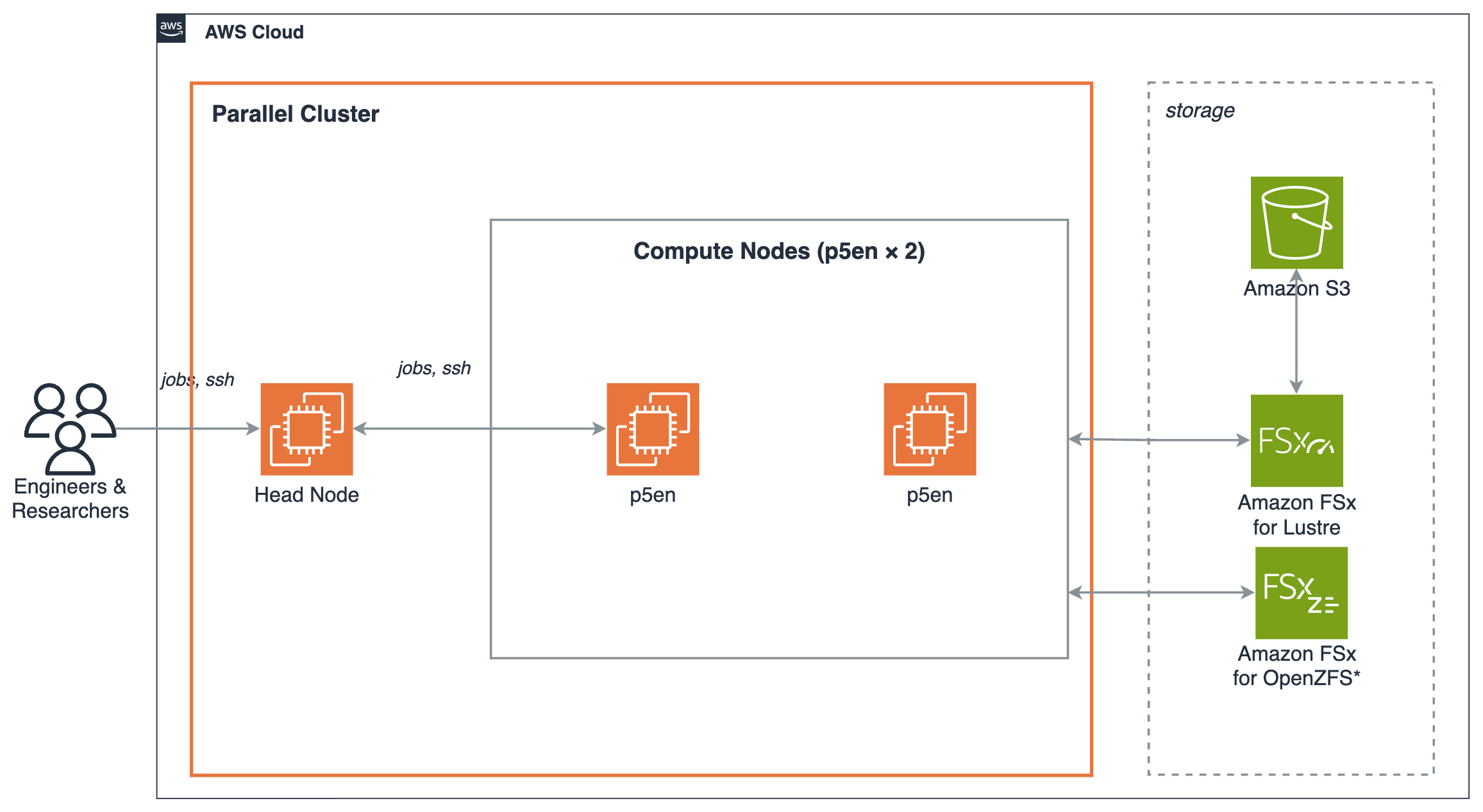
図 1:AWS ParallelCluster でオーケストレーションされた Amazon EC2 P5en インスタンスと、高スループットなデータアクセスを実現する Amazon FSx for Lustre を活用した Ishigaki-IDS のトレーニングアーキテクチャ
評価
当社は社内 IDS 専門家の協力を得て独自に「IDS-Bench」という評価ベンチマークを構築しました。このベンチマークは、IFC バージョンや建築・構造・設備(MEP)、共通分野といった建設分野の分類、日本語と英語という言語の違い、さらに実装・構造・コンテンツの各軸における性能を測定します。これにより、モデルが実際の業務で直面する課題に対する対応能力を正確に反映したスコアリングが可能になります。
結果
IDS-Bench の評価において、Ishigaki-IDS は XML 構造の適合性と IDS 構造の適合性でほぼ 100% に近いスコアを記録し、IDS コンテンツの一貫性でも 80% を上回りました。一方、最先端の汎用モデルは異なる結果を示しました。XML の構文自体は正しく生成できるものの、IDS 構造の適合性は約 25% 未満、IDS コンテンツの一貫性に至ってはほぼ 0% という結果でした。
IDS は専門性が強く比較的新しい分野であり、ドメイン特化型モデルが解決すべき課題です。また、このモデルは YaRN (Yet another RoPE extensioN) を活用してコンテキスト長の拡張にも対応しています。YaRN は、Transformer モデルの元の学習長を超えてコンテキストウィンドウを拡大しつつ、主要な性能低下なしに機能します。我々の確認では、入力と出力が約 120k トークンに至る場合でも、モデルは正しく動作することが証明されました。
buildingSMART と共同で実施した概念実証(PoC)では、IDS の専門家だけでなく非専門家の双方から、業務での利用や曖昧なプロンプトからも意図通りの IDS を生成できる能力について肯定的なフィードバックを得ました。さらに、今後の開発に向けた改善提案のリストも提出されましたが、これはモデルの実用性を裏付けるものでもありました。
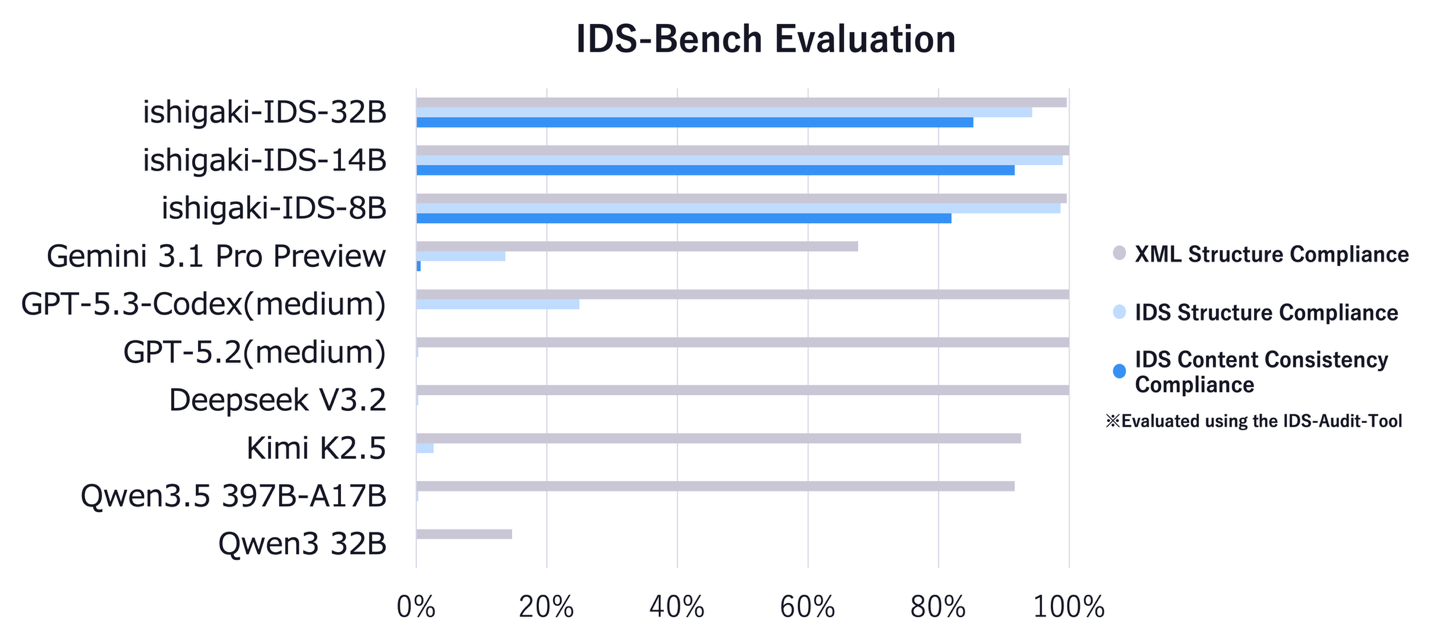
図 2: XML 構造、IDS 構造、および IDS コンテンツの一貫性における一般最先端モデルに対する Ishigaki-IDS バリアントの比較スコア(IDS-Bench)
得られた教訓
本プロジェクトから得た重要な知見は以下の 3 点です。
- 合成データの質が量よりも重要である。 モデル性能を決定づけたのは、ドメイン専門家が合成データ作成に深く関与したことです。単にデータを大量に用意しただけでは、同様の結果は得られませんでした。
- 検証可能な報酬信号がイテレーションを加速する。
IDS-Audit-Toolを自動化された報酬シグナルとして活用したことで、手動評価では不可能なスピードで反復開発が可能になりました。特にデータが少ない環境下においてその効果は顕著でした。
- 安定したインフラが自由な実験を支える。 Amazon EC2 P5en、AWS ParallelCluster、Amazon FSx for Lustre 上で信頼性の高い分散トレーニングを実現できたおかげ、クラスターの問題デバッグに時間を割かずにモデル改善に注力できました。
結論
ドメイン専門家の協力、合成データ、検証ツールと連携した RLVR(Reinforcement Learning from Verifiable Rewards)を組み合わせることで、データが不足している専門分野においてもドメイン特化型の基盤モデルを構築することができました。GenAIIC からの継続的な技術助言により、GENIAC フェーズ 3 の期間内に IDS-Bench で測定された精度目標の達成も可能になりました。ONESTRUCTION は今後も AWS と連携し、建設業界への AI ツールの普及に取り組んでいきます。
次のステップ
ご自身の産業向けにドメイン特化型の基盤モデルを構築したいとお考えの場合は、以下のリソースが優れた出発点となります。
AWS GenAIIC の活用方法 – AWS 生成 AI イノベーションセンターは、技術的な助言とベストプラクティスを通じて、生成 AI プロジェクトを支援しています。
分散トレーニングの開始 – AWS ParallelCluster ユーザーガイドを確認し、同様のインフラストラクチャを設定しましょう。
Ishigaki-IDS の試行 – Hugging Face でモデルにアクセスし、独自の IDS シナリオで実行してみてください。
著者について

日高 耕洋
ONESTRUCTION の AI ストラテジーユニットマネージャーとして、社内での AI 開発や製品への統合、顧客との共同研究を主導しています。最近では、日常の意思決定にも AI エージェントを活用し始めています。好きな SF は『エヴァンゲリオン』と『STEINS;GATE』です。

金澤 遼
ONESTRUCTION の AI 戦略ユニットで AI エンジニアとして活躍する Ryo 氏は、建設と AI を融合させた基盤モデルの開発に取り組んでいます。GENIAC Cycle 3 では、IDS(インテリジェント・ドキュメント・システム)に特化した「Ishigaki-IDS」を開発しました。現在は東京理科大学の修士課程2年生です。お気に入りのSF作品は『STEINS;GATE』と『三体』です。

王晨光
王晨光氏は、アマゾン・ウェブ・サービス(AWS)ジャパンの応用科学者です。APJAC 地域の企業顧客向けに、大規模言語モデル(LLM)、視覚言語モデル(VLM)、マルチモーダル学習モデル(MLM)のトレーニング支援や、エージェントの展開に関する技術サポートを提供しています。

江大元
江大元氏は、アマゾン・ウェブ・サービス(AWS)ジャパンのシニアディープラーニングアーキテクトです。AI と機械学習分野で9年以上の実績を持つ同氏は、ビジネス現場でのデータサイエンス応用に精通しており、現実世界の課題をモデル化し、データを解釈して解決策を導き出すことに長けています。

アンジー・ワン
アンジー・ワン氏は、Amazon Web Services(AWS)ジャパンのシニアジェネレーティブAIストラテジストです。同氏は、顧客がジェネレーティブAIの戦略策定から本番環境への導入までを円滑に進めるよう支援しています。コンピュータサイエンスとベンチャーキャピタルの実務経験を持つアンジー氏は、ビジネス戦略と技術実装の間をつなぐ役割を果たしています。
原文を表示
*This post was co-written by ONESTRUCTION, Inc. and Amazon Web Services Japan G.K. as part of GENIAC (Generative AI Accelerator Challenge) Phase 3, with technical advisory from the AWS Generative AI Innovation Center (GenAIIC).*
Building domain-specialized foundation models in data-scarce fields is hard. You need enough training data, specialized knowledge, and ways to verify your outputs.
ONESTRUCTION, Inc. is a construction technology startup that solves industry problems through openBIM. With technical advisory from GenAIIC, the company built Ishigaki-IDS, a foundation model (FM) specialized for construction industry BIM (Building Information Modeling) workflows. BIM is a digital representation of a building’s physical and functional characteristics, used across the construction lifecycle.
Japan’s construction sector faces a persistent labor shortage. BIM is promoted at the national level because it lets design, construction, and maintenance teams share information in one place. But adopting BIM requires specialist knowledge, and that learning cost has slowed wider use. A good example is IDS (Information Delivery Specifications), an XML-based standard that defines the information attached to and validated against a BIM model (an IFC (Industry Foundation Classes) model). Authoring an IDS file takes fluency in its grammar plus knowledge of IFC and its rules. Ishigaki-IDS lowers that barrier so practitioners who aren’t BIM specialists can review and manage attribute information.
This post is an architectural case study of how ONESTRUCTION built Ishigaki-IDS. If you’re a machine learning (ML) engineer working on domain adaptation, or a technical leader weighing how to build specialized AI models where data is scarce, you will find a pattern you can reuse. Construction and BIM professionals will also see what AI can do in their field. Familiarity with foundation model training (pre-training and fine-tuning) and basic AWS compute concepts helps, but it isn’t required.
You will learn:
- How to use synthetic data generation to overcome data scarcity in niche domains.
- How to build a three-stage training pipeline (CPT, SFT, RLVR) for domain specialization.
- How to use verifiable rewards for structured output generation.
- How to run distributed training on Amazon Elastic Compute Cloud (Amazon EC2) P5en instances with AWS ParallelCluster.
Three challenges in building an IDS foundation model
Three problems stood between us and a working IDS model.
The first was data scarcity. IDS is a relatively new standard, published in 2024, and construction in general is a domain with limited public web content. Many other domains such as finance, healthcare, and law train models on corpora of billions to hundreds of billions of tokens, but no comparable public dataset exists for IDS. Even after collecting recent web data, the volume was small and the depth was shallow, which meant the model couldn’t pick up enough context about IDS and related topics from data alone.
The second was injecting an IFC vocabulary of several thousand terms. For example, “beam” maps to IfcBeam and “air conditioner” maps to IfcUnitaryEquipment. This mapping has historically been done by hand by domain experts, and we needed the model to learn it directly.
The third was IDS-specific grammar. IDS is more than plain XML: its tag structure changes depending on what information is being attached or validated, and authors must use repeated patterns and dedicated tags. General-purpose foundation models struggle to produce this structure with accuracy.
Solution
Our approach combined three ingredients: a multi-stage training pipeline, close collaboration with domain experts, and infrastructure built for stable distributed training. We start with the training pipeline.
Three-stage training pipeline
We built Ishigaki-IDS on top of Qwen3 (8B / 14B / 32B), an open-source large language model (LLM) from Alibaba Cloud known for strong multilingual capabilities and a wide range of parameter sizes. With the size range, we can experiment at smaller scales before committing to full training runs at 32B. We applied a three-stage training pipeline.
First, in *continued pre-training (CPT)*, we injected IDS and IFC domain knowledge using web corpora plus synthetic data created with our internal domain experts. We generated valid IDS files at scale and built synthetic datasets that explained IDS-related documents from multiple angles, with synthetic data covering most of the training corpus.
Second, in *supervised fine-tuning (SFT)*, we trained the model on pairs of IDS authoring instructions (in CSV or natural language) and their expected IDS output. SFT alone left expected issues, such as plausible but incorrect XML tag choices and wrong attribute values, so we designed a third stage to address them.
Third, in *reinforcement learning with verifiable rewards (RLVR)*, we used IDS-Audit-Tool from buildingSMART, the international standards body, as the reward function. The tool checks XML well-formedness, IDS structural validity, and semantic consistency, so the model can iterate against mechanical correctness signals. RLVR fits the IDS task well because it refines output quality without large amounts of supervised data—useful for a data-poor domain.
Technical advisory from GenAIIC
We led development with our construction and BIM domain expertise and met with GenAIIC every two weeks for technical advisory. At each milestone, we brought training results and evaluation data to these sessions, and together we worked through five key areas:
- Training data design – synthetic data strategies for the IDS domain and how to balance the data mix across CPT, SFT, and RLVR stages.
- Evaluation benchmarks – metrics covering IFC and IDS knowledge, structured generation, and general dialogue ability.
- Training stages and techniques – refining CPT, SFT, and RLVR, including long-context handling, reward shaping, and structured generation.
- Training infrastructure – parallelization, throughput, and stability for distributed training.
- Result diagnosis – when issues appeared, diagnosing root causes and setting direction for the next iteration.
Iterating on “what change improves IDS generation accuracy and practicality” at each cycle helped us build a domain-specialized foundation model in a niche, data-poor area within a short timeline.
Architecture
For the training infrastructure, we used Amazon EC2 P5en instances (two p5en.48xlarge nodes with NVIDIA H200 Tensor Core GPUs), orchestrated with AWS ParallelCluster. ParallelCluster is an open source tool that simplifies deploying and managing High Performance Computing (HPC) clusters on AWS. We stored training data, synthetic data, and checkpoints on Amazon FSx for Lustre, a fully managed file system optimized for compute-intensive workloads that delivers sub-millisecond latencies and high throughput. This setup gave us stable multi-node distributed training and parallel access to large datasets.
Figure 1: Ishigaki-IDS training architecture using Amazon EC2 P5en instances orchestrated by AWS ParallelCluster with Amazon FSx for Lustre for high-throughput data access
Evaluation
We built our own evaluation benchmark, IDS-Bench, with our internal IDS specialists. IDS-Bench measures performance across IFC version, construction discipline (architecture, structure, MEP, and common), language (Japanese and English), and the Implement, Structure, and Content axes, so the scores reflect what the model needs to handle in real work.
結果
In our IDS-Bench evaluation, Ishigaki-IDS scored close to 100 percent on XML structural compliance and IDS structural compliance, and above 80 percent on IDS content consistency. General frontier models told a different story: they produced well-formed XML but scored under roughly 25 percent on IDS structural compliance and near 0 percent on IDS content consistency. IDS is a specialized and relatively new area, which is the kind of problem a domain-specialized model can solve. The model also supports context-length scaling with YaRN (Yet another RoPE extensioN). YaRN extends the context window of transformer models beyond their original training length without major performance degradation. We confirmed that the model generates correctly with inputs and outputs up to roughly 120k tokens.
In a joint proof-of-concept with buildingSMART, both IDS specialists and non-specialists responded positively to using the model in their work and to its ability to produce the intended IDS even from ambiguous prompts. They also gave us a list of suggestions for further development, which reinforced our view that the model is useful in practice.
Figure 2: IDS-Bench scores comparing Ishigaki-IDS variants against general frontier models across XML structure, IDS structure, and IDS content consistency
Lessons learned
Three takeaways from this project:
- Synthetic data quality matters more than quantity. Our domain experts’ involvement in synthetic data creation was the difference-maker for model performance. Volume alone wouldn’t have produced the same result.
- Verifiable rewards accelerate iteration. Using IDS-Audit-Tool as an automated reward signal let us iterate faster than manual evaluation would allow, especially in a data-poor setting.
- Stable infrastructure lets us experiment freely. Reliable distributed training on Amazon EC2 P5en, AWS ParallelCluster, and Amazon FSx for Lustre freed us to focus on model improvements rather than debugging cluster issues.
まとめ
Combining domain expert collaboration, synthetic data, and RLVR tied to a verification tool worked well for building a domain-specialized model in a data-poor specialty area. Continuous technical advisory from GenAIIC helped us reach the accuracy targets measured on IDS-Bench within the GENIAC Phase 3 timeline. ONESTRUCTION will continue working with AWS to bring AI tools to the construction industry.
Next steps
If you’re interested in building domain-specialized foundation models for your industry, the following resources are a good place to start:
- Explore AWS GenAIIC – Learn how the AWS Generative AI Innovation Center supports generative AI projects with technical advisory and best practices.
- Get started with distributed training – See the AWS ParallelCluster User Guide to set up similar infrastructure.
- Try Ishigaki-IDS – Access the model on Hugging Face and run it against your own IDS scenarios.
About the authors
Koyo Hidaka
Koyo is Manager of the AI Strategy Unit at ONESTRUCTION, where he leads in-house AI development, AI integration into the company’s products, and joint AI research with clients. He has recently started entrusting everyday decisions to AI agents. His favorite science fiction is Evangelion and Steins;Gate.
Ryo Kanazawa
Ryo is an AI Engineer in the AI Strategy Unit at ONESTRUCTION, working on foundation models for construction × AI. In GENIAC Cycle 3 he developed Ishigaki-IDS, the IDS-specialized model. He is a second-year master’s student at Tokyo University of Science. His favorite science fiction is Steins;Gate and The Three-Body Problem.
Chenguang Wang
Chenguang is an Applied Scientist at Amazon Web Services Japan. He provides technical support for training LLMs, VLMs, and MLMs and for deploying agents to enterprise customers across APJC.
Dayuan Jiang
Dayuan is a Senior Deep Learning Architect at Amazon Web Services Japan. With more than nine years of experience in AI and machine learning, he is skilled at applying data science in business settings—modeling real-world problems and interpreting data to solve them.
Angie Wang
Angie is a Senior Generative AI Strategist at Amazon Web Services Japan. She helps AWS customers from generative AI strategy through production deployment. With a background in computer science and venture capital, she bridges business strategy and technical implementation.
News to Guide
ニュースの次に確認する
発表内容を、現在の料金や仕様と照らし合わせられる関連ガイドです。
今日のまとめ
AIデイリーブリーフで今日の重要ニュースをまとめ読み