高度な結合技術:LATERAL 結合、セミ結合、アンチ結合
本文の状態
日本語全文を表示中
詳細モードで約7分の本文を読めます。
同じ出来事の情報源
この情報源を基点に整理
KDnuggets
KDnuggets は、サブクエリが FROM クラースの先行列を参照できる LATERAL 結合や、一致する行のみを返すセミ結合、一致しない行を返すアンチ結合といった SQL の高度な結合技術について解説した。
Source Article
元記事を日本語で読む
本文に関係しない購読案内、埋め込み通知、サイト内プロモーションは除いています。
**
# イントロダクション
INNER JOIN と LEFT JOIN は、SQL クエリの大部分を処理できます。しかし、より少数のクラスの問題には、他の 結合タイプ が必要です**:集計関数(set-returning function)の結果を行ごとにカウントする、別のテーブルでの存在に基づいて行をフィルタリングする、あるいは別のテーブルで一致しない行を返すといったケースです。
これらをきれいに処理するのが、3 つのあまり一般的ではない結合です。LATERAL 結合(LATERAL join)は、FROM クラース内のサブクエリが、同じ FROM クラース内で先行する列を参照することを可能にします。Semi 結合(Semi join)は、別のテーブルで一致が存在する行を返しますが、その行の重複は発生しません。Anti 結合(Anti join)は、別のテーブルで一致が存在しない行を返します。
これらのパターンを実践的にどのように適用するかを探っていきましょう。
**

FROM クラース内の LATERAL サブクエリは、同じ FROM クラース内の先行するテーブルの列を参照できます。LATERAL を使用しない場合、FROM 内のサブクエリは独立して評価され、それらの列を認識することはできません。
これは、セット返却関数(set-returning function:入力に対して複数の行を返す関数)を呼び出す際に特に重要です。セット返却関数は SELECT リスト内で呼び出すこともできますが、FROM クラース内の外部テーブルの列に対して行ごとに適用するには、LATERAL が必要です。
一般的なケース:**
- 配列カラムに対して unnest() を呼び出し、配列の各要素ごとに 1 行を取得する
- 'g' フラグを指定して regexp_matches() を呼び出し、各行ごとのすべての一致箇所を抽出する
- FROM 句に相関サブクエリを使用して、グループごとの上位 N 件結果を計算する
- 各行の JSON 配列を分割する
// 例:単語出現回数のカウント
この Google の質問 では、contents カラム内の「bull」という単語と「bear」という単語がそれぞれ何回出現しているかを数えるよう求めています。一致は大文字小文字を区別せずに行う必要がありますが、「bullish」や「bearing」のような部分文字列は除外する必要があります。
データ: google_file_store テーブルの内容は以下の通りです:
filename
contents
draft1.txt
The stock exchange predicts a bull market which would make many investors happy.
draft2.txt
The stock exchange predicts a bull market... but analysts warn... we are awaiting a bear market.
final.txt
The stock exchange predicts a bull market... a bear market. As always predicting the future market is uncertain...
コード: regexp_matches() は一致するたびに 1 行を返します。google_file_store の各行に対してこれを一度実行し、テーブル全体のすべての一致箇所を数えるために、LATERAL を使用して FROM 句に配置します。\m と \M アカーは PostgreSQL の単語境界を示すものであり、これによって「bullish」や「bearing」が除外されます。
SELECT 'bull' AS word,
       COUNT(*) AS nentry
FROM google_file_store,
     LATERAL regexp_matches(LOWER(contents), '\m(bull)\M', 'g')
UNION ALL
SELECT 'bear' AS word,
       COUNT(*) AS nentry
FROM google_file_store,
     LATERAL regexp_matches(LOWER(contents), '\m(bear)\M', 'g');
// Output
word
nentry
bull
3
bear
2
# Semi Joins (セミジョイン)
**
セミジョインは、右テーブルに少なくとも1つの一致が存在する左テーブルの行を返すものであり、各左テーブルの行は最大1回しか現れません。INNER JOIN では、右側に複数の一致がある場合、左テーブルの行が重複して表示されます。しかし、セミジョインではそのような重複は発生しません。
2 つの SQL 実装方法:**
- WHERE EXISTS (SELECT 1 FROM ...)
- WHERE col IN (SELECT col FROM ...)
EXISTS はより一般的な形式です。これは、クエリを書き換えることなく、複数列の結合条件や相関サブクエリを処理できるためです。
// Example: Finding High-Value Customers (例:高価値顧客の特定)
この質問 では、$100 以上の注文を少なくとも 1 つ行った顧客を見つけ、その顧客 ID と名前を返すよう求めています。
データ**: online_store_customers および online_store_orders のプレビュー:
customer_id
customer_name
1
Alice Johnson
2
Bob Smith
3
Carol Williams
…
…
10
Jack Anderson
order_id
customer_id
amount
status
101
1
150
paid
102
1
200
paid
103
1
75
paid
...
...
...
...
115
9
450
paid
コード: EXISTS サブクエリは、顧客ごとに $100 を超える注文が存在するかどうかを確認します。SELECT 1 は、EXISTS が行が返ってくるかどうかにのみ関心があり、その中身には関心がないため、この慣習です。
SELECT
    c.customer_id,
    c.customer_name
FROM online_store_customers c
WHERE EXISTS (
    SELECT 1
    FROM online_store_orders o
    WHERE o.customer_id = c.customer_id
      AND o.amount > 100
);
もし INNER JOIN を使用した場合、顧客 1 は一致する注文が 2 つあるため結果に 2 回表示されます。EXISTS は顧客 1 を 1 回のみ返します。
// 出力
customer_id
customer_name
1
Alice Johnson
2
Bob Smith
3
Carol Williams
…
…
9
Ivy Taylor
# アンチジョイン (Anti Joins)
**アンチジョインは、右テーブルに一致する行が存在しない場合、左テーブルから行を返します。これはセミジョインの逆です。
2 つの SQL 実装:**
- LEFT JOIN ... WHERE right_table.col IS NULL
- WHERE NOT EXISTS (SELECT 1 FROM ...)
両方とも同じ結果を生成します。NOT EXISTS は、最新の PostgreSQL バージョンではより良いクエリプランを生成することが多く、読みやすさの点でも直接的です。LEFT JOIN + IS NULL パターンは古くからあるもので、一致しない行についても右側の列が必要となる場合に有用です。
// 例:4 月に通話のない無料ユーザー
この質問 は、2020 年 4 月に通話をしなかった無料ユーザーを返すよう求めています。
データ**: rc_calls と rc_users のプレビュー:
user_id
call_id
call_date
1218
0
2020-04-19 01:06:00
1554
1
2020-03-01 16:51:00
1857
2
2020-03-29 07:06:00
1525
3
2020-03-07 02:01:00
…
…
…
1910
39
2020-03-11 08:33:00
user_id
status
company_id
1218
free
1
1554
inactive
1
1857
free
2
…
…
…
1884
free
1
コード: 日付フィルタは WHERE 句ではなく ON 句に配置されます。この区別こそが、これをアンチ結合(Anti Join)とする理由です。日付フィルタを WHERE に置くと、LEFT JOIN で NULL が生成された行が削除され、結果としてインナー結合(Inner Join)に戻ってしまいます。一方、フィルタを ON 句に配置することで、条件を満たす 4 月の通話がないフリーユーザーも右側に NULL を持つ行として出力されます。その後、IS NULL チェックによってこれらの行のみが保持されます。
SELECT DISTINCT u.user_id
FROM rc_users u
LEFT JOIN rc_calls c
       ON u.user_id = c.user_id
      AND c.call_date BETWEEN '2020-04-01' AND '2020-04-30'
WHERE u.status = 'free'
  AND c.user_id IS NULL;
// 出力
user_id
1575
1910
# 結論
**
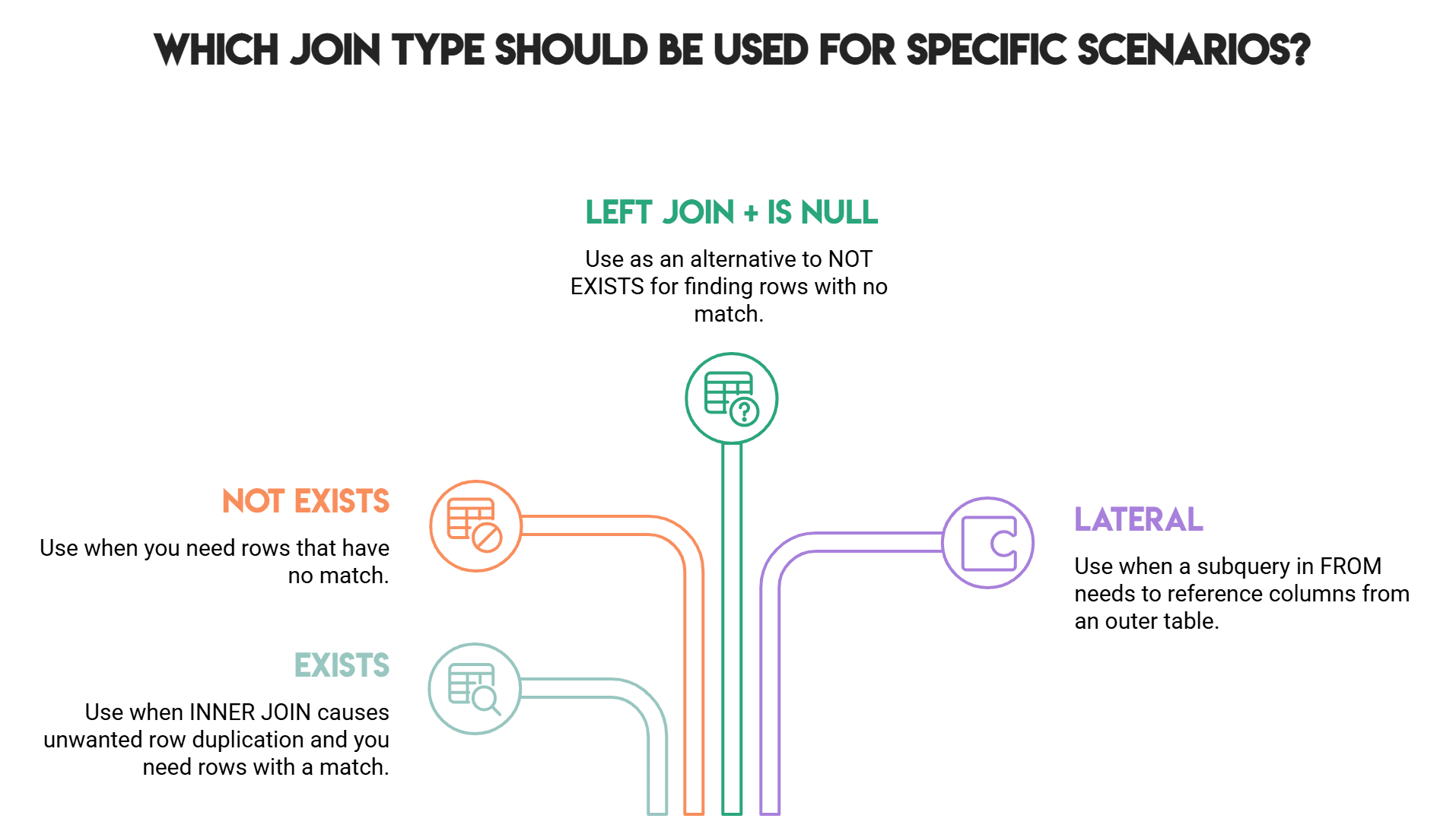
これら 3 つの結合手法は、インナー結合(INNER JOIN)や左結合(LEFT JOIN)が不適切または誤りとなるケースを解決します:**
- LATERAL は、FROM 句内でセット返却関数(set-returning functions)を行ごとに呼び出すための方法です。
- EXISTS を使用すると、重複を引き起こすインナー結合(INNER JOIN)による問題なく、「一致する行」を取得できます。
- NOT EXISTS または LEFT JOIN + IS NULL を組み合わせることで、「一致しない行」をきれいに取得できます。
覚えるべきパターンは短いです。INNER JOIN で望まない行の重複が発生する場合は EXISTS を使い、一致する行がない場合が必要なときは NOT EXISTS または LEFT JOIN + IS NULL を使用します。FROM 句内のサブクエリが外部テーブルの列を参照する必要がある場合は、LATERAL を追加してください。
原文を表示

**
# Introduction
INNER JOIN and LEFT JOIN handle most SQL queries. A smaller class of problems needs other join types**: counting set-returning function results row by row, filtering rows by existence in another table, and returning rows that have no match in another table.
Three less-common joins handle these cleanly. LATERAL joins let a subquery in the FROM clause reference columns from earlier in the same FROM clause. Semi joins return rows where a match exists in another table, without duplicating those rows. Anti joins return rows where no match exists.
Let's explore how to apply these patterns in practice.
**
A LATERAL subquery in the FROM clause can reference columns from preceding tables in the same FROM clause. Without LATERAL, a subquery in FROM is evaluated independently and cannot see those columns.
This matters most when calling a set-returning function (one that returns multiple rows per input). Set-returning functions can be called in the SELECT list, but to apply them row-by-row to a column from an outer table inside the FROM clause, LATERAL is required.
Common cases:**
- Calling unnest() on an array column to get one row per array element
- Calling regexp_matches() with the 'g' flag to extract every match per row
- Computing a top-N-per-group result with a correlated subquery in FROM
- Splitting JSON arrays per row
// Example: Counting Word Occurrences
This Google question asks us to count how many times the words "bull" and "bear" appear in a contents column. Matches must be case-insensitive, and substrings like bullish or bearing should be excluded.
Data**: the google_file_store table is:
| filename | contents |
|---|---|
| draft1.txt | The stock exchange predicts a bull market which would make many investors happy. |
| draft2.txt | The stock exchange predicts a bull market... but analysts warn... we are awaiting a bear market. |
| final.txt | The stock exchange predicts a bull market... a bear market. As always predicting the future market is uncertain... |
Code: regexp_matches() returns one row per match. To run it once per row of google_file_store and count all matches across the table, we put it in the FROM clause with LATERAL. The \m and \M anchors are PostgreSQL** word boundaries, which is what excludes "bullish" and "bearing".
SELECT 'bull' AS word,
COUNT(*) AS nentry
FROM google_file_store,
LATERAL regexp_matches(LOWER(contents), '\m(bull)\M', 'g')
UNION ALL
SELECT 'bear' AS word,
COUNT(*) AS nentry
FROM google_file_store,
LATERAL regexp_matches(LOWER(contents), '\m(bear)\M', 'g');// Output
| word | nentry |
|---|---|
| bull | 3 |
| bear | 2 |
# Semi Joins
**
A semi join returns rows from the left table where at least one match exists in the right table, with each left-table row appearing at most once. INNER JOIN duplicates left-table rows when the right side has multiple matches. Semi joins do not.
Two SQL implementations:**
- WHERE EXISTS (SELECT 1 FROM ...)
- WHERE col IN (SELECT col FROM ...)
EXISTS is the more general form because it handles multi-column join conditions and correlated subqueries without rewriting the query.
// Example: Finding High-Value Customers
This question asks us to find customers who have placed at least one order over $100 and return their customer ID and name.
Data**: Previews of online_store_customers and online_store_orders:
| customer_id | customer_name |
|---|---|
| 1 | Alice Johnson |
| 2 | Bob Smith |
| 3 | Carol Williams |
| … | … |
| 10 | Jack Anderson |
| order_id | customer_id | amount | status |
|---|---|---|---|
| 101 | 1 | 150 | paid |
| 102 | 1 | 200 | paid |
| 103 | 1 | 75 | paid |
| ... | ... | ... | ... |
| 115 | 9 | 450 | paid |
Code**: The EXISTS subquery checks, per customer, whether any order over $100 exists. SELECT 1 is the convention because EXISTS only cares whether any row comes back, not what is in it.
SELECT
c.customer_id,
c.customer_name
FROM online_store_customers c
WHERE EXISTS (
SELECT 1
FROM online_store_orders o
WHERE o.customer_id = c.customer_id
AND o.amount > 100
);If we used INNER JOIN instead, customer 1 would appear twice in the result because two orders match. EXISTS returns customer 1 once.
// Output
| customer_id | customer_name |
|---|---|
| 1 | Alice Johnson |
| 2 | Bob Smith |
| 3 | Carol Williams |
| … | … |
| 9 | Ivy Taylor |
# Anti Joins
**
An anti join returns rows from the left table where no match exists in the right table. It is the inverse of a semi join.
Two SQL implementations:**
- LEFT JOIN ... WHERE right_table.col IS NULL
- WHERE NOT EXISTS (SELECT 1 FROM ...)
Both produce the same result. NOT EXISTS often produces a better query plan in modern PostgreSQL versions and reads more directly. The LEFT JOIN + IS NULL pattern is older and useful when you also need columns from the right side for non-matching rows.
// Example: Free Users With No April Calls
This question asks us to return free users who did not make any calls in April 2020.
Data**: Previews of rc_calls and rc_users:
| user_id | call_id | call_date |
|---|---|---|
| 1218 | 0 | 2020-04-19 01:06:00 |
| 1554 | 1 | 2020-03-01 16:51:00 |
| 1857 | 2 | 2020-03-29 07:06:00 |
| 1525 | 3 | 2020-03-07 02:01:00 |
| … | … | … |
| 1910 | 39 | 2020-03-11 08:33:00 |
| user_id | status | company_id |
|---|---|---|
| 1218 | free | 1 |
| 1554 | inactive | 1 |
| 1857 | free | 2 |
| … | … | … |
| 1884 | free | 1 |
Code**: The date filter sits in the ON clause, not WHERE. That distinction is what makes this an anti join. Putting the date filter in WHERE would drop rows where the LEFT JOIN produced NULLs, collapsing it back to an INNER JOIN. With the filter in ON, free users with no qualifying April call still produce a row, with NULLs on the right side, and the IS NULL check keeps only those rows.
SELECT DISTINCT u.user_id
FROM rc_users u
LEFT JOIN rc_calls c
ON u.user_id = c.user_id
AND c.call_date BETWEEN '2020-04-01' AND '2020-04-30'
WHERE u.status = 'free'
AND c.user_id IS NULL;// Output
| user_id |
| --- |
| 1575 |
| 1910 |
# Conclusion
**
These three joins solve cases where INNER JOIN and LEFT JOIN are awkward or wrong:**
- LATERAL is the way to call set-returning functions row by row inside FROM.
- EXISTS gives you "rows with a match" without the duplication that INNER JOIN causes.
- NOT EXISTS or LEFT JOIN + IS NULL gives you "rows with no match" cleanly.
The pattern to remember is short. When INNER JOIN duplicates rows you don't want, use EXISTS. When you need rows that have no match, use NOT EXISTS or LEFT JOIN + IS NULL. When a subquery in FROM needs to reference columns from an outer table, add LATERAL.
Nate Rosidi is a data scientist and in product strategy. He's also an adjunct professor teaching analytics, and is the founder of StrataScratch, a platform helping data scientists prepare for their interviews with real interview questions from top companies. Nate writes on the latest trends in the career market, gives interview advice, shares data science projects, and covers everything SQL.
今日のまとめ
AIデイリーブリーフで今日の重要ニュースをまとめ読み