児童と教育 #18:算数を実践せよ
著者はスタンフォード大学のジョ・ボアラー教授による教育研究がデータ操作や不誠実な手法を用いたものであると主張し、ベイエリアでの代数授業停止などの具体的な被害事例を挙げて批判している。
キーポイント
教育研究における不正行為の指摘
著者は特定の教育研究者がデータを操作し、不誠実な手法で成果を誇張した「犯罪レベルの詐欺」を行ったと断じ、その具体例としてジョ・ボアラー教授の名前を挙げている。
ベイエリアでの代数授業停止の背景
カリフォルニア州ベイエリアの学校システムが中学生への代数教育を中止した決定は、上記のような不誠実な研究結果に基づいて行われたものであり、その動機を「犯罪レベル」と表現している。
Railside 校におけるデータ改ざんの具体例
研究者が追跡調査を行った結果、ボアラー教授は比較対象の生徒層を意図的に選別し、テスト内容も学年に適合していない低レベルの問題で構成されていたことが明らかになった。
評価手法の欠陥と予測妥当性の欠如
その研究で使用されたテストは、SAT などの他の数学能力指標との相関がなく(予測妥当性なし)、実際には生徒が学習していない内容を含んでおり、教育効果を実証できていない。
教育研究の信頼性欠如
Jo Boaler氏の研究を含む教育現場の研究には、証拠の質が著しく低く、誤ったデータに基づいて政策が決定されている。
成績インフレの長期的悪影響
平均的な成績インフレは高校卒業率や大学進学を下げ、最終的に学生の生涯賃金を大幅に減少させることが示唆されている。
表面的な合格と実力不足の矛盾
生徒が代数を「合格」したとしても実際には理解できておらず、出席率や成績操作によって虚偽の成果が作られている。
影響分析・編集コメントを表示
影響分析
この記事は、教育政策の決定プロセスにおいて科学的根拠が歪曲された場合、生徒の学習機会を奪う深刻な結果を招くことを警告しています。特に数学教育のような基礎分野における研究の透明性と倫理的重要性を再認識させる内容であり、教育現場や政策立案者にとって重要な警鐘となっています。
編集コメント
本記事は特定の研究者への強い批判を含んでいますが、AI テクノロジーや企業の動向に関する直接的な報道ではないため、技術トレンドとしての重要性は限定的です。
昨日は読書を行いました。今度は数学です。数学は難しいものです。
必ずしもこれほど難しくある必要はありません。
数学が難しい、あるいは退屈である理由の大部分は、教育研究、特に数学に関する研究が、あなたが思っているよりもさらに劣っているからです。それは単に数学と統計学の両方を永遠に失敗させるというレベルを超え、私が基本的に詐欺と呼ぶものへと至ります。様々な人々が数学教育と戦っており、それをその場で止めるために何をするでもします。私たちは反撃しなければなりません。
教育研究はあなたが思っているよりも劣っている
ケルシー・パイパーは、「教育研究は弱く、ずさんだ。なぜか?」というタイトルで、彼女が報告している絶望的なひどさのレベルを完全に過小評価しています。
ベイエリア全体の学校システムが子供たちに代数を教えるのをやめたあの一件をご存知ですか?あれは犯罪レベルの詐欺によって動機づけられたものです。これが事実であれば、私はジョー・ボアラーを刑務所に入れ、重労働で服役させるべきだと考えます。
有料壁の前までの部分は以下の通りです:
ケルシー・パイパー:ジョー・ボアラーはスタンフォード大学教育大学院の教育学教授であり、「発見」ベースの手法を通じて生徒が数学をより速く、より効果的に学ぶと主張する影響力の極めて大きな著作を持っています。彼女の業績により、ベイエリア全体の中学校から代数が削除されました。
これは私がジャーナリストとして過去 10 年間で見た中で、最も無能かつ不誠実に実施された研究の一部です。
一例を挙げましょう:彼女は、カリフォルニア州の貧困層・恵まれない学校である「レイルサイド」において、彼女の革新的な新しい数学カリキュラムが驚くべき成功を収めたという報告を、「教師のための全国数学協議会(National Council of Teachers of Mathematics)」で行いました(ただし、研究が行われた実際の学校の名称は明かしていません)。彼女は、自らのカリキュラムを採用した生徒たちが、従来のカリキュラムを持つ学校に通う生徒たちよりも劇的に先を進んだと述べています。
他の研究者たちは彼女の業績を検証するために、カリフォルニア州のすべての学校を精査し、「レイルサイド」がどの学校に該当するかを特定しようとしました。その目的は、ボアラー氏が共有を拒否していたパフォーマンスデータを調査するためでした。しかし彼らが明らかにしたのは、ボアラー氏が「レイルサイド」の上位2つの四分位数(quartile)の生徒たちと、他の学校の中間四分位数の生徒たちを比較していたことでした。実際には、「レイルサイド」の生徒たちは、研究期間中に実施された数学的能力のすべてのテストにおいて、他の学校の生徒たちに比べて著しく劣る結果を示していました。ボアラー氏が彼女のプレゼンテーションで強調した1つの例外を除いてです。そして、彼女が実際に強調したそのテストは、革新的な新しいカリキュラムにさらされていない生徒たちを対象に行われたものでした。
彼らは、ボアラー氏が生徒たちの成功を評価するために使用した「試験」が一般的に以下の問題を含んでいることを発見しました:
- 学年レベルより2〜3年下の内容が含まれていたこと。
- 代数1(Algebra 1)または幾何学(Geometry)の授業用でありながら、それらに関する重要な内容は一切含まれていなかったこと。
- 誤って採点された問題が含まれていたこと。
数学の成績に関する他の指標、例えば SAT のスコアなどに対しては「予測的妥当性」を示すことができませんでした。
Boaler 氏の基本的な計算力を問う誤答だらけのテストでよくできたことと、生徒が習得すべき内容をマスターしたことの間に、単に何の関係もありませんでした。さらにその論文では、Boaler 氏の手法によって数学の成績における性差が解消され、女子が男子と同様にスコアを上げたと主張していましたが、外部のテストの結果を見ると、「Railside」高校における性差は他のどの場所と変わらなかったことが示されています。
別の機会には、Boaler 氏はたった 4 週間のサマープログラムで生徒に数年分の数学成績向上をもたらせると主張しました。しかし、人々がその根拠を掘り下げてみると、彼女はキャンプの開始時と終了時に同じテストを実施し、生徒のスコアが向上したというだけの事実でした——他の研究者が指摘したように、これはおそらく数週間前に全く同じ問題を見たという事実に過ぎないためです。これほどまでに漫画的なほどに悪い証拠基準です。
これが Jo Boaler 氏に対する特定の批判であればと願いますが、そうではありません。教育研究の現状は全体的に極めて深刻なものです。
これを純粋に Jo Boaler 氏のせいにすることはできません。主に、そのような詐欺を調査もせず容認・受け入れ、それが政策を推進させたシステム全体に責任があるのです。これは私が最初の数分で発見するレベルの問題です。
数学への戦争
そして、生徒がついに代数を学ぶことになったとき、多くの場合、実際に代数を解くことができません。
なぜ、代数を修了した生徒たちが代数ができないのか?
ああ。
ウェンディ:教師が決して聞きたくない言葉は二つあります。それは「成長計画」です。私たちの学校では、今まさに Algebra I の合格率 100% を達成しようとしています。過度な欠席に対して最後まで抵抗していた最後の教員たちも、とうとう折れ始めています。どの教員も「成長計画」に組み込まれることを望んでいません。
ジョニーは 80 日間のうち 5 日間しか出席していません。心配はいりません。彼は今、合格しています。
次に起こる出来事を、実際の成績や SAT スコアが防げたかもしれないと知っていましたか?
また、成績のインフレ(grade inflation)は実際には生徒にとって非常に悪いことだと知っていましたか?
セブ・クリエー(Google DeepMind の AGI ポリシー開発責任者):「平均的な成績インフレが 1 標準偏差高い教員の下で学んだ生徒の、生涯所得の現在価値は、その教員の指導する毎年あたり 213,872 ドル減少します。」
完全な結果として、「合格ラインでの成績インフレ」は限界において収入にはプラスに働きますが、平均的な成績インフレは収入に対して非常に悪影響を及ぼします。私はこれらの結果の規模については懐疑的ですが(ロールして否定)、方向性については否定しません。
2025 年 9 月の論文『Easy A's, Less Pay: The Long Term Effects of Grade Inflation』(「楽な A、低い報酬:成績インフレの長期的影響」)は以下を主張しています。
合格ラインでの成績インフレは留年の可能性を減らし、高校卒業率を増加させ、2 年制大学への初期入学を増加させます。一方、平均的な成績インフレは将来のテストスコアを低下させ、高校卒業の可能性を減らし、大学進学率を低下させ、最終的には収入を減少させます。
これは高校における成績のみを対象としており、9 年生から 10 年生の成績に偏っています。
つまり、以下のようになります:
不合格となるべき生徒を合格させることは、留年する可能性を低下させ、卒業や 2 年制大学への初期入学の可能性を高める。なぜなら、それはほぼ必然だからだ。つまり、偽のシグナルがさらに偽のシグナルを生み出していると言っているのだ。
平均成績のインフレは、将来のテストスコアを低下させ、高校卒業や大学進学の可能性を下げ、最終的には収入にも悪影響を与える。うわっ。これは、助けを得ている生徒にとっても普遍的に悪いことだと言っている(なぜなら、明らかに成績がインフレされていない生徒には害になるからだ)。
カリフォルニア大学サンディエゴ校
実は、成績は最初から重要な役割を果たしていたことが判明した。公式報告書も参照のこと。
マシュー・ザイトリン氏によると、これは viral ツイートが示唆しているよりもはるかに深刻だが、「短期的には何も変わらない」し、SAT や ACT は必須要件とはならない。また、これをパンデミックのせいにするのは間違いだ。すでにその段階を遥かに超えている。
ケルシー・パイパー:世界の注目を集めた問題は「7 + 2 = [_] + 6」だった。トリックはない。見たままに簡単な問題だ。答えは 3 である。
この質問は、カリフォルニア大学サンディエゴ校(UCSD)の急速に成長している補習数学クラス「Math 2」の生徒に出されたが、その四分の一が間違えた。
以下は、補習数学クラスの生徒たちの結果の一部である:
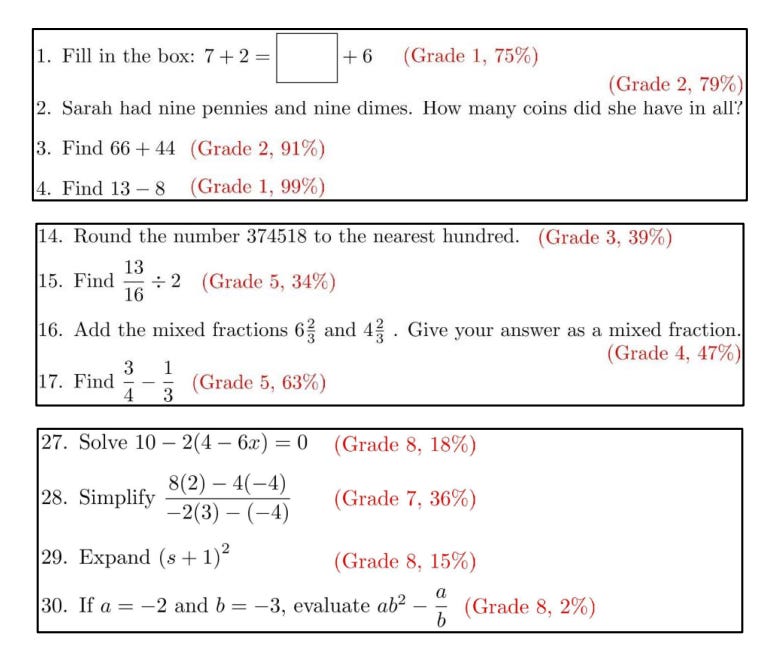
まあ、確かにそれは非常に悪いように聞こえますが、これは補習クラスなので、大したことないですよね?
2020 年の秋学期に数学 2(Math 2)を受講したのは 32 人の学生でした。しかし、2025 年の秋学期には、1,000 人もの学生が数学の配置テストで極めて低いスコアを記録し、補習が必要となりました。
ああ、そうか。では、これは UCSD(カリフォルニア大学サンディエゴ校)の学生の 12% にあたりますね。では、いったい誰が数学に失敗したのでしょうか?
このような試験結果をレビューすると、成績表には C や D、あるいは不合格の成績がびっしりと書かれていると予想するでしょう。しかし、驚くべきことに、これらの学生の成績表には数学における深刻な苦戦は反映されていませんでした。むしろ、彼らは高度な数学コースを受講し、良好な成績を収めていた学生たちでした。
「中学レベルの数学スキルを示さなかった人々のうち」、報告書によると 42% が微積分または予備微積分(calculus or precalculus)を修了したと回答しました。
…また、これらの学生は全体的に良好な成績も受けていました:補習数学が必要な学生の 4 分の 1 以上が、数学の GPA(成績平均点)で 4.0 を獲得していました。平均値は 3.7 です。
アンデリア:はい、私も VTech でそれを目撃しました。基本的に入学審査は 3 つのエッセイへの回答に基づいて行われます。そのうちの一つでは、自分が排除されたと感じた時の体験を記述するよう求められます。これは明らかにエンジニアリングにおいて重要な要素です。
ああ、そうか。成績はあまりにも偽物で、完全に無価値なのですね。では、そのようにしていったことがよくわかりました。
年を追うごとに、彼らはさらに遅れを取り、生徒が数学ができないことを認め、それに応じて評価を下すことが教師にとってますます不可能になっていきます。なぜなら、それが子供たちの GPA や大学への見通しを台無しにしてしまうからです。このようにして、彼らは中学レベル、あるいは場合によっては小学レベルの数学しかできないと気づくまで、そのまま大学に進んでしまいます。
ああ、そうか。では、数学教育システム全体が詐欺だったということになります。2020 年に UC システムにおける SAT および ACT の要件が廃止された後、ケルシーが言うように、そのすべてに対する『現実確認』はなくなり、それで終わりでした。
もしかしたら、生徒に数学の知識を必要としないことをさせることができるかもしれません?
補習数学を受講している生徒たちが最も多く選択する専攻は、生物学と心理学です。心理学科の学士号専攻および生物学科の専攻では大学レベルの微積分が必要であり、学生たちは通常 UCSD の微積分クラス 10A と 10B を履修します。
しかし、報告書によると、補習数学から来た生徒たちは、大学が提供できるすべての補習コースを履修した後でもこれらのクラスで苦労していることがわかりました。2017 年から 2023 年の間、これらの学生の 24% が 10A で D、F を取得するか、または退学しました。その後 10B に進んだ学生のうち、30% が D、F を取得するか、または退学しています。
Oh. Well, then. That’s actually better than I expected. Half of them pass those classes. Except that kind of suggests that’s worse, because how exactly did they pass?
These students are not lazy or dumb.
… These kids were not doing anything wrong. They were lied to. They were told that they were prepared for classes they were not prepared for. They were told that they were excelling in classes that they were not excelling in. They deserved better.
I would love to not also blame the kids in all this, but that’s kind of nuts?
If you can’t do the most basic math questions, and there’s an AP test at the end that almost no one in class even bothers taking, and you’re somehow opting out of every objective standardized test for math (or you’re taking them), how can you possibly actually think you’re passing Calculus for real?
I flat out don’t buy it. Yes you’re being lied to, but if you’re being fooled, then there’s something deeply wrong with that. If you aren’t fooled but are going along with it because you think that’s best for your future and you’ll deal with the problem once you get into the UC system? I’m sympathetic. Hate the game and all that. But don’t tell me you’re smart, you’re not lazy, and also this all comes as a genuine surprise.
Where do we go from here?
Cargo cult equity needs to die.
Yes. Simple as that. Cargo cult equity, and passing kids who didn’t pass, have to go.
SAT または ACT は、すべての大学出願において厳格な法的要件とする必要があります。そうすれば学生は少なくとも自分のスコアを知ることになり、大学も「あなたのスコアを知っており、それを認める」という記録を残すことになります。
次に、このシステムが意図的に達成することが最高裁判所の判決により違法とされている入学者配分の結果を達成しようとしているという問題があります。その結果、実質的に全体が巨大な詐欺の連続となり、それでもなおその結果を達成しようとしています。これはさらに悪いです。それがより悪いことだとあなたはご存知でしょう?
高校について言えば:ある学校があなたに微積分で A を与えたのに、あなたが基本的な代数 I の問題を解けないのであれば、それが止まるまで人々は解雇されるべきです。ひどい話ですが、微積分で A を取得した人の過半数が AP 試験で少なくとも 3(実際には私は「過半数」という言葉で「大多数」を意味し、「3」という数字で「5」を意味しています)を取得しないのであれば、誰かが解雇されるべきです。
PoliMath:子供たちの貴重な年月を無駄にして彼らに教えるふりをするのは罪です。すべての金と時間を浪費して何も提供しないことは道徳的な犯罪です。
誰かがこれに対して支払うべきですが(誰も支払いません)。
それでも、嘘は続きます。
Saul Geiser:カリフォルニア大学システム(UC)はすでに 4 年間試験なしで運営されています。空が落ちたわけではありません。学術基準も低下していません。変化したのは学生層です:低所得者、初代大学生、そして代表性の低い学生たちが、積極的差別是正措置なしでも入学枠を獲得しています。
ケルシー・パイパー:これは、低所得層の学生の機会を改善するための実質的な努力を損なうあり得ない嘘です。学術基準は確かに壊滅的に低下しました。このような嘘をつけば、その話題におけるあなたの信頼性はすべて失われます。
より多くの低所得層の学生が高等教育にアクセスできるようになる改革が存在することは確信しています。しかし、「資格が大幅に低い学生を入学させる」ことを欠点がない奇策であるかのように単に無視すれば、そのような改革は決して実現しません!!
UCSD を超えて
ジャスティン・スカイカク:これは UCSD だけの問題ではありません。ハーバード大学でも実際に進行しています。はい、ハーバードです。米国で最も権威のある大学であり、おそらく世界でもそうでしょう。昨年、彼らは初年次レベルの微分積分学(Calculus)コースに補習サポートを追加する必要がありました。
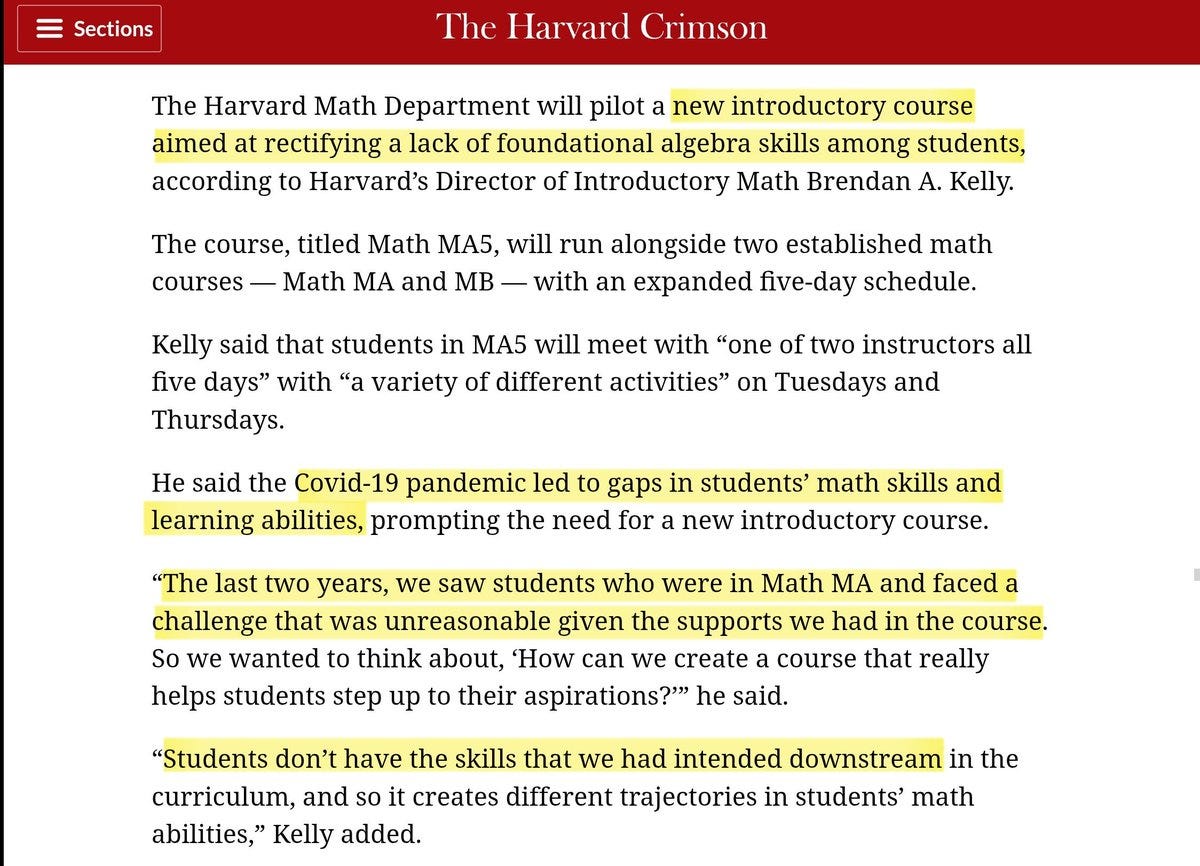
微分積分学(Calculus)に備えたハーバードのクラスを選定することがこれほど困難であるべきではありません。学生の半数が第一希望とする学校でさえそれができないのであれば、それは彼らの選択です。
ニューヨークは数学ができない
悪いコロナウイルス対策政策は、確かに一世代の子供たちを大きく傷つけました。
ニューヨークで何が起こったか、相対的なランキングの変化を含めて見てみましょう。幸いにも、私たちは回復しました。
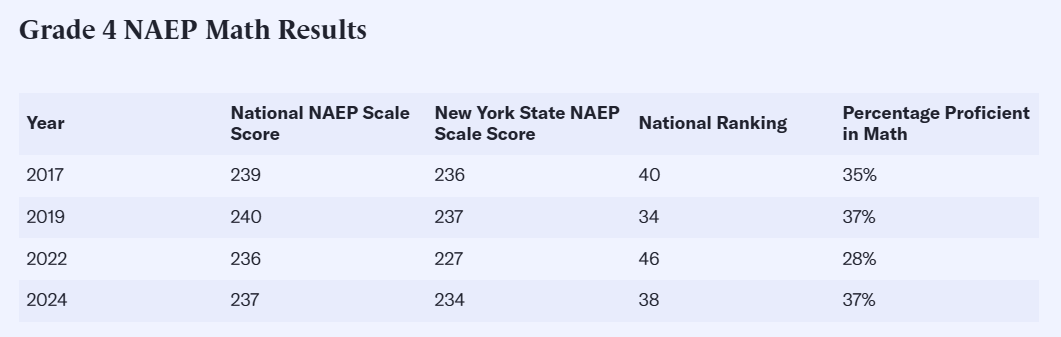
ニューヨーク州のような豊かな州が数学で 38 位であることも、また数学の熟練度が 63% に満たないという事実も、非常に悲惨なことです。
リンク先のより広範な物語は、基準は変更されたもののパフォーマンスは停滞しているという点にあります。はい、これほど悪い状態での停滞は好きではありませんが、なぜ『基準を変更する』ことが何かを解決するとお考えになったのでしょうか?
学術基準は低すぎるように見える
ジェラニ・ネルソン:

同様に、ある高校からの投稿です。いったいこれは何ですか?
ジャスティン・ロス:この数学クラスの成績評価尺度に気づかざるを得ませんでした。
A = 80-100
B = 60-79
C = 40-59
D = 20-39
F = 0-19
私が通った高校では、65% は F(不合格)でした。
シェーン・アダムズ:これは本当ですか?どこで?
ジャスティン・ロス:LA パブリック高校です。少人数クラスのため閉鎖されています。
リンク先にその尺度は表示されていませんが、彼の画像の元となった場所です。彼はこれが、私たちが皆経験したような通常の高校数学の問題に関するものであり、意図的に 50 点を中心に設計された超難問テストではないことを確認しています。
これらのような換算は、テストが最大限の情報を引き出すように設計されており、平均的な学生の得点が 50% となる大学クラスでは許容されます。重要な点として、あなたの数値スコアは恣意的なものであり、スケールの半分を『明らかに不合格』という評価に浪費するのは良くありません。
特に悪いのは、良い成績を得るために本質的に一度もミスをしない必要があるネガティブ・セレクト(negative selection)の採用です。私の高校では、クラス内やクラス間での A-F ではなく、0-100 のスコアが用いられており、良い大学に進学するには、科目全体で平均 95 点以上が必要でした。これは実質的に『ミスをしないこと』に対して評価されるものであり、その結果、過剰なプレッシャーがかかる一方で、改善する動機さえも失われるケースがありました。文脈上すでに 100 点を達成していたためです。
残念ながら…これはそうではありませんでした。
これは『課題の半分しか提出せず、答えの半分しか知らなくても C をもらえる』というものです。そして、テストは古いまま変化しておらず、簡単にもなっていません。素晴らしいことではありません。
さらに事態はエスカレートします:
Azmazing: シアトル公立学校では、教科ごとに評価基準が異なります(例えば、数学では 80 点が B- ですが、英語・文学・芸術(ELA)では B です)。シアトルが行っているもう一つの特徴的な取り組みとして、「ゼロ非評価(non-zero grading)」があります。これは、未提出または不合格の課題であっても、利用可能なポイントの 50% が付与されるというものです。
これが人々を欺くのでしょうか?残念ながら、ある程度は確かに欺きます。しかし同時に、それはある意味で合理的でもあります。なぜなら、半分間違えた課題と、全く提出しないことの間に大きな違いを感じないからです。また、数学においてゼロが支配することを望むわけにもいきません。
新数学
数学教育を破壊するもう一つの「楽しい」方法は、ありえないほど愚かな技法を教えておきながら、他の方法を使おうとする生徒を罰することです。その技法自体が優れていたとしても、一方の方法を他方よりも強制することは、数学の成り立ちや数学的直観を構築する方法とは正反対のことです。
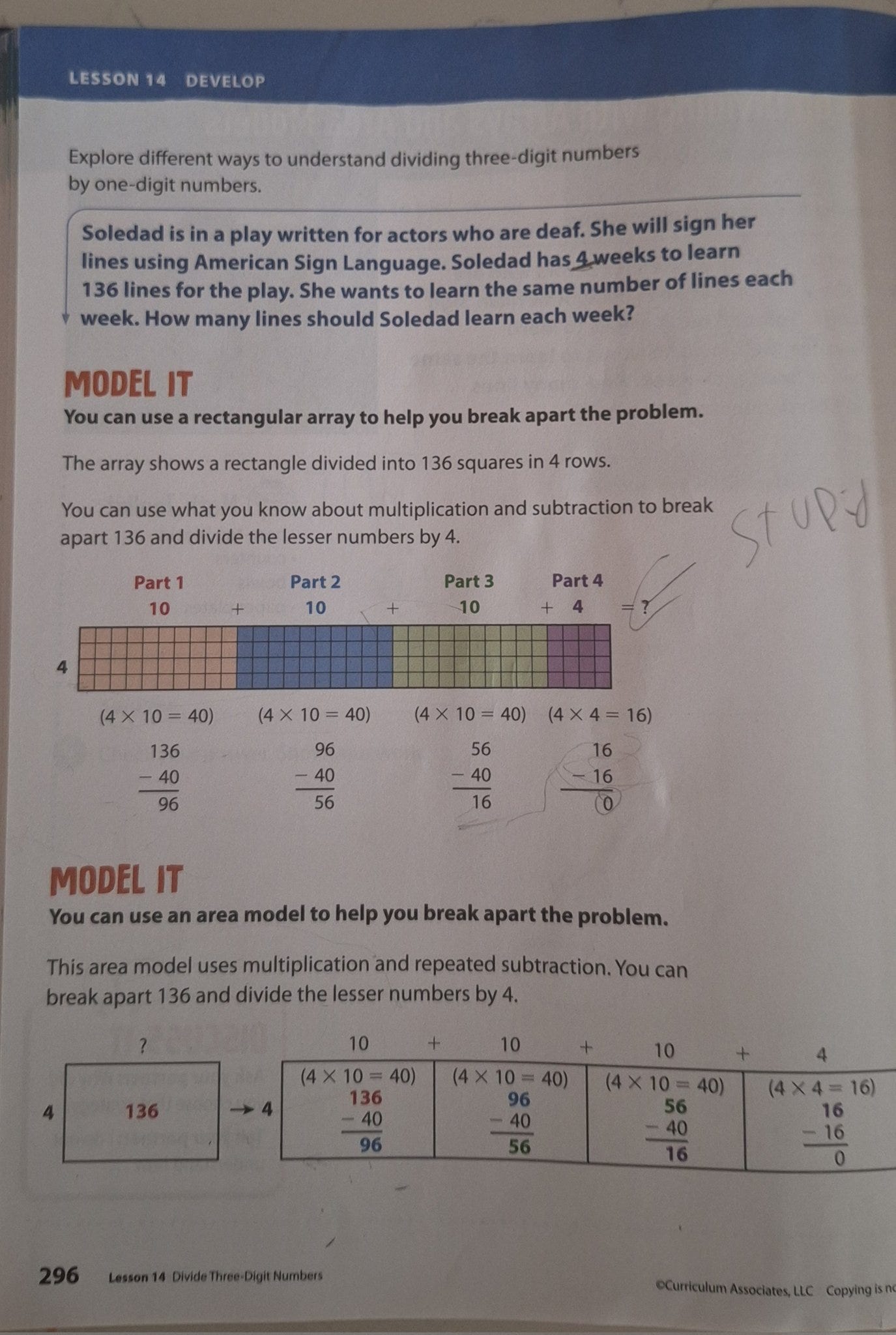
この特定の過程は…実は通常の筆算除算と全く同じですが、少しだけ遅いので、概念的な説明のためでなければ実際にはかなり愚かなものであり、もしこれを使うなら通常よりも前に行うべきであって後に行うべきではありません?
ラッセル・ワーン:私の娘の小学校では、「長方形配列」法という筆算除算の方法を教えています。この手順では、生徒が数字を推測し、それを除数に掛け、その結果を被除数から引く必要があります。その後、被除数が尽きるか余りが残るまでこの過程を繰り返します。最後に、推測したすべての数字を合計します。
これは非効率的で、エラーを起こしやすく、従来の筆算除算よりも多くの手順が必要です。この手順に利点が一つも見当たりません。
(娘はページに「愚か」と書いていました。😆 彼女は正しいです。)
Chelsea Sierra Voss: このトピックは、正解に至るための複数の方法を教えることは、理解を促し、暗算力を養い、作業の確認を行うための優れた実践である一方で、一度に一つの指定された方法のみを使用することを学生に強制することは官僚主義です。
… 示されている長方形のトリックは実は素晴らしいものです。決して「非効率的」でも「誤りやすい」わけではなく、オプションとしてアルゴリズム的には筆算と同一ですが、追加の柔軟性が加わっています。保証された log(n) の実行時間を望む場合は、2 の累乗を引くことだけに制限してください。
数学不安は多くの場合、知識の欠落によるものです
Kelsey Piper とは異なり、私はこれが私の事前の仮定すべてを確認するものではないと報告します。その中には、私が自分の無能さ(少なくとも関連する教師の無能さにおいて)のレベルまで数学を成功裏に学んだという事実も含まれます。そして私の唯一の不安は「これで平均が台無しになるのではないか」というものでしたが、学部生全員が紳士的な B を得ることに気づいた瞬間に消えました。しかし一方で、確かに数学が得意な人はそれについて不安を抱きにくいので、驚くべきことではありません。
Kelsey Piper: 長年疑っていたことが研究によって裏付けられるのは素晴らしいものです。つまり、多くの「数学不安」は… 数学の基礎的なスキルの欠如によるものであり… それらを教えることで消えていくのです。
算数でつまずいている子供に対して、多くの人が声高に「数学不安」と宣言し、結局のところ彼らが掛け算の九九をまだ覚えていないだけであることが判明するケースが非常に多いです。
はい、必要な基礎スキルが体系的に教わったことのないクラスで意味がわからない授業を受けさせられれば、子供は不安を感じたり回避行動をとったりするのは当然です。しかし、もしあなたがその
原文を表示
We did reading yesterday. Now we do the math. Math is hard.
It does not have to be this hard.
A large part of the reason math is hard, or boring, is that education studies, especially in math, are worse than you know. It goes beyond the studies failing both math and statistics forever and into what I’d basically call fraud. Various people are at war with math education, and will do what it takes to stop it in its tracks. We must fight back.
Education Research Is Worse Than You Know
Kelsey Piper lets her title, ‘Education research is weak and sloppy. Why?’ completely downplay the level of utter awfulness she is reporting finding.
You know that whole thing where the entire Bay Area school system stopped teaching kids Algebra? That was motivated by criminal levels of fraud. I want Jo Boaler in jail doing hard time for this if it is accurate.
Here’s the part before the paywall:
Kelsey Piper: Jo Boaler is a professor of education at the Stanford Graduate School of Education, with an enormously influential body of work arguing that students learn math faster and more effectively through her “discovery”-based methods. Her work got Algebra removed from middle schools across the Bay Area.
It is some of the most incompetently or dishonestly conducted research I have seen in a decade as a journalist.
Take one example: A report she gave at the National Council of Teachers of Mathematics on the stunning success of her innovative new math curriculum at “Railside” (she did not disclose the name of the real school where the study took place). This was a poor, disadvantaged California school, where, she said, students adopting her curriculum rocketed ahead of students attending schools with traditional curricula.
When other researchers looked into her work — combing through every school in California to figure out which one “Railside” might be, so they could look at the performance data that Boaler had declined to share — they found that Boaler had compared the top two quartiles of students at “Railside” to the middle quartiles of students at the other schools; that “Railside” students were in fact dramatically underperforming students at the other schools on every single mathematical ability test conducted during the study period, except the one that Boaler highlighted in her presentation. And the one she did highlight was actually conducted on a population of students who weren’t even exposed to the innovative new curriculum.
They found that the “tests” Boaler used to evaluate whether students were succeeding generally:
Contained material two or three years below grade level.
Did not contain any significant Algebra 1 or Geometry material despite being for an Algebra 1 or Geometry class.
Had problems that were incorrectly graded.
Had no “predictive validity” for other measures of math performance like SAT scores.
There was simply no relationship between doing well on Boaler’s error-strewn test of basic math and having mastered the material that students were supposed to master. Furthermore, the paper claimed that Boaler’s tactics closed the mathematics performance gender gap, with girls scoring as well as boys, but performance on outside tests found the gender gap at “Railside” the same as everywhere else.
On a different occasion, Boaler claimed that a single four-week summer camp could give students several years of math performance gains. Her evidence, when people dug into it, was that she gave the same test at the start of the camp and at the end, and the students’ scores improved — but that, as other researchers pointed out, is probably just explained by the fact they had seen the exact same question only a few weeks earlier. These are cartoonishly bad standards for evidence.
I wish this were a critique specific to Jo Boaler, but it isn’t. Across the board, the state of education research is incredibly grim.
One cannot purely pin this on Jo Boaler. One must mostly pin it on an entire system that allowed and accepted such fraud without examining it, and let that drive policy. This is on the level of things I uncover in the first few minutes.
The War on Math
Then, when the students finally do take algebra, they often can’t do algebra.
Why can’t the students do algebra when they passed algebra?
Oh.
Wendy: Two words a teacher never wants to hear: growth plan.
Our school is about to have a 100% Algebra I pass rate.
The last teachers holding the line on excessive absences are caving. No teacher wants to be put on a growth plan.
Johnny’s been present 5 out of 80 days. No worries. He’s passing now.
Did you know that real grades or SAT scores could have prevented what happens next?
Also, did you know that grade inflation is actually very bad for students?
Séb Krier (AGI Policy Dev Lead, Google DeepMind): “A teacher with one standard deviation higher mean grade inflation reduces the present discounted value of lifetime earnings of their students by $213,872 per year of teaching.”
The full result is that ‘passing grade inflation’ is good for earnings on the margin, but average grade inflation is quite bad for earnings. I roll to disbelieve both results in terms of magnitude, but not in terms of direction.
A paper from September 2025 called ‘Easy A’s, Less Pay: The Long Term Effects of Grade Inflation’ claims:
Passing grade inflation reduces the likelihood of being held back, increases high school graduation, and increases initial enrollment in two-year colleges. Mean grade inflation reduces future test scores, reduces the likelihood of graduating from high school, reduces college enrollment, and ultimately reduces earnings.
This is for grades in high school only, skewed towards grades 9-10.
So we have:
Passing students who should fail decreases the chance of being held back, and increases the chance of graduating, and initial enrollment in two-year colleges, because it almost has to. That’s saying fake signals create fake signals.
Inflated mean grades reduce future test scores and reduce chance of high school graduation or college enrollment, and ultimately earnings. Ut oh. That’s saying this is universally bad, even for the students getting the help (since it obviously hurts any students who don’t get their grades inflated).
University of California San Diego
It turns out that yes, grades were load bearing all along. See the official report too.
As Matthew Zeitlin says, it’s way worse than the viral tweets imply, and yet ‘in the short-term nothing will change’ and the SAT and ACT will not be required. And no, you cannot blame this on the pandemic, we are way way past that at this point.
Kelsey Piper: The question that captured the world’s attention was 7 + 2 = [_] + 6. There’s no trick; it’s as easy as it looks. The answer is 3.
The question was posed to students in the University of California San Diego’s (UCSD) fast-growing remedial math class, Math 2, and one-quarter of them got it wrong.
Here are some results for those in the remedial math class:
Well, sure, that sounds really bad, but it’s the remedial class, so it’s nothing, right?
In the fall of 2020, 32 students took Math 2. In the fall of 2025, fully 1,000 students had math placement scores so low they would need it.
Oh. Well, then. That’s 12% of students at UCSD. Who all failed math, then?
Reviewing test results like these, you would expect transcripts full of Cs, Ds, or even failing grades. But alarmingly, these students’ transcripts did not even reflect profound struggles in math. Mostly, they were students whose transcripts said they had taken advanced math courses and performed well.
“Of those who demonstrated math skills not meeting middle school levels,” the report found, 42% reported completing calculus or precalculus.
… The students were broadly receiving good grades, too: More than a quarter of the students needing remedial math had a 4.0 grade point average in math. The average was 3.7.
Andrea: Yep, I saw that with VTech. You basically get admitted on the basis of your response to 3 essays, one of which asks you to describe a time when you were not being included. This is obviously a crucial factor in engineering.
Oh. So grades are so fake that they’re completely worthless. Well, then. I guess we know exactly how that happened.
Year after year, they fall farther behind, and it becomes more and more impossible for any teacher to admit that the students cannot do math and grade accordingly — since that would ruin the kids’ GPAs and college prospects. In this manner, they may make it all the way to college before they find out that they can only do math at a middle-school or sometimes an elementary-school level.
Oh. Well, then. The whole math educational system is a fraud. Once the SAT and ACT were eliminated as requirements for the UC system in 2020, there was no, as Kelsey puts it, ‘reality check’ on any of it, and that was that.
Maybe we can have them do things that don’t require the students know math?
The most common majors selected by the students taking remedial math are biology and psychology. Psychology BS majors and biology majors require college-level calculus, and students typically take UCSD’s calculus classes 10A and 10B.
But the report found that students coming from remedial math struggle in these classes, even after they’ve taken all the remedial coursework the university can offer: Between 2017 and 2023, 24% of these students earned a D, F, or withdrew from 10A. Of those who went on to 10B, 30% earned a D, F, or withdrew.
Oh. Well, then. That’s actually better than I expected. Half of them pass those classes. Except that kind of suggests that’s worse, because how exactly did they pass?
These students are not lazy or dumb.
… These kids were not doing anything wrong. They were lied to. They were told that they were prepared for classes they were not prepared for. They were told that they were excelling in classes that they were not excelling in. They deserved better.
I would love to not also blame the kids in all this, but that’s kind of nuts?
If you can’t do the most basic math questions, and there’s an AP test at the end that almost no one in class even bothers taking, and you’re somehow opting out of every objective standardized test for math (or you’re taking them), how can you possibly actually think you’re passing Calculus for real?
I flat out don’t buy it. Yes you’re being lied to, but if you’re being fooled, then there’s something deeply wrong with that. If you aren’t fooled but are going along with it because you think that’s best for your future and you’ll deal with the problem once you get into the UC system? I’m sympathetic. Hate the game and all that. But don’t tell me you’re smart, you’re not lazy, and also this all comes as a genuine surprise.
Where do we go from here?
Cargo cult equity needs to die.
Yes. Simple as that. Cargo cult equity, and passing kids who didn’t pass, have to go.
The SAT or ACT needs to be a hard legal requirement for all college applications everywhere, so that the student has to at least know what their score was, and the college needs to be on record saying ‘I know what your score is and I accept it.’
Then there is the problem that the system wants to achieve results in the distribution of admissions that it’s illegal (via Supreme Court decisions) to achieve intentionally, so effectively the entire system is turned into a giant series of frauds to let them achieve it anyway. That’s worse. You know that’s worse, right?
As for the high schools: If a school awards you an A in Calculus, and you can’t solve basic Algebra I questions, then people need to be fired until that stops happening. Hell, if a majority of those with an A in Calculus don’t get at least a 3 on the AP exam someone should be fired, and really by majority I want to mean most and by 3 I want to mean 5.
PoliMath: It is a sin to waste the precious years of these kids’ lives pretending to teach them. It is a moral crime to waste all that money and all that time and deliver nothing.
Someone should pay for this (but no one will).
And yet, the lies continue.
Saul Geiser: UC has now been test-free for four years. The sky hasn’t fallen. Academic standards haven’t slipped. What has changed is the student body: More low-income, first-generation and underrepresented students are earning spots without affirmative action.
Kelsey Piper: This is an absurd lie which undermines substantive efforts to improve opportunities for low income students. Academic standards *have* catastrophically slipped. When you lie like this you destroy all your credibility on the topic.
I am confident there are reforms that will allow more low-income students to access higher education. But if you just flatly pretend that ‘admit students who are much less qualified’ is a miracle policy with no drawbacks, then none of those reforms will happen!!
Beyond UCSD
Justin Skycak: This isn’t just a UCSD problem. It’s even playing out at Harvard. Yeah, Harvard. The most prestigious university in the USA and maybe even the world. Last year they had to add remedial support to their entry-level calculus courses.
It should not be so difficult to select a Harvard class that is ready for Calculus. If the school that is the first choice of half of students can’t do it, then that is their choice.
New York Can’t Do Math
Having bad Covid policies really did do a number on a generation of kids,
Look at what happened in New York, including the change in relative ranking. Luckily we have bounced back.
A state as rich as New York being 38th in math is also rather horrible, as is a 63% rate of not being proficient in math.
The broader story at the link is that standards have changed but performance is stagnant. Okay, I don’t love stagnant performance when it is this bad, but why did you think ‘change the standards’ was going to fix anything?
The Academic Standards Seem Low
Jelani Nelson:
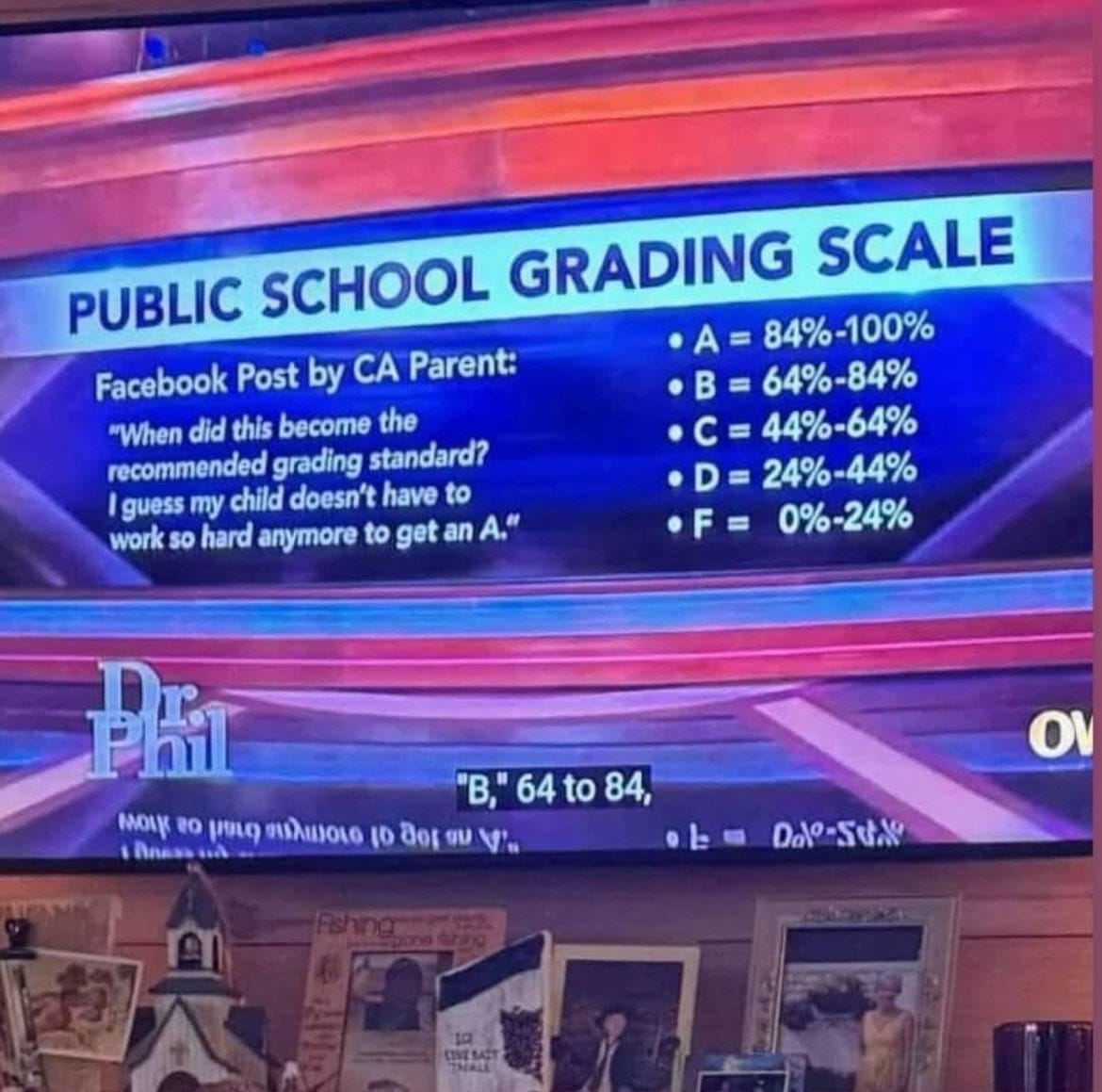
Similarly, from a high school: What in blazes is this?
Justin Ross: Couldn’t help but notice the grade scale in this Math Class:
A = 80-100
B = 60-79
C = 40-59
D = 20-39
F = 0-19
Where I went to high school, a 65% was an F.
Shane Adams: Is this for real? Where at?
Justin Ross: LA Public High School, shutting down due to small classes.
I don’t see that scale at the link but that’s where his picture was from. He confirms this was on normal high school math questions like the ones we all had, not a super hard test designed intentionally to center around 50.
These kinds of conversions fine for a college class where the test is designed to reveal maximum information, and the average student scores 50%. In a key sense, your numerical score is arbitrary, and wasting half the scale on ‘obviously you fail’ is bad.
Especially bad is using negative selection, where you have to essentially never make a mistake to get a Good Grade. At my high school, scores were from 0-100 rather than A-F within and between classes, and if you wanted to go to the good colleges, you needed to average 95+ across classes. You were effectively being graded on ‘not screwing up’ and this meant a mix of insane pressure and also cases where you had no incentive to improve, you’d already hit 100 in context.
This was, unfortunately… not that.
This is ‘you can only turn in half the assignments and know half the answers and still get a C.’ And that the tests haven’t changed from the old ones, or got easier. Not great.
It does get crazier:
Azmazing: In Seattle Public Schools the grading scale differs from subject to subject (e.g. an 80 is a B- in math but a B in ELA). What Seattle also does though is “non-zero grading,” where a missing or failed assignment still earns 50% of the available points.
Does this fool people? To some extent, alas, it surely does. But also it’s kind of reasonable, in the sense that I don’t see much difference between a half-wrong assignment and not turning it in? Nor do we want the 0s to dominate the math.
New Math
Another ‘fun’ way to destroy math education is to teach absurdly stupid techniques, and then punish any students who attempt to use any other method. Even if the technique was good, forcing one method over another is the opposite of how math works, and how you build mathematical intuitions.
This particular process is… exactly the same as regular long division actually except a bit slower, so it’s actually rather stupid except as conceptual illustration and should clearly come before rather than after usual long division if you’re going to use it?
Russel Warne: My daughter’s elementary school is teaching the “rectangular array” method of performing long division. The procedure requires students to guess a number, multiply it by the divisor, and subtract the result from the dividend. They then repeat this process until the dividend is exhausted or there is a remainder. They then sum the numbers they guessed together.
It’s inefficient, more prone to error, and requires more steps than traditional long division. I can’t see a single advantage to this procedure.
(My daughter wrote “Stupid” on the page. She’s right.)
Chelsea Sierra Voss: This topic is a scissor because *teaching* multiple methods of arriving at the correct answer is an excellent practice for encouraging understanding, mental math, and checking work, but *requiring* students use only one prescribed method at a time to get the answer is Bureaucracy
… The rectangular trick shown is in fact great btw. It’s not at all “inefficient” or “prone to error,” and it’s optionally algorithmically identical to long division, just with added flexibility. If you want a guaranteed log(n) runtime, limit to subtracting off powers of 2 only.
Math Anxiety Is Often Due To Knowledge Gaps
Unlike Kelsey Piper, I report that this does not confirm all of my priors, including the fact that I did successfully take math up until the level of my incompetence (at least given the incompetence of the relevant teacher) and my only anxiety was ‘is this going to ruin my average’ which went away when I realized the undergraduates were all going to get gentleman’s Bs. Then again, yes, if you are good at math you’re less likely to be anxious about it, so it’s not exactly surprising.
Kelsey Piper: love it when a study validates something you’ve suspected for years which is that most “math anxiety” is... missing foundational skills in mathematics... and goes away if you...teach them.
I have had so many interactions where a child is floundering in math, a lot of people vocally declare it “math anxiety” and then it just turns out they don’t know their times tables yet.
yeah a kid is going to be anxious/avoidant in a class that makes no sense to them because they were never systematically taught the prerequisite skills! but if you treat th
関連記事
今日のまとめ
AI日報で今日の重要ニュースをまとめ読み