2026 年開発者に重要なオープンウェイト AI モデル 5 選
本文の状態
日本語全文を表示中
詳細モードで約14分の本文を読めます。
同じ出来事の情報源
この情報源を基点に整理
Cline Blog
Cline Blog は2026年における開発者にとって重要なオープンウェイトモデル5選を特定し、各モデルのコーディング性能やコスト構造を比較分析して提示した。
AI深層分析を開く2026年8月4日 22:16
AI深層分析
キーポイント
2026年のオープンウェイトモデルの台頭
DeepSeek、Z.ai、Moonshot AIなどのラボが公開したモデルが、従来クローズドな最先端モデルに支配されていたコーディングやAIエンジニアリング分野で実用化されている。
主要5モデルの比較分析
Kimi K3、DeepSeek V4 Flash、GLM 5.2、DeepSeek V4 Pro、MiniMax M3がコーディング能力、コスト、サイズ、適したタスクに基づいて選定され、ベンチマークスコアやAPI価格が比較された。
Kimi K3の具体的な性能と特徴
Moonshot AIが2026年7月に公開したKimi K3は2.8TパラメータのMoEモデルであり、1Mトークンのコンテキストウィンドウとネイティブビジョン機能を備え、Terminal-Bench 2.1で88.3点を記録している。
オープンウェイトの定義と限界
学習済みパラメータがダウンロード可能である「オープンウェイト」モデルは、トレーニングデータやコードが非公開の場合もあり、完全なオープンソースとは区別される。
Kimi K3 の長文コンテキストとビジョン機能
2.8T パラメータの Kimi K3 は、多ファイルにわたる複雑な実装やフロントエンド開発において優れた性能を発揮する。スクリーンショットやブラウザ出力といった視覚的コンテキストを活用できるため、コード生成タスクに適している。
重要な引用
An open weight model is a model whose trained parameters are downloadable, so you can self-host, quantize, fine-tune or use it through third-party inference platforms, subject to the license.
Kimi K3 was released by Moonshot AI in July 2026 as a 2.8T-parameter MoE model with a 1M token context window and native vision support.
That gives Kimi K3 a clear position - it is built for long horizon coding.
For an open-weight model, it has given the real signal that it is not just leading other open models; it is close enough to closed frontier coding models that developers can reasonably test it in real world software development workflows.
編集コメントを表示
編集コメント
2026年という未来の時点でのモデル比較記事は、業界がオープンウェイトモデルへ急速にシフトしている現状を浮き彫りにしている。特にKimi K3のような大規模MoEモデルが実用レベルで公開される背景には、開発者コミュニティの強い需要と技術的成熟があると言えるだろう。
Source Article
元記事を日本語で読む
本文に関係しない購読案内、埋め込み通知、サイト内プロモーションは除いています。
 image 2026 年、オープンウェイトモデルの状況は大きく変化しました。ここ数ヶ月で DeepSeek、Z.ai、Moonshot AI、MiniMax、Qwen といったラボが相次いでモデルを公開し、開発者はこれまでクローズドな最先端モデルに依存していたコーディングや AI エンジニアリングの作業を、これらのオープンウェイトモデルでも行えるようになりました。
本稿では、今すぐ試す価値のあるオープンウェイトモデルをご紹介します。これらはコミュニティから強い支持を集め、コーディング性能、長文脈推論、マルチモーダル機能、そして実際の開発者による使いやすさにおいて、着実な進歩を示しているものです。
Cline はモデル非依存(model agnostic)であるため、より強力なオープンウェイトモデルが登場するたびに、その中から最良の選択肢を ClinePass に追加していきます。Cline で構築中の方、モデル API を比較検討中の方、あるいはご自身の業務に最適なモデルを選定しようとしている方にとって、2026 年はこれらのモデルに注目すべき年です。
「オープンウェイト」とは具体的に何を指すのでしょうか?
オープンウェイトモデルとは、学習済みのパラメータをダウンロード可能にしたモデルのことです。ライセンスの条件に従えば、セルフホスティングや量子化(quantize)、ファインチューニングが可能であり、サードパーティの推論プラットフォームを通じて利用することもできます。これは、通常 API やホストされた製品を通じてのみモデルと対話することになるクローズドモデルとは明確に異なります。
オープンウェイトモデルとは、学習済みのパラメータのみを公開するモデルを指します。学習データやトレーニングコード、そして完全な手法は非公開のままとなる可能性があります。つまり、「オープンウェイト」であっても「完全にオープンソース」とは限りません。
各モデルの比較
開発者のコーディング能力、コスト、モデルサイズ、そして得意とするタスクの種類に基づき、Kimi K3、DeepSeek V4 Flash、GLM 5.2、DeepSeek V4 Pro、MiniMax M3 の 5 つを候補に選びました。これらを一覧で比較すると以下のようになります。
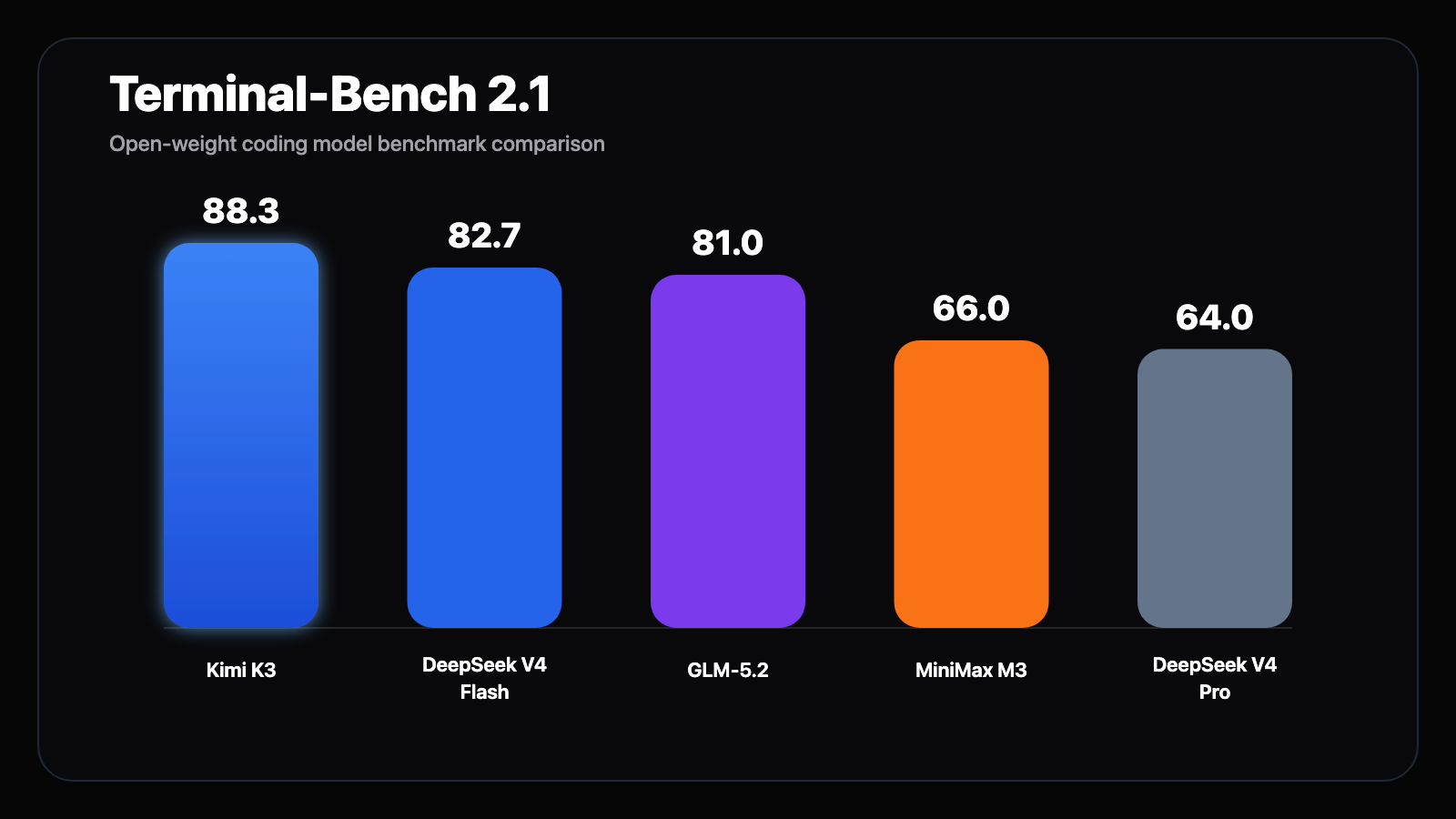
モデル別のコーディングベンチマーク性能
5 つのモデルにおける Terminal Bench 2.1 の報告スコアを比較したものです。
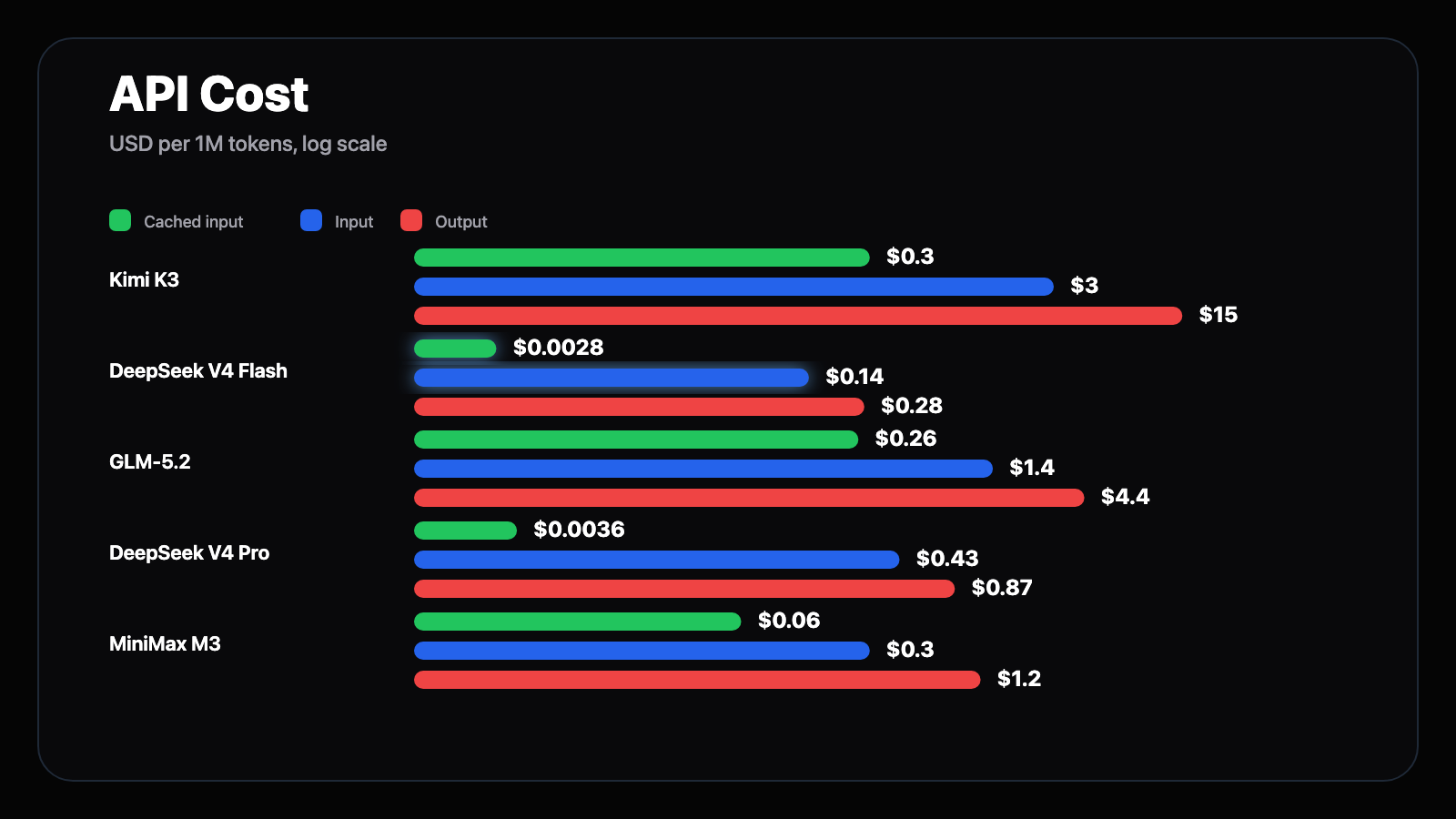
モデル別の API 価格
100 万トークンあたりの入力コスト、キャッシュされた入力のコスト、出力コストを比較したものです。
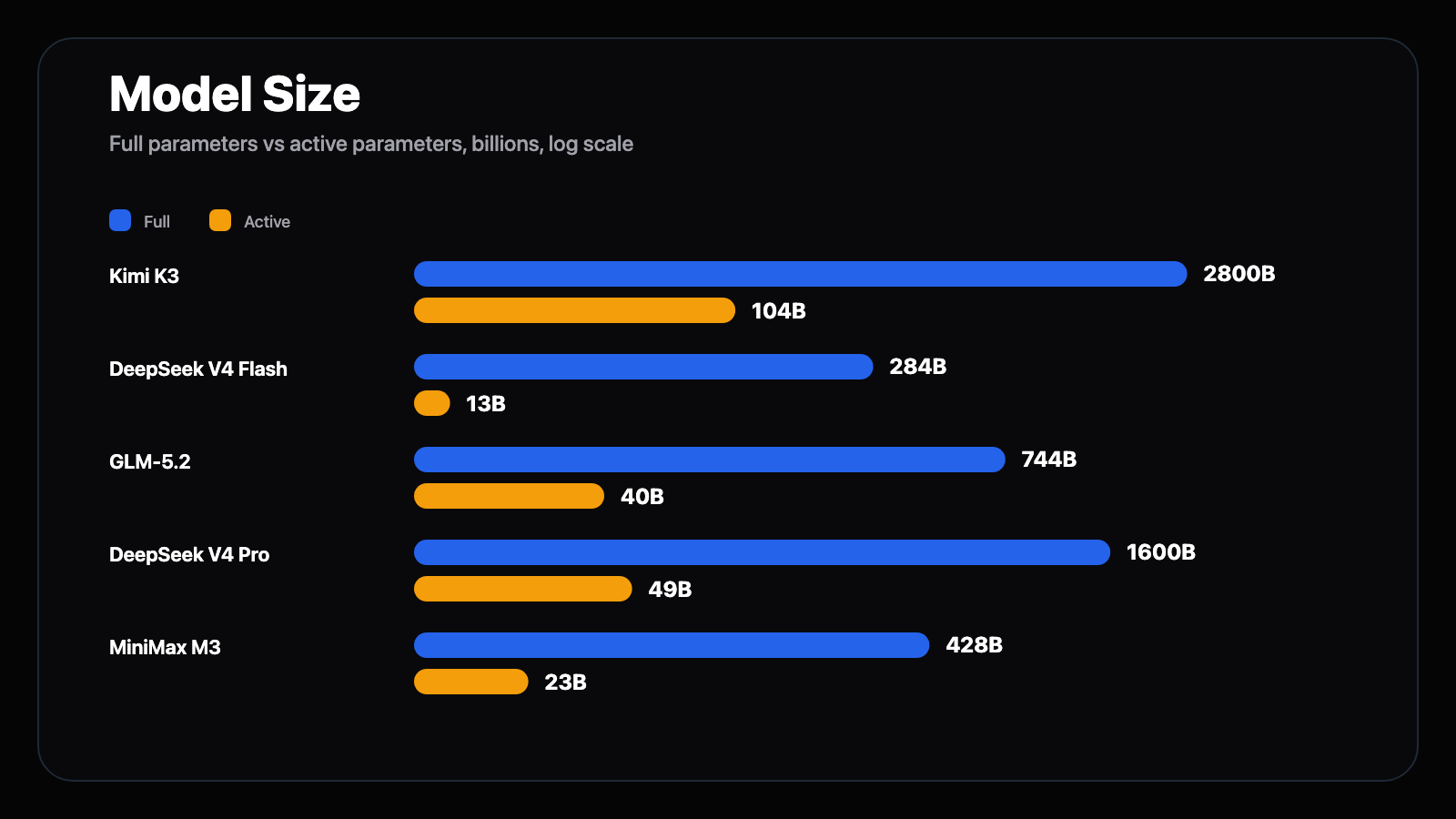
モデル別の総パラメータ数とアクティブパラメータ数
各モデルの全体サイズと、トークン生成時に実際に動作するパラメータ数を比較したものです。
各オープンウェイトモデルの適した用途
- Kimi K3
Kimi K3 は、Moonshot AI によって 2026 年 7 月にリリースされました。これは 2.8T パラメータの MoE モデルで、100 万トークンのコンテキストウィンドウとネイティブなビジョン機能を備えています。完全なオープンウェイト版は 2026 年 7 月 27 日に公開され、これまでに発表されたオープンウェイトモデルの中でも最大規模のリリースの一つとなりました。
Moonshot は Terminal-Bench 2.1 で 88.3 を記録し、同カテゴリのトップクローズドモデルに迫るスコアを叩き出しました。公開ベンチマークでは、GPT-5.6 Sol が 88.8、Claude Fable 5 が 84.6 となっています。
この結果から、Kimi K3 の立ち位置が明確になります。同モデルは長期のコーディングタスクを目的に設計されており、単一のファイルやプロンプトを超えて複数の情報を追跡する必要がある、長文コンテキストを活用した実装や、フロントエンド中心の開発、多段階のソフトウェア作業において特に威力を発揮します。
ビジョン機能により、Kimi K3 はフロントエンド開発での有用性がさらに高まります。スクリーンショット、ブラウザ出力、デザインリファレンスといった視覚情報をコードと併せて処理できるためです。
Kimi K3 はオープンウェイトモデルですが、軽量なわけではありません。2.8T パラメータを有するため、ローカル環境で動作させるのではなく、ホストアクセスや推論プロバイダー、Cline などのコーディングツールを経由して利用する必要があります。
Kimi K3 を選ぶべきケース:大規模なコードベース、複雑な実装、視覚的コンテキストが役立つフロントエンド作業には最適です。
- DeepSeek V4 Flash
DeepSeek V4 Flash 0731 はもはや、V4 Pro の小型・低価格版という位置づけだけではありません。7 月 31 日のアップデートにより、総パラメータ数 284B、アクティブパラメータ数 13B、トークンコンテキストウィンドウ 1M という基本スペックは維持しつつ、エージェントとしての機能が大幅に強化されました。
最も明確な指標は Terminal Bench 2.1 の結果です。DeepSeek はこのベンチマークで 82.7 というスコアを記録し、4 月の初期プレビュー時点の 56.9 から驚異的な 25.8 ポイントもの向上を示しました。更新されたモデルはツール呼び出しと Responses API にも対応しており、複数の手順を要するコーディングツールとの連携に最適化されています。
価格設定も大きな強みです。DeepSeek の料金は、キャッシュミス時の入力トークン 100 万あたり$0.14、キャッシュヒット時は$0.0028、出力トークン 100 万あたりは$0.28 です。多数の繰り返し呼び出しを行うコーディングエージェントにとっては、ベンチマークでのスコア向上と同様に、このキャッシュ対応型の価格体系が重要な判断材料となります。
DeepSeek V4 Flash を選ぶべきタイミング:コストを抑えつつ強力なコーディング能力とツール使用性能を求め、反復的なエージェント実行の費用対効果を明確にしたい場合に最適です。
- GLM-5.2
GLM-5.2 は 2026 年 6 月、Z.ai からリリースされた大規模オープンウェイト MoE モデルです。コーディング、推論、ツール使用、そして長文コンテキストワークフローに特化して設計されています。総パラメータ数は約 744B で、アクティブなパラメータは約 40B です。100 万トークンのコンテキストウィンドウをサポートし、MIT ライセンスの下で公開されています。
GLM-5.2 の特徴を際立たせるのは、コーディングエージェント向けのベンチマーク結果です。Z.ai が発表した資料によると、GLM-5.2 は Terminal-Bench 2.1 で 81.0 というスコアを記録しました。これは同じくこのベンチで約 63.5 を記録した GLM-5.1 と比較すると、大きな飛躍です。81.0 というスコアは、Claude Opus 4.8 や Gemini 3.1 Pro といったトップクラスのクローズドモデルに僅差で迫りつつも、Gemini 3.1 Pro よりも上位の位置を占めています。
オープンウェイトモデルにおいて、GLM-5.2 は単に他のオープンモデルをリードしているだけでなく、クローズドな最前線モデルと遜色ないレベルにあることを示す明確なシグナルとなりました。これにより、開発者は実際のソフトウェア開発ワークフローでこのモデルを実際にテストすることが可能になっています。
GLM-5.2 を選ぶべきタイミング:長文コンテキストでのコーディング、リポジトリ全体の推論、そしてクオリティやタスク完了率が純粋な速度よりも重要視されるコードエージェントのワークフローにおいて、オープンウェイトモデルを求める場合に GLM-5.2 が最適です。
- DeepSeek V4 Pro
DeepSeek V4 Pro は 2026 年 4 月 24 日にプレビュー版としてリリースされ、DeepSeek V4 ファミリーにおける大規模モデルとなりました。総パラメータ数は 1.6T、アクティブパラメータは約 49B、コンテキストウィンドウは 1M トークンです。
V4 Pro は本リストの主力モデルです。Kimi K3 のようなスケールの物語や、MiniMax M3 のようなマルチモーダルな切り口はありません。その魅力はより直接的で、優れたソフトウェアエンジニアリングのパフォーマンス、オープンウェイトであること、そしてエージェントの繰り返し利用を正当化しやすい価格設定にあります。
注目すべき主要ベンチマークは SWE-bench Verified です。V4 Pro はここで 80.6% のスコアを記録しており、これは比較セットに含まれる Claude Opus 4.6 や Gemini 3.1 Pro といった主要なクローズドモデルと同程度の性能を示しています。
V4 Pro は、バックエンド実装、複数ファイルにまたがる変更、デバッグ、アーキテクチャ設計など、重いコーディングタスクに適しています。また、変更を加える前に慎重に推論を行う必要がある状況でも力を発揮します。
このモデルの価格設定は、その能力を考えると非常に攻めています。DeepSeek の V4 Pro は、キャッシュミス時に 100 万トークンあたり 0.435 ドル、キャッシュヒット時は 0.003625 ドル、出力トークンは 100 万あたり 0.87 ドルです。
ただし注意点として、V4 Pro はまだ重たいモデルの一つです。すべての小さなコーディングステップをこのモデルにルーティングすると、タスクに必要な以上の計算リソースを消費してしまう可能性があります。このモデルが最も効果を発揮するのは、その複雑さを正当化できる十分な規模のタスクの場合です。
DeepSeek V4 Pro を選ぶべきタイミング:より低コストで最先端レベルのコーディング性能が必要な場合に V4 Pro を選びましょう。
- MiniMax M3
MiniMax M3 は 2026 年 6 月、MiniMax からネイティブなマルチモーダル・オープンウェイトモデルとしてリリースされました。総パラメータ数は 428B で、アクティブに使用されるのは約 23B、コンテキストウィンドウは 100 万トークンです。
MiniMax M3 が際立っている理由は、その組み合わせにあります。多くのオープンウェイト・コーディングモデルはテキストとコードを前面に出していますが、MiniMax M3 はコーディング、長文コンテキスト、画像入力、動画入力、そしてエージェントワークフローを一つのモデルに統合しています。これにより、テキストベースのコーディングや推論に特化した DeepSeek V4 Pro や、サイズが大きく運用が難しい Kimi K3 とは異なる立ち位置になります。
MiniMax 自身のリリースでは、M3 の能力を「コーディング」「エージェントワーク」「ネイティブなマルチモーダル性」の 3 つに焦点を当てて紹介しています。ベンチマーク結果では、SWE-bench Pro で 59.0% を記録し、GPT-5.5(58.6%)や Gemini 3.1 Pro(54.2%)を上回っています。
MiniMax M3 を考える上で最も有用な視点は、コードが文脈の一部に過ぎないワークフローにおけるオープンウェイトモデルとして捉えることです。UI 状態の処理、スクリーンショットの解析、ブラウザタスクの実行、長文書の扱い、あるいは動画ベースの入力データを扱う場合、テキストのみを扱うコーディングモデルよりも MiniMax M3 の方がはるかに優れています。
MiniMax M3 を選ぶべきタイミング:スクリーンショットや UI 中心の開発、ブラウザタスク、画像や動画とともにコードを理解する必要がある視覚的なデバッグなど、マルチモーダルな文脈が関わる作業を行う場合に MiniMax M3 を選択してください。
結びの言葉
オープンウェイトモデルの分野は変化が速すぎて、一つのモデルが長く「最高」として君臨することはありえません。重要なのは、実際にカテゴリを前進させているモデルを試す手段を持つことです。GLM 5.2、Kimi K3、DeepSeek V4 Pro、MiniMax M3、そして DeepSeek V4 Flash はそれぞれ異なる強みを持っており、各モデルがどこに位置するかを理解する最良の方法は、あなたが実際に取り組んでいる作業でそれらを使ってみることです。
ClinePass が目指しているのはまさにそのプロセスの簡素化です。月額 9.99 ドルで、別個のプロバイダー設定やローカルインフラの管理なしに、Cline の内部で厳選されたオープンウェイトモデル群を直接使用できます。
ぜひ自分のコードで試して、あなたのビルドスタイルに合うものを見つけてください。
よくある質問(FAQs)
オープンウェイトモデルとは何ですか?
オープンウェイトモデルとは、学習済みのパラメータがダウンロード可能になっている AI モデルのことです。ライセンス内容に応じて、開発者はこれらのモデルを実行したり、ファインチューニングしたり、自前でホストしたりすることが可能です。
オープンウェイトとオープンソースの AI モデルの違いは何ですか?
オープンウェイトとオープンソースの違いは、前者が学習済みの重み(weights)を公開するのに対し、後者はコードや開発プロセスへのアクセス範囲が広い点にあります。つまり、モデルがオープンウェイトであっても、完全にオープンソースであるとは限りません。
オープンウェイトモデルは、Claude や GPT、Gemini といったクローズドモデルに取って代われるのでしょうか?
一部のコーディングタスクにおいては置き換えが可能です。しかし多くの開発者は、パフォーマンスやコスト、プライバシー、信頼性がタスクによって異なるため、両方を併用しています。
2026 年のコーディングにおいて最適なオープンウェイトモデルは何でしょうか?
最良のモデルはタスク次第です。GLM 5.2 は長文コンテキスト処理に強く、Kimi K3 は複雑なコーディングに、DeepSeek V4 Pro は推論能力に、DeepSeek V4 Flash は速度に、そして MiniMax M3 はマルチモーダルタスクにそれぞれ優れています。
オープンウェイトモデルをローカルで実行することは可能でしょうか?
可能です。特にサイズが小さいものや量子化(quantised)されたモデルであれば、ローカル環境でも動作します。一方、大規模なモデルは高性能な GPU やホストインフラストラクチャが必要になるケースがほとんどです。
開発者がオープンウェイトのコーディングモデルを選ぶ際に重視すべき点はどこでしょうか?
コーディング品質、エージェントの信頼性、コンテキスト処理能力、速度、コスト、ライセンス条件、そしてハードウェア要件を総合的に評価する必要があります。ベンチマーク結果よりも、実際の現場でのテストの方が有用なケースが多いです。
なぜ中国発のオープンウェイトモデルがこれほど注目されているのでしょうか?
オープンウェイトモデルは、その能力が向上し、クローズドな最先端モデルに対する信頼性が高くコストの低い代替手段として確立されるにつれ、一般に注目を集めています。DeepSeek、Z.ai、Moonshot AI、MiniMax、Qwen などの研究機関は特に急速に進化しており、強力なコーディングおよび推論モデルを次々とリリースしています。
原文を表示
imageThe perspective for open weight models has changed significantly in 2026. In just the past few months, labs like DeepSeek, Z.ai, Moonshot AI, MiniMax, and Qwen have released models that developers are now using for the same coding and AI engineering work that was previously dominated by closed frontier models.
In this blog, we’ll look at the open-weight models that are worth trying right now. These are the ones which have been showing strong signals from the community and have shown a meaningful progress in coding performance, long-context reasoning, multimodal capabilities, and real developer usability.
Cline is model agnostic, so as stronger open weight models emerge, we bring the best options into ClinePass. Whether you are building with Cline, comparing model APIs, or deciding which model fits your work, these are the ones worth paying attention to in 2026.
What does “open weight” actually mean?
An open weight model is a model whose trained parameters are downloadable, so you can self-host, quantize, fine-tune or use it through third-party inference platforms, subject to the license. This is different from a closed model, where you usually interact with the model only through an API or hosted product.
An open-weight model may only release the trained parameters. The training data, training code, and full methodology can still remain private. This means a model can be open weight without being fully open source.
How these models compare
We shortlisted Kimi K3, DeepSeek V4 Flash, GLM 5.2, DeepSeek V4 Pro, and MiniMax M3 based on their coding capabilities, cost, model size, and the kinds of development tasks they are best suited for. Here is how they compare at a glance.
Coding benchmark performance by model
A comparison of reported Terminal Bench 2.1 scores across the five models.
imageAPI pricing by model
A comparison of input, cached input, and output costs per 1 million tokens.
imageTotal and active parameter size by model
A comparison of each model’s overall size and the number of parameters active per token.
imageWhere each open weight model fits
- Kimi K3
Kimi K3 was released by Moonshot AI in July 2026 as a 2.8T-parameter MoE model with a 1M token context window and native vision support. The full open-weight release was made on July 27, 2026, making it one of the largest open weight model releases so far.
Moonshot reported 88.3 on Terminal-Bench 2.1, putting it very close to top closed models in the same category. Public benchmark comparisons placed GPT-5.6 Sol at 88.8 and Claude Fable 5 around 84.6 on Terminal-Bench 2.1.
That gives Kimi K3 a clear position - it is built for long horizon coding. The model is especially useful for long-context implementation, frontend-heavy development, and multi-step software tasks where the model needs to keep track of more than a single file or prompt.
Vision makes Kimi K3 more useful for frontend work, where the model can work from screenshots, browser output, and design references alongside the code.
Though the Kimi K3 is open-weight, it is not a lightweight model. At 2.8T parameters, you will have to use it through hosted access, inference providers, or coding tools like Cline rather than running it locally.
When to choose Kimi K3: Consider it for large codebases, complex implementations, and frontend work that benefits from visual context.
- DeepSeek V4 Flash
DeepSeek V4 Flash 0731 is no longer just the smaller and cheaper alternative to V4 Pro. The July 31 update keeps the same 284B total parameters, 13B active parameters, and 1M token context window, but has substantially enhanced agentic capabilities.
The clearest signal is Terminal Bench 2.1, where DeepSeek reports a score of 82.7, a massive +25.8 point leap from its initial April preview score of 56.9. The updated model also supports tool calls and the Responses API, making it better suited to coding tools that need to work through several steps.
Its pricing remains a major advantage. DeepSeek lists it at $0.14 per 1M input tokens on cache miss, $0.0028 on cache hit, and $0.28 per 1M output tokens. For coding agents that make many repeated calls, that cache-aware pricing can matter as much as the benchmark jump.
When to choose DeepSeek V4 Flash: Choose it when you want strong coding and tool-use performance at a cost that makes repeated agent runs easier to justify.
- GLM-5.2
GLM-5.2 was released by Z.ai in June 2026 as a large open-weight MoE model built for coding, reasoning, tool use, and long-context workflows. It has roughly 744B total parameters, around 40B active parameters, supports a 1M token context window and is released under an MIT license.
The numbers that make GLM-5.2 stand out are its coding-agent benchmarks. In Z.ai’s own release material, GLM-5.2 scored 81.0 on Terminal-Bench 2.1. That is a major jump over GLM-5.1, which scored around 63.5 on the same benchmark. At 81.0, GLM-5.2 is only a few points behind top closed frontier models like Claude Opus 4.8 and ahead of models like Gemini 3.1 Pro.
For an open-weight model, it has given the real signal that it is not just leading other open models; it is close enough to closed frontier coding models that developers can reasonably test it in real world software development workflows.
When to choose GLM 5.2: Choose GLM-5.2 when you want an open-weight model for long-context coding, repo-level reasoning, and coding-agent workflows where quality and task completion matter more than raw speed.
- DeepSeek V4 Pro
DeepSeek V4 Pro was released in preview on April 24, 2026 as the larger model in the DeepSeek V4 family. It has 1.6T total parameters, around 49B active parameters, and a 1M token context window.
V4 Pro is the workhorse of this list. It does not have Kimi K3’s scale story or MiniMax M3’s multimodal angle. Its appeal is more direct with a strong software engineering performance, open weights, and pricing that makes repeated agent use easier to justify.
The main benchmark to look at is SWE-bench Verified, where V4 Pro is reported at 80.6%. That puts it in the same range as leading closed models in the comparison set, including Claude Opus 4.6 and Gemini 3.1 Pro.
V4 Pro is a good fit for heavier coding tasks like backend implementation, multi-file changes, debugging, architecture work, and situations where the model needs to reason carefully before making changes.
The pricing is unusually aggressive for such a capable model. DeepSeek lists V4 Pro at $0.435 per 1M input tokens on cache miss, $0.003625 on cache hit, and $0.87 per 1M output tokens.
The caveat is that V4 Pro is still one of the heavier options. If you are routing every small coding step to it, you may be using more model capacity than the task needs. It works best when the task has enough complexity to justify the larger model.
When to choose DeepSeek V4 Pro: Choose V4 Pro when you need frontier level coding performance at a much lower cost.
- MiniMax M3
MiniMax M3 was released by MiniMax in June 2026 as a native multimodal open weight model. It has 428B total parameters, about 23B active parameters, and a 1M token context window.
The reason MiniMax M3 stands out is the combination. Most open weight coding models lead with text and code. MiniMax M3 brings coding, long context, image input, video input, and agentic workflows into one model. That makes it different from DeepSeek V4 Pro, which is more focused on text-based coding and reasoning, and from Kimi K3, which is much larger and harder to serve.
MiniMax’s own release positioned M3 around three capabilities - coding, agentic work, and native multimodality. On benchmarks, MiniMax scores 59.0% on SWE-bench Pro, slightly above GPT-5.5 at 58.6% and ahead of Gemini 3.1 Pro at 54.2% in the same comparison.
The most useful way to think about MiniMax M3 is as the open weight model for workflows where code is only part of the context. If you are working with UI states, screenshots, browser tasks, long documents, or video-based input, MiniMax M3 is much better than a text-only coding model.
When to choose MiniMax M3: Choose MiniMax M3 when your work involves multimodal context like screenshots, UI heavy development, browser tasks or visual debugging where code needs to be understood alongside images or video.
Closing Note
The open weight model space is moving too quickly for one model to stay “the best” for long.
What matters more is having a way to try the models that are actually pushing the category forward. GLM 5.2, Kimi K3, DeepSeek V4 Pro, MiniMax M3, and DeepSeek V4 Flash are all strong for different reasons and the best way to understand where each model fits is to use it on the kind of work you actually do.
That is what we want to make easier with ClinePass. For $9.99 a month, you can use a curated set of open weight models directly inside Cline without setting up separate providers or managing local infrastructure.
Try them on your own code and see which one fits the way you build.
FAQs
What are open-weight models?
Open weight models are AI models whose trained parameters are available for download. Depending on the licence, developers can run, fine-tune, or host them.
What is the difference between open weight and open source AI models?
The difference between open weight and open source is that open weight models release the trained weights, while open source models provide broader access to the code and development process. This means a model can be open weight without being fully open source.
Can open weight models replace closed models like Claude, GPT, or Gemini?
Open weight models can replace closed models for some coding tasks. However, many developers use both because performance, cost, privacy, and reliability vary by task.
What is the best open weight model for coding in 2026?
The best open weight coding model in 2026 depends on the task. GLM 5.2 is strong for long-context work, Kimi K3 for complex coding, DeepSeek V4 Pro for reasoning, DeepSeek V4 Flash for speed, and MiniMax M3 for multimodal tasks.
Can you run open weight models locally?
Open weight models can be run locally, especially when they are smaller or quantised. Larger models usually require powerful GPUs or hosted infrastructure.
What should developers look for in an open weight coding model?
Developers should evaluate open weight models based on the coding quality, agent reliability, context handling, speed, cost, licence terms, and hardware requirements. Real world testing is often more useful than benchmarks alone.
Why are Chinese open weight models getting so much attention?
Open weight models are getting more attention in general as their capabilities improve and they become credible, lower cost alternatives to closed frontier models. Labs such as DeepSeek, Z.ai, Moonshot AI, MiniMax, and Qwen are especially moving quickly, releasing strong coding and reasoning models at a rapid pace.
News to Guide
ニュースの次に確認する
発表内容を、現在の料金や仕様と照らし合わせられる関連ガイドです。
今日のまとめ
AIデイリーブリーフで今日の重要ニュースをまとめ読み