アリババ、2.4兆パラメータのMoEモデル「Qwen3.8-Max」を公開し来週にオープンウェイト化へ
本文の状態
日本語全文を表示中
詳細モードで約5分の本文を読めます。
同じ出来事の情報源
この情報源を基点に整理
MarkTechPost
アリババのQwenチームは、2.4兆パラメータのMoEモデル「Qwen3.8-Max」を公開し、APIとオープンウェイト版の提供を開始した。
AI深層分析を開く2026年8月3日 18:05
AI深層分析
キーポイント
超大規模モデルの登場
アリババは2.4兆パラメータの混合专家(MoE)モデル「Qwen3.8-Max」をリリースし、同ファミリーで最も能力が高いと発表した。
マルチモーダル対応とコンテキスト
本モデルはテキスト、画像、動画を同時に処理可能であり、最大100万トークンのコンテキストウィンドウをサポートする。
ベンチマークでの高性能
Terminal-BenchやGPQA Diamondなどの主要な評価基準でClaude Opus 4.8やGPT-5.6 Solと競合し、特にマルチモーダル分野で大幅な進歩を示した。
コスト構造とデプロイ要件
API利用は即時可能だが、オープンウェイト版の運用にはマルチノードデータセンターが必要であり、起動パラメータ数は未公開のためコスト計算が困難である。
ベンチマーク性能と改善点
Qwen3.8-Max は PaperBench や GPQA Diamond で高いスコアを記録し、特にマルチモーダルやエージェント機能において前世代から大幅な向上を示した。ただし、SWE-bench Pro などのコード関連タスクでは競合他社モデルに劣る結果となった。
重要な引用
Qwen3.8-Max is a 2.4-trillion-parameter mixture-of-experts model.
The hosted API is deployable today by any company size.
At 2.4T total parameters, the checkpoint is a multi-node datacenter artifact.
The clearest gains are multimodal and agentic, not reasoning.
編集コメントを表示
編集コメント
アリババはQwen3.8-Maxを通じて、大規模モデルの性能とマルチモーダル能力をさらに強化した。ただし、オープンウェイト版の運用コストやインフラ要件については詳細な数値が公開されていないため、導入を検討する際は実証実験が不可欠である。
Source Article
元記事を日本語で読む
本文に関係しない購読案内、埋め込み通知、サイト内プロモーションは除いています。
アリババの Qwen チームは、Qwen3.8-Max を一般利用可能にし、来週にはオープンウェイト版も公開すると発表しました。また、Qwen3.8-27B という第 2 のチェックポイントもオープンウェイト化されます。Qwen3.8-Max はパラメータ数が 2.4 兆に達する混合専門家(MoE)モデルで、テキスト、画像、動画を入力として受け取り、テキストを出力します。
実用性はどうか?
結論から言えば「可能」ですが、どのアーティファクトを対象とするかによって状況は異なります。
ホスト型 API は、規模の大小に関わらず今日から利用可能です。OpenAI や DashScope と互換性があるため、統合にはベース URL とモデル ID の変更だけで十分です。一方、オープンウェイト版については事情が異なります。総パラメータ数が 2.4T に達するこのチェックポイントは、マルチノードのデータセンター環境を前提としたアーティファクトです。アリババはアクティブ化されたパラメータ数を開示しておらず、サービス提供にかかるコストを現時点で正確に算出することはできません。一方、Qwen3.8-27B は、一般的なオンプレミス GPU ハードウェアでも動作するチェックポイントです。
公開されている機能セットは、明確に 4 つの業界に対応しています。それはソフトウェアエンジニアリング、法務・金融文書のレビュー、メディアおよび EC(電子商取引)運営、そしてデザインです。
具体的なユースケースとしては、リポジトリ規模のコーディングエージェントや、長文ドキュメントを扱うナレッジベースが挙げられます。また、動画のインデックス作成、構造化データ抽出、多段階のリサーチアシスタントといった用途にも適しています。
インタラクティブな解説
技術的に利用可能な範囲は?
モデルページには、100 万トークンのコンテキストウィンドウが記載されています。最大入力トークンは 991K で、思考機能が有効な場合は 983K に減少します。出力は両方のモードで最大 131K トークン、推論バジェットは最大 262K トークンです。レート制限は 1 分あたり 200 万トークン、1 分あたり 15,000 リクエストとなっています。
料金は、入力 1M トークンあたり 2.00 ドル、出力 1M トークンあたり 6.00 ドルです。キャッシュ読み取りは 1M トークンあたり 0.25 ドル、明示的なキャッシュ作成は 2.50 ドル、明示的なキャッシュ読み取りは 1M トークンあたり 0.17 ドルです。キャッシュされた入力は新規入力よりも 8 倍安価です。つまり、コストを左右するのはプロンプトの長さではなく、プレフィックスの安定性です。
サポートされている機能には、関数呼び出し、構造化出力、バッチ処理、プレフィックス補完、ファインチューニングが含まれます。Responses API にはコード実行、ウェブ検索、ウェブ抽出、テキストから画像への検索、画像から画像への検索という 5 つの組み込みツールが標準搭載されています。
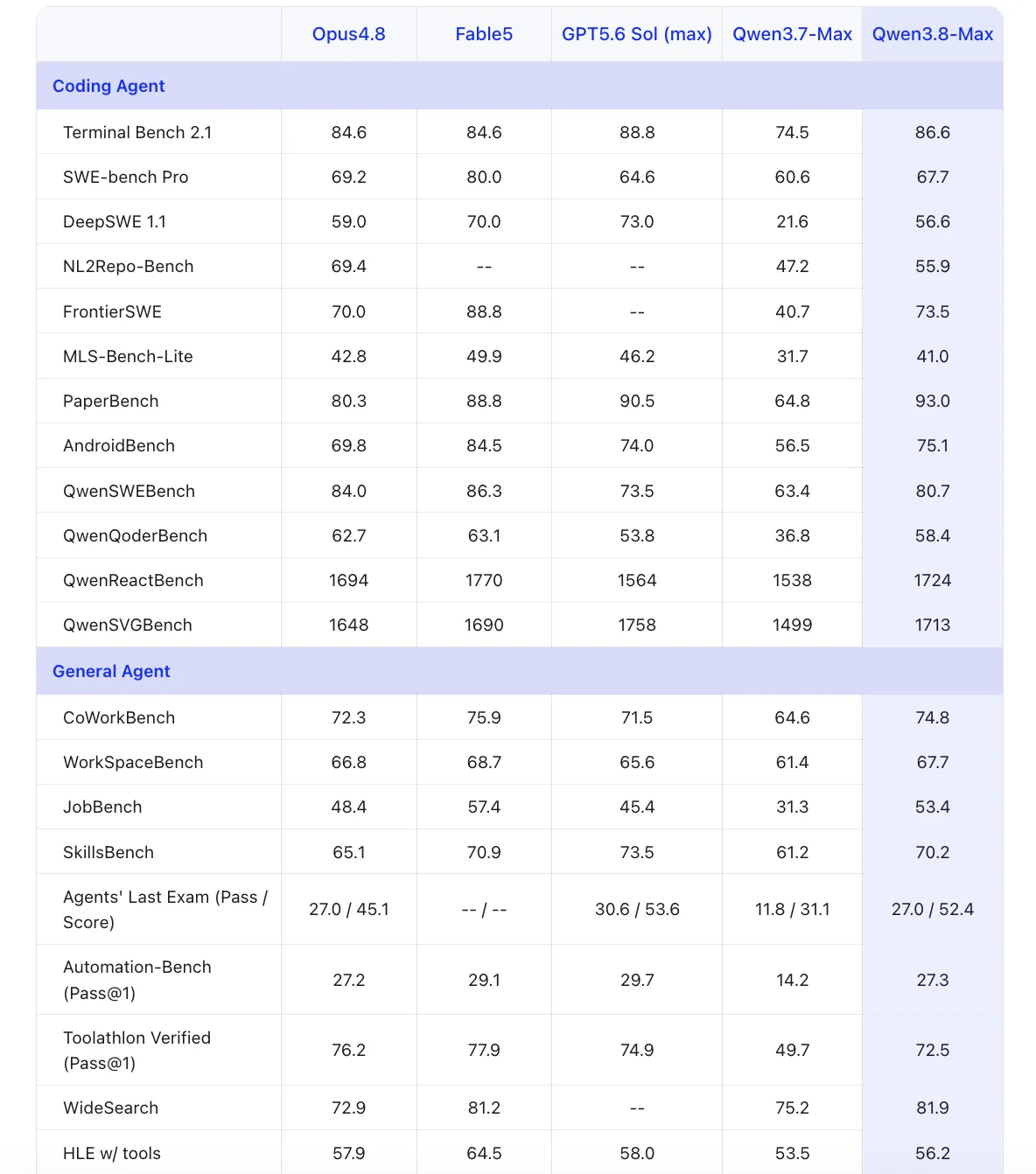 image https://qwen.ai/blog?id=qwen3.8
パフォーマンス
アリババは今回のリリースに合わせて、完全なベンチマーク表を公開しました。Qwen3.8-Max は Terminal-Bench 2.1 で 86.6 を記録し、Claude Opus 4.8 や Claude Fable 5(ともに 84.6)を上回っていますが、GPT-5.6 Sol (max) の 88.8 には及びません。SWE-bench Pro では 67.7 で Fable 5 の 80.0 に劣り、FrontierSWE でも 73.5 と Fable 5 の 88.8 を下回ります。一方で PaperBench では 93.0、IFBench では 82.8 とトップを維持しています。GPQA Diamond は 92.6 で、先行モデルの Qwen3.7-Max(92.4)からわずかに改善されました。
最も明確な進歩は推論能力ではなく、マルチモーダル処理やエージェント機能にあります。OSWorld-Verified(86.1)、Parametric CAD Bench(91.5)、OmniDocBench 1.5(92.1)など、視覚関連のベンチマークではほぼすべてで首位を独占しています。
先行モデルとの比較では飛躍的な向上が見られます。DeepSWE は 21.6 から 56.6 に、FrontierSWE は 40.7 から 73.5 に、JobBench は 31.3 から 53.4 へと大幅にスコアを伸ばしました。
ただし、この結果を客観的に読む際には2つの注意が必要です。まず、マルチモーダルのベンチマークは Qwen3.7-Max ではなく Qwen3.7-Plus と比較されており、世代間の差が実際より大きく見えている可能性があります。また、アリババ自身が公開した RL スケーリング曲線では、約4,000のトレーニング環境で 0.725 がピークに達した後、0.719、そして 0.689 と低下していることが示されています。
要点
- Qwen3.8-Max は 2.4T パラメータの MoE モデルで、コンテキスト長は 1M です。現在、一般利用可能です。
- 料金は入力 1M トークンあたり$2、出力$6、キャッシュされた入力は$0.25 です。
- Qwen3.8-Max と Qwen3.8-27B のオープンウェイト版は来週公開される予定です。
- ベンチマーク表、ライセンス情報、アクティブ化パラメータ数についてはまだ公表されていません。
- 本格的なオンプレミス環境での導入を現実的に考えるなら、フラッグシップモデルではなく 27B チェックポイント版が適しています。
原文を表示
Alibaba’s Qwen team has made Qwen3.8-Max broadly available and confirmed that its open weights ship next week. A second checkpoint, Qwen3.8-27B, is also going open-weights. Qwen3.8-Max is a 2.4-trillion-parameter mixture-of-experts model. It accepts text, image and video as input and returns text.
Is it deployable
Yes, but the deployable surface depends on which artifact you are applying.
The hosted API is deployable today by any company size. It is OpenAI- and DashScope-compatible, so integration is a base-URL and model-ID change. The open weights are a different matter. At 2.4T total parameters, the checkpoint is a multi-node datacenter artifact. Alibaba has not disclosed the activated-parameter count. Serving cost therefore cannot yet be modeled. Qwen3.8-27B is the checkpoint that fits ordinary on-premise GPU hardware.
The published feature set maps cleanly onto four industries. Those are software engineering, legal and financial document review, media and e-commerce operations, and design.
Applications include repository-scale coding agents and long-document knowledge bases. Long-video indexing, structured data extraction and multi-step research assistants also fit.
Interactive explainer
What is Technically Available
The model page lists a 1M-token context window. Maximum input is 991K tokens, dropping to 983K when thinking is enabled. Maximum output is 131K tokens in both modes, and the maximum reasoning budget is 262K tokens. Rate limits are 2M tokens per minute and 15K requests per minute.
Pricing is $2.00 per 1M input tokens and $6.00 per 1M output tokens. Implicit cache reads cost $0.25 per 1M tokens. Explicit cache creation is $2.50 and explicit cache reads are $0.17 per 1M tokens. Cached input is eight times cheaper than fresh input. Prefix stability therefore drives cost more than prompt length does.
Supported capabilities include function calling, structured outputs, batches, prefix completion and fine-tuning. Five built-in tools ship on the Responses API: code_interpreter, web_search, web_extractor, t2i_search and i2i_search.
imagehttps://qwen.ai/blog?id=qwen3.8
Performance
Alibaba published a full benchmark table with this release. Qwen3.8-Max scores 86.6 on Terminal-Bench 2.1, ahead of Claude Opus 4.8 and Claude Fable 5 at 84.6, behind GPT-5.6 Sol (max) at 88.8. It reports 67.7 on SWE-bench Pro against Fable 5’s 80.0, and 73.5 on FrontierSWE against Fable 5’s 88.8. It leads PaperBench at 93.0 and IFBench at 82.8. GPQA Diamond lands at 92.6, up marginally from Qwen3.7-Max’s 92.4. The clearest gains are multimodal and agentic, not reasoning. It tops most vision rows, including OSWorld-Verified 86.1, Parametric CAD Bench 91.5, and OmniDocBench 1.5 at 92.1. Against its own predecessor the jump is large: DeepSWE 1.1 moves from 21.6 to 56.6, FrontierSWE from 40.7 to 73.5, JobBench from 31.3 to 53.4. Two caveats belong in any honest read. The multimodal table benchmarks against Qwen3.7-Plus, not Qwen3.7-Max, which flatters the generational delta. And Alibaba’s own RL scaling curve peaks at 0.725 near 4,000 training environments, then declines to 0.719 and 0.689.
Key Takeaways
Qwen3.8-Max is a 2.4T-parameter MoE model with 1M context, now generally available.
Pricing is $2 input, $6 output and $0.25 cached input per 1M tokens.
Open weights for Qwen3.8-Max and Qwen3.8-27B are promised next week.
No benchmark table, license, or activated-parameter count has been published.
The 27B checkpoint, not the flagship, is the realistic on-premise deployment path.
Check out the Technical details, API and Qwen Studio. Also, feel free to follow us on Twitter and don’t forget to join our 150k+ML SubReddit and Subscribe to our Newsletter. Wait! are you on telegram? now you can join us on telegram as well.
Need to partner with us for promoting your GitHub Repo OR Hugging Face Page OR Product Release OR Webinar etc.? Connect with us
The post Alibaba Qwen Releases Qwen3.8-Max: A 2.4 Trillion Parameter MoE Model and the Most Capable One in the Qwen Family to Date appeared first on MarkTechPost.
関連記事
News to Guide
ニュースの次に確認する
発表内容を、現在の料金や仕様と照らし合わせられる関連ガイドです。
今日のまとめ
AIデイリーブリーフで今日の重要ニュースをまとめ読み