Google Cloud、AI を活用したメインフレームの安全なクラウド移行戦略を提案
本文の状態
日本語全文を表示中
詳細モードで約12分の本文を読めます。
同じ出来事の情報源
この情報源を基点に整理
Google Cloud AI
Google Cloud は、レガシーなメインフレームの近代化において、AI とクラウドの敏捷性を活用した反復的なアプローチを提案し、依存関係や複雑なデータ形式を維持しながら機能等価を保つ戦略を示す。
AI深層分析を開く2026年8月4日 06:37
AI深層分析
キーポイント
ハイリスクな移行の回避と新戦略の提示
Google Cloud は、既存のメインフレームを維持し続けるか、不確実性の高い「ビッグバン」移行を行うという従来のジレンマに対し、AI とクラウドを活用した反復的かつ継続的な近代化戦略を提案する。
大規模環境における実世界の課題の特定
単一アプリケーションの変換は容易である一方、大規模グローバル企業において複雑な依存関係やレガシーデータ形式を壊さずに機能等価を保つことが真の難点であると指摘する。
技術的障壁の詳細な列挙
アプリケーションロジックとデータベースの融合、AI エージェントがアクセスできない非リレーショナル形式(VSAM など)、複雑なトランザクション管理システムなど、6 つの実践的な課題を挙げている。
本格的な現代化の範囲
COBOLからJavaへの単なる変換ではなく、データモデルや隠された依存関係、データストアの近代化も含まれる。
リスク低減のための検証
本番環境の実際のトラフィックを用いて新しいコードを検証・リスク低減することが重要である。
重要な引用
mainframe modernization isn't a pure code-to-code conversion problem
The real challenge lies in modernizing at real-world scale without breaking the intricate web of dependencies and legacy data formats you find in a large global enterprise, all while ensuring functional equivalence.
Non-relational formats that are inaccessible by AI Agents, such as VSAM, flat files, IMS hierarchical structures.
real-world modernization of mainframe applications is so much more than converting COBOL to Java
編集コメントを表示
編集コメント
レガシーシステムの近代化は長年の課題であり、AI を活用した漸進的アプローチの提案は実務的な意義が大きい。特に AI エージェントが扱えない非リレーショナルデータ形式への言及は、現場の技術的障壁を正確に捉えている点で価値がある。
Source Article
元記事を日本語で読む
本文に関係しない購読案内、埋め込み通知、サイト内プロモーションは除いています。
長年、レガシーなメインフレームを保有する企業は、高リスクなジレンマに直面してきました。一つは、現代化の必要性を認識しながらも対応を先送りし続けること(いずれは対処せざるを得ないことは承知の上で)、もう一つは、不確実性とリスクが多数伴う危険な「ビッグバン」方式での移行です。
Google Cloud では、これらとは異なるアプローチを提案します。AI の力を活用し、クラウドの敏捷性を発揮しながら、反復的かつ継続的な現代化を実現する戦略です。このアプローチは、ある根本的な真実に基づいています。すなわち、メインフレームの現代化は単なるコードからコードへの変換問題ではないということです。確かに、AI や大規模言語モデルの最近の進展を背景に、孤立した小規模なアプリケーション一つを現代化する程度であれば比較的容易です。しかし、真の課題は、大規模なグローバル企業の複雑な依存関係やレガシーデータ形式を壊すことなく、機能等価性を確保しながら、現実的なスケールで現代化を進めることにあります。
例えば、こうした「現実世界」における課題には以下のようなものがあります:
- アプリケーションのロジックが、レガシーかつ独自仕様のデータベースやレコードスキーマに密接に結合されていること。
- AI エージェントがアクセスできない非リレーショナル形式(VSAM、フラットファイル、IMS の階層構造など)が存在すること。
- CICS や IMS TM などのトランザクションモニターは高度に統合されたトランザクション管理を提供しており、単一のトランザクションシナリオには数百万行のコードが含まれることもあること。
複雑な順序付きワークフローには、高度な条件分岐ロジックと依存関係が絡み合っています。
内部・外部の境界では、CTG、IMS Connect、MQ、LU 6.2 Sockets といった独自プロトコルが利用されています。
専門的な独自メインフレームユーティリティスイートによる運用上のロックインも深いです。
つまり、実世界のメインフレームアプリケーション近代化とは、単に COBOL を Java に書き換えるだけではありません。基盤となるデータモデルの近代化、何十年にもわたる隠れたアプリケーション依存関係やインターフェースの処理、そして基盤データベースの刷新も必要です。最も重要なのは、本番環境への移行前に実際の生産トラフィックを用いて新コードを検証し、リスクを軽減することです。
私たちのアプローチでは、コード理解のための高度な推論能力とスケールを持つ Gemini モデル [https://blog.google/products-and-platforms/products/gemini/gemini-3/] と、実世界の複雑さや課題に対応するメインフレーム特化型の近代化製品を組み合わせます。当社のソリューションは、評価(assessment)、近代化(modernization)、リスク低減(de-risking)、データ移行(data migration)の 4 つの柱で構成されています。

それぞれの要素を見ていきましょう。
1. 評価:AI を活用したレガシーアプリケーションの逆エンジニアリング
Google Cloud の「メインフレーム評価ツール(MAT)」は、大規模なレガシーコードベースを逆解析することで、既存のレガシーアプリケーションに対する説明可能性を提供するとともに、近代化に必要な基盤を整えます。
MAT は、以下の 4 つの主要領域において、あなたのメインフレーム環境に関する深い洞察をもたらします。
- 依存関係の可視化: DB2 データベースや VSAM ファイルなど、異なるアプリケーション間およびデータストア間の関係性と相互接続性をマッピングします。
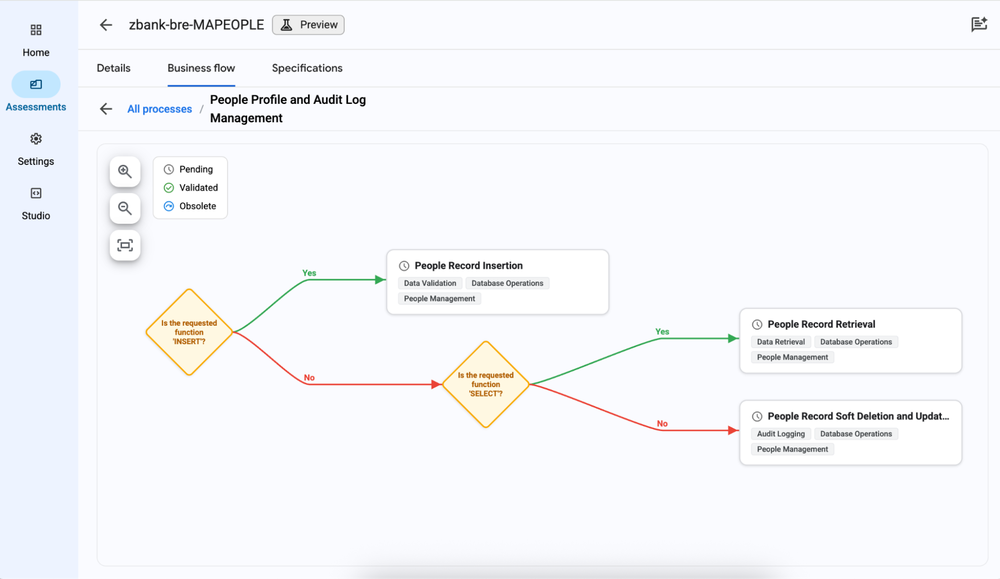
- 自動ビジネスルール抽出(BRE): 複雑なメインフレームアプリケーションロジックを、平易な言語による要件定義と視覚的な意思決定ツリーに変換します。
- 自動ドキュメント生成: 本番環境のメインフレームソースコードから直接包括的で最新の技術ドキュメントを生成します。
- ドメインおよびビジネス機能の発見: アプリケーションの境界を自動的に特定し、アプリケーションを高レベルのビジネスドメインにグループ化。さらに、各ドメインのアーキテクチャ(入力・出力・インターフェース、処理が行われる場所など)を可視化します。
MAT は、既存のアプリケーションとビジネスプロセスを理解し、クラウドネイティブな未来を設計するために必要な、明確で検証済みのロジック要件を提供します。MCP を介してこれらの出力をエージェント型モダナイゼーションワークフローに直接統合することで、AI エージェントは高精度なコード変換、実行規模の拡大、自社のコードベースへの最適化を保証するために必要な、細粒度かつアプリケーション固有の文脈を獲得できます。

2. モダナイゼーション:コード変換
現代化には、目指すビジネス成果に合わせて戦略的な選択が必要です。すべてのユースケースに通用する単一の道はめったにありません。当社の適応型アプローチでは、企業が求める現代化の深さを正確に選定でき、異なるメインフレームワークロードに対してそれぞれ最適な戦略を適用できます。
理論と実行(つまり AI から実用 AI へ)のギャップを埋めるため、私たちはメインフレーム現代化のプロフェッショナルサービスチームと連携し、専用の AI エージェントを開発しました。これらのエージェントは、確立された手法や現場での実践経験を構造化されたアジェンティックな現代化ワークフローとしてコード化します。
Google のアジェンティック・メインフレーム現代化ソリューションでは、現代化を推進する 2 つの方法があります。
書き換え / 再考(Rewrite / Reimagine)
ビジネスロジックの革新が最も高い戦略的 ROI を生み出すレガシーアプリケーションには、このパスを選択してください。このパターンは、メインフレーム評価ツール(MAT)でビジネスルールを抽出し、メインフレーム現代化エージェントが前方エンジニアリングを担当します。このアジェンティックなワークフローでは複雑なビジネスプロセスを分析・抽出し、レガシーコードを明確なビジネス仕様へと変換します。
このソリューションは、エージェント型ハネスとして機能する Antigravity と連携し、各工程で必要に応じて人間の監視を組み込んだ安全な AI 加速開発パイプラインを実現します。具体的には、メインフレームアプリケーションからのビジネスルール抽出から始まり、ターゲットとなるアプリケーション仕様の策定、アーキテクチャ設計の作成、ユーザーストーリーとバックログの生成、そしてエージェントによるコーディング実装計画の立案までをカバーしています。
これにより、エンジニアリングチームは複雑なロジックを実装の詳細から切り離すことが可能になり、従来のメインフレームという「ブラックボックス」に代わり、透明性が高く保守が容易で、進化の余地も大きいクラウドネイティブアプリケーションへと移行できます。

決定論的近代化(レプリカ・ライク)
このパターンは、構造的な近代化が必要でありながら、既存のアプリケーション動作を正確に維持しなければならないユースケース向けに設計されています。内部アプリケーション構造に対するコードからコードへの直接変換に AI を活用し、厳格な契約の忠実さを最優先の制約条件とします。近代化したシステムは、特定の入力に対して従来システムと同じビジネス出力を生成しなければなりません。これにより、外部インターフェースを変更することなく技術的負債のみを解消できます。
ワークロードに合わせたパターンの選定
これらのパターンを用いた現代化が、実際の現場ではどのように行われるのでしょうか。金融サービス業界の顧客を例に、資産全体に対して混合アプローチを採用する場合を考えてみましょう。
まず、安定した高ボリュームのバックオフィスバッチ処理(例えば夜間の明細書発行など)については、リスクを抑えつつ実行時間を短縮し、MIPS 消費量を削減するために、同等機能への置き換えパスを採用します。次に、中核となる一般元帳については、決定論的な AI による現代化を選択し、データ構造を Google Cloud SQL へ移行して分析能力を向上させながら、規制コンプライアンスロジックは維持します。
最後に、顧客向けのローン発行プラットフォームのように競争優位性の源泉となるアプリケーションについては、AI を活用した書き換え戦略を採用。Gemini を用いてリアルタイム承認に対応するアプリケーションへと再構築し、ビジネスに真の差別化要因を生み出します。
3. 安全網:本番導入前のリスク低減
本番環境への移行リスクを排除するため、Google Cloud の Dual Run では、メインフレームと新しい Google Cloud 環境の両方で実際の生産ワークロードを同時に処理します。この機能は、リアルタイムのメインフレーム取引を自動的にキャプチャし、それをモダンなアプリケーションで実行して、プロトコル、メッセージ、データ変更などの出力を並列比較します。完全なロジックとデータの整合性が達成されるまでこの継続的な検証が繰り返され、レガシーアプリケーションを廃止する前に安全性が保証され、運用上の中断はゼロになります。すでにグローバル企業では、移行リスクの排除や、特定の業界で必要となる厳格な規制承認の取得のために Dual Run を活用しています。Dual Run は、メインフレームの近代化成功のための本番環境向けの保険政策と捉えることができます。

4. データ移行:分断されたメインフレームデータを近代化する
最後に、Google Cloud の Mainframe Connector を利用すれば、メインフレームからデータを抽出し、BigQuery や Spanner、Cloud SQL、Cloud Storage などの各種 Google Cloud サービスへ転送することが可能です。Mainframe Connector はコードベースとデータ型の自動変換を担い、既存の ETL プロセスに容易に統合できるため、メインフレーム上のデータを段階的にクラウドへ移行できます。これにより、メインフレームからの処理負荷を軽減しつつ、拡張型モダナイゼーションや分析・データウェアハウジングのパターンをサポートできます。結果として、孤立していたメインフレームデータの活用が可能になり、新たなビジネス機能をクラウド上で構築しながら、MIPS(百万命令/秒)の使用量も削減できるのです。
これら 4 つのソリューションを組み合わせることで、既存の業務プロセスの理解、アプリケーションのモダナイゼーション、本番導入前のリスク低減、そして孤立データの統合といった、メインフレーム顧客が直面する現実的な課題に対し、ターゲットを絞った AI の応用がどのように解決策となるかが示されます。
実際に試してみましょう
メインフレームのモダナイゼーションに、盲目的な信頼は必要ありません。不確実性から実行へ移行させることを目的としたターゲティングされたパイロットプログラムを通じて、AI 加速型アプローチを実際に検証してください。
開始までの手順は以下の通りです:
コードベースの自動評価:ターゲットアプリケーションに対して Mainframe Assessment Tool を実行し、隠れた依存関係をマッピングし、ドメインアーキテクチャを可視化するとともに、レガシーコードから平易なビジネスルールを直接抽出します。
アジェンティック・モダナイゼーション・ワークショップとパイロット:Google Cloud の専門家や専門パートナーと共同で手作業を行い、アジェンティックワークフローが実世界のメインフレームモダナイゼーションの問題解決にどう適用できるかをデモンストレーションします。一緒に一つのアプリケーションを選定し、モダナイゼーションの事業ケースを構築しましょう。
準備はできましたか?mainframe@google.com までお問い合わせください。
原文を表示
For too long, enterprises with legacy mainframe estates have been faced with a high-stakes dilemma: continue maintaining their mainframes, essentially kicking the modernization can down the road (they know they will need to deal with it eventually), or perform a dangerous "big bang" migration with many unknowns and risks.
At Google Cloud, we propose an alternative: a modernization strategy that leverages the power of AI, agility of the cloud and allows for iterative and continuous modernization. This approach recognizes a fundamental truth: mainframe modernization isn’t a pure code-to-code conversion problem. Sure, modernizing a single, isolated and small application is relatively easy, especially with recent advancements with AI and large language models. The real challenge lies in modernizing at real-world scale without breaking the intricate web of dependencies and legacy data formats you find in a large global enterprise, all while ensuring functional equivalence.
For example, some of these “real world” challenges include:
- Application logic is tightly fused directly to legacy and proprietary databases and record schemas.
- Non-relational formats that are inaccessible by AI Agents, such as VSAM, flat files, IMS hierarchical structures.
- Transaction monitors like CICS and IMS TM deliver highly integrated transaction management. A single transaction scenario can consist of millions of lines of code.
- Intricate sequential workflows with complex conditional step logic and dependencies.
- Internal/external boundaries utilizing proprietary protocols like CTG, IMS Connect, MQ, LU 6.2 Sockets.
- Deep operational lock-in with specialized proprietary mainframe utility suites.
In other words, real-world modernization of mainframe applications is so much more than converting COBOL to Java. You also need to modernize the underlying data models, handle decades of obscured application dependencies and interfaces and modernize the underlying data stores. Most importantly, you need to validate and de-risk the modern code with actual production traffic before going live.
Our approach combines the advanced reasoning and scale of our Gemini models for code understanding, with mainframe-specific modernization products to address real-world complexity and challenges. Our solutions span four core pillars: assessment, modernization, de-risking, and data migration.
Let’s take a look at each of these.
1. Assessment: AI reverse-engineering of the legacy applications
Our Mainframe Assessment Tool (MAT) reverse-engineers legacy codebases at massive scale to provide both explainability for the current legacy applications and sets the required foundation for modernization.
MAT delivers deep insights into your mainframe environment in four key areas:
- Dependency visualization: Mapping relationships and interconnectivity between the different applications and data stores, such as DB2 databases or VSAM files.
- Automated business rule extraction (BRE): Translating complex mainframe application logic into both plain-language requirements and visual decision trees.
- Automated documentation: Generating comprehensive, up-to-date technical documentation directly from your production mainframe source code.
- Domain and business function discovery: Automatically identifying application boundaries, grouping applications into high-level business domains and visualizing the architecture for these domains including inputs, outputs, interfaces, and where processing occurs.
MAT gives you the clean, verified logic requirements needed to understand your existing applications and business processes and to design a cloud-native future. By integrating these outputs directly into agentic modernization workflows through MCP, it equips your AI agents with the granular, application-specific context they need to guarantee high-accuracy code transformation, scale execution, and optimize for your own codebase.
2. Modernization: code transformation
Modernization requires strategic choices tailored to your desired business outcomes. There is rarely a single path that fits every use case. Our adaptable approach lets you select the exact depth of modernization your business needs, allowing you to apply different strategies to different mainframe workloads.To bridge the gap between theory and execution (aka AI to Applied AI), we partnered with our Mainframe Modernization Professional Services team to build specialized AI agents. These agents directly codify their proven methodologies and hands-on field experience into structured, agentic modernization workflows. With Google’s agentic mainframe modernization solution, you have two ways to modernize:
****Rewrite / Reimagine
Choose this path for legacy applications where business logic innovation drives the highest strategic ROI. This pattern relies on the Mainframe Assessment Tool (MAT) to extract business rules together with our Mainframe Modernization Agents to handle forward-engineering. This agentic workflow analyzes and extracts complex business processes to translate legacy code into clear business specifications.
Combined with Antigravity as the agentic harness, this solution provides a safe, AI-accelerated development pipeline with optional human-in-the-loop governance at every step: business rule extraction from the mainframe applications -> creating target application specifications -> creating target architecture design -> generate user stories and backlog -> create the agentic coding implementation plan and more.
This allows engineering teams to decouple complex logic from implementation details and replaces the legacy mainframe "black box" with a transparent, easily maintainable, and highly evolvable cloud-native applications.
Deterministic modernization (like-to-like)
This pattern is designed for use cases that require structural modernization while preserving exact, legacy application behavior. We use AI for direct code-to-code modernization of the internal application structures, using strict contract fidelity as our governing constraint. The modernized system must produce the identical business output as the legacy system for any given input, removing technical debt without altering external application interfaces.
Matching the pattern to the workload
What does modernizing with these two patterns look like in the real world? Imagine a customer in the financial services industry that applies a mixed approach across their estate. They could modernize stable, high-volume back-office batch jobs (like nightly statement processing) with the like-for-like path to reduce MIPS consumption with reduced risk and faster timelines. They might choose deterministic AI modernization for their core general ledger, modernizing the data structure to Google Cloud SQL for better analytics while preserving the regulatory compliance logic. Finally, for applications that are competitive differentiators, such as a customer-facing loan origination platform, they could deploy a rewrite-with-AI strategy, using Gemini to rewrite the application for real-time approvals, creating a true differentiator for the business.
3. The safety net: De-risk before going live
To eliminate go-live risk, Google Cloud Dual Run processes real-world production workloads simultaneously across both your mainframe and your new Google Cloud environment. It automatically captures live mainframe transactions, runs them against your modern applications, and compares the outputs side-by-side (protocols, messages and changes to data). This continuous validation runs until you achieve complete logic and data equivalence, ensuring safety and zero operational disruption before you retire the legacy applications on the mainframe. Global enterprises are already using Dual Run to eliminate migration risk and even secure the strict regulatory approvals needed for modernization in certain industries. Think of Dual Run as your production-grade insurance policy for mainframe modernization success.
4. Data migration: Modernize siloed mainframe data
Finally, with the Google Cloud Mainframe Connector, you can copy data off the mainframe and into various Google Cloud services such as BigQuery, Spanner, Cloud SQL, Cloud Storage, and others. Mainframe Connector handles the codebase and data-type conversions, and can easily be integrated into existing ETL processes to iteratively copy data off the mainframe and onto Google Cloud. Mainframe Connector lets you both offload processing from the mainframe to support both the augmentation modernization pattern as well as analytics/data-warehousing. Now you can unlock siloed mainframe data to create new business functions in the cloud, all while reducing MIPS usage.
Combined, these four solutions demonstrate how targeted applied AI can help solve real-world modernization challenges for mainframe customers: understanding the existing business processes, modernizing the applications, de-risking before going live and modernizing the siloed data.
Put us to the test
Mainframe modernization shouldn't require a leap of faith. Put our AI-accelerated approach to the test through a targeted pilot program designed to move your enterprise from uncertainty to execution.
Here is how we get started:
- Automated codebase assessment: Run a Mainframe Assessment Tool scan on a target application to map hidden dependencies, visualize domain architecture, and extract plain-language business rules directly from the legacy code.
- Agentic modernization workshop and pilot: Collaborate hands-on with Google Cloud experts and specialized partners to showcase the capabilities of how agentic workflows can be applied in the real-world to solve the mainframe modernization problem. Together we can pick one application to modernize and build the business case for modernization.
Ready to get started? Contact us at mainframe@google.com.
AI算出
技術分析ainew評価標準
記事は AI モデル(Gemini)と特定ツール(MAT)を用いた移行戦略の詳細な技術分析を提供しており、新規性としては既存のベンダー発表の再構成であるが、実装プロセスに関する具体的な知見を含んでいる。
6つの評価軸を見る
- AI関連度
- 75
- 情報源の信頼性
- 25
- 新規性
- 25
- 調べる価値
- 75
- 重複の少なさ
- 100
- 日本での有用性
- 25
今日のまとめ
AIデイリーブリーフで今日の重要ニュースをまとめ読み