ABC Legal、全社員にClaude Managed Agents導入し自動化を推進
本文の状態
日本語全文を表示中
詳細モードで約20分の本文を読めます。
同じ出来事の情報源
この情報源を基点に整理
Claude Blog
ABC Legal は Claude Managed Agents を導入し、全社的な AI エージェントのバージョン管理と監視を実現したことで、非エンジニアである従業員が自ら自動化ツールを構築する文化を確立した。
AI深層分析を開く2026年8月19日 09:13
AI深層分析
キーポイント
全社員による自律的な自動化
CTO の Brandon Fuller が Claude Enterprise を導入した後、法務書類配送業務の各チームが自発的に自動化ツールを構築し、業務効率化を進めた。
Managed Agents によるインフラ基盤の統一
個々のデスクトップに依存していたエージェントをクラウド上の Managed Agents へ移行し、単一の監査・課金画面と常時稼働環境を実現した。
コードとしてのエージェント管理
エージェントのプロンプトや設定を Git リポジトリで管理し、プルリクエストによる承認プロセスを経てバージョン履歴とロールバック機能を担保している。
非開発者による生産用エージェントの構築
15名のステアリング委員会がソフトウェアを書かずに構成とプロンプトを入力するだけで、Claude Code を活用して Managed Agents を構築した。このアプローチにより、開発チームを介さないボトルネックが解消され、1 か月で 50 以上のエージェントが稼働した。
標準化されたエージェント管理とデプロイ
各エージェントは JSON 設定ファイルやシステムプロンプトを含む独自のフォルダに格納され、メインブランチへのマージで自動的にデプロイされる。ビルダーはリポジトリをクローンしてテンプレートを使用するだけで、必要な構成やメモリ環境を即座に取得できる。
重要な引用
"Our users really flocked to it," Fuller recalls. "They saw the ease of use of connectors and tools, and suddenly we had people all over the organization automating the tasks that had always eaten up their day."
"an agent is really just structured text, a prompt plus configuration, and anything that is text can live in a repository where the whole company can see it, review it, and improve it."
"I had to explain what a PR was to them. A lot of [the non-software engineers] thought it meant running, like a PR, the fastest you can," he said. "Now they're doing pull requests and sending them to each other."
"The account manager who set it up had never automated anything, and built it in about an hour by describing it to Claude Code."
編集コメントを表示
編集コメント
この事例は、大規模な組織において AI エージェントを「コード」として扱うことで、セキュリティと拡張性を両立させる有効なアプローチを示している。企業は技術的な導入だけでなく、社員の自律的な活用を促す文化作りが成功の鍵となることを再認識できる内容だ。
Source Article
元記事を日本語で読む
本文に関係しない購読案内、埋め込み通知、サイト内プロモーションは除いています。
米国に本拠を置く法務文書配送会社「ABC Legal」の CTO、ブランドン・フルラー氏は、今年初めに同社 1,100 名の従業員向けに Claude Enterprise の導入を開始しました。すると、すぐに大きな変化が起きました。
法廷送達業務、電子提出(eFiling)、出廷弁護士対応、マーケティング、コンプライアンス、財務など、社内のあらゆるチームが、指示を待たずに自ら自動化ツールの構築に取りかかりました。
「ユーザーの反応は素晴らしかったです」とフルラー氏は振り返ります。「コネクタやツールの使いやすさに気づいた瞬間、組織全体から『これまで一日中かかっていた業務』を自動化する動きが湧き上がりました」
これは CTO が望むような理想的な導入事例です。しかし、フルラー氏はさらに一歩踏み込む機会を見出しました。「ABC Legal は、バージョン管理が可能で、動作状況の可視化ができ、常時稼働する AI エージェント群を運用できないだろうか?」
その野望を実現するには、インフラ基盤の整備が不可欠でした。当初のエージェントは、開発者が各自のデスクトップに配置したスケジュールタスクとして存在していました。これらを個人のパソコンから移行することで、無人での実行が可能になり、フルラー氏は「何が開発されたか」「コストはいくらか」「昨夜も正常に動作していたか」という全体像を一元管理できるようになります。
そこでフルラー氏が導入したのが Claude Managed Agents です。共通のデプロイ構造、共有ワークスペース、一元化された監査・請求画面、そして個人のノートパソコンではなくクラウド上で常時稼働するエージェントという仕組みです。
2026 年 7 月現在、フルラー氏とそのチームは以下のような実績を追跡しています:
50 以上のエージェントを「Managed Agents」で実運用に導入
一部の人間が担当するタスクのコストは、大規模な最適化を行う前でも最大約 50% 削減
全 310 名の従業員が部署を問わず、日常業務で Claude を活用
彼らがどのようにしてこの成果を達成し、その過程で何を学んだのか。
エンターテインメントからエンジニアリングへ:すべてのエージェントをソフトウェアとして扱う
Claude Managed Agents の導入当初、フルラーはチームに対し、あらゆるエージェントをコードとして定義するよう指示しました。彼はこれがエージェントにとって自然な姿だと考えています。彼が説明するように、「エージェントとは本質的に構造化されたテキスト、つまりプロンプトと設定の組み合わせに過ぎません。テキストであれば何でも、全社で閲覧・レビュー・改善できるリポジトリ内に保存できます」。エージェントのプロンプト、ツール一覧、スケジュール、認証情報、メモリなどはすべて、会社のソフトウェアと同じ Git リポジトリ内の設定ファイルに格納されます。変更は誰かが承認したプルリクエストを通じてのみ行われるため、すべてのエージェントにバージョン履歴、コードレビュー機能、ロールバック機能、監査証跡が自動的に付与されます。
ある担当者は、2 つのテンプレートを用いて 1 週間でスターターキットを構築しました。これらは専用の Git リポジトリに保存されています。
1 つはイベント駆動型エージェント用で、新しいジョブが到着したり、裁判所から文書が戻ってきたりといった「何か」が発生した瞬間に起動します。もう 1 つはスケジュール実行型エージェント用で、時間(毎時・毎日・毎週)を刻んで自動的に稼働します。
各エージェントは独自のフォルダ内に配置され、標準的な構造を持っています。具体的には、JSON 形式の設定ファイル、Markdown 記法で作成されたシステムプロンプト、デプロイスクリプト、そして運用ドキュメントです。変更をメインブランチにマージすると、エージェントは自動的にデプロイされます。
ビルダー(構築者)がソフトウェアを書く必要はありません。リポジトリをクローンし、スターターテンプレートをコピーして、Claude Code に「このエージェントに何をしてほしいか」を指示するだけで、必要なものがすべて揃います。設定ファイル、プロンプト、認証情報の保存場所、そしてメモリです。
技術的な壁の解消
フルラーは、財務、マーケティング、運営、開発部門から選ばれた 15 人のステアリング委員会を集めました。彼らはソフトウェア開発者ではありませんでした。そのメンバーにリポジトリをクローンさせ、Claude Code を使って Managed Agents の構築を実行してもらいました。
目的は、非エンジニアの社員が自分たちで本番環境のエージェントを構築できることを証明することです。もしすべてのエージェント作成が開発チームを経由しなければならないとすれば、それがボトルネックとなり、会社全体のスピードが制限されてしまいます。安全に実現できた理由は、ソフトウェアを書かなかったからです。彼らは設定とプロンプトを埋める作業を行い、Managed Agents が実行環境(ランタイム)を提供しました。
「PR の意味を説明する必要がありました。ソフトウェアエンジニア以外の社員は、PR を『走ること』、つまり可能な限り速く走る行為だと誤解していたのです」と彼は語ります。「今は彼らがプルリクエストを作成し、互いに送り合っています。」
わずか1週間で、全15名の従業員が動作するエージェントを手にしました。これらのビルダーはそれぞれのチームに戻り、他のメンバーの育成を行いました。1ヶ月後には、ABC Legal 全体で約50以上のエージェントが稼働しています。各エージェントには名前と所有者が割り当てられ、担当業務は1つに絞られています。
法文書プロセスのほぼ全段階に対応するエージェント
現在、ABC Legal では法文書の提出プロセスおよび関連する運用のほぼすべての段階で、エージェントが活躍しています。
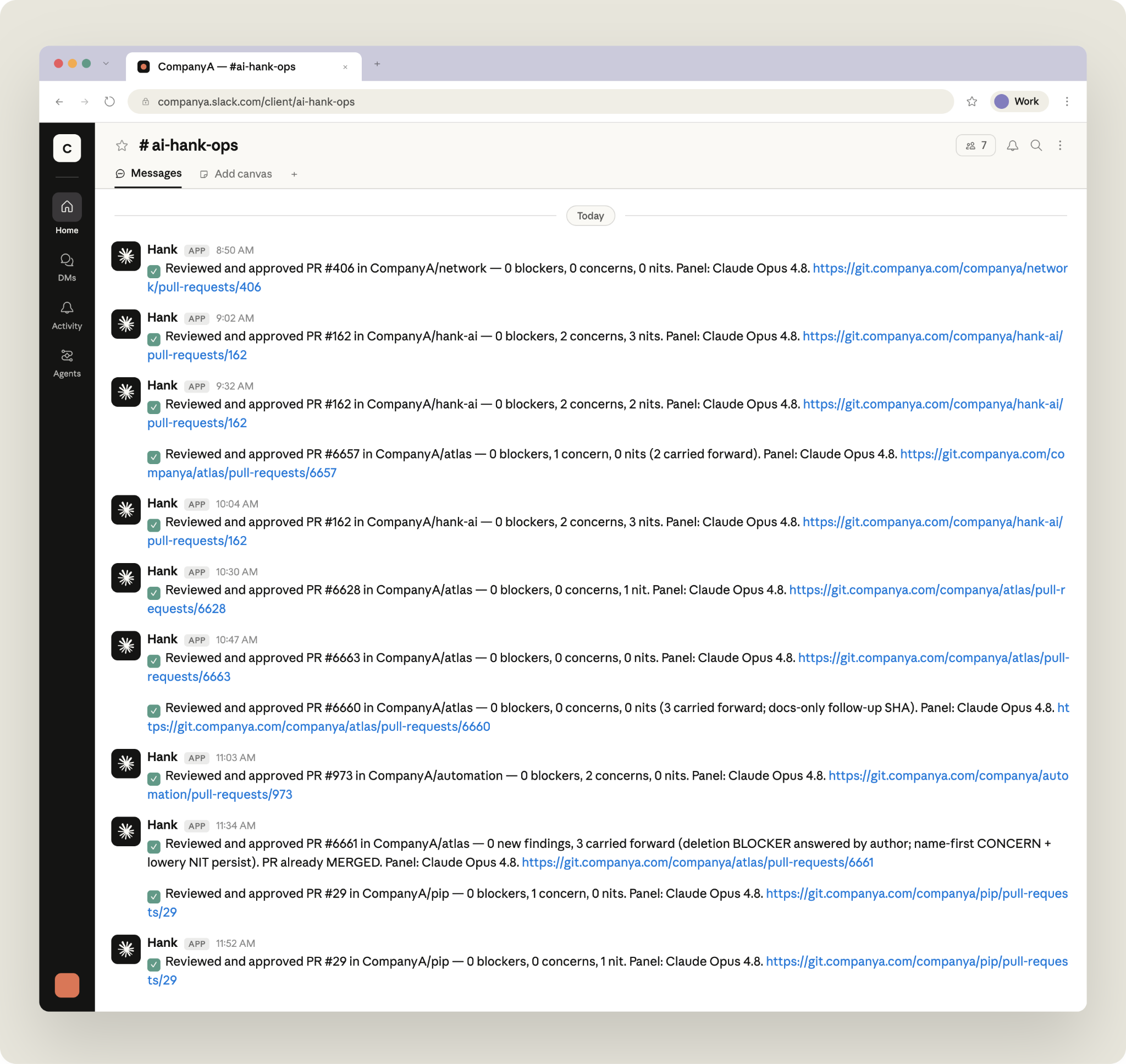
AI コードレビューアーは、4 つのコードベース全体にあるすべてのプルリクエストを審査します。複数のモデルによる分析を実行し、セキュリティ上の脆弱性、パフォーマンスの低下、そして誤ってコミットされた認証情報を検出します。エンジニアたちは、マージを行う前に必ずこのレビュー結果を確認するようになりました。
EvidenceChain™ Delivery Agent は、元々担当者が手作業で行っていた週次の業務を自動化しました。ABC Legal が運営する独自サイト「EvidenceChain.com」では、裁判所や原告・被告が、現場でのサービス完了記録(誰が配達したか、いつ試みたか、書類配達の写真など)を検索できます。ある顧客は、このデータから特定の記録を継続的に取得したいと考えていました。
そこで導入されたエージェントは、マッチするジョブのデータベースレポートを取得し、Managed Agent に内蔵されたブラウザで各 PDF を取得して、顧客の FTP サーバーへ毎日配信しています。この自動化システムを構築した担当者はこれまで一度も自動化を行ったことがありませんでしたが、Claude Code に対して手順を説明するだけで約 1 時間で完成させました。
eFiling Rejection Diagnoser は、裁判所が提出書類を却下した際に自動的に起動し、ジョブの詳細を読み込み、裁判所の規則を確認して、約 1 分で診断結果を Slack に投稿します。以前は従業員の日中を数時間消費していた作業です。また、ジョブ検証エージェントは、すべての着信ジョブを裁判所と照合します。ブラウザ上で裁判所ウェブサイトを操作し、聴聞会や事件が適切に提出され、かつ指定された日付に実際に開催されていることを確認。その後、発見した内容に基づいてジョブを調整し、管轄区域、裁判所、時効期間などをフラグ付けします。
Attorney Coverage Agent は、弁護士ネットワークを活用して聴聞会の対応を確保します。利用可能状況を確認し、メールを送信し、返信から利用可能性や料金を読み取って、コーディネーターが対応を確定できるように支援しています。
金融部門では、AR・送金エージェントが送金メールを解析し、NetSuite 用の支払申請ファイルを作成して Slack に投稿、ワンクリック承認を促します。承認後はインポートされ、毎日実行される別エージェントが各エンジニアリングチケットに対して「資本化すべきか経費処理すべきか」の判断を下します。
マーケティング部門では、Google Ads を分析するエージェントが週次で推奨事項をチャンネル責任者に投稿しています。
オペレーション部門では、「Charvis」と呼ばれるレビューエージェントが完了したサービス業務を確認し、コンプライアンスチームとの合意率が約 98% に達しています。
「サービス期限超過通知」エージェントは、ABC Legal の運用上のバックログにおける Tier-1 レイヤー(通常人が手動で行う最初の反復処理)を担当し、人間による承認を待って段階的な日次 outreach メッセージを作成します。
エージェントの知能向上:収集・調整・再実行
ABC Legal のエージェントは人間の監督下で稼働しており、自身の行動や推奨事項を Slack に投稿します。チームメンバーはスレッドで返信したり、絵文字リアクションで反応したりしてフィードバックを与えます。
フルラーは、こうした反応データをトレーニング信号として無駄にしていることに気づきました。ただし、すべてのエージェントがその信号を必要とするわけではありません。 fleet の大半は単一タスクを実行するだけで、誰にも評価されない出力しか生み出さない独立した存在です。
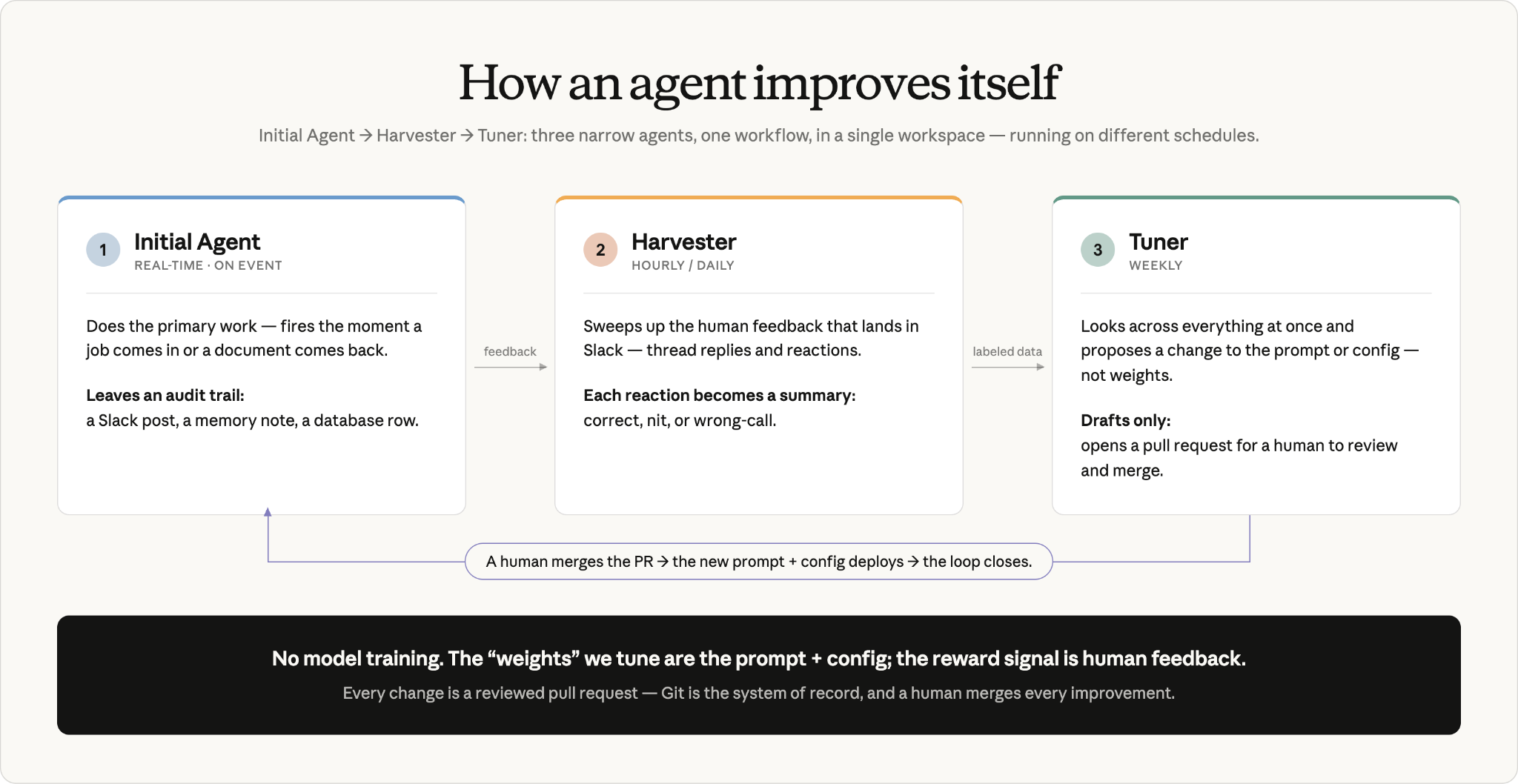
一方、評価付きフィードバックを集めることができるエージェントについては、ABC Legal は 3 つの役割を持つアーキテクチャを採用しています。これらは同じワークスペース、環境、認証情報を共有しますが、異なるスケジュールで動作する別々のエージェントとして機能します。このパターンにより、Slack のメッセージがバージョン管理された人間承認済みの変更へと変換されます。
- 初期エージェントは、ジョブの到着やドキュメントの戻り時にリアルタイムで作業を行い、各アクションの監査証跡を記録します。
- ハーベスターは時間ごとまたは毎日実行され、Slack 上のスレッド返信や絵文字リアクションとして届く人間のフィードバックを集めます。これらはすべてラベル付きデータポイントとなります。
- チューナーは週次で実行され、モデルの重みではなくプロンプトや設定の変更を提案します。作成するのはドラフトのみで、最終的なマージは人間がレビューして行います。
一例として、フルラー氏が考案した「デリバリー・アズ・コード」があります。これは ABC Legal の系列会社である 50 人の従業員を持つ Docketly で始まった、作業のルーティングを調整するためのエージェントシステムです。Docketly では業務全体が「デリバリー」を中心に構成されており、それぞれに独自のルーティングおよび処理ルールセットが存在します。現在約 145 存在するすべてのルールセットは、管理画面のレコードではなく、Git に保存された単一の YAML ファイルとして扱われています。そのため、デリバリーの調整とは、ファイルの編集とプルリクエストの作成を意味します。
このループを構成するのは 4 つのエージェントです。1 つ目は週ごとに Slack に判定結果を投稿するもの、2 つ目は人間のフィードバックに基づいて反応をラベルに変換するハーベスター、3 つ目は YAML ファイルに対してプルリクエストを作成するチューナー、そして 4 つ目はマージされた設定を本番データベースに反映させるものです。この 4 つ目のエージェントが実行するのは、人間がすでにレビューして承認した内容のみです。実際には、誤ったルーティングを示す絵文字の反応が、その週のうちにデリバリーのルール変更としてマージされることもあります。ループ内で唯一手動で行うのはレビューだけです。
なぜ Claude Managed Agents を選んだのか
フルラー氏は、組織のエージェントハネスとして Claude Managed Agents に落ち着くまでに複数のフレームワークを評価しました。彼の判断基準は具体的でした。プラットフォームにはバージョン管理機能、観測可能なセッション、ワークスペースごとの課金、モデルの選択機能、メモリプリミティブ、MCP の接続機能が必要であり、何より重要なのは、インフラストラクチャの手間をかけずに運用できる点です。
このプラットフォームの責任分担は、フルラー氏が運営を望む姿と見事に一致しています。Anthropic が管理するインフラがエージェントの実行ループ、セッション、メモリ、コンソール、そしてモデルそのものなど、エージェントを動かすためのすべての要素を担当します。一方、ABC Legal はプロンプト、ツールリスト、トリガーロジック、監査証跡、そして成果に対するフィードバックループの責任を負います。
スケーラビリティにおいて特に重要だった機能は以下の通りです。
- バージョン管理: 各プッシュで楽観的ロック付きの新規エージェントバージョンが作成され、ロールバックも容易に行えます。
- モデルの柔軟性: デフォルトでは Claude Sonnet を使用しますが、高ボリュームかつ高速なタスクには Claude Haiku を、深い推論が必要でコストに見合う場合のみ Claude Opus を選択します。モデルの切り替えは一行の変更だけで完了します。
- MCP の接続と認証情報の管理: エージェントは ABC Legal 独自のプラットフォーム(100 以上のツールが利用可能)やレポート用の Metabase、人間による介入が必要な Slack、プロジェクト管理の Atlassian に接続されます。
- スケジュールデプロイメント: 定期実行されるエージェントは Bitbucket Pipelines を通じて cron スケジュールで稼働します。これにより、リポジトリアクセス、シークレット管理、請求処理がすでに自動化されています。
ABC Legal は AI の支出をベンダー、ツール、チーム、ユースケースごとに内訳して追跡しています。春にかけてフリートが本番環境に投入されるにつれて支出は増加しましたが、7 月以降は使用量が伸び続ける一方で支出は減少傾向にあります。これは後述する効率化の成果であり、多くのエージェントが担当するタスクのコストを約 50% 削減し、全社 310 名の従業員が Claude を活用しています。
同社のコスト管理アプローチは意図的なものです。投資を、リターンが測定可能な垂直領域の業務用ツールやエージェントに集中させつつ、横断的なチャットやアイデア出しの利用範囲を広げながらコストを抑えています。
ほとんどのエージェントは「人間が監視するループ」からスタートします。エージェントがタスクやチケットを確認し、実行前に人がレビューすべき推奨事項を提示する仕組みです。その推奨事項は、作業フローの中で人が承認または拒否できるようバナーとして表示され、あるいは Slack チャンネルに投稿されてスレッド上で返信が行われる形をとります。
これらの反応データは「良い判断」と「悪い判断」のラベル付きデータセットを構築し、ハルベスターとチューナ(調整役)のループにフィードされます。これによりチームは評価基準(evals)を作成し、最先端モデル間でエージェントのパフォーマンスをベンチマークできます。
あるタスクにおいて人間と同等かそれ以上の性能を発揮することが証明されると、そのエージェントは自動化モードへ移行して自律的に動作します。その後、パフォーマンスの変化を検知するために、同じ測定フレームワーク内に留まり続けます。
ABC Legal が追跡する指標は「効率性比率」です。これは、エージェントが提供する価値を、実行にかかるコストで割った値です。各 Managed Agent は、実行ごとに自らの価値(時間と金額の単位で)をデータウェアハウスへ報告します。
エージェントのパフォーマンス曲線は J カーブを描くことが多く、新規導入時や大規模モデルを使用している初期段階ではコスト超過(アンダーウォーター)に陥ります。しかし、評価基準の整備、より安価で高速なモデルへの移行、トークン数の削減が進むにつれて、やがてプラス転換します。
エージェント群の展開におけるベストプラクティス
フルーラー氏は、AI の展開、特に Claude Managed Agents の運用経験から、この技術を効果的に活用するためのいくつかの実践原則を導き出しました。
- すべてをコードとして捉える。「コードとは構造化されたテキストに過ぎません。LLM(大規模言語モデル)は本質的にテキストエンジンです」と同氏は語ります。「ビジネスのどの部分をリポジトリ内のテキストに変換できるかによって、エージェントが得られる効果は大きく変わります」。これは従来のソフトウェア開発だけでなく、プロンプト、スキーマ、配信ルール、通知テンプレート、そしてビジネス設定にも当てはまります。
- 最初は人間をループに組み込む。すべてのエージェントは、まず人間のレビューのために提案を投稿することから始まります。人間の判断と一貫して合致する実績を積み重ねて初めて、独立して行動する権利を得ます。「各エージェントは、単独で行動する前に信頼を獲得します。最初からそうあるわけではありません。」
PR をコントロールの中心に据える。「エージェントを意思決定に関与させたいなら、その決定をプルリクエストとして表現すればよい。」行ごとのコメント、承認ワークフロー、不変の監査証跡はバージョン管理システムに標準で備わっており、AI と人間のレビューが自然に組み合わさる。
フィードバックループへの投資。ハーベスター・チューナーパターンにより、エージェントは再学習なしで改善される。Slack の返信や絵文字による反応が構造化されたシグナルとなり、同じプルリクエストワークフローを通じてプロンプトや設定の修正にフィードバックされる。
スケジュールタスクへの迂回を避ける。ABC Legal は Managed Agents へ移行する前に、スケジュールタスクとローカルルーチンの構築に時間を割いていたが、これは製品がベータ版としてリリースされたばかりだったことが主な理由だ。フルラーの現在のアドバイスは、Managed Agents に直接進むことである。
AI の壁ではなく Git の壁を想定せよ。困難だったのは AI 自体よりも、ビジネスユーザーがリポジトリのクローン作成や Git 操作、プルリクエストへの慣れを促すことだった。結果として迅速に機能したが、これは確かに大きな障壁であり、フルラーはツール側でこれをより容易にするよう改善してほしいと考えている。
すべてのタスクにエージェントが必要ではない。コストは現実的なものなので、各チームはコスト対価値の観点で考える必要がある。取り組むべきは時間を節約したり自動化を実現できる具体的な問題を選び、特定のタスクにはエージェントを割り当てる価値がないと判断する勇気を持つことだ。
今後の展望
ABC Legal のエージェント群は、現在も拡大を続けています。進行中のプロジェクトには、サービス写真のレビューを行うもの、PagerDuty のトリアージを担当するもの、日々の KPI を要約するもの、既存のエージェントに対する Tuner ループの拡張などが含まれています。
チームは今後、「X-as-code」として実装可能な対象をさらに掘り起こしています。具体的には、通知テンプレートやイベントルーティングルール、ディスパッチロジックなどです。これらはエージェントが読み込み、推論し、改善案を提案できるリポジトリへ移行される予定です。
フルラー氏はこう述べています。「私たちは、AI が自律して稼働するビジネスを支え、従業員はそれを舵取りすることに専念できるような未来を実現したいのです。」
Claude Managed Agents について詳しくはこちら。
原文を表示
When Brandon Fuller, CTO of ABC Legal, a U.S.-based legal document delivery company, rolled out Claude Enterprise to the company's 1,100 employees earlier this year, something clicked immediately. Teams across the company (service of process, eFiling, and appearance counsel operations, plus marketing, compliance, finance, and more) started building automations on their own, without being asked.
"Our users really flocked to it," Fuller recalls. "They saw the ease of use of connectors and tools, and suddenly we had people all over the organization automating the tasks that had always eaten up their day."
It was exactly the kind of adoption any CTO hopes for. But Fuller saw an opportunity to go further: what if ABC Legal could also run a fleet of AI agents that were versioned, observable, and always on?
That ambition came down to infrastructure. Early agents lived wherever their builder happened to put them, as scheduled tasks on individual desktops. Moving them off personal machines would let them run unattended and give Fuller a single view of what had been built, what it cost, and whether it ran last night.
So he deployed Claude Managed Agents: one common deployment structure, shared workspaces, a single audit and billing surface, and always-on agents in the cloud instead of on a person’s laptop.
As of July 2026, Fuller and his team at ABC Legal have tracked:
- 50+ agents built with Managed Agents in production
- Up to ~50% reduction in the cost of the human tasks some agents cover, before heavy optimization
- ~310 employees across every department using Claude for daily work
Here’s how they got there and what they learned in the process.
From enthusiasm to engineering: treating every agent like software
When they first deployed Claude Managed Agents, Fuller had the team define every agent as code. He believes this is the natural form for an agent to take. As he explains, “an agent is really just structured text, a prompt plus configuration, and anything that is text can live in a repository where the whole company can see it, review it, and improve it.” An agent's prompt, tool list, schedule, credentials, and memory all go into configuration files kept in a git repository alongside the company's software. Nothing about an agent changes except through a pull request someone approves, which gives every agent version history, code review, rollback, and an audit trail.
He spent a week building a starter kit with two templates, stored in dedicated git repositories. One is for event-driven agents, which start the moment something happens, like a new job arriving or a document coming back from a court. The other is for scheduled agents, which run on a timer: hourly, daily, or weekly. Each agent lives in its own folder with a standard structure: a JSON config file, a system prompt in Markdown, deployment scripts, and operational documentation. Merging a change into the main branch deploys the agent automatically. A builder never has to write software. They clone the repo, copy a starter template, tell Claude Code what the agent should do, and get back everything the agent needs: config, prompt, credential store, and memory.
Bridging the technical divide
Fuller gathered the company’s 15-person steering committee, drawn from finance, marketing, operations, and development (none of them software developers), and had them clone the repository and build Managed Agents using Claude Code.
The goal was to prove that non-developers could build production agents themselves. If every agent had to route through the dev team, that bottleneck would cap how fast the whole company could move. What made it safe is that they were not writing software. Instead, they were filling in configuration and a prompt, and Managed Agents supplied the runtime.
"I had to explain what a PR was to them. A lot of [the non-software engineers] thought it meant running, like a PR, the fastest you can,” he said. “Now they're doing pull requests and sending them to each other."
Within a week, all 15 employees had working agents. Those builders went back to their teams and trained others. Within a month, roughly 50+ agents were running across ABC Legal. Each agent has a name, an owner, and a single job.
An agent for most stages of the legal document process
ABC Legal now has an agent at most stages of the legal filing process and the operations around it.
The AI Code Reviewer reviews every pull request across four codebases, running multi-model analysis to catch security bugs, performance regressions, and committed credentials. Engineers now wait for its review before merging.
The EvidenceChain™ Delivery Agent took over a weekly chore an account manager used to do by hand. ABC Legal runs a proprietary site, EvidenceChain.com, where courts, plaintiffs, and defendants look up the record of a service completed in the field, including who the process server was, when they attempted it, and photos of the document delivery. One customer wanted specific records pulled from it on an ongoing basis. The agent now pulls a database report for matching jobs, retrieves each PDF with a browser built into the Managed Agent, and delivers it to the customer's FTP server daily. The account manager who set it up had never automated anything, and built it in about an hour by describing it to Claude Code.
The eFiling Rejection Diagnoser fires automatically when a court rejects a filing, reads the job details, checks the court's rules, and posts a diagnosis to Slack in about a minute, work that used to consume hours of an employee’s day. A job-verification agent checks every incoming job against the courts. It navigates a court website in a browser, confirms the hearing or case is filed appropriately and actually occurring on the stated date, then adjusts the job based on what it found, flagging jurisdictions, courts, and statute-of-limitations timeframes.
The Attorney Coverage Agent works the network of attorneys to get hearings covered, checking availability, emailing them, and reading replies about availability and pricing so a coordinator can confirm coverage.
In finance, an AR-remittance agent parses a remittance email, builds the NetSuite payment-application file, and posts it to Slack for one-click approval, and then imports it, with a daily agent that renders a capitalize-or-expense verdict on each engineering ticket. Marketing runs a Google Ads analyst that posts a weekly recommendation for the channel lead. In operations, a review agent called Charvis checks completed service jobs and now agrees with the compliance team about 98% of the time.
The Service-Overdue-Nudger works the tier-1 layer of ABC Legal's operational backlogs, the repetitive first pass a person would otherwise do, and drafts tiered daily outreach messages for human approval.
Making the agents smarter: harvest, tune, repeat
ABC Legal's agents work under human supervision, posting what they did or what they recommend to Slack, where people reply in threads and react with emoji.
Fuller saw all that reaction data as a training signal going to waste. Not every agent needs the signal, though. Most of the fleet are single-task runners whose output no one grades, and they work alone. For the agents that do collect graded feedback, ABC Legal uses a three-role architecture: separate agents that share one workspace, environment, and credential vault but run on different schedules. The pattern turns messages in Slack into versioned, human-approved changes to the agent:
- The Initial Agent does the work, usually in real time as a job comes in or a document comes back, and records an audit trail of each action.
- The Harvester runs hourly or daily and gathers human feedback from Slack, where it arrives as thread replies and emoji reactions. Each one becomes a labeled data point.
- The Tuner runs weekly, looks across everything at once, and proposes a change to the prompt or config rather than the model's weights. It drafts only. A human reviews and merges the pull request.
One example is "deliveries-as-code," Fuller's agentic system for tuning how work gets routed, which started at Docketly, ABC Legal's 50-person sister company. Docketly organizes its work around deliveries, each with its own ruleset for routing and handling. All 145 or so rulesets are single YAML files in git rather than records in an admin screen, so tuning a delivery means editing a file and opening a pull request.
Four agents make up the loop: one posts a weekly verdict to Slack, the Harvester turns reactions into labels based on human feedback, the Tuner opens a pull request on the YAML, and a fourth agent pushes the merged config to the production database. That fourth agent only executes what a human has already reviewed and approved. In practice, an emoji reaction flagging a mis-routed delivery can become a merged change to that delivery's routing rules within the week. The review is the only manual step in the loop.
Why Claude Managed Agents
Fuller evaluated multiple frameworks before settling on Claude Managed Agents as his organization’s agentic harness. His criteria were specific: the platform had to have versioning, observable sessions, workspace billing, model selection, memory primitives, MCP wiring, and, most critically, no infrastructure to babysit.
The platform's division of responsibility maps cleanly to how Fuller wants to run things. Anthropic’s managed infrastructure owns everything that makes an agent run: the execution loop, sessions, memory, the console, and the models themselves. ABC Legal owns the prompt, the tool list, the trigger logic, the audit trail, and the feedback loop on outcomes.
A few capabilities proved especially important at scale:
- Versioning: every push creates a new agent version with optimistic locking. Rollback is trivial.
- Model flexibility: the default is Claude Sonnet for most agents, Claude Haiku for high volume and fast tasks, and Claude Opus when deeper reasoning justifies the cost. Swapping models is a one-line change.
- MCP wiring and credential vaults: agents connect to ABC Legal's own platform (with over 100 tools available), Metabase for reporting, Slack for human-in-the-loop interaction, and Atlassian for project management.
- Scheduled deployments: recurring agents run on cron schedules through Bitbucket Pipelines, which already handles repo access, secrets, and billing.
ABC Legal tracks every dollar of AI spend, broken out by vendor, tool, team, and use case. Spend climbed as the fleet went live through the spring, then started falling in July while usage kept growing, the result of the efficiency work described below, with a ~50% reduction in cost for the tasks many agents cover and ~310 employees across every department using Claude.
The company's approach to cost is deliberate: push spend toward vertical, operational tools and agents where return is measurable, whilef keeping horizontal chat and ideation usage broad and costs in check. Most agents start with a human in the loop, where the agent looks at the job or ticket and makes a recommendation for a person to review before anything is acted on. The recommendation is either stored in the job and surfaced in a banner so the person can accept or reject it in the flow of their work, or posted to a Slack channel where people can reply in the thread. Those responses build a labeled dataset of good and bad calls, which feeds the harvester and tuner loop and lets the team write evals and benchmark agents across frontier models. Once an agent proves it is as good as or better than the humans on that specific task, it shifts into automation mode and acts on its own, and it stays inside the same measurement framework afterward to watch for any changes in performance.
The metric ABC Legal tracks is an efficiency ratio; the value an agent delivers measured against what it costs to run. Every Managed Agent reports its own value back to a data warehouse on each run, in hours and dollars. Agents follow a J-curve, often starting underwater while they are new and running larger models, then flipping positive as the team writes evals, moves to cheaper and faster models, and trims tokens.
Best practices for deploying a fleet of agents
Fuller’s experience with deploying AI–specifically Claude Managed Agents led him to a few working principles about using the technology:
- Think of everything as code. "Code is just structured text. LLMs are text engines,” he said. “The more of your business you can turn into text in a repo, the more leverage agents give you." This applies to traditional software and equally to prompts, schemas, dispatch rules, notification templates, and business configurations.
- Start with humans in the loop. Every agent begins by posting recommendations for human review. Only after demonstrating consistent agreement with human decisions does it earn the right to act independently. "Every agent earns trust before it acts alone. It doesn't start there."
- Use the PR as your control surface. "If you want an agent involved in a decision, make the decision look like a pull request." Line-by-line comments, approval workflows, and immutable audit trails come free with version control, and compose naturally with both AI and human review.
- Invest in the feedback loop. The harvester-tuner pattern means agents improve without retraining. Slack replies and emoji reactions become structured signals that feed back into prompt and config changes, all through the same pull request workflow humans already use.
- Skip the scheduled-tasks detour. ABC Legal spent real time building scheduled tasks and local routines before moving to Managed Agents, largely because the product had only just launched in beta. Fuller's advice today is to go straight to Managed Agents.
- Expect the git hurdle, not the AI hurdle. The hard part was getting business users comfortable with cloning a repo and working in Git and pull requests, more than anything about the AI itself. It worked, and fast, but it was a real hurdle, and Fuller would like to see it made easier in the tooling itself.
- Not every task deserves an agent. The cost is real, so every team has to think in terms of value over cost. The work is picking tractable problems that genuinely save time or create automation, and being willing to say a given task is not worth an agent.
What's next
ABC Legal's agent fleet continues to grow. In-flight projects include a service photo reviewer, a PagerDuty triage agent, a daily KPI digest, and expanded Tuner loops on existing agents.
The team is also identifying more "X-as-code" candidates: notification templates, event routing rules, and dispatch logic that can be moved into repositories where agents can read, reason about, and propose improvements.
As Fuller puts it: "We want AI to support a business that can run itself, with employees free to steer it."
Learn more about Claude Managed Agents.
関連記事
今日のまとめ
AIデイリーブリーフで今日の重要ニュースをまとめ読み