Mobileye、Amazon Bedrock AgentCore でサポート業務を転換
本文の状態
日本語全文を表示中
詳細モードで約14分の本文を読めます。
同じ出来事の情報源
この情報源を基点に整理
AWS Machine Learning Blog
Mobileye は Amazon Bedrock AgentCore を活用し、エンジニアの日常業務を自動化する AI サポートエージェントを導入して応答時間を 90% 削減し、精度を 95% 以上に達成した。
AI深層分析を開く2026年8月6日 03:37
AI深層分析
キーポイント
運用課題の可視化と解決
データ収集パイプラインの拡大により、エンジニアの 66% が手動でのチケット対応に追われ、従来のルールベース自動化では文脈理解が不足していた。
AI エージェントの実装成果
Anthropic の Claude モデルを基盤とした AI サポートエージェントの導入により、応答時間が 90% 短縮され、精度目標である 95% を上回った。
ハイブリッドアーキテクチャとスケーラビリティ
オンプレミスシステムと AWS クラウドを橋渡しする構造を採用し、インフラ管理不要で企業レベルのガバナンスを保ちながら全社展開を可能にした。
Model Context Protocolによるリアルタイムデータ連携
MCPを活用することでエージェントはドライブデータ処理プラットフォームのAPIにリアルタイムアクセスし、セッションステータスの照会や診断情報の取得が可能になった。
Amazon Bedrock AgentCoreの選定基準とアーキテクチャ
オンプレミスチケットシステムとのセキュアな連携を含む5つの要件を満たすため、Bedrock AgentCoreが採用された。
重要な引用
Mobileye deployed an AI Support Agent that cut response times by 90% and exceeded 95% accuracy targets, with zero infrastructure overhead.
66% of support tickets became routine status inquiries requiring engineers to manually navigate 15 clicks across multiple backend systems.
Traditional automation approaches – scripting, static workflows, and rule-based decision trees – proved inadequate.
The critical enabler was the Model Context Protocol (MCP), which gave the agent real-time access to the drive-data processing platform's APIs -allowing it to query session status, retrieve processing logs, and pull diagnostic information during inference.
編集コメントを表示
編集コメント
Mobileye の事例は、大規模なオンプレミスシステムを持つ企業が AI エージェントを実装する際の典型的な障壁を克服した好例である。特にインフラ管理不要でセキュリティとガバナンスを保ちながら業務効率化を実現した点は、他社への示唆に富んでいる。
Source Article
元記事を日本語で読む
本文に関係しない購読案内、埋め込み通知、サイト内プロモーションは除いています。
生産レベルの AI エージェントを構築する際、インフラ管理が不要で、エンタープライズ向けの観測機能が標準装備され、既存のオンプレミスシステムとも容易に連携できる世界があったらどうでしょうか?
世界中の約 1,200 車種モデルに搭載された 2.3 億個以上の EyeQ システム・オン・チップを誇る自動運転のパイオニア、Mobileye は、熟練エンジニアが日常的な内部チケットのステータス確認から解放される機会を見出しました。
Mobileye のデータ収集処理パイプラインでは、毎日数千件のドライブ記録セッションが取り込まれ、エンジニアやデータチームからのステータス問い合わせが絶えず発生しています。従来は各問い合わせに対して、セッションの特定、可視化ツールの照合、出力の検証、ログの確認といった手作業を複数のシステムにまたがって行い、回答を作成する必要がありました。しかし、Amazon Bedrock AgentCore を活用した AI サポートエージェントの導入により、応答時間は 90% 短縮され、95% を超える精度目標も達成しました。さらにインフラ管理のオーバーヘッドはゼロです。この成果があまりに画期的だったため、Mobileye は AgentCore を社内の各チームが独自の AI エージェントを構築できるセルフサービスプラットフォームへと進化させました。
本稿では、Mobileye が Amazon Bedrock AgentCore を活用して AI サポートエージェントをどのように導入したかを探ります。この取り組みは、サポートのボトルネックからアイデアが生まれ、概念実証(PoC)でその有効性が検証され、オンプレミスシステムと AWS クラウドサービスを橋渡しするハイブリッドアーキテクチャへと発展しました。このアプローチは、AI エージェントのスケーリングに苦しみつつも、エンタープライズレベルのガバナンスやセキュリティ基準を維持したい企業にとって参考になるはずです。
手作業によるボトルネックから AI 駆動型サポートへ
Mobileye のデータ収集パイプラインが拡大するにつれ、サポートチケットの 66% が単純なステータス確認の問い合わせとなりました。これにはエンジニアが複数のバックエンドシステムをまたいで 15 クリックの手順を手動で踏む必要があり、非常に非効率でした。この時間のかかるプロセスにより、熟練したエンジニアは複雑な問題解決から離れさせられ、内部ユーザーも待ち時間が長くなるという悪循環に陥っていました。
従来の自動化アプローチ——スクリプト、静的ワークフロー、ルールベースの意思決定ツリーなど——では不十分であることが判明しました。これらは予測可能な問い合わせには対応できても、現実世界のサポート依頼が持つ多様性を解釈するために必要な文脈理解がありませんでした。そこでチームは、文脈を理解し、多様な問い合わせパターンに適応できる AI エージェントの開発を選択しました。
手法の検証:概念実証(PoC)
本番環境への完全展開に先立ち、Mobileye のチームは概念実証を行いました。ここでは、チケット分類で 95% の精度を達成し、応答時間を 2 分未満に抑えることを目標としました。
このエージェントは、Anthropic の Claude ファウンデーションモデルを利用しています。利用は Mobileye 社内の LLM ゲートウェイを介して行われ、ファウンデーションモデルへのアクセスは管理され、クォータ制で制限されています。
このプロジェクトを成功させた決定的な要因は、モデル・コンテキスト・プロトコル(MCP)です。これにより、エージェントはドライブデータ処理プラットフォームの API にリアルタイムでアクセスできるようになりました。その結果、推論中にセッションステータスの照会や処理ログの取得、診断情報の抽出が可能になっています。
これにより、エージェントは単なるチケット分類の枠を超え、以前は時間のかかる手作業で対応していた問い合わせを処理できる知的な調査役へと進化しました。ユーザーがドライブレコーダーの記録セッションについて問い合わせた際、エージェントは現在の状態を把握し、以下のような回答を即座に行います。
完了したセッションについてはアクセス情報を確認し、エラーが発生した場合は具体的なエラー内容とデバッグ推奨事項、ログへのリンクを提示します。また、リクエストが不足している場合でも、提出プロセスを案内します。これらの対応はすべて、人間の介入なしで2 分以内に行われます。
オプションの評価
AI エージェントによる概念実証に成功した後、Mobileye は本番環境での導入を検討しました。この移行には、概念実証で示した柔軟性を維持しつつ、エンタープライズグレードの要件を満たすソリューションが必要です。慎重な評価の結果、Mobileye は Amazon Bedrock AgentCore の採用を決断しました。これは、あらゆるフレームワークやモデルに対応し、大規模に AI エージェントを構築・接続・最適化するための完全管理型プラットフォームです。
この決定に至った背景には、以下の 5 つの主要な要因がありました:
- エンタープライズワークロードに対応したサーバーレスインフラストラクチャ
- サポート問い合わせへの解決までの時間短縮
- 包括的な組み込み観測機能
- 複数のエージェントフレームワークのサポート
- 既存のオンプレミスチケットシステムとの容易な統合が可能なハイブリッドアーキテクチャのサポート
この最後の点は特に重要でした。Mobileye の社内チケット管理システムはオンプレミスで稼働しており、AWS からはアクセスできないため、セキュリティやコンプライアンスを損なうことなく、この隔たりを埋めるソリューションが必要でした。
本番環境のアーキテクチャ:2 つの世界をつなぐ
概念実証(PoC)が成功した後の本番導入では、Mobileye は明確に役割分担されたコンポーネントを持つ洗練されたハイブリッド・アーキテクチャを採用しました。これは 2 つの異なる環境にまたがる構成です。
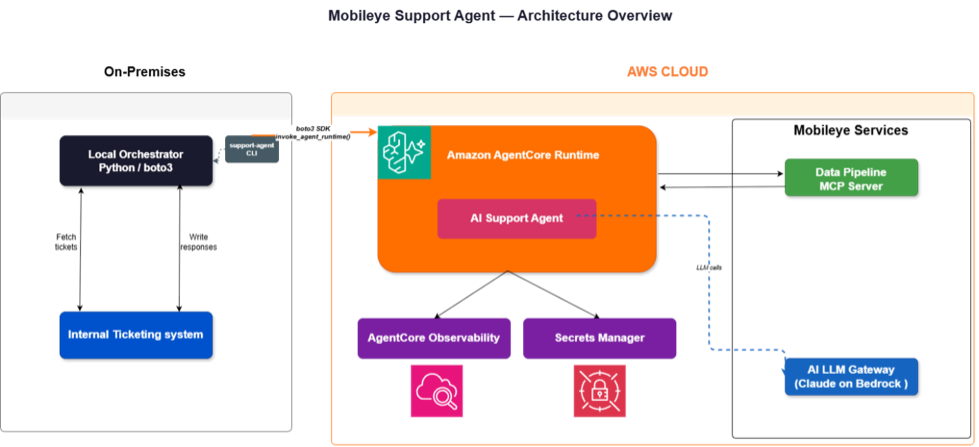
オンプレミス側のコンポーネント
以下の表は、ローカルのチケット処理を担当し、クラウド上の AI 処理と連携するオンプレミス環境の各コンポーネントを説明しています。
| コンポーネント | 役割 |
|---|---|
| ローカルオーケストレーター | チケット処理業務をローカルで実行し、新規チケットの抽出と完了した回答をチケットシステムへの投稿を行います。 |
| 社内チケット管理システム | オンプレミスのチケット管理システムは、サポートチケットの発生源かつ AI 生成回答の宛先として機能します。AWS からアクセスできないことが、ハイブリッド設計を主導した主な要因です。 |
AWS クラウドコンポーネント
以下の表は、AI エージェントにサーバーレスコンピューティング、セキュリティ、観測インフラを提供する AWS のクラウドコンポーネントを説明しています。
| コンポーネント | 役割 |
|---|---|
| AgentCore Runtime | Mobileye は、AI サポートエージェントを AgentCore のサーバーレスランタイム上で実行し、インフラストラクチャの管理を不要にしています。チームはサーバーのプロビジョニングなしでデプロイと反復開発を行い、サポート量の急増に対応するための自動スケーリングの恩恵を受けながら、任意のアジェンティックフレームワークを使用する完全な柔軟性を維持できます。エージェントの呼び出しは単一の API コールで行われるため、既存システムとの統合が容易です。 |
| AgentCore Observability | Mobileye のエンジニアリングチームは、組み込みの観測機能を使用して、エージェントとのやり取りを最初のリクエストから MCP ツール呼び出しを経てバックエンドシステムへ、そして最終的なレスポンスに至るまでエンドツーエンドで追跡しています。詳細なログとトレースバックにより、エージェントがどのように推論し、どのようなデータを取得したか、エラーが発生した場所が明確に把握できるため、デバッグ時間の大幅な短縮と反復開発サイクルの加速を実現します。 |
| AWS Secrets Manager | Mobileye は、GenAI プラットフォームのための非対面かつ安全な認証を可能にするために Secrets Manager を使用しています。AI エージェントを呼び出すチームは、直接認証情報を扱う必要がなく、エージェントやバックエンドシステムとのやり取りに必要なシークレットはプログラムによって保存、ローテーション、取得されるため、エンドユーザーに摩擦を加えることなく企業セキュリティ基準が維持されます。 |
Mobileye のサービス
以下の表は、エージェントがデータ接続と管理されたモデルアクセスを実現するために利用する、Mobileye 独自のサービスについて説明しています。
| コンポーネント | 役割 |
|---|---|
| データパイプラインモデルコンテキストプロトコル (MCP) | データパイプライン MCP サーバーは、推論中に運転セッションのウォーミングステータス、リクエストの進捗状況、処理エラーなどのライブ生産データをリアルタイムで照会可能にし、エージェントがその場で文脈に即した回答を提供できるようにします。 |
| AI LLM ゲートウェイ | Amazon Bedrock およびその他の LLM プロバイダー上の基盤モデルに対する、Mobileye による管理されたクォータ管理アクセス |
仕組みの全体像
自動化されたワークフローは、簡素化された4つのステップで構成されています。
- ローカルオーケストレーターが新しいチケットを抽出し、AgentCore Runtime上で動作するAIサポートエージェントへ転送します。
- AIサポートエージェントは各チケットをエンドツーエンドで処理します。問い合わせの分類を行い、MCP Serverを通じてライブ生産システムにクエリを実行してリアルタイムのセッションデータを取得し、AI LLM Gatewayを経由してClaudeにアクセスすることで、リンクや推奨事項、実行可能な次のステップを含む完全なフォーマットのレスポンスを生成します。
- ローカルオーケストレーターは完成したレスポンスを受け取り、適切なコメントとラベルを付与して内部チケットシステムへ投稿します。
- AgentCore Observabilityがエージェントのアクティビティ(セッションメトリクス、レイテンシ、トークン使用量、トレースなど)をキャプチャし、継続的な監視とデバッグを可能にします。
数字で示す成果
MobileyeがAgentCore上で導入したAIサポートエージェントは、当初の設定目標を常に達成または上回る結果をもたらしました。
- 全体の成功率:98%(当初の目標である95%を上回る)
- レスポンス時間:数時間から約1分へ短縮(90%の改善)
- 自動化されたサポート件数:全チケット数の66%
- 月間処理量:100件以上のチケットを処理
戦略的なメリット
サポートエンジニアは複雑な業務に集中できるようになり、チームがインフラをゼロから構築する必要もありませんでした。AgentCoreには標準で必要な機能が備わっているためです。
「Amazon Bedrock AgentCore を活用することで、セキュリティと企業が必要とする運用基準を維持しつつ、明確なビジネス価値を提供する本番環境対応の AI エージェントを構築できました。AI サポートエージェントはサポート業務を変革し、エンジニアが従来ルーティンのチケット検索に費やしていた数百時間を節約し、彼らの得意分野に集中できる環境を作りました。」
— Shay Margalit、Mobileye 主任エンジニア
ビジョンの拡大:単一エージェントから企業向けプラットフォームへ
AI サポートエージェントが生産環境で成果を上げている中、Mobileye は新たな課題に直面しました。組織内の多くの開発者が、AgentCore でエージェントを独立してデプロイするための AWS 資格情報やインフラアクセスを持っていないのです。この課題に対処するため、Mobileye のクラウドインフラチームは内部向けエージェントデプロイプラットフォームを構築しました。
この内部マネージドサービスにより、Mobileye の開発者は AWS の専門知識やクラウド資格情報を必要とせず、本番環境対応の AI エージェントをデプロイできます。そのプロセスは以下の手順に従います:
- チームがエージェントコードを提供する
- チームが必要とする AgentCore の機能(Memory、Browser Tool、Code Interpreter、Observability、Gateway)を指定する
- クラウドインフラチームがすべてのインフラをプロビジョニングします。具体的には AWS IAM ロール、Amazon S3 ストレージ、Amazon CloudWatch モニタリング、および Amazon Cognito 認証です
- 開発者はプロジェクトに直接統合される事前設定済みの
bedrock_agentcore.yamlファイルを受け取る - デプロイは単一コマンド
agentcore deployで完了します
構築されたインフラは、Mobileye が定めるセキュリティ、コストガバナンス、運用の卓越性という基準に完全に準拠しています。コード例外に関する CloudWatch Alarms の設定により、問題が発生した際に即座に検知・確認することが可能です。
単一の概念実証(PoC)から始まったこの取り組みは、今や企業全体で活用されるプラットフォームへと進化しました。チームは数週間を要する従来のプロセスではなく、わずか数分で安全かつ監視可能、コスト管理が可能なエージェントをデプロイできるようになりました。
手作業による業務からインテリジェントな自動化への移行は、想像以上に短期間で実現可能です。Mobileye の事例が示す通り、その成果は極めて顕著なものとなります。
執筆者について

Shay Margalit
Shay Margalit は Mobileye のシニアエンジニアであり、同社のデータインフラ向けに AI を活用したソリューションの開発を率いています。

Max Rabin
Max Rabin は Mobileye のクラウド運用部門でシニアエンジニアを務め、大規模な本番環境のアーキテクチャ設計と運用を担当しています。

Adi Jabkowsky
Adi Jabkowsky は Amazon Web Services のシニア AI スペシャリストとして、顧客がインパクトの大きい生成 AI のユースケースを特定し、実装するのを支援しています。

Adir Gozlan
Adir Gozlan は、Amazon Web Services のシニア AI/ML スペシャリスト技術アカウントマネージャーです。企業規模での AI ワークロードの実運用化を支援しています。

Liat Tzur
Liat Tzur は、Amazon Web Services のシニア技術アカウントマネージャーであり、クラウドと AI への移行を加速させるための企業顧客とのパートナーシップを通じて、AI エンタスチアストとして活動しています。
原文を表示
What if deploying production-grade AI agents required zero infrastructure management, came with enterprise observability built-in, and worked easily with your existing on-premises systems?
Mobileye, the autonomous driving pioneer with more than 230 million EyeQ system-on-chips deployed across roughly 1,200 vehicle models worldwide, saw an opportunity to free skilled engineers from routine internal ticket status inquiries.
Mobileye’s Data Collection Processing pipeline ingests thousands of drive-recording sessions daily, generating a constant stream of status inquiries from engineers and data teams. Each inquiry previously required manual steps across multiple systems – identifying sessions, cross-referencing visualization tools, validating outputs, and reviewing logs – before composing a response. Using Amazon Bedrock AgentCore, Mobileye deployed an AI Support Agent that cut response times by 90% and exceeded 95% accuracy targets, with zero infrastructure overhead. The results were so compelling that Mobileye transformed AgentCore into a self-service platform for teams across the company to deploy their own AI agents.
In this post, we’ll explore how Mobileye deployed an AI support agentic solution on Amazon Bedrock AgentCore – from the support bottleneck that sparked the idea, through the proof of concept that validated it, to the hybrid architecture that bridges on-premises systems with AWS cloud services. This approach is relevant for enterprises struggling to scale AI Agents while maintaining enterprise grade governance and security standards.
From manual bottleneck to AI-powered support
As Mobileye’s Data Collection pipeline scaled, 66% of support tickets became routine status inquiries requiring engineers to manually navigate 15 clicks across multiple backend systems. This time-consuming process diverted skilled engineers from complex issues while internal users faced longer wait times.
Traditional automation approaches – scripting, static workflows, and rule-based decision trees – proved inadequate. While these could handle predictable queries, they lacked the contextual understanding needed to interpret the variability of real-world support requests. The team chose to build an AI agent capable of understanding context and adapting to diverse inquiry patterns.
Validating the approach: Proof of concept
Before full production rollout, Mobileye’s team conducted a proof of concept targeting 95% accuracy in ticket classification with sub-2-minute response times.
The agent uses Anthropic Claude foundation models, accessed through Mobileye’s internal LLM Gateway that provides governed, quota-managed access to foundation models on Amazon Bedrock. The critical enabler was the Model Context Protocol (MCP), which gave the agent real-time access to the drive-data processing platform’s APIs -allowing it to query session status, retrieve processing logs, and pull diagnostic information during inference.
This meant the agent went far beyond simple ticket classification, becoming an intelligent investigator capable of handling inquiries that were previously resolved through time-consuming manual effort. When users inquired about drive-recording sessions, the agent could determine current state and respond with answers: confirming completed sessions with access details, surfacing specific errors with debugging recommendations and log links for failures, or guiding users through submission processes for missing requests – all in under two minutes with no human intervention.
Evaluating the options
After successfully proving the concept with their AI agent, Mobileye needed to take it to production. This transition required a solution that could meet enterprise-grade requirements while maintaining the flexibility they had demonstrated in their proof of concept. After careful evaluation, they chose to deploy their AI Agent on Amazon Bedrock AgentCore, a fully managed platform to build, connect and optimize AI agents at scale with any framework or model. The decision came down to five key factors:
- Serverless infrastructure ready for enterprise workloads
- Accelerated time-to-resolution for support inquiries
- Comprehensive built-in observability
- Support for multiple agentic frameworks
- Hybrid architecture support that could integrate easily with their existing on-premises ticketing system
This last point was particularly important. Mobileye’s internal ticketing system operated on-premises and was inaccessible from AWS, so any solution would need to bridge that divide without compromising security or compliance.
The production architecture: Bridging two worlds
Following the successful proof of concept, Mobileye moved to production with a sophisticated hybrid architecture featuring clearly defined component roles across two environments.
On-premises components
The following table describes the on-premises components that handle local ticketing operations and bridge to cloud-based AI processing.
| Component | Role |
|---|---|
| Local Orchestrator | Handles ticketing operations locally, extracting new tickets and posting completed responses back into the ticketing system. |
| Internal ticketing system | The on-premises ticket management system serves as both the source of support tickets and the destination for AI-generated responses. Its inaccessibility from AWS was the primary driver behind the hybrid design. |
AWS cloud components
The following table describes the AWS cloud components that provide serverless compute, security, and observability infrastructure for the AI agent.
| Component | Role |
|---|---|
| AgentCore Runtime | Mobileye runs their AI Support Agent on AgentCore’s serverless runtime, eliminating all infrastructure management. The team deploys and iterates without provisioning servers, benefits from automatic scaling to handle spikes in support volume and maintains full flexibility to use any agentic framework. A single API call invokes the agent – keeping integration with their existing systems straightforward. |
| AgentCore Observability | Mobileye’s engineering team uses built-in observability to trace every agent interaction end-to-end — from the initial request, through MCP tool calls to backend systems, to the final response. Detailed logs and tracebacks surface exactly how the agent reasoned, what data it retrieved, and where errors occur, dramatically reducing debugging time and accelerating iteration cycles. |
| AWS Secrets Manager | Mobileye uses Secrets Manager to enable faceless, secure authentication for their GenAI platform. Teams invoking AI agents never handle credentials directly – secrets required to interact with agents and backend systems are stored, rotated, and retrieved programmatically, enforcing enterprise security standards without adding friction for end users. |
Mobileye service
The following table describes Mobileye’s own services that provide data connectivity and governed model access for the agent.
| Component | Role |
|---|---|
| Data Pipeline Model Context Protocol (MCP) | The Data Pipeline MCP server enables real-time querying of live production data during inference including driving session warming statuses, request progress, and processing errors – allowing the agent to deliver context-aware responses on the fly. |
| AI LLM Gateway | Mobileye’s governed, quota-managed access to foundation models on Amazon Bedrock and other LLM providers |
How it all works together
The automated workflow follows a streamlined four-step process:
- The Local Orchestrator extracts new tickets and sends them to the AI Support Agent running on AgentCore Runtime.
- The AI Support Agent processes each ticket end-to-end – categorizing the inquiry, querying live production systems via the MCP Server for real-time session data, and accessing Claude through the AI LLM Gateway – to generate a fully formatted response with links, recommendations, and actionable next steps.
- The Local Orchestrator receives the completed response and posts it back to the Internal Ticketing System with appropriate comments and labels.
- AgentCore Observability captures agent activity – session metrics, latency, token usage, and traces – for continuous monitoring and debugging
Measurable results that speak for themselves
The production deployment of Mobileye’s AI Support Agent on AgentCore delivered results that consistently met or surpassed initial targets.
- Overall success rate: 98% (surpassing the original 95% target)
- Response time: Reduced from hours to ~1 minute (90% improvement)
- Support volume automated: 66% of total ticket volume
- Monthly throughput: 100+ tickets processed
Strategic benefits
Support engineers are freed to focus on complex work – and the team didn’t have to build the infrastructure themselves, because AgentCore provides it out of the box.
“Amazon Bedrock AgentCore enabled us to build a production-grade AI agent that delivers measurable business value while maintaining the security and operational standards our enterprise requires. The AI Support Agent has transformed our support operations, saving our engineers hundreds of hours previously spent on routine ticket lookups, and freed them to focus on what they do best.” — Shay Margalit, Principal Engineer, Mobileye
Scaling the vision: From single agent to enterprise platform
With the AI Support Agent delivering results in production, Mobileye faced a new challenge: most developers across the organization lacked the AWS credentials or infrastructure access to deploy agents on AgentCore independently. To address this, the Mobileye Cloud Infra team built an internal agent deployment platform.
This internal managed service enables Mobileye developers to deploy production-grade AI agents without AWS expertise or cloud credentials. The process follows these steps:
- Teams provide their agent code
- Teams specify needed AgentCore capabilities – Memory, Browser Tool, Code Interpreter, Observability, Gateway.
- The Cloud Infra team provisions all infrastructure: AWS IAM Roles, Amazon S3 storage, Amazon CloudWatch monitoring, and Amazon Cognito authentication.
- Developers receive a pre-configured bedrock_agentcore.yaml file that integrates directly into their project.
- Deployment is a single command: agentcore deploy.
The provisioned infrastructure aligns with Mobileye’s standards for security, cost governance, and operational excellence. CloudWatch Alarms on code exceptions help verify issues surface immediately.
What began as a single proof-of-concept has evolved into an enterprise-wide platform where teams can deploy secure, monitored, cost-tracked agents in minutes rather than weeks.
The path from manual processes to intelligent automation is shorter than you think, and the results, as Mobileye has shown, can be extraordinary.
About the authors
Shay Margalit
Shay Margalit is a Principal Engineer at Mobileye, where he leads the development of AI-powered solutions for the company’s data infrastructure.
Max Rabin
Max Rabin is a Principal Engineer in Cloud Ops at Mobileye, responsible for architecting and operating production cloud environments at scale.
Adi Jabkowsky
Adi Jabkowsky is a Senior AI Specialist at Amazon Web Services, helping customers identify and implement high-impact generative AI use cases.
Adir Gozlan
Adir Gozlan is a Senior AI/ML Specialist Technical Account Manager at Amazon Web Services, focused on helping customers operationalize AI workloads at enterprise scale.
Liat Tzur
Liat Tzur is a Principal Technical Account Manager at Amazon Web Services and an AI enthusiast who partners with enterprise customers to accelerate their cloud and AI journeys.
今日のまとめ
AIデイリーブリーフで今日の重要ニュースをまとめ読み