火山に焼かれた数百のローマ文字巻物――AIはテキストを復元できるか?
本文の状態
日本語全文を表示中
詳細モードで約20分の本文を読めます。
同じ出来事の情報源
この情報源を基点に整理
Understanding AI
21歳の学生、ルーケ・ファリトールはスペースXでのインターン期間中、約2000年前の炭化した古代巻物の解読機械学習モデルを訓練した。この取り組みは、79年のヴェスヴィオ火山噴火で埋もれた古代文書の復元において重要な進展を示している。
Source Article
元記事を日本語で読む
本文に関係しない購読案内、埋め込み通知、サイト内プロモーションは除いています。
2023 年の夏、21 歳の大学生だったルーク・ファリトールはスペース X でインターンをしていた。彼は夜になると、約 2,000 年前の焦げた巻物を解読するために機械学習モデルを訓練するという、予想以上に重要なプロジェクトに取り組んでいた。
この巻物は、紀元前 79 年にヴェスヴィオ山の噴火によって埋没した約 800 点の一つである。これらの巻物は 1700 年代に近隣のヘルクラネウムで再発見されたが、考古学者らがそれらを解こうとした際、最初の数点は崩壊してしまった。炭素を主成分とするインクと焦げたパピルスの区別がつかないため、従来のイメージング技術では効果がないことが証明されている。
ヴェスヴィオ・チャレンジは 2023 年 3 月、テック起業家のナット・フリードマンとダニエル・グロス、そしてコンピュータサイエンティストのブレント・シーレスによって立ち上げられた。シーレスは非侵襲的なスキャンからのデータを用いて、未損傷の巻物を「仮想的に解く」技術の開発に取り組んでいた。
フリードマンとグロスは、これらの技術を改善する人々を支援するために賞金として 100 万ドルを集めることに成功した。この賞金は 1,000 チーム以上を引き寄せ、ファリトールもその一つに参加していた。
もう一人の参加者であるケイシー・ハンドマーは、パピルスの表面に残されたインクの残留物によって生じた、かすかだが特徴的な「ひび割れパターン」に気づいていた。ファリトールはこの洞察を受け入れ、さらに発展させた。
ファリトールは、ディスコードでケイシーのひび割れパターンについて議論されているのを「見て」、そのひび割れパターンを機械学習モデルに訓練させるために夜や深夜を過ごすようになった」と、ファリトールの画期的成果に関する公式発表には記されています。「発見される新しいひび割れごとに、モデルは改善し、巻物からより多くのひび割れが明らかになる——これは発見と洗練のサイクルです。」
ある8月の夜、彼のソフトウェアは人間の目には見えないインクの痕跡を明らかにし始めました。これを強化すると、一つの単語として解像されました:ΠΟΡΦΥΡΑϹ(ポルフィラス)。紫。
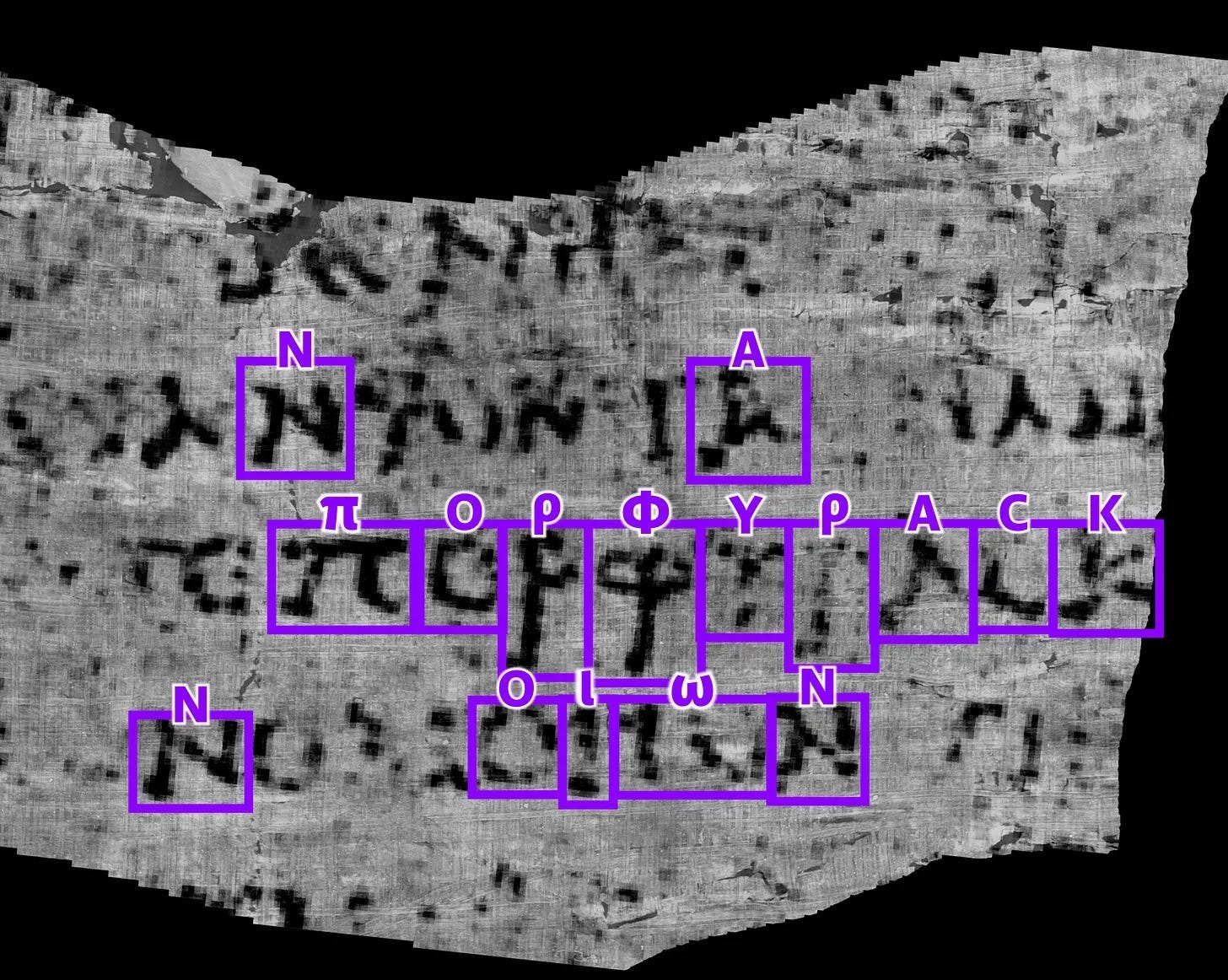
「ΠΟΡΦΥΡΑϹ」——ギリシャ語で「紫」。 (写真提供:ヴェスビウス・チャレンジ)
これは、ヘルクラネウム(Herculaneum)の巻物から非侵襲的にテキストが復元された初めての事例でした。ファリトールはその後、2024年に他の二人の研究者と共に70万ドルのグランドプライズの一部を共同受賞しました。
これらの巻物には、キリスト教の教義と矛盾するためほとんど再写されなかったエピクロス派(Epicurean)の哲学書など、他ではほぼ失われてしまったギリシャ語散文が含まれていると考えられています。
「中世に保存されたギリシャ語散文の著者はごくわずかしか残っていません」と、数十年にわたりこれらの巻物を研究してきたケルン大学の古典学者ユルゲン・ハマーシュタエド(Jürgen Hammerstaedt)は述べています。
トラキア・デモクリトス大学の助教であるマリア・コンスタンティニドゥは、その興奮を共有します。「誰も時間や処理能力を持って理解したり知ったりできない作品があまりにも多くあります」と、コンスタンティニドゥは私に語りました。
しかし、パピロロジー学者にとって有用なテキストを生み出すためには、これらの初期のブレークスルーを実用的でコスト効果の高いスロール解読パイプラインへと転換する誰かが必要です。現在、解読を待つ完全な状態のスロールは約 300 本ありますが、専門家の話によると、現在の技術を用いればこれには数年かかる可能性があります。
購読する now
スロールを解読するために必要なもの
2024 年 2 月、ユセフ・ナデル、ルーク・ファリトル、ジュリアン・シッリーガーのチームは、密封されたスロールから 15 カラム(全 2,000 文字以上)を復元したことで、このチャレンジの 70 万ドルのグランドプライズを受賞しました。
彼らのパイプラインは、仮想巻き戻し、インク検出、そして専門家の解釈を組み合わせて密封されたスロールから読み可能なテキストを回復させた点で印象的な技術的達成でしたが、完全に自動化されたわけではありませんでした。
このプロセスは、オックスフォード近郊のダイヤモンド・ライトソース粒子加速器のような施設で始まります。ヴェスヴィウス・チャレンジが発表された際、研究者たちはすでに X 線コンピュータ断層撮影(CT)を用いた高解像度スキャンを完了していました。これにより、スロールごとに数テラバイトの三次元データが生成されました。
次のステップはセグメンテーションです。これは、三次元 CT スキャン内のパピルスの個々の層を特定し分離する工程です。もしこれらの巻物が展開された場合、長さ 12 メートル以上になるものも存在します。2,000 年にわたる圧縮により、表面は歪み、破れ、互いに押し付けられています。
ファリトールと共にグランプリを受賞したジュリアン・シッリーガーが、スキャンされた巻物を仮想的に展開するために使用されるセグメンテーションソフトウェアを作成しました。このシステムは機械学習モデルと従来の幾何学処理技術(geometry-processing techniques)を組み合わせています。「非常に軟らかくねじれた巻物領域」にも対応可能であり、これまで読まれたことのない部分、例えば巻物の最外層の巻き込み部分などにおいてもインクの検出を可能にしました。しかし、自己交差や表面の断裂、誤って識別された層といったエラーを修正するためには、依然として広範な人間の監視が必要です。
それから 2 年後でも、ワークフローは部分的にしか自動化されていません。機械学習は可能性の高い表面と幾何形状を提案する役割を果たしますが、それらの表面を精査し、読み取りに使用可能なものとするためには人間が介入する必要があります。これは決して安価な作業ではありません。最新のアルゴリズムの支援があったとしても、労働および処理時間において 1 平方センチメートルあたり約 100 ドルのコストがかかります。このペースで計算すると、300 巻すべての巻物を仮想的に展開するには、数億ドル、あるいは数十億ドルもの費用がかかることになります。
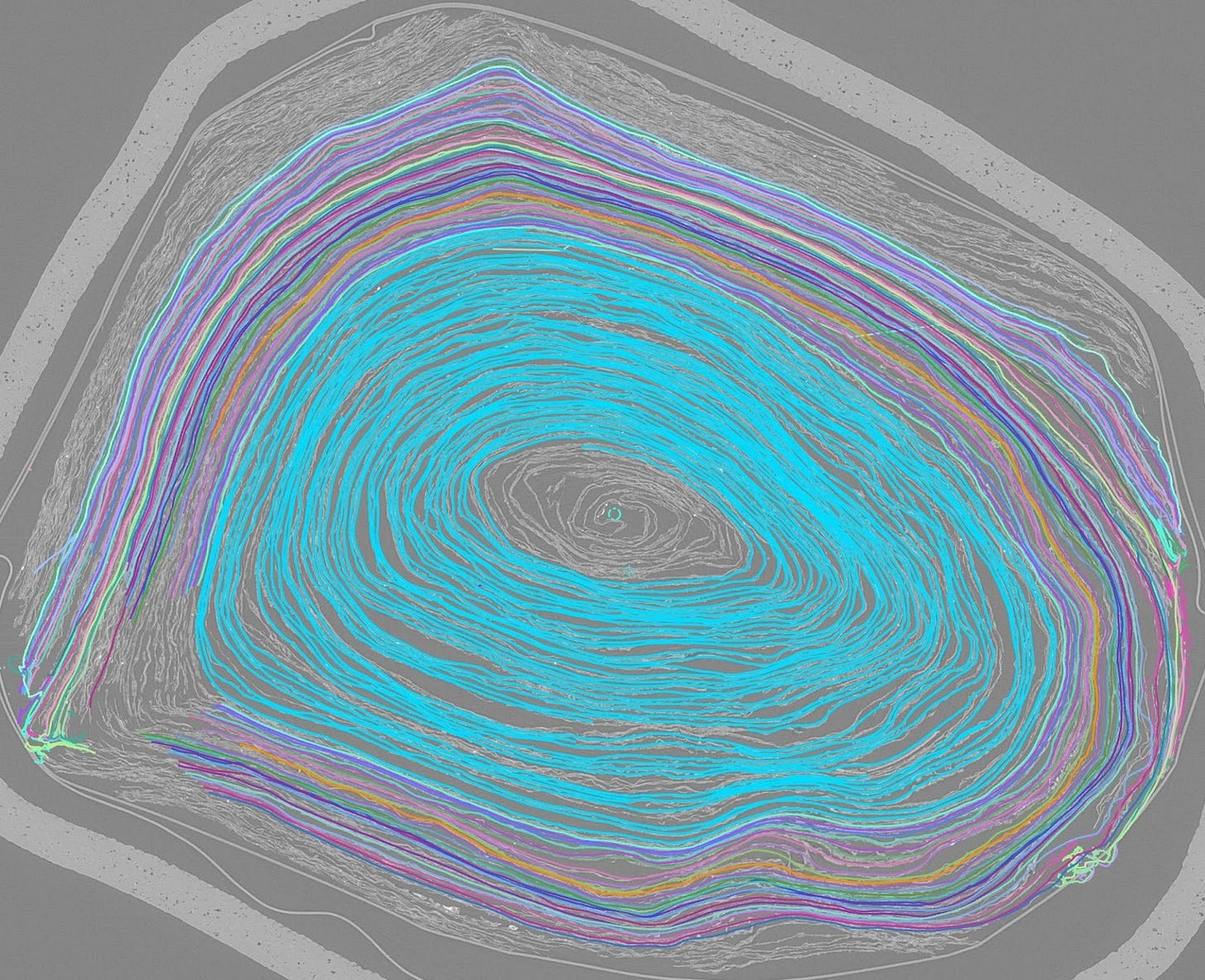
セグメンテーションソフトウェアは、炭化した巻物内の個々のパピルスシートを 3D スキャン上で追跡しています。(写真提供:ヴェスビウス・チャレンジ)
ヴェスビウス・チャレンジに参加したコンピュータビジョンの専門家であるヘンドリック・シリング氏によると、完全な自動展開プロセスの実現は依然として困難であり、その理由の一つは学習データの不足にあります。ほとんどの巻物については、「未展開時の外観を示す参照データがない CT スキャンしか存在しない」ため、アルゴリズムが学習するための確実な基準(グランドトゥルース)がほとんど得られません。より多くの学習データを生成するには、多額の費用がかかる人的労力が必要です。
セグメンテーションは、各パピルスシートのねじれや曲がり traced した三次元メッシュを生成します。このメッシュはその後、コンピュータビジョンモデルが必要とする二次元フォーマットに平坦化されなければなりません。このプロセスにおいて歪みを最小限に抑えることが重要であり、なぜならわずかな誤差でも薄いインクの信号を破壊してしまう可能性があるからです。システムは、インクが痕跡として存在する可能性のある場所を捉えるために、セグメント表面の上下 32 レイヤー(合計 65 レイヤー)をキャプチャします。
次のステップは、(仮想的に)展開されたパピルスの表面にインクが存在するかどうかを検出することです。優勝チームはこのために深層学習を活用しました。具体的には、もともと動画の理解を目的として Facebook によって開発されたモデルを応用しました。彼らは展開されたパピルスを動画シーケンスとみなし、異なる深さにおける空間的なスライスを動画フレームに相当するものとして扱いました。冗長性を高めるため、このモデルを他の 2 つのモデルと組み合わせ、複数のアーキテクチャが類似した結果を生み出すことで相互検証を行いました。
インクの痕跡はまず微小な領域で検出され、その後より大きな形状へと集約されました。ハルシネーション(幻覚的生成)のリスクを最小限に抑えるため、モデルはギリシャ文字の形状に関する既存の知識には依存しませんでした。
インク検出モデルの訓練データは 2 つのソースから得られました。第一に、過去の展開試行からの断片が赤外線写真によって表面のインクを明らかにすることで、正解データ(ground truth)を提供しました。第二のソースは、Casey Handmer と Luke Farritor によって発見された「ひび割れ」パターンです。Youssef Nader が両方のデータソースを用いて単一のモデルを訓練する方法を見出したことが突破口となりました。彼はまずラベル付けされていないひび割れデータでモデルを事前学習し、その後、人間がラベル付けした赤外線画像で微調整を行いました。
パイプラインの末端では、学術研究が引き継ぎました。インク検出モデルは、各ピクセルにおけるインクの存在確率を示すノイズの多い確率マップを出力しました。これらはパピロロジーチームに送られ、筆跡の形状、文字の形式、間隔、そして文献学的文脈が評価されました。最終的に、何がテキストとみなされるか、どのように読むべきか、そしてその意味は何であるかを決定するのは人間の専門家です。
今すぐ購読する
チャレンジのアーキテクチャ
ヴェスヴィオ・チャレンジは、競争と協力の融合、クラウドソーシングと機関支援の組み合わせ、賞金インセンティブとオープンソース要件という、非常に珍しい構造を持っています。2023 年 3 月の発表により、世界中から興味を持つ参加者が集まりました。中には関連分野における深い専門知識を持つ者もいれば、完全なアマチュアもいました。
ショーン・ジョンソンは、ウィスコンシン州矯正局で勤務中に、Bing のランディングページに掲載されたヴェスヴィオ・チャレンジに関する記事を目にしました。彼には学位やプログラミングの背景はありませんでしたが、協力したいと考えていました。
「私はコーディングやこのプロジェクトの超技術的な側面については得意ではありませんが、バイバンズの処方箋があり、多くの空き時間を持っています」とジョンソンは 2023 年 10 月、ヴェスヴィオ・チャレンジの Discord で書き込みました。「ここで、単に時間のかかる手作業によって制約されているタスクはありませんか?」
「私はこれまで Python プログラムを一度も書いたことがなく、機械学習の経験もありませんでした」とジョンソンは私に語りました。彼はオンラインコースで独学し、「ほとんどは ChatGPT と格闘するだけ」だったそうです。進捗にはムラがありました。「何度も何度も頭をぶつけているようなものです」と彼は言いました。
しかし、パイプラインが最初から最後まで機能したとき、その成果は不釣り合いに感じられました。それは「インディアナ・ジョーンズのようなもの」だと彼は言います。「バンッ。単語が見えてきます。歴史の彼方から、あるいは無から単語を切り取ったようなものです」。
コンピュータビジョンの専門家であるシリングは、技術的な挑戦を楽しんでいるために参加しました。「私は何か意味のあることを成し遂げるために働きたいのですが、私は考古学のオタクではありません」と彼は私に語りました。
ジョンソンによると、ヴェスヴィオ・チャレンジは Kaggle のような他の競争型機械学習プラットフォームとは異なる構造を持っています。Kaggle などは通常、短く明確なタスクに対して報酬を与える傾向があります。ヘラクレウムの巻物を解読することは「本当に小さな別個のパッケージにまとめることはできません」とジョンソンは言います。完全なパイプラインには「100 のステップがあり、それぞれが独自のサブフィールドとなっています」。
技術用語: 機械学習 (machine learning)、コンピュータビジョン (computer vision)、パイプライン (pipeline)、Kaggle (Kaggle)、ヴェスヴィオ・チャレンジ (Vesuvius Challenge)、ヘラクレウムの巻物 (Herculaneum scrolls)
もし競争が単一の最優秀賞に限定されていたなら、それは画期的な成果の独占を促し、どのチームも必要な要素をすべて集める確率を低下させることになっていたでしょう。そこで主催者は、「進捗賞」も設けました。これは通常数ヶ月ごとに 1,000 ドルから 10,000 ドルの範囲で授与されます。賞を獲得するには、貢献者がコードや研究成果をオープンソースとして公開する必要があり、これによりコミュニティ全体がレベルアップしました。進捗賞は受賞者が設備や時間に再投資することを可能にし、また最優秀賞受賞者たちとのように、人々が協力者を見つける手助けもしました。
2023 年の初夏、主催者は中核的なボトルネックに対処するため、社内セグメンテーションチームを雇用しました。それはインクを検出する前に、誰かがパピルスの層を特定し追跡しなければならないという課題です。インク検出の機能がない状態で巻物を正しく展開できたかどうかを非専門家が判断するのは難しく、鶏と卵のような問題が生じていました。数ヶ月にわたる地道な手作業の結果、チームは約 4,000 平方センチメートルの高品質な平坦化表面セグメント(segmentation)を生産し、参加者たちに共有参照資料を提供しました。これにより進捗が大幅に加速されました。
その決断は極めて重要でした。それにより、ケイシー・ハンドマー氏が「クラックルパターン」を発見し、完全な巻物内部のインクを直接視覚的に確認できる最初の証拠が得られました。社内セグメンテーションチームはコミュニティ参加者と緊密に連携し、より優れたセグメンテーションソフトウェアの開発に取り組んでいます。シリング氏は組織について、「スタートアップのように少し機能しています。多くの人々が異なる役割を担い、役割を交代したりするなど、非常に柔軟な体制です」と語りました。
このチャレンジはまた、機関パートナーにも依存しています。パピロロジー(古代文書研究)の作業には、ナポリ・フェデリーコ二世大学やピサ大学など、他の諸機関からの学者が関わっています。スキャン作業は巻物を所蔵するフランス学士院と調整して行われています。より広範なネットワークには、数百点の巻物を収蔵しているナポリ国立図書館も含まれており、イタリア当局との継続的な調整が必要です。
自動化への技術的障壁
大賞を受賞したチームが開発したパイプラインは1本の巻物に対して有効であることが証明されましたが、他の巻物への適用可能性については不確実なままでした。そこでヴェスヴィオ・チャレンジの組織者は、これを巻物を次々と処理できるものへと再構築することを目指しました。しかし、すぐに別の大賞を発表するのではなく、セグメンテーション(領域分割)、表面抽出、タイトル識別などのタスク別にカテゴリ別賞を導入しました。
2025 年 5 月、中間賞の一つである 6 万ドルの「初回タイトル賞」が、まだ封印されたヘルクラネウム遺跡の巻物に記されていると見られるタイトルが復元された際に授与されました。そのタイトルは、エピクロス派哲学者フィロデモスによる『悪徳について』です。
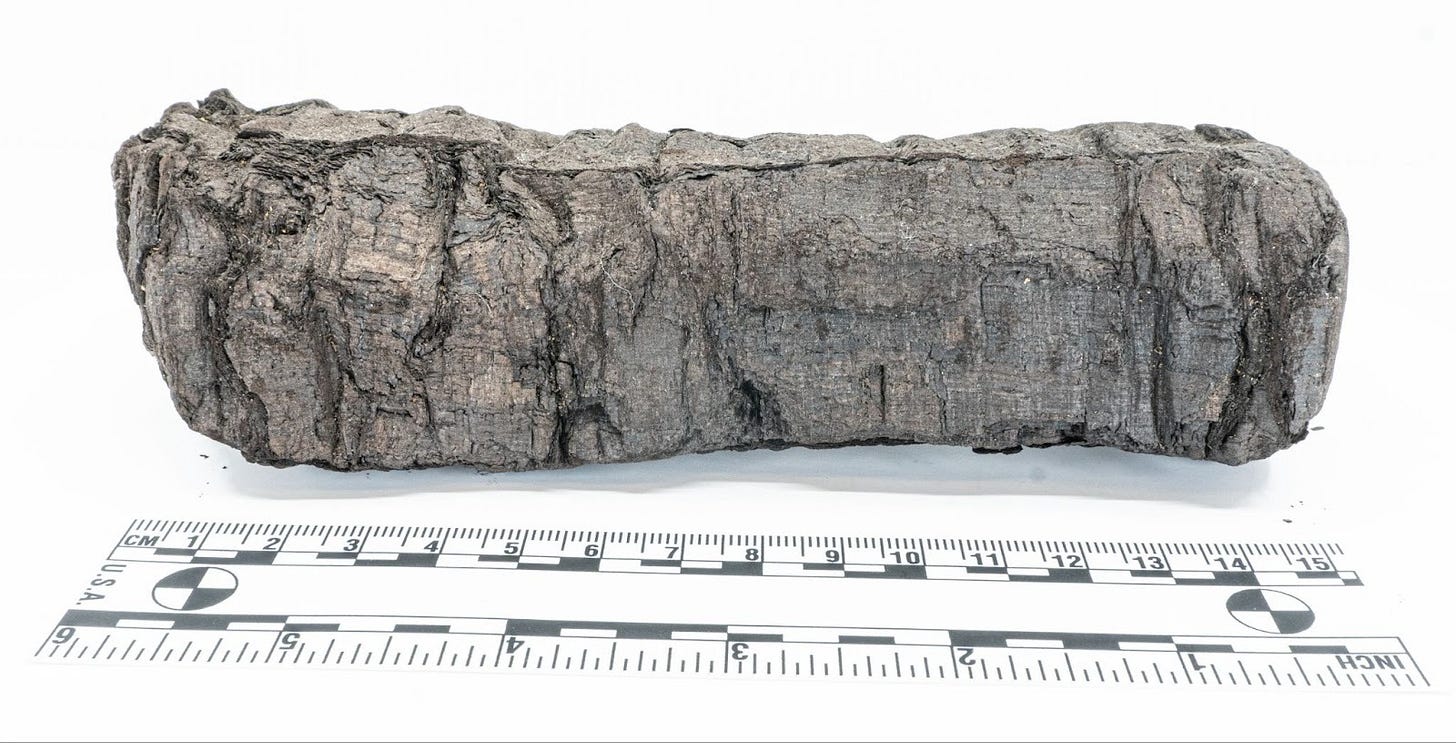
非侵襲的なスキャンデータを用いて、参加者たちはこの巻物のタイトル(ギリシア語で)が『悪徳について』であると特定しました。(写真提供:ヴェスヴィウス・チャレンジ)
その巻物のセグメンテーション(画像の領域分割)を担当したジョンソンは、最初のレンダリング結果はほとんど判読不能だったと振り返ります。さらに精査した後、彼はパピロロジー学者のフェデリカ・ニコラールに一枚の画像を見せましたが、彼女は即座に読み取りました。「驚愕しました」とジョンソンは述べています。その後、他の 2 つのチームもより明瞭な結果を導き出し、正式にこの賞を受賞しました。
しかし、重要な注意点が存在します。「その巻物の部分は主に手作業で展開されました」とジョンソンは私に語りました。2025 年の初回タイトル賞で使用された手法は、2023 年に用いられた手法と根本的に異なるものではなく、特に有望な巻物の領域に対して慎重に適用された、同じ半自動技術の延長線上にあるものです。
したがって、中心的な問いは「文字を回復できるか否か」から、「それを日常的に実現できるか否か」へと移り変わりました。現在のペースでは、ヘルクラネウム図書館全体を処理するには数年を要します。2025 年 7 月に発表された「ヴェスヴィオ・チャレンジ・マスタープラン(Vesuvius Challenge Master Plan)」は、この期間を短縮するための一連のステップを概説しています。これには、表面抽出技術の向上、自動化の深化、および各工程における人的介入を減らすためのツールの開発が含まれます。
シリング氏によれば、問題点は現在の手法が完全に失敗していることではなく、過度な人間の監督を必要としている点にあります。
「現状では、速さや効果、コスト面で期待される水準には達していません」と彼は私に語りました。「現在、機能する解決策は存在しますが、それらは人的入力に依存しています」。研究者たちが目指すのは、「グローバル最適解(global optimal solution)」です。これは、パピルスの表面を特定し、それを展開し、絶え間ない修正なしに多数の巻物全体でインクを検出できるシステムを指します。
スキャン自体が制約となっています。高解像度でのスキャンは費用がかかり、入手が困難であり、スケジュール調整にも時間がかかります。さらに、スキャン品質のばらつきは、その後のすべての工程にノイズをもたらします。そのため、研究者たちはスキャンプロトコルの改善、アーティファクト(画像ノイズや歪み)の低減、そしてコレクション全体で不均一または低品質なデータにも耐性を持つ手法の開発に取り組んできました。
その転換を支援するために、このチャレンジはもともとクラウドソーシングモデルに限定されていた枠を超えて拡大しました。博物館、政府、スキャン施設との調整が中心となり、フルタイムのスタッフ、機関間のパートナーシップ、そして長期的な資金調達が並行して進められています。明確な終点はなく、未読資料のアーカイブは増え続ける一方で、スケールする方法をまだ学習中のパイプラインが存在します。
購読する
進捗、忍耐、そして予測
巻物が完全に読み解ける時期に関する予測は大きく異なります。
「来年までにはこれを解決できると感じています」とジョンソン氏は私に語りました。しかし直ちに自身の発言を補足しました。「私は絶望的な楽観主義者です。過去 2 年間のどの時点でも、来週には解決できるとお答えしたでしょう。」
このプロジェクトはジョンズ氏にとって感情的なジェットコースターのようなものでした。「絶望に陥る部分もあります」と彼は言いました。「自分がいったい何をしているのかと自問するのです。しかし翌日には大きな突破口が開けることもあります。」
シリング氏は冷静ながらも希望を持っています。「常に時間とともに漸進的な進歩があります」と彼は述べました。「主要な問題は解決されました。現在は一般化と高速化が課題です。まだやるべきことがたくさんあるかもしれませんが、同時に巻物を展開できるプロセスはすでに機能しています。」
「来年のうちにかなりの部分を自動化できると思います」と彼は付け加えました。「2026 年末までに本当に自動化された手法が完成していても驚きません。」
しかし、ユルゲン・ハマーシュタエトは、何十年にもわたるパピロロジーの経験に基づき、忍耐を促しました。
「多くの点でまだ長い道のりがあることは理解していますが、それはパピロロジーでは通常の出来事です」と彼は述べました。
原文を表示
In the summer of 2023, Luke Farritor was a 21-year-old college student doing an internship at SpaceX. He spent his evenings on a project that turned out to be far more significant: training a machine learning model to decode a charred scroll that was almost 2,000 years old.
The scroll was one of about 800 that had been buried in AD 79 by the eruption of Mount Vesuvius. The scrolls were rediscovered in the 1700s in the nearby town of Herculaneum, but the first few scrolls crumbled when archeologists tried to unroll them. Conventional imaging techniques have proven ineffective because carbon-based ink is indistinguishable from the charred papyrus.
The Vesuvius Challenge was launched in March 2023 by tech entrepreneurs Nat Friedman and Daniel Gross and computer scientist Brent Seales. Seales had been working on techniques to “virtually unwrap” intact scrolls using data from non-invasive scans.
Friedman and Gross helped to raise $1 million in prize money to encourage people to help improve those techniques. The prize money attracted more than a thousand teams — Farritor had joined one of them.
Another contestant, Casey Handmer, had noticed a faint but distinctive “crackle pattern” left by ink residue on the surface of the papyrus. Farritor took that insight and ran with it.
Farritor “saw Casey’s crackle pattern being discussed in the Discord, and began spending his evenings and late nights training a machine learning model on the crackle pattern,” according to the official announcement of Farritor’s breakthrough. “With each new crackle found, the model improved, revealing more crackle in the scroll — a cycle of discovery and refinement.”
One August night, his software started to reveal traces of ink that were invisible to the human eye. Enhanced, they resolved into a word: ΠΟΡΦΥΡΑϹ. Purple.
“ΠΟΡΦΥΡΑϹ” — “Purple” in Greek. (Photo courtesy of the Vesuvius Challenge)
It was the first time text had been recovered non-invasively from a Herculaneum scroll; Farritor went on to win a share of the $700,000 Grand Prize alongside two other researchers in 2024.
These scrolls are believed to contain Greek prose that largely vanished elsewhere, including philosophical works from the Epicurean tradition that were rarely recopied because they conflicted with Christian doctrine.
“We only have very few remaining authors of Greek prose who have been preserved in the Middle Ages,” said Jürgen Hammerstaedt, a classicist at the University of Cologne who has studied the scrolls for decades.
Maria Konstantinidou, an assistant professor at Democritus University of Thrace, shares the excitement. “There are so many works out there that nobody has the time and processing power to understand or to know,” Konstantinidou told me.
But to produce text that’s useful to papyrologists, someone needs to turn those early breakthroughs into a cost-effective pipeline for decoding scrolls at scale. There are around 300 intact scrolls waiting to be decoded, but experts told me this could take several years using today’s techniques.
Subscribe now
What it takes to decode a scroll
In February 2024, Youssef Nader, Luke Farritor, and Julian Schilliger won the challenge’s $700,000 Grand Prize for recovering 15 columns from a sealed scroll — over 2,000 characters in total.
Their pipeline was an impressive technical achievement, bringing together virtual unwrapping, ink detection, and expert interpretation to recover readable text from a sealed scroll. But it was far from fully automated.
The process begins at a facility like the Diamond Light Source particle accelerator near Oxford. When the Vesuvius Challenge was announced, researchers had already performed high-resolution scans using X-ray computed tomography (CT). This produced several terabytes of three-dimensional data per scroll.
The next step is segmentation — identifying and separating the individual layers of papyrus inside the three-dimensional CT scan. Some scrolls would be more than a dozen meters long if they were unrolled. After 2,000 years of compression, surfaces have warped, torn, and been pressed together.
Julian Schilliger, who won the Grand Prize alongside Farritor, created the segmentation software used to virtually unroll scanned scrolls. The system combines machine learning models with traditional geometry-processing techniques. It can handle “very mushy and twisted scroll regions,” and it enabled ink detection in areas that had never been read before, including parts of a scroll’s outermost wrap. But it still requires extensive human oversight to correct errors such as self-intersections, surface breaks, and misidentified layers.
Two years later, workflows are still only partially automated. Machine learning helps propose likely surfaces and geometries, but humans still intervene to refine those surfaces and make them usable for reading. That isn’t cheap. Even with help from the latest algorithms, it costs about $100 per square centimeter in labor and processing time. At that rate, virtually unrolling all 300 scrolls would cost hundreds of millions — if not billions — of dollars.
Segmentation software traces individual papyrus sheets inside a 3-D scan of a charred scroll. (Photo courtesy of the Vesuvius Challenge)
Fully automating the unrolling process remains difficult in part because of limited training data, according to Hendrik Schilling, a computer vision expert who participated in the Challenge. For most scrolls, “we only have the CT scans that don’t have a reference of what it looks like unrolled,” leaving algorithms with little ground truth to learn from. Creating more training data requires a lot of expensive human labor.
Segmentation produces a three-dimensional mesh that traces the twists and turns of each papyrus sheet. This mesh must then be flattened into the two-dimensional format required by computer vision models. It’s important to minimize distortions during this process, because even small errors can destroy faint ink signals. The system captures 32 layers above and below the segment surface (65 total) to help capture locations where traces of ink may be present.
The next step is to detect ink on the surface of the (virtually) unrolled papyrus. The winning team used deep learning to do this. Specifically, they adapted a Facebook-created model that was originally designed to understand video. They treated the unrolled papyrus as a video sequence where spatial slices at different depths become analogous to video frames. To improve redundancy, they combined this model with two others; multiple architectures producing similar results served as mutual validation.
Traces of ink were first detected in tiny patches before being aggregated into larger shapes. To minimize the risk of hallucinations, the model did not rely on any pre-existing knowledge about the shape of Greek letters.
Training data for the ink detection model came from two sources. First, fragments from historical unrolling attempts provided ground truth through infrared photography revealing surface ink. The second source was those “crackle” patterns discovered by Casey Handmer and Luke Farritor. The breakthrough came when Youssef Nader figured out how to train a single model using both data sources. He first pretrained the model using unlabeled crackle data, then fine-tuned it with human-labeled infrared images.
At the pipeline’s end, scholarship took over. Ink detection models output noisy probability maps showing the likelihood of ink at each pixel. These went to a papyrology team that assessed stroke shapes, letter forms, spacing, and philological context. Ultimately, human experts decide what constitutes text, how it should be read, and what it means.
Subscribe now
The architecture of the Challenge
The Vesuvius Challenge has an unusual structure blending competition with cooperation, crowdsourcing with institutional support, and prize incentives with open-source requirements. Its March 2023 announcement attracted interested contestants from around the world. Some had deep expertise in relevant fields. Others were complete amateurs.
Sean Johnson was working for Wisconsin’s Department of Corrections when he saw an article about the Vesuvius Challenge on Bing’s landing page. He had no degree or programming background, but he wanted to help out.
“I’m not great with coding or any of the super technical aspects of this project, but I have a Vyvanse script and a lot of free time,” Johnson wrote on the Vesuvius Challenge Discord in October 2023. “Is there any task here that is constrained by just time-consuming manual work?”
“I’d never written a Python program or done any machine learning,” Johnson told me. He taught himself through online courses and “mostly just battling with ChatGPT.” Progress was uneven. “I’ve just kind of thrown my head at it over and over and over again,” he said.
But when a pipeline worked end to end, the payoff felt disproportionate. It’s an “Indiana Jones kind of thing,” he said. “Boom. You’re looking at a word. You’ve ripped a word from the ether, out of history.”
Schilling, the computer vision expert, joined because he enjoys a technical challenge. “I want to work for something that does something meaningful, but I’m not some archeology nerd,” he told me.
Johnson told me that the Vesuvius Challenge had a different structure than other competitive machine-learning platforms like Kaggle, which tend to reward people for short, well-defined tasks. Decoding the Herculaneum scrolls “can’t really be packaged into a discrete little package,” Johnson said. The full pipeline involves “100 steps, and each one of them is its own subfield.”
If the competition had been limited to a single Grand Prize, that would have incentivized hoarding breakthroughs and reduced the probability any team could assemble all necessary pieces. So the organizers also offered “progress prizes” — typically $1,000 to $10,000 — every few months. To win a prize, contributors had to publish their code or research as open source, leveling up the entire community. Progress prizes allowed winners to reinvest in equipment or time. The process also helped people find collaborators, as happened with the Grand Prize winners.
In early summer 2023, organizers hired an in-house segmentation team to address a core bottleneck: before any ink could be detected, someone had to identify and trace the papyrus layers. It was hard for non-experts to judge whether they had unrolled a scroll correctly without working ink detection, creating a chicken-and-egg problem. Over several months of painstaking manual work, the team produced roughly 4,000 square centimeters of high-quality flattened surface segments, giving contestants shared reference material that significantly accelerated progress.
The decision proved crucial. It led to Casey Handmer’s discovery of the “crackle pattern,” the first directly visible evidence of ink within complete scrolls. The in-house segmentation team worked closely with community contestants to produce better segmentation software. Schilling told me that the organization “works a bit like a startup. Many people do many different jobs and switch around and so on. It’s quite flexible.”
The Challenge also relies on institutional partners. Papyrology work involves scholars from the University of Naples Federico II, the University of Pisa, and other institutions. Scanning is coordinated with the Institut de France, which holds some scrolls. The broader network includes the Biblioteca Nazionale di Napoli, which houses hundreds of scrolls, requiring ongoing coordination with Italian authorities.
Technical barriers to automation
The pipeline developed by the Grand Prize-winning team proved effective for one scroll, but its applicability to others remained uncertain. So the organizers of the Vesuvius Challenge set out to rebuild it into something that could work scroll after scroll. But rather than announcing another Grand Prize immediately, they introduced category-based awards for tasks such as segmentation, surface extraction, and title identification.
In May 2025, one of those intermediate awards, the $60,000 First Title Prize, was claimed when researchers recovered what appears to be the title of a still-sealed Herculaneum scroll: On Vices by the Epicurean philosopher Philodemus.
Using data from non-invasive scans, contestants determined that the title of this scroll (in Greek) was “On Vices.” (Photo courtesy of the Vesuvius Challenge)
Johnson, who worked on the segmentation for that scroll, recalled that the first renderings were barely legible. After additional refinement, he showed one image to papyrologist Federica Nicolardi, who read it immediately. “Blew my mind,” he said. Two other teams later produced clearer results and formally won the prize.
But there was an important caveat. “That part of the scroll was mostly manually unrolled,” Johnson told me. The methods used for the 2025 First Title Prize were not fundamentally different from those used in 2023; they were extensions of the same semi-automatic techniques, applied carefully to especially promising regions of a scroll.
So the central question has shifted from whether text could be recovered at all to whether it could be done routinely. At the current pace, processing the full Herculaneum library would take several years. The Vesuvius Challenge Master Plan, published in July 2025, outlines a series of steps intended to compress that timeline. These include improved surface extraction, deeper automation, and tools designed to reduce manual intervention at every stage.
According to Schilling, the problem is not that current methods fail outright, but that they require too much human steering.
“It’s not as fast or effective or cheap as it should be,” he told me. “Right now, we have solutions that work but that require human input.” What researchers want instead is a “global optimal solution” — a system that can isolate papyrus surfaces, unwrap them, and detect ink reliably across many scrolls without constant correction.
Scanning itself is a constraint. High-resolution scans are expensive, scarce, and slow to schedule, and variations in scan quality introduce noise at every downstream stage. So researchers have worked to improve scanning protocols, reduce artifacts, and develop methods that can tolerate uneven or lower-quality data across the collection.
To support that shift, the Challenge has expanded beyond its original crowdsourced model. Coordination with museums, governments, and scanning facilities has become central, alongside full-time staff, institutional partnerships, and longer-term funding. There is no fixed endpoint — only a growing archive of unread material, and a pipeline that is still learning how to scale.
Subscribe now
Progress, patience, and predictions
Predictions about when scrolls will be fully readable vary widely.
“We feel like we’re going to get this solved within the next year,” Johnson told me. But then he immediately qualified his own statement: “I’m a hopeless optimist. If you asked me at any point over the last two years, I would have told you we could solve it next week.”
The project has been an emotional roller coaster for Johnson. “You go through parts of it where you’re just in despair,” he said. “You’re like, what the hell am I even doing? And then the next day you have this huge breakthrough.”
Schilling is measured but hopeful. “It’s always gradual progress over time,” he said. “The principal problem is solved. Now it’s about generalizing and speeding it up. This could still mean there’s quite a lot of stuff to be done, but at the same time, we can already unroll scrolls, so the process is working.”
“I think that in the next year we can probably automate quite a bit,” he added. “I wouldn’t be surprised if by the end of [2026] we have a really automated method.”
But Jürgen Hammerstaedt, drawing on his decades of papyrological experience, counseled patience.
“I understand that there’s still a long way to go in many regards, but that’s normal in papyrology,” he said.
今日のまとめ
AIデイリーブリーフで今日の重要ニュースをまとめ読み