AWS AgentCore、LangGraphとStrandsを活用した市場監視エージェントを公開
AWS は LangGraph と Strands を組み合わせた市場監視エージェントのアーキテクチャを公開し、複雑なマルチエージェントワークフローの実装と AgentCore による本番環境での展開方法を提示した。
AI深層分析を開く2026年7月29日 02:58
AI深層分析
キーポイント
マルチエージェントワークフローの課題解決
従来の単一エージェントでは対応が困難な複雑なビジネスプロセスに対し、専門知識を持つ複数のエージェントを協調させる必要性が指摘されている。
LangGraph と Strands の役割分担
ワークフローのオーケストレーションと状態管理には LangGraph を、個々のノード内の推論エンジンとしてはモデル非依存の Strands Agent をそれぞれ採用する構成が提案されている。
Amazon Bedrock AgentCore の活用
本番環境でのスケーラブルな展開を可能にするため、AgentCore をインフラ基盤として利用し、信頼性と観測性を確保するアプローチが示されている。
具体的な実装例の公開
GitHub 上で完全なソリューションコードが公開されており、チェックポイントシステムを用いた状態駆動型ワークフローの実装方法を確認できる。
モデル非対応のアーキテクチャと推論ループ
Strands Agent は既存インフラに適合するモデル非対応アーキテクチャを採用し、中間結果に基づいてツール出力を継続的に評価・判断するエージェント推論ループを実装している。
重要な引用
Traditional single-agent approaches often fall short when dealing with intricate business processes that require specialized expertise, dynamic decision-making, and robust error recovery mechanisms.
LangGraph excels at managing state and directed graphs for multi-agent coordination. It gives you fine-grained control over both workflow execution and state that can be shared between agents.
The combination provides a strong foundation for production-ready agentic AI systems that can handle complex use cases while helping to deliver the infrastructure reliability and observability that enterprise applications demand.
The agent implements an agentic reasoning loop that continuously evaluates tool outputs and makes decisions based on intermediate results, so you can build sophisticated multi-step analysis workflows.
編集コメントを表示
編集コメント
本番環境での AI エージェント運用における課題解決策として、ワークフロー管理と推論機能を分離したアーキテクチャの具体例が示された点は実務的に価値が高い。特に金融監視のような厳格なコンプライアンス要件を持つ領域での適用可能性が高く、開発者にとって有益な知見となる。
Source Article
元記事を日本語で読む
本文に関係しない購読案内、埋め込み通知、サイト内プロモーションは除いています。
AI アプリケーションが単純なチャットボットから洗練された自律システムへと進化する中、組織は現実世界の生産環境に対応できる複雑なマルチエージェントワークフローを調整するという新たな課題に直面しています。従来の単一エージェントのアプローチでは、専門知識の活用や動的な意思決定、堅牢なエラー回復メカニズムが求められる複雑なビジネスプロセスには対応しきれないケースが多々あります。
金融サービス業界はこの課題を象徴する好例です。市場監視システムは、取引パターンの分析、不審活動の調査、包括的なレポート作成といったタスクを遂行しつつ、厳格なコンプライアンスと信頼性の基準を維持するために、複数の専門エージェントを調整する必要があります。
本ソリューションは、2 つのフレームワークを組み合わせています。マクロレベルのワークフローオーケストレーションには LangGraph を、インテリジェントなエージェント推論には Strands を活用します。
LangGraph は、マルチエージェント間の調整において状態管理と有向グラフの処理に優れています。これにより、ワークフローの実行と、エージェント間で共有される状態に対して細かな制御が可能になります。また、中央集約型の永続化層を備えており、人間がループに参加するインタラクションや、障害発生時の堅牢なチェックポイントベースの復旧など、本番環境で重要な機能をサポートしています。
一方、Strands エージェントは、個々のワークフローノード内で推論エンジンとして機能します。モデルに依存しない能力を持ち、さまざまな大規模言語モデル(LLM)プロバイダーと統合しながら、柔軟なツール連携と包括的な観測性を提供します。
昨年の Amazon Bedrock AgentCore のリリースにより、多くのユースケースでエージェント型ソリューションの本番導入が簡素化される可能性があります。この組み合わせは、複雑なユースケースを処理しつつ、エンタープライズアプリケーションが求めるインフラの信頼性と観測性を実現する、本番対応のエージェント AI システムのための堅固な基盤となります。
本記事では、AWS インフラ上で LangGraph と Strands を活用してマルチエージェント AI システムを設計・デプロイする方法を紹介します。LangGraph のチェックポイントシステムを用いた状態駆動型のワークフロー制御や、専門的な推論タスクに特化した Strands エージェントの統合、そしてスケーラブルな本番環境での運用を実現する AgentCore の活用方法について解説します。
完全な実装は GitHub で公開されています。
Strands:インテリジェントなエージェント推論
Strands エージェントは、既存のインフラに適合するモデル非依存アーキテクチャを採用しており、独自の制約を課すことなく柔軟に動作します。このエージェントは、ツールの出力を継続的に評価し、中間結果に基づいて判断を下す「アジェンティック・ループ(推論ループ)」を実装しています。これにより、複雑な多段階分析ワークフローの構築が可能になります。
また、フレームワークには包括的なセッション管理とステート管理機能、そしてコンテキストウィンドウが溢れるのを防ぐための複数の会話マネージャーが含まれています。
Strands を使えば、ツールスキーマやアクセスパターンを定義することで、外部ツールの連携を柔軟に設定できます。本稿の監視エージェントでは、ハルシネーション(幻覚)を防ぎ、インジェクション攻撃への耐性を高めるため、「データの発見」と「データ取得」のプロセスを分離しています。具体的には、get_report_list や get_report_schema といったツールを使ってレポートを検索し、検証済みのパラメータで SQL クエリを構築して実行する run_report ツールを活用します。
以下に、セキュリティ監視用エージェント(security_monitor)のシステムプロンプトと使用ツールの構成を示します。
Strands の Agent と Bedrock モデルを活用した、市場監視エージェントの構築例です。
まず、必要なライブラリをインポートします。strands から Agent クラスと tool デコレータを読み込み、strands.models.bedrock から BedrockModel を読み込みます。
次に、使用するモデルの設定を行います。ここでは Anthropic の Claude Sonnet 4.6 (us.anthropic.claude-sonnet-4-6) を米国東部リージョン(us-east-1)で利用します。最大トークン数は 16,000 に設定し、思考プロセスには適応型のアダプティブ・シンキングを適用して、8,000 トークンの予算を割り当てています。また、プロンプトのキャッシュはデフォルト設定を使用します。
次に、エージェントが利用可能なレポート一覧を取得するためのツール get_report_list を定義します。このツールは特定のエージェント名(例:'security_monitor')を受け取り、そのエージェントに関連する利用可能なレポートの名前と説明を含む JSON 配列を返します。内部では load_agent_reports 関数を呼び出してデータを取得し、整形された JSON 文字列として出力します。
続いて、レポートのクエリ構築に必要なカラム定義を取得するためのツール get_report_schema を用意します。このツールは、対象となるレポート名(例:'TradeActivity')と、抽出したいデータの意図(query_intent)を受け取ります。内部で load_json_report_definition 関数を呼び出してパラメータとカラム定義を含む JSON オブジェクトを取得し、整形された文字列として返します。
最後に、事前定義済みレポートを実行するツール run_report を定義します。このツールはレポート名、フィルタ条件(辞書形式)、および結果の上限値を受け取ります。重要なのは、このツールがすべてのフィルタをレポートのスキーマに対して検証し、パラメータ化された SQL クエリを構築することです。これにより、LLM が生 SQL を直接記述する必要がなくなり、SQL インジェクションによるセキュリティリスクを防ぐことができます。
引数:
report_name: get_report_list から取得したレポート名(例:'TradeActivity')。
filters: カラム名をキーとする等値フィルタ。例:{"symbol": "AAPL", "date": "2024-03-15"}。
limit: 任意の行数上限(1〜10,000)。
戻り値:
dict: {'success': bool, 'data': str (CSV), 'error': str または None}
"""
schema = load_json_report_definition(report_name)
allowed_columns = {c["name"] for c in schema["columns"]}
レポートで許可されているカラムリストに含まれないフィルタフィールドがあれば拒否する。
unknown = set(filters) - allowed_columns
if unknown:
raise ValueError(
f"レポート '{report_name}' で不明なフィルタフィールド {sorted(unknown)} が検出されました。"
f"許可されているカラム: {sorted(allowed_columns)}"
)
名前付きバインドパラメータを使用した SQL を構築する。
where = " AND ".join(f"{field} = :{field}" for field in filters)
sql = f"SELECT * FROM {schema['reportName']}"
if where:
sql += f" WHERE {where}"
if limit is not None:
if not isinstance(limit, int) or not 1
LangGraph: マクロワークフローのオーケストレーション
LangGraph は、複雑な AI ワークフローに適した 3 つのコア機能を通じて、マルチエージェントシステムの生産レベルでのオーケストレーションを提供します。
グラフベースの状態機械: LangGraph は、エージェントのワークフローを有向グラフとしてモデル化します。ここでノードはエージェントロジックを含む関数を表し、エッジが実行フローを決定します。この宣言的なアプローチにより、複雑な多段階推論を読みやすく保守可能なコードに変換できます。グラフは条件分岐、並列実行、動的ルーティングをサポートしており、中間結果に基づいてワークフローが適応する実世界シナリオにおいて重要な機能です。
永続的な状態管理: このフレームワークのチェックポイントシステムは、ノードの実行完了後にワークフローの状態を自動的にスナップショットします。これらのチェックポイントにより、障害からスムーズに回復したり、人間が関与するインタラクションをサポートしたりできます。アナリストが中間結果を確認する場合やエラーが発生した場合でも、システムは正確なチェックポイントから復元され、以前の作業を失うことなく再開されます。この状態管理アーキテクチャは、多段階の会話、反復的な改善、数時間または数日にわたる長期調査など、一般的に使用されるパターンを支えています。
本番環境での信頼性: LangGraph には、スロットリングやシステム内で発生しうる他の障害への対応のための、指数バックオフを備えた組み込みのリトライ戦略が用意されています。また、OpenTelemetry を通じて包括的な観測性を提供するため、主要な観測アプリケーションとの統合も容易です。
専門的な Strands エージェント間でクエリをルーティングするオーケストレーション層を構築しましょう。以下のコードは、共有状態、どの専門エージェントを呼び出すかを選択するオーケストレーター、それらの間での条件付きルーティング、および回復や人間によるレビューを可能にするチェックポイントベースの永続化機能を備えたワークフローグラフを定義しています。
from typing import TypedDict, Optional, List, Dict, Any
from langgraph.graph import END, StateGraph
from langgraph_checkpoint_aws import AgentCoreMemorySaver
class AgentState(TypedDict):
query_text: str
session_id: Optional[str]
agent_task_map: Optional[Dict[str, str]]
required_agents: Optional[List[str]]
current_agent_index: Optional[int]
# 各専門エージェントはここに洞察を記述します
security_monitor_insights: Optional[Dict[str, Any]]
broker_monitor_insights: Optional[Dict[str, Any]]
risk_monitor_insights: Optional[Dict[str, Any]]
intel_analyst_insights: Optional[Dict[str, Any]]
synthesizer_insights: Optional[str]
SPECIALIST_NODES = {
"security_monitor": security_monitor_node,
"broker_monitor": broker_monitor_node,
"risk_monitor": risk_monitor_node,
"intel_analyst": intel_analyst_node,
}
def route_analysts(state: AgentState) -> str:
"""動的ルーティング --- required_agents リストをインデックス順に走査します。"""
required = state.get("required_agents", [])
index = state.get("current_agent_index", 0)
if not required:
return END
if index
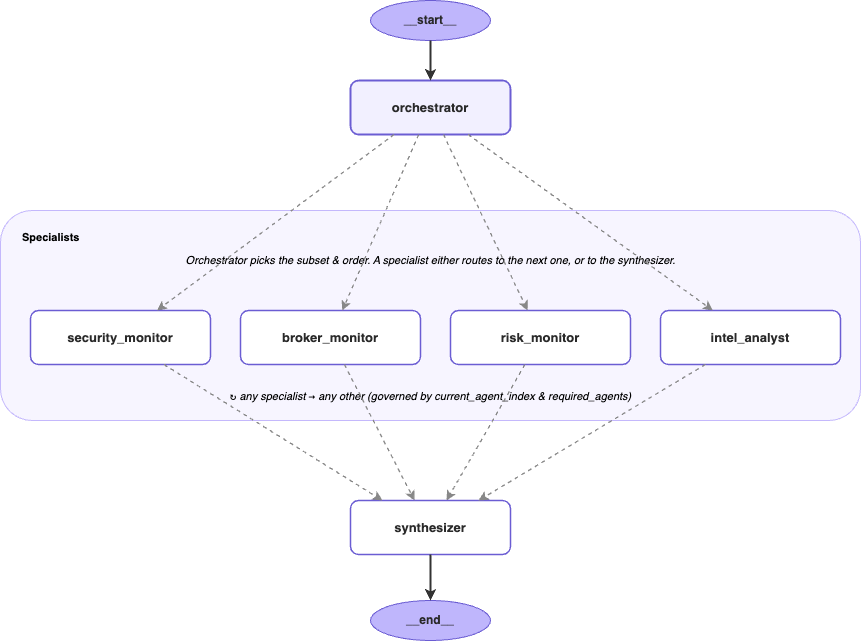
市場分析エージェントにおける LangGraph ワークフローのオーケストレーション
なぜ LangGraph と Strands を組み合わせるのか
多くの企業ユースケースでは、厳格で事前に定義されたワークフローが不可欠です。LLM の非確定的な性質に頼って正しい手順を実行させるのはリスクがあります。しかし、そのワークフロー内の特定のステップには、LLM が持つ俊敏な推論能力と知性が求められます。
LangGraph と Strands を組み合わせることで、このギャップを埋めることができます。これにより、決定論的なオーケストレーションが局所的で動的な知能を内包するシステムを構築できます。
このアーキテクチャの組み合わせが、複雑なワークフローの課題をどのように解決するかを見てみましょう。
「ノード」レベルでの知能: LangGraph はワークフロー全体の上位レベルのオーケストレーションを定義します。一方、Strands エージェントは特定のノードに配置されます。複雑なワークフローにおいて LLM による分析や曖昧さへの対応が必要な場合に、このノードが機能します。自律的な推論とツールの使用は、その柔軟性が厳密に必要とされる箇所でのみ適用されます。
ノード型エージェントによるコンテキストの分離: モノリス型のエージェントは、指示を把握し続けることが容易ではありません。個別の Strands エージェントを独立した LangGraph ノード内に配置することで、メモリを区画化できます。各エージェントが自身の超焦点化されたコンテキストとツールの履歴を管理する一方、LangGraph は構造化された包括的なセッション状態を維持します。これにより、異なるエージェントは互いに独立してこの状態を更新したり参照したりすることが可能になります。
オーケストレーションの強化: LangGraph の中核は、低レベルなルーティングとオーケストレーションツールです。ここに Strands を埋め込むことで、包括的なエンタープライズエージェントフレームワークをグラフに即座に組み込めます。LangGraph の堅牢なルーティング機能に加え、Strands 独自のモデルコンテキストプロトコル(MCP)連携、ステアリング制御、セーフティガードレール、評価機能を同時に活用できます。
具体的には、各専門家が LangGraph ノードとして機能します。ノードはシステムプロンプト、ツール、孤立した文脈を持つ新しい Strands エージェントを起動し、オーケストレーターから割り当てられたタスクを実行して状態更新を返します。LangGraph はこの部分的な更新を、他のノードが参照する共有状態に統合します。以下がセキュリティ監視ノードの例です。
async def security_monitor_node(state: AgentState) -> AgentState:
    """
    単一日の活動分析を行うエージェントで、価格、出来高、ティックレベルの取引を評価します
    """
    agent = Agent(
        name="security_monitor",
        model=analyst_model,
        system_prompt=SECURITY_MONITOR_PROMPT,
        tools=[get_report_list, get_report_schema, run_report],
        callback_handler=None,
    )

# オーケストレーターが共有状態に設定したタスクをこのノードから取得します。
    task = state.get("agent_task_map", {}).get("security_monitor", state["query_text"])
Strands は独自の推論とツールループを実行し、エージェントの最終的なテキストを収集します。
chunks = []
async for event in agent.stream_async(task):
    if "data" in event:
        chunks.append(event["data"])
result = "".join(chunks)
共有状態の更新を返却します。
return {
    "security_monitor_insights": {"task": task, "business_insights": result},
    "current_agent_index": state.get("current_agent_index", 0) + 1,
}
AgentCore を活用した AWS インフラとデプロイ
Amazon Bedrock AgentCore は、スケーラブルなエージェントの展開と運用を完全に管理するサービスです。インフラ管理の手間を減らしながら、本番環境で使える機能を提供します。
ランタイムでのデプロイ:AgentCore ランタイム(Amazon Bedrock AgentCore の機能)は、最小限の設定でローカルのエージェントコードをクラウドネイティブな展開に変換します。このサービスはフレームワークに依存せず、LangGraph や Strands と相性が良く、すぐに利用可能です。動的なエージェントワークロード向けに特別に設計されたインフラを提供し、長時間続く調査のための拡張ランタイムや、対話型ワークフロー用の低遅延実行、需要に応じた自動スケーリングが含まれています。
Amazon Bedrock AgentCore の機能である Python SDK とスターターツールキットを活用すれば、LangGraph オーケストレーターと Strands エージェントを簡単にデプロイできます。ランタイムがコンテナ化、ネットワーク設定、計算リソースの割り当てを自動で処理します。AgentCore は、コンテナのオーケストレーション、スケーリング、セッション管理といった本質的ではない重労働を一手に引き受けます。
api.py --- AgentCore ランタイムのエントリーポイント
from bedrock_agentcore.runtime import BedrockAgentCoreApp
from src.agents import Workflow
app = BedrockAgentCoreApp()
workflow = Workflow()
@app.entrypoint
async def market_surveillance_workflow(payload):
"""各リクエストに対して AgentCore から呼び出されます。ストリーミング形式でチャンクを返します。"""
prompt = payload.get("prompt")
session_id = payload.get("session_id", "default-session")
actor_id = payload.get("actor_id", "default-actor")
async for chunk in workflow.stream_query(
session_id=session_id, prompt=prompt, actor_id=actor_id
):
yield chunk
if __name__ == "__main__":
app.run()
AgentCore スターターツールキットでデプロイする
from bedrock_agentcore_starter_toolkit import Runtime
runtime = Runtime()
runtime.configure(
entrypoint="api.py",
auto_create_execution_role=True,
auto_create_ecr=True,
requirements_file="requirements.txt",
region="us-east-1",
agent_name="market_surveillance_workflow",
)
result = runtime.launch()
print(f"Agent ARN: {result.agent_arn}")
デプロイしたエージェントを呼び出す
import boto3, json
client = boto3.client("bedrock-agentcore", region_name="us-east-1")
response = client.invoke_agent_runtime(
agentRuntimeArn=result.agent_arn,
qualifier="DEFAULT",
payload=json.dumps({
"prompt": "What caused the AAPL price spike at 11:00 AM on March 15, 2024?",
"session_id": "session-001",
"actor_id": "analyst-jane",
}),
)
AgentCore はサーバー送信イベント(SSE)ストリームを返します。これを解析します。
for raw in response["response"].iter_lines():
if not raw:
continue
line = raw.decode("utf-8") if isinstance(raw, bytes) else raw
if not line.startswith("data: "):
continue
try:
chunk = json.loads(line[6:])
if isinstance(chunk, str) and chunk.startswith("data: "):
chunk = json.loads(chunk[6:])
except json.JSONDecodeError:
continue # データ形式が崩れているチャンクは無視して、クラッシュは回避
if isinstance(chunk, dict) and chunk.get("type") == "text":
print(chunk["content"], end="")
メモリ連携:LangGraph は langgraph-checkpoint-aws パッケージを介して Amazon Bedrock AgentCore の機能である AgentCore Memory と統合されます。これにより、数行のコードで短期間のチェックポイント保存と、インテリジェントな長期メモリの検索が可能になります。
本例で用いる AgentCoreMemorySaver クラスは、ユーザーメッセージや AI の応答、グラフの実行状態、メタデータを含むチェックポイントオブジェクトを管理します。各ノードの処理が完了するたびに LangGraph は自動的にチェックポイントを AgentCore メモリに保存するため、Amazon DynamoDB テーブルの管理や独自シリアライズロジックの実装なしで、状態を保持した対話やワークフローの復元が可能になります。
AgentCoreMemoryStore クラスは、AgentCore が会話から洞察・要約・ユーザーの好意を自動的に抽出するインテリジェントなメモリ機能を提供します。エージェントは将来のやり取りでこれらの記憶を検索できるため、時間とともに改善されるパーソナライズされた体験を実現できます。これは、エージェントがステートレスであるという根本的な課題への解決策です。各対話では新しい状態から始めるのではなく、過去の知識を基に積み上げていくことができます。
import boto3, time
REGION = "us-east-1"
control_client = boto3.client("bedrock-agentcore-control", region_name=REGION)
response = control_client.create_memory(
name="MarketSurveillanceMemory",
description="Memory for market surveillance multi-agent workflow.",
eventExpiryDuration=90, # days
)
MEMORY_ID = response["memory"]["id"]
print(f"Memory ID: {MEMORY_ID}")
ACTIVE を待機する(10 分以内)
通常、作成には 1〜3 分かかります。
deadline = time.time() + 600
while True:
    status = control_client.get_memory(memoryId=MEMORY_ID)["memory"]["status"]
    if status == "ACTIVE":
        break
    if status == "FAILED" or time.time() >= deadline:
        raise RuntimeError(f"Memory {MEMORY_ID} is {status!r}")
原文を表示
As artificial intelligence applications evolve from simple chatbots to sophisticated autonomous systems, organizations face new challenges in orchestrating complex multi-agent workflows that can handle real-world production scenarios. Traditional single-agent approaches often fall short when dealing with intricate business processes that require specialized expertise, dynamic decision-making, and robust error recovery mechanisms. The financial services industry exemplifies this challenge. Market surveillance systems must coordinate multiple specialized agents to analyze trading patterns, investigate suspicious activities, and generate comprehensive reports while maintaining strict compliance and reliability standards.
The solution combines two frameworks: LangGraph for macro-level workflow orchestration and Strands for intelligent agent reasoning. LangGraph excels at managing state and directed graphs for multi-agent coordination. It gives you fine-grained control over both workflow execution and state that can be shared between agents. Its central persistence layer supports features critical for production, including human-in-the-loop interactions and robust checkpoint-based recovery from failures. Meanwhile, Strands Agent serves as the reasoning engine within individual workflow nodes. It offers model-agnostic capabilities that integrate with various large language model (LLM) providers while maintaining flexible tool integration and comprehensive observability.
With the release of Amazon Bedrock AgentCore last year, productionizing an agentic solution might be simplified for many use cases. The combination provides a strong foundation for production-ready agentic AI systems that can handle complex use cases while helping to deliver the infrastructure reliability and observability that enterprise applications demand.
In this post, we demonstrate how to architect and deploy a multi-agent AI system using LangGraph and Strands on AWS infrastructure. You learn how to implement state-driven workflow orchestration with LangGraph’s checkpoint system, integrate Strands agents for specialized reasoning tasks, and use AgentCore for scalable production deployment. The complete solution is available on GitHub.
Strands: Intelligent agent reasoning
Strands Agent operates on a model-agnostic architecture that adapts to your existing infrastructure without imposing architectural constraints. The agent implements an agentic reasoning loop that continuously evaluates tool outputs and makes decisions based on intermediate results, so you can build sophisticated multi-step analysis workflows. The framework includes comprehensive session and state management and multiple conversation managers to keep your context window from overflowing.
With Strands, you can configure external tool interactions by defining tool schemas and access patterns. For our surveillance agent, we separate the discovery of data from the retrieval to avoid hallucinations and strengthen the solution against injection attacks. We use tools like get_report_list and get_report_schema to find reports and run_report to build the SQL query with validated parameters and run it.
We create a security_monitor agent with the following tools and a system prompt:
from strands import Agent, tool
from strands.models.bedrock import BedrockModel

model = BedrockModel(
    model_id="us.anthropic.claude-sonnet-4-6",
    region_name="us-east-1",
    max_tokens=16000,
    additional_request_fields={
        "thinking": {"type": "adaptive", "budget_tokens": 8000},
    },
    cache_prompt="default",
)

@tool
def get_report_list(agent_name: str) -> str:
    """Load the list of available reports for a specific agent.

    Args:
        agent_name: Name of the agent (e.g. 'security_monitor').

    Returns:
        str: JSON array of report objects with name and description.
    """
    reports_data = load_agent_reports(agent_name)
    return json.dumps(reports_data["reports"], indent=2)

@tool
def get_report_schema(report_name: str, query_intent: str) -> str:
    """Load column definitions for a report so you can build queries.

    Args:
        report_name: Name of the report (e.g. 'TradeActivity').
        query_intent: Description of what data to extract.

    Returns:
        str: JSON object with parameters and column definitions.
    """
    return json.dumps(load_json_report_definition(report_name), indent=2)

@tool
def run_report(
    report_name: str,
    filters: Dict[str, Any],
    limit: Optional[int] = None,
) -> Dict[str, Any]:
    """Run a predefined report. The tool validates every filter against the
    report's schema and builds a parameterised SQL query. The LLM never writes
    raw SQL, so filter values cannot be injected into the query.

    Args:
        report_name: A report from `get_report_list` (e.g. 'TradeActivity').
        filters: Equality filters keyed by column name, e.g.
            {"symbol": "AAPL", "date": "2024-03-15"}.
        limit: Optional row cap (1..10000).

    Returns:
        dict: {'success': bool, 'data': str (CSV), 'error': str or None}
    """
    schema = load_json_report_definition(report_name)
    allowed_columns = {c["name"] for c in schema["columns"]}

    # Reject any filter field that is not in the report's allowed list of columns.
    unknown = set(filters) - allowed_columns
    if unknown:
        raise ValueError(
            f"Unknown filter field(s) {sorted(unknown)} for {report_name}. "
            f"Allowed: {sorted(allowed_columns)}"
        )

    # Build SQL with named bind parameters.
    where = " AND ".join(f"{field} = :{field}" for field in filters)
    sql = f"SELECT * FROM {schema['reportName']}"
    if where:
        sql += f" WHERE {where}"
    if limit is not None:
        if not isinstance(limit, int) or not 1 <= limit <= 10_000:
            raise ValueError("limit must be an integer in [1, 10000]")
        sql += f" LIMIT {limit}"

    return query_market_data(report_name=report_name, sql=sql, bind=filters)

security_monitor = Agent(
    model=model,
    system_prompt=SECURITY_MONITOR_PROMPT,
    tools=[get_report_list, get_report_schema, run_report],
    name="security_monitor",
)
LangGraph: Macro workflow orchestration
LangGraph provides production-grade orchestration for multi-agent systems through three core capabilities that make it well-suited for complex AI workflows.
Graph-based state machines: LangGraph models agent workflows as directed graphs where nodes represent functions containing agent logic, and edges determine execution flow. This declarative approach transforms complex multi-step reasoning into readable, maintainable code. Graphs support conditional branching, parallel execution, and dynamic routing. These capabilities are important for real-world scenarios where workflows adapt based on intermediate results.
Persistent state management: The framework’s checkpoint system automatically snapshots complete workflow state after every node execution. With these checkpoints, you can recover smoothly from failures and support human-in-the-loop interactions. When analysts need to review intermediate results or errors occur, the system restores from the exact checkpoint. It then resumes without losing previous work. This stateful architecture supports commonly used patterns like multi-turn conversations, iterative refinement, and long-running investigations that span hours or days.
Production reliability: LangGraph includes built-in retry strategies with exponential backoff for handling throttling or other failures that might occur in your system. It also provides comprehensive observability through OpenTelemetry for straightforward integration with most observability applications.
Let’s build an orchestration layer that routes queries between our specialist Strands agents. The following code defines our workflow graph: a shared state, an orchestrator that selects which specialist agents to invoke, conditional routing between them, and checkpoint-backed persistence for recovery and human-in-the-loop review.
from typing import TypedDict, Optional, List, Dict, Any
from langgraph.graph import END, StateGraph
from langgraph_checkpoint_aws import AgentCoreMemorySaver

class AgentState(TypedDict):
    query_text: str
    session_id: Optional[str]
    agent_task_map: Optional[Dict[str, str]]
    required_agents: Optional[List[str]]
    current_agent_index: Optional[int]
    # Each specialist writes its insights here
    security_monitor_insights: Optional[Dict[str, Any]]
    broker_monitor_insights: Optional[Dict[str, Any]]
    risk_monitor_insights: Optional[Dict[str, Any]]
    intel_analyst_insights: Optional[Dict[str, Any]]
    synthesizer_insights: Optional[str]

SPECIALIST_NODES = {
    "security_monitor": security_monitor_node,
    "broker_monitor": broker_monitor_node,
    "risk_monitor": risk_monitor_node,
    "intel_analyst": intel_analyst_node,
}

def route_analysts(state: AgentState) -> str:
    """Dynamic routing --- walk the required_agents list by index."""
    required = state.get("required_agents", [])
    index = state.get("current_agent_index", 0)
    if not required:
        return END
    if index < len(required):
        return required[index]
    return "synthesizer"

# Build the graph
workflow = StateGraph(AgentState)
workflow.add_node("orchestrator", orchestrator_node)
for name, node_fn in SPECIALIST_NODES.items():
    workflow.add_node(name, node_fn)
workflow.add_node("synthesizer", synthesizer_node)
workflow.set_entry_point("orchestrator")

# Conditional edges --- the orchestrator and every specialist route through route_analysts, which can hand off to any specialist or the synthesizer.
ALL_TARGETS = {name: name for name in SPECIALIST_NODES} | {
    "synthesizer": "synthesizer",
    END: END,
}
workflow.add_conditional_edges("orchestrator", route_analysts, ALL_TARGETS)
for name in SPECIALIST_NODES:
    workflow.add_conditional_edges(name, route_analysts, ALL_TARGETS)
workflow.add_edge("synthesizer", END)

# AgentCoreMemorySaver checkpoints the state after every node
checkpointer = AgentCoreMemorySaver(MEMORY_ID, region_name=REGION)
graph = workflow.compile(checkpointer=checkpointer)
LangGraph workflow orchestration for the market analysis agent
Why LangGraph and Strands together
Many enterprise use cases must be grounded in strict, predefined workflows. Relying purely on the non-deterministic nature of an LLM to execute the right steps is a risk. However, specific steps within those workflows do require the agile reasoning with the intelligence of the LLM.
The combination of LangGraph and Strands bridges this gap. You can use it to build systems where deterministic orchestration houses localized, dynamic intelligence.
Here is how this architectural pairing solves complex workflow challenges:
“Node” level intelligence: LangGraph defines the higher-level orchestration for the workflow. Strands agents are placed at specific nodes, where a complex workflow might require LLM analysis or navigating ambiguity. They apply autonomous reasoning and tool use only where that flexibility is strictly required.
Context isolation with nodal agents: Monolithic agents easily lose track of their instructions. By placing individual Strands agents inside separate LangGraph nodes, you compartmentalize memory. Each agent manages its own hyper-focused context and tool history, while LangGraph maintains a structured, overarching session state that these different agents can update and reference independently.
Supercharging orchestration: At its core, LangGraph is a low-level routing and orchestration tool. By embedding Strands, you instantly plug a comprehensive enterprise agent framework into your graph. You get the robust routing of LangGraph alongside Strands’ native Model Context Protocol (MCP) integrations, steering controls, safety guardrails, and evaluation.
Concretely, each specialist is a LangGraph node. The node spins up a fresh Strands agent with its own system prompt, tools, and isolated context. It runs the task the orchestrator assigned and returns a state update. LangGraph merges that partial update into the shared state the other nodes read from. Here is the security monitor node:
async def security_monitor_node(state: AgentState) -> AgentState:
    """
    Single-day activity analyst agent that assesses price, volume and tick-level trades
    """
    agent = Agent(
        name="security_monitor",
        model=analyst_model,
        system_prompt=SECURITY_MONITOR_PROMPT,
        tools=[get_report_list, get_report_schema, run_report],
        callback_handler=None,
    )

    # Pull this node's task from the shared state the orchestrator populated.
    task = state.get("agent_task_map", {}).get("security_monitor", state["query_text"])

    # Strands runs its own reasoning + tool loop; collect the agent's final text.
    chunks = []
    async for event in agent.stream_async(task):
        if "data" in event:
            chunks.append(event["data"])
    result = "".join(chunks)

    # Return shared state updates
    return {
        "security_monitor_insights": {"task": task, "business_insights": result},
        "current_agent_index": state.get("current_agent_index", 0) + 1,
    }
AWS infrastructure and deployment with AgentCore
Amazon Bedrock AgentCore provides a fully managed service for deploying and operating agents at scale, alleviating infrastructure management while delivering production-grade capabilities.
Runtime deployment: AgentCore runtime, a capability of Amazon Bedrock AgentCore, transforms local agent code into cloud-native deployments with minimal configuration. The service is framework agnostic and works with LangGraph and Strands out of the box. It provides purpose-built infrastructure for dynamic agent workloads, including extended runtimes for long-running investigations, low-latency execution for interactive workflows, and automatic scaling based on demand.
Deploy your LangGraph orchestrator and Strands agents using the AgentCore Python SDK, a capability of Amazon Bedrock AgentCore, and the starter toolkit. The runtime handles containerization, networking, and compute provisioning automatically. AgentCore handles the undifferentiated heavy lifting of container orchestration, scaling, and session management.
# api.py --- AgentCore runtime entry point
from bedrock_agentcore.runtime import BedrockAgentCoreApp
from src.agents import Workflow

app = BedrockAgentCoreApp()
workflow = Workflow()

@app.entrypoint
async def market_surveillance_workflow(payload):
    """Invoked by AgentCore for each request. Yields streaming chunks."""
    prompt = payload.get("prompt")
    session_id = payload.get("session_id", "default-session")
    actor_id = payload.get("actor_id", "default-actor")
    async for chunk in workflow.stream_query(
        session_id=session_id, prompt=prompt, actor_id=actor_id
    ):
        yield chunk

if __name__ == "__main__":
    app.run()

# Deploy with the AgentCore starter toolkit
from bedrock_agentcore_starter_toolkit import Runtime

runtime = Runtime()
runtime.configure(
    entrypoint="api.py",
    auto_create_execution_role=True,
    auto_create_ecr=True,
    requirements_file="requirements.txt",
    region="us-east-1",
    agent_name="market_surveillance_workflow",
)
result = runtime.launch()
print(f"Agent ARN: {result.agent_arn}")

# Invoke the deployed agent
import boto3, json

client = boto3.client("bedrock-agentcore", region_name="us-east-1")
response = client.invoke_agent_runtime(
    agentRuntimeArn=result.agent_arn,
    qualifier="DEFAULT",
    payload=json.dumps({
        "prompt": "What caused the AAPL price spike at 11:00 AM on March 15, 2024?",
        "session_id": "session-001",
        "actor_id": "analyst-jane",
    }),
)

# AgentCore returns a server-sent-events stream. Parse it:
for raw in response["response"].iter_lines():
    if not raw:
        continue
    line = raw.decode("utf-8") if isinstance(raw, bytes) else raw
    if not line.startswith("data: "):
        continue
    try:
        chunk = json.loads(line[6:])
        if isinstance(chunk, str) and chunk.startswith("data: "):
            chunk = json.loads(chunk[6:])
    except json.JSONDecodeError:
        continue  # malformed chunk --- skip, don't crash
    if isinstance(chunk, dict) and chunk.get("type") == "text":
        print(chunk["content"], end="")
Memory integration: LangGraph integrates with AgentCore memory, a capability of Amazon Bedrock AgentCore, through the langgraph-checkpoint-aws package with a few lines of code, providing both short-term checkpoint persistence and intelligent long-term memory retrieval.
The AgentCoreMemorySaver class, used in this example, handles checkpoint objects containing user messages, AI responses, graph execution state, and metadata. After each node completion, LangGraph automatically saves checkpoints to AgentCore memory. You get stateful conversations and workflow recovery without managing Amazon DynamoDB tables or implementing custom serialization logic.
The AgentCoreMemoryStore class provides intelligent memory capabilities where AgentCore automatically extracts insights, summaries, and user preferences from conversations. Agents can search through these memories in future interactions, so you can deliver personalized experiences that improve over time. This addresses the fundamental challenge of agent statelessness: each interaction builds upon previous knowledge rather than starting fresh.
import boto3, time
REGION = "us-east-1"
control_client = boto3.client("bedrock-agentcore-control", region_name=REGION)
response = control_client.create_memory(
name="MarketSurveillanceMemory",
description="Memory for market surveillance multi-agent workflow.",
eventExpiryDuration=90, # days
)
MEMORY_ID = response["memory"]["id"]
print(f"Memory ID: {MEMORY_ID}")
Wait for ACTIVE, with a 10-minute deadline. Creation normally takes 1-3 min.
deadline = time.time() + 600
while True:
status = control_client.get_memory(memoryId=MEMORY_ID)["memory"]["status"]
if status == "ACTIVE":
break
if status == "FAILED" or time.time() >= deadline:
raise RuntimeError(f"Memory {MEMORY_ID} is {status!r} (exp
AI算出
導入事例ainew評価標準
記事は特定の技術スタック(LangGraph, Strands)を用いた具体的な実装例を提示しており AI 関連度は高いが、これは既存製品の組み合わせ紹介であり新規性は限定的である。また、日本固有のコンプライアンスや価格情報などは含まれていないため、日本の読者への直接的な付加価値は低い。
6つの評価軸を見る
- AI関連度
- 75
- 情報源の信頼性
- 100
- 新規性
- 25
- 調べる価値
- 75
- 重複の少なさ
- 100
- 日本での有用性
- 25
関連記事
今日のまとめ
AIデイリーブリーフで今日の重要ニュースをまとめ読み