Fable 5 の再展開(18 分読了)
本文の状態
日本語全文を表示中
詳細モードで約22分の本文を読めます。
同じ出来事の情報源
この情報源を基点に整理
TLDR AI
Anthropic は Claude Fable 5 と Mythos 5 を再展開した。Fable 5 は 7 月 7 日まで週次利用制限の最大 50% に含まれ、以降は利用クレジットで提供される。Mythos 5 は一部の米国組織で復元され、政府と連携して Glasswing プログラムへのアクセス拡大を進めている。
Source Article
元記事を日本語で読む
本文に関係しない購読案内、埋め込み通知、サイト内プロモーションは除いています。
- UpdateClaude Fable 5 と Mythos 5 の再デプロイ完了
2026 年 7 月 1 日
Claude Fable 5 および Claude Mythos 5 へのアクセスが復元されました。
金曜日、6 月 12 日に米国政府は、当社の最新モデルである Claude Fable 5 と Claude Mythos 5 に対して輸出管理措置を適用しました。これにより、米国国内・国外を問わず外国人に対するアクセス制限が必要となりました。命令が即時発効し、リアルタイムでの国籍確認に信頼できる手段が存在しなかったため、両モデルへのすべてのユーザーのアクセスを一時的に停止いたしました。
本日、6 月 30 日をもって、Fable 5 および Mythos 5 に対する輸出管理措置は解除されましたこちら。
Fable 5 は、明日の 7 月 1 日(水曜日)より、Claude Platform、Claude.ai、Claude Code、および Claude Cowork の世界中のユーザーにご利用いただけるようになります。Pro、Max、Team、および一部の Enterprise プランでは、7 月 7 日まで週間の利用制限の最大 50% を Fable 5 に充当いただけます。それ以降は 利用クレジット を通じてご利用いただけるようになります。AWS、Google Cloud、Microsoft Foundry におけるアクセスの再有効化も、可能な限り迅速に実施いたします。
米国政府の承認を受け、6月26日以降、一連の米国の組織に対して Mythos 5 へのアクセスを復元しました。引き続き政府と連携し、Glasswing プログラムにおけるより広範な国内および国際的なパートナー向けに アクセスを拡大 していく予定です。
本投稿の後半では、以下の4つの領域についてさらに詳細と最新情報を提供します。
- セーフガードへの更新を含む出来事のタイムライン。輸出管理指令に至った経緯と、新しいセーフガードによってどのように対応したかについて議論します。
- 当社のセーフガードに対する一般的なアプローチ。モデルの潜在的に危険なサイバーセキュリティ用途を検出するために、安全性分類器をどのように使用しているかについて、より多くの背景情報を提供します。
- 業界全体で共有される枠組み。建設的な解決策に至りましたが、これらの出来事により、AI モデルの「 Jailbreak(セーフガード回避)」(モデルの制限を迂回する技術)の潜在的なリスクを評価し修正するための一貫した方法が業界に必要であることが明確になりました。特定の Jailbreak の深刻度を判断するための共通基準は、新たな発見が生じた際に AI 開発者が優先順位をつけ、より高い安全性をもって高度な機能を備えたモデルをリリースし、政府や産業パートナーに対してリスクレベルを一貫して伝えることを可能にします。Amazon、Microsoft、Google、およびその他の Glasswing パートナーと共に、私たちはそのような枠組みの開発を開始しており、その概要を以下に示します。
- 政府とのより深い協力。また、米国政府との間で、リリース前の新たなテスト、情報共有、研究協力における協力のレベルを強化しています。このより深い協力については最終節で詳述します。
タイムラインとセーフガードの更新
私たちは火曜日、6 月 9 日に Fable 5 と Mythos 5 をリリースしました。両者は同じ基盤モデルを共有していますが、Fable 5 は一般利用における安全性を高めるために強力なセーフガード(安全装置)とともにリリースされました。一方、セーフガードが比較的少ない Mythos 5 は、防御的なサイバーセキュリティ用途に限定し、信頼できるプロジェクト・グラスウィングのパートナーの一部のみに対してリリースされています。
6 月 12 日の輸出管理指令は、政府が Amazon の研究者らが Fable 5 のセーフガードを回避する方法を見つけたという報告書の内容を知った後に発令されました。その方法とは、モデルにプロンプト(指示)を与えてソフトウェアの脆弱性を特定させるというものです。あるケースでは、モデルは関連する脆弱性がどのように悪用されるかを示すコードを生成しました。過去 2 週間にわたり、私たちは政府や Amazon を含む他のパートナーと緊密に連携し、報告書および証拠を見直してきました。
私たちのテストにより、多くの能力が低いモデル——Claude Opus 4.8、GPT-5.5、Kimi K2.7 など——も、Fable 5 が報告書で特定したのと同じ脆弱性を識別できることが確認されました。また、単一の脆弱性の悪用方法をデモンストレーションする点に関しても、テストしたすべてのモデル(Claude Haiku 4.5、Sonnet 4.6、Opus 4.6、Opus 4.7、Opus 4.8、GPT-5.4、GPT-5.5、Kimi K2.7)が Fable 5 と同じデモンストレーションを生成できることが判明しました。
重要なのは、報告された手法はミソスレベルの独自のサイバー能力を露呈していなかったことです。この行動は Fable 5 のセーフガードにおける境界事例を示しており、以下で説明するように、危険である可能性は低いものの、過剰な警戒心からセーフガードによってブロックされるタスクが存在します。報告された手法はこの種の行動へのアクセスを可能にしましたが、関与したのは日常的な防御的なサイバーセキュリティ作業のみでした。
それでも私たちは、報告されたバイパスに対処すべく迅速に動き出しました。政府と緊密に連携し、報告書で記述された行動を対象としてブロックする改善されたセーフティ分類器(safety classifier)を訓練しました。Fable 5 へのリクエストがブロックされる場合、ユーザーには通知が行われ、そのリクエストは代わりに Opus 4.8 に送信されます。
新しい分類器により、Amazon の報告書で記述された特定の手法はケースの 99% 以上でブロックされます。ごく一部のケースでは、モデルがサイバー攻撃者に役立つほど詳細ではない情報を提供することがあります。以下で説明するように、モデルのセーフガードは、すべての低リスクかつ日常的なサイバー防御能力をブロックするものではなく、潜在的に有害なもののみを対象とすると想定されています。米国商務省 AI 標準化・イノベーションセンター(CAISI)の研究員が、私たちの以前のセーフガードおよび新しいセーフガードの両方をテストし、それらが極めて強力であると合意しています。
新しい分類器は、通常のコーディングやデバッグタスク中に良性の要求をより頻繁にフラグ付けするコストも伴います。すべての安全対策と同様に、私たちは本格的な悪用と正当な要求をより明確に区別し、誤検知(false positives)を減らすために、引き続きこの仕組みを改善していきます。
セキュリティ対策へのアプローチ
Claude Mythos 5 は、ソフトウェアの脆弱性を発見・悪用する能力において、他のどのモデルよりも優れており、熟練した人間のセキュリティ専門家を除けば他を凌駕します。これらの卓越したサイバーセキュリティ機能は、サイバー攻撃に悪用しようとする悪意のある行為者にとって特に魅力的な存在となります。
しかし、Claude Fable 5 はそのような独自の攻撃能力を提供しません。これは、モデルに適用された中で最も強力な安全対策を備えてリリースされたためです。リリースの直前1ヶ月間、Anthropic内のさまざまなチームからスタッフを移籍させ、この問題に取り組む研究者とエンジニアの数を倍増させました。
Fable 5 は、それぞれ単独では完璧な防御を提供しないが、組み合わせることでモデルの悪用を極めて困難にする(「多層防御」と呼ばれるアプローチ)様々な安全メカニズムとともにリリースされました。一部の防御策は、危険な要求への支援を断るようモデルを訓練するものであり、他のものは悪用のパターンを事後に分析するものです。
特に重要な安全機構の一つに「分類器(classifiers)」があります。これは、対話中にモデルが潜在的に有害なサイバーセキュリティタスクの実行を求められた場合や、潜在的に有害な出力を生成した場合を検出する、より小型の自動化された AI システムです。この状況が発生すると、分類器はモデルがリクエストに応答することをブロックします。これらの分類器の究極的な目的は、モデルが独自に危険な行動をとることを防ぐことです。
すべての安全機構と同様に、分類器も誤りを犯すことがあります。潜在的に危険なコンテンツを見逃してしまう場合があり、また特定のケースでは意図的に「 Jailbreak(脱獄)」されることがあります。ユーザーは、分類器を欺いてシステムがブロックすべき有害な出力をモデルに生成させるために、通常とは異なる方法でモデルにプロンプトを入力します。
そのため、私たちは安全分類器が、明らかに無害であると確信できる一連のリクエストに対してトリガーするように意図的に設定しました。この「安全マージン」アプローチでは、リクエストが非常に明確に安全である場合にのみ、分類器のトリガーを回避できます(以下の図の行 A を参照)。ユーザーにとっては、安全マージンにより、合理的で有害ではないいくつかのリクエストに対してモデルが応答しないという体験となります。
Fable 5 では、この安全マージンを過去のあらゆるリリースよりもはるかに大きく設定しました(行 B)。その結果、無害なリクエストの多くがブロックされることになります。私たちは、このような偽陽性(false positives)がユーザーにとってフラストレーションの原因となることを理解していましたが、モデルの他の機能を広く利用可能にするという目的のために、このトレードオフを選択しました。
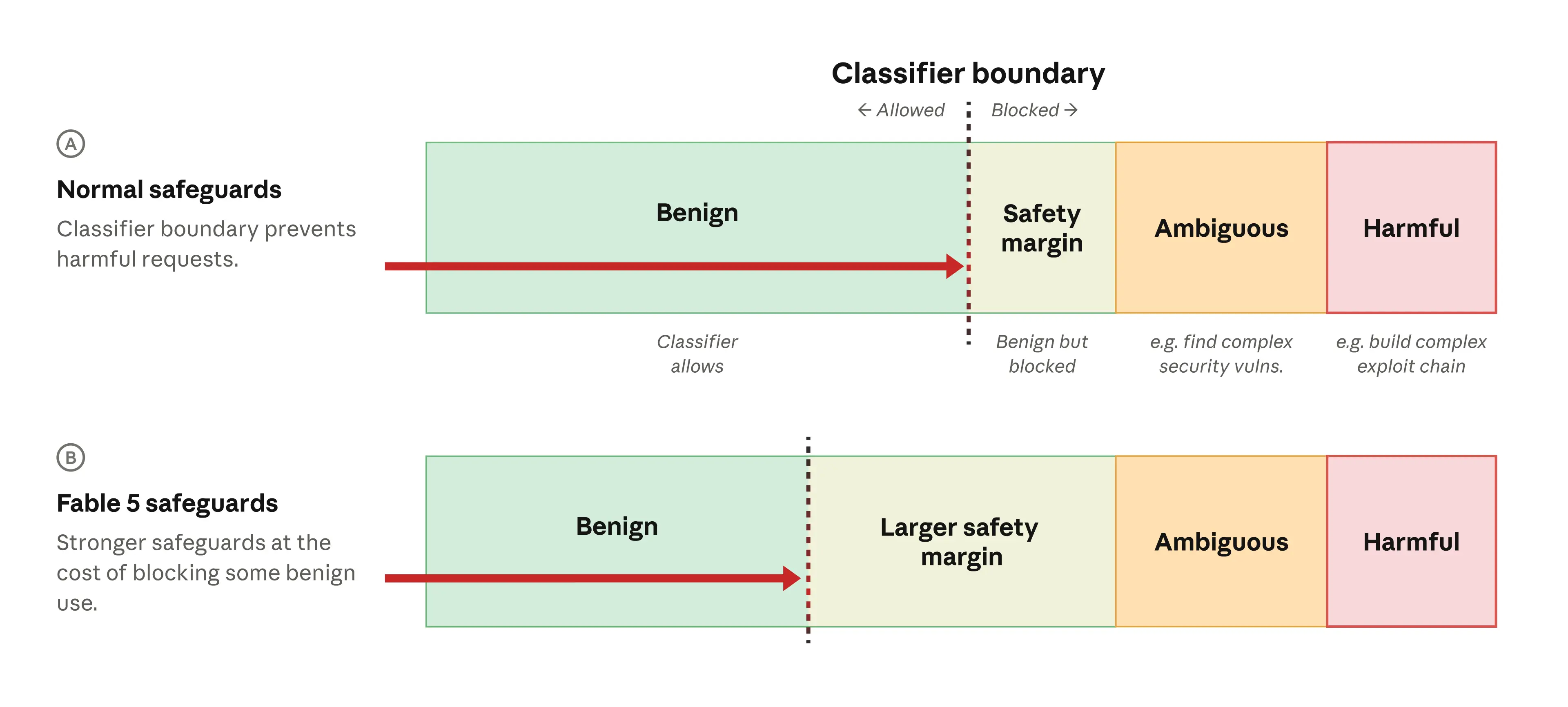 image サイバーセキュリティの安全性分類器のイラストです。 モデルへのリクエストがなされた際、この分類器はそれが benign(安全で許可されるべき)であるか、潜在的に有害(ブロックされるべき)であるかを検出します。分類器は曖昧なリクエスト(サイバーセキュリティに関連する明確なものだが、防御目的、例えばセキュリティ脆弱性の発見などである可能性もあるもの)と、有害なリクエスト(ソフトウェアの脆弱性を悪用するチェーンを構築するよう求めるなど、明らかに危険なものを指す)をブロックします。行 A に示されているように、「安全性マージン」も設けており、分類器はおそらく benign だが有害になるわずかな可能性のあるリクエストもブロックします。これにより、すべての有害なリクエストが確実にブロックされるという確信が高まります。Fable 5(行 B)ではこの安全性マージンをさらに大きく設定しました。その結果、より多くの benign なリクエストがブロックされますが、真に有害なリクエストを見逃すケースは減少します。「Vulns」とは脆弱性(vulnerabilities)を意味します。
安全マージンはまた、ジールブレイク( Jailbreak)の緩和にも役立ちます。多くのジールブレイクは狭義のものであり、非常に特定のモデル挙動のみを解除するが、それ以上のことは行いません。あるケースでは、仮想的なユーザーがモデルをわずかにジールブレイクし、安全マージン(あるいは時として曖昧に有害とみなされる行動)に侵入することはできても、私たちがブロックしようとする核心的な有害行為には至りません(以下の表の C 行)。私たちの見解では、これまでに報告されている Fable 5 に対するジールブレイクは、この軽微なカテゴリに該当します。
より深刻なジールブレイクは、より多くの有害行為を解除します。狭義の有害なジールブレイク(D 行)は、特定の有害行為を引き起こす可能性があります。これらのジールブレイクは通常、低から中程度の重大度であり、なぜならその狭義性が攻撃者を制限するためです。最も懸念されるカテゴリは、広範な有害行為を解除する*普遍的な*ジールブレイク(E 行)です。
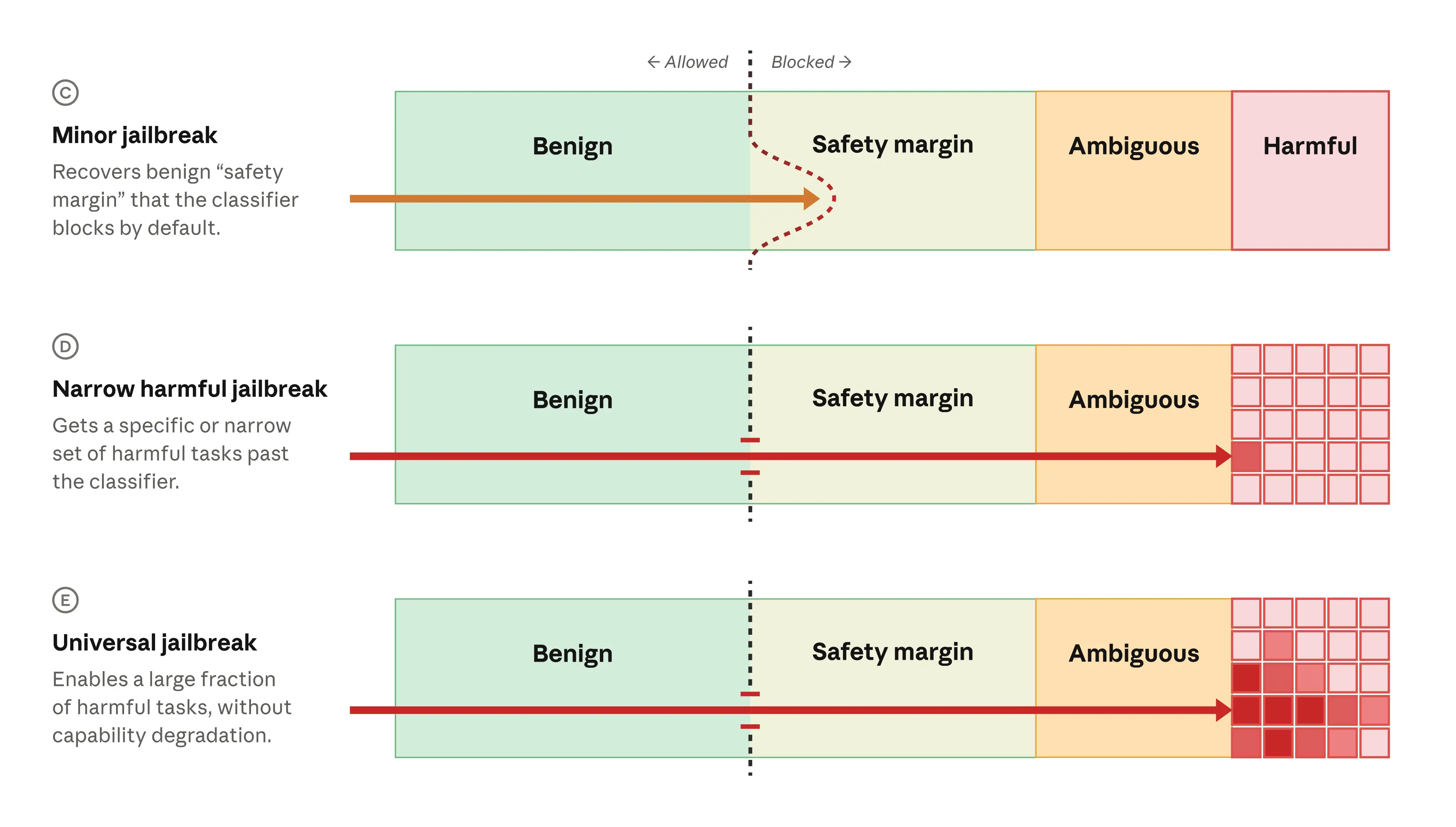 imageジールブレイクが私たちの安全分類器とどのように相互作用するか。**
軽微なジールブレイク(C 行)の場合、分類器はリクエストをブロックしませんが、そのリクエストは依然として安全マージンの範囲内にあり(したがって有害である可能性は非常に低く)、狭義の有害なジールブレイク(D 行)では、プロンプトが分類器を突破してモデルから特定の有害行為を解除します。普遍的なジールブレイク(E 行)では、プロンプトが有害行為のクラス全体を解除します。
私たちが Fable 5 をリリースした際に指摘した通り Anthropic のニュース 、あらゆる AI モデルを完全な堅牢性(つまり、ジャイブレイクに対して無敵であること)にすることはおそらく不可能です。私たちのモデルに対してもいくつかのジャイブレイクが発見されることを想定しており、その深刻さは様々です:多くの軽微なジャイブレイクが存在し、一部の狭義の有害なものもあります。執筆時点では Fable 5 に対する普遍的なジャイブレイクは見つかっていませんが、専門的な安全性研究者たちは引き続きレッドチーム(攻撃シミュレーション)を実施しています。私たちは、悪意のある行為者が危害を加える前に、主要なジャイブレイクを私たちと安全パートナーが最初に発見し、修正することを確保しようとしています。
上記の慎重なアプローチにより、圧倒的多数のジャイブレイクは危険な行動を無効化することに成功しません。私たちの分類器は、成功したジャイブレイクの生成に非常に高いコストと多大な労力を要するように設計されており、たとえ*もし*ジャイブレイクが成功した場合でも、追加された防御層がさらなる緩和措置を提供します。新しいジャイブレイク技術についてより多くを学ぶにつれて、分類器の更新を継続していきます。
ジャイブレイクに関する業界共通の枠組み
現在、AI 業界において、AI のジャイブレイクの深刻さを客観的な用語で記述する方法については合意されていません。これは、新しいジャイブレイク技術が発見されるたびに大きな不確実性を生み出します:開発者には最も緊急に注目すべき発見事項に対する共通の基準がなく、政府にも行動を起こすべき時期に関する共通の基準がありません。
4
この問題は、サイバーセキュリティ(およびその他の)能力に優れたモデルがより多く訓練され、評価され、公開される今後数ヶ月において、さらに深刻化していくでしょう。AI の脱獄(jailbreak)を評価するための共通基準は、当社や他の企業が新しいモデルを安全にリリースするのを助けるとともに、ユーザーが高度な機能を最大限に活用することを可能にします。
そのため、私たちはアマゾン、マイクロソフト、グーグル、およびその他のグラスウィング(Glasswing)パートナーと連携し、AI の脱獄の深刻度を評価し、AI 開発者がそれらに対応すべき方法に関するコンセンサスに基づく枠組みを策定しています。他の業界パートナーやモデルプロバイダーにも、この取り組みへの参加を呼びかけます。
現在の提案では、特定の脱獄を以下の4つの異なる基準に基づいてスコアリングすることです。最初の2つは攻撃者が脱獄によって得られるものを記述し、残りの2つは脱獄が現実世界の問題となるまでの速度を記述します:
- キャパビリティの向上。この Jailbreak(拘束解除)によって、ユーザーは既存のツールをどの程度超えることができるのか?既存の広く利用可能なツール(他のより弱い AI モデルを含む)が、Jailbreak されたモデルと同じ能力に到達できる場合、ここでのスコアは低くなります;一方、Jailbreak がドメインの専門家ですら大幅な加速をもたらす可能性のあるモデルの能力を解放する場合、スコアは高くなります。
- キャパビリティ向上の範囲。同じ Jailbreak テクニックがいくつの異なる攻撃タスクで機能するか?この Jailbreak がモデルに狭いターゲットのみを追及させることを許可するケースでは低く評価され;同じ Jailbreak テクニックが複数の異なるターゲットやテクニックに対して機能するケースでは高く評価されます。
- 兵器化の容易さ。Jailbreak を攻撃に変換するために必要な人的努力はどの程度か?Jailbreak に高度なスキルを要するプロンプティングと多数のリトライが必要となる場合、スコアは低くなります;一方、単一のプロンプトで、あるいは最初の試行または2回目の試行で機能する場合、スコアは高くなります。
- 発見可能性。誰かがこのテクニックを取得することはどの程度容易か?専門知識を必要とする場合は低く評価され;すでに広く知られておりオンライン上で入手可能である場合は高く評価されます。
私たちは、この深刻度フレームワークを使用して、新たに発見された Jailbreak に対する対応を調整することを提案します。最も深刻なクラスの Jailbreak(例えば、他の特徴に加え、実際に重要な電力網や銀行システムに壊滅的な影響を与えるために使用されている Jailbreak)については、その深刻度が確認され次第、直ちに予備的な緩和策の展開を開始します。また、主要な Jailbreak 提出チャネルを24時間365日監視するためのチームも編成しています。
ジャイブレイク(脱獄)のスコアリング手法は完璧なものにはなり得ません。それでも、共通の枠組みを通じて特定の発見の概算 severity を伝える価値はあります。これは進行中の作業であり、より多くのパートナーからのフィードバックを受け取るにつれて、この枠組みは時間とともに進化していくと予想されます。
提案された枠組みの詳細については近日中に共有する予定です。その間、セキュリティ研究者が Fable 5(利用可能になった際)で発見した潜在的なサイバージャイブレイクを提出し、当社のレビューを受けることができる新しい HackerOne プログラム を開始します。
フロンティア AI セキュリティにおける米国政府との連携
過去 10 週間にわたり、Anthropic は 6 月 2 日付の 高度人工知能イノベーションとセキュリティの促進に関する大統領令 に反映されたアプローチの開発にあたり、米国政府と緊密に協力してきました。当社の関与範囲は、国家サイバーディレクター事務所、科学技術政策局、財務省、商務省(CAISI を含む)、および関連する国家安全保障機関に及びました。
私たちは、米国政府パートナーとの事前展開テストおよび評価に関するほぼ2年間にわたる既存の協力[1]を基盤とし、その取り組みを継続することにコミットしています。以下のコミットメントは、これらの既存の取り組みと、上記の枠組みが最終化されるにつれて政府間の協力を拡大するための私たちの新たな提案の両方を反映したものです。
[1]: https://www.anthropic.com/news/strengthening-our-safeguards-through-collaboration-with-us-caisi-and-uk-aisi
- 事前の政府アクセスと評価。国家安全保障に関連する分野において、能力の限界を本格的に押し広げるモデルについては、指定された政府パートナーに対して、モデルおよびそれに付随するセーフガードへの早期アクセスを拡大して提供します。これらのパートナーは、広く公開する前に、独立した能力評価を実施し、当社のガードレール(安全装置)を検証することができます。これらのテスト期間中、Anthropic の技術スタッフが政府の評価者と並んで作業にあたることを約束します。
- セーフガードに関する迅速な情報共有。重大な Jailbreak(脱獄)や悪用のパターンが特定された場合、私たちは速やかに調査を行い、優先順位をつけて対応し、適切な政府の担当機関に通知します。それに応じて構築した新たなセーフガードを共有し、独立してテストできるようにします。また、公開前に脅威インテリジェンス報告書を政府パートナーに提供し、6 月 2 日の大統領令第 2(d) 条に基づいて設立された省庁間サイバーセキュリティ脆弱性クリアリングハウスに参加します。
- 共同研究のための専用リソース。AI セキュリティに関する政府パートナーとの共同作業を大幅に拡大しています。政府の優先事項に取り組むための Anthropic 専任チームを設置し、政府のテストと研究をサポートするための相当な計算資源(Compute)を割り当てるとともに、AI 評価の最先端を推進するために、当社の安全性およびレッドチーム(攻撃側シミュレーション)の専門知識を提供します。
- 業界共通の基準。私たちは、政府や業界の同僚とともに、フロンティアモデルプロバイダー向けの共有された自主的なセキュリティおよび評価標準に向けて取り組んでいきます。政府が分野全体に適用できる評価結果、ツール、ベストプラクティスを貢献します。
私たちの希望は、この協力関係と私たちが提案する合意に基づく業界フレームワークが、業界全体の体系的な規則の基礎となり、さらに AI のリスクと便益に関する効果的なグローバル調整のためのテンプレートの萌芽を提供することです。
これらのルールは強力な規制に明文化され、最先端モデル開発者全体に均等に適用されるべきです。AI のリリースにおける政府の関与には、サイバー防衛担当者やその他の関係者が強力なモデルへのアクセスについて必要な確信を得られるよう、持続可能で透明性の高いプロセスが必要です。
上記のような形で政府との協力をさらに深めていくことを楽しみにしています。また、今回の混乱を辛抱強く受け入れてくださったユーザーの皆様、そして Fable 5 と Mythos 5 を再び利用可能にするために私たちと共に尽力してくださった研究者や業界パートナーの皆様に心から感謝申し上げます。
関連コンテンツ
Claude Sonnet 5 のご紹介
Sonnet 5 は、コーディング、エージェント、大規模な専門業務において最先端のパフォーマンスを提供します。
科学者向けの AI ワークベンチ「Claude Science」が利用可能に
Claude Science は、研究者が最も頻繁に使用するツールやパッケージを統合し、監査可能な成果物を生成し、計算リソースへの柔軟なアクセスを提供するカスタマイズ可能なアプリです。
Claude Tag のご紹介
Claude Tag は、チームが Claude と共に作業するための新しい方法です。
原文を表示
- UpdateClaude Fable 5 and Mythos 5 redeployedJul 1, 2026Access to Claude Fable 5 and Mythos 5 is now restored.
On Friday, June 12, the US government applied export controls to our newest models, Claude Fable 5 and Claude Mythos 5. This required us to restrict access to foreign nationals, whether inside or outside the United States. Because the order took effect immediately and we had no reliable way to verify nationality in real-time, we suspended access to both models for all users.
As of today, June 30, the export controls on Fable 5 and Mythos 5 have been lifted.
Fable 5 will be available starting tomorrow, Wednesday, July 1, to users globally on the Claude Platform, Claude.ai, Claude Code, and Claude Cowork. For Pro, Max, Team, and select Enterprise plans,1 Fable 5 will be included for up to 50% of weekly usage limits through July 7, after which it will be available via usage credits. We will re-enable access on AWS, Google Cloud, and Microsoft Foundry as quickly as possible.
We have also restored access to Mythos 5 for a set of US organizations, following the US government’s approval on June 26. We continue to coordinate with the government to expand access to the broader set of domestic and international partners in the Glasswing program.
In the remainder of this post, we provide further details and updates in four areas:
- A timeline of events, including updates we made to our safeguards. We discuss the events that led to the export control directive and how we addressed it with new safeguards.
- Our general approach to safeguards. We provide more context on how we use safety classifiers to detect potentially dangerous cybersecurity uses of our models.
- A shared industry framework. Although we have reached a constructive resolution, these events have made clear that the industry needs a consistent way to assess and fix potential “jailbreaks” of AI models (techniques that bypass a model’s safeguards).2 A shared standard for judging the severity of a given jailbreak would help AI developers triage new findings as they arise, launch highly capable models with greater safety, and communicate the level of risk consistently to government and industry partners. Together with Amazon, Microsoft, Google, and other Glasswing partners, we’ve started to develop such a framework, and we outline it below.
- Deeper government collaboration. We’re also strengthening our level of collaboration with the US government on new pre-release testing, information sharing, and research collaboration. We describe this deeper collaboration in the final section.
Timeline and safeguard updates
We released Fable 5 and Mythos 5 on Tuesday, June 9. They both share the same underlying model, but Fable 5 was released with strong safeguards to make it safer for general use. Mythos 5, which has fewer safeguards, was only released to a small number of trusted Project Glasswing partners for use in defensive cybersecurity.
The export control directive on June 12 came after the government became aware of a report in which Amazon researchers had found a method of bypassing Fable 5’s safeguards: prompting it so that it identified a number of software vulnerabilities. In one case, the model produced code demonstrating how the relevant vulnerability could be exploited. Over the past two weeks, we have worked closely with the government and other partners, including Amazon, to review the report and evidence.
Our testing confirmed that many less capable models—including Claude Opus 4.8, GPT-5.5, and Kimi K2.7—could identify the same vulnerabilities as Fable 5 did in the report. When it came to the demonstration of how to exploit the single vulnerability, every model we tested could produce the same demonstration as Fable 5 (including Claude Haiku 4.5, Sonnet 4.6, Opus 4.6, Opus 4.7, Opus 4.8, GPT-5.4, GPT-5.5, and Kimi K2.7).
Importantly, the reported technique did not expose any unique Mythos-level cyber capabilities. The behavior reflected a borderline case for Fable 5’s safeguards—as we will explain below, there are some tasks that are unlikely to be dangerous but are nonetheless blocked by the safeguards out of an abundance of caution. The reported technique allowed access to one such behavior, but it only involved routine defensive cybersecurity work.
Even so, we moved quickly to address the reported bypass. Working closely with the government, we trained an improved safety classifier that targets and blocks the behavior described in the report. Users will be notified if a request to Fable 5 is blocked, and the request will instead be sent to Opus 4.8.
The new classifier means that the specific technique described in the Amazon report is blocked in over 99% of cases. In a very small fraction of cases the model may provide information that isn’t detailed enough to help a cyberattacker. As we describe below, the model’s safeguards are not expected to block *all* low-risk routine cyberdefense capabilities—just those that are potentially harmful. Researchers from the US Department of Commerce’s Center for AI Standards and Innovation (CAISI) have tested both our prior and new safeguards and agree that they are extraordinarily strong.
The new classifier also comes at the cost of flagging benign requests more often during routine coding and debugging tasks. As with all our safeguards, we’ll continue to refine this to better distinguish genuine misuse from legitimate requests and reduce false positives.
Our approach to cybersecurity safeguards
Claude Mythos 5 can be used to find and exploit software vulnerabilities more effectively than any other model—and all but the most skilled human security experts. These prodigious cybersecurity capabilities make it uniquely attractive to malicious actors who wish to misuse it in cyberattacks.
Claude Fable 5, however, provides no such unique offensive capabilities.* *This is because we launched it with the strongest safeguards we’ve ever applied to a model. In the month prior to launch, we transferred staff from various teams within Anthropic to double the number of researchers and engineers working on this problem.
Fable 5 launched with a variety of safety mechanisms, each of which alone does not provide perfect defense but when combined make the model very difficult to misuse (an approach known as “defense in depth”). Some defenses involve training the model to decline to assist with dangerous requests; others involve retroactively analyzing patterns of misuse.
One particularly important safety mechanism involves *classifiers*—smaller automated AI systems that, during an interaction, detect when the model is asked to perform a potentially harmful cybersecurity task (or produces potentially harmful outputs). When this occurs, the classifiers block the model from responding to requests. The ultimate goal of these classifiers is to prevent the model from engaging in uniquely dangerous behaviors.
Like all safety mechanisms, classifiers can make mistakes. They sometimes fail to notice potentially dangerous content, and in some cases they can be deliberately “jailbroken”: users can prompt the model in unusual ways to trick the classifiers and get the model to produce harmful outputs that the system should have blocked.
We therefore deliberately set the safety classifiers to trigger on a set of requests that we know are likely benign. This “safety margin” approach means that a request has to look very clearly safe to avoid triggering the classifier (see row A in the diagram below). Users experience the safety margin as a model refusing to respond to some reasonable, non-harmful requests.
For Fable 5, we made this safety margin much larger than in any prior launch (row B), meaning that many more benign requests would be blocked. We understood that these kinds of false positives would be frustrating for users, but made this tradeoff in the interest of making the model’s other capabilities widely available.
The safety margin also helps mitigate jailbreaks. Many jailbreaks are narrow: they unblock a very specific model behavior but nothing more. In some cases, a hypothetical user can jailbreak the model in a minor way and intrude into the safety margin (or sometimes into ambiguously harmful behavior), but not to the core harmful behaviors that we aim to block (row C below). Our view is that jailbreaks of Fable 5 reported so far fit into this minor category.
More serious jailbreaks unblock more harmful behaviors. Narrow harmful jailbreaks (row D) can elicit some specific harmful behaviors. These jailbreaks are typically of low to moderate severity, because the narrowness limits the attacker. The most concerning category is a *universal* jailbreak (row E), which unblocks a wide range of harmful behaviors.
As we noted when we launched Fable 5, it is probably impossible to make any AI model fully robust (that is, impervious) to jailbreaks.3 We expect that some jailbreaks will be found for our models, and that they will vary in severity: there will be many minor jailbreaks, some narrow harmful ones, and although no universal jailbreaks for Fable 5 have been discovered at the time of writing, expert safety researchers continue to red-team it. We seek to ensure that we and our safety partners will be the first to find major jailbreaks and fix them before malicious actors can use them for harm.
The cautious approach outlined above means that the vast majority of jailbreaks will not successfully unblock dangerous behaviors. Our classifiers make successful jailbreaks very costly and high-effort to produce, and even *if* a jailbreak is successful, our extra layers of defense provide additional mitigation. We’ll continue to update our classifiers as we learn more about novel jailbreak techniques.
A consensus industry framework for jailbreaks
There’s currently no consensus in the AI industry on how to describe, in objective terms, the severity of an AI jailbreak. This adds a great deal of uncertainty whenever a new jailbreak technique is discovered: developers have no agreed-upon standard for which findings to focus on most urgently, and governments have no agreed-upon standard for when to act.4
This problem will become more acute in the coming months, as more models with powerful cybersecurity (and other) capabilities are trained, assessed, and released. A common standard for assessing AI jailbreaks would help us and other companies launch new models safely, as well as allow our users to make the most of their advanced capabilities.
We are therefore partnering with Amazon, Microsoft, Google, and other Glasswing partners to draft a consensus framework for assessing the severity of AI jailbreaks and how AI developers should respond to them. We invite other industry partners and model providers to join us in this effort.
Our current proposal is to score a given jailbreak on the four different criteria below. The first two describe what the jailbreak provides to the attacker; the latter two describe how quickly the jailbreak can become a real-world problem:
- Capability gain. How far beyond existing tools does the jailbreak take the user? If existing widely available tools (including other, weaker AI models) can reach the same capability as the jailbroken model, the score here will be low; if the jailbreak unblocks model capabilities that can significantly accelerate even domain experts, the score will be high.
- Breadth of capability gain. For how many distinct offensive tasks does the same jailbreak technique work? Cases where the jailbreak only allows the model to pursue narrow targets will score low; cases where the same jailbreak technique works for multiple different targets or techniques will score high.
- Ease of weaponization. How much human effort does it take to turn the jailbreak into an attack? Where the jailbreak involves a great deal of skilled prompting and many retries, the score will be low; where the jailbreak works on a single prompt or on the first or second try, the score will be high.
- Discoverability. How easy is it for someone to obtain the technique? If it requires specialist knowledge it will score low; if it is already widely known and available online it will score high.
We propose to use this severity framework to calibrate our response to newly discovered jailbreaks. For the most severe class of jailbreaks (e.g., a jailbreak that, among other characteristics, is being used to actively cause a devastating impact on critical power grids or banking systems), we will immediately begin deploying preliminary mitigations upon confirmation of severity. We are also creating a team to provide 24/7 monitoring of key jailbreak submission channels.
Any method of scoring jailbreaks will be imperfect. Still, there is value in being able to communicate the approximate severity of a given finding through a common framework. This is a work in progress; as we receive feedback from more partners, we expect the framework to evolve over time.
We expect to share more details on the proposed framework soon. In the meantime, we’re also launching a new HackerOne program where security researchers can submit potential cyber jailbreaks they’ve discovered in Fable 5 (once available) for our review.
Partnering with the US government on frontier AI security
Over the past ten weeks, Anthropic has worked closely with the US government as it developed the approach reflected in the June 2 Executive Order on Promoting Advanced Artificial Intelligence Innovation and Security. Our engagement spanned the Office of the National Cyber Director, the Office of Science and Technology Policy, the Department of the Treasury, the Department of Commerce (including CAISI), and relevant national security agencies.
We are committed to continuing that work, building on nearly two years of pre-existing collaborations with US government partners on pre-deployment testing and evaluation. The commitments below reflect both that pre-existing work and our new proposals to scale up our government collaboration as the above framework is finalized:
- Pre‑release government access and evaluation. For models that materially advance the capability frontier in areas relevant to national security, we will provide designated government partners with expanded early access to both the models and the safeguards that accompany them. Those partners can then run independent capability evaluations and test our guardrails before broad release. We will dedicate Anthropic technical staff to work alongside government evaluators during these testing periods.
- Rapid information sharing on safeguards. When significant jailbreaks or misuse patterns are identified, we will quickly investigate, triage, and notify appropriate government counterparts. We will share the new safeguards we build in response so they can be independently tested. We will also provide government partners with our threat intelligence reporting in advance of publication and participate in the interagency cybersecurity vulnerability clearinghouse established under Sec. 2(d) of the June 2 Executive Order.
- Dedicated resources for joint research. We are substantially scaling up joint work with government partners on AI security. We will stand up dedicated Anthropic teams to work on shared government priorities, provide a significant compute allocation to support government testing and research, and make our safety and red‑teaming expertise available to help advance the state of the art in AI evaluation.
- A common industry bar. We will work with the government and with industry peers toward a shared, voluntary security and evaluation standard for frontier model providers. We’ll contribute evaluations, tooling, and best practices that the government can apply across the field.
Our hope is that this collaboration, along with our proposed consensus industry framework, will serve as the basis for systematic rules for the whole industry—and even offer the beginnings of a template for effective global coordination on the risks and benefits of AI.
These rules should be codified in strong regulation and applied equally across frontier model developers. Government involvement in AI releases requires a durable, transparent process that gives cyber defenders and others the certainty they need about access to powerful models.
We look forward to deepening our government collaboration in the ways we’ve described above. We’re also grateful to our users for bearing with us through this disruption, and to the researchers and industry partners who worked alongside us to make Fable 5 and Mythos 5 available again.
Related content
Introducing Claude Sonnet 5
Sonnet 5 delivers frontier performance across coding, agents, and professional work at scale.
Claude Science, an AI workbench for scientists, is now available
Claude Science is a customizable app that integrates the tools and packages researchers most often use, produces auditable artifacts, and provides flexible access to computing resources.
Introducing Claude Tag
Claude Tag is a new way for teams to work with Claude.
関連記事
今日のまとめ
AIデイリーブリーフで今日の重要ニュースをまとめ読み