Yahoo、Amazon Bedrock で検索リターゲティングを強化
Yahoo は従来の Word2Vec と LSH を組み合わせた手法が、古い語彙への対応不足や構文類似性への依存により、検索意図の深い理解に課題を抱えていた。
AI深層分析を開く2026年7月31日 02:14
AI深層分析
キーポイント
既存アーキテクチャの限界
Yahoo は従来の Word2Vec と LSH を組み合わせた手法が、古い語彙への対応不足や構文類似性への依存により、検索意図の深い理解に課題を抱えていた。
生成 AI による拡張機能の実装
Amazon Bedrock を活用した生成 AI 技術を採用することで、キーワード展開プロセスを高度化し、文脈に基づいた意味的な拡張を可能にした。
検索意図と広告の統合強化
Yahoo DSP の検索リターゲティング(SRT)機能を通じて、ユーザーの過去の検索行動から示された意図を検索以外の表示や動画広告にもシームレスに反映できるようになった。
ターゲット精度の向上
従来のフレーズベースや構文類似性ではなく、エンティティや意味的意味を捉えることで、ゼロ拡張の問題を解決し、より適切な広告マッチングを実現した。
Amazon Bedrock を活用した generative AI によるキーワード拡張
Amazon Bedrock と大規模言語モデル(LLM)を用いて、より関連性が高く意味的に豊かなキーワード拡張を生成する仕組みを導入した。これにより、広告主はより広範かつ精密なオーディエンスにリーチできるようになった。
重要な引用
Traditional keyword expansion approaches often struggle with outdated vocabulary, limited semantic understanding, and inability to capture the nuanced meaning behind search queries.
The Word2Vec + LSH approach had several limitations: Outdated vocabulary, Phrase-based searches, Syntactic similarity, Zero expansion.
This enhancement generates more relevant, semantically rich keyword expansions, helping advertisers reach larger and more precise audiences.
Amazon Bedrock made this work possible. By offering serverless access to a broad selection of leading foundation models (FMs), Amazon Bedrock helped our teams experiment with multiple LLMs, including Amazon Nova, Meta Llama, and Anthropic's Claude, without building custom infrastructure.
編集コメントを表示
編集コメント
Yahoo が自社の DSP において、従来の機械学習モデルから生成 AI を基盤としたアプローチへ移行した事例は、広告業界における LLM の実用化が加速していることを示唆する。この技術転換により、単なるキーワードマッチングを超えた文脈理解に基づく広告配信が可能になり、広告主とユーザー双方の体験向上に寄与すると考えられる。
Source Article
元記事を日本語で読む
本文に関係しない購読案内、埋め込み通知、サイト内プロモーションは除いています。
デジタル広告において、ユーザーの検索意図と各チャネルでの関連性の高い広告体験を結びつけることは、長年の課題です。広告主は、ユーザーが示した興味や行動、特に検索活動という最も強力な意図シグナルに基づいて、高度な方法でオーディエンスにリーチする必要があります。従来のキーワード拡張アプローチでは、古い語彙への対応の遅れ、限定的な意味理解、そして検索クエリ背後にある微妙なニュアンスを捉えられないといった課題を抱えています。
Yahoo のオムニチャネル・デマンドサイドプラットフォーム(DSP)は、これらの課題に対処します。広告主に対して、先進的なテクノロジー、プレミアムな在庫へのアクセス、広大なスケール、そして信頼される消費者との関係を提供しています。DSP を使えば、広告主は単一のインターフェースを通じて複数の取引所やチャネルで広告在庫を購入できます。Yahoo DSP は、広告主が定義したルール、機械学習(ML)、生成 AI に支えられた高度なオーディエンスターゲティング機能を強化することで、この能力をさらに高めています。
このターゲティングの核心にあるのが「オーディエンスセグメント」の概念です。これは、特定の興味、人口統計属性、行動を共有するユーザーのグループであり、広告キャンペーンでまとめてターゲティングできます。これらのセグメントは広告配信システムへ渡され、ユーザーが最も関連性の高い広告主のキャンペーンとマッチングされるようにします。
本稿では、Yahoo が Amazon Bedrock を活用して、自社の DSP(アドテク)スイートにおける検索リターゲティング(SRT)機能をどのように強化したかを紹介する。SRT は、広告主が過去の検索行動に基づいてユーザーにリーチできる中核的なオーディエンスターゲティングソリューションだ。検索意図とディスプレイ、動画、ネイティブ広告を結びつける役割を果たす。Yahoo Search で入力されたキーワードのターゲティングに加え、SRT は AI を駆使して、Yahoo 内および統合パートナーシステム全体での検索活動を通じて意欲を示すユーザーを特定し、エンゲージメントを図る。
ビジネス上の課題
従来、Yahoo の SRT アーキテクチャでは、Word2Vec 埋め込みモデルと局所感度ハッシュ(LSH)を組み合わせて広告主のキーワードを拡張していた。この多段階のプロセスには、キーワードのカノニカル化、埋め込みの生成、インデックス作成、LSH 検索の実行、機密用語のフィルタリング、そして結果のランキングが含まれていた。
しかし、Word2Vec と LSH を組み合わせたアプローチにはいくつかの限界があった。
従来の手法にはいくつかの課題がありました。まず、用語が時代遅れで現在の状況を反映していない点です。また、フレーズベースの検索に依存し、特定のエンティティ(実体)を捉えきれていませんでした。さらに、拡張処理が文法的な類似性に基づいており、意味的なつながりを考慮できていなかったため、場合によっては全く新しいキーワードが生成されないという問題もありました。
これらの課題に対し、Amazon Bedrock と大規模言語モデル(LLM)を活用した生成 AI による SRT キーワード拡張を導入しました。これにより、より関連性が高く、意味的に豊かなキーワードの展開が可能になり、広告主はより広範かつ精密なオーディエンスにリーチできるようになりました。
ソリューションの概要
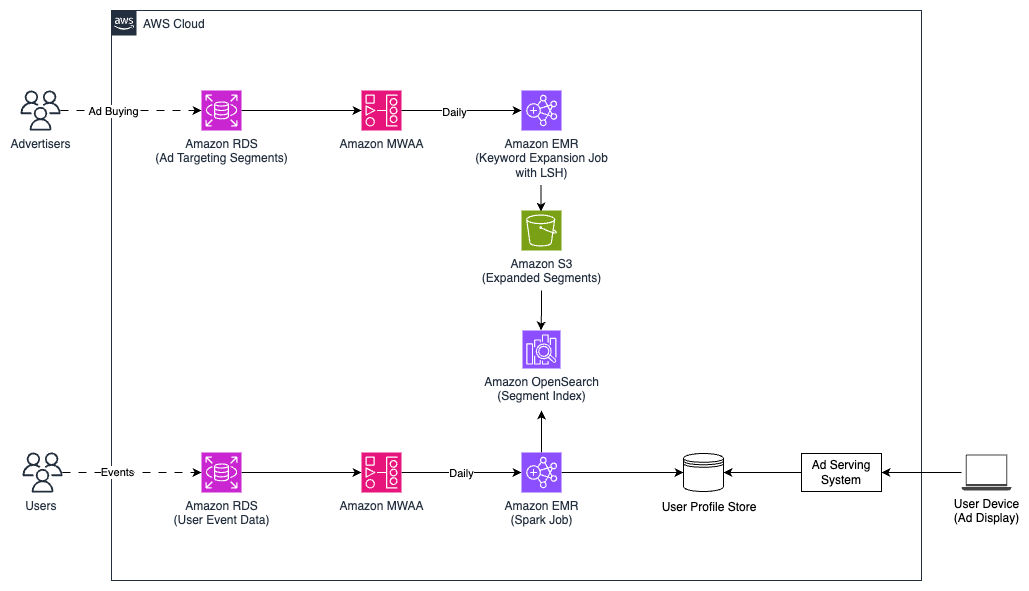
導入前に、従来の SRT ワークフローを振り返っておきましょう。以下の図のように、広告主はまず一連のターゲットキーワードを用いて各セグメントを定義します。このメタデータは SQL データベースに保存されます。その後、バックエンドシステムがキーワード拡張を実行し、意味的に関連する用語を生成することで、オーディエンスの到達範囲を広げ、広告主の成果向上を図ります。元のキーワードセットと拡張後のセットは両方とも Amazon OpenSearch Service クラスターに保存されます。
また、「バッチスコアリング」と呼ばれる別のワークフローでは、Yahoo ユーザーの検索履歴をこのセグメントメタデータと比較し、ユーザーがどのセグメントに属するかを判定します。
生成 AI で刷新されたアプローチ
従来の手法の限界を認識し、キーワード拡張を現代的な生成 AI ソリューションで刷新することが目標でした。この実現を支えたのが Amazon Bedrock です。サーバーレスで主要な基盤モデル(FMs)を幅広く利用可能にする Amazon Bedrock を活用することで、カスタムインフラを構築することなく、Amazon Nova や Meta Llama、Anthropic の Claude など複数の大規模言語モデル(LLM)を実験的に検証することができました。
新たなアプローチを検証する際、計算広告特有の重要な要件も考慮しました。具体的には以下の点です。
- 機密キーワードのフィルタリング
- セグメントごとの拒否リスト(denylists)
- ユーザーのプライバシー設定への対応
- ポリシー準拠要件の満たし方
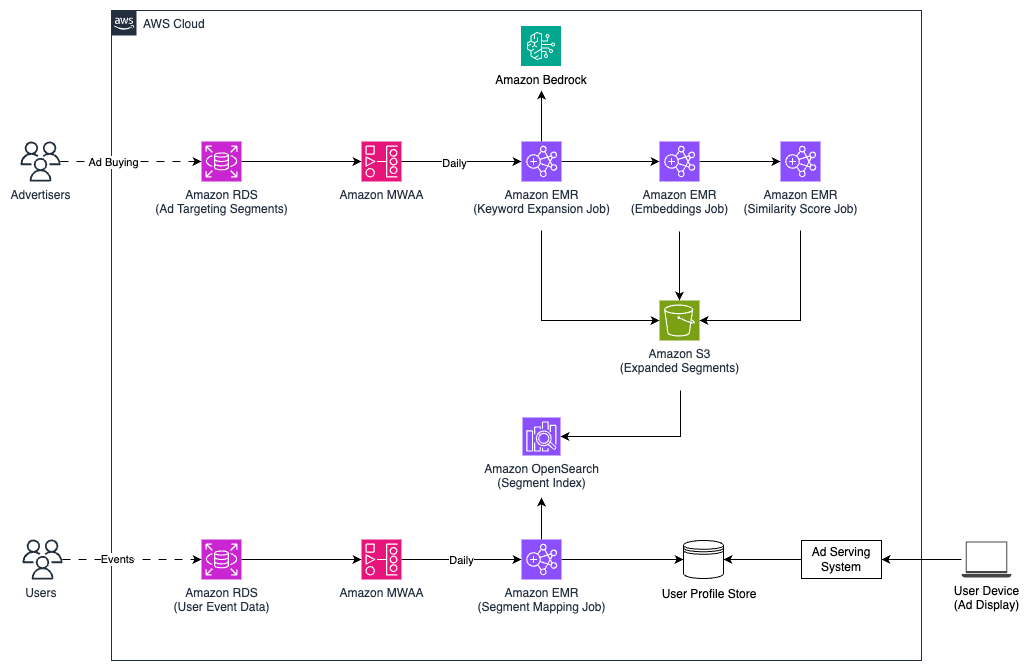
以下に、Amazon Bedrock と生成 AI を活用した更新後のアーキテクチャを示します。
LLM の選定と結果
LLM の選定と評価プロセスでは、Amazon SageMaker Studio を用いて Amazon Titan や Meta Llama、Anthropic の Claude など複数のモデルをプロトタイプ化し、検証を行いました。その結果、拡張率と意味的類似性のバランスが最も優れていた Anthropic の Claude 3.5 Sonnet v2 を、検索キーワード拡張のための最適なモデルとして選定しました。
評価プロセスでは、大規模言語モデル(LLM)からハルシネーション(幻覚現象)が観測されました。これを抑制し品質を維持するため、検証ステップを導入しました。LLM が生成した拡張キーワードは埋め込みベクトルに変換され、元のセットと比較されます。類似度が閾値を下回るキーワードはフィルタリングされ、最も関連性の高い用語のみが残される仕組みです。この検証ステップは、ワークフローの精度と信頼性を保つ上で中心的な役割を果たしています。
Amazon Bedrock を通じて展開した際、Claude 3.5 Sonnet v2 は従来の LSH(ローカル感度ハッシュ)法と比較して、拡張能力が著しく優れていました。LSH が全くキーワードを生成しなかったケースでも、数百乃至数千のキーワードを頻繁に生成しています。厳格な類似度閾値の下でも、広義の拡張比率の中央値は 5 倍に向上し、最大拡張比率も 2 倍になりました。以下のグラフをご参照ください。
全体として、生成 AI を活用したキーワード拡張により、取得されるキーワード数が増加し、かつ意味的に関連性のあるもののみが選別されます。これにより、検索ユーザーのターゲティング精度が大幅に向上しました。
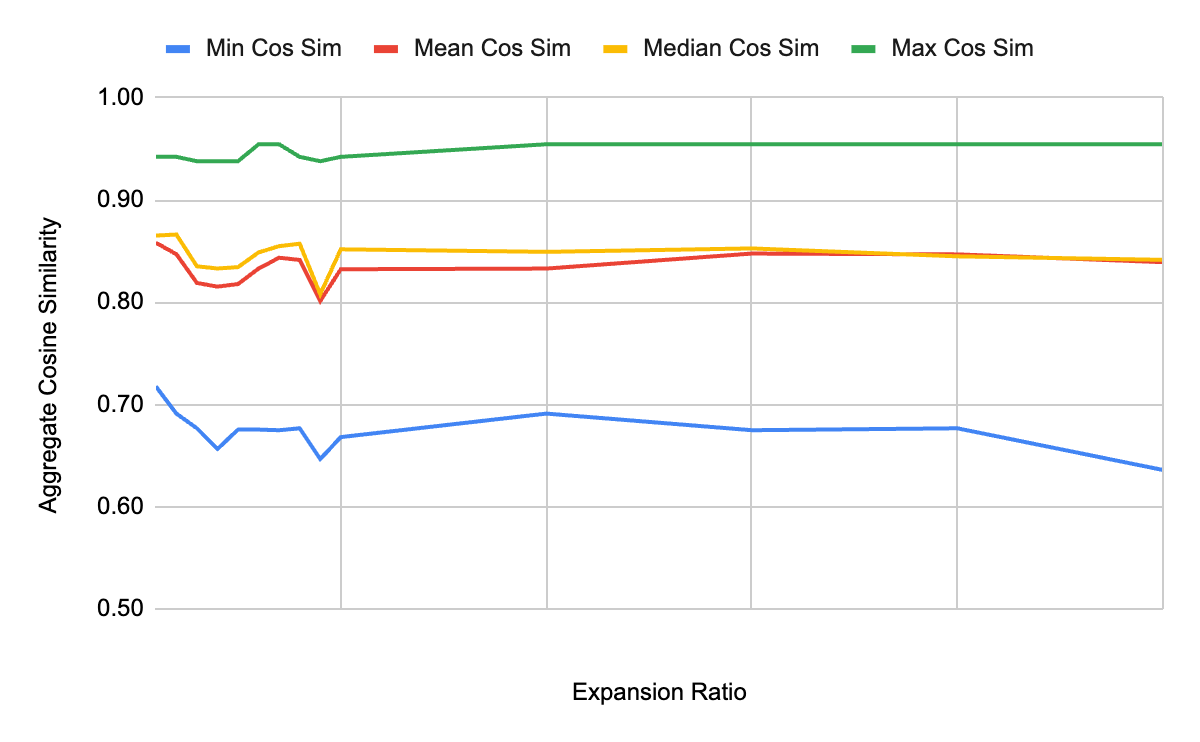
*LLM のキーワード拡張比率とコサイン類似度スコアの比較*
生成 AI ワークフローにおけるキーワード拡張のガードレール
当初、SRT(Search Retargeting)のキーワード拡張ワークフローを設計する際、私たちは拡張ステップにのみ注力していました。シードキーワードを入力し、生成 AI モデルを用いて関連性の高い用語のセットを広げるというアプローチでした。この手法は機能しましたが、いくつかの課題も生じました。
- 場合によってはモデルが過剰に拡張し、膨大な数のキーワードを生成してしまうこと。
- 稀な用語や曖昧なシードキーワードから、無関係またはノイズの多い拡張結果が導き出されること。
これらの問題は、品質管理メカニズムの必要性を浮き彫りにしました。そこで私たちは、エンベディング(埋め込み)の生成と類似度スコアリングを導入することでこの課題に対処しました。
埋め込みベクトルと類似度チェック
拡張された各キーワードに対して埋め込みベクトルを生成します。
その後、元のキーワードの埋め込みベクトルとの類似度スコアを計算し、定義された閾値を超えるキーワードのみを保持します。これにより、拡張されたキーワードが元の意図と意味的に整合していることを保証しています。
機密キーワードによるガードレール
意味的なフィルタリングに加えて、機密キーワードのチェックも実施しています。
不適切な用語の拡大を防ぐため推論前にフィルタリングを行い、推論後に機密性の高い拡張結果を除去する二段構えの仕組みです。
このように、類似度スコアと機密キーワードフィルタリングを組み合わせたガードレール付きキーワード拡張パイプラインを実現しました。生成 AI による拡張が持つ広範な可能性や創造性を保ちつつ、関連性、品質、コンプライアンスを維持するアプローチとなっています。
ビジネス価値とインパクト
この生成 AI を活用した強化されたキーワード拡張機能は、2025年第1四半期に本番環境で稼働を開始しました。
広告主への価値
広告主は、より広範かつ精密なオーディエンスリーチの恩恵を受けます。LLM(大規模言語モデル)を活用した拡張ロジックにより候補キーワードのプールが拡大しながら品質もフィルタリングされるため、ユーザーの意図に即したキャンペーンを構築できます。その結果、関連性の向上、エンゲージメントの強化、そしてコンバージョン率の改善につながります。
Yahoo DSP への価値
システム観点からは、新システムにより大幅なスケールアップが実現されました。
キーワード展開率が最大 600 倍に向上し、対象となるオーディエンスのリーチが最大 5 倍拡大。キャンペーンのパフォーマンスとコンバージョン率にも明確な改善が見られました。
LLM(大規模言語モデル)を活用してキーワード展開を近代化したことで、Yahoo DSP は広告主にとっての価値創出をより効果的に推進できるようになり、プログラムmatic 環境における競争優位性も強化されました。
Amazon Bedrock を選んだ理由
Amazon Bedrock を利用したことで、Yahoo チームは複雑なインフラの構築や管理を行うことなく、Amazon Nova や Meta の Llama、Anthropic の Claude など、複数の主要なファウンデーションモデル(FM)にサーバーレスでアクセスできるようになりました。この機能により、迅速な実験、ワークロードのスケーリング、そして柔軟なデプロイが可能となりました。
- 多様なモデルへの対応: Amazon Bedrock を活用すれば、複数の主要なファウンデーションモデルを素早く試すことができます。
- インフラ管理の不要化: LLM へのサーバーレスアクセスを提供するため、モデルのホスティングやスケーリング、パッチ適用といった作業が不要になります。
- 柔軟な推論オプション: バッチ処理とリアルタイム推論の両方に対応しており、迅速なプロトタイピングと意思決定を可能にします。
- シンプルなモデルアップグレード: Amazon Bedrock を使えば、より新しいバージョンや高度なモデルへの切り替えは設定変更だけで完了します。アーキテクチャが基盤インフラや互換性の課題を抽象化しているため、チームは最小限の労力で最新モデルを導入できます。
結論
本稿では、Yahoo DSP の中核製品である SRT(Semantic Retargeting Targeting)の概要と、生成 AI を活用したキーワード拡張の変革について解説しました。Amazon Bedrock を採用することで、インフラ管理の手間を省きながら、複数の主要な大規模言語モデル(LLM)にサーバーレスでアクセスできるようになりました。この機能により、広告主が提供する元のキーワードを、意味的に豊かで高品質なセットへと拡大することが可能になり、ターゲティング対象の規模と精度の両方を向上させることができました。
従来の Word2Vec と LSH を組み合わせたワークフローから、Amazon Bedrock 搭載の LLM へ移行した結果、より正確で文脈に即したキーワード拡張が実現しました。この新しいアプローチは、キャンペーンのパフォーマンス強化、コンバージョン率の向上、そして運用上の柔軟性の拡大をもたらしています。Amazon Bedrock がこの変革を可能にし、Yahoo DSP が AI を駆使した広告において、より迅速かつ効率的にスケールする手助けとなりました。
詳細については、Amazon Bedrock の詳細ページ や Amazon Bedrock ユーザーガイド をご覧ください。開発を始めるには、Amazon Bedrock コンソール を開いてください。
執筆者について

ジェシカ・ヤング
ジェシカは、Yahoo のソフトウェアエンジニアリングディレクターです。大規模分散システム上で AI/ML ソリューションを構築するエンジニアチームを率いています。生産環境での AI/ML システム構築における豊富な実務経験を持ち、自然言語処理や推薦エンジン、ビッグデータエコシステムに関する深い専門知識を有しています。
機械と人間の両方を理解することに情熱を注いでおり、新技術への強い好奇心を抱きつつも、個人を単なるリソースとしてではなく人間として尊重する「人第一主義」の文化を育むことにコミットし続けています。

スジュヨティ・アディガ
スジュヨティは、Yahoo のシニアソフトウェア開発エンジニアです。Yahoo Small Business、検索、広告の各事業でエンジニアリング経験を積んでいます。
文脈やオーディエンスに基づく広告ターゲティングシステム向けに、機械学習と AI を活用したソリューションを構築しています。大規模なコンテンツ理解に注力しており、生成 AI、モデルの蒸留、AWS サービス(Amazon EMR、Amazon Bedrock、Amazon SageMaker)を活用した分散データパイプラインなど幅広い領域で活動しています。
Yahoo Ads 向けのエンドツーエンドの文脈ターゲティングソリューションのアーキテクチャ構築にも貢献し、多言語コンテンツ分類における特許出願や査読付きの機械学習研究への寄与も果たしています。

ジョナサン・ジー
ジョナサン氏は Yahoo DSP のシニアソフトウェアエンジニアです。同社では、エージェント型 AI アシスタントや検索製品の設計、研究、構築を率いています。プロダクト、サイエンス、エンジニアリングのリーダーと密接に連携し、生成 AI を試作段階から本番環境へ移行させることを推進しています。
Yahoo では、生成 AI エージェントや大規模言語モデル(LLM)、MCP ツール、テキストおよび画像検索、機械学習、スケッチ推定、そして大規模処理・分散クエリプラットフォームを活用した革新的なプロダクトとサービスの開発に携わってきました。

ダニエル・リー
ダニエル氏は Amazon Web Services(AWS)のシニアソリューションアーキテクトです。戦略的顧客と連携し、スケーラブルなクラウド、データ、生成 AI のソリューション設計を担当しています。
エンジニアリングからエンタープライズ戦略まで 20 年以上にわたる経験を持つダニエル氏は、大規模なクラウド移行やモダナイゼーション、AI/ML 施策を主導してきました。顧客のビジネス目標を現実的な技術ロードマップへと変換し、AWS 上での生成 AI の導入加速をサポートしています。
原文を表示
Connecting user search intent with relevant ad experiences across channels is a longstanding challenge in digital advertising. Advertisers need sophisticated ways to reach audiences based on their demonstrated interests and behaviors, particularly their search activity, which is one of the strongest signals of user intent. Traditional keyword expansion approaches often struggle with outdated vocabulary, limited semantic understanding, and inability to capture the nuanced meaning behind search queries.
The Yahoo omnichannel Demand-Side Platform (DSP) addresses these challenges by providing advertisers with advanced technology, premium supply access, vast scale, and trusted consumer relationships. A DSP lets advertisers purchase ad inventory across multiple exchanges and channels through a single interface. Yahoo DSP enhances this capability with sophisticated audience targeting powered by advertiser-defined rules, machine learning (ML), and generative AI.
At the heart of this targeting is the concept of an audience segment: a group of users who share specific interests, demographics, or behaviors and can be targeted collectively in advertising campaigns. These segments are passed to targeting systems for ad serving, making sure that users are matched with the most relevant advertiser campaigns.
In this post, we demonstrate how Yahoo implemented Amazon Bedrock to enhance their Search Retargeting (SRT) capabilities in the Yahoo DSP ad tech suite. SRT is a core audience targeting solution that helps advertisers reach users based on their historical search behavior, bridging search intent with display, video, and native advertising. Beyond targeting keywords entered on Yahoo Search, SRT uses AI to identify and engage users who demonstrate intent through search activity both on Yahoo and across integrated partner systems.
Business challenges
Previously, the Yahoo SRT architecture used the Word2Vec embedding model combined with locality-sensitive hashing (LSH) to expand advertiser keywords. This multi-step process involved canonicalizing keywords, generating embeddings, indexing them, performing LSH searches, filtering sensitive terms, and ranking the results.
However, the Word2Vec + LSH approach had several limitations:
- Outdated vocabulary: It didn’t always reflect current terms.
- Phrase-based searches: It focused on phrases rather than specific entities.
- Syntactic similarity: Expansion relied on syntactic rather than semantic meaning.
- Zero expansion: In some cases, it failed to generate any new keywords.
We addressed these challenges by deploying generative AI–powered SRT keyword expansion using Amazon Bedrock and large language models (LLMs). This enhancement generates more relevant, semantically rich keyword expansions, helping advertisers reach larger and more precise audiences.
Solution overview
Before introducing the solution, it’s useful to review the legacy SRT workflow, illustrated in the following diagram. Advertisers begin by defining each segment through a set of target keywords. This metadata is stored in a SQL database. The backend system then performs keyword expansion, generating semantically related terms to increase audience reach and improve advertiser outcomes. Both the original and expanded keyword sets are persisted in an Amazon OpenSearch Service cluster. Another workflow called Batch Scoring evaluates Yahoo users’ search histories against this segment metadata to determine segment membership.
Modernized with generative AI
Recognizing the limitations of the legacy approach, our goal was to refresh keyword expansion with a modern generative AI solution. Amazon Bedrock made this work possible. By offering serverless access to a broad selection of leading foundation models (FMs), Amazon Bedrock helped our teams experiment with multiple LLMs, including Amazon Nova, Meta Llama, and Anthropic’s Claude, without building custom infrastructure.
In evaluating new approaches, we also factored in critical considerations for computational advertising, including:
- Filtering of sensitive keywords.
- Segment denylists.
- User privacy preferences.
- Policy compliance requirements.
The following diagram illustrates the updated architecture using Amazon Bedrock and generative AI.
LLM selection and results
During the LLM selection and evaluation process, we prototyped and assessed several models using Amazon SageMaker Studio, including Amazon Titan, Meta Llama, and Anthropic’s Claude. Ultimately, Anthropic’s Claude 3.5 Sonnet v2 was selected as the most effective model for search keyword expansion, balancing both expansion ratio and semantic similarity.
In the evaluation process, we observed hallucination behaviors from the LLMs. To reduce hallucinations and maintain quality, we introduced a verification step. Expanded keywords generated by the LLM are converted into embeddings and compared with the original set. Keywords falling below a similarity threshold are filtered out, making sure only the most relevant terms are retained. This validation step is central to maintaining accuracy and trust in the workflow.
When deployed through Amazon Bedrock, Claude 3.5 Sonnet v2 demonstrated substantially superior expansion capabilities compared to the legacy LSH method, frequently generating hundreds or even thousands of keywords in cases where LSH produced none. The median broad expansion ratio improved fivefold, and the maximum expansion ratio doubled, even under strict similarity thresholds. See the following graph.
Overall, generative AI–based keyword expansion increases the number of keywords retrieved and makes sure they are semantically relevant, significantly enhancing search user targeting.
*LLM keyword expansion ratio vs. cosine similarity score.*
Guardrailing keyword expansion in generative AI workflows
When we first designed our SRT keyword expansion workflow, we focused solely on the expansion step, taking seed keywords and generating a broader set of related terms using generative AI models. This approach worked, but it also introduced challenges:
- In some cases, the model over-expanded, producing a large set of keywords.
- Rare or ambiguous seed keywords sometimes resulted in unrelated or noisy expansions.
This highlighted the need for a quality control mechanism. To address this, we introduced embedding generation and similarity scoring:
- Embedding and similarity check.
For each expanded keyword, we generate an embedding.
- We then compute a similarity score against the original keyword’s embedding.
- Only keywords above a defined similarity threshold are retained.
- This makes sure that expanded keywords remain semantically aligned with the original intent.
- Sensitive keyword guardrails.
In addition to semantic filtering, we also apply checks for sensitive keywords.
- Filtering happens before inference (to avoid expansion of undesirable terms) and after inference (to remove sensitive expansions).
By combining semantic similarity scoring with sensitive keyword filtering, we created a guardrailed keyword expansion pipeline. This approach preserves the breadth and creativity of generative AI–driven expansion while maintaining relevance, quality, and compliance.
Business value and impact
This generative AI–based enhanced keyword expansion capability launched in production in Q1 2025.
Value to advertisers
Advertisers benefit from significantly broader and more precise audience reach. The LLM-powered expansion logic increases the pool of candidate keywords while filtering for quality, leading to campaigns that align more closely with user intent. This translates into higher relevancy, stronger engagement, and improved conversion rates.
Value to Yahoo DSP
From a system perspective, the new system delivers substantial scale improvements:
- Up to 600 times increase in keyword expansion rates.
- Up to 5 times growth in addressable audience reach.
- Gains in campaign performance and conversions.
By modernizing keyword expansion with LLMs, Yahoo DSP is better positioned to drive value for advertisers while strengthening its competitive edge in the programmatic environment.
Why Amazon Bedrock
Amazon Bedrock provided serverless access to multiple leading FMs, including Amazon Nova, Meta Llama, and Anthropic’s Claude, without requiring the Yahoo team to build or manage complex infrastructure. This capability helped us experiment rapidly, scale our workloads, and deploy flexibly.
- Breadth of models – Amazon Bedrock helped us experiment quickly with multiple leading FMs.
- No infrastructure management – Amazon Bedrock provides serverless access to LLMs, removing the need for model hosting, scaling, or patching.
- Flexible inference options – Amazon Bedrock provides both batch and real-time inference options for quick and flexible prototyping and decision making.
- Straightforward model upgrades with Amazon Bedrock – Switching to a newer or more advanced model version is a configuration change. Amazon Bedrock’s architecture abstracts away the underlying infrastructure and compatibility challenges, so teams can adopt updated models with minimal effort.
まとめ
In this post, we highlighted how SRT serves as a core product offering on Yahoo DSP and how we transformed keyword expansion using generative AI. By using Amazon Bedrock, our teams gained serverless access to multiple leading LLMs without the overhead of managing infrastructure. This capability helped us expand advertisers’ original keywords into semantically rich, high-quality sets, increasing both the size and precision of the targeting audience.
Replacing the legacy Word2Vec and LSH workflow with Amazon Bedrock–powered LLMs delivered more accurate, contextually relevant keyword expansions. The new approach drives stronger campaign performance, higher conversion rates, and greater operational flexibility. Amazon Bedrock made this transformation possible, helping Yahoo DSP scale faster and more efficiently in AI-driven advertising.
To learn more, see the Amazon Bedrock detail page and the Amazon Bedrock User Guide. To start building, open the Amazon Bedrock console.
About the authors
Jessica Young
Jessica is a Director of Software Engineering at Yahoo, where she leads engineering teams building AI/ML solutions on large-scale distributed systems. She brings extensive hands-on experience building production AI/ML systems, with deep expertise in natural language processing, recommendation engines, and Big Data ecosystems. She is equally passionate about understanding machines and understanding people, driven by a deep curiosity for emerging technologies while remaining committed to fostering a people-first culture that values individuals not merely as resources, but as human beings.
Sujyothi Adiga
Sujyothi is a Principal Software Development Engineer at Yahoo, with engineering experience across Yahoo Small Business, Search, and Yahoo Ads. She builds machine learning and AI-driven solutions for contextual and audience-based ad targeting systems, focusing on large-scale content understanding. Her work spans generative AI, model distillation, and distributed data pipelines using AWS services, including Amazon EMR, Amazon Bedrock, and Amazon SageMaker. She has helped architect end-to-end contextual targeting solutions for Yahoo Ads and has contributed to patent filings and peer-reviewed machine learning research in multilingual content classification.
Jonathan Ji
Jonathan is a Principal Software Engineer at Yahoo DSP, where he leads teams that design, research, and build agentic AI assistant and search products. He partners closely with product, science, and engineering leaders to take generative AI from prototype to production. At Yahoo, he has developed innovative products and services powered by generative AI agents, large language models, MCP tools, text and image search, machine learning, sketch estimation, and large-scale processing and distributed query platforms.
Daniel Li
Daniel is a Senior Solutions Architect at Amazon Web Services, where he partners with strategic customers to design scalable cloud, data, and generative AI solutions. With over 20 years of experience spanning engineering and enterprise strategy, Daniel has led major cloud migration, modernization, and AI/ML initiatives, helping customers translate business goals into pragmatic technology roadmaps and accelerate their adoption of generative AI on AWS.
AI算出
導入事例ainew評価標準
記事は生成 AI(LLM)と大規模言語モデルの応用が主テーマであり、従来の手法との比較や実装詳細が含まれているため ai_relevance は 0.75 と評価される。新規性は Yahoo の具体的な導入事例として一定の価値があるが、既存の技術紹介の延長線上にあるため novelty は 0.5 となる。検索機会は明確な製品名(Amazon Bedrock)を含むため 0.75。日本企業による直接的な発表や日本固有のコンテキストがないため japan_relevance は 0.25。
6つの評価軸を見る
- AI関連度
- 75
- 情報源の信頼性
- 100
- 新規性
- 50
- 調べる価値
- 75
- 重複の少なさ
- 100
- 日本での有用性
- 25
関連記事
今日のまとめ
AIデイリーブリーフで今日の重要ニュースをまとめ読み