[AINews] コデックスの利用者が半年で10倍以上に増加し700万人に、過去1日でさらに100万人増;コデックスはクロード・コードを追い抜いたのか?
OpenAI の Codex が半年でユーザー数が 10 倍超に急成長し、700 万人規模に達した一方、Claude Code は報告を控えている現状から、コーディング AI 市場の覇権争いが激化している。
キーポイント
Codex の爆発的ユーザー成長
OpenAI の Codex ユーザー数が半年で約 10 倍に増加し、700 万人規模に達したことが示唆されている。
Claude Code との比較分析
Claude Code は直近の公式データが数ヶ月前のものにとどまる一方、Codex の成長率を凌駕する可能性が議論されている。
市場動向と競合状況
GPT-5.6 のローンチや Claude Fable のサブスクリプション延長など、複数の要因が重なり合う中で、コーディング AI 分野の競争が激化している。
Prime Intellect の技術革新
エージェント型 RL(強化学習)のための環境スタック「Verifiers v1」をリリースし、評価と実行の効率化を図っている。
ロールアウトトレースの効率化と大規模学習の実現
メッセージを DAG として保存する設計により、履歴成長が O(n²) から O(n) に改善され、6 つの H200 ノードで 100B モデルの RL 学習を 2 日以内で完了可能になった。
ハッシュ設計とオーケストレーションが製品競争力の中心に
モデル性能だけでなく、タスク特化型のハッシュや「デザインモード」などのオーケストレーション技術が成果を決定する主要な差別化要因となっている。
コスト効率の基準がトークン価格からタスク単価へ移行
強力なモデルによる適切な委任と判断により不要な作業が減り、結果として高価なモデルでもタスクあたりのコストが低くなるケース(Fable 5 の事例)が確認された。
影響分析・編集コメントを表示
影響分析
このニュースは、コーディング支援 AI ツール市場における OpenAI の圧倒的な成長と、競合他社の戦略的沈黙が示す市場構造の変化を浮き彫りにしています。特に、ユーザー数の急増は開発者コミュニティの動向や、次世代モデル(GPT-5.6 等)への移行が加速していることを示唆しており、企業における AI ツール選定基準の見直しを迫る重要な指標となります。
編集コメント
Codex の成長速度は業界の注目を集めるに値しますが、Claude Code のデータ不足についてはツールの利用形態の違いによる統計の非対称性も考慮する必要があります。市場の覇権争いが激化する中、開発者体験(DX)の質が次の勝負どころとなるでしょう。
Allen が Engram CEO の Dan Biderman とともに『Latent Space Food』の最新回を公開したことをお祝いします。また、Prime Intellect 社が 10 億ドルの評価額と 1 億ドルの年間経常収益(ARR)、そして検証者 v1 を達成したことにも祝意を表します。
本日は比較的静かな一日となりました。まだ先週行われた複数の最先端モデルの発表内容を、読者が深く消化している最中だからです。「今日は特になんも起きませんでした」と書くところでしたが、私たちは「あなたが把握しておくべき外れ値的なトレンド」については、繰り返し情報を提供するというポリシーを持っています。
以下の Reddit の AINews まとめを振り返る中で、以前見落としていたツイートが浮上しました。それは以下のような内容です。
GPT-5.6 は 7 月 9 日にリリースされました。
7 月 12 日のこのツイートでは、直前の 48 時間(7 月 10 日〜12 日)にユーザー数が 600 万人に達したと報じられています。それから 24.5 時間後には Tibo が「700 万人」と報告しました。
…これは、Claude Code のサブスクリプションステータスが突然延長されたことと奇妙にも一致しています(両者の関連性があるかどうかは私どもにはわかりませんが、常時オンラインの陰謀論者たちは当然ながらこの二つを結びつけています)。
私たちはもちろん、Fidji が 3 月に Codex のユーザー数が 200 万人だと発表したことを記憶しています。これにより、AIE NYC 2025 のチャートを更新することが可能です(次回の AIE NYC は 2026 年です!)。
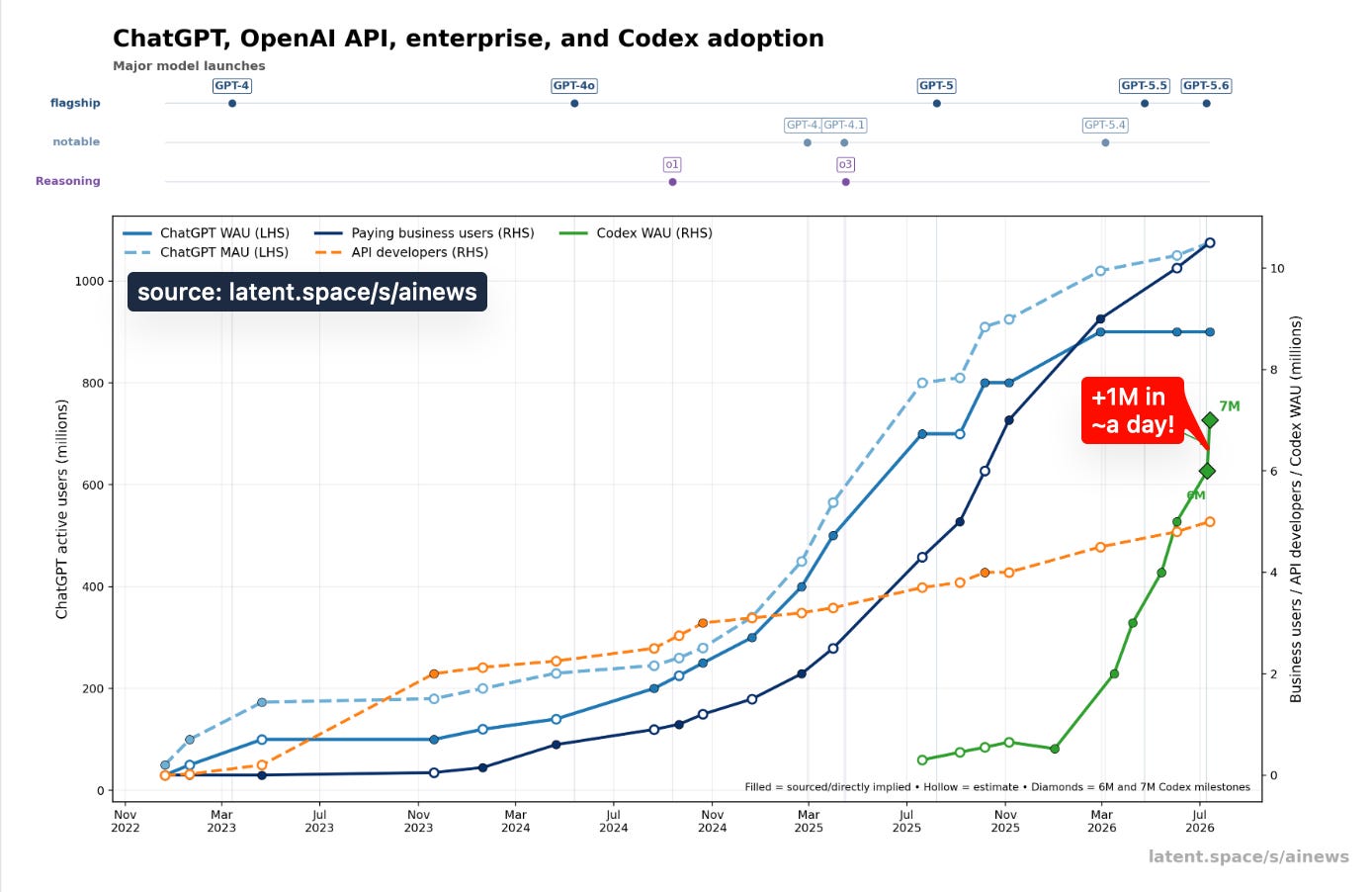
対照的に、Claude Code に関する最新の情報は、2 月に発表された約 200 万人のユーザー数と 25 億ドルの年間経常収益(ARR)が最後です。当時、「1 月 1 日(6 週間前)から週次アクティブユーザー数が倍増した」と報告されていました。
一方、Codex は年初に約 55 万人〜70 万人のユーザー数(Fidji の発言より)でスタートしました。このデータをもとに推測すると、Codex も Claude Code と同様の成長軌道を描き、現時点では年初から約 10 倍のユーザー増加を達成したと考えられます。
Claude Code が報告を控えていることに対する好意的な解釈としては、すでに数ヶ月前にコーディング業務の大部分を「Claude Tag」に移行し、現在はそちらへの集中を図っているという可能性があります。ただし、Slack ボットと CLI ツールではアクセシビリティが異なるため、単純に比較できる利用統計データにはならないでしょう。
それでも、6 ヶ月間で 10 倍の成長を達成したという数字は、非常に印象的です。
2026 年 7 月 11 日〜13 日の AI ニュース
今回は 12 のサブレッドと 544 件の Twitter、さらに Discord は確認しましたが追加情報はありませんでした。AINews のウェブサイトでは過去のニュースをすべて検索可能です。なお、AINews は現在「Latent Space」の一部門となっています。メール配信の頻度設定は自由にオンオフできます。
AI Twitter リキャップ
Agent RL インフラストラクチャ:Prime Intellect の Verifiers v1 とロング・ホライズン・ロールアウト
Prime Intellect が「verifiers v1」をリリースしました。これは、エージェント型強化学習(RL)と評価用環境スタックの大規模な再設計です。今回の改修の核心は、環境を「タスクセット」「ハルネス」「ランタイム」の 3 つに抽象化し、多様な実行環境におけるコーディングやコンピュータ操作を行うエージェント向けに、「自分で用意したハルネス(bring your own harness)」ワークフローを明示的にサポートする点にあります。この方針は、Johannes Hage の解説および続編の深掘り記事で強調されています。
チームメンバーたちは今回のリリースについて、数ヶ月にわたるインフラ近代化の成果であり、大きな効率向上をもたらしたと評価しています。willccbb、mikasenghaas、xeophon といったメンバーからの詳細なコメントも発表されました。
技術的な意義として最も重要なのは、ロールアウト(実行)のトレース記録が「メッセージ DAG(有向非巡回グラフ)」形式で保存されるようになった点です。これにより、各メッセージは履歴に繰り返しコピーされるのではなく、一度だけ保存されます。その結果、ターン数に対するトレース成長の計算量が O(n²) から O(n) に短縮され、長時間のマルチモーダルロールアウトやルーターの再生成が実用的なものになりました(Prime Intellect による)。チームはさらに、具体的な学習構成についても言及しました。100B パラメータを持つ推論モデルを、ユーザー提供のコーディングハルネス上で、40 ターン分の SWE エージェントタスクに対して 1,000 ステップの強化学習を行う場合でも、H200 グラフィックボード 6 台で 2 日以内に完了できるとのことです(willccbb)。この主張は、vLLM によるエコシステムサポートによって裏付けられました。vLLM は、verifiers のロールアウトパスが vLLM で実行可能であり、推論時と学習時のトークン化のズレを防ぐために正確なトークン ID や logprobs を使用できると指摘しています。
コーディングエージェント、ハルネス設計、そしてタスクあたりのコスト競争
ハルネス(オーケストレーター)が製品面の中心になりつつあります。複数の投稿で指摘されているように、モデルの品質だけが差別化要因ではもはやなくなり、ハルネスやオーケストレーターの質が結果を大きく左右するようになっています。
threepointone の発表は「ハルネスこそがアプリである」と要約され、LangChain は「勝つエージェント製品は汎用的なラッパーではなく、タスク特化型のハルネスから生まれる」と主張しました。Factory はこれに関連し、「デザインモード」という UI 側のアプローチを提案しています。これはユーザーが編集内容を言葉で再指定するのではなく、UI の要素やファイルを指すだけで済むというものです。
オーケストレーションの側面では、omarsar0 が価格変動やポリシー変更に対する保険として、モデル間でプロバイダーを切り替える機能を強調しました。
ベンチマークの評価基準も、「トークンあたりの価格」から「タスクあたりのコスト」へと移行しています。skirano はコーディングエージェントのインデックスエクスプローラーを構築し、Terra Max が Fable 5 Max よりわずかにスコアで上回っている一方で、圧倒的に低コストであるといった、コストと性能の重要なトレードオフを発見しました。
また Cognition の報告によると、Devin Fusion は現在 Fable 5 を採用しており、驚くべきことに、より強力な委任機能や判断力によって不要な作業を減らした結果、Opus 4.8 よりもタスクあたりのコストが低くなっているそうです。imjaredz はこれらの実験から重要な統計データを指摘しました。Fable が主導する実行の 81% で、リードモデルは一度もコード編集を行わないという事実です。つまり、無駄な行動を回避できる高価なモデルの方が、結果として安くなる可能性があるのです。
実世界におけるエージェントのベンチマークは、ますます詳細化されています。Arena は 7,800 件の実世界のアクティブなセッションに基づき、GPT-5.6 Sol をエージェントリーダーボードで 2 位にランク付けしました。同モデルは操作性が高く、タスク成功率も高いことが評価されました。その後、Arena は Grok-4.5 を 13 位に位置づけ、これは前バージョンの Grok 4.3 と比較すると大幅な進歩です。
Artificial Analysis もまた、長期的な知識作業におけるコスト効率を重要な指標として強調しました。トークン単価のみを追うだけでは、会話数や冗長さ、キャッシュヒット率といった要素の影響を見逃してしまうからです。一方、Parlance Labs による別の実験では、生産環境での音声エージェントのログデータを用いて、自動化評価プラットフォームと基盤モデルの故障分析能力を比較しました。
dair.ai が紹介した論文は、CLI コーディングエージェントの失敗がどのように発生するかという構造に焦点を当てています。単なる最終的な成功・失敗の結果だけでなく、実行が回復不能な状態に陥る具体的な地点を特定することに重点を置いています。
OpenAI GPT-5.6 Sol の動向と Codex の利用状況改善、そしてプロダクトの機能範囲拡大について
OpenAI は、Codex と Sol の利用急増に対する対応を透明性を持って行いました。最大の議論の的となったのは thsottiaux 氏で、ChatGPT Work や Codex における GPT-5.6 Sol の改善策について詳細を説明しました。具体的には、推論最適化により利用量が約 10% 増加した点や、課金・利用状況への悪影響を受け、コンテキスト制限を 372k から 272k に引き下げたこと、実験的な推論努力("juice")に関する変更の一部を元に戻したこと、そして高設定域におけるマルチエージェントの過剰な動作に対する修正などが含まれます。
コミュニティでは theo 氏による逆解析から、長期コンテキスト、サブエージェントの生成、高速モードといった複合要因が利用急増の原因ではないかとの指摘がありました。ただし、theo 氏は後続の投稿で課金に関する一部の情報を訂正しています。反応は二分されており、「弱体化(nerf)」という見方への批判(ns123abc)と、異例とも言える透明性への称賛(theo, sama)が交錯しました。
ユーザーからは、コーディングやコンピュータ操作における能力の高さが相次いで報告されています。複数の実践者が、OpenAI がコーディングモデル分野で主導権を握ったと指摘する一方、schrockn 氏もその見解に同意しています。また gdb 氏は、スタートアップの候補選定、ウェブデザイン、モバイル作業、サイト生成などにおいて、ChatGPT Work と Codex のワークフローを実演し続けています。
特に印象的なデモとして、Blender の経験がなかった Star_Knight12 氏が Cursor で Sol を使い、Blender MCP をセットアップして浮遊する MacBook をレンダリングした事例や、petergostev 氏が GPT-5.6 Sol Ultra を用いて SQL でドゥーム(Doom)のようなゲームを構築した事例が挙げられます。
製品レベルでの展開は続いています。ChatGPT アプリは、欧州経済領域(EEA)における WhatsApp への復帰に加え、カカオトークや Viber のサポートを他の市場でも開始したと発表しました。また、OpenAI Devs では「OpenAI Build Week」の応募受付を開始しています。OpenAI エコシステム全体を要約すると、gdb は「モノづくりができるようになった」という一言でこの瞬間を表現しています。
オープンモデル、推論システム、そして量子化について
Transformer と vLLM の統合により、モデル実装の重複が解消されました。Clement Delangue 氏は、オープンな推論の使いやすさが大幅に改善された点を強調しました。現在では Hugging Face の Transformers モデルを vLLM でネイティブ速度で実行できるようになり、手書きの実装と同等かそれ以上の性能を発揮するケースも出ています。この傾向が広く一般化すれば、新しいアーキテクチャを「研究・トレーニング用」と「高性能推論用」の 2 回実装するという長年の負担が軽減され、新たなオープンモデルアーキテクチャの普及が加速する可能性があります。
量子化は依然として重要な手段です。waterloo_intern は、既存のアプローチ(NVIDIA の ModelOpt など)を上回る新しい量子化手法をプレビューしました。この手法は、より迅速に層ごとの精度配分を見つけ出し、より積極的な量子化と高いベンチマークスコアを実現するものです。これに続く形で、Unsloth が GGUF、NVFP4、FP8 を含む LLM の量子化とデプロイに関する AWS ガイドを公開しました。また、nrehiew_ 氏からは fp4(4 ビット浮動小数点)を用いた RL や推論に関する実践的なコメントも寄せられ、低ビット数のポストトレーニングが、品質の低下を抑えつつ安価な推論サービスを実現する可能性があると指摘されています。
GLM-5.2 をはじめ、ローカルやオープンソースのコーディングスタックの利用がさらに広がっています。実際、複数のユーザーが本番環境でのワークフローをオープンまたは準オープンな構成へ移行したと報告しています。
juanju cm は GLM-5.2 を用いたコーディングエージェントのワークフロー構築について詳しく解説しました。一方、TheZachMueller 氏は、Claude から GLM 5.2 NVFP4 と Kimi K2.7 Code NVFP4 を組み合わせたスタックへ、実際の業務パイプラインを移行したと報告しています。この構成は 8 台の B200 ノードで動作し、コストは数セントで済むものの、処理にかかる実時間(ウォークロック)は若干遅くなるものの、より詳細なレポートが得られるとのことです。
また、nutlope 氏も GLM-5.2 を基盤に再構築した「LlamaCoder v4」をリリースしました。
エージェントツールにおけるセキュリティ、プライバシー、データ管理
Grok Build のコードアップロードをめぐる論争:最も重要なセキュリティ関連のニュースは、IntCyberDigest と hrkrshnn 氏による指摘でした。彼らは xAI が提供する「Grok Build CLI」が、コーディングタスクに必要な範囲を超えて、プライベートなコードや機密情報を含むリポジトリ全体を Google Cloud のバケットへアップロードしていると主張しました。
批判の焦点は、アップロードのスコープの広さ、サーバー側での無言の対策、そしてデータ保持・削除に関する保証が不明確である点にありました。これにより、エージェントツールが実際にどのようなデータを転送しているのか、またなぜ「オプトアウト」のユーザー体験と実際の通信レベルの挙動が乖離するのかという議論が広がりました。
xAI の回答では ZDR(ゼロデータリテンション)とプライバシー制御を強調:SpaceXAI は、ゼロデータリテンション設定を利用するチームについては、トレース情報やコードデータは保持されず、API キーの使用も ZDR に準拠していること、また「/privacy」コマンドを実行することで保持機能を無効化し、以前に同期されたデータを削除できると回答しました。これは運用上の疑問には一定の答えを示しましたが、デフォルト動作、過去にアップロードされたデータ、そして開示の慣習に関するコミュニティの懸念を完全に解消したわけではありません。
信頼境界(トラスト・バウンダリー)をめぐる議論は、オープンとクローズドの対立軸として中心に位置し始めています。この一件をきっかけに、複数の投稿者が議論を広げました。
mchiang0610 氏と jmorgan 氏は、オープンモデルが単なるコスト削減のためではなく、人間と AI の学習ループに対するコントロール権や、組織内の知識資産を社内に保持できる点にこそ価値があると主張しました。一方、Arav Srinivas 氏は、ZDR(ゼロデイレスポンス)の可用性が、Perplexity が Grok 4.5 を Computer ハーネスへ迅速に統合した理由の一つだと指摘しています。
継続学習、マルチモーダルシステム、そして研究の方向性
継続学習(Continual Learning)は、もはや単なる課題ではなく、システム設計における第一級の課題として再浮上しています。ysu_nlp 氏は、すべての組織が独自の人間と AI の学習ループを所有する世界を実現するには、継続学習の問題解決が不可欠であり、現在の手法であるメモリ活用や RAG(検索拡張生成)、ドメイン特化の事後トレーニング、タスクベースの強化学習(RL)ではまだ不十分だと論じました。
このテーマは、skyfallai による新たな研究でも繰り返されています。同チームは「Morpheus」というプロジェクトを発表しました。これは世界がリセットされない現実世界の強化学習を可能にする、永続的な企業向けシミュレーションです。fchollet 氏はこれを評価し、固定されたエピソード型の RL に比べ、実際のデプロイ環境に即したベンチマークであると endorsing しています。
大規模言語モデル(LLM)における「睡眠と夢」:Behrouz Ali 氏ら共同研究者は、短期記憶を長期記憶へ定着させるための「睡眠フェーズ」と、再帰的な自己改善のための「夢フェーズ」が LLM に必要かもしれないと提案しました。彼らは「知識の種まき(Knowledge Seeding)」という手法を導入し、継続学習や推論タスクにおける効果を実証しています。この考え方は、現在の継続学習の手法に対する広範な不満とも合致しており、リッチ・サットン氏らによる新ベンチャー「Oak Lab」の方向性とも重なります。同ラボは、標準的な LLM パイプラインではなく、経験から学ぶ動物のような知能の実現を目指しています。
LLM エージェントに依存しない研究も多数発表されました。注目すべき成果として、Sakana AI がモジュール型システムにおける分散型の自己認識と修復を可能にする「スマート・セルラー・ブリックス(Smart Cellular Bricks)」を発表しました。ByteDance は、視覚的なデモンストレーションから直接推論やダイナミクス、計画学習を行うとされる「UniVR-34B」を紹介しています。Google DeepMind は過去の事象を推測するワークフロー向けの「Predicting the Past(過去予測)」スキルを発表しました。また Anthropic は、匿名化された 30 万件以上の会話データを分析し、Claude の表現する価値観がモデルや言語によってどう変動するかを調査した研究結果を公開しています。
エンゲージメント数の多い注目ツイート
OpenAI Codex/Sol の利用状況と修正:thsottiaux氏が GPT-5.6 における Sol の利用、コンテキストの扱い、「ジュース(リソース)」、そしてマルチエージェント環境での修正について言及。
Grok Build のプライバシーインシデント:IntCyberDigest が xAI クラウドバケットへのフルリポジトリアップロード問題を取り上げました。
OpenAI の対応態度とユーザーへの扱い:sama 氏より「最高のモデルを求めて来て、我々があなたを軽蔑して扱わないからこそ留まるのだ」というメッセージが寄せられました。
Prime Intellect の展開効率:willccbb氏が、6 H200 を用いて 40 ターン分の SWE RL(ソフトウェアエンジニアリング強化学習)データで、100B パラメータの推論モデルを 2 日未満でトレーニングする方法について語る
Anthropic の研究重視の姿勢:30 万回以上の会話データを分析し、モデルや言語によって価値観の表現がどう変わるかについて Anthropic が解説
Transformers と vLLM の相互運用性:Clement Delangue氏が、Transformers モデルをネイティブ速度で vLLM で実行する方法について語る
AI Reddit まとめ
/r/LocalLlama と /r/localLLM のまとめ
- 廃棄 GPU を活用した推論ベンチマークと対策
続きを読む
原文を表示
Congrats to Allen for the next episode of the Latent Space Food show with Engram CEO Dan Biderman today, and to the Prime Intellect folks on their 1B valuation, $100M ARR, and verifiers v1.
Today was pretty quiet and people are still deeply digesting last week’s multiple frontier model launches. We were going to write “not much happened today”, but we also have a policy of updating you repeatedly on outlier trends that you should really be on top of. In reviewing the Reddit AINews recaps below surfaced this post, we saw a tweet we had missed before -
GPT 5.6 was launched on July 9.
This tweet on July 12 says they hit 6M users in the prior 48 hours (Jul 10-12).
Then 24.5 hours later Tibo reports 7M users…
…oddly coinciding with a surprise extension of Claude Fable’s subscription status (we have of course no idea if the two are related, but the permanently online conspiracy theorists are of course making a connection).
We of course recall Fidji’s March disclosure of 2M Codex users, which allows us to update our AIE NYC 2025 chart (AIE NYC 2026 is next!):
Comparatively, the last update we got about Claude Code is the roughly 2M users and $2.5B ARR in Feb (“The number of weekly active Claude Code users has also doubled since January 1 [six weeks ago]."). Now we have a sense of where Codex started the year (Fidji puts the Jan 1 number at around 550k-700k users), we can reasonably conclude that Codex has followed a similar trajectory and is now around 10x user growth year to date.
The charitable interpretation on Claude Code’s comparative silence on reporting, of course, is that they moved the bulk of coding to Claude Tag months ago and are now focusing users there, which will have different/hard to compare usage statistics given the different accessibility of a Slackbot vs a CLI tool.
But 10x growth in 6 months is an impressive number to beat nonetheless.
AI News for 7/11/2026-7/13/2026. We checked 12 subreddits, 544 Twitters and no further Discords. AINews’ website lets you search all past issues. As a reminder, AINews is now a section of Latent Space. You can opt in/out of email frequencies!
AI Twitter Recap
Agent RL Infrastructure: Prime Intellect’s Verifiers v1 and Long-Horizon Rollouts
Prime Intellect’s verifiers v1: Prime Intellect released verifiers v1, a substantial redesign of its environment stack for agentic RL and evals. The key abstraction splits environments into a taskset, harness, and runtime, explicitly supporting “bring your own harness” workflows for coding and computer-use agents across heterogeneous execution setups, as highlighted by Johannes Hage and in a follow-up deep dive. The release was framed by team members as months of infra modernization work with major efficiency gains, including richer commentary from willccbb, mikasenghaas, and xeophon.
Why it matters technically: one of the most important underlying changes is that rollout traces are now stored as message DAGs, so each message is stored once instead of repeatedly copied into full histories; that shifts trace growth from O(n²) to O(n) in turn count, making long-horizon multimodal rollouts and router replay much more practical, per Prime Intellect. The team also claimed a concrete training configuration: a 100B reasoning model, on 40-turn SWE agent tasks, in a user-supplied coding harness, for 1000 RL steps, using 6 H200 nodes in under 2 days (willccbb). That claim was reinforced by ecosystem support from vLLM, which noted verifiers’ rollout path runs on vLLM with exact token IDs/logprobs to avoid tokenization drift between serving and training.
Coding Agents, Harness Design, and Cost-Per-Task Competition
Harnesses are becoming the product surface: several posts converged on the idea that model quality is no longer the only differentiator; the harness/orchestrator increasingly determines outcomes. threepointone’s talk was summarized as “the harness is the app,” while LangChain argued that winning agent products will come from task-specialized harnesses, not generic wrappers. Factory pushed a related UI angle with “design mode,” where users point at UI elements/files instead of verbally re-specifying edits. On the orchestration side, omarsar0 emphasized provider-switching across models as a hedge against pricing/policy churn.
Benchmarks are moving from token price to cost per task: skirano built a coding-agent index explorer and found notable cost/perf tradeoffs such as Terra Max slightly ahead of Fable 5 Max on score for materially lower cost, while Cognition reported that Devin Fusion now uses Fable 5 and that, surprisingly, it can be lower cost per task than Opus 4.8 because stronger delegation and judgment reduce unnecessary work. imjaredz highlighted the key stat from those experiments: in 81% of Fable-led runs, the lead model never makes a code edit, implying expensive models can be cheaper when they avoid wasted actions.
Real-world agent benchmarks are getting denser: Arena placed GPT-5.6 Sol at #2 on its agent leaderboard based on 7.8K real-world agentic sessions, with strong steerability and task success; later, Arena put Grok-4.5 at #13, a significant jump over Grok 4.3. Artificial Analysis also emphasized cost per task as an increasingly important metric for long-horizon knowledge work, arguing token pricing alone misses effects from turns, verbosity, and cache hit rates. Separate evaluation work from Parlance Labs compared automated eval platforms and foundation models on failure analysis over production voice-agent traces, while dair.ai highlighted a paper on the anatomy of CLI coding-agent failures, focusing on where runs become unrecoverable rather than only final pass/fail.
OpenAI GPT-5.6 Sol, Codex Usage Fixes, and Product Surface Expansion
OpenAI addressed Codex/Sol usage burn transparently: the biggest operational thread came from thsottiaux, who explained several fixes for GPT-5.6 Sol in ChatGPT Work/Codex: inference optimizations yielding roughly 10% more usage, a rollback of context limit from 372k to 272k after billing/usage side effects, reversion of some experimental reasoning-effort (“juice”) changes, and fixes for overactive multi-agent behavior at high/xhigh settings. Community reverse-engineering from theo proposed that compounding factors around long context, subagent spawning, and fast mode were behind the severe burn, though he later corrected one billing detail in a follow-up. Reactions split between criticism of a perceived “nerf” narrative (ns123abc) and praise for unusual transparency (theo, sama).
Users are reporting strong coding/computer-use capability: multiple practitioners argued that OpenAI has taken the lead on coding models, including schrockn, while gdb repeatedly showcased ChatGPT Work and Codex workflows for startup prospecting, web design, mobile work, and site generation. Particularly illustrative user demos included Star_Knight12 using Sol in Cursor to set up Blender MCP and render a floating MacBook without prior Blender experience, and petergostev showing GPT-5.6 Sol Ultra building a Doom-like game in SQL.
Product-level expansion continues: ChatGPTapp announced ChatGPT’s return to WhatsApp in the EEA, plus Kakao/Viber support in additional markets. OpenAIDevs opened submissions for OpenAI Build Week. Across the OpenAI ecosystem, gdb summarized the moment succinctly: “you can just create things.”
Open Models, Inference Systems, and Quantization
Transformers↔vLLM integration removes duplicated model implementation work: Clement Delangue highlighted a major open-inference usability improvement: Hugging Face Transformers models can now run in vLLM at native speed, often matching or exceeding hand-written implementations. If this generalizes broadly, it reduces the long-standing burden of implementing each new architecture twice—once for research/training and once for high-performance serving—and could materially accelerate adoption of new open model architectures.
Quantization remains a major lever: waterloo_intern previewed a new quantization method claimed to beat existing approaches, including NVIDIA’s ModelOpt, by finding better layerwise precision assignments faster, with more aggressive quantization and higher benchmark scores. Complementing that, Unsloth published an AWS guide to LLM quantization and deployment spanning GGUF, NVFP4, and FP8. There was also practitioner commentary around fp4 RL / fp4 serving from nrehiew_, arguing low-bit post-training may enable cheap serving with limited quality loss.
GLM-5.2 and local/open coding stacks continue to gain traction: several users described moving real workflows onto open or semi-open setups. juanjucm wrote up using GLM-5.2 for coding-agent workflows, while TheZachMueller reported migrating one actual work pipeline from Claude to a stack built around GLM 5.2 NVFP4 plus Kimi K2.7 Code NVFP4 on an 8xB200 node, getting denser reports for pennies albeit at slower wall-clock latency. nutlope also released LlamaCoder v4, rebuilt around GLM 5.2.
Security, Privacy, and Data Control in Agent Tooling
Grok Build code upload controversy: the most consequential security story came from IntCyberDigest and hrkrshnn, who alleged that xAI’s Grok Build CLI was uploading entire repositories—including private code and secrets—to a Google Cloud bucket, far beyond what was needed for the coding task. The criticism centered on scope, silent server-side mitigation, and unclear retention/deletion guarantees. This triggered broader discussion about what agent tools actually transmit and why opt-out UX can diverge from wire-level behavior.
xAI’s response emphasized ZDR and privacy controls: SpaceXAI replied that for teams using zero data retention, trace and code data is not retained, API key use respects ZDR, and the /privacy command can disable retention and delete previously synced data. That answered some operational questions but did not fully resolve community concern around default behavior, prior uploads, and disclosure norms.
Trust boundaries are becoming a central open-vs-closed argument: several posts extended the conversation beyond this incident. mchiang0610 and jmorgan argued that open models are not just about cost but about control over the human-AI learning loop and keeping institutional knowledge in-house. Arav Srinivas said ZDR availability was one reason Perplexity integrated Grok 4.5 quickly into its Computer harness.
Continual Learning, Multimodal Systems, and Research Directions
Continual learning is re-emerging as a first-class systems problem: ysu_nlp argued that a world where every organization owns its own human-AI learning loop depends on solving continual learning, and that current approaches—memory/RAG, domain post-training, task RL—are not yet sufficient. That theme recurred in new work from skyfallai, which introduced Morpheus, described as a persistent enterprise simulation for real-world RL where the world does not reset; fchollet endorsed it as a benchmark better aligned with real deployment than stationary episodic RL.
“Sleep and dreaming” for LLMs: behrouz_ali and coauthors proposed that LLMs may need a sleep phase to consolidate short-term into long-term memory plus a dreaming phase for recursive self-improvement, introducing Knowledge Seeding and reporting benefits on continual learning/reasoning tasks. This dovetails with broader dissatisfaction around current continual-learning recipes and with Oak Lab, the new venture from Rich Sutton and collaborators pursuing animal-like intelligence that learns from experience rather than today’s standard LLM pipeline.
A broad spread of non-LLM-agent research shipped: notable items included Sakana AI’s Smart Cellular Bricks for decentralized physical self-recognition and repair in modular systems; ByteDance’s UniVR-34B, described as learning reasoning/dynamics/planning directly from visual demonstrations; Google DeepMind’s Predicting the Past skill for historical inference workflows; and Anthropic’s research on how Claude’s expressed values vary across models and languages based on analysis of 300K+ anonymized conversations.
Top tweets (by engagement)
OpenAI Codex/Sol usage fixes: thsottiaux on GPT-5.6 Sol usage, context, “juice,” and multi-agent fixes
Grok Build privacy incident: IntCyberDigest on full-repo uploads to xAI cloud buckets
OpenAI response tone and user treatment: sama: “come for the best model, stay because we don’t treat you with contempt”
Prime Intellect rollout efficiency: willccbb on training a 100B reasoning model for 40-turn SWE RL on 6 H200s in under 2 days
Anthropic values research: Anthropic on model/language-dependent value expression across 300K+ conversations
Transformers + vLLM interoperability: Clement Delangue on running Transformers models in vLLM at native speed
AI Reddit Recap
/r/LocalLlama + /r/localLLM Recap
- E-Waste GPU Inference Benchmarks and Fixes
Read more
関連記事
今日のまとめ
AI日報で今日の重要ニュースをまとめ読み