Meta AI、ターミナルコーディングエージェント「Muse Code」を公開
本文の状態
日本語全文を表示中
詳細モードで約8分の本文を読めます。
同じ出来事の情報源
この情報源を基点に整理
MarkTechPost
Meta AI は Muse Spark 1.2 モデルを搭載した「Muse Code」をベータ版としてリリースし、大規模リポジトリにおける計画策定、コード記述、結果検証を一貫して行うエージェントを提供する。
AI深層分析を開く2026年8月6日 05:45
AI深層分析
キーポイント
ターミナル型コーディングエージェントの登場
Meta AI は Muse Spark 1.2 モデルを搭載した「Muse Code」をベータ版としてリリースし、大規模リポジトリにおける計画策定、コード記述、結果検証を一貫して行うエージェントを提供する。
非同期バックグラウンドエージェントによる効率化
タスクごとに起動されるのではなくセッション全体で常駐する専用エージェントが動作し、重複情報の収集を回避して複雑な多段階タスクのレイテンシとステアリングコストを削減する。
再現性と耐障害性を担保するローカルイベントログ
すべてのモデル呼び出し、ツール実行、承認、編集を記録するローカルの追加専用イベントログを採用し、クラッシュ後も停止した地点から正確に再開可能な「リプレイ・エクサクト」な動作を実現する。
Muse Spark 1.2 モデルの学習特性と性能向上
同モデルはコード生成、複雑なデバッグ、コードベース理解、エンドツーエンドの開発ワークフローにおいて前世代から改善され、ハッチ自体との共同訓練(co-training)により強化された。
Muse Spark 1.2 と Muse Code の共同トレーニングと長期ホライズン対応
Muse Spark 1.2 は Muse Code と共に再トレーニングされ、拒否サンプリングされた軌道データやレシピ最適化を活用している。このモデルは計画、ゴール条件付け、コンテキスト圧縮を用いて、リポジトリ全体の生成や大規模なエンドツーエンドプロジェクトの作成を可能にする。
重要な引用
Muse Code targets complex software engineering across large repositories: it plans changes, writes code, and validates the results.
A local append-only event log records every model call, tool run, approval, and edit, which Meta calls replay-exact and restart-safe.
These specialized agents remain active throughout each session. They are not spawned for individual tasks, which Meta says avoids redundant information gathering.
Muse Code is a beta terminal coding agent for macOS and Linux, powered by Muse Spark 1.2.
編集コメントを表示
編集コメント
ターミナル環境で完結し、セッション全体を管理するエージェントというアプローチは、開発者のワークフローに深く統合される可能性を示唆している。共同訓練によるモデル強化とイベントログによる耐障害性の確保は、実運用における信頼性を高める重要な要素となる。
Source Article
元記事を日本語で読む
本文に関係しない購読案内、埋め込み通知、サイト内プロモーションは除いています。
Meta AI は、最新モデル「Muse Spark 1.2」を搭載したターミナル型コーディングエージェント「Muse Code(ベータ版)」を公開しました。同社は、この製品とモデルを次世代のフロンティアへの一歩として位置づけており、さらに大規模なモデルも開発中です。
Muse Code は大規模リポジトリにまたがる複雑なソフトウェアエンジニアリングタスクを対象としています。変更計画の立案、コードの実装、結果の検証を一貫して行います。セッション全体を通じて常駐する非同期バックグラウンドエージェント群が機能し、タスクごとに新規起動する従来の方式とは異なります。また、すべてのモデル呼び出し、ツール実行、承認、編集を記録するローカル向けの追加専用イベントログを採用。Meta はこれを「リプレイ完全(replay-exact)」かつ「再起動安全(restart-safe)」な仕組みと呼んでいます。
Muse Spark 1.2 モデルは、この運用基盤自体と共同でトレーニングされています。さらに Meta は、最大 24 時間にわたり 1,000 回以上のツール呼び出しを処理したケーススタディも公開しました。
導入可能か?
はい、可能です。Muse Code はベータ版として macOS および Linux で利用でき、以下のコマンドでインストールできます。
curl -fsSL https://dev.meta.ai/install.sh | bash
Muse Spark 1.2 は Muse Code と Meta Model API の両方で利用可能になり、グローバルなアクセス範囲も拡大しました。発表記事にはダウンロード可能な重み(weights)についての言及はないため、これはホスト型依存関係として扱う必要があります。
企業レベルでは:API パスはあらゆる規模の組織に適しています。Muse Code パスは、すでにサンドボックス内でエージェントを実行し、レビューゲートを設けているチームに最適です。
産業別:ソフトウェア・SaaS、開発者向けツール、フィンテックエンジニアリング、GPU および推論インフラストラクチャ、半導体・HPC(高性能計算)など。
主な用途:リポジトリ規模のリファクタリングと移行、長期間にわたるバグのトリアージ、テスト生成、GPU カーネル最適化など。
Muse Code は、シンプルなエージェントループと一連の非同期バックグラウンドエージェントで構成されています。これらの専門化されたエージェントはセッション全体を通じて常時稼働しており、個別のタスクのために生成されるわけではありません。Meta によれば、これにより重複する情報収集が回避されます。各エージェントは次のステップを実行し、メインのエージェントへの報告タイミングを自ら判断します。この永続的な設計により、複雑な多段階タスクにおけるレイテンシの削減と制御性の向上を実現しています。
ランタイム設計
Muse Code はローカルイベントログを採用しています。モデル呼び出し、ツール実行、承認、編集などすべての操作がここに順次記録されます。Meta はこれを「単一の真実源」と呼び、完全な再生性と再起動耐性を保証します。システム障害が発生してもエージェントは停止した位置から正確に再開できるため、長時間実行されるタスクも失敗に耐えられます。
標準機能の統合
このエージェントには 3 つのデフォルト機能が搭載されています。/plan はタスクを承認ゲート付きの計画に変換します。/grill はその計画が破綻するまで徹底的なストレステストを実行し、/goal は指定された目標の成功達成に向けて作業を進めます。
Muse Spark 1.2 の変更点
Muse Spark 1.2 は、Muse Spark 1.1 をコード生成に特化させたアップデートです。Meta はコード生成能力、複雑なデバッグ、コードベースの理解、そしてエンドツーエンドの開発ワークフローにおいて性能向上を報告しています。研究チームはコーディングタスクにおける計算リソースを大幅に拡大し、環境の多様性も拡張しました。このモデルは一般エージェントを含む他の分野での強みも維持しています。
重要なトレーニングの詳細は以下の 3 点です:
ハルネスとの協調学習:Muse Spark 1.2 は Muse Code と共同でトレーニングされました。トレーニングには、拒否サンプリングされたハルネスの軌跡や、ゴール、圧縮、サブエージェント向けのレシピ最適化が含まれています。ハルネスとの互換性を最大化するために、Muse Code のツールセットが統合されています。
長期ホライゾンの学習:トレーニングは、リポジトリ全体の生成、大規模なエンドツーエンドプロジェクト、そして自動研究をカバーしています。モデルは、計画立案、ゴール条件付け、コンテキスト圧縮を活用して進捗を維持します。
自己改善:Muse Spark 1.1 は、挑戦的なコーディング環境や指示に従うテンプレートを作成し、候補となる解決策がそれらの要件を満たすかを評価しました。これにより、1.2 のためのスケーラブルなトレーニングデータセットが生成されました。
 imagehttps://research.meta.ai/blog/introducing-muse-code-and-muse-spark-1-2
評価
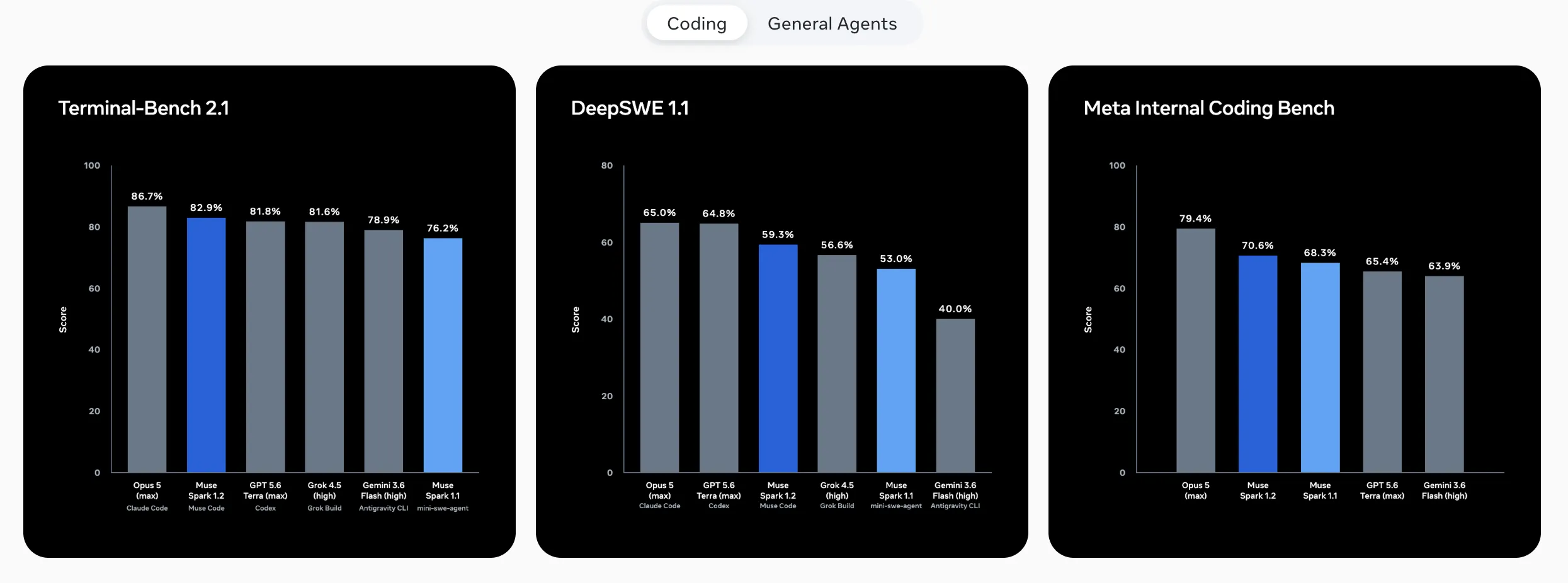
Meta の手法報告書は、非常に具体的です。Terminal-Bench 2.1 では全 89 タスクが使用され、5 回の試行における pass@1 が計測されます。DeepSWE v1.1 は、91 のリポジトリと 5 つの言語にわたる 113 のタスクをカバーしています。Meta Internal Coding Bench には、実際の社内プルリクエストから派生した 440 のタスクが含まれています。実行は隔離された Daytona クラウドサンドボックス内で行われます。比較対象には、それぞれが独自のエージェント製品を持つ Grok 4.5、Claude Opus 5、GPT-5.6 Terra、Gemini 3.6 Flash、Kimi K3 が含まれます。Meta は、自社のハルネスがサードパーティ製モデル向けに最適化されていない可能性について言及しています。参考までに、Meta のモデルページには Muse Spark 1.1 の Terminal-Bench 2.1 でのスコアが 80.0 と記載されています。
ケーススタディ:カーネル最適化
Meta は、1,000 回以上のツール呼び出しを要する反復的な GPU カーネル最適化のテストを実施しました。このプロセスには最大 24 時間がかかり、モデルは提供されたベースラインに対してコードの記述、コンパイル、プロファイリングを行い、段階的にカーネルを改善します。
ベンチマークでは、NVIDIA Hopper グラフィックボード上の KDA および MLA カーネルが対象となりました。KDA の場合、ベースラインには FLA Triton 実装が採用され、サードパーティ製のカーネルライブラリの使用は禁止されています。Muse Spark 1.2 は、チャンク並列処理用の準備カーネルと、チャンク間の逐次スキャンを行うカーネルを組み合わせています。
MLA の場合の参照基準は、バッチサイズ 1、ヘッド数 64、シーケンス長 8192、潜在次元 512 という条件での PyTorch です。モデルは共有される KV 潜在変数を K と V の両方に再利用する、2 つのカーネルからなる Triton パイプラインを構築しました。
主なポイント
Muse Code は、Muse Spark 1.2 モデルを搭載したベータ版のターミナルコーディングエージェントで、macOS および Linux で動作します。
タスクごとの起動ではなく、永続的な非同期バックグラウンドエージェントを採用することで、重複する情報収集を削減しています。
追加のみを行うローカルイベントログにより、ランタイムは正確な再生が可能となり、クラッシュ発生後も安全に再起動できます。
Muse Spark 1.2 は、開発環境(ハネス)と共訓練され、長期かつリポジトリ規模の作業データでトレーニングされています。
今回のカーネルケーススタディでは、NVIDIA Hopper の KDA および MLA カーネルを対象に、24 時間かけて 1,000 回以上のツール呼び出しを行いました。
GitHub リポジトリや Hugging Face ページ、製品リリース、ウェビナーなどのプロモーションをご希望の場合は、ぜひパートナーシップをご検討ください。お問い合わせはこちらから。
本記事は MarkTechPost にて公開された「Meta AI がターミナル型コーディングエージェント『Muse Code(ベータ版)』をリリース。新モデル『Muse Spark 1.2』を搭載」という内容のものです。
原文を表示
Meta AI has released Muse Code (in beta), a terminal coding agent in beta, powered by its new Muse Spark 1.2 model. Meta positions the pair as its next step toward the frontier, with larger models on the way. Muse Code targets complex software engineering across large repositories: it plans changes, writes code, and validates the results. A set of async background agents stays alive for the whole session instead of spawning per task. A local append-only event log records every model call, tool run, approval, and edit, which Meta calls replay-exact and restart-safe. Muse Spark 1.2 was co-trained with the harness itself. Meta also published a kernel-optimization case study running 1,000+ tool calls over as long as 24 hours.
Is it deployable
Yes. Muse Code ships in beta for macOS and Linux via curl -fsSL https://dev.meta.ai/install.sh | bash. Muse Spark 1.2 is available in Muse Code and the Meta Model API, with expanded global access. The launch post does not mention downloadable weights, so treat this as a hosted dependency.
Company level: The API path fits any size. The Muse Code path fits teams already running agents in sandboxes with review gates.
Industries: Software and SaaS, developer tooling, fintech engineering, GPU and inference infrastructure, semiconductors and HPC.
Applications: Repository-scale refactors and migrations, long-running bug triage, test generation, and GPU kernel optimization.
Async background agents
Muse Code runs a simple agent loop plus a set of async background agents. These specialized agents remain active throughout each session. They are not spawned for individual tasks, which Meta says avoids redundant information gathering. They carry out next steps and choose when to report back to the main agent. Meta states this persistence reduces latency and steering on difficult, multi-step tasks.
Runtime design
Muse Code uses a local event log. Every model call, tool run, approval, and edit is appended to it. Meta calls this single source of truth replay-exact and restart-safe. After a crash, the agent resumes precisely where it stopped, letting long-running tasks survive failures.
Bundled skills
Three default skills ship with the agent. /plan turns a task into an approval-gated plan. /grill stress-tests that plan until it holds up. /goal works toward successful completion of the specified objective.
What changed in Muse Spark 1.2
Muse Spark 1.2 is a coding-focused update to Muse Spark 1.1. Meta reports gains in code generation, complex debugging, codebase understanding, and end-to-end developer workflows. The research team significantly scaled up training compute on coding tasks and expanded environment diversity. The model keeps its strength in other areas, including general agents.
Three important training details:
Co-training with the harness: Muse Spark 1.2 was co-trained with Muse Code. Training included rejection-sampled harness trajectories and recipe optimizations for goals, compaction, and subagents. The Muse Code toolset was integrated to maximize harness compatibility.
Long-horizon training: Training covered whole-repository generation, large end-to-end projects, and auto-research. The model uses planning, goal conditioning, and context compaction to sustain progress.
Self-improvement: Muse Spark 1.1 generated challenging coding environments and instruction-following templates, then graded candidate solutions against those requirements. That produced a scalable training dataset for 1.2.
imagehttps://research.meta.ai/blog/introducing-muse-code-and-muse-spark-1-2
Evaluation
Meta’s methodology report is unusually specific. Terminal-Bench 2.1 uses all 89 tasks, pass@1 over five attempts. DeepSWE v1.1 covers 113 tasks across 91 repositories and five languages. Meta Internal Coding Bench holds 440 tasks derived from real internal pull requests. Runs execute in isolated Daytona cloud sandboxes. Comparisons include Grok 4.5, Claude Opus 5, GPT-5.6 Terra, Gemini 3.6 Flash, and Kimi K3, each with its own agent product. Meta notes its harness may not be tuned for third-party models. For reference, Meta’s model page lists Muse Spark 1.1 at 80.0 on Terminal-Bench 2.1.
Case study: kernel optimization
Meta tested iterative GPU kernel optimization over 1,000+ tool calls, running up to 24 hours. The model writes, compiles, profiles, and progressively improves kernels against a provided baseline. Benchmarks covered KDA and MLA kernels on NVIDIA Hopper GPUs. For KDA, the baseline is the FLA Triton implementation, with third-party kernel libraries prohibited. Muse Spark 1.2 paired a chunk-parallel preparation kernel with a sequential inter-chunk scan. For MLA, the reference is PyTorch at batch size 1, 64 heads, sequence length 8192, and latent dimension 512. The model built a two-kernel Triton pipeline that reuses the shared KV latent as both K and V.
Key Takeaways
Muse Code is a beta terminal coding agent for macOS and Linux, powered by Muse Spark 1.2.
Persistent async background agents replace per-task spawning to cut redundant information gathering.
An append-only local event log makes the runtime replay-exact and restart-safe after crashes.
Muse Spark 1.2 was co-trained with the harness and trained on long-horizon, repository-scale work.
Kernel case study ran 1,000+ tool calls over 24 hours on NVIDIA Hopper KDA and MLA kernels.
Check out the Technical details, Model (Muse Spark 1.2) and Evaluation Methodology. Also, feel free to follow us on Twitter and don’t forget to join our 150k+ML SubReddit and Subscribe to our Newsletter. Wait! are you on telegram? now you can join us on telegram as well.
Need to partner with us for promoting your GitHub Repo OR Hugging Face Page OR Product Release OR Webinar etc.? Connect with us
The post Meta AI Releases Muse Code (Beta): A Terminal Coding Agent Powered by the New Muse Spark 1.2 Model appeared first on MarkTechPost.
News to Guide
ニュースの次に確認する
発表内容を、現在の料金や仕様と照らし合わせられる関連ガイドです。
今日のまとめ
AIデイリーブリーフで今日の重要ニュースをまとめ読み