MLPerf Inference、マルチターン・エージェント推論をベンチマークに追加へ
本文の状態
日本語全文を表示中
詳細モードで約15分の本文を読めます。
同じ出来事の情報源
この情報源を基点に整理
MLCommons Inference
MLCommons は大規模言語モデルの生産環境における利用形態の変化に対応し、マルチターンなエージェント推論を評価対象に追加した新しいベンチマークを公開する。
AI深層分析を開く2026年8月1日 14:06
AI深層分析
キーポイント
アジェンティック推論ワークロードの定義
単発のクエリではなく、コード編集やタスク解決のように複数のターンと依存関係を持つ複雑なワークロードを「Trajectory」として定義し、MLPerf Endpoints に追加した。
推論サーバーへの新たな技術的課題
コンテキストの成長による KV キャッシュ圧力の増大、出力長の多様性、ターン間の依存関係がスループット指標に与える影響を具体的な課題として挙げている。
評価対象モデルの選定基準
長文コンテキスト処理や思考能力を要するエージェントアプリケーションの負荷をかけるため、Kimi K2.6 と Qwen3.6-35B-A3B の 2 つの異なるアーキテクチャを持つモデルを選定した。
測定手法と最適化制約
プレフィックスキャッシュや推測的デコーディングなどの最適化に対する制約を定義し、各モデルは独立して評価され、統合スコアにはならないことを明確にしている。
ベンチマークのドメイン構成と特性
613 のマルチターン軌跡からなるベンチマークは、コード作成とワークフロー処理という2つの異なる領域でインフラボトルネックを評価する。コード作成は深い対話とコンテキストの成長により KV キャパシティに負荷をかけ、ワークフローは共有プロンプトの再利用とルーティング効率を重視する。
重要な引用
Early inference benchmarks focused on image classification, object detection, speech recognition, recommendation, and single-turn language generation.
Turn dependencies make throughput a measure of closed-loop progress, not independent request rate.
The benchmark needs long-context, thinking-capable LLMs that stress the serving behavior of agentic applications.
The two domains are intentionally different: Coding traces grow aggressively over many turns. Workflow traces begin with a large common prefix and grow more slowly.
編集コメントを表示
編集コメント
MLPerf が従来の単発推論評価から、実社会で複雑なタスクをこなすエージェントの挙動に焦点を当てたことは、ベンチマークの実用性を高める重要な転換点である。特に KV キャッシュやスループット測定の再定義は、大規模モデルを運用するエンジニアにとって即座に検討すべき課題となる。
Source Article
元記事を日本語で読む
本文に関係しない購読案内、埋め込み通知、サイト内プロモーションは除いています。
MLPerf Inference ベンチマークスイートは、AI の展開パターンに合わせて進化し続ける必要があります。初期の推論ベンチマークは画像分類、物体検出、音声認識、推薦システム、そして単発的な言語生成に焦点を当てていました。これらのワークロードは今でも重要ですが、大規模言語モデルが本番環境で使われるようになっている最も急速な成長分野の一つである「マルチターン・アジェンティック推論」は、もはやカバーしきれていません。
例えば、コーディングアシスタントは単一のクエリよりもはるかに複雑です。エージェントは課題を読み込み、ファイルを調査し、コマンドを実行し、失敗を観察し、コードを編集し、何回も反復します。同様に、ワークフローエージェントは顧客情報を収集し、ツールを呼び出し、結果を解釈し、フォローアップ質問を行い、タスクが解決するまで続けます。どちらの場合も、ワークロードは「軌道」です。つまり、各リクエストにその時点までの会話履歴が含まれる、依存関係のある一連のターンからなるものです。
これがサービングの問題を4つの具体的な点で変えます。
・トラジェクトリー(軌道)を通じてコンテキストが成長するため、プリフェッチと KV キャッシュへの負荷は時間とともに増大します。
・パフォーマンスと効率性の観点から、KV キャッシュの再利用が重要なサービング最適化となります。
・出力長は、コンパクトなツール呼び出しから長い推論トレースまで幅広く変化します。
・ターンの依存関係により、スループットは独立したリクエスト率ではなく、クローズドループでの進捗を測る指標となります。
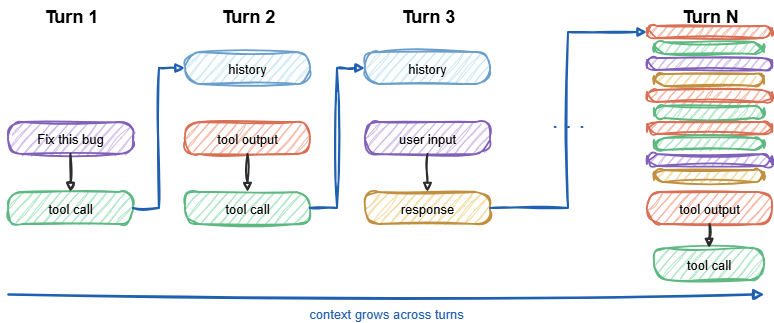
図 1. マルチターンを含むアジェンティック推論のシナリオを示すイラスト。
MLPerf Endpoints フレームワークに、この「エージェント型推論」のワークロードクラスが追加されました。一般的な MLPerf の測定原則はそのまま維持しつつ、モデル選定やデータセット構成、マルチターンでの負荷生成、出力検証、プレフィックスキャッシュやスペキュレーティブ・ディコーディングといった最適化手法に対する制約など、ワークロード固有の要素を定義しています。
用語解説
ターン:クライアントから発行されたユーザーまたはツールの要求 1 つと、それに対してモデルが生成した応答のセット。
トラジェクトリ:1 つのタスクまたはシミュレートされたユーザーにおける、順序付けられたターンの連続。後のターンには、蓄積された会話履歴が含まれます。
モデル選定
本ベンチマークでは、エージェント型アプリケーションのサービング挙動を厳しくテストできる、長文脈対応かつ推論能力を持つ大規模言語モデル(LLM)が必要です。具体的には、コンテキストサイズの増大、KV キャッシュの再利用、出力長の可変性、そして厳格なターン間の依存関係といった負荷が想定されます。
そこで採用したのが「Kimi K2.6」と「Qwen3.6-35B-A3B」です。Kimi K2.6 は最先端のコーディング能力を備え、主要なエージェントシステムを代表する大規模モデルのプロファイルを持っています。一方、Qwen3.6-35B-A3B はよりコンパクトながら、新しいゲート型デルタネット(GDN)アーキテクチャを採用し、そのサイズに対して驚異的なコーディング性能を発揮します。
この組み合わせにより、本ベンチマークは異なるサービング挙動やアーキテクチャの選択、スペキュレーティブ・ディコーディングの実装パスなど、多角的なカバレッジを実現しています。両モデルとも同じ評価方法とデータセットを用いて測定されます。曖昧さを避けるため、各モデルは個別に結果を出力し、2 つのモデルを併走させて一つのスコアに統合することはありません。
Model | Kimi K2.6 | Qwen3.6-35B-A3B
アーキテクチャ
MoE + MLAMoE + Gated DeltaNet/Attention
パラメータ数
1T / アクティブ35B
32B / アクティブ3B
コンテキスト長
262,144 トークン
262,144 トークン
設定
Thinking; temp=1.0; top_p=0.95; preserve_thinking
temp=1.0; top_p=0.95; top_k=20; presence=1.5; repetition=1.0; preserve_thinking
Speculative decoding
nvidia/Kimi-K2.6-Eagle3 head
モデル内蔵のネイティブ MTP
表 1. モデルメタデータとベンチマーク設定
データセットとタスク選定
本ベンチマークは、それぞれ異なるインフラボトルネックを露呈させる 2 つのエージェントドメインを組み合わせて構成されています。これらには合計 613 のマルチターン軌跡が含まれており、そのうち 113 がエージェントによるコーディング、500 がエージェントによるワークフローです。参照データセット全体では、これらの軌跡に 30,335 のクライアント発行ターンと 30,328 のアシスタントターンが含まれています。
ベンチマークには実際の収集トレースを使用しているため、推論サーバーのスタックにおける現実世界の動作をシミュレートできます。具体的には、実用的なマルチターントラフィック下での Speculative decoding やエキスパートランクバランスの挙動がどうなるかを検証します。
ドメイン | スケール | 主な負荷
---|---|---
Agentic Coding | 113 トラジェクトリ; 15,981 クライアントターン | 深いトラジェクトリ、コンテキストの増加、KV キャパシティ
Agentic Workflow | 500 トラジェクトリ; 4,316 クライアントターン | 大規模な共有プロンプト、プレフィックス重複、プレフィックスキャッシュ効率
表 2. データセット構成と平均トークン統計
DeepSWE データセット(DataCurve 社提供)から得られたエージェントによるコーディングのトレースは、リポジトリレベルのバグ修正や機能追加を目的としたソフトウェアエンジニアリングタスクで構成されています。典型的なトレースでは、まずユーザーが問題について説明するリクエストを出し、アシスタントが一連の bash コマンドを実行してリポジトリを検査します。エージェントはファイルの検索、コードの読み取り、テストの実行、エラーの確認、実装の編集を行い、これらを繰り返します。これらのトレースは非常に深掘りされており、中央値の経路では数十回のやり取りが行われ、コマンド出力やファイル内容、テストログが蓄積されるにつれて会話履歴も順次膨らんでいきます。
Workato 社提供のエージェントによるワークフローのトレースは、エンタープライズ顧客サポートとオーケストレーションのシナリオから抽出されたものです。これらは、模擬的な顧客が助けを求め、エージェントがツールを使って注文情報の取得、荷物の追跡、ポリシー確認、ケースのエスカレーション、アカウント関連の質問解決などを行う相互作用を表しています。これらの経路はコーディング系のトレースに比べて深さは浅い傾向がありますが、多数のツール定義やビジネスルールを含む共有システムプロンプトを大きく含んでいます。Workato はエンタープライズ向けエージェント制御・実行基盤を提供する企業であり、その実務経験に基づいて構築された合成データがワークフローのトレースとして提供されています。
この 2 つのドメインは意図的に異なる特徴を持っています。
コーディング系のトレースは、多くのやり取りを通じて急激に成長します。
ワークフローのトレースは、大きな共通プレフィックスから始まり、その後ゆっくりと成長します。
コーディングタスクは KV キャパシティと長文コンテキストのスケジューリングに負荷をかけます。一方、ワークフロータスクは共有プレフィックスの再利用とルーティングの局所性を重視します。
これらを組み合わせた負荷により、システムは単一のエージェント型トラフィック形状への最適化しかできず、文脈を考慮したルーティングの重要性が浮き彫りになります。
クライアント設計
MLPerf Endpoints ではマルチターン対応を導入し、標準的なサービングスタックに対してフルエンドツーエンドのエージェントワークロードを駆動できるようにしました。参加者は、vLLM、SGLang、TensorRT-LLM、または他のサービングフレームワークを使用して OpenAI 互換のエンドポイントを立てるだけでよく、そのエンドポイントをクライアントに指定すれば、フルエンドツーエンドのベンチマークが実行可能です。
このクライアントは以下のマルチターン動作を処理します:
・クローズドループリプレイ:1 つのアクティブな会話に対して、1 回ずつターンを送信し、モデルからの完全なレスポンスを受け取るまで次のターンに進みません。
・目標とする並行度:負荷発生器は、ターンの依存関係を崩すことなく、アクティブなユーザー数や会話数を制御します。
・ターン間の遅延:データセットに定義された待機時間をツール呼び出しやユーザー入力前に挿入し、現実的なペースを維持しつつ、この遅延をモデルサービングのレイテンシとして計測しないようにしています。
・会話認識型ルーティング:各トラジェクトリに対して安定した X-Session-ID ヘッダーを送信し、ルーターが KV キャッシュの局所性を保てるようにします。
・キャッシュの塩付け:システムプロンプトの周囲に決定論的な塩マーカーを設定することで、同一トラジェクトリ内での有効な再利用を許可しつつ、異なるトラジェクトリ間での無効な再利用を防ぎます。これにより、ベンチマークが実際の生産環境のワークロードを適切に反映することを保証します。
決定論的なプロンプト再構築では、将来のプロンプトはライブモデルの出力ではなく事前に記録されたデータセットから作成されます。これにより、生成された出力を測定しつつ、パフォーマンス実行の再現性を確保できます。
生成トークンのキャッシュクリア:すべてのプラットフォームで公平なベンチマークを実施するため、空白文字を追加して KV キャッシュ内の生成トークンをクリアします。これにより、トレース生成に使用されたシステムに依存しないパフォーマンス評価が可能になります。
パフォーマンス指標
主要なパフォーマンスチャートはパレート曲線であり、各点は固定並列度のベンチマーク結果を示しています。提出者は MLPerf エンドポイント規則で定義されている通り、完全なパレート曲線を提出する必要があります。
Y 軸:システムあたりの秒間出力トークン数。これは集約的なサービススループットを測定する指標です。
X 軸:ユーザーあたりの秒間出力トークン数。計算式は「軌道ごとの出力トークン数 / (エンドツーエンド時間 - 総遅延)」で求められます。
この二つの軸は、サービスシステムの異なる側面を表しています。X 軸の「ユーザーあたりの秒間出力トークン数」は、個々のエージェントがタスクをどの程度速く完了できるかを捉えます。右方向に進むほど、タスク完了速度が向上します。一方、Y 軸の「システムあたりの秒間出力トークン数」は、アクティブな全エージェント全体で完了した総作業量を表します。上方向に進むほど、集約スループットとシステム利用率が高まります。
並列度が増加すると、システム全体の総作業量は増える一方で、個々のエージェントの進行速度は低下する可能性があります。パレート曲線はこのトレードオフを可視化します。
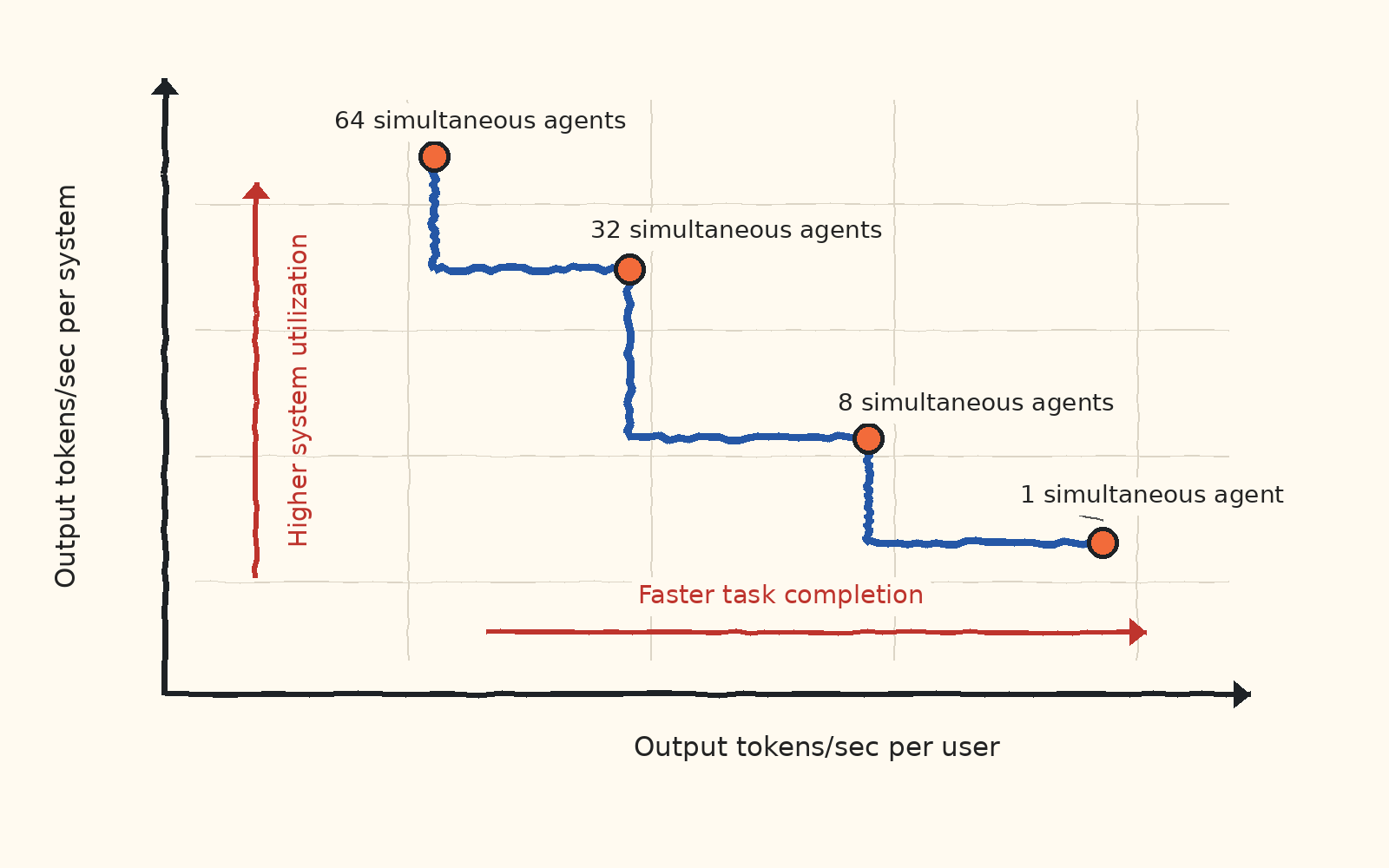
図 2. エージェント型推論の性能を示すチャート
精度指標について
精度は、3 つの階層構造として厳格に適用されます。これにより、単に回答が短かったり品質が低かったり、あるいは処理が容易なケースではなく、実際に活用可能なエージェント型の進歩をパレート曲線で評価することが可能になります。
OSL 平均値(出力シーケンス長):システムが回答の切り捨てや回答長さの分布を変化させることでスループットを水増しするのを防ぎます。このチェックでは、ワークロードに対して期待される平均出力シーケンス長が生成された出力に保持されていることを確認します。
インライン精度(推論実行中の即時評価):報告される性能設定の直中で行動のズレを検出します。これはパフォーマンスラン自体で生成された出力を、データセット内に保存された正解値と比較して行います。具体的には、コードツールの呼び出しアクションやワークフローの意図に基づくコードチェックが含まれます。これにより、追加で推論パスを実行する必要はありません。
スタンドアロン精度(タスクレベルの能力検証):ターンごとの類似性を超えた、タスク全体の解決能力を検証します。SWE-bench Verified データセットから 200 のタスクを選定し、提出されたモデル設定が代表的なタスクを最初から最後まで完遂できるかどうかを確認します。
パレート曲線上のすべてのポイントにおいて、これら 3 つのレベルの評価をすべて実行する必要があります。また、各スコアは事前に定義された閾値を満たさなければなりません。この閾値は、評価レベルごとに、そして Kimi K2.6 と Qwen3.6-35B-A3B の両モデルに対して個別に設定されています。
精度レベル | Kimi K2.6 | Qwen3.6-35B-A3B
---|---|---
インライン精度 | 63.08% | 55.86%
OSL 1 タンク平均範囲 | [404, 494] | [355, 434]
スタンドアロン精度は 76.5%、67.0% です。
表 3 は暫定の数値であり、変更される可能性があります。
参考実装
提出者は、vLLM、SGLang、TensorRT-LLM、または他のサービングフレームワークを使用して OpenAI 互換のサーバーを起動し、MLPerf Endpoints クライアントをそのエンドポイントに接続するだけで、ベンチマーク全体を実行できます。MLPerf Endpoints Agentic Inference の README には、設定例やコマンドライン、セットアップ手順が記載されています。
結論
アジェンティック・インファレンスは現在、AI 分野で最も急速に成長しているアプリケーションの一つであり、既存の単発テキスト生成よりもはるかに複雑です。アジェンティック・ワークフローには、コンテキストの拡大、厳格なターン依存関係、ツールを介した遅延、共有プレフィックス、ロングテール軌道、そしてパフォーマンス測定と同じ設定下で実行される出力品質チェックなど、独自の制約を持つサービングパターンが存在します。
アジェンティック・インファレンスベンチマークは、これらの制約を再現可能な形で MLPerf に導入しました。深いコーディング軌道と共有プレフィックスワークフロー軌道を組み合わせることで、ハードウェア効率を維持しつつ、実際のマルチターンユーザーに対してサービングシステムが進展できるかどうかを測定します。
エージェント型アプリケーションが生成する LLM トラフィックの割合が増える中、業界は「実際に重要なシステム負荷」を測定できるベンチマークを必要としています。具体的には、キャッシュの局所性を維持すること、長いコンテキストのスケジューリング、出力品質の担保、そして集計スループットとユーザーごとの進捗バランスの調整です。このベンチマークは、そのような測定基準に向けた一歩となります。
マルチターン型エージェント向けのサービングインフラを構築しているチームは、MLCommons へ参加することで参照実装へのアクセス権を得られ、結果を提出できます。
参考文献
- MLPerf Endpoints リポジトリ
- MLPerf Endpoints インファレンスルールとパレート収集手法
- MLPerf Endpoints エージェント型インファレンスの参照実装
- SWE-bench Verified ベンチマーク
- Workato のエージェント型ワークフローおよびエンタープライズタスク定義
- Datacurve による DeepSWE データセット
原文を表示
Introduction
The MLPerf Inference benchmark suite must evolve alongside AI deployment patterns. Early inference benchmarks focused on image classification, object detection, speech recognition, recommendation, and single-turn language generation. Those workloads remain important, but they no longer cover one of the fastest-growing ways large language models are used in production: multi-turn agentic inference.
For example, a coding assistant is far more complex than a single query. The agent will read an issue, inspect files, run commands, observe failures, edit code, and iterate potentially many times. Similarly, a workflow agent gathers customer information, calls tools, interprets results, asks follow-up questions, and continues until the task is resolved. In both cases, the workload is a trajectory: a sequence of dependent turns where each request includes the conversation history up to that point.
This changes the serving problem in four concrete ways:
Context grows across the trajectory, so prefill and KV-cache pressure increase over time.
KV-cache reuse is now a critical serving optimization for performance and efficiency.
Output lengths vary widely, from compact tool calls to long reasoning traces.
Turn dependencies make throughput a measure of closed-loop progress, not independent request rate.
Figure 1. Illustration of an agentic inference scenario involving multiple turns.
The Agentic Inference benchmark adds this class of workload to the MLPerf Endpoints framework. It keeps the general MLPerf measurement principles intact while defining the workload-specific pieces: model choice, dataset composition, multi-turn load generation, output validation, and constraints for optimizations such as prefix caching and speculative decoding.
Terminology
Turn: one client-issued user or tool request and the model response generated for that request.
Trajectory: the ordered sequence of turns for one task or simulated user; later turns include the accumulated conversation history.
Model selection
The benchmark needs long-context, thinking-capable LLMs that stress the serving behavior of agentic applications: growing context, KV-cache reuse, variable output lengths, and strict turn dependencies. For this benchmark, we chose Kimi K2.6 and Qwen3.6-35B-A3B. Kimi K2.6 brings state-of-the-art coding capability and a large model profile representative of leading agentic systems; Qwen3.6-35B-A3B is more compact and brings a new Gated DeltaNet (GDN) architecture and exceptional coding performance for its size. This gives the benchmark coverage across distinct serving behaviors, architectural choices, and speculative-decoding paths. Both models are evaluated with the same methodology and dataset. To avoid ambiguity, each model produces its own result; the two models are not run together or combined into a single score.
ModelKimi K2.6Qwen3.6-35B-A3B
ArchitectureMoE + MLAMoE + Gated DeltaNet/Attention
Params1T / 32B active35B / 3B active
Context262,144 tokens262,144 tokens
SettingsThinking; temp=1.0; top_p=0.95; preserve_thinkingtemp=1.0; top_p=0.95; top_k=20; presence=1.5; repetition=1.0; preserve_thinking
Spec decodingnvidia/Kimi-K2.6-Eagle3 headNative MTP within the model
Table 1. Model metadata and benchmark settings
Dataset and task selection
The benchmark dataset combines two agentic domains that exercise different infrastructure bottlenecks. Together, they contain 613 multi-turn trajectories: 113 agentic coding trajectories and 500 agentic workflow trajectories. Across the reference dataset, these trajectories contain 30,335 client-issued turns and 30,328 assistant turns. By using real collected traces for benchmarking, the workload simulates real-world behavior in the serving stack, including how speculative decoding and expert-rank balancing behave under realistic multi-turn traffic.
DomainScalePrimary stress
Agentic Coding113 traj.; 15,981 client turnsDeep trajectories; growing context; KV-cache capacity
Agentic Workflow500 traj.; 4,316 client turnsLarge shared prompt; prefix overlap; prefix-cache efficiency
Table 2. Dataset composition and mean token statistics
The agentic coding traces come from the DeepSWE dataset by DataCurve (datacurve.ai), which contains software engineering tasks built around repository-level bugs and feature requests. A typical trace begins with a user request describing an issue, followed by an assistant that investigates the repository through a series of bash commands. The agent searches files, reads code, runs tests, observes errors, edits the implementation, and iterates. These traces are deep: the median trajectory contains dozens of turns, and the conversation history grows steadily as command outputs, file contents, and test logs accumulate.
The Workato agentic workflow traces come from enterprise customer-support and orchestration scenarios. They represent interactions where a simulated customer asks for help and the agent uses tools to retrieve orders, track shipments, check policies, escalate cases, or resolve account questions. These trajectories are usually shallower than the coding traces, but they include a much larger shared system prompt with many tool definitions and business rules. The agentic workflow traces were provided by Workato, the agentic control and execution plane for the enterprise. The data are synthetic traces modeled on Workato’s production experience orchestrating customer support agents for enterprise customers.
The two domains are intentionally different:
Coding traces grow aggressively over many turns.
Workflow traces begin with a large common prefix and grow more slowly.
Coding stresses KV-cache capacity and long-context scheduling.
Workflow stresses shared-prefix reuse and routing locality.
The combined workload prevents systems from optimizing for only one agentic traffic shape and stresses context-aware routing.
Client Design
We introduced multi-turn support to MLPerf Endpoints so the benchmark can drive full end-to-end agentic workloads against standard serving stacks. Submitters simply need to spin up an OpenAI-compatible endpoint using vLLM, SGLang, TensorRT-LLM, or another serving framework, then point the client at that endpoint for full end-to-end benchmarking.
The client handles the multi-turn behavior:
Closed-loop replay: one active conversation issues one turn at a time and waits for the complete model response before the next turn.
Target concurrency: the load generator controls the number of active users or conversations without breaking turn dependencies.
Inter-turn delay: dataset-provided waits before tool or user turns preserve realistic pacing without counting delay as model serving latency.
Conversation-aware routing: a stable X-Session-ID header is sent for each trajectory so routers can preserve KV-cache locality.
Cache salting: deterministic salt markers around the system prompt allow valid within-trajectory reuse while blocking invalid cross-trajectory reuse to ensure the benchmark is representative of production workloads.
Deterministic prompt reconstruction: future prompts are built from the pre-recorded dataset rather than from live model output, which keeps performance runs reproducible while still measuring generated outputs.
Generated token cache clearing: In order to enable fair benchmarking of all platforms, the generated tokens are cleared out of the KV cache by introducing a whitespace character – ensuring that the performance is independent of the system that was used for generating the traces.
Performance metrics
The primary performance chart is a Pareto curve where each point is a fixed-concurrency benchmark result. Submitters need to submit a full Pareto curve as defined in the MLPerf Endpoints rules.
Y-axis: output tokens per second per system, measuring aggregate serving throughput.
X-axis: output tokens per second per user, computed as output tokens per trajectory / (E2E time – total delays).
The two axes represent complementary views of the serving system. The x-axis, output tokens per second per user, captures how quickly an individual agent progresses through its task; moving right means faster task completion. The y-axis, output tokens per second per system, captures the total work completed across all active agents; moving up means greater aggregate throughput and higher system utilization. As concurrency increases, the system may complete more total work while each individual agent progresses more slowly. The Pareto curve makes this tradeoff visible.
Figure 2. Chart illustrating agentic inference performance
Accuracy metrics
Accuracy is enforced as a three-level hierarchy so the Pareto curve measures usable agentic progress rather than responses that are shorter, lower quality, or easier to serve.
OSL mean value: prevents systems from gaining throughput by truncating responses or shifting the answer-length distribution. The check requires generated outputs to preserve the expected mean output sequence length for the workload.
Inline accuracy: catches behavior drift during the exact performance configuration being reported. It operates on the outputs produced by the performance run itself and compares them against ground-truth values preserved in the dataset, including coding tool-call action checks and workflow intent-code checks, so no separate inference pass is required.
Standalone accuracy: verifies task-level capability beyond turn-level similarity. The standalone evaluation will use 200 tasks from the SWE-bench Verified dataset to check whether the submitted model configuration can solve representative tasks end to end.
All three levels must be run for every point on the Pareto curve, and each score must meet a pre-defined threshold. Thresholds are defined separately for each level and for both Kimi K2.6 and Qwen3.6-35B-A3B.
Accuracy levelKimi K2.6Qwen3.6-35B-A3B
Inline accuracy63.08%55.86%
OSL per-turn mean range[404,494][355,434]
Standalone accuracy76.5%67.0%
Table 3. Tentative accuracy values, subject to change.
Reference implementation
Submitters only need to spin up an OpenAI-compatible server using vLLM, SGLang, TensorRT-LLM, or another serving framework, then point the MLPerf Endpoints client at that endpoint to run the full benchmark. The MLPerf Endpoints Agentic Inference README includes the example configs, command lines, and setup steps.
Conclusion
Agentic inference is one of the fastest growing applications of AI today and it’s far more complicated than existing single-turn text generation. Agentic workflows have serving patterns with unique constraints: growing context, strict turn dependencies, tool-mediated delays, shared prefixes, long-tail trajectories, and output quality checks that must run on the same configuration used for performance.
The Agentic Inference benchmark brings those constraints into MLPerf in a reproducible form. By combining deep coding trajectories with shared-prefix workflow trajectories, it measures whether serving systems can make progress for real multi-turn users while still using hardware efficiently.
As agentic applications become a larger share of production LLM traffic, the industry needs benchmarks that measure the systems work that actually matters: preserving cache locality, scheduling long contexts, maintaining output quality, and balancing aggregate throughput with per-user progress. This benchmark is a step toward that measurement standard. If your team is building serving infrastructure for multi-turn agents, join MLCommons to access the reference implementation and submit results
References
MLPerf Endpoints repository.
MLPerf Endpoints Inference Rules and Pareto collection methodology.
MLPerf Endpoints Agentic Inference reference implementation.
SWE-bench Verified benchmark.
Workato agentic workflow and enterprise task definitions.
DeepSWE Dataset by Datacurve.
The post Agentic Inference for MLPerf Inference appeared first on MLCommons.
AI算出
主要ニュースainew評価標準
AI ベンチマークの進化という核心的なトピックであり、既存の単発推論から複雑なエージェントワークロードへの移行を定義する新基準が示されているため新規性が高い。また、Kimi や Qwen の具体的なモデル名とアーキテクチャ詳細が含まれているため検索機会も高い。
6つの評価軸を見る
- AI関連度
- 100
- 情報源の信頼性
- 25
- 新規性
- 75
- 調べる価値
- 75
- 重複の少なさ
- 100
- 日本での有用性
- 25
関連記事
News to Guide
ニュースの次に確認する
発表内容を、現在の料金や仕様と照らし合わせられる関連ガイドです。
今日のまとめ
AIデイリーブリーフで今日の重要ニュースをまとめ読み