Google Cloud、小規模ユーザー向け推薦に「Malachyte」を管理型リアルタイム AI で提供
本文の状態
日本語全文を表示中
詳細モードで約8分の本文を読めます。
同じ出来事の情報源
この情報源を基点に整理
Google Cloud AI
Sidd が設立した AI 推奨プラットフォーム「Malachyte」は、LLM のアテンション機構を応用して小規模ユーザーへの商品推薦という課題を解決し、Google Cloud のインフラを活用することで売上の倍増を実現している。
Continue in AI NEW LAB
このニュースを、実務の判断につなげる
AI NEW LABで、試したことや先に確認したい条件を共有できます。まずはログインなしで読めます。
AI NEW LABで論点を見るAI深層分析を開く2026年8月11日 01:19
AI深層分析
キーポイント
冷戦開始問題の解決手法
Malachyte は大規模言語モデル(LLM)で使われているアテンション機構を持つニューラルネットワークを応用し、顧客の行動シーケンスから意味を抽出して商品推薦をパーソナライズする。
Google Cloud インフラの活用
同社は Bigtable や Managed Service for Apache Kafka といった Google Cloud のツールを利用することで、安全でスケーラブルかつ信頼性の高い基盤を構築している。
実証されたビジネス成果
同社のソリューションを導入した小売業者の一部では、売上を倍増させたり、場合によっては3倍に伸ばしたりする結果が得られていると発表されている。
コールドスタート問題の解決
Malachyte は訪問直後のユーザーに関する情報が少ない「コールドスタート」問題を、各インタラクションをベクトルに追加してリアルタイムで解消する。
双方向の学習メカニズム
クリックや検索などの新たな入力は、次の要望の予測を駆動すると同時にユーザー情報を強化し、モデルと個々の理解を同時に向上させる。
重要な引用
What's the best way to recommend products to little-known users?
Malachyte was inspired by some unique insights into how advanced AI models, and large language models in particular, could be applied in new ways to old challenges like personalization and recommendations.
For Malachyte, the aha moment was discovering that it could use neural networks with attention mechanisms — the same concept powering large language models — to personalize retail search and product pages.
What if we predicted the next thing a user wants on an ecommerce website just like LLMs predict the next word in a sentence?
編集コメントを表示
編集コメント
本記事は、LLM の技術要素を既存のビジネス課題に適用する具体的なケーススタディとして価値がある。特に「冷戦開始問題」と呼ばれるデータ不足領域への対応において、アテンション機構がどのように機能するかを示している点は実務的な示唆に富む。
Source Article
元記事を日本語で読む
本文に関係しない購読案内、埋め込み通知、サイト内プロモーションは除いています。
未知のユーザーに商品をどうおすすめするのが最適か?
私たちはこれまで、Spotify や Priceline といった大手企業の課題解決に取り組んできました。その経験から Sidd は、AI を活用した EC レコメンデーションプラットフォーム「Malachyte」を設立しました。現在、消費者はパーソナライズされた関連性の高いコンテンツを当然のものとして求めており、彼らの注目を集めようとするオンラインサービスも、これを極めて高いレベルで提供せざるを得ません。
Malachyte は、先進的な AI モデル、特に大規模言語モデル(LLM)が、パーソナライゼーションやレコメンデーションといった古くからの課題に対してどのように新たな形で応用できるかという独自の洞察から着想を得ています。
潜在的な顧客を獲得するために Malachyte が取り組む中で、私たちが常に描いてきたパーソナライゼーションアルゴリズムを構築し続けるためには、安全でスケーラブルかつ信頼性が高く、何よりも最先端の AI インフラが必要でした。Google Cloud の Bigtable や Managed Service for Apache Kafka といったツールを活用したことで、Malachyte は一部の小売業者において売上を倍増させ、場合によっては3倍に伸ばすことにも成功しています。
これは私たちがどのように構築したかという物語であり、同時に、いかにして創業者がこれらのサービスを利用して AI ファウンデーションモデルを新たな形で展開できるかを示す事例でもあります。
Malachyte がユーザーの売上を押し上げた方法
Malachyte の「なるほど」という瞬間は、大規模言語モデル(LLM)を支えるアテンション機構を備えたニューラルネットワークを活用すれば、小売りの検索や商品ページを個人化できることに気づいたことでした。このアプローチこそが、LLM がシーケンス内のアイテムの相対的な順序から意味を導き出すことを可能にします。彼らの場合、それは文の中の単語や音節の順序です。一方、小売りのウェブサイトやアプリにおいては、Malachyte が捉えようとしたのは、顧客がサイトと行う一連のインタラクションのシーケンスでした。

GPT 以前の言語モデルは、特定の単語のシーケンスや、単語の一部(現在ではトークンと呼ばれるもの)に注目しようとしたかもしれませんが、それらの初期モデルは、単語の順序が似ていても連続していない場合や、再配置された場合にどうなるかを検討することはできませんでした。その突破口となったのは、Google のトランスフォーマーに関する研究などを通じて、LLM がアイテムのシーケンス内の複雑で長距離にわたる依存関係を理解する能力を獲得した時でした。
このより洗練された手法は、生成 AI 全体の普及において劇的な成果をもたらすとともに、Malachyte における技術応用においても大きな成果を上げています。
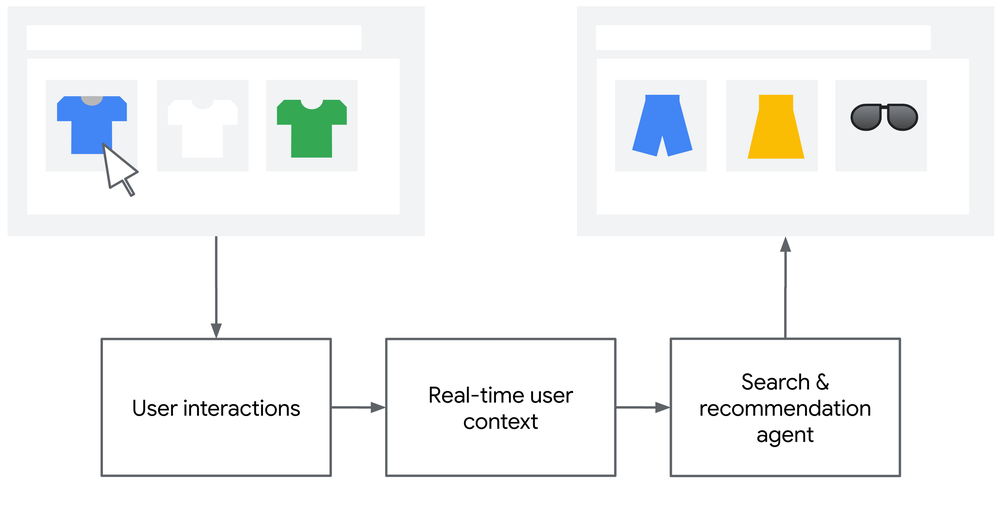
*Malachyte の推薦および検索エージェントは、ユーザーが過去にクリックした内容に基づき、次のページの検索結果や推薦カルーセルを自動で生成します。
もちろん、このアイデア自体が新しいわけではありません。小売業者は長年、協力的フィルタリング推薦システムを用いて、類似するユーザーやアイテムを特定してきました。しかし、これらのモデルには大量のデータが必要で、サードパーティ製のクッキーベースのプロファイルや人口統計情報などが含まれていました。
一方、セッション内のインタラクションの順序に焦点を当てることで、小売業者は、ユーザーのプロフィールのみを対象とする場合よりも、必要なデータ量やコストを抑えつつ、はるかにパーソナライズされた体験を提供できるようになります。さらに付随するメリットとして、長期的なクッキーデータへの依存を避けることで、ユーザーのプライバシー保護も強化できます。
この仕組みが機能するのは、モデル構造とマルチモーダルベクトルのおかげです。これらはブラウザデータやクリック履歴、検索履歴など、ユーザーに関するあらゆる情報をエンコードします。出力側もまたマルチモーダルであり、同じモデルをサイト内の商品ページ検索、カテゴリページ、カート追加用カルーセルなど、さまざまな場所に適用できます。
これを可能にするため、カタログ内の各製品はユーザーベクトルと同じ空間に埋め込まれます。このベクトルは更新され、関連性の高い製品には近づき、そうでないものからは遠ざかるように動きます。埋め込みを計算するニューラルネットワークは、Malachyte と提携する小売業者全体で継続的に学習が進み、すべてのユーザーにとっての精度が向上します。結果として、このシステムはデータ協同組合のような役割を果たし、各小売業者のユーザーがモデルをより賢くする一助となっています。

このように、各推論で全ユーザーに対して 100 ミリ秒以内のレスポンスを実現するために、Malachyte は Google Cloud のリアルタイム AI スタックの上に構築することによる明確なメリットを見出しました。
本システムでは、すべての行動イベントが Managed Service for Apache Kafka クラスターにストリーミングされます。将来のトレーニングジョブを待ってキューイングするのではなく、各イベントは即座に Bigtable 内のユーザープロファイルへの更新として反映されます。Kafka クラスターにより、顧客側のフロントエンドでセッション情報を永続化できるため、ユーザーセッションがベクトル空間内でどのように位置づけられるかという懸念を抱えることなく、迅速なシグナル伝達が可能になります。
Bigtable によって Malachyte のサービスは必要なユーザーベクトルの参照と更新を行えます。Kafka と Bigtable はそれぞれ 10 ミリ秒オーダーで動作するため、ユーザーエクスペリエンスを損なうことなく、推薦ループ全体が完結します。
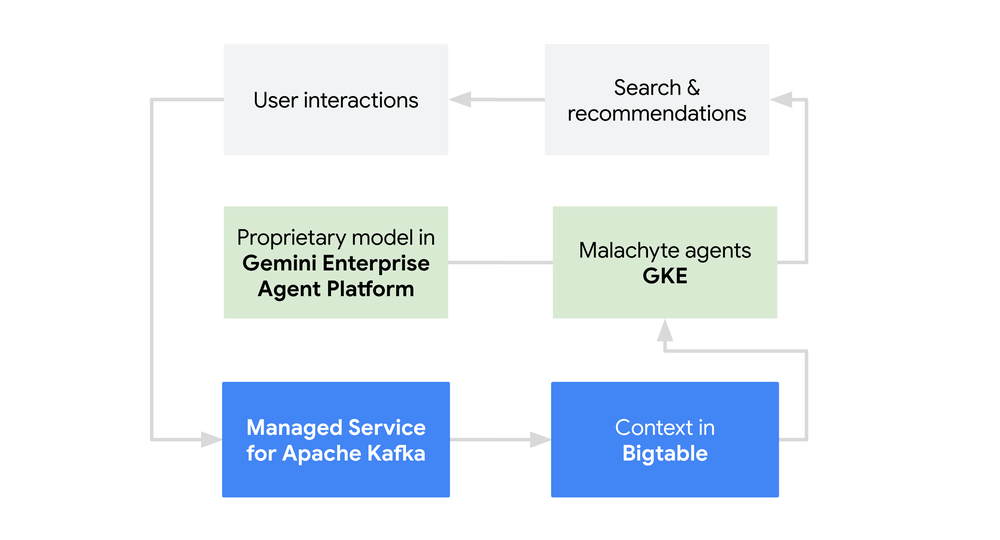
コアの高速化に加え、製品カタログの更新情報や在庫シグナル、小売業者固有の次元データといった第 2 レイヤーが常時稼働することで、製品データの鮮度を保っています。これらは Cloud Pub/Sub を経由して流れます。同サービスはグローバルにアクセス可能な REST API を提供しており、深い統合作業を要さずに接続を利用できます。
Malachyte のエージェントは Google Kubernetes Engine(GKE) 上で動作し、モデル推論は Google Compute Engine (GCE) で実行されます。

*製品カタログの更新など外部データの継続的な取り込みは、Pub/Sub のグローバルメッセージングシステムを通じて行われます。
Google Cloud の AI アーキテクチャへの移行により、Malachyte は生産環境での AI 推論やトレーニングが、単に GPU やストレージの問題ではないことを示しました。重要なのは、高速なキーバリューストア、ストリーミング層、管理されたメッセージングシステムを基盤モデルアーキテクチャと統合した、リアルタイムの継続学習インフラです。
このアプローチは、Malachyte のような小規模チームでも、強力なインフラとコア AI 管理サービスへのアクセスがあれば、業界に大きな影響を与えられることを示しています。
実際に試してみる
業界を革新し、競合他社に先んじたいとお考えなら、Malachyte のような事例も参考になるでしょう。そのためには、Managed Service for Apache Kafka、Cloud Pub/Sub、そして Bigtable を活用するのがおすすめです。新規のお客様には、Google Cloud クレジット 300 ドルが提供されます。
原文を表示
What’s the best way to recommend products to little-known users?
We’ve spent our careers trying to solve this problem for major companies like Spotify and Priceline, and it’s why Sidd founded Malachyte, an AI-powered ecommerce recommendation platform. These days, consumers have come to expect content that feels personalized and relevant, and online services competing for their attention have no choice but to do this exceptionally well.
Malachyte was inspired by some unique insights into how advanced AI models, and large language models in particular, could be applied in new ways to old challenges like personalization and recommendations.
As Malachyte set out to win potential customers’ business, we needed secure, scalable, reliable and, above all, leading-edge AI infrastructure to continue building the personalization algorithm we had always envisioned. By utilizing Google Cloud tools like Bigtable and Managed Service for Apache Kafka, Malachyte has been able to help some of its retailers double and sometimes even triple their sales.
This is the story of how we built it, and the ways any founder can use services like these to start deploying AI foundation models in new ways.
How Malachyte lifted sales for their users
For Malachyte, the aha moment was discovering that it could use neural networks with attention mechanisms — the same concept powering large language models — to personalize retail search and product pages. This approach is what enables LLMs to derive meaning from the relative order of items in a sequence, in their case the order of words and syllables in a sentence. When it comes to a retail website or app, what Malachyte wanted to capture was the sequence of customer interactions with the site.
A pre-GPT language model might have tried to look at a specific sequence of words or even fragments of words (what we now know of as tokens), but those earlier models wouldn’t examine what happens if the words were in the comparable order but weren’t contiguous or were re-arranged. The breakthrough came — in part through Google’s work on transformers — when LLMs gained the ability to understand complex and long-range dependencies within a sequence of items.
This more sophisticated method has delivered dramatic results — both for the proliferation of gen AI in general, and for Malachyte’s application of the technology.
To make this work in practice, Malachyte creates a vector of everything known about a visitor when they arrive on a site. Most users are visiting for the first time, so little is known about them. This is what’s known as the “cold start” problem. The trick is to use every interaction with a user to refine this vector. Each new addition to the vector, like a click or a query, does two things: it drives a prediction about the next thing the user wants, and it provides more information about the user.
Malachyte’s platform then updates the user vector and the prediction at the same time. This not only enhances the understanding of the individual user and their preferences, it also improves the overall model with the anonymized user data. With every inference, the context of both the average and the specific shopper grows.
The company further innovates by not just using attention-based neural networks but combining that with updating user profiles 100 milliseconds at time.
To be sure, this idea isn’t in itself new. Retailers have long used collaborative filtering recommendations systems to identify similar users and items that required massive sets of interaction history. These models typically required a lot of data, including third-party cookie-based profiles and demographics.
By focusing on the sequence of interactions in a session, retailers can achieve far more personalization — with less required data or spend — than by focusing only on a user’s profile. As a bonus, retailers can now offer their users more privacy by not relying on long-term cookie data.
This works because of the model structure and multimodal vectors that encode everything they know about a user, including browser data, click history and searches. The output, too, is multimodal: The same model can be applied to on-site search product pages, category pages, and add-to-cart carousels.
To make this work, each product in the catalog is embedded into the same space as the user vector, which gets updated and subsequently moves the vector closer to relevant products and further from those that aren’t. The neural network computing the embedding is being continuously trained across retailers who work with Malachyte, improving the quality for everyone. The system effectively becomes a data cooperative with each retailer's user helping make the model smarter for everyone.
To make this delivery for every user at every inference in 100 milliseconds, Malachite found real benefits in building onGoogle Cloud’s real-time AI stack.
With this system, every behavioral event streams into a Managed Service for Apache Kafka cluster. Rather than queuing for a future training job, each event immediately becomes an update to the user’s profile in Bigtable. The Kafka cluster allows the customer’s front-end to persist, so the user session signals quickly with little worry about how they fit into the user vector.
Bigtable allows Malachyte’s services to look up and update the right user vectors, and it and Kafka operate at the order of 10 milliseconds per step, which allows the entire recommendation loop to complete with no disruption to the user experience.
In addition to a fast core, a second layer of product catalog updates, inventory signals, and retailer-specific dimensional data keeps product data up to date. This flows through Cloud Pub/Sub, which offers globally accessible REST APIs that enable connections retailers can use without deep integration work. Malachyte agents run on Google Kubernetes Engine(GKE), with model inference on Google Compute Engine (GCE).
With its migration to Google Cloud’s AI architecture, Malachyte demonstrated that production AI inference and training are about more than GPUs and storage. They require real-time continuous learning infrastructure that includes a fast key-value store, a streaming layer, and a managed messaging system, all integrated with the foundation model architecture.
This approach also shows that even a small team like Malachyte’s can have a big impact in an industry. It just needs access to powerful infrastructure and core AI managed services.
Try it for yourself
Looking to shake up your industry or stay ahead of the competition like Malachyte? Try Managed Service for Apache Kafka, Cloud Pub/Sub, and Bigtable. New customers can receive $300 in Google Cloud credits.
関連記事
今日のまとめ
AIデイリーブリーフで今日の重要ニュースをまとめ読み