nOps、Amazon Bedrock AgentCore で FinOps エージェント開発を 75% 高速化
本文の状態
日本語全文を表示中
詳細モードで約17分の本文を読めます。
同じ出来事の情報源
この情報源を基点に整理
AWS Machine Learning Blog
クラウド最適化ソリューション「nOps」は、Amazon Bedrock AgentCore の導入により FinOps エージェントの構築を 75% 加速し、複雑なインフラの制約から脱却して製品開発と分析品質を向上させた。
Continue in AI NEW LAB
このニュースを、実務の判断につなげる
AI NEW LABで、試したことや先に確認したい条件を共有できます。まずはログインなしで読めます。
AI NEW LABで論点を見るAI深層分析を開く2026年8月11日 02:13
AI深層分析
キーポイント
FinOps エージェントの高速化
nOps は Amazon Bedrock AgentCore を採用することで、FinOps エージェントの構築期間を 75% 短縮し、製品デリバリーを加速させた。
API 依存型インフラの限界突破
従来の API ベースのインフラでは遅延や一貫性の欠如が発生していたが、新しい基盤によりこれらの課題を解決し、複雑な分析ワークフローを効率的に処理可能にした。
システム複雑度の低減
オーケストレーション層の多さによる維持コストを削減し、エンジニアがインフラ保守から製品革新へリソースを集中させる環境を整えた。
アーキテクチャの転換と選定理由
API 応答に依存していた従来のデータパスから、Amazon Bedrock AgentCore を中核とした専用アーキテクチャへ移行した。この選択により、フレームワークやモデルの変更をサービス切り替えなしで可能にし、チームはインフラよりもドメインロジックに集中できる。
4 つのレイヤーによる構成
インタラクション層、エージェントランタイム層、データ層、非同期ワークフロー層という 4 つの構成要素でエンドツーエンドのソリューションが構築されている。各層は Vercel、Bedrock AgentCore、Databricks Lakehouse、および AWS のイベント駆動型サービスによって機能する。
重要な引用
"We were attempting to build advanced AI capabilities on top of infrastructure that wasn't designed for analytics-driven agents, which made iteration slow, complex, and prone to inaccuracies."
"Existing infrastructure patterns introduced friction: Response latency and inconsistency... System complexity... Innovation drag."
We chose Bedrock AgentCore for its managed agent runtime, built-in memory, and orchestration, along with the freedom to use any framework or model.
With this freedom, we built on Strands and evolved our model choices without switching services, so the team could focus on domain logic rather than infrastructure.
編集コメントを表示
編集コメント
nOps の事例は、FinOps という特定のドメインにおいて AI エージェントの導入が直面するインフラ上の課題と、それを解決するための具体的なアーキテクチャ変更を示している。開発者は、単にモデルを呼び出すだけでなく、エージェントの運用基盤自体を見直す必要性を認識する必要がある。
Source Article
元記事を日本語で読む
本文に関係しない購読案内、埋め込み通知、サイト内プロモーションは除いています。
AI によるクラウド最適化ソリューション「nOps」は、Financial Operations(FinOps)分析機能を刷新するため、Amazon Bedrock AgentCore への移行を行いました。Amazon Bedrock AgentCore は、あらゆるフレームワークやモデルに対応し、エージェントの構築・連携・大規模な最適化を可能にするサービスです。
この新しい基盤により、nOps は AWS、Google Cloud Platform(GCP)、Microsoft Azure にわたるコミットメント最適化を担当する顧客へのサポートを強化しました。予約インスタンスや AWS セービングスプランなどのコミットメントを継続的に最適化することで、チームはコスト削減の最大化、リスク低減、そして手動 FinOps の業務負担の自動化を実現できます。現在、nOps はクラウド支出総額 40 億ドル以上を管理する顧客をサポートしています。
本稿では、Amazon Bedrock AgentCore、Databricks Lakehouse Metric Views、Databricks Lakebase、Amazon DynamoDB、Vercel を活用し、製品開発の加速、レスポンス品質の向上、運用複雑性の低減を実現した nOps の分析機能とエージェント体験への移行について解説します。
API 中心型インフラの限界を超えた FinOps AI の拡張
製品ポートフォリオと顧客基盤が拡大するにつれ、インフラ、フロントエンド、バックエンドチームは、高い信頼性とマルチテナント分離を維持しつつ、ますます複雑化する分析ワークフローに対応する必要に迫られました。既存のインフラパターンには以下の課題がありました:
課題:応答の遅延と不安定性
API を介したデータアクセスによる長文コンテキストが、応答の遅延を招き、回答の一貫性を損なっていました。
システムの複雑化
オーケストレーション層や観測(オブザーバビリティ)層が多重に存在することで、システム全体の複雑さが膨らんでいました。
革新の阻害要因
エンジニアリングのリソースがインフラの維持管理に奪われ、製品そのものの革新に割く時間が減少していました。
「私たちは、分析駆動型のエージェント向けに設計されていない基盤の上に、高度な AI 機能を構築しようとしていました。その結果、試行錯誤は遅く、複雑になり、不正確さにもつながりました。」
— Jordan Stein
移行前の現状
移行前に、既存のインフラコンポーネントの上に FinOps AI エージェント「Clara」を導入しました。具体的には、Kubernetes、Amazon Bedrock を用いたモデル呼び出し、LangChain/LangGraph によるオーケストレーション、および Web API 用のツールラッパーを組み合わせました。
これにより初期の迅速な提供が可能となりましたが、同時に構造的な限界も浮き彫りになりました。
- 洞察までの時間の遅延: API に依存したデータ構造と巨大なコンテキストウィンドウが、応答ターン(処理サイクル)の遅延を引き起こしました。
- 運用オーバーヘッド: 専用設計ではない複数のレイヤーが重なることで、試行錯誤やデバッグが困難になりました。
- データ経路の不整合: エージェントからの回答が API のレスポンスに依存したままとなり、専用のセマンティック分析層と連携できていませんでした。
この課題に対処するため、ランタイムとオーケストレーションには Amazon Bedrock AgentCore を、統制された分析セマンティクスには Databricks Metric Views を、永続的なアプリケーション状態には Databricks Lakebase を中核とした目的別アーキテクチャへ移行しました。Amazon Bedrock AgentCore を選定した理由は、マネージド型エージェントランタイムと内蔵メモリ、オーケストレーション機能に加え、任意のフレームワークやモデルを利用できる自由度にあります。この自由度を活かし、Strands 上で構築しながらモデル選択を進化させたため、サービス変更を伴わずに済みました。その結果、チームはインフラストラクチャよりもドメインロジックの開発に集中できるようになりました。
ソリューション概要
新アーキテクチャは、需要に応じたスケーラビリティの確保、正確な回答の生成、そして開発者の迅速な実装を可能にするよう設計されています。
以下の図は、Amazon Bedrock AgentCore 上で構築された nOps Clara ソリューションのエンドツーエンド・アーキテクチャを示しています:
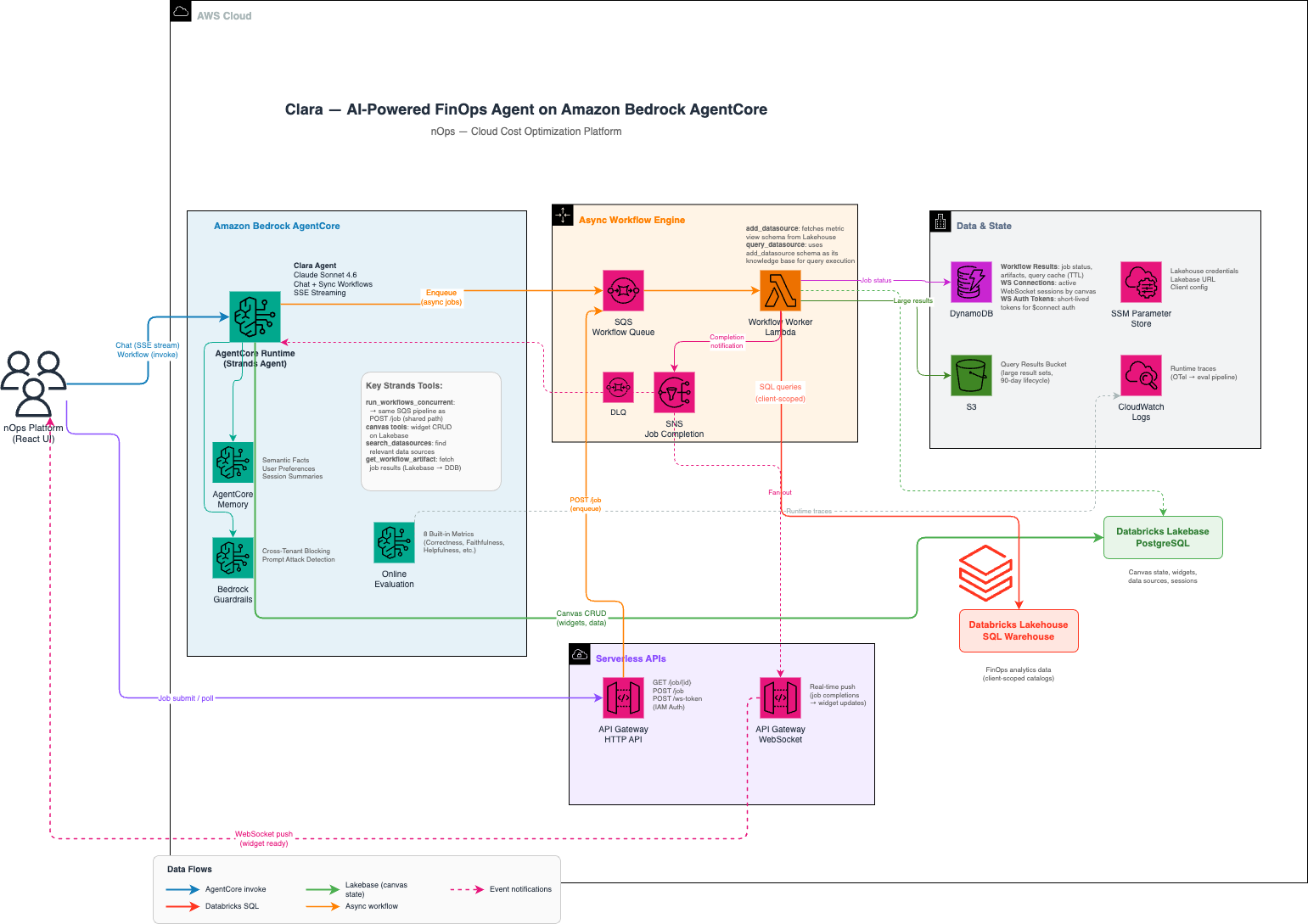
図 1:Amazon Bedrock AgentCore 上の nOps Clara ソリューションのエンドツーエンド・アーキテクチャ
本ソリューションは以下の要素で構成されています。
- インタラクション層: Vercel でホストされた Next.js ウェブアプリケーション。顧客は、ストリーミング Server-Sent Events をバックボーンとする会話型インターフェースを通じて Clara と対話します。
エージェント実行層:Amazon Bedrock AgentCore は、単一の Strands ベースのエージェントを実行し、キャンバス操作、クエリ実行、データソースの発見、ワークフローのオーケストレーションに対して直接ツールアクセスを提供します。これにより、マルチエージェント間のルーティングオーバーヘッドを軽減しています。
データ層:Databricks Lakehouse のメトリックビューは、統制されたセマンティック分析レイヤーを提供し、Databricks Lakebase(サーバーレス PostgreSQL)にはセッション、キャンバス、ウィジェット仕様といった永続的なアプリケーション状態が保存されます。
非同期ワークフロー層:イベント駆動型の実行パスを採用しており、Amazon DynamoDB でジョブを追跡し、Amazon Simple Notification Service (Amazon SNS) と Amazon Simple Queue Service (Amazon SQS) を通知に利用します。また、長時間実行される分析タスクの UI 更新をリアルタイムで行うため、Amazon API Gateway の WebSocket プッシュを活用しています。
Web アプリケーション
インタラクション層では、顧客は Vercel でホストされた Web アプリケーションを通じて Clara を利用します。リクエストは Next.js Backend for Frontend (BFF) を経由し、Amazon Bedrock AgentCore を呼び出します。Clara はストリーミングレスポンスとツール呼び出しをサポートする Strands ベースのエージェントランタイムとして動作しています。ユーザーは、Strands ツールを通じて Clara が実行するのと同じワークフローを手動で起動できます。**これは重要な要件であり、Clara の構築基盤です。なぜなら、この製品要件内で人間が従う手順と同様のタスクをエージェントが実行できる必要があるからです。
Amazon Bedrock AgentCore バックエンド
ランタイムは Amazon Bedrock AgentCore 上で Docker コンテナとしてデプロイされ、実行環境、メモリ、ガードレール、キュー、ワーカー関数を含むインフラ全体が、単一の AWS Cloud Development Kit (AWS CDK) スack で定義されています。Clara はマルチエージェントのルーターではなく、シングルエージェントアーキテクチャを採用しています。1 つの Strands Agent が、キャンバス操作、クエリ実行、データソースの発見、ワークフローのオーケストレーションという 4 つのツールに直接アクセスします。これにより、エージェント間の引き継ぎに伴うレイテンシやエラー伝播のオーバーヘッドを避けつつ、ツールの呼び出しを確定的に保つことが可能になります。
ストリーミングはこの体験の中核です。Strands の非同期ストリームと Server-Sent Event 出力の間には、カスタムのマージ層が設置されており、1 つのパースで以下の 3 つの課題を同時に処理します。
- ハートビートにより、長時間続くツール実行中も接続を維持します。
- 単語境界を意識してフラッシュするテキストバッファが、小さなモデルの差分を読みやすいチャンクにまとめ、ユーザーインターフェース (UI) のちらつきを防ぎます。
- ウィジェットポーリングワーカーが、リアルタイムのキャンバス更新イベントを同じストリームに織り交ぜて出力します。
クララは、AgentCore memory を用いて 3 つの戦略(セマンティック・ファクト、ユーザー設定、キャンバス要約)を組み合わせることで、時間経過とともに各ユーザーがデータをどう活用するかを学習します。ユーザー設定はレイアウトの選択やデフォルト集計、チャートの種類を決定する根拠となります。ファクトには、アカウント構造やコスト配分の慣習といった組織コンテキストが含まれます。また、キャンバス要約によってセッション間を通じて分析の流れが維持されるため、ユーザーは文脈の説明を繰り返すことなく、前回の作業からすぐに再開できます。
セッションの範囲は、一時的な HTTP セッションではなく「キャンバス」単位で設定されているため、ブラウザのリフレッシュや再接続後も会話の文脈は保持されます。
テナント間の分離については、Amazon Bedrock Guardrails がエージェント呼び出し前に独立した事前チェックとして動作し、生ユーザープロンプトに対してクロステナントデータアクセスポリシーの適用やプロンプト攻撃の検出を強制します。さらにテナントポリシー層が、出力ストリームのチャンクやウィジェットイベントをサンitize し、内部識別子がフロントエンドに到達する前に削除処理を行います。
データレイクハウス
データレイヤーにおいて、Clara はもはや分析コンテキストのために汎用的な製品 API に依存していません。代わりに、厳選されたツールを使用して、Databricks Lakehouse Metric Views をバックエンドに持つ Databricks SQL Warehouse に対して構造化クエリ言語(SQL)を実行します。これにより、指標と次元に対する統制されたセマンティックレイヤーが提供され、チャットでの回答とダッシュボードの出力間の整合性が向上します。
例
メトリックビューと生 SQL の比較(真の顧客コスト)
ユーザーの質問:「過去 30 日間のアカウント別の真の AWS コストを表示してください」
生 SQL モデルコンテキストプロトコル(MCP)アプローチ: ツールは、さまざまな AWS プライシングプログラムやコミットメントベースの割引にわたってビジネスロジックを毎回再計算する必要があり、それらの値を結合・正規化した上でアカウントごとにグループ化する必要があります。
-- Raw SQL MCP approach
-- User asks: "True Customer Cost for last 30 days by account"
SELECT
    a.account_name,
    SUM(
        -- Base amortized cost
        COALESCE(c.amortized_cost, 0)
        -- Apply EDP discount
        - COALESCE(c.edp_discount_amount, 0)
        -- Apply PPA credits
        - COALESCE(c.ppa_credit_amount, 0)
        -- Add RI effective amortized component
        + COALESCE(c.ri_effective_cost, 0)
        -- Add Savings Plan effective amortized component
        + COALESCE(c.sp_effective_cost, 0)
    ) AS true_customer_cost
FROM raw_cost_and_usage c
JOIN account_dim a
    ON c.account_id = a.account_id
LEFT JOIN pricing_adjustments p
    ON c.account_id = p.account_id
    AND c.usage_day = p.usage_day
WHERE c.usage_day >= date_sub(current_date(), 30)
    AND c.usage_day < current_date()
    AND c.charge_type NOT IN ('Credit', 'Refund')
GROUP BY a.account_name
ORDER BY true_customer_cost DESC;
メトリックビュー MCP アプローチ: ツールは、定義済みの指標(true_customer_cost など、詳細なコメントや同義語を利用)にクエリを実行し、次元(account_name)と時間範囲(過去 30 日間)を指定します。
-- Metric View MCP approach
-- Same user ask, but financial logic is pre-modeled in metric view measure
SELECT
    account_name,
    SUM(true_customer_cost) AS true_customer_cost
FROM mv_true_customer_cost
WHERE usage_day >= date_sub(current_date(), 30)
    AND usage_day < current_date()
GROUP BY account_name
ORDER BY true_customer_cost DESC;
結果: 「真の顧客コスト」に対する統制された定義が一つになり、MCP ロジックが簡素化され、チャットとダッシュボードの間で出力が一貫します。
メトリックビューの指標が大規模言語モデル(LLM)にどう見えるか
ID: true_customer_cost表示名: True Customer Costコメント: クレジット、返金、コミットメント、およびエンタープライズ割引プログラム(EDP)やプライベート価格契約(PPA)などの割引を考慮した顧客支出の実質コスト。
シノニム: LLM 分析に使用するカスタムフィールド。key:value ペアを使用して追加メタデータをフロントエンドへ送信するために、シノニム機能を流用しています。
ステート層
ステート層では、Databricks Lakebase(サーバーレス PostgreSQL)が永続的な製品オブジェクト、セッション、キャンバス、ウィジェット、クエリ/チャートの仕様を保存します。これにより、チャットで生成されたインサイトは、永続的で共有可能な分析アーティファクトとして昇格させることが可能になります。
分析ワークフロー
長時間実行される分析ワークフローには、ワークフローワーカー、Amazon DynamoDB のジョブ追跡、Amazon SNS および Amazon SQS の通知、そして Amazon API Gateway WebSocket プッシュを活用した非同期実行パスを導入しました。これにより、Clara は背景で重い処理が完了する間もレスポンシブなユーザーインタラクションを提供でき、UI をリアルタイムで更新できます。
結果
これらのコンポーネントは以下の機能を持つ単一の管理アーキテクチャを形成しています:
- Amazon Bedrock AgentCore がエージェントのランタイムとオーケストレーションを実行します。
- Databricks Lakehouse Metric Views が統制された分析クエリを駆動します。
- Lakebase が永続的なアプリケーションおよびダッシュボードの状態を保存します。
- 非同期ワークフローと WebSocket がスケーラブルなリアルタイムユーザーエクスペリエンス(UX)を提供します。
成果
Clara を Amazon Bedrock AgentCore と Lakehouse 中心の分析モデルに再構築したことで、AI 活用型 FinOps ワークフローを支えるよりスケーラブルな基盤を確立しました。
開発速度の向上
- 自己管理型の Amazon Elastic Kubernetes Service (Amazon EKS) スタックを単一のマネージドサービスへ置き換えた結果、本番環境への展開までの期間が 10〜12 ヶ月から 4 ヶ月に短縮され、75% の削減を実現しました。
- 現在では、共有ランタイム上で分析業務を担う、本番運用可能なエージェントが 4〜6 基稼働しています。
レスポンス品質の向上
- 正答率スコアが 81.7% に達し(前年同期比で 145% 向上)、v1 の約 65% から大幅に改善されました。
- 有用性スコアも 79.4% を記録し、前年同期比で 138% の向上を果たしました。
- Amazon Bedrock AgentCore と新しいツール呼び出しメソッドの導入により、ツールの失敗率が 7.49% から 0.92% に低下しました。
オペレーション効率化
- カスタマーサクセスマネージャーやソリューションアーキテクトによる手動分析にかかる時間が、推定 2 時間から 30 分へと短縮され、75% の削減となりました。
- ストリーミングレスポンスとプッシュ型ワークフロー完了機能の導入により、カスタマーサクセス、ソリューションアーキテクチャ、アカウントエグゼクティブチームの日々の手作業負担が軽減されました。
インフラストラクチャの簡素化
- LangGraph や LangChain のオーケストレーション層を完全に撤廃し、代わりに AgentCore ランタイムとメモリ、および組み込みのリクエストルーティングと観測機能を導入しました。これにより、エンジニアリングチームは製品差別化に集中できるようになりました。
結論
クララを、階層化された API 依存型の AI アシスタントから、統合されたエージェントネイティブな分析システムへと転換しました。Amazon Bedrock AgentCore と Databricks の Lakehouse Metric Views、Lakebase を組み合わせることで、大規模展開時にも高い精度を維持しつつ、重厚な運用負荷をかけずに構築できるエンタープライズ向け AI 分析体験の反復可能なパターンを実現しています。
エージェントネイティブなアプリケーションの構築については、Amazon Bedrock AgentCore のドキュメント をご覧ください。これらの機能を本番環境でどのように活用しているかは、nops.io で確認できます。
著者について

Jordan Stein
Jordan は nOps のプロダクトおよびエンジニアリング担当ディレクターです。同社のプラットフォームと AI 製品の開発を率いています。主な業務は、Amazon Web Services、Microsoft Azure、Google Cloud Platform にわたるインフラの管理と最適化を支援するマルチクラウド機能の構築に注力しています。

Benjamin White
ベンジャミンは nOps のソフトウェアエンジニアです。クラウドコストの分析を支援する AI 駆動機能の開発を担当しています。データワークフロー、メディアポストプロダクション、複雑な生産環境向けのソリューション構築など、幅広い経験を持っています。

レン・リュー
レンはシアトルの AWS に所属するアソシエイト・ソリューションズアーキテクトです。クラウドガバナンスとリアルタイムストリーミングデータアーキテクチャを専門としています。FinOps、サイバーセキュリティ、ヘルスケア分野の独立系ソフトウェアベンダー(ISV)に対し、生成 AI を活用した安全で拡張性の高いソリューションの設計を支援しています。

アディティ・グプタ
アディティは Amazon Web Services のシニア GenAI スペシャリスト ソリューションズアーキテクトです。政府機関や大規模企業向けに、高スケーラブルで信頼性の高いシステムの設計・開発に 18 年以上の経験があります。ビッグデータ、人工知能(AI)、機械学習(ML)が主な関心分野です。
原文を表示
nOps, an AI-powered cloud optimization solution, recently reimagined its Financial Operations (FinOps) analytics capabilities by transitioning to Amazon Bedrock AgentCore. Amazon Bedrock AgentCore is a service to build, connect, and optimize agents at scale, with any framework or model. The new foundation helps nOps better serve customers managing commitment optimization across Amazon Web Services (AWS), Google Cloud Platform (GCP), and Microsoft Azure. Through continual optimization of commitments such as Reserved Instances and AWS Savings Plans, nOps helps teams maximize savings, reduce risk, and automate away the operational burden of manual FinOps. Today, nOps supports customers representing more than USD $4 billion in cloud spend under management.
In this post, we explain how nOps transitioned our analytics and agent experience to accelerate product delivery, improve response quality, and reduce operational complexity using Amazon Bedrock AgentCore, Databricks Lakehouse Metric Views, Databricks Lakebase, Amazon DynamoDB, and Vercel.
Scaling FinOps AI beyond the limits of API-centric infrastructure
As we expanded our product portfolio and customer base, the infrastructure, front-end, and back-end teams needed to support increasingly complex analytics workflows while maintaining high reliability and multi-tenant isolation. Existing infrastructure patterns introduced friction:
- Response latency and inconsistency: Long context messages from API-based data access increased latency and reduced response consistency.
- System complexity: Multiple orchestration and observability layers increased system complexity.
- Innovation drag: Engineering time was increasingly consumed by infrastructure maintenance rather than product innovation.
“We were attempting to build advanced AI capabilities on top of infrastructure that wasn’t designed for analytics-driven agents, which made iteration slow, complex, and prone to inaccuracies.”
— Jordan Stein
Current state
Before transitioning, we introduced Clara, our FinOps AI agent, on top of existing infrastructure components including Kubernetes, Amazon Bedrock model invocation, LangChain/LangGraph orchestration, and tool wrappers around web APIs.
This allowed rapid initial delivery, but it also revealed structural limits:
- Slower time to insight: API-shaped data and large context windows increased turn latency.
- Operational overhead: Multiple non-purpose-built layers made iteration and debugging harder.
- Data path mismatch: Agent answers were tied to API responses instead of a dedicated semantic analytics layer.
To address this, we shifted to a purpose-built architecture centered on Amazon Bedrock AgentCore for runtime/orchestration, Databricks Metric Views for governed analytics semantics, and Databricks Lakebase for durable application state. We chose Bedrock AgentCore for its managed agent runtime, built-in memory, and orchestration, along with the freedom to use any framework or model. With this freedom, we built on Strands and evolved our model choices without switching services, so the team could focus on domain logic rather than infrastructure.
Solution overview
We designed the new architecture to scale with demand, produce accurate answers, and allow developers to ship faster.
The following diagram illustrates the end-to-end architecture of the nOps Clara solution built on Amazon Bedrock AgentCore:
**Figure 1: End-to-end architecture of the nOps Clara solution on Amazon Bedrock AgentCore
The solution consists of:
- Interaction layer: A Vercel-hosted Next.js web application where customers interact with Clara through a conversational interface backed by streaming Server-Sent Events.
- Agent runtime layer: Amazon Bedrock AgentCore running a single Strands-based agent with direct tool access for canvas operations, query execution, datasource discovery, and workflow orchestration, which alleviates multi-agent routing overhead.
- Data layer: Databricks Lakehouse Metric Views providing a governed semantic analytics layer, with Databricks Lakebase (serverless PostgreSQL) storing durable application state such as sessions, canvases, and widget specifications.
- Async workflow layer: An event-driven execution path using Amazon DynamoDB job tracking, Amazon Simple Notification Service (Amazon SNS) and Amazon Simple Queue Service (Amazon SQS) notifications, and Amazon API Gateway WebSocket push for long-running analytics tasks that update the UI in real time.
Web application
At the interaction layer, customers use Clara through a Vercel-hosted web application. Requests flow through a Next.js Backend for Frontend (BFF) that invokes Amazon Bedrock AgentCore. Clara runs as a Strands-based agent runtime that supports streaming responses and tool calling. Users can invoke the same workflows manually that Clara calls through Strands tools.** This is an important requirement and building block for Clara because it requires the agent to perform tasks that follow the same procedures as a human would within the product requirements.
Amazon Bedrock AgentCore backend
The runtime is deployed as a Docker container on Amazon Bedrock AgentCore, with the full infrastructure (runtime, memory, guardrails, queues, and worker functions) defined in a single AWS Cloud Development Kit (AWS CDK) stack. Clara uses a single-agent architecture rather than a multi-agent router: one Strands Agent with direct access to the following tools: canvas operations, query execution, datasource discovery, and workflow orchestration. This avoids the latency and error-propagation overhead of agent-to-agent handoffs while keeping tool dispatch deterministic.
Streaming is central to the experience. A custom merge layer sits between the Strands async stream and the Server-Sent Event output, handling three concerns in one pass:
- Heartbeats keep connections alive during long tool executions.
- A text buffer with word-boundary-aware flushing coalesces small model deltas into readable chunks to help prevent user interface (UI) flicker.
- A widget-poll worker interleaves real-time canvas update events into the same stream.
Clara uses AgentCore memory with three strategies (semantic facts, user preferences, and canvas summaries), so it learns how each user engages with their data over time. Preferences inform layout choices, default aggregations, and chart types. Facts capture organizational context such as account structures and cost allocation conventions. Canvas summaries preserve the analytical thread across sessions so users can pick up where they left off without re-explaining context. Sessions are scoped by canvas (not the ephemeral HTTP session), so conversation context persists across browser refreshes and reconnections.
For tenant isolation, Amazon Bedrock Guardrails runs as a standalone pre-check on the raw user prompt before the agent is invoked, enforcing cross-tenant data access policies and prompt-attack detection. A tenant policy layer then sanitizes outbound stream chunks and widget events, redacting internal identifiers before they reach the front end.
Data lakehouse
At the data layer, Clara no longer depends on generic product APIs for analytical context. Instead, it uses curated tools to execute Structured Query Language (SQL) against Databricks SQL Warehouse backed by Databricks Lakehouse Metric Views. This provides a governed semantic layer for measures and dimensions, improving consistency between conversational answers and dashboard outputs.
Example
Metric views compared to raw SQL (True Customer Cost)
User asks: “Show my true AWS Cost for the last 30 days by account.”
Raw SQL Model Context Protocol (MCP) approach: The tool must recalculate business logic every time across various AWS pricing programs and commitment-based discounts, then join and normalize those values before grouping by account.
-- Raw SQL MCP approach
-- User asks: "True Customer Cost for last 30 days by account"
SELECT
    a.account_name,
    SUM(
        -- Base amortized cost
        COALESCE(c.amortized_cost, 0)
        -- Apply EDP discount
        - COALESCE(c.edp_discount_amount, 0)
        -- Apply PPA credits
        - COALESCE(c.ppa_credit_amount, 0)
        -- Add RI effective amortized component
        + COALESCE(c.ri_effective_cost, 0)
        -- Add Savings Plan effective amortized component
        + COALESCE(c.sp_effective_cost, 0)
    ) AS true_customer_cost
FROM raw_cost_and_usage c
JOIN account_dim a
    ON c.account_id = a.account_id
LEFT JOIN pricing_adjustments p
    ON c.account_id = p.account_id
    AND c.usage_day = p.usage_day
WHERE c.usage_day >= date_sub(current_date(), 30)
    AND c.usage_day < current_date()
    AND c.charge_type NOT IN ('Credit', 'Refund')
GROUP BY a.account_name
ORDER BY true_customer_cost DESC;
Metric View MCP approach: The tool queries a predefined measure, utilizing detailed comments and synonyms, (for example, true_customer_cost) with a dimension (account_name) and a time range (last 30 days).
-- Metric View MCP approach
-- Same user ask, but financial logic is pre-modeled in metric view measure
SELECT
    account_name,
    SUM(true_customer_cost) AS true_customer_cost
FROM mv_true_customer_cost
WHERE usage_day >= date_sub(current_date(), 30)
    AND usage_day < current_date()
GROUP BY account_name
ORDER BY true_customer_cost DESC;
Result: One governed definition of True Customer Cost, simpler MCP logic, and consistent outputs across chat and dashboards.
How a Metric View measure appears to a large language model (LLM)
ID: true_customer_cost Display Name: True Customer Cost Comment: The true cost of a customer’s spend after taking credits, refunds, commitments, and discounts, such as Enterprise Discount Program (EDP) and Private Pricing Agreements (PPA).
Synonyms: Custom fields to be used for LLM analysis. We have co-opted Synonyms for use with key:value pairs to send additional metadata to the front end.
State layer
At the state layer, Databricks Lakebase (serverless PostgreSQL) stores durable product objects, sessions, canvases, widgets, and query/chart specifications, so insights generated in chat can be promoted into persistent, shareable analytics artifacts.
Analytics workflow
For long-running analytics workflows, we introduced an asynchronous execution path using workflow workers, Amazon DynamoDB job tracking, Amazon SNS and Amazon SQS notifications, and Amazon API Gateway WebSocket push. Clara can then provide responsive user interactions while heavy processing completes in the background and updates the UI in real time.
Result
Together, these components form a single, managed architecture where:
- Amazon Bedrock AgentCore runs agent runtime and orchestration.
- Databricks Lakehouse Metric Views drive governed analytics queries.
- Lakebase stores durable application and dashboard state.
- Async workflows and WebSockets provide scalable real-time user experience (UX).
Outcome
By restructuring Clara around Amazon Bedrock AgentCore and a Lakehouse-first analytics model, we established a more scalable foundation for AI-powered FinOps workflows.
Development velocity
- 75 percent reduction in time-to-production, from 10–12 months to 4 months after replacing a self-managed Amazon Elastic Kubernetes Service (Amazon EKS) stack with a single managed service.
- 4–6 production-ready agents now serving analytics across a shared runtime.
Response quality
- 81.7 percent Correctness score (up 145 percent over the previous period), compared to approximately 65 percent in v1.
- 79.4 percent Helpfulness score (up 138 percent over the previous period).
- Tool failure rate reduced from 7.49 percent to 0.92 percent after adopting Amazon Bedrock AgentCore with a new tool-calling method.
Operational efficiency
- 75 percent time reduction for manual analysis, from an estimated 2 hours to 30 minutes for Customer Success Managers and Solutions Architects.
- Reduced daily manual effort for customer success, solutions architecture, and account executive teams through streaming responses and push-based workflow completion.
Infrastructure simplification
- Removed the LangGraph/LangChain orchestration layer entirely, replaced by AgentCore runtime and AgentCore memory, along with built-in request routing and observability. This freed engineering teams to focus on product differentiation.
まとめ
We transformed Clara from a layered, API-centric AI assistant into a unified, agent-native analytics system. By combining Amazon Bedrock AgentCore with Databricks Lakehouse Metric Views and Lakebase, we created a repeatable pattern for building enterprise AI analytics experiences that stay accurate at scale without heavy operational overhead.
To learn more about building agent-native applications, visit Amazon Bedrock AgentCore documentation. To see how we use these capabilities in production, visit nops.io.
About the authors
Jordan Stein
Jordan is Director of Product and Engineering at nOps, where he leads development of the company’s Platform and AI products. His work focuses on building multi-cloud capabilities that help organizations manage and optimize infrastructure across Amazon Web Services, Microsoft Azure, and Google Cloud Platform.
Benjamin White
Benjamin is a Software Engineer at nOps, where he develops AI-driven features that help customers make sense of their cloud costs. His background spans data workflows, media post-production, and building solutions for complex production environments.
Ren Liu
Ren is an Associate Solutions Architect at AWS in Seattle, specializes in cloud governance and real-time streaming data architecture. He supports independent software vendors (ISVs) in FinOps, cybersecurity, and healthcare to architect secure, scalable solutions powered by generative AI.
Aditi Gupta
Aditi is a Senior GenAI Specialist Solutions Architect at Amazon Web Services. She has 18+ experience in designing and developing highly scalable and reliable systems for many government agencies and large-scale enterprises. Her interests include Big Data, Artificial Intelligence and Machine Learning.
関連記事
今日のまとめ
AIデイリーブリーフで今日の重要ニュースをまとめ読み