Google、DeepMindの運営体制変更と新ラボ設立を発表
本文の状態
日本語全文を表示中
詳細モードで約11分の本文を読めます。
同じ出来事の情報源
この情報源を基点に整理
TLDR AI
Google は DeepMind の運営責任者を交代し、Jeff Dean が新ラボ「Discovery Loop」を立ち上げる方針を示したが、分析筋はこれを後方撤退ではなくクラウド事業への戦略的転換と捉えている。
Continue in AI NEW LAB
このニュースを、実務の判断につなげる
AI NEW LABで、試したことや先に確認したい条件を共有できます。まずはログインなしで読めます。
AI NEW LABで論点を見るAI深層分析を開く2026年8月11日 22:27
AI深層分析
キーポイント
DeepMind の経営体制変更
Demis Hassabis が日常業務から退き、Koray Kavukcuoglu が DeepMind と Gemini の運営責任を継承する。
Jeff Dean の新ラボ設立
Google 工学の創始者である Jeff Dean は、Sanjay Ghemawat らと共に「Discovery Loop」という新ラボを立ち上げるために退任する。
戦略的転換論の提示
SemiAnalysis はこの人事変更を、フロンティア AI 競争へのリスク回避から、高収益なクラウド事業(GCP)と TPU 販売への集中へシフトした判断と分析している。
財務実績の対比
Google Cloud の急成長(前年比82%増)に対し、Gemini の収益は相対的に小さいため、企業は利益重視の道を選んだとの見方が示されている。
交流電流の勝利と直流の復権
ジーネンハウスはテスラの交流電流特許を購入し、長距離送電を可能にして社会への普及でエジソンに勝った。しかし歴史は直線的ではなく、現代では電子機器やEVなどで直流が再び重要な役割を果たしている。
重要な引用
"Our Tokenomics Model estimates that Gemini ARR was $12B in 2Q26. In contrast, by the end of 2027, GCP will be doing over $73B..."
"DeepMind has stopped being a frontier lab, they noted."
"Google had sophisticated conversational-AI systems well before ChatGPT, but was far more reluctant than OpenAI to put them in users' hands."
History rarely goes in straight lines.
編集コメントを表示
編集コメント
Google の人事異動は単なる組織再編ではなく、AI バブル下における収益構造の再構築を示唆する重要なシグナルである。開発者や投資家は、同社の技術的野心がクラウドインフラという実利へと向かい始めたことを認識すべきだ。
Source Article
元記事を日本語で読む
本文に関係しない購読案内、埋め込み通知、サイト内プロモーションは除いています。
8 月 5 日、Google はニクソン元大統領の「土曜日の夜の虐殺」を彷彿とさせる企業内の大規模な人事異動を発表しました。DeepMind のデミス・ハサビスは日常業務から退き、Google エンジニアリングの創設者であるジェフ・ディーンが、サンジャイ・ゲマワット、クオック・レ、オリオール・ヴィンヤルスを率いて「Discovery Loop」という新ラボを立ち上げるために離職します。DeepMind の CTO であるコラヤ・カヴュクチュオグルは、現在 DeepMind と Gemini の運営責任を負っています。
SemiAnalysis のディラン・パテル氏らはこの動きを、直近のニュースレター「Gemini is Cooked but GCP is Cooking」で指摘したような同社の失敗の一環と捉えています。彼らは「DeepMind はもはやフロンティア(最先端)ラボではなくなった」と分析しています。この人材流出は、長年にわたる慎重すぎる計算資源の配分と、官僚的でリスクを避ける文化の結果であるという見方です。実際、Google は ChatGPT の登場以前から高度な対話型 AI システムを持っていましたが、OpenAI に比べてユーザーに提供することに極めて消極的でした。SemiAnalysis は、コア事業へのリスク回避が結局は同社の足かせになったと指摘しています。
しかし、これは Google にとっての破滅ではありません。SemiAnalysis の試算では、Google Cloud は最先端 AI 競争でライバルを追い抜くことよりも、はるかに大きな経済的機会になり得ます。
同社は「我々のトークノミクスモデルによると、Gemini の年間契約収益(ARR)は 2026 年第 2 四半期に 120 億ドルと推定される。一方、2027 年末までには GCP は他社向け AI IaaS/TaaS で 730 億ドル以上、TPU の販売でさらに 1200 億ドルを達成する見込みだ」と述べています。「外部売上高が 2000 億ドルに達し、EBIT マージンも 30% を超える高い水準にあるのに対し、自社事業である Gemini は現在わずか 120 億ドル。この対比から、Google の注力点がどこにあるかが明確になる」と分析しています。
さらに、長年クラウド収益で Amazon や Microsoft に遅れを取っていた Google ですが、今や追い上げを見せています。直近の四半期における Alphabet の Cloud 収益は 248 億ドルで、前年同期比 82% 増となりました。これに対し、AWS は 37% 増、Microsoft の Azure やその他のクラウドサービスは 43% 増です。
ただし、これらの数値を単純に比較することはできません。Google Cloud には Workspace や他のアプリケーション収益も含まれており、Microsoft も Azure の収益をクラウドアプリケーションから分離して開示していません。一方、AWS は純粋なクラウド収益のみを計上しています。また SemiAnalysis は、この四半期に TPU システムの販売が Google Cloud 収益に約 12 億ドルを追加したと推定しています。
これは Google が利益を最先端への野心よりも優先する選択をしたのでしょうか。SemiAnalysis はこれを過去の戦略的誤りと比較しています。例えば IBM が PC から撤退しメインフレームコンサルティングへと回帰した際や、Intel が Pat Gelsinger の大胆な賭けから撤退して既存のチップ事業に回帰した事例です。どちらも後に大きな失敗と評価されました。
その見解も一理ある。しかし、事実を裏付けるもう一つのシナリオが存在し、それもまた歴史に根ざしている。
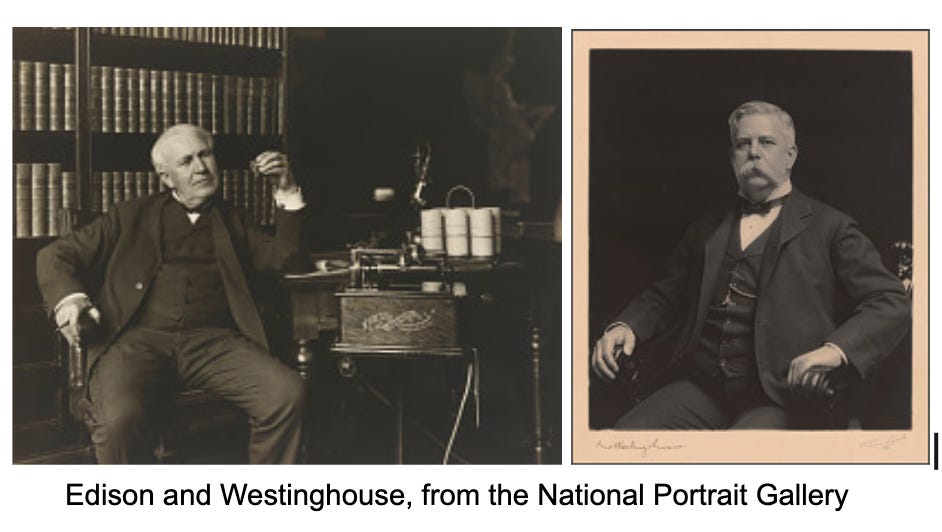
1880 年代、トーマス・エジソンは電気革命の英雄として名を馳せていた。彼は実用可能な最初の白熱電球を発明し、大規模な商業化を果たすと同時に、マンハッタン下部に初の商用発電所も建設した。しかし、彼のシステムは比較的低電圧の直流(DC)で動作しており、短距離では実用的だったものの、顧客に近い場所に発電所を建設する必要があった。
一方、ジョージ・ウェスティングハウスはニコラ・テスラの交流(AC)に関する特許を購入した。交流は高電圧で何マイルも送電でき、その後一般利用のために電圧を下げることも可能だ。テスラはまた、交流で動作する電動機や発電機の開発も行っていた。
1893 年にはウェスティングハウスがシカゴ万国博覧会を交流電力で照らし出し、1896 年までにウェスティングハウスの交流発電機はナイアガラの滝からバッファローへ送電を開始した。エジソンは開拓者としてのリーダーシップを発揮したが、社会全体に電力を広めたのはウェスティングハウスだったのだ(これは、直流が長期的には多くの用途で優れているという点において、エジソンの見解の多くが正しかったこととは矛盾しない。直流は現代のエレクトロニクス、バッテリー、太陽光発電、電気自動車、そして高圧送電において重要な役割を再び果たしている。歴史は直線的に進むものではない)。
ジェフ・ディンの著書『テクノロジーと大国の台頭』は、技術革命における発明と普及の影響を比較検討しています。ディンは、汎用技術の「主導セクター」を支配する国が、その結果として必ずしも国力を増大させるわけではないと主張します。重要なのは普及の速度です。
同氏は、英国が第一次産業革命で優位に立った理由を、蒸気機関の発明や製鋼技術の進歩よりも、機械を経済全体に広く普及させた点に見出しています。これにより、蒸気機関メーカーや製鋼業者だけでなく、多くの企業が収益性を高めることができたのです。
同様に、米国が第二次産業革命で優位に立ったのも、単一の画期的な発明によるものではなく、互換性のある製造方式、電化、そして自動車が瞬く間にあらゆる分野へ広がったスピードによるものです。ドイツは多くの最前線産業を支配していましたが、その国では成長と利益が一部の大手企業に集中し、社会全体に広く普及することはなかったのです。
丁氏の主張によれば、20 世紀においても「拡散」の重要性は「最前線での覇権」よりも高かった。米国が電子技術革命を先導したことは事実だが、丁氏の物語では一時期、日本がその競争で勝利していたように見える側面もある。1980 年代を通じて、日本は半導体、家電、コンピュータハードウェアの分野で世界をリードしていた。しかし長期的に見れば、情報革命における勝敗は米国に軍配が上がった。米国はチップ製造においては日本より劣っていたものの、社会全体においてコンピュータをいかに活用するかという点では圧倒的に優れていたからだ。
私は数週間前に、これらの洞察を AI とその企業導入の文脈で適用した。それは Jeff 氏の著書『Ordinary Engineers, Not Heroic Inventors』に関するレビューの中で述べたことだ。そこで SemiAnalysis のデータを参照し、Google がウェスティングハウスと同じ戦略的賭けに出ているのではないかと考えた。SemiAnalysis の数値は、「Google が拡散に賭けている」という説を裏付けるだけでなく、「最前線でのリーダーシップを放棄した」という説も支持する材料となり得る。つまりこれは、Google 内部で Google Cloud CEO のトーマス・クリアン氏が勝利し、デミス・ハサビス氏とジェフ・ディーン氏が敗れたという戦略的議論の表れとも読み取れる。社内で実際にそう表現されているかどうかは別として、資本配分が示すのは、自社だけでなく他社の AI アプリケーションも受け入れるプラットフォームへと進化しようとする明確な戦略だ。
クリリアン氏は以前から、Google の TPU を「汎用インフラ」へと進化させたいと考えていると述べてきました。Citadel Securities やエネルギー省といった顧客に対し、Gemini と同じように提供できるようにする構想です。
もちろん、Ding 氏のフレームワークを適用した場合の重要な問いは、Google が大量の TPU を販売しているかどうかではありません。むしろ、それらの TPU が経済の他の分野で起こる生産性向上のための広範なイノベーションの波と補完関係にあるかどうかという点です。
クリリアン氏はまた、Anthropic への計算リソースの販売を「プラットフォーム企業として当然のこと」として擁護しています。これは、競合他社を含め、他社の AI が動作する基盤層になることが最大の勝利だと主張している人物の考え方に通じます。先端的な AI 競争に賭けることで生じる破滅的なコストをさらに増やすよりも、その方が賢明だという立場です。
結局のところ、SemiAnalysis はこの点には踏み込みませんでしたが、オープンウェイトモデルが推論価格を引き下げ続けるなら、最先端のラボは「モデルのリーダーシップ」が半導体製造業と似ていることに気づくかもしれません。戦略的には極めて重要ですが、単独のビジネスとしては意外にも収益性が低いという現実です。
Google はフロンティアでの勝利を収めなくても、エッジ領域で支配力を確立できる。Flash クラスの Gemini モデルはすでに AI Mode を検索機能に搭載し、膨大な規模で運用されており、競合他社よりも遥かに多くのユーザーデータを保有している。また、Android、Chrome、Search、Play といったプラットフォームを通じて、Google は圧倒的な流通網を有している。
もしかすると、高コストで採算の取れないフロンティア競争から一旦手を引くことで、120B パラメータ規模という領域で成功を収めるかもしれない。ここは、低価格とローカルハードウェアが現在、ちょうど良いバランス点(スイートスポット)として出会っている場所だ。
電化の歴史に立ち返れば、第二次産業革命を牽引したのは巨大な発電機ではなく、至る所に普及した小型モーターだった。私の同僚であるイラン・スト劳斯は、「優れた小型モデルの開発チームを買収すれば、Google がすでに検索の日常的な層を支配しているように、AI の日常的な層を支配できる企業はない」と推測している。
これは少し飛躍しすぎかもしれない。ChatGPT や Claude も AI の普及において目覚ましい進歩を遂げているが、私見では、彼らが「AGI は富と権力を勝者に集中させる」という主張は、彼らが普及戦略を意識して行動していることを説得力を持って示すものではない。
一方、両社とその顧客はいまだに、汎用技術の普及がもたらす広範な生産性向上を模索し続けている。
要約すると、SemiAnalysis は 8 月 5 日に Google が何かを諦めたという点で正しい可能性が高いが、その理由については誤っているかもしれない。証拠は必ずしも Google が技術的野心を放棄したことを示しているわけではない。セルゲイ・ブリン氏はまだ十分な影響力を持っているようだ。少なくとも現時点では、Google が限られた AI 計算資源をどこに配分し、どこで経済的価値を生み出すと見込んでいるかにシフトが生じたことを示している可能性がある。
AI 競争が「誰が最も優れた知能を構築するか」についてのものであると考えるのは間違いかもしれない。実際には、「誰が電力網を構築するか」の競争になる可能性もある。Google は勝つのをやめようと決めたのではなく、別のレースの方が勝つ価値が高いと判断したに過ぎないのかもしれない。
原文を表示
On August 5, Google announced what appeared to be a corporate version of Nixon’s Saturday night massacre. Demis Hassabis stepped back from day to day operations at DeepMind. Jeff Dean, the founding father of Google engineering, is leaving to start a new lab called Discovery Loop, taking Sanjay Ghemawat, Quoc Le, and Oriol Vinyals with him. Koray Kavukcuoglu, DeepMind’s CTO, now has operational responsibility for DeepMind and Gemini
Dylan Patel and his colleagues at SemiAnalysis read this as a kind of failure in their recent newsletter“Gemini is Cooked but GCP is Cooking.” DeepMind has stopped being a frontier lab, they noted. The departures, they say, are a symptom of years of timid compute allocation and a bureaucratic, risk-averse culture. After all, Google had sophisticated conversational-AI systems well before ChatGPT, but was far more reluctant than OpenAI to put them in users’ hands. SemiAnalysis argues that Google’s failure to risk the core business has finally caught up with it.
It’s not a disaster for Google, though. In SemiAnalysis’s estimates, Google Cloud may be a much larger economic opportunity than pursuing its rivals in the frontier AI race. SemiAnalysis wrote “Our Tokenomics Model estimates that Gemini ARR was $12B in 2Q26. In contrast, by the end of 2027, GCP will be doing over $73B in third party AI ARR IaaS/TaaS and another $120B of TPU sales. $200B of external sales at high 30s EBIT margins vs a first party business generating just $12B today shows where the focus is.”
What’s more, after years of lagging Amazon and Microsoft in cloud revenue, Google seems to be gaining ground. Alphabet reported $24.8 billion of Cloud revenue in the latest quarter, up 82% year over year, compared with 37% growth at AWS and 43% growth in Microsoft’s Azure and other cloud services. The figures aren’t strictly comparable, though. Google Cloud includes Workspace and other applications, and Microsoft does not disclose Azure revenue separately from its cloud applications either, while AWS is pure cloud revenue. SemiAnalysis also estimates that TPU system sales added roughly $1.2 billion to Google Cloud revenue during the quarter.
Is this a choice by Google of profit over frontier ambition? SemiAnalysis compares it to past strategic missteps such as when IBM retreated from the PC into mainframe consulting, or when Intel retreated from Pat Gelsinger’s bold bets into its legacy chip business. Both ended up judged as major mistakes.
That may be correct. But there’s a second scenario that fits the facts, and is also rooted in history.
In the 1880s, Thomas Edison was famed as the hero of the electricity revolution. He had invented the first practical incandescent light bulb and commercialized it at scale, and had built the first commercial power plant in lower Manhattan. However, his system ran on relatively low-voltage direct current, which was practical over short distances but required generating stations close to customers. George Westinghouse bought Nikola Tesla’s patents for alternating current, which could travel for miles at high voltage and then be stepped down for ordinary use. Tesla had also developed electric motors and generators that ran on alternating current. By 1893 Westinghouse had lit the Chicago World’s Fair with AC. And by 1896, Westinghouse’s AC generators were sending power from Niagara Falls to Buffalo. Edison was the frontier leader, but Westinghouse won the race to diffuse electricity through society. (This is how it worked out even though Edison was, in many ways, right in the long term about the many applications for which direct current is superior. DC has returned as a crucial part of modern electronics, batteries, solar, EVs and high-voltage transmission. History rarely goes in straight lines.)
Jeff Ding’s book *Technology and the Rise of Great Powers* traces the relative impact of invention and diffusion during technology revolutions. Ding argues that nations that dominate the “leading sector” of a general purpose technology don’t reliably grow more powerful as a result. Diffusion is the defining factor. He posits that Britain’s edge in the first industrial revolution came less from inventing the steam engine and advances in steelmaking than from diffusing machinery through the whole economy so that many businesses, not just the steam engine manufacturers and the steelmakers, became more profitable. And America’s edge in the second industrial revolution had less to do with any single American breakthrough than with how fast interchangeable manufacturing, electrification, and eventually the automobile spread into every sector at once. Germany dominated many frontier industries, but there, growth and profits were concentrated in a few leading companies rather than diffused widely through society.
According to Ding, the importance of diffusion over frontier dominance continued in the 20th century. Though the US pioneered the electronics revolution, Japan appeared for a time to be winning the frontier race, at least in Ding’s narrative. It led the world in semiconductors, consumer electronics, and computer hardware through the 1980s, yet in the long run it still lost the information revolution to the US, a country that was worse at making the chips and better at putting computers to work throughout society.
I applied these insights to AI and its corporate adoption a few weeks ago ina review of Jeff’s book called Ordinary Engineers, Not Heroic Inventors. So reading SemiAnalysis, I wondered whether Google might be making the same strategic bet as Westinghouse. SemiAnalysis’s numbers can make the case that Google is betting on diffusion at least as well as the case that it is giving up on frontier leadership. So this could be read as a strategic argument inside Google that Google Cloud CEO Thomas Kurian won and that Demis Hassabis and Jeff Dean lost. Whether or not anyone inside Google describes it this way, the capital allocation increasingly looks like a strategy to become a platform for not just its own but for other people’s AI applications.
Kurian has been saying for a while that he wants Google TPUs to become “general purpose infrastructure,” serving Citadel Securities and the Department of Energy as readily as Gemini. Of course, the crucial question if we were using Ding’s framework isn’t whether Google sells lots of TPUs but whether those TPUs become complements to a broad wave of productivity-enhancing innovation in other parts of the economy.
Kurian has also defended selling compute to Anthropic as what happens when you’re a platform company. That sounds like someone who has argued that the bigger prize is being the layer that others’ AI runs on, competitors included, rather than doubling down on the potentially ruinous costs of the frontier AI race. After all, while SemiAnalysis didn’t go there, there’s a chance that if open-weight models continue to compress inference pricing, frontier labs may discover that model leadership resembles semiconductor fabrication, enormously important strategically but surprisingly poor as a standalone business.
Google also doesn’t need to win the frontier to dominate the edge. Its Flash-class Gemini models already run AI Mode in Search at enormous scale, with more user telemetry than almost any competitor. Google has enormous distribution advantages through Android, Chrome, Search, and Play. Perhaps they cede the expensive unprofitable frontier race and excel in the 120B space where affordability and local hardware are currently meeting in a sort of sweet spot. Returning to the history of electrification, it was ubiquitous small motors that powered the second industrial revolution, not giant dynamos. Buy one good small model team, my colleague Ilan Strauss speculates, and there may be no company better positioned to own the ordinary, everyday layer of AI the way Google already owns the ordinary, everyday layer of search. This may be a stretch. ChatGPT and Claude have made their own remarkable advances in the diffusion of AI, but IMO, their rhetoric about the way that AGI will concentrate enormous wealth and power in the hands of the winner doesn’t make a convincing case that they are operating with a diffusion strategy in mind. Meanwhile, both they and their customers are still in search of the widespread productivity uplift that diffusion of a general purpose technology brings.
In short, SemiAnalysis is probably right that Google gave something up on August 5, but possibly wrong about why. The evidence does not necessarily show that Google has abandoned technological ambition. Sergey Brin still seems to have plenty. But at least for the moment it may show a shift in where Google is allocating scarce AI compute and where it expects to capture economic value. It may be a mistake to assume that the AI race is about who builds the best intelligence. It may turn out to be about who builds the electrical grid. Maybe Google didn’t decide to stop trying to win so much as to decide that a different race was more worth winning.
関連記事
今日のまとめ
AIデイリーブリーフで今日の重要ニュースをまとめ読み