AI エージェントのスキル設計に 6 つの実証的実践法
本文の状態
日本語全文を表示中
詳細モードで約19分の本文を読めます。
同じ出来事の情報源
この情報源を基点に整理
Arize AI Blog
3 つの研究により、優れたスキルは最長の文書や巧妙なプロンプトではなく、反復する失敗を修正する手続き的専門知識であることが示された。
AI深層分析を開く2026年8月4日 08:30
AI深層分析
キーポイント
スキル設計の核心原則
効果的なスキルは長さや巧妙さではなく、反復する失敗を修正する手続的専門知識をコンパクトにパッケージ化し、必要な時だけ読み込まれるものである。
実証された6つの実践ルール
人間の経験に基づく設計、評価ゲートによるモデルのドラフト承認、1〜3個の関連スキルへの絞り込み、および変更時の意味ある向上確認など、データに基づいた具体的な指針が提示される。
スキルと他概念の明確な区別
AI エージェント・スキルは特定のタスクへの回答ではなく、再利用可能な判断や制約をパッケージ化するものであり、プロンプト、ツール、検索とは異なる役割を持つ。
研究による設計の定量化
SkillsBench や SkillComposer などの最新研究により、スキル設計が主観から実験データに基づく手法へと移行し、モデルとハーネスの組み合わせごとの挙動検証の重要性が示された。
モデルは編集者として活用し、ドメインの真実は人間が定義する
モデルに依存した自己生成スキルは性能を低下させるため、専門家の知識と評価結果に基づいてスキルを作成・改善する必要がある。
重要な引用
a good skill isn't the longest SKILL.md or the cleverest prompt. It's a compact package of procedural expertise that fixes a repeatable failure
The work is no longer adding skills—it's designing, routing, and evaluating them as one system.
One to three skills performed best; flooding context wasted tokens and accuracy.
You really have to tell the agent what you mean.
編集コメントを表示
編集コメント
この記事は、AI エージェントのスキル設計における「量より質」の重要性をデータで裏付けた貴重な知見である。開発者は既存のプロンプトやドキュメント中心のアプローチを見直し、評価を前提としたシステム設計への転換を図る必要がある。
Source Article
元記事を日本語で読む
本文に関係しない購読案内、埋め込み通知、サイト内プロモーションは除いています。
スキルは、Anthropic から GitHub まで、実装済みの製品機能として定着しつつあります。しかし、多くの AI エンジニアにとって、効果的なスキルの作成手法はまだ体系化されていません。ただし、最近の 3 つの研究がこの状況を覆しました。その最大の発見とは、優れたスキルとは最も長い SKILL.md ファイルや最も巧妙なプロンプトではないということです。それは、反復する失敗を解決し、必要な時だけ読み込まれ、対応する評価でその地位を勝ち取るための、手続き的専門知識のコンパクトなパッケージなのです。
もはや重要なのはスキルを追加することではなく、それらを一つのシステムとして設計し、ルーティングし、評価することです。
この記事では、新しいデータを基に、エージェントのパフォーマンスを実証的に向上させるスキルの作成に関する 6 つの実践ルールを解説します。また、各ルールがどのように評価によって証明できるかも示します。
TL;DR:効果的な AI エージェントスキルとは何か?
研究は以下の 6 つの実践的ルールを示しています。
- 人間の実際の業務手順に基づいて構築する。モデルによる草案や改訂は、評価ゲートを通過した後のみ許可する。
- 焦点を絞る。包括的なドキュメントよりも、簡潔または標準的な長さのガイドラインの方が性能が高い。
- 必要な最小限のセットを読み込む。1 つから 3 つのスキルが最も効果的でした。文脈に溢れさせることはトークンと精度の無駄になります。
- すべてのモデルとハッチの組み合わせをテストする。ポータブルなファイル形式であっても、動作が移植可能である保証はありません。
- 反復する知識のギャップを狙う:内部規約、規制されたワークフロー、不安定な API、専門的な手順などです。
- 対応する「スキルあり」対「スキルなし」の評価で有意な改善が見られる場合のみ、変更を受け入れる。
AI エージェントスキルとは何か?
AI エージェントのスキルとは、特定のタスククラスに対する手続的知識をファイルシステムベースのパッケージとして再利用可能な形で提供するものです。通常は必須の SKILL.md ファイルを含み、スクリプト、テンプレート、サンプル、参照資料などを追加できます。このスキルはエージェントにワークフローを実行する方法を示すものであり、特定の一つのタスクに対する答えそのものを含むべきではありません。
これにより、スキルはプロンプト、ツール、検索とは明確に区別されます。プロンプトは現在の文脈における指示であり、ツールはエージェントが呼び出せるアクションを公開するものです。検索は変化する事実的情報をもたらす役割を持ちます。一方、スキルは再利用可能な判断、手順、制約、リソースをパッケージ化します。
一部の専門家は、評価(evals)、判定器、フィードバック信号でスキルを包むより大きなシステムに対して「レシピ」という用語を使用しています。
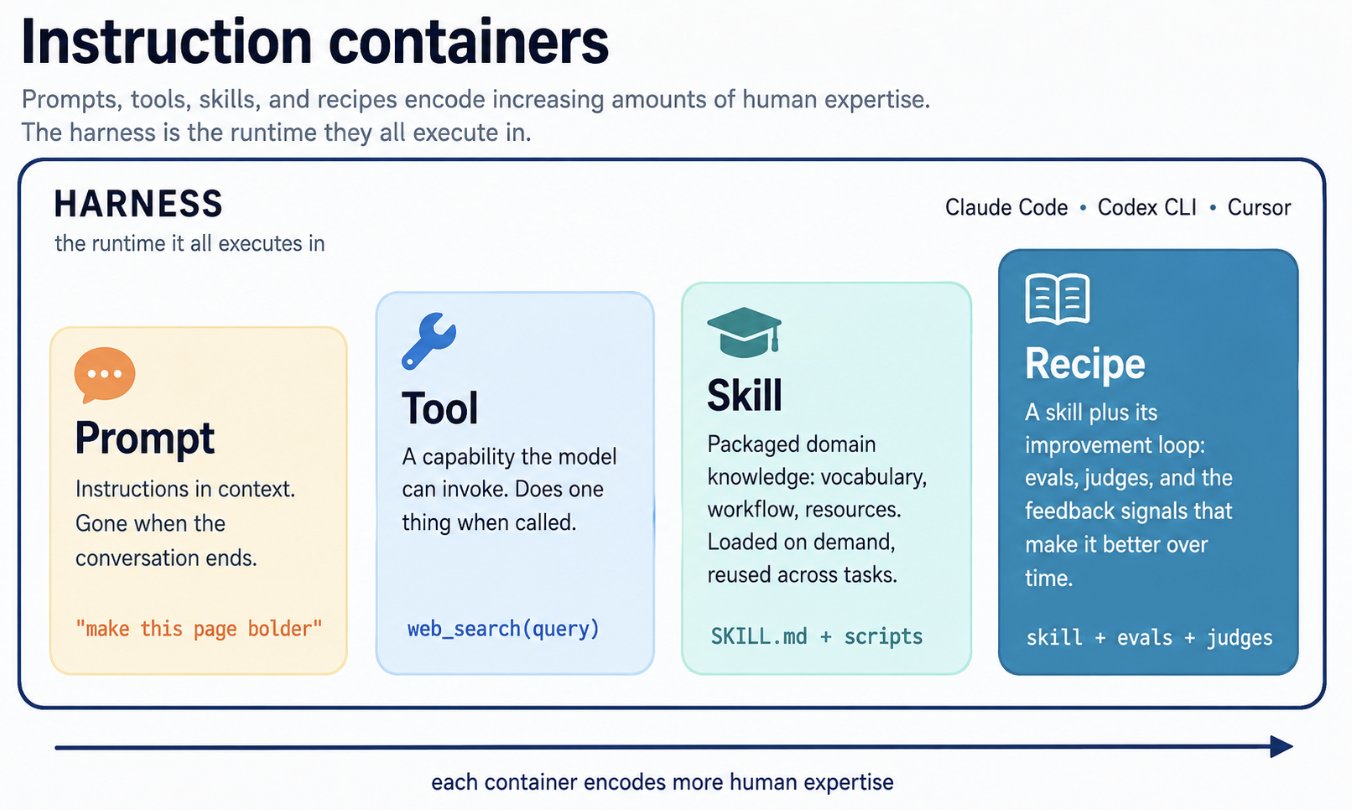 image図 1. プロンプト、ツール、スキル、レシピは、エージェントの枠組み内に人間の専門知識を段階的に蓄積するパッケージです。
研究では何を測定したのか?
最近の三つの研究により、スキルの設計は主観的な意見から実験に基づくものへと進化しました。SkillsBench では、スキルなしの実行と厳選されたスキル付きの実行を比較します。SkillComposer はスキルの進化に関するテストで、モデルが明示的な品質管理の下でスキルを作成し、改善し、統合できるかどうかを検証します。また別の生成型スキル構成研究では、大規模なライブラリからどのスキルを読み込むべきか、いくつ読み込むべきか、そしてどのような順序で読み込むべきかを問うています。
- 研究:問い / 実践的な示唆
| SkillsBench | 厳選されたスキルはタスクの成功を向上させるのか?
キュレーション済みスキルを追加すると、平均で 16.6 ポイントの向上が見られました。ただし、モデルとハネス(実行環境)の組み合わせやタスクによっては効果にばらつきがあり、一部では性能が低下するケースもありました。
SkillComposer: 進化
モデルはスキルを生成・改善できるのか?
無秩序な抽出は逆効果になる可能性があります。候補となるスキルが「合格率を向上させる」ことを条件とする場合、モデル支援による進化アプローチの方が有効です。
SkillComposer: 構成
大規模なスキルライブラリはどのように読み込むべきか?
196 個のスキルをすべて読み込むよりも、短く順序立てたリスト(小規模な候補群)を採用する方が、入力トークンの使用量を減らしつつ高い性能を発揮しました。
- 空白の状態から始めるのではなく、人間の専門知識を出発点に
モデルはドメインの真実を提供する源ではなく、編集者や実装者として扱うべきです。SkillsBench の評価では、Claude Code、Codex、Gemini CLI の各設定において、モデルが自己生成したスキルは「スキルなし」ベースラインに対して 8.1〜11.5 ポイント低い結果となりました。一方、同じ設定でキュレーション済みスキルを採用すると、18.2〜24.8 ポイントの向上が見られました。
注目すべきは、単なる数値上の成果よりも失敗のパターンです。生成されたスキルパックの中には、実際に使用されなかったものや、タスク解決に割くべきリソースを消費してしまったもの、あるいは「確信に満ちた誤った前提」を記述してしまい、その後のソルバーがそれを盲信して失敗したケースがありました。見た目が整った SKILL.md ファイルであっても、エージェントの信頼性を損なう可能性があります。
これはモデル支援が無意味だということではありません。スキル進化に関する研究から浮かび上がったのは、より狭く、根拠のあるパターンです。つまり、モデルにスキルの提案や改訂を行わせ、その変更が保持されたタスクセットの合格率を定義された閾値以上に向上させる場合にのみ採用する、というアプローチです。ドメインの真実を提供するのは、ドメインの専門家と評価結果であり、モデルの自信度ではありません。
Paul Bakaus の優れたデザインスキルは、良い例です。支援なしのモデルが「このページをもっと大胆に」という指示を受け取った場合、グラデーションやネオンカラーを連想する可能性があります。しかし、デザインの専門家なら、大胆さを階層構造、スケール、コントラスト、そして決定的なタイポグラフィを通じて定義できます。Bakaus 自身が言うように、「エージェントには、あなたが何を求めているのかを明確に伝える必要があります」。
スキルに含めるべき要素とは何でしょうか?
優れた成果と単なる妥当な成果を分ける専門用語や判断基準です。
ブランチ、前提条件、停止条件を含む標準的なワークフローです。
調整されたデフォルト値、制約条件、不変条件、そして健全性チェックです。
モデルが繰り返し見落としがちな API の癖、ファイル形式の要件、パースルールなどの詳細情報です。
推論を繰り返す必要を減らすための実行可能なスクリプト、具体的な事例、またはテンプレートです。
既知の失敗モードと、それぞれに対する回復手順です。
- スキルはコンパクトに、手続的に保つ
SKILL.md をマニュアルにしてはいけません。最新の SkillsBench 分析では、コンパクトなスキルと標準的な長さのスキルが、合格率をそれぞれ 19.0 ポイント、21.5 ポイント向上させました。詳細なスキルでも 14.5 ポイントの改善が見られましたが、包括的なドキュメントはわずか 0.7 ポイントの改善にとどまり、ほぼ横ばいでした。
モデルには限られた注意(アテンション)の予算しかありません。各段落はタスク、ツールからの出力、そしてハネス全体の残りと競合します。余計な文章は実際の判断ルールを埋もれさせたり、矛盾する指示を導入したりする恐れがあります。
SKILL.md には、最小限の実行手順を記載してください。いつそのスキルを使うのか、実行順序と分岐点、そして完了の定義です。参照資料やサンプルコード、スクリプトなどは別ファイルに移動させ、エージェントが必要になった時にのみ開けるようにします。この段階的開示のパターンにより、詳細を保ちつつ、毎回コンテキストコストを全額支払う必要がなくなります。
焦点を絞ったスキルは、以下の 5 つの問いに答えるべきです。
- エージェントはこのスキルをいつ読み込むのか?
- どのような順序と意思決定ポイントに従うべきか?
- 絶対に違反してはならない制約や不変条件は何なのか?
- 正しい結果とはどのようなものか?
- メインパスでは不十分な場合に、どのリソースを開くまたは実行すべきか?
- タスクに必要なスキルのみをルーティングする
スキルライブラリは、選定という新たなエンジニアリング課題を生みます。システムは、どのスキルを読み込むか、いくつ読み込むか、そしてどのような順序で読み込むかを決定する必要があります。すべてのスキルを読み込むことは、安全なデフォルトではありません。
生成コンポジションに関する研究では、196 件の人間が手作業で選定したスキルからなるライブラリをテストしました。GPT-5.2-Codex において、全スキルを読み込んだ場合の合格率は 29.3% でした。一方、タスク条件に基づいて選択するコンポーザーでは 45.3% に達しています。また、全スキル読み込みの場合は、コンポーザーよりも約 23% 多い入力トークンを使用しました(127 万対 103 万)。全スキル読み込みは、スキルなしの場合よりは優れていましたが、利用可能な性能向上の大部分を見逃し、その分だけコストも高くつきました。
SkillsBench は別の角度から同じパターンを突き止めました。スキルが 1 つのタスクでは 18.0 ポイント、2〜3 つのスキルを持つタスクでは 19.0 ポイント獲得しましたが、より多くのスキルを束ねたグループではわずか 10.1 ポイントでした。最適なデフォルト設定はカタログ全体ではなく、必要な最小限のセットです。
ルーティングをハッチネスの一部に組み込む
タスクが解決する際の言語に合わせて、具体的なスキルの名前と説明を記述してください。
必要な手順をカバーする最小限の部分集合を選択します。
相互依存関係がある場合、実行スキルよりも前提条件を先に配置します。
エージェントが実際に選択したスキルを発見し、読み込み、使用したかを追跡します。
ルーティングエラーと実行エラーは別々に評価してください。どんなに優れたスキルでも、ロードされなければ役立ちません。
- サポートするすべてのモデルとハッチネスの組み合わせをテストする
スキルはファイルとして移植可能ですが、動作まで自動的に移植されるわけではありません。ハッチネスが決定するのは、スキルの発見、コンテキスト注入、ツール、権限、サブエージェント、ワークスペースの状態、そして実行です。これらの選択次第で、スキルが見られるか、その手順が追従できるかが決まります。
SkillsBench は異なるハッチネス下で同じモデルを測定しました。Gemini 3.1 Pro は Gemini CLI でスキルを使用した場合に 60.8% を達成しましたが、OpenHands では 52.8% でした。Claude Opus 4.7 も同様に、Claude Code では 61.2%、OpenHands では 53.1% でした。したがって、互換性を主張する際はモデル名だけでなく、完全なスタックを明記する必要があります。
各ターゲットに対して、スキル発見のテスト、ツールおよび権限との互換性確認、実行の成功、トークンコスト、レイテンシ、回帰テストを実施してください。ハーンネスが著しく異なる機能を提供する場合は、1 つのファイルがどこでも同じように動作すると偽るのではなく、共有コアにターゲット固有の指示を組み合わせて提供することが望ましいです。
これは、Arize がエージェントハーンネスを単なる薄いプロンプトラッパーではなく、モデルを取り巻く完全な制御層として位置づけている理由と同じです。ハーンネスには、モデルが呼び出せるツール、受け取るコンテキスト、出力するトレース、実行する評価、安全にリリースされる変更を決定するレビューゲートが含まれます。
- ベースモデルが確実に埋められないギャップを狙う
最も有望なスキルの候補は、専門的な手順を必要とする反復的な失敗です。スキルが最も価値を持つのは、モデルが一般的な事前学習だけでは回復できない判断やワークフローを符号化している場合です。
内部の慣習、規制されたレビューステップ、科学または製造プロセス、脆い API、珍しいファイル形式、インシデント対応プレイブックなど、小さな見落としが大きな下流障害につながるプロセスを探してください。これらは専門知識をパッケージ化する上で高いレバレッジを持つ場所です。
一方、一般的なスキルでよく知られたコーディングアドバイスを繰り返すだけではほとんど価値がなく、より強力なデフォルト戦略を置き換えてしまう恐れがあります。スキルを作成する前に、その問題が本当に再利用可能な手順であるかどうか自問してください。
必要 | 最良のメカニズム
---|---
このタスクに対する一方向性の指示 | プロンプト
エージェントが呼び出せる決定論的なアクション | ツール
鮮度のある、あるいは変化する事実の文脈
検索機能や RAG(Retrieval-Augmented Generation)
再利用可能な専門家の手順と判断力
スキル
評価指標、ジャッジ、フィードバックを備えたスキル
レシピまたは改善システム
- スキルの変更はすべて実験として扱う
Markdown が美しく整えられていても、そのスキルが完成したわけではありません。対照的な条件で勝つとき初めて完了です。
SkillsBench の調査では、87 件のタスクのうち 13 件でネガティブな結果(パフォーマンス低下)が確認されました。原因は往々にして、スキルが不必要に重いパイプラインを指定していたこと、より優れたデフォルト設定を置き換えてしまったこと、あるいはエージェントがデバッグできないソルバーへと誘導してしまったことにあります。
実用的なアプローチはペア評価です。タスク、モデル、ハネス(実行環境)、ツール、予算、スコアリング基準をすべて固定した状態で、まずスキルなしのベースラインを実行し、次にそのスキルを利用する条件で実行します。そして両者を比較します。
決定論的な作業には自動検証器を使用し、主観的な判断が必要な作業には明確な評価基準(ルブリック)、キャリブレーションされたジャッジ、曖昧さが残る箇所については人の目によるレビューを導入してください。また、両方の条件における実行トレースを検証し、ルーティング、推論、ツール利用、出力のいずれで失敗したのかを切り分けて分析します。
実用的なスキル評価ループ
- 期待される成功ケース、エッジケース、そして起こりうる回帰(性能低下)を含む、代表的なタスクセットを構築する
- モデル、ハネス、ツール、権限、時間制限、トークン予算を凍結(固定)する
- スキルなしでベースラインを実行し、完全なトレースを保存する
- 同じタスクセットにスキルを利用可能にし、同じスコアリング基準で再実行する
- タスクの成功率、スキルの利用率、軌跡の質、コスト、レイテンシ、回帰率を比較する
- 失敗箇所を検証し、仮説は一つずつ修正して、フルセットを再実行する
改善が明確で、独立した検証セットでも持続するものだけをリリースしてください。
このループは評価駆動型開発です。エージェントの行動を追跡し、その振る舞いを評価し、失敗箇所を検証し、ハネスやスキルを改良して再実行します。これが自己改善型エージェントの基盤でもあります。変更が安定したスコアカードに対して測定されなければ、フィードバックは有用になりません。
何を測るべきでしょうか?
- メトリック:回答する質問
- タスク成功率またはパス率:このスキルは代表的なタスクの結果を改善しましたか?
- スキル利用率:エージェントはこのスキルを発見し、読み込み、適用できましたか?
- トラジェクトリの正確性:適切なツール、順序、チェック、回復経路を選択しましたか?
- コストとレイテンシ:追加のコンテキストと実行時間に見合うメリットがありましたか?
- リグレッション率:以前は成功していたタスクのうち、どれが失敗するようになりましたか?
- 一般化能力:このスキルは同じワークフローファミリー内の未見タスクにも役立ちますか?
| 多様性 | クリエイティブな作業において、品質の向上と出力の収束防止を両立できましたか?
主観的なスキルはどう評価すべきでしょうか?
すべてのスキルが pytest で検証可能な出力を生み出すわけではありません。デザイン品質、文章品質、調査品質など、判断に依存する成果物には異なるスコアカードが必要です。基本原則は同じです:条件を揃えて比較しますが、評価は多次元で行います。
正しさ、明瞭さ、ブランド適合性、独自性、制約遵守といった独立した次元を持つルブリックを定義してください。
LLM の評価者(judge)は、専門家によってラベル付けされた事例に対してキャリブレーションを行い、結果が微妙な場合やリスクの高いケースでは、盲検化された人間のレビューを併用すべきです。
最終的な成果物だけでなく、そのプロセス全体も評価してください。見た目が立派な回答でも、脆いプロセスや安全上の欠陥を隠している可能性があります。
一度に一つの出力の品質だけを測るのではなく、バッチ全体での多様性も測定する必要があります。すべてのサイトが同じように見えるようなスキルは、コーパスレベルでの後退(レグレスション)を生み出すことになります。
ホールドアウトセット(検証用データセット)を保持し、定期的に更新して、そのスキルが静的なベンチマークに過学習しないようにしてください。
これらの主観的かつ集団レベルの失敗に対する統一された基準はまだ確立されていません。だからこそ、スコアカードを明確にする必要があるのです。「なんとなく」で判断する理由にはなりません。
評価こそがスキルである
新しいルールブックは明確です。人間の専門知識から始め、スキルの範囲を絞り込み、タスクに必要なものだけをルーティングし、サポートされるすべてのスタックをテストし、実際のプロセス上の隙間(ギャップ)に焦点を当て、変更のたびに評価でゲートキーピングを行うことです。
今や難しいのは、説得力のある Markdown を書くことではありません。そのスキルがエージェントを本当に向上させるのかを実証することです。
実践的な第一歩として、Arize Skills を使用してコーディングエージェントにトレーシングと評価ワークフローを追加し、エージェントのループ全体を計測可能にし、Arize AX でスキルやハッチバージョンの違いをエージェント実験と比較してください。基準はシンプルです。測定可能な効果があるものは維持し、ないものは廃棄します。
この記事「How to write effective AI agent skills: 6 data-backed practices」は、もともと Arize AI の投稿として公開されました。
原文を表示
Skills are now a shipping product surface, from Anthropic to GitHub. Yet for most AI engineers, the practice of writing them well remains poorly codified. Three recent studies change that, though. The headline finding: a good skill isn’t the longest SKILL.md or the cleverest prompt. It’s a compact package of procedural expertise that fixes a repeatable failure, loads only when relevant, and earns its place against a matched evaluation. The work is no longer adding skills—it’s designing, routing, and evaluating them as one system.
This piece distills that new data into six practical rules for writing skills that measurably improve your agent and shows how to prove each one with an eval.
TL;DR: What makes an effective AI agent skill?
The research points to six practical rules:
Ground it in real human procedural expertise. Let models draft or refine only behind an evaluation gate.
Keep it focused. Compact or standard-length guidance outperformed comprehensive documentation.
Load the smallest relevant set. One to three skills performed best; flooding context wasted tokens and accuracy.
Test every model-harness pair. A portable file format does not guarantee portable behavior.
Aim at repeated knowledge gaps: internal conventions, regulated workflows, brittle APIs, and specialized procedures.
Accept each change only when a matched with-skill versus without-skill evaluation shows meaningful lift.
What is an AI agent skill?
An AI agent skill is a reusable, file-system-based package of procedural knowledge for a class of tasks. It typically includes a required SKILL.md file and can add scripts, templates, examples, or reference material. A skill tells the agent how to perform a workflow; it should not contain the answer to one specific task.
That makes a skill different from a prompt, a tool, or retrieval. A prompt is an instruction in the current context. A tool exposes an action the agent can invoke. Retrieval brings in changing factual context. A skill packages reusable judgment, sequence, constraints, and resources.
Some practitioners use the term recipe for the larger system that wraps a skill with evals, judges, and feedback signals.
imageFigure 1. Prompts, tools, skills, and recipes package increasing amounts of human expertise inside the agent harness.
What did the research measure?
Three recent studies move skill design from opinion to experiment. SkillsBench compares matched runs with no skills and curated skills. SkillComposer for skill evolution tests whether models can create, improve, and merge skills under explicit quality control. A separate generative skill composition study asks which skills a large library should load, how many it should load, and in what order.
Study
Question
Practical signal
SkillsBench
Do curated skills improve task success?
Curated skills added 16.6 percentage points on average, but gains varied by model-harness pair and some tasks regressed.
SkillComposer: evolution
Can models create and improve skills?
Uncontrolled extraction can hurt. Model-assisted evolution works better when candidates must improve pass rate.
SkillComposer: composition
How should a large skill library be loaded?
A small, ordered shortlist beat loading all 196 skills while using fewer input tokens.
- Start with human expertise, not a blank model
Treat the model as an editor or implementer, not the source of domain truth. In SkillsBench, self-generated skills landed 8.1 to 11.5 points below the no-skill baseline across Claude Code, Codex, and Gemini CLI configurations. Curated skills on the same configurations added 18.2 to 24.8 points.
The failure modes matter more than the headline. Generated packs sometimes went unused, consumed effort that should have gone toward solving the task, or encoded a confident but wrong assumption that the solver then followed. A polished-looking SKILL.md can still make the agent less reliable.
That does not mean model assistance is useless. The skill-evolution study shows a narrower, more defensible pattern: let a model propose a skill or revision, then retain it only when it improves a held-out task suite by a defined pass-rate margin. The source of truth is the domain expert plus the eval, not the model’s confidence.
Paul Bakaus’s Impeccable design skill is a useful example. An unassisted model may interpret “make this page bolder” as gradients and neon. A design expert can define boldness through hierarchy, scale, contrast, and decisive typography. As Bakaus put it, “You really have to tell the agent what you mean.”
What belongs in the skill?
The expert vocabulary and decision criteria that separate good work from plausible work.
The canonical workflow, including branches, prerequisites, and stop conditions.
Calibrated defaults, constraints, invariants, and sanity checks.
API quirks, file-format requirements, parsing rules, and other details the model repeatedly misses.
Executable scripts, worked examples, or templates when they reduce repeated reasoning.
Known failure modes and the recovery procedure for each one.
- Keep the skill compact and procedural
Do not turn SKILL.md into a manual. In the latest SkillsBench analysis, compact and standard-length skills improved pass rate by 19.0 and 21.5 points. Detailed skills improved it by 14.5 points. Comprehensive documentation was almost flat at a 0.7-point lift.
The model has a finite attention budget. Every paragraph competes with the task, tool outputs, and the rest of the harness. Extra prose can bury the actual decision rule or introduce conflicting instructions.
Put the minimum viable procedure in SKILL.md: when to use the skill, the ordered steps, the critical branches, and the definition of done. Move bulky references, examples, and scripts into separate files that the agent can open only when needed. This progressive-disclosure pattern preserves detail without paying the full context cost on every run.
A focused skill should answer five questions
When should the agent load this skill?
What sequence and decision points should it follow?
Which constraints or invariants must never be violated?
What does a correct result look like?
Which resource should it open or run when the main path is not enough?
- Route only the skills the task needs
A skill library creates a second engineering problem: selection. The system has to decide which skills to load, how many to load, and in what order. Loading everything is not a safe default.
The generative composition study tested a library of 196 human-curated skills. On GPT-5.2-Codex, loading all skills reached a 29.3% pass rate. A task-conditioned composer reached 45.3%. The all-skills condition also used about 23% more input tokens than the composer: 1.27 million versus 1.03 million. All-skills was still better than no skills, but it left most of the available gain on the table and paid more to do it.
SkillsBench found the same pattern from a different angle: tasks with one skill gained 18.0 points, tasks with two or three gained 19.0 points, and larger bundles gained only 10.1 points. The best default is the smallest relevant set, not the whole catalog.
Make routing part of the harness
Write specific skill names and descriptions that mirror the language of the tasks they solve.
Select the minimum subset that covers the required procedure.
Order prerequisites before execution skills when one depends on another.
Trace whether the agent actually discovered, read, and used the selected skill.
Evaluate routing errors separately from execution errors. A perfect skill cannot help if it is never loaded.
- Test every model-harness combination you support
Skills are portable as files, not automatically portable as behavior. The harness controls discovery, context injection, tools, permissions, subagents, workspace state, and execution. Those choices determine whether the skill is seen and whether its procedure can be followed.
SkillsBench measured the same models under different harnesses. Gemini 3.1 Pro reached 60.8% with skills in Gemini CLI and 52.8% in OpenHands. Claude Opus 4.7 reached 61.2% in Claude Code and 53.1% in OpenHands. A compatibility claim should therefore name the complete stack, not just the model.
For each target, test skill discovery, tool and permission compatibility, successful execution, token cost, latency, and regressions. Where harnesses expose materially different capabilities, ship a shared core plus target-specific instructions rather than pretending one file behaves identically everywhere.
This is the same reason Arize frames the agent harness as the full control layer around the model, not a thin prompt wrapper. The harness includes the tools the model can call, the context it receives, the traces it emits, the evals it runs, and the review gates that determine what changes safely ship.
- Aim at gaps the base model cannot reliably fill
The best skill candidates are repeated failures that require specialized procedure. Skills are most valuable when they encode judgment or workflow the model is unlikely to recover from general pretraining alone.
Look for internal conventions, regulated review steps, scientific or manufacturing workflows, brittle APIs, uncommon file formats, incident-response playbooks, and any process where a small missed detail causes a large downstream failure. Those are high-leverage places to package expertise.
By contrast, a generic skill that restates familiar coding advice may add little and can displace a stronger default strategy. Before writing a skill, ask whether the problem is really reusable procedure.
Need
Best-fit mechanism
One-off direction for this task
Prompt
A deterministic action the agent can invoke
Tool
Fresh or changing factual context
Retrieval or RAG
Reusable expert procedure and judgment
Skill
A skill plus evals, judges, and feedback
Recipe or improvement system
- Treat every skill change as an experiment
A skill is not done when the Markdown looks polished. It is done when it wins a controlled comparison.
SkillsBench found negative deltas on 13 of 87 tasks, often because a skill prescribed an unnecessarily heavy pipeline, displaced a better default, or pointed the agent toward a solver it could not debug.
The practical method is paired evaluation: hold the task, model, harness, tools, budget, and scorer constant; run a no-skill baseline; run the skill condition; then compare.
For deterministic work, use automated verifiers. For subjective work, use explicit rubrics, calibrated judges, and human review where ambiguity remains. Inspect traces in both conditions so you can separate routing, reasoning, tool-use, and output failures.
A practical skill evaluation loop
Build a representative task set, including expected successes, edge cases, and likely regressions.
Freeze the model, harness, tools, permissions, time limit, and token budget.
Run the baseline without the skill and store the full traces.
Run the same tasks with the skill available and the same scorer.
Compare task success, skill utilization, trajectory quality, cost, latency, and regression rate.
Inspect failures, revise one hypothesis at a time, and rerun the full suite.
Ship only when the improvement is meaningful and holds on a separate validation set.
That loop is evaluation-driven development: trace what the agent did, evaluate the behavior, inspect the failure, refine the harness or skill, and rerun. It is also the foundation for self-improving agents. Feedback becomes useful only when changes are measured against a stable scorecard.
What should you measure?
Metric
Question it answers
Task success or pass rate
Did the skill improve the outcome on representative tasks?
Skill utilization
Did the agent discover, read, and apply the skill?
Trajectory correctness
Did it choose the right tools, order, checks, and recovery path?
Cost and latency
Did the gain justify the extra context and execution time?
Regression rate
Which previously passing tasks now fail?
Generalization
Does the skill help unseen tasks in the same workflow family?
Diversity
For creative work, did quality rise without making outputs converge?
How do you evaluate subjective skills?
Not every skill produces an output that can be checked with pytest. Design quality, writing quality, investigation quality, and other judgment-heavy outcomes need a different scorecard. The core principle is still the same: compare matched conditions, but make the evaluation multidimensional.
Define a rubric with independent dimensions such as correctness, clarity, brand fit, originality, and constraint adherence.
Calibrate LLM judges against expert-labeled examples and use blinded human review for close or high-stakes cases.
Evaluate the trajectory as well as the final artifact. A good-looking answer can hide a brittle or unsafe process.
Measure diversity across a batch, not only quality one output at a time. A design skill that makes every site look the same is creating a corpus-level regression.
Keep a holdout set and periodically refresh it so the skill does not overfit to a static benchmark.
The field does not yet have one standard for these subjective and population-level failures. That is a reason to make the scorecard explicit, not a reason to fall back to vibes.
The eval is the skill
The emerging rulebook is clear: start with human expertise, keep the skill focused, route only what the task needs, test every supported stack, target real procedural gaps, and gate every change with an eval.
The hard part is no longer writing convincing Markdown, it is proving that the skill makes the agent better.
For a practical starting point, use Arize Skills to add tracing and evaluation workflows to coding agents, instrument the full agent loop, and compare skill or harness versions with agent experiments in Arize AX. The standard is simple: keep what measurably helps, and discard what does not.
The post How to write effective AI agent skills: 6 data-backed practices appeared first on Arize AI.
今日のまとめ
AIデイリーブリーフで今日の重要ニュースをまとめ読み