Amazon Bedrock、OpenAI GPT-5.6 モデルのクロスリージョン推論をサポート
本文の状態
日本語全文を表示中
詳細モードで約15分の本文を読めます。
同じ出来事の情報源
この情報源を基点に整理
AWS Machine Learning Blog
Amazon Bedrock が OpenAI の GPT-5.6 モデル(Sol、Terra、Luna)のクロスリージョン推論をサポートし、25 以上の AWS リージョンで容量拡張と地理的制約に応じた柔軟な運用を可能にした。
AI深層分析を開く2026年8月21日 09:31
AI深層分析
キーポイント
GPT-5.6 のクロスリージョン推論対応
Amazon Bedrock は OpenAI GPT-5.6 モデルの Sol、Terra、Luna 3 変種に対してクロスリージョン推論(CRIS)機能を導入し、25 以上の AWS リージョンで利用可能になった。
インフェレンスプロファイルによる柔軟なルーティング
地理的プロファイルとグローバルプロファイルの 2 つが用意され、前者は特定の地域内でのデータ処理を維持しつつスケールし、後者は全リージョンの容量を動的に活用する。
主要機能と API サポート
3 モデルはいずれも 100 万トークンのコンテキストウィンドウ、推論モード、サーバーサイドツール呼び出し、プロンプトキャッシュをサポートし、OpenAI 標準 API と Bedrock Converse API で利用可能。
地理的推論プロファイルの機能
地理コードでプレフィックスされたプロファイルは、定義された地理内のリージョンに処理を制限し、データ居住要件を満たしながらスケーリング可能である。
グローバル推論プロファイルの仕組み
リアルタイム容量に基づいて任意のサポート対象商用 AWS リージョンへリクエストをルーティングするこのプロファイルは、地理的制限がないワークロードに最適な選択肢となる。
重要な引用
Amazon Bedrock now offers OpenAI GPT-5.6 models on Amazon Bedrock in more than 25 AWS Regions, with cross-Region inference.
CRIS is primarily a capacity mechanism. By allowing requests to draw on a broader pool of compute rather than being bound to one Region's available capacity, it improves throughput and helps maintain consistent performance under load.
Billing and quota consumption are tracked against your account regardless of which backend Region handled the request, so a single spending and throughput picture still applies.
The quickest way to try GPT-5.6 is the text playground in the Amazon Bedrock console, which requires no coding or SDK setup.
編集コメントを表示
編集コメント
OpenAI と AWS の連携がさらに深化し、モデルの可用性とスケーラビリティの課題をインフラレベルで解決する方向性が明確になった。企業はデータ主権とコスト効率を両立させるための戦略的アーキテクチャ構築が求められる局面である。
Source Article
元記事を日本語で読む
本文に関係しない購読案内、埋め込み通知、サイト内プロモーションは除いています。
この投稿は、OpenAI の Chris Dickens 氏との共著です。
Amazon Bedrock では、OpenAI GPT-5.6 モデルの利用が可能となり、25 以上の AWS リージョンでクロスリージョン推論(Cross-Region Inference)に対応しています。GPT-5.6 のうち、Sol、Terra、Luna の 3 つのバリアントがクロスリージョン推論をサポートしており、それぞれ性能とコストのバランスを異なる観点から最適化されています。
Amazon Bedrock におけるクロスリージョン推論(CRIS)は、「インフェレンスプロファイル」を通じて実現されます。このプロファイルでは、モデルと、リクエストをルーティング可能な AWS リージョンが定義されます。ソースリージョンからプロファイルを呼び出すと、Amazon Bedrock はそのリージョンの計算リソースを用いて、リクエストを宛先リージョンへ転送します。
CRIS は主にキャパシティ確保のための仕組みです。単一のリージョンに縛られず、より広範な計算リソースプールを活用できるため、スループットの向上や、負荷下でのパフォーマンス安定化に寄与します。地理的なインフェレンスプロファイルは、特定の地理領域内でのみリクエストをルーティングするため、データ処理をその領域内に保ちながらスケールアウトが可能です。
GPT-5.6 の場合、今回の発表で「米国リージョン間(US cross-Region inference)」と「グローバル CRIS」が導入されました。こちら をご覧ください。
グローバルなインフェレンスプロファイルでは、モデルが展開されているすべての対応 AWS 商用リージョン間で、リアルタイムのキャパシティ状況に基づいてリクエストをルーティングします。これにより、Amazon Bedrock の広範な計算リソースへのアクセスが可能になります。
本稿では、Amazon Bedrock 上の GPT-5.6 モデルの概要と、地理的・グローバルなクロスリージョン推論の仕組みについて解説します。また、OpenAI Responses API、OpenAI Chat Completions API、および Amazon Bedrock Converse API を用いて、コンソール上やコードからこれらのモデルを呼び出す方法についても紹介します。
Amazon Bedrock 上の GPT-5.6
Amazon Bedrock で利用可能な GPT-5.6 ファミリーには、汎用モデルとセキュリティ特化型の変種が含まれています。本稿ではクロスリージョン推論をサポートする 3 つの汎用変種である Sol、Terra、Luna に焦点を当てます。これらはすべてテキストと画像を入力として受け取り、テキストを出力します。コンテキストウィンドウは 100 万トークンで、推論モード、サーバーサイドでのツール呼び出し、プロンプトキャッシングに対応しています。
呼び出しには OpenAI Responses API、OpenAI Chat Completions API、Amazon Bedrock Converse API を利用できます。ストリーミング機能は、Responses および Chat Completions API では stream=True パラメータを指定することで、Converse API では ConverseStream を使用してサポートされています。
Amazon Bedrock の推論プロファイルとは、生のモデル ID の代わりに使用する論理的な識別子です。
- 地理的推論プロファイル(
us.などの地理コードでプレフィックスされる例:us.openai.gpt-5.6-terra)は、推論処理を定義された地理内のリージョン内に保持します。リクエストはソースリージョンから入り、その地理内の宛先リージョンにのみルーティングされます。これにより、データ所在地要件を満たすワークロードがリージョンを超えてスケーリングできつつも、境界内にとどまることができます。
「global.」で始まるグローバル推論プロファイル(例:global.openai.gpt-5.6-terra)を使用すると、モデルがデプロイされている対応する AWS リージョンの中から、リアルタイムの容量状況に基づいてリクエストを最適なリージョンへルーティングできます。これは利用可能な容量プールを最大限に活用できるため、地理的な処理要件がないワークロードに適しています。
バックエンドでどのリージョンがリクエストを処理したかに関わらず、請求とクォータの使用量はアカウント単位で追跡されます。つまり、支出やスループットの状況は1つの視点として把握できます。グローバル CRIS を通じて処理されるデータは、そのモデルの許可されたセットに含まれる複数のリージョン間を移動する可能性があります。もしワークロードに特定の地理領域でのみデータを処理する必要がある場合(データ所在地要件など)は、グローバルプロファイルではなく、該当地域の地理プロファイル(例:us.openai.gpt-5.6-terra)を使用するか、直接特定のリージョンへの呼び出しを行ってください。Amazon Bedrock の cross-Region inference documentation では、各モデルのグローバルプロファイルと地理プロファイルにどのリージョンが参加しているかが一覧で確認できます。
以下の表では、GPT-5.6 推論プロファイルを呼び出すことができるソースリージョンと、リクエストが処理される宛先リージョンの一覧を示します。このルーティングルールは、Sol、Terra、Luna の3つのバリアントすべてに共通して適用されます。
US cross-Region inference profile (us.openai.gpt-5.6-sol / -terra / -luna)
| ソースリージョン | 宛先リージョン |
|---|---|
| US East (N. Virginia) us-east-1 | US East (N. Virginia) us-east-1, US West (Oregon) us-west-2, US East (Ohio) us-east-2 |
| US West (Oregon) us-west-2 | US East (N. Virginia) us-east-1, US West (Oregon) us-west-2, US East (Ohio) us-east-2 |
| US East (Ohio) us-east-2 | US East (N. Virginia) us-east-1, US West (Oregon) us-west-2, US East (Ohio) us-east-2 |
| US West (N. California) us-west-1 | US East (N. Virginia) us-east-1, US West (Oregon) us-west-2, US East (Ohio) us-east-2, US West (N. California) us-west-1 |
| Canada (Central) ca-central-1 | US East (N. Virginia) us-east-1, US West (Oregon) us-west-2, US East (Ohio) us-east-2, Canada (Central) ca-central-1 |
| Canada West (Calgary) ca-west-1 | US East (N. Virginia) us-east-1, US West (Oregon) us-west-2, US East (Ohio) us-east-2, Canada West (Calgary) ca-west-1 |
OpenAI GPT-5.6 モデル(global.openai.gpt-5.6-sol / -terra / -luna)のグローバル・クロスリージョン推論プロファイル
| ソースリージョン | 宛先リージョン |
|---|---|
| 米国: US East (N. Virginia) us-east-1, US East (Ohio) us-east-2, US West (Oregon) us-west-2, US West (N. California) us-west-1 カナダ: Canada (Central) ca-central-1 欧州: Europe (Stockholm) eu-north-1, Europe (Paris) eu-west-3, Europe (Ireland) eu-west-1, Europe (Frankfurt) eu-central-1, Europe (Spain) eu-south-2, Europe (Milan) eu-south-1, Europe (London) eu-west-2, Europe (Zurich) eu-central-2 アジア太平洋: Asia Pacific (Melbourne) ap-southeast-4, Asia Pacific (Sydney) ap-southeast-2, Asia Pacific (Tokyo) ap-northeast-1, Asia Pacific (Osaka) ap-northeast-3, Asia Pacific (Seoul) ap-northeast-2, Asia Pacific (Mumbai) ap-south-1, Asia Pacific (Hyderabad) ap-south-2, Asia Pacific (Singapore) ap-southeast-1, Asia Pacific (Jakarta) ap-southeast-3, Asia Pacific (Thailand) ap-southeast-7, Asia Pacific (Malaysia) ap-southeast-5, Asia Pacific (Taipei) ap-east-2 中東: Middle East (UAE) me-central-1, Israel (Tel Aviv) il-central-1 南米: South America (São Paulo) sa-east-1 | 世界中の対応済み AWS コマーシャルリージョンへのルーティング |
Amazon Bedrock コンソールで GPT-5.6 を試す
GPT-5.6 の動作を最も手軽に確認するには、コード記述や SDK の設定が不要な Amazon Bedrock コンソールのテキストプレイグラウンドが最適です。プロンプトを送信したり、推論パラメータを調整したり、モデルのバリエーションを切り替えたりして、API 統合前に各モデルの挙動を把握できます。
モデル選択リストには、地理的な推論プロファイルとグローバルなクロスリージョン推論プロファイルの両方が表示されます。これにより、コードを書く前にクロスリージョン推論のオプションを試すことができます。上記のスクリーンショットでは、ソースリージョンは米国東部(バージニア北部)です。
モデル選択リストにある「US」エントリが地理的推論プロファイル、「Global」エントリがグローバル推論プロファイルに対応しています。
- モデルが利用可能なリージョン(例:米国東部(バージニア北部))で Amazon Bedrock コンソール を開きます。
- ナビゲーションペインの Test セクションで、Playground を選択します。
- ページ中央にある Select model をクリックします。
- OpenAI GPT-5.6 Sol と検索し、US OpenAI GPT-5.6 Sol または Global OpenAI GPT-5.6 Sol のいずれかを選択して Apply をクリックします。
- プロンプトを入力し、Run を選択して応答を生成します。
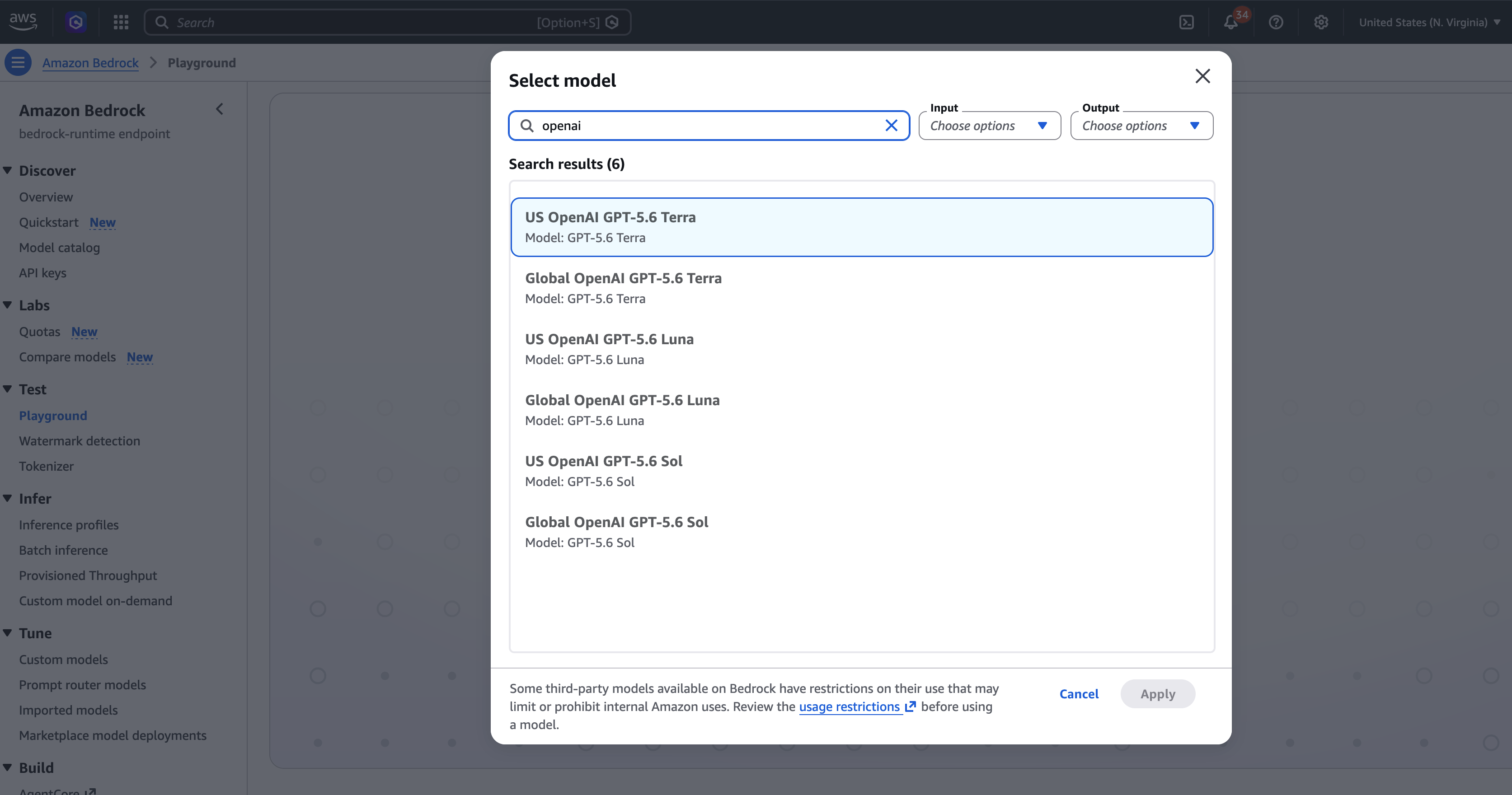
図 1: Amazon Bedrock コンソールのモデルセレクターで、米国またはグローバルの GPT-5.6 推論プロファイルを選択する
API を使い始める
GPT-5.6 は、Amazon Bedrock 上で OpenAI Responses API のフォーマットをネイティブにサポートしています。すでに OpenAI モデルを呼び出しているアプリケーションであれば、既存の OpenAI SDK クライアントを Amazon Bedrock の OpenAI 互換エンドポイントに指し替えるだけで利用可能です。その際、推論プロファイル ID(グローバルまたは地理的なもの)をモデルパラメータとして差し替えれば完了です。
認証には、標準的な AWS 認証情報か、Amazon Bedrock API キーのいずれかが使用できます。OpenAI SDK に最も直感的に適合するのは API キーパスで、これはベアートークンとして渡されます。本番環境では、aws-bedrock-token-generator パッケージを使ってプログラムから短期間の API キーを生成することをお勧めします。このパッケージは既存の AWS 認証情報からベアートークンを導出しますが、長期キーの使用は探索目的に限るべきです。
from aws_bedrock_token_generator import provide_token
from openai import OpenAI
region = "us-east-1"
# Point the OpenAI SDK at Amazon Bedrock's OpenAI-compatible endpoint for your Region. provide_token() generates a short-term Amazon Bedrock API key from your current AWS credentials (valid up to 12 hours), so no static key needs to be stored.
client = OpenAI(
    base_url= f"https://bedrock-runtime.{region}.amazonaws.com/openai/v1",
    api_key=provide_token(region=region),
)

# Use the global inference profile ID for GPT-5.6 Terra.
model_id = "global.openai.gpt-5.6-terra"
response = client.responses.create(
    model=model_id,
    input="Summarize the difference between horizontal and vertical scaling in two sentences.",
     max_output_tokens=512,
)

print(response.output_text)
サポートされているパラメータの完全な一覧については、Amazon Bedrock ユーザーガイドの OpenAI GPT モデル パラメータ ページをご参照ください。同じクライアントは Chat Completions API とも連携可能で、アプリケーション側ですでにこのフォーマットを利用している場合に役立ちます。
response = client.chat.completions.create(
     # For US Geo CRIS, use "us.openai.gpt-5.6-terra".
     # Other variants: gpt-5.6-sol, gpt-5.6-luna
     model="global.openai.gpt-5.6-terra",
     messages=[
         {
             "role": "user",
             "content": "In one sentence, what is cross-Region inference in Amazon Bedrock?",
         }
     ],
     max_completion_tokens=2000,
     reasoning_effort="low",
 )

print(response.choices[0].message.content)
OpenAI SDK を介さずに Amazon Bedrock に直接アクセスする場合は、Amazon Bedrock Converse API を使用します。これにより、Bedrock 上の他のモデルで既に使用しているリクエスト形状をそのまま維持できます。
import boto3

client = boto3.client("bedrock-runtime", region_name="us-east-1")

model_id = "global.openai.gpt-5.6-terra"
 response = client.converse(
     modelId=model_id,
     messages=[{"role": "user", "content": [{"text": "List three common uses for a message queue."}]}],
     inferenceConfig={"maxTokens": 512},
 )
 print(response["output"]["message"]["content"][0]["text"])
ストリーミングレスポンスが必要な場合は、converse_stream を同じ引数で呼び出し、イベントストリームを順次処理してください。
stream_response = client.converse_stream(
     modelId=model_id,
     messages=[{"role": "user", "content": [{"text": "List three common uses for a message queue."}]}],
     inferenceConfig={"maxTokens": 512},
 )

for event in stream_response["stream"]:
     if "contentBlockDelta" in event:
         print(event["contentBlockDelta"]["delta"]["text"], end="")
セキュリティとコンプライアンス
クロスリージョン推論は、リージョン内での直接呼び出しと同じ Amazon Bedrock のセキュリティモデルを採用しています。リクエストの認証には AWS Identity and Access Management (IAM) 資格情報が使用され、ロールがどの推論プロファイルを実行できるかは IAM ポリシーによって制御されます。
Amazon Bedrock はチップレベルで強制されるゼロオペレーターアクセス(ZOA)セキュリティモデルを採用しており、AWS の運営担当者がユーザーのプロンプトや生成結果にアクセスすることはできません。すべてのモデル呼び出しは IAM ポリシーの下で実行され、VPC エンドポイントを通じて仮想プライベートクラウド (VPC) からプライベートに接続可能であり、そのログは AWS CloudTrail に記録されます。データ囲い込みポリシーにより、アカウント間やネットワーク境界を越えたデータの不正流出が防止されます。
GPT-5.6 を含む一部のモデルでは、Amazon Bedrock の自動悪意検出分類器によって「悪質」と判定されたコンテンツが、オフラインでの悪意検出のために最大 30 日間保持されます。このポリシーが適用されるモデルやその仕組みについては、Amazon Bedrock ユーザーガイドの Abuse detection をご覧ください。Bedrock 上のデータ保持設定の詳細については、Amazon Bedrock データ保持ドキュメント を参照してください。各プロファイルのルーティングセットに含まれるリージョンの公式リストは、Amazon Bedrock クロスリージョン推論サポート ページでご確認ください。
クロスリージョン推論リクエストは、ソースリージョンの AWS CloudTrail に記録されます。各リクエストを処理したリージョンは、additionalEventData.inferenceRegion フィールドに記録されます。
モデル呼び出しログを有効化すると、リクエストとレスポンスのペイロードは、同じアカウントおよび同じリージョン内の Amazon Simple Storage Service (Amazon S3) または Amazon CloudWatch Logs に転送されます。
クロスリージョン推論用の IAM 権限設定
ロールが推論プロファイルを通じて GPT-5.6 を呼び出せるようにするには、そのプロファイルと、プロファイルがルーティング可能なすべてのリージョンにある基盤モデルへのアクセス権を付与する必要があります。この目的には、管理ポリシー AmazonBedrockLimitedAccess を使用するか、独自に作成することもできます。
地理的推論プロファイルの場合、ポリシーは 3 つのステートメントで構成されます。最初のステートメントでは、ソースリージョン内の地理的推論プロファイルとデフォルトプロジェクトへのアクセス権を付与します。2 つ目のステートメントでは、ソースリージョンおよびその地理に含まれるすべての宛先リージョンにある基盤モデルへのアクセス権を付与し、このアクセスが特定の推論プロファイル経由でのみ行われるリクエストに限定されるよう条件を設定します。3 つ目のステートメントでは、OpenAI 互換 API が使用するベアータークン認証の権限を付与します。
{
  "Version": "2012-10-17",
  "Statement": [
    {
      "Sid": "GrantGeoCrisProfileAndProjectAccess",
      "Effect": "Allow",
      "Action": ["bedrock:InvokeModel"],
      "Resource": [
        "arn:aws:bedrock:::inference-profile/us.openai.gpt-5.6-terra",
        "arn:aws:bedrock:::project/default"
      ]
    },
    {
      "Sid": "GrantGeoCrisDestinationModelAccess",
      "Effect": "Allow",
      "Action": ["bedrock:InvokeModel"],
      "Resource": [
        "arn:aws:bedrock:us-east-1::foundation-model/openai.gpt-5.6-terra",
        "arn:aws:bedrock:us-east-2::foundation-model/openai.gpt-5.6-terra",
        "arn:aws:bedrock:us-west-2::foundation-model/openai.gpt-5.6-terra"
      ],
      "Condition": {
        "StringLike": {
          "bedrock:InferenceProfileArn": "arn:aws:bedrock:::inference-profile/us.openai.gpt-5.6-terra"
        }
      }
    },
    {
      "Sid": "AllowBearerTokenAuth",
      "Effect": "Allow",
      "Action": ["bedrock:CallWithBearerToken"],
      "Resource": "*"
    }
  ]
}
グローバル推論プロファイルは、4 つのポリシーから構成されます。最初の 1 つは、ソースリージョン内のグローバル推論プロファイルとデフォルトプロジェクトへのアクセス権を付与します。2 つ目は、ソースリージョン内のファウンデーションモデルへのアクセス権を付与します。3 つ目は、リージョン非依存のグローバル ARN を通じてファウンデーションモデルへのアクセス権を付与し、これによりクロスリージョンルーティングが可能になります。4 つ目は、OpenAI 互換 API で使用されるベアートークン認証の権限です。
{
 "Version": "2012-10-17",
 "Statement": [
   {
     "Sid": "GrantGlobalCrisProfileAndProjectAccess",
     "Effect": "Allow",
     "Action": ["bedrock:InvokeModel"],
     "Resource": [
       "arn:aws:bedrock:::inference-profile/global.openai.gpt-5.6-terra",
       "arn:aws:bedrock:::project/default"
     ],
     "Condition": {
       "StringEquals": { "aws:RequestedRegion": "" }
     }
   },
   {
     "Sid": "GrantGlobalCrisInRegionModelAccess",
     "Effect": "Allow",
     "Action": ["bedrock:InvokeModel"],
     "Resource": ["arn:aws:bedrock:::foundation-model/openai.gpt-5.6-terra"],
     "Condition": {
       "StringEquals": {
         "aws:RequestedRegion": "",
         "bedrock:InferenceProfileArn": "arn:aws:bedrock:::inference-profile/global.openai.gpt-5.6-terra"
       }
     }
   },
   {
     "Sid": "GrantGlobalCrisGlobalModelAccess",
     "Effect": "Allow",
     "Action": ["bedrock:InvokeModel"],
     "Resource": ["arn:aws:bedrock:::foundation-model/openai.gpt-5.6-terra"],
     "Condition": {
       "StringEquals": {
         "aws:RequestedRegion": "unspecified",
         "bedrock:InferenceProfileArn": "arn:aws:bedrock:::inference-profile/global.openai.gpt-5.6-terra"
       }
     }
   },
   {
     "Sid": "AllowBearerTokenAuth",
     "Effect": "Allow",
     "Action": ["bedrock:CallWithBearerToken"],
     "Resource": "*"
   }
 ]
}
これらのポリシーは、OpenAI の Responses API や Chat Completions API が Amazon Bedrock API キーを使用して認証し、推論を実行する際に必要となる bedrock:CallWithBearerToken と bedrock:InvokeModel を、プロジェクト/デフォルトリソースに対して付与します。ストリーミング対応の Converse API(ConverseStream)を利用する場合は、bedrock:InvokeModelWithResponseStream も追加してください。
原文を表示
*This post is co-written with Chris Dickens from OpenAI.*
Amazon Bedrock now offers OpenAI GPT-5.6 models on Amazon Bedrock in more than 25 AWS Regions, with cross-Region inference. Three GPT-5.6 variants support cross-Region inference, Sol, Terra, and Luna, each tuned for a different balance of capability and cost.
Cross-Region inference (CRIS) in Amazon Bedrock works through inference profiles, which define a model and the AWS Regions to which Amazon Bedrock can route a request. You call the profile from a source Region, and Amazon Bedrock routes the request to a destination Region using compute in that Region. CRIS is primarily a capacity mechanism. By allowing requests to draw on a broader pool of compute rather than being bound to one Region’s available capacity, it improves throughput and helps maintain consistent performance under load. A geographic inference profile routes requests within a single geography, so you can scale while keeping data processed within that geography. For GPT-5.6, this launch introduces US geographic (US cross-Region inference) and global CRIS. A global inference profile routes across all supported AWS commercial Regions where the model is deployed, based on real-time capacity, giving you broad access to Amazon Bedrock capacity.
In this post, we walk through an overview of GPT-5.6 models on Amazon Bedrock, how geographic and global cross-Region inference work for these models, and how to call them from the Amazon Bedrock console and in code with the OpenAI Responses API, the OpenAI Chat Completions API, and the Amazon Bedrock Converse API.
GPT-5.6 on Amazon Bedrock
The GPT-5.6 family on Amazon Bedrock includes general-purpose and specialized cyber security variants. This post covers the three general-purpose variants that support cross-Region inference, Sol, Terra, and Luna. All three accept text and image inputs and return text, have a 1 million token context window, and support reasoning mode, server-side tool calling, and prompt caching. You can call them with the OpenAI Responses API, the OpenAI Chat Completions API, and the Amazon Bedrock Converse API. Streaming is supported through the Responses and Chat Completions API (stream=True), and ConverseStream.
Amazon Bedrock inference profiles are logical identifiers you pass instead of a raw model ID.
- A geographic inference profile (prefixed with a geography code such as us., for example us.openai.gpt-5.6-terra) keeps inference processing within the Regions of its predefined geography. Requests enter through your source Region and can only be routed to destination Regions inside that geography, so workloads with data residency requirements can scale across Regions while staying within the boundary.
- A Global inference profile (prefixed global. such as global.openai.gpt-5.6-terra) can route a request to any supported commercial AWS Region where the model is deployed, based on real-time capacity. It offers the widest capacity pool and is the right choice when your workload has no geographic processing requirements.
Billing and quota consumption are tracked against your account regardless of which backend Region handled the request, so a single spending and throughput picture still applies. Data processed through global CRIS may cross the Regions in that model’s eligible set. If your workload has data residency requirements that restrict processing to specific geographies, use the geographic profile for that geography (such as us.openai.gpt-5.6-terra) or a direct call to one Region instead of the global profile. The Amazon Bedrock cross-Region inference documentation lists which Regions participate in each model’s global and geographic profile sets.
The following tables list the source Regions where you can invoke the GPT-5.6 inference profiles and the destination Regions where your requests can be processed. The same routing applies to all three variants: Sol, Terra, and Luna.
US cross-Region inference profile (us.openai.gpt-5.6-sol / -terra / -luna)
| Source Region | Destination Regions |
|---|---|
| US East (N. Virginia) us-east-1 | US East (N. Virginia) us-east-1, US West (Oregon) us-west-2, US East (Ohio) us-east-2 |
| US West (Oregon) us-west-2 | US East (N. Virginia) us-east-1, US West (Oregon) us-west-2, US East (Ohio) us-east-2 |
| US East (Ohio) us-east-2 | US East (N. Virginia) us-east-1, US West (Oregon) us-west-2, US East (Ohio) us-east-2 |
| US West (N. California) us-west-1 | US East (N. Virginia) us-east-1, US West (Oregon) us-west-2, US East (Ohio) us-east-2, US West (N. California) us-west-1 |
| Canada (Central) ca-central-1 | US East (N. Virginia) us-east-1, US West (Oregon) us-west-2, US East (Ohio) us-east-2, Canada (Central) ca-central-1 |
| Canada West (Calgary) ca-west-1 | US East (N. Virginia) us-east-1, US West (Oregon) us-west-2, US East (Ohio) us-east-2, Canada West (Calgary) ca-west-1 |
Global cross-Region inference profile (global.openai.gpt-5.6-sol / -terra / -luna)
| Source Regions | Destination Regions |
|---|---|
| United States: US East (N. Virginia) us-east-1, US East (Ohio) us-east-2, US West (Oregon) us-west-2, US West (N. California) us-west-1 Canada: Canada (Central) ca-central-1 Europe: Europe (Stockholm) eu-north-1, Europe (Paris) eu-west-3, Europe (Ireland) eu-west-1, Europe (Frankfurt) eu-central-1, Europe (Spain) eu-south-2, Europe (Milan) eu-south-1, Europe (London) eu-west-2, Europe (Zurich) eu-central-2 Asia Pacific: Asia Pacific (Melbourne) ap-southeast-4, Asia Pacific (Sydney) ap-southeast-2, Asia Pacific (Tokyo) ap-northeast-1, Asia Pacific (Osaka) ap-northeast-3, Asia Pacific (Seoul) ap-northeast-2, Asia Pacific (Mumbai) ap-south-1, Asia Pacific (Hyderabad) ap-south-2, Asia Pacific (Singapore) ap-southeast-1, Asia Pacific (Jakarta) ap-southeast-3, Asia Pacific (Thailand) ap-southeast-7, Asia Pacific (Malaysia) ap-southeast-5, Asia Pacific (Taipei) ap-east-2 Middle East: Middle East (UAE) me-central-1, Israel (Tel Aviv) il-central-1 South America: South America (São Paulo) sa-east-1 | Routes to supported AWS commercial Regions globally |
Try GPT-5.6 in the Amazon Bedrock console
The quickest way to try GPT-5.6 is the text playground in the Amazon Bedrock console, which requires no coding or SDK setup. You can send prompts, adjust inference parameters, and switch between variants to get a feel for each model before you integrate the API. The model selector lists both the geographic and global cross-Region inference profiles, so you can test either cross-Region inference option before writing code. In the preceding screenshot, the source Region is US East (N. Virginia). The US entry in the model selector is the geographic inference profile, and the Global entry is the global inference profile.
- Open the Amazon Bedrock console in a Region where the models are available, such as US East (N. Virginia).
- In the navigation pane, under Test, choose Playground.
- Choose Select model in the middle of the page.
- Search for OpenAI GPT-5.6 Sol, select either US OpenAI GPT-5.6 Sol or Global OpenAI GPT-5.6 Sol, and choose Apply.
- Enter a prompt and choose Run to generate a response.
**Figure 1: Selecting a US or Global GPT-5.6 inference profile in the Amazon Bedrock console model selector
Getting started with the API
GPT-5.6 speaks the OpenAI Responses API formats natively on Amazon Bedrock. If your application already calls OpenAI models, you can point your existing OpenAI SDK client at the Amazon Bedrock OpenAI-compatible endpoint. Then swap in the inference profile ID (global or geographic) as the model parameter. For authentication, Amazon Bedrock accepts either standard AWS credentials or an Amazon Bedrock API key. The API key path is the most direct fit for the OpenAI SDK, which passes it as the bearer token. For production, generate short-term API keys programmatically using the aws-bedrock-token-generator package, which derives a bearer token from your existing AWS credentials (long-term keys are recommended only for exploration).
from aws_bedrock_token_generator import provide_token
from openai import OpenAI
region = "us-east-1"
# Point the OpenAI SDK at Amazon Bedrock's OpenAI-compatible endpoint for your Region. provide_token() generates a short-term Amazon Bedrock API key from your current AWS credentials (valid up to 12 hours), so no static key needs to be stored.
client = OpenAI(
    base_url= f"https://bedrock-runtime.{region}.amazonaws.com/openai/v1",
    api_key=provide_token(region=region),
)

# Use the global inference profile ID for GPT-5.6 Terra.
model_id = "global.openai.gpt-5.6-terra"
response = client.responses.create(
    model=model_id,
    input="Summarize the difference between horizontal and vertical scaling in two sentences.",
     max_output_tokens=512,
)

print(response.output_text)
For the full list of supported parameters, see the OpenAI GPT model parameters page in the Amazon Bedrock User Guide. The same client also works with the Chat Completions API, useful if your application already uses this format.
response = client.chat.completions.create(
     # For US Geo CRIS, use "us.openai.gpt-5.6-terra".
     # Other variants: gpt-5.6-sol, gpt-5.6-luna
     model="global.openai.gpt-5.6-terra",
     messages=[
         {
             "role": "user",
             "content": "In one sentence, what is cross-Region inference in Amazon Bedrock?",
         }
     ],
     max_completion_tokens=2000,
     reasoning_effort="low",
 )

print(response.choices[0].message.content)
If you’re calling Amazon Bedrock directly rather than through the OpenAI SDK, use the Amazon Bedrock Converse API, which gives you the same request shape you already use for other models on Bedrock:
import boto3

client = boto3.client("bedrock-runtime", region_name="us-east-1")

model_id = "global.openai.gpt-5.6-terra"
 response = client.converse(
     modelId=model_id,
     messages=[{"role": "user", "content": [{"text": "List three common uses for a message queue."}]}],
     inferenceConfig={"maxTokens": 512},
 )
 print(response["output"]["message"]["content"][0]["text"])
For streaming responses, call converse_stream with the same arguments and iterate over the event stream:
stream_response = client.converse_stream(
     modelId=model_id,
     messages=[{"role": "user", "content": [{"text": "List three common uses for a message queue."}]}],
     inferenceConfig={"maxTokens": 512},
 )

for event in stream_response["stream"]:
     if "contentBlockDelta" in event:
         print(event["contentBlockDelta"]["delta"]["text"], end="")
Security and compliance
Cross-Region inference uses the same Amazon Bedrock security model as direct in-Region calls. Requests are authenticated with your AWS Identity and Access Management (IAM) credentials, and IAM policies control which inference profiles a role can invoke. Amazon Bedrock uses a zero-operator access (ZOA) security model enforced at the chip, so no AWS operators can access your prompts or completions. Every model call runs under your IAM policies, can be reached privately from your virtual private cloud (VPC) through a VPC endpoint, and is logged on AWS CloudTrail. Data perimeter policies help prevent exfiltration across account and network boundaries.
For certain models, including GPT-5.6, content flagged by the Amazon Bedrock automated abuse-detection classifiers is retained for up to 30 days for offline abuse detection. To see which models this applies to and how it works, see Abuse detection in the Amazon Bedrock User Guide. To understand more about data retention configuration on Bedrock, see the Amazon Bedrock data retention documentation. For the authoritative list of Regions in each profile’s routing set, see the Amazon Bedrock cross-Region inference support page.
Cross-Region inference requests appear on AWS CloudTrail in your source Region, and the additionalEventData.inferenceRegion field records which Region processed each request. If you enable model invocation logging, the request and response payloads are delivered to Amazon Simple Storage Service (Amazon S3) or Amazon CloudWatch Logs in the same account and Region.
Setting up IAM permissions for cross-Region inference
To let a role invoke GPT-5.6 through an inference profile, grant it access to the inference profile and to the foundation model in every Region the profile can route to. You can use this managed policy AmazonBedrockLimitedAccess or create your own.
For a geographic inference profile**, the policy has three statements. The first grants access to the geographic inference profile and the default project in your source Region. The second grants access to the foundation model in your source Region and in every destination Region in the geography, with a condition that limits this access to requests made through that profile. The third grants the bearer-token authentication the OpenAI-compatible APIs use.
{
  "Version": "2012-10-17",
  "Statement": [
    {
      "Sid": "GrantGeoCrisProfileAndProjectAccess",
      "Effect": "Allow",
      "Action": ["bedrock:InvokeModel"],
      "Resource": [
        "arn:aws:bedrock:::inference-profile/us.openai.gpt-5.6-terra",
        "arn:aws:bedrock:::project/default"
      ]
    },
    {
      "Sid": "GrantGeoCrisDestinationModelAccess",
      "Effect": "Allow",
      "Action": ["bedrock:InvokeModel"],
      "Resource": [
        "arn:aws:bedrock:us-east-1::foundation-model/openai.gpt-5.6-terra",
        "arn:aws:bedrock:us-east-2::foundation-model/openai.gpt-5.6-terra",
        "arn:aws:bedrock:us-west-2::foundation-model/openai.gpt-5.6-terra"
      ],
      "Condition": {
        "StringLike": {
          "bedrock:InferenceProfileArn": "arn:aws:bedrock:::inference-profile/us.openai.gpt-5.6-terra"
        }
      }
    },
    {
      "Sid": "AllowBearerTokenAuth",
      "Effect": "Allow",
      "Action": ["bedrock:CallWithBearerToken"],
      "Resource": "*"
    }
  ]
}
A global inference profile uses a four-part policy. The first grants access to the global inference profile and the default project in your source Region. The second grants access to the foundation model in your source Region. The third grants access to the foundation model through the Region-agnostic global ARN, which is what enables cross-Region routing. The fourth grants the bearer-token authentication used by the OpenAI-compatible APIs.
{
 "Version": "2012-10-17",
 "Statement": [
   {
     "Sid": "GrantGlobalCrisProfileAndProjectAccess",
     "Effect": "Allow",
     "Action": ["bedrock:InvokeModel"],
     "Resource": [
       "arn:aws:bedrock:::inference-profile/global.openai.gpt-5.6-terra",
       "arn:aws:bedrock:::project/default"
     ],
     "Condition": {
       "StringEquals": { "aws:RequestedRegion": "" }
     }
   },
   {
     "Sid": "GrantGlobalCrisInRegionModelAccess",
     "Effect": "Allow",
     "Action": ["bedrock:InvokeModel"],
     "Resource": ["arn:aws:bedrock:::foundation-model/openai.gpt-5.6-terra"],
     "Condition": {
       "StringEquals": {
         "aws:RequestedRegion": "",
         "bedrock:InferenceProfileArn": "arn:aws:bedrock:::inference-profile/global.openai.gpt-5.6-terra"
       }
     }
   },
   {
     "Sid": "GrantGlobalCrisGlobalModelAccess",
     "Effect": "Allow",
     "Action": ["bedrock:InvokeModel"],
     "Resource": ["arn:aws:bedrock:::foundation-model/openai.gpt-5.6-terra"],
     "Condition": {
       "StringEquals": {
         "aws:RequestedRegion": "unspecified",
         "bedrock:InferenceProfileArn": "arn:aws:bedrock:::inference-profile/global.openai.gpt-5.6-terra"
       }
     }
   },
   {
     "Sid": "AllowBearerTokenAuth",
     "Effect": "Allow",
     "Action": ["bedrock:CallWithBearerToken"],
     "Resource": "*"
   }
 ]
}
These policies grant bedrock:CallWithBearerToken and bedrock:InvokeModel on the project/default resource, which the OpenAI Responses and Chat Completions APIs use to authenticate with an Amazon Bedrock API key and run inference. If you use the streaming Converse API (ConverseStream), add bedrock:InvokeModelWithResponseStream
関連記事
News to Guide
ニュースの次に確認する
発表内容を、現在の料金や仕様と照らし合わせられる関連ガイドです。
今日のまとめ
AIデイリーブリーフで今日の重要ニュースをまとめ読み