Antigravity と Gemini を活用したドメインギャップの解消:AI レースコーチの開発
本文の状態
日本語全文を表示中
詳細モードで約9分の本文を読めます。
同じ出来事の情報源
この情報源を基点に整理
Google Developers AI
Google は Sonoma Raceway で開催されたイベントにおいて、Antigravity と Gemini を活用したリアルタイム AI レースコーチを公開し、物理法則に基づく信頼性の高いエッジ AI の実証に成功した。
AI深層分析を開く2026年8月7日 06:45
AI深層分析
キーポイント
ドメインギャップの解消と信頼性確保
Antigravity がドメイン橋渡しエンジンとして機能し、物理法則やリアルタイム検証を基盤とした信頼できる AI アーキテクチャを実現した。
実戦での具体的な成果
Turn 2 のコーナー内でスロットル適用領域の最適化を提案し、0.1 秒のタイム短縮という明確な成果を達成した。
開発プロセスの変革
Google Developer Experts が Antigravity を用いてステートフルなオーケストレーションとテレメトリ処理を担当し、高レベルのシステム設計に集中できる環境を提供した。
エッジ AI の本番導入
プロトタイプ段階から生産グレードのエッジ AI への移行プロセスが実証され、開発者が「雰囲気コーディング」から現場適用可能なデプロイへと移行する様子が記録された。
Trustable AI を証明する3つの運用階層
Sonomaでは、初心者向けのアクセシビリティ重視、中級者向けのデータロギング活用、プロ向けの実時間テレアlemetry処理という3つのティアでAIの信頼性を検証した。
重要な引用
using Antigravity and Gemini to create an AI tool that gives drivers split-second, actionable advice
We are closing the AI trust gap by grounding our architecture in physics and real-time verification
The system pinpointed a new throttle application zone mid-corner in Turn 2, securing a 0.1-second advantage
The Entry-Level Tier (Beginner Pod): This team mirrored the initial adoption phase of enterprise AI, focusing on accessibility and intuitive coaching pedagogy.
編集コメントを表示
編集コメント
この発表は、生成 AI が単なる情報提供から、物理法則に基づく信頼性の高い意思決定支援へと進化する重要な転換点を示している。特に、高リスクな実世界環境での適用可能性を証明した点は、今後の産業用 AI の展開において大きな示唆を与える。
Source Article
元記事を日本語で読む
本文に関係しない購読案内、埋め込み通知、サイト内プロモーションは除いています。
2026 年 7 月 8 日
Ajeet Mirwani(Google Developer Experts のアメリカプログラムリーダー)
2026 年 5 月 23 日、Google I/O のステージを直後に控えた私たち Google Developer Experts (GDE) はソノマ・レースウェイに集結し、インスピレーションを得て、リアルタイムで AI を活用したレーシングコーチの構築に取り組みました。私たちのパイロットプロジェクト(信頼できる AI への青写真:チャットボットの先へ)が基本的なテレメトリデータの処理が可能であることを実証した一方で、ソノマでの取り組みは次の一歩を踏み出すものでした。Antigravity と Gemini を活用し、ドライバーがトラック上でラップタイムを短縮するために即座に実行可能なアドバイスを提供する AI ツールを創り出すことです。
私たちは、アーキテクチャを物理学とリアルタイム検証に基づかせることで、AI における信頼のギャップを埋めています。これにより、人々は生成モデルに対して重要な判断を一任することに安心感を持てるようになります。例えば、システムは理論的なアドバイスを提供するのではなく、ターン 2 のコーナー中盤において新しいスロットル操作領域を特定し、失敗が許されない状況で 0.1 秒のアドバンテージを確保しました。
Google Antigravity を用いたドメインギャップの解消
Sonoma での最も強力な発見の一つは、Antigravity がどのようにしてドメインを横断するエンジンとして機能し、信頼できる AI アーキテクチャ(Trustable AI)に基づいた AI レースコーチを構築したかという点です。熟練したソフトウェアエンジニアである GDEs は、Antigravity を用いてレースカーからのステートフルなオーケストレーションとテレメトリの取り込みを担当しました。これにより、ビルダーたちはレーシングエキスパートが提供する高レベルのシステム動作やコーチング手法に集中することが可能となり、AI がどのようにしてチームを支援し、見知らぬドメインにおける実世界アプリケーションを構築できるかを証明するものとなりました。Antigravity の製品チームは現場でこの移行過程そのものを撮影しており、開発者が「雰囲気コーディング(vibe coding)」からエッジでの本番グレードのデプロイへと移行する様子を捉えていました。

プロトタイプから本番グレードのエッジ AI へ
Sonoma では、GDEs はエンタープライズ導入の段階に類似した特殊なマトリックス内で活動し、信頼できる AI が組織的な課題に対応するためにスケール可能であることを証明しました。
- エントリーレベルティア(ビギナーポッド):このチームは、エンタープライズ AI の初期導入フェーズを反映しており、アクセシビリティと直感的なコーチング pedagogy に焦点を当てています。
- 最適化ティア(インターメディアートポッド):成長段階の統合を表すこのチームは、高度なデータロギングシステムを使用して、厳密な閾値管理を通じてプラットフォームの機能を最大化しました。
- ミッションクリティカルティア(プロティアポッド):このチームは、レーシングにおける極端なドメインギャップに取り組み、膨大なリアルタイムテレメトリを処理し、プロレベルのドライバーと協力して人間の知覚を超えたパフォーマンス向上を見出しました。
速度を支えるスタック
ソノマ・レースウェイでの成功は、高速推論のために設計された洗練された技術スタックによって支えられていました。Antigravity が重要なオーケストレーション「接着剤」として機能する一方で、このフレームワークは Google Cloud Platform (GCP) と Agent Development Kit (ADK) の力を活用し、テレメトリデータの深遠なオンライン分析を可能にしました。この組み合わせにより、GDE は生データの入力と実行可能な戦略的洞察の間のギャップを埋めることができました。
 image
image
コアプロダクトスタック:
- リアルタイムコードの反復とドメイン間のギャップを埋めるための Antigravity。
- バックエンドでのテレメトリデータ取り込みと解析のための Python。
- 主要機能を調整する一連のエージェントを管理する Agent Development Kit (ADK)。
- 重負荷下のテレメトリ処理でもフレームドロップを起こさず、高リフレッシュ率の Android コックピットダッシュボードを実現する Jetpack Compose。
- セッション後の複雑なドライバーモデリングとクラウド推論を管理する Gemini API。
- ゼロレイテンシでオフライン対応の音声コーチングアラートを提供するエッジインテリジェンス層としてローカルで稼働する Gemma 4。
- リアルタイムでの聴覚的配信を実現するための Text-to-Speech (TTS) 統合。

アーキテクチャフロー:
このアーキテクチャフローは、生データであるレーシングテレメトリをリアルタイムのドライバーコーチングに変換する高速なデータパイプラインの詳細を示しています。これは、エッジでの取り込みとリアルタイム処理からハイブリッド型エッジ・クラウド推論を経て、即座に聴覚的および視覚的なインサイトが得られるに至るまでのデータの移動経路を明らかにします。
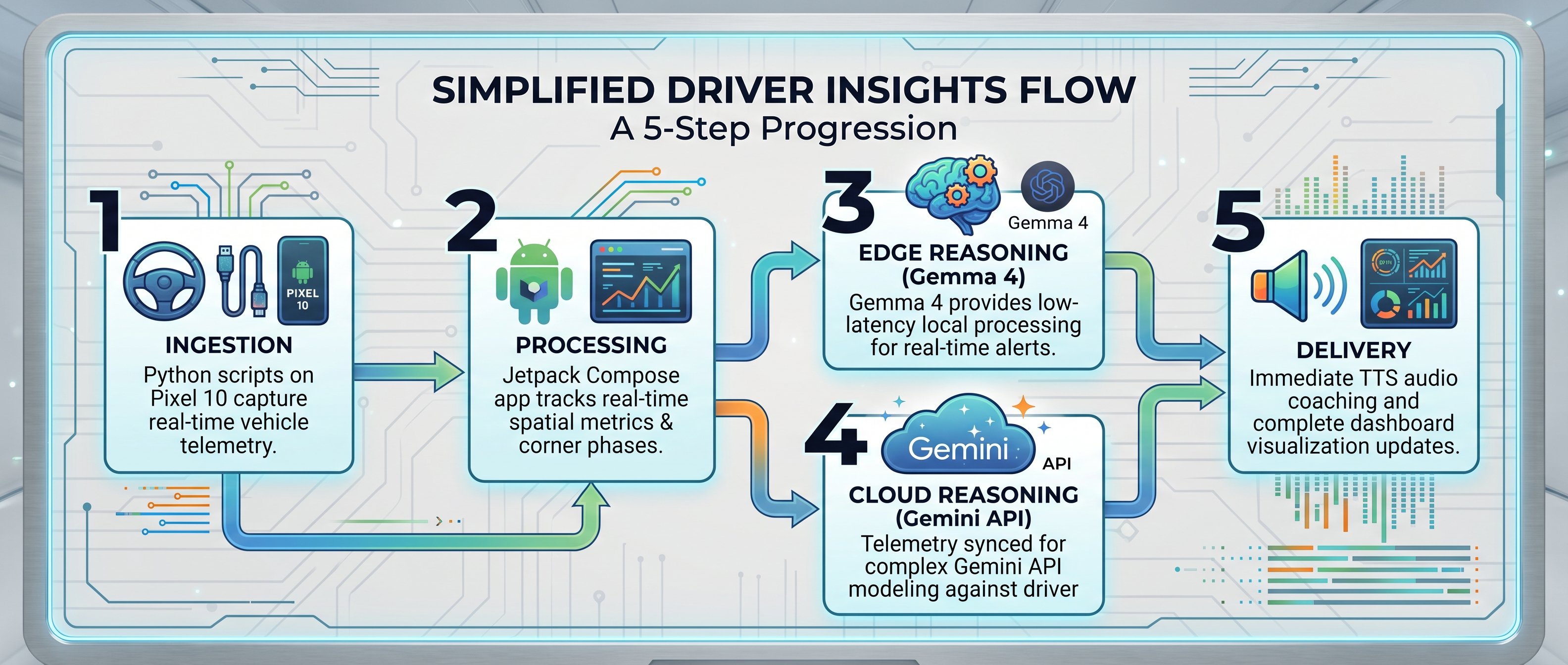
- 入力収集:Pixel 10 インターフェース上で動作する Python スクリプトが車両と連携し、モバイルエッジにおいてリアルタイムのテレメトリデータを直接キャプチャします。
- 処理:Jetpack Compose を用いて構築された Android アプリが空間指標を滑らかに追跡し、コーナーフェーズをリアルタイムで表示します。
- エッジ推論:Gemma 4 がローカライズされたストリームを低遅延で処理し、セルラー接続が切断された際のリアルタイムアラートに対するフェイルセーフとして機能します。
- クラウド推論:テレメトリデータはクラウドに同期され、Gemini API が確立したドライバーモデルに対してパフォーマンスを評価します。
- 配信:即座のインサイトは TTS(テキスト読み上げ)によるコーチング音声をトリガーし、複雑な可視化は Compose ダッシュボードを更新します。
私たちのエッジアーキテクチャが、時速 100 マイルで走行するレースカーという過酷な環境下で実際に機能するためには、耐性のあるデータパイプラインが必要でした。私たちはハードウェアのギャップを解決してくれたコミュニティメンバーである Brian Luc に深く感謝しています。彼は Pixel 10 を車両テレメトリネットワークに直接配線するためのカスタム USB インターフェースを設計・実装しました。これにより、スマートフォンは標準的な無線遅延をバイパスし、車両の数百あるセンサーから直接 10 Hz のデータストリームを取得できるようになりました。その結果、AI はリアルタイムでコーチング判断を実行するために必要な物理的入力を正確に得ることが可能となりました。
ソノマテストにおける画期的な成果は、Pixel 10 TPU の技術的有効化でした。Android エンジニアとの協力によりオンデバイス TPU が起動され、パフォーマンスは毎秒 40 トークンに急上昇しました。この飛躍により、ドライバーが必要とするまさにその瞬間にコーチングを提供するために必要なリアルタイム信頼性が実現されました。
このアーキテクチャは、ミッションクリティカルなエンタープライズドメインにも直接応用可能です。COI Energy の Vijay Vivekanand 氏や Bloom Energy の Jorge Mendieta 氏といったスタートアップの創業者たちが参加し、エージェント型オーケストレーションがどのようにエネルギーパイプラインを保護し、農業管理を実現するかを探求しました。100 マイル/時という速度でこのフレームワークを実証することで、失敗が許されない産業における信頼できる AI の道を開拓しています。
グローバルスプリント:目的地はインテルラゴス
ソノマでの進化は単なる始まりに過ぎません。勢いを維持するため、本イニシアチブは次へブラジルのインテルラゴスへと向かいます。ここでは新たな気候条件と複雑なトラック構成においてアーキテクチャをさらに強化し、世界中で AI 信頼性ギャップ(AI Trust Gap)を埋めるという使命を引き続き果たしていきます。

「AI Field Test」7 月期のメンバーたち
ビルドの準備はできましたか?
トラックで使用した同じ技術を実際に体験してみましょう。バイブコーディング(直感に頼ったコーディング)を超えて、Vertex AI のプロ向けレベルで構築を始める準備ができたら、ADK クラッシュコース から始めましょう。その後、Trustable AI Codelab を活用して独自の AI レースコーチを構築し、次のレベルへと進みましょう。
GDE による詳細解説
- Henry Ruiz 氏による ApexAI の実装:チーム 3 のプロ向けエッジ ML(機械学習)のリポジトリ。
- Taha Boushine 氏の「カブを信頼せよ、コミットを信頼せよ」:本番環境対応型 AI エージェントの構築。
- Simon Margolis 氏の「データに駆動され、高速で信頼される」:技術的信頼性に関する教訓。
- Rabimba Karanjai 氏の「レースクラフト:起源物語」:Project Koru のナビゲーション。
- David McLaughlin 氏の「トラックの先へ」:Trustable AI のビジョン。
Previous
Next
原文を表示
JULY 8, 2026
Americas Program Lead, Google Developer Experts
On May 23, 2026, fresh off the stage at Google I/O, our Google Developer Experts (GDEs) converged on Sonoma Raceway to get inspired and build a real-time, AI-powered race coach. While our pilot proved we could process basic telemetry, Sonoma was about taking the next step: using Antigravity and Gemini to create an AI tool that gives drivers split-second, actionable advice to improve their lap times on the track.
We are closing the AI trust gap by grounding our architecture in physics and real-time verification so people feel confident handing over high-stakes decisions to generative models. For instance, rather than offering theoretical advice, the system pinpointed a new throttle application zone mid-corner in Turn 2, securing a 0.1-second advantage where failure is not an option.
Bridging the domain gap with Google Antigravity
One of the most powerful revelations from Sonoma was how Antigravity served as a domain-bridging engine to build an AI Race Coach that grounded our Trustable AI architecture. Our GDEs, who are expert software engineers, used Antigravity to handle stateful orchestration and telemetry ingestion from the race cars. This allowed builders to focus on high-level system behavior and coaching methods provided by racing experts, demonstrating how AI can empower teams to build real-world applications in unfamiliar domains. The Antigravity product teams were on-site filming this exact transition, capturing how developers move from vibe coding to production-grade deployment at the edge.
From prototype to production-grade Edge AI
At Sonoma, the GDEs operated in a specialized matrix, similar to enterprise adoption tiers to prove Trustable AI scales to meet organizational challenges.
- The Entry-Level Tier (Beginner Pod): This team mirrored the initial adoption phase of enterprise AI, focusing on accessibility and intuitive coaching pedagogy.
- The Optimization Tier (Intermediate Pod): Representing growth-phase integration, they used advanced data logging systems to maximize platform capabilities through precise threshold management.
- The Mission-Critical Tier (Pro-Tier Pod): This team tackled extreme domain gaps in racing, processing massive real-time telemetry and collaborating with pro-level drivers to identify performance gains beyond human perception.
The stack behind the speed
The success at Sonoma Raceway was underpinned by a sophisticated technology stack designed for high-velocity inference. While Antigravity acted as the critical orchestration "glue," the framework leveraged the power of Google Cloud Platform (GCP) and Agent Development Kit (ADK) to facilitate deep, online analysis of telemetry data. This combination allowed the GDEs to bridge the gap between raw data ingestion and actionable strategic insights.
Core product stack:
- Antigravity for real-time code iteration and domain expertise bridging.
- Python for backend telemetry ingestion and data parsing.
- Agent Development Kit (ADK) managing a collection of agents orchestrating key functions.
- Jetpack Compose powering the high-refresh Android cockpit dashboard without dropping frames under heavy telemetry loads.
- Gemini API managing complex post-session driver modeling and cloud reasoning.
- Gemma 4 running locally as an edge-intelligence layer for zero-latency, offline audio coaching alerts.
- Text-to-Speech (TTS) integration for real-time auditory delivery.
Architecture flow:
The architecture flow details a high-velocity data pipeline that translates raw racing telemetry into real-time driver coaching across five key stages. It demonstrates how data moves from edge ingestion and real-time processing to hybrid edge-cloud reasoning, culminating in immediate auditory and visual insights.
- Ingestion: Python scripts running on Pixel 10 interface with the vehicle to capture real time telemetry directly at the mobile edge.
- Processing: The Android app built using Jetpack Compose to fluidly track spatial metrics and display corner phases in real-time.
- Edge Reasoning: Gemma 4 processes the localized stream with low-latency, acting as a fail-safe for real-time alerts when cellular connectivity drops.
- Cloud Reasoning: Telemetry is synced to the cloud where the Gemini API evaluates performance against our established driver models.
- Delivery: Immediate insights trigger TTS audio coaching, while complex visualizations update the Compose dashboard.
Our edge architecture required a resilient data pipeline to actually work in the hostile environment of a race car at 100 mph. We are incredibly grateful to community member Brian Luc for solving the hardware gap. He engineered a custom USB interface that wired the Pixel 10 directly into the vehicle telemetry network. This allowed the phone to bypass standard wireless latency and pull a 10 Hz data stream straight from the car’s hundreds of sensors, giving the AI the exact physical inputs needed to execute coaching decisions in real time.
The breakthrough of the Sonoma test was the technical activation of the Pixel 10 TPU. By collaborating with Android engineers to activate the on-device TPU, performance surged to 40 tokens per second. This jump provided the real-time reliability required to deliver coaching exactly when the driver needed it.
This architecture translates directly to mission-critical enterprise domains. Startup founders like Vijay Vivekanand (COI Energy) and Jorge Mendieta (Bloom Energy) joined the cohort to explore how agentic orchestration can secure energy pipelines and manage agriculture respectively. By proving the framework at 100 mph, we are paving the way for trustable AI in industries where failure is not an option.
The global sprint: Destination interlagos
The Sonoma evolution is just the beginning. To maintain our momentum, the initiative heads next to Interlagos, Brazil. There, we will further harden the architecture in a new climate and complex track configuration, continuing our mission to bridge the AI Trust Gap across the world.
Members of the July cohort of the "AI Field Test"
Ready to build?
Get hands-on with the same tech we used on the track. If you are ready to move beyond vibe coding and start building on the pro-tier of Vertex AI, get started with our ADK Crash Course. Then, take it to the next level by building your own AI Race Coach with the Trustable AI Codelab.
Deep Dives from our GDEs
- ApexAI Implementation by Henry Ruiz: Repo for Team 3's pro-tier edge ML.
- Trust the Curb, Trust the Commit by Taha Boushine: Building production-grade AI agents.
- Driven by Data, Trusted at Speed by Simon Margolis: Lessons in technical reliability.
- Racecraft: The Origin Story by Rabimba Karanjai: Navigating Project Koru.
- Beyond the Track by David McLaughlin: The vision for Trustable AI.
Previous
Next
関連記事
今日のまとめ
AIデイリーブリーフで今日の重要ニュースをまとめ読み