推論速度の向上がサイバーセキュリティ企業の競争優位をもたらす
本文の状態
日本語全文を表示中
詳細モードで約11分の本文を読めます。
同じ出来事の情報源
この情報源を基点に整理
Cerebras Engineering
Cerebras Engineering は、サイバーセキュリティ分野における攻撃と防御の非対称性が AI の進化によりさらに拡大している現状を指摘し、推論速度の向上が防御チームに優位性をもたらす可能性について解説した。
AI深層分析を開く2026年8月4日 10:52
AI深層分析
キーポイント
サイバーセキュリティ戦場の非対称性の増大
攻撃者は多数存在し行動も迅速であるため、従来の防御体制では対応が困難であり、AI の進化がこの格差をさらに拡大させている。
推論速度の重要性
Cerebras Engineering は、高速な推論(inference)能力がセキュリティ企業に競争優位性を与える鍵であると主張している。
攻撃者の分類と現状
過去のセキュリティチームは攻撃者を熟練度で分類していたが、95% の攻撃者がスクリプトキッド(脚本使い)であるという統計的背景がある。
AI を活用する攻撃の高度化とリスク
攻撃者が AI を利用することで、知識や経験のハードルが下がり、より複雑で持続的なサイバー攻撃が日常化している。また、検証プロセスが不十分な低品質な AI コーディングアシスタントは、セキュリティ上の脆弱性をコードに導入するリスクがある。
高速推論による戦略的優位性の確立
高速推論は、限られた運用時間内により多くの文脈取得、ツール使用、自己チェック、検証を行うことを可能にし、セキュリティ AI の能力を飛躍的に高める。これはインフラのベンチマークではなく、ユーザーが求める速度の中でどの程度の文脈や制御を組み込めるかという製品設計上の課題となる。
重要な引用
Cybersecurity has always been an asymmetrical battle; attackers are plentiful and they are moving much faster than defending teams.
With the acceleration and the evolution of AI, the battlefield is getting even further skewed.
The answer is not to add AI everywhere. It is to apply AI where it improves the security outcome.
Faster inference lets security AI do more reasoning per second: more context retrieval, more tool use, more self-checking, and more validation inside the same operational window.
編集コメントを表示
編集コメント
本記事は Cerebras Engineering の技術的優位性を強調する内容を含んでいるが、具体的なベンチマークデータや他社との比較数値は提示されていない。セキュリティ分野における AI 応用の文脈を理解する上で参考となる視点ではあるものの、実装レベルの詳細な知見には欠ける。
Source Article
元記事を日本語で読む
本文に関係しない購読案内、埋め込み通知、サイト内プロモーションは除いています。
推論速度がなぜ重要なのか
サイバーセキュリティは、常に非対称な戦いでした。攻撃者は数多く存在し、防御チームよりも遥かに高速で動いています。AI の加速と進化により、この戦場はさらに偏り始めています。
かつてセキュリティチームは、攻撃者を技術レベルによって分類していました。その約 95% は「スクリプトキディ(素人ハッカー)」や、特定の組織を狙うわけではなくランダムに攻撃を仕掛ける「ドライブ・バイ・シューティング」の犯行に及ぶ者たちでした。
しかし現在、攻撃者が AI を活用するようになり、攻撃の複雑さと適応性が劇的に高まっています。これにより、高度な知識や経験がなくても、より賢く粘り強いサイバー攻撃が可能となり、それが日常茶飯事となっています。
攻撃者は、偵察、フィッシング、マルウェアの変種作成、脆弱性の発見、エクスプロイトの開発といったあらゆる工程で AI を活用し、活動速度を加速させています。一方で、検証やレビュー、修正のワークフローが十分に確立されていない場合、低品質な AI コーディングアシスタントは、セキュリティ上の欠陥を含むコードを生み出すリスクもあります。
企業はまた、新たなセキュリティ上の問いを生み出す AI コパイロットや AI アプリケーション、そしてエージェント型ワークフローの導入を進めています。エージェントが呼び出せるツールは何なのか?取得できるデータは何か?回答を返す前に何を検査すべきか?チームは、有用な作業を停滞させることなく、これらのシステムをどのように監視し統制すればよいのか。
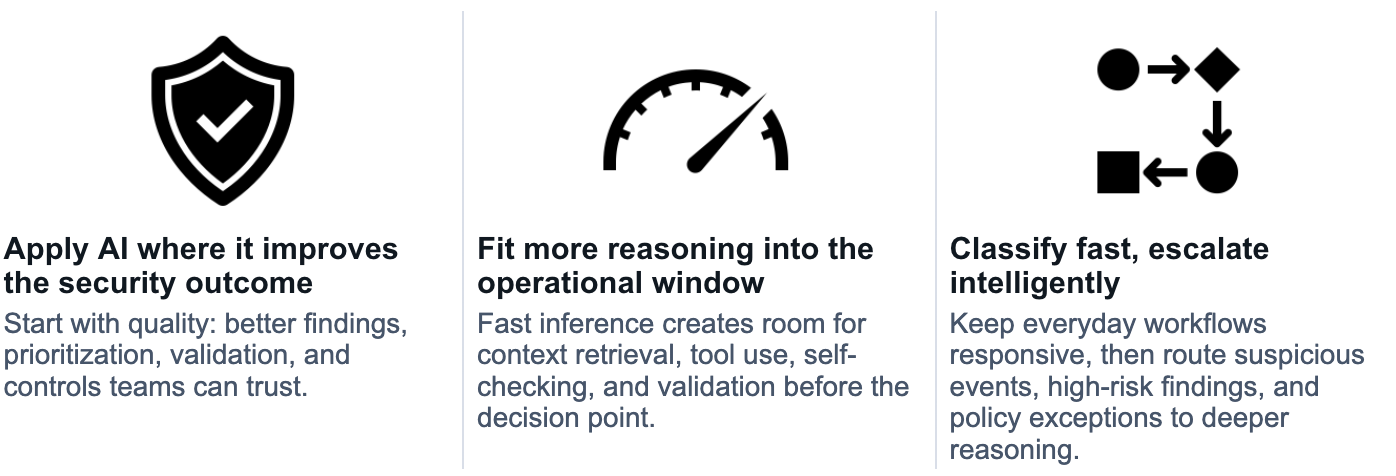
答えは「あらゆる場所に AI を追加する」ことではありません。セキュリティの成果を向上させる場所に応用することが重要です。その第一歩は品質にあります:より精度の高い検出結果、優先順位の最適化、検証の強化、そして信頼できるコントロールチームへの提供です。しかし、これらの機能が成熟するにつれ、レイテンシと出力速度が戦略的な制約要因となります。推論速度を高めることで、セキュリティ AI は 1 秒間に処理できる推論量を増やすことができます:より多くの文脈取得、より多くのツール利用、自己検証の強化、そして同じ運用時間枠内でのより多くの検証が可能になります。
セキュリティ製品開発者にとって、高速推論は単なるインフラのベンチマークではなく、製品設計における重要な課題です。セキュリティプラットフォームを構築する創業者、製品リーダー、エンジニアチーム、AI チームは、ユーザーが速さを期待するワークフローに、どの程度の文脈、推論、検証、コントロールを組み込むことができるかを決定する必要があります。
重要なのは、すべてのセキュリティワークフローで最速のモデルが必要だということではありません。高速な推論が可能になることで、プロダクション環境におけるセキュリティ製品ができることがどう変わるかを示すことです:同じユーザー体験の中で、より多くの文脈、より多くのチェック、より多くの検証、そして摩擦の少ないコントロールを実現できる点です。
2 つの側面からセキュリティを変える AI、そして「速度」が重要になる理由
AI はサイバーセキュリティを、関連しつつも異なる 2 つの側面から変革しています。
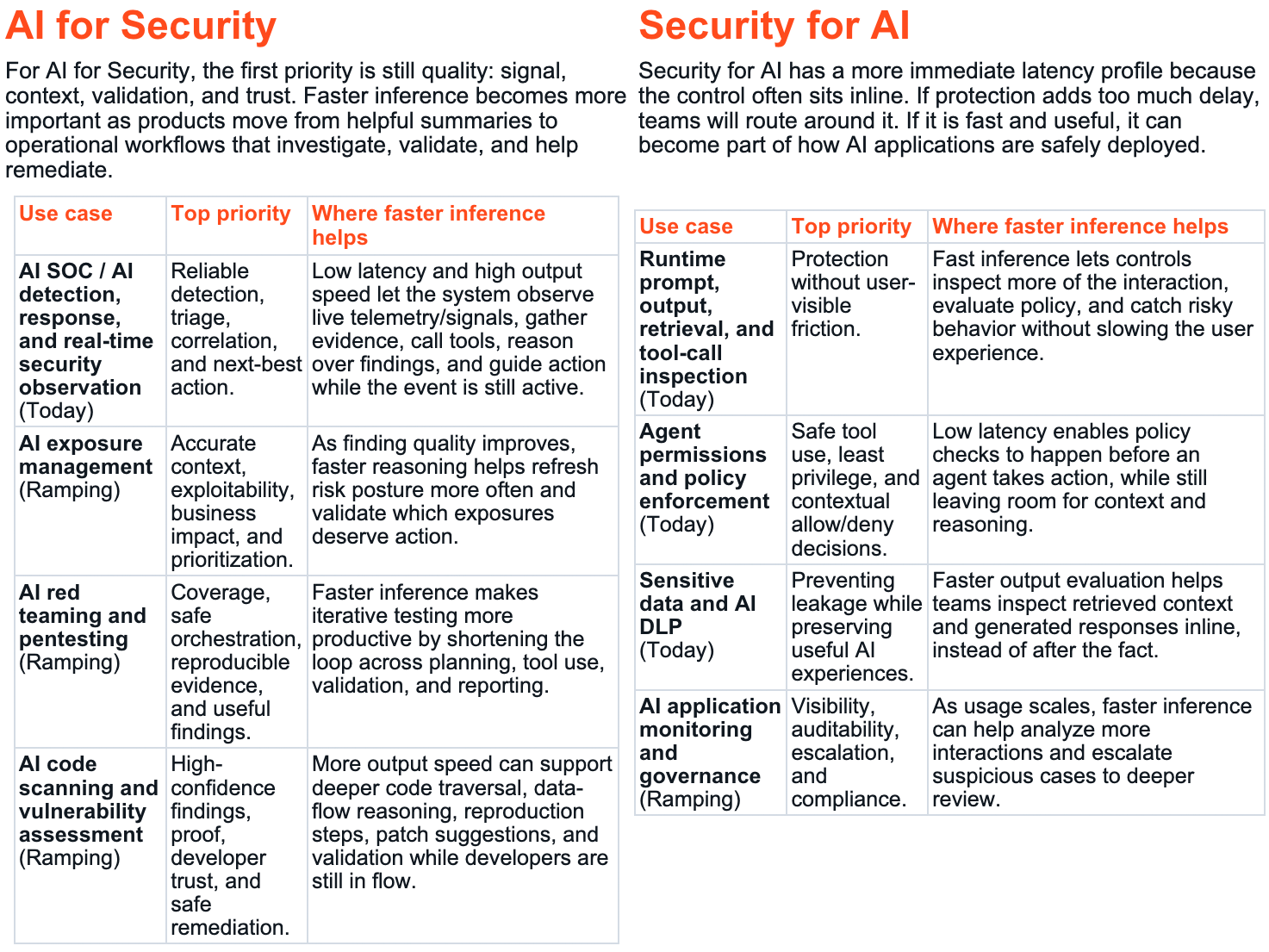
1 つ目は「セキュリティのための AI(AI for Security)」です。これは、検知、調査、優先順位付け、テスト、修正といった業務において、セキュリティ製品やチームの能力を高めるために AI を活用するアプローチです。
2 つ目は「AI 向けのセキュリティ(Security for AI)」です。こちらは、企業が本番環境に導入している AI アプリケーション、エージェント、モデル、データフロー、プロンプト、検索システム、ツール呼び出しなどを保護することを目的としています。
どちらの取り組みにも、高品質なモデルと信頼性の高いワークフローが不可欠です。ただし、「速度(レイテンシ)」が問題となる場面は異なります。
「セキュリティのための AI」では、ワークフローが進行中に深い推論を行う必要がある際に、スピードが重要になります。一方、「AI 向けのセキュリティ」では、制御機能がユーザーやアプリケーション、エージェントの直近に位置しているため、即座の速度が求められるケースが多いのです。
実用的なアーキテクチャ:高速分類と知的エスカレーション
これらのユースケースに共通するのは、すべてのシグナルやトランザクション、アラート、コード変更、エージェントのアクションが、同じレベルの推論を必要とするわけではないという点です。本番環境では、セキュリティプラットフォームは日常業務を迅速に処理しつつ、本当に深い分析が必要な局面のためにリソースを温存できるアーキテクチャが必要です。
実用的なパターンは階層化されています。ルール、古典的なモデル、そして小規模言語モデルが最初のパスを担い、フィルタリング、分類、重複排除、ルーティングを行います。その後、より強力な推論モデルがエスカレーションポイントとして機能し、深い分析が必要な少数のケース(不審なイベント、高リスクの発見事項、重要なコードパス、機密性の高いツール呼び出し、ポリシー例外など)に対応します。
レイテンシと出力速度は両方のレベルで重要です。最初のパスは製品体験を損なわないよう十分に高速である必要があります。また、エスカレーション経路も十分に速く、深い推論が新たな待ち行列とならないようにする必要があります。このアーキテクチャにおいて、高速推論は単なる迅速対応のレバーではありません。それは、品質が最も求められる瞬間に高品質な思考を収容するための手段です。
競争優位性としての高速推論
過密化が進むサイバーセキュリティ市場では、多くのベンダーが AI を活用していると主張しています。真の違いは、その AI がセキュリティワークフローを遅滞させることなく実装できるかどうかにかかっています。高速推論により、サイバーセキュリティ企業は、ユーザー体験が損なわれる前に、より多くの文脈を検査し、より多くの仮説を検討し、より多くの推奨事項を検証し、より多くの意思決定を説明することが可能になります。
高速推論がセキュリティワークフローをどう変えるか
「セキュリティのためのAI」でも「AIのセキュリティ」でも、共通する基本的なループが存在します。それは文脈の収集、推論、検証、推奨または強制、そして再検証という一連のプロセスです。推論速度を高めることで、各ステップにおける遅延が削減され、意思決定ポイントまでにシステムが処理できる推論量が増加します。

実用的なアーキテクチャ:高速分類と賢明なエスカレーション
これらのユースケースに共通するのは、すべてのシグナル、トランザクション、アラート、コード変更、エージェントのアクションが、同じレベルの推論を必要とするわけではないという点です。実際の運用環境では、セキュリティプラットフォームは日常業務のレスポンス性を維持しつつ、本当に深い分析が必要な局面のためにリソースを温存するアーキテクチャが必要です。
実用的なパターンは多層構造(ティアード)です。ルール、古典的なモデル、そして小型言語モデルが最初のパスを担当し、フィルタリング、分類、重複排除、ルーティングを行います。一方、より強力な推論モデルは、深い分析に値する少数のケースに対するエスカレーションポイントとして機能します。具体的には、不審なイベント、高リスクの発見、重要なコードパス、機密性の高いツール呼び出し、およびポリシー例外などが対象となります。
レイテンシと出力速度は、すべてのレベルで重要です。最初の処理は製品体験を損なわないよう十分に速くある必要がありますし、エスカレーションパスも深い推論が別の待ち行列に陥らないように十分速いものでなければなりません。このアーキテクチャにおいて、高速推論は単なる迅速対応のレバーではありません。それは、品質が最も重要な瞬間に高品質な思考を収容するための手段なのです。
競争優位性としての高速推論
混雑するサイバーセキュリティ市場では、多くのベンダーが AI を利用していると主張します。真の違いは、その AI がセキュリティワークフローを遅滞させることなくリアルタイムで動作できるかどうかにかかっています。高速推論により、サイバーセキュリティ企業は、ユーザー体験が損なわれる前に、より多くの文脈を検査し、より多くの仮説を検討し、より多くの推奨事項を検証し、より多くの意思決定を説明することが可能になります。
高速推論によるセキュリティワークフローの変革
「セキュリティのための AI」と「AI のためのセキュリティ」の両分野において、同じ基本的なループが繰り返されます。すなわち、文脈の収集、推論、検証、推奨または強制の実行、そして確認です。高速推論は、各ステップを改善し、意思決定のポイントに至るまでにシステムが完了できる推論量を減らす遅延と増やすことで向上させます。

Cerebras がセキュリティ構築企業に競争優位をもたらす理由
Cerebras は、レイテンシや出力速度が製品のボトルネックになりつつある分野で、セキュリティ企業が製品を構築するのを支援します。当社のウェーハスケール・アーキテクチャは、従来の GPU ベースの推論を遅らせるデータ転送や分散システムオーバーヘッドの多くを削減します。これにより、実際のセキュリティワークフローの時間枠内で、より深い推論、検証、ツール利用が可能になります。
Cerebras は、主要な GPU ベースのソリューションよりも最大 10 倍速く推論を実行します。セキュリティ構築企業にとって、この速度は製品開発に余裕をもたらします。ワークフローが即座の対応を必要とする際には迅速なレスポンスを支える一方、推奨事項をユーザーに届ける前により多くのチェック、コンテキスト、検証を行うことで高品質な回答を実現することも可能です。
これは AI がセキュリティを変革する 2 つの側面すべてで重要です。AI を活用したセキュリティ(AI for Security)においては、高速推論により調査や修正処理が実用的になります。一方、AI のためのセキュリティ(Security for AI)では、本番環境で使用できる十分な速度をインライン制御が維持できるよう支援します。また、階層化アーキテクチャにおいては、より強力な推論モデルへのエスカレーションが別々のキューに回されるのではなく、製品の一部として自然に感じられるようにします。
AI を構築したいなら、最速の計算リソースが必要です。一方、AI のセキュリティを確保したいなら、CrowdStrike が最適です。
Cerebras 上で Falcon AIDR モデルを実行することで、世界最高峰のセキュリティ AI を、世界で最も高速な推論環境に搭載しました。この「高速かつ安全な AI」が、急速な普及を牽引しています」と、CrowdStrike のチーフビジネスオフィサーであるダニエル・バーナードは述べています。
Cerebras は AI 計算領域において極めて重要な存在であり、同社自らのイノベーションを守るために Falcon プラットフォームを採用しました。AI の未来を築く企業たちは、その保護のために CrowdStrike を選んでいるのです。
原文を表示
Why inference speed matters
Cybersecurity has always been an asymmetrical battle; attackers are plentiful and they are moving much faster than defending teams. With the acceleration and the evolution of AI, the battlefield is getting even further skewed. In the past, security teams would classify attackers by their expertise level, with 95% of attackers being “script kiddies” or attackers that do not target organizations (“drive-by shooting”). Today, the usage of AI by attackers increases the level of complexity and adaptation of attacks significantly, lowering the bar of knowledge and experience, making smarter and more persistent cyber-attacks a daily reality.
Attackers can use AI to move faster across reconnaissance, phishing, malware variation, vulnerability discovery, and exploit development. At the same time, low-quality AI coding assistants can introduce insecure code when teams do not have strong verification, review, and remediation workflows around them.
Enterprises are also deploying AI copilots, AI applications, and agentic workflows that create new security questions. Which tools can an agent call? What data can it retrieve? What should be inspected before an answer is returned? How do teams observe and govern these systems without slowing useful work to a crawl?
The answer is not to add AI everywhere. It is to apply AI where it improves the security outcome. That starts with quality: better findings, better prioritization, better validation, and controls teams can trust. But as those capabilities mature, latency and output speed become strategic constraints. Faster inference lets security AI do more reasoning per second: more context retrieval, more tool use, more self-checking, and more validation inside the same operational window.
For cybersecurity builders, this makes fast inference a product-design question, not only an infrastructure benchmark. Founders, product leaders, engineering teams, and AI teams building security platforms have to decide how much context, reasoning, validation, and control they can fit into workflows that users expect to remain fast.
The point is not that every security workflow needs the fastest model. The point is to show where faster inference changes what a cybersecurity product can do in production: more context, more checks, more validation, and lower-friction controls inside the same user experience.
Two ways AI is changing security, and where speed matters
AI is changing cybersecurity in two related but different ways. The first is AI for Security: using AI to make security products and teams better at detection, investigation, prioritization, testing, and remediation. The second is Security for AI: protecting the AI applications, agents, models, data flows, prompts, retrieval systems, and tool calls that enterprises are putting into production.
Both require strong model quality and trustworthy workflows. They differ in where latency shows up: in AI for Security, speed matters when deeper reasoning has to happen while a workflow is still active; in Security for AI, speed often matters immediately because controls sit directly in the path of the user, application, or agent.
A practical architecture: classify fast, escalate intelligently
The common thread across these use cases is that every signal, transaction, alert, code change, or agent action does not need the same level of reasoning. In production, cybersecurity platforms need architectures that keep everyday workflows responsive while preserving deeper analysis for the moments that deserve it.
A practical pattern is tiered. Rules, classical models, and small language models handle the first pass: filtering, classifying, deduplicating, and routing. Stronger reasoning models are then used as an escalation point for the smaller share of cases that deserve deeper analysis: suspicious events, high-risk findings, critical code paths, sensitive tool calls, and policy exceptions.
Latency and output speed matter at both levels. The first pass has to stay fast enough for the product experience. The escalation path has to be fast enough that deeper reasoning does not become another queue. In that architecture, faster inference is not only a rapid-response lever. It is a way to fit higher-quality thinking into the moments where quality matters most.
Fast inference as a competitive advantage
In a crowded cybersecurity market, many vendors will claim to use AI. The difference will be whether that AI can operate inside real security workflows without slowing them down. Faster inference lets cybersecurity companies inspect more context, reason through more hypotheses, validate more recommendations, and explain more decisions before the user experience breaks.
How faster inference transforms the security workflow
Across both AI for Security and Security for AI, the same basic loop appears: gather context, reason, validate, recommend or enforce, and verify. Faster inference improves each step by reducing delay and increasing the amount of reasoning the system can complete before the decision point.
A practical architecture: classify fast, escalate intelligently
The common thread across these use cases is that every signal, transaction, alert, code change, or agent action does not need the same level of reasoning. In production, cybersecurity platforms need architectures that keep everyday workflows responsive while preserving deeper analysis for the moments that deserve it.
A practical pattern is tiered. Rules, classical models, and small language models handle the first pass: filtering, classifying, deduplicating, and routing. Stronger reasoning models are then used as an escalation point for the smaller share of cases that deserve deeper analysis: suspicious events, high-risk findings, critical code paths, sensitive tool calls, and policy exceptions.
Latency and output speed matter at both levels. The first pass has to stay fast enough for the product experience. The escalation path has to be fast enough that deeper reasoning does not become another queue. In that architecture, faster inference is not only a rapid-response lever. It is a way to fit higher-quality thinking into the moments where quality matters most.
Fast inference as a competitive advantage
In a crowded cybersecurity market, many vendors will claim to use AI. The difference will be whether that AI can operate inside real security workflows without slowing them down. Faster inference lets cybersecurity companies inspect more context, reason through more hypotheses, validate more recommendations, and explain more decisions before the user experience breaks.
How faster inference transforms the security workflow
Across both AI for Security and Security for AI, the same basic loop appears: gather context, reason, validate, recommend or enforce, and verify. Faster inference improves each step by reducing delay and increasing the amount of reasoning the system can complete before the decision point.
Where Cerebras helps cybersecurity builders compete
Cerebras helps cybersecurity companies build products where latency and output speed are becoming product constraints. Our wafer-scale architecture reduces much of the data movement and distributed-system overhead that slows conventional GPU-based inference. That can make more reasoning, validation, and tool use practical within the time budget of a real security workflow.
Cerebras delivers inference up to an order of magnitude faster than leading GPU-based solutions. For cybersecurity builders, that speed creates product headroom. It can support faster responses when the workflow demands it, but it can also support higher-quality answers when the workflow benefits from more checks, more context, and more validation before a recommendation reaches a user.
That matters across both ways AI is changing security. In AI for Security, faster inference can make deeper investigation and remediation more usable. In Security for AI, it can help inline controls remain fast enough for production use. And in tiered architectures, it can make escalation to stronger reasoning models feel like part of the product rather than a separate queue.
If you want to build AI, you need the fastest compute. If you want to secure AI, you need CrowdStrike. By running Falcon AIDR models on Cerebras, we put the world’s best security AI on the world’s fastest inference. Fast, secure AI drives rapid adoption,” said Daniel Bernard, chief business officer at CrowdStrike. “Cerebras is one of the most important names in AI compute, and they’ve standardized on the Falcon platform to secure their own innovation. The companies building the future of AI are choosing CrowdStrike to protect it.
AI算出
論評・提言ainew評価標準
記事は Cerebras の技術(推論速度)がサイバーセキュリティ分野でどのように優位性を生むかを論じており、AI とセキュリティの関連性は高いが、具体的な新製品発表や独自調査データに欠けるため novelty は低く設定される。また、日本固有の情報や企業事例が含まれていないため japan_relevance も低い。
6つの評価軸を見る
- AI関連度
- 75
- 情報源の信頼性
- 100
- 新規性
- 25
- 調べる価値
- 25
- 重複の少なさ
- 100
- 日本での有用性
- 25
今日のまとめ
AIデイリーブリーフで今日の重要ニュースをまとめ読み