アドバイザー戦略:エージェントに知能ブーストを与える
本文の状態
日本語全文を表示中
詳細モードで約7分の本文を読めます。
同じ出来事の情報源
6媒体で確認
Claude Blog · InfoQ · AWS Machine Learning Blog · TechCrunch AI · Simon Willison Blog · The Decoder
各社の報じ方を比較 ↓OpenAIが、AIエージェントにアドバイザー戦略を導入し、複雑なタスクの実行能力を向上させる手法を発表した。
Continue in AI NEW LAB
このニュースを、実務の判断につなげる
AI NEW LABで、試したことや先に確認したい条件を共有できます。まずはログインなしで読めます。
AI NEW LABで論点を見るSource Article
元記事を日本語で読む
本文に関係しない購読案内、埋め込み通知、サイト内プロモーションは除いています。
アドバイザー戦略: エージェントの知性をブーストする
アドバイザーとしてOpusを、エグゼキューターとしてSonnetまたはHaikuを組み合わせることで、エージェントにOpusレベルの知性に近い性能を、コストは大幅に抑えて実現できます。
カテゴリー製品発表
製品Claude Platform
日付2026年4月9日
読了時間5分
共有リンクをコピーhttps://claude.com/blog/the-advisor-strategy
知性とコストのバランスをより良くしたい開発者の間で、アドバイザー戦略と呼ばれる手法が注目を集めています。アドバイザーとしてOpusを、エグゼキューターとしてSonnetまたはHaikuをペアリングするこの方法により、エージェントにOpusレベルの知性に近い性能をもたらしつつ、コストはSonnetレベルに抑えることができます。
本日、Claude Platformにアドバイザーツールを導入し、API呼び出しを1行変更するだけでアドバイザー戦略を実現できるようにします。
アドバイザー戦略でコスト効率の高いエージェントを構築
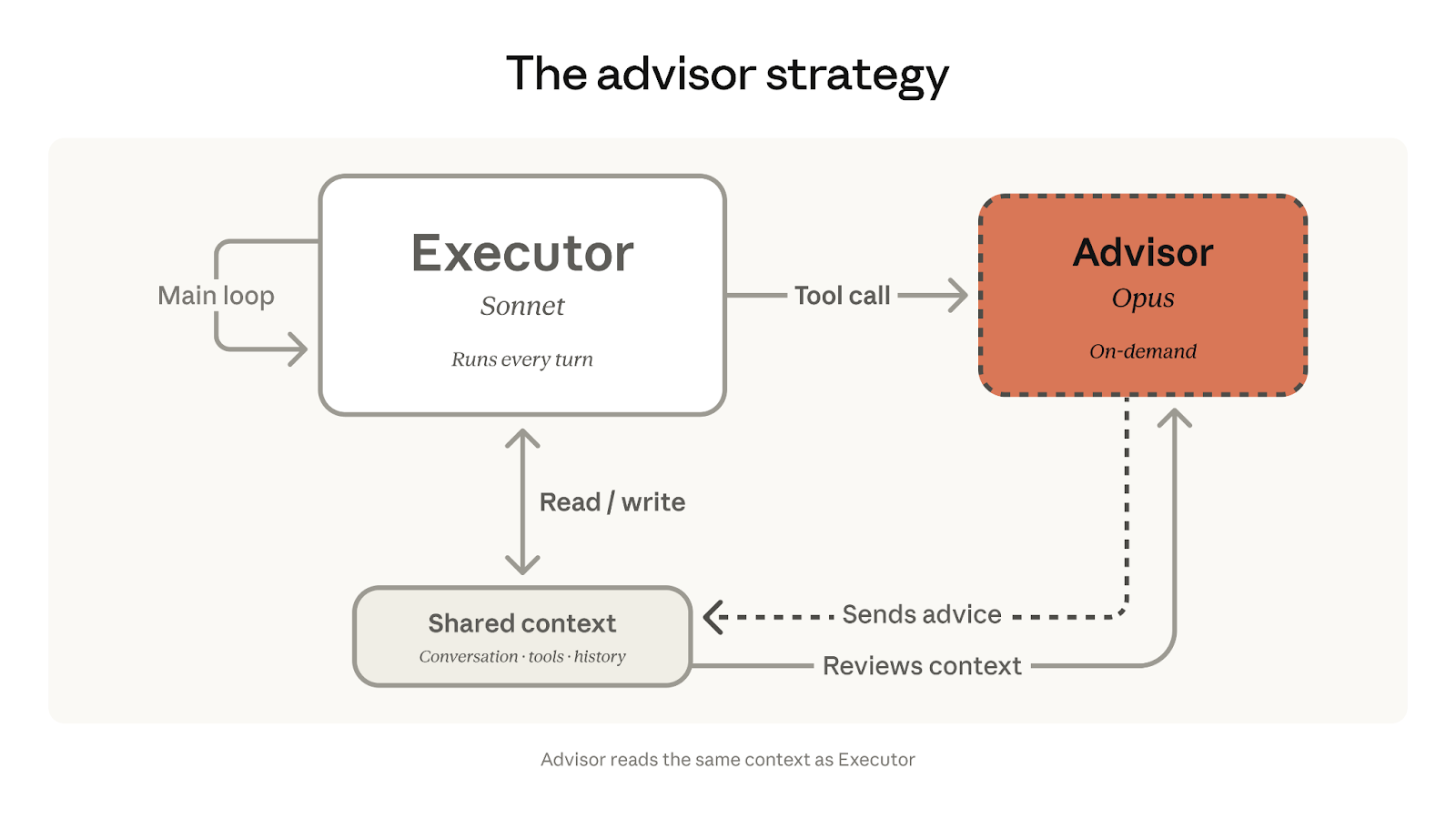
アドバイザー戦略では、SonnetまたはHaikuがエグゼキューターとしてタスクを最初から最後まで実行し、ツールを呼び出し、結果を読み取り、解決に向けて反復処理を行います。エグゼキューターが自力では合理的に解決できない判断に直面した場合、アドバイザーとしてOpusに指示を仰ぎます。Opusは共有コンテキストにアクセスして計画、修正、または停止信号を返し、その後エグゼキューターが処理を再開します。アドバイザーはツールを呼び出したり、ユーザー向けの出力を生成したりすることはなく、エグゼキューターに対して指示を提供するのみです。
これは、より大規模なオーケストレーターモデルが作業を分解して小規模なワーカーモデルに委任する、一般的なサブエージェントパターンを逆転させたものです。アドバイザー戦略では、より小規模でコスト効率の高いモデルが、分解やワーカープール、オーケストレーションロジックなしに駆動し、必要に応じて上位モデルを利用します。フロンティアレベルの推論はエグゼキューターがそれを必要とする場合にのみ適用され、実行の残りの部分はエグゼキューターレベルのコストに留まります。
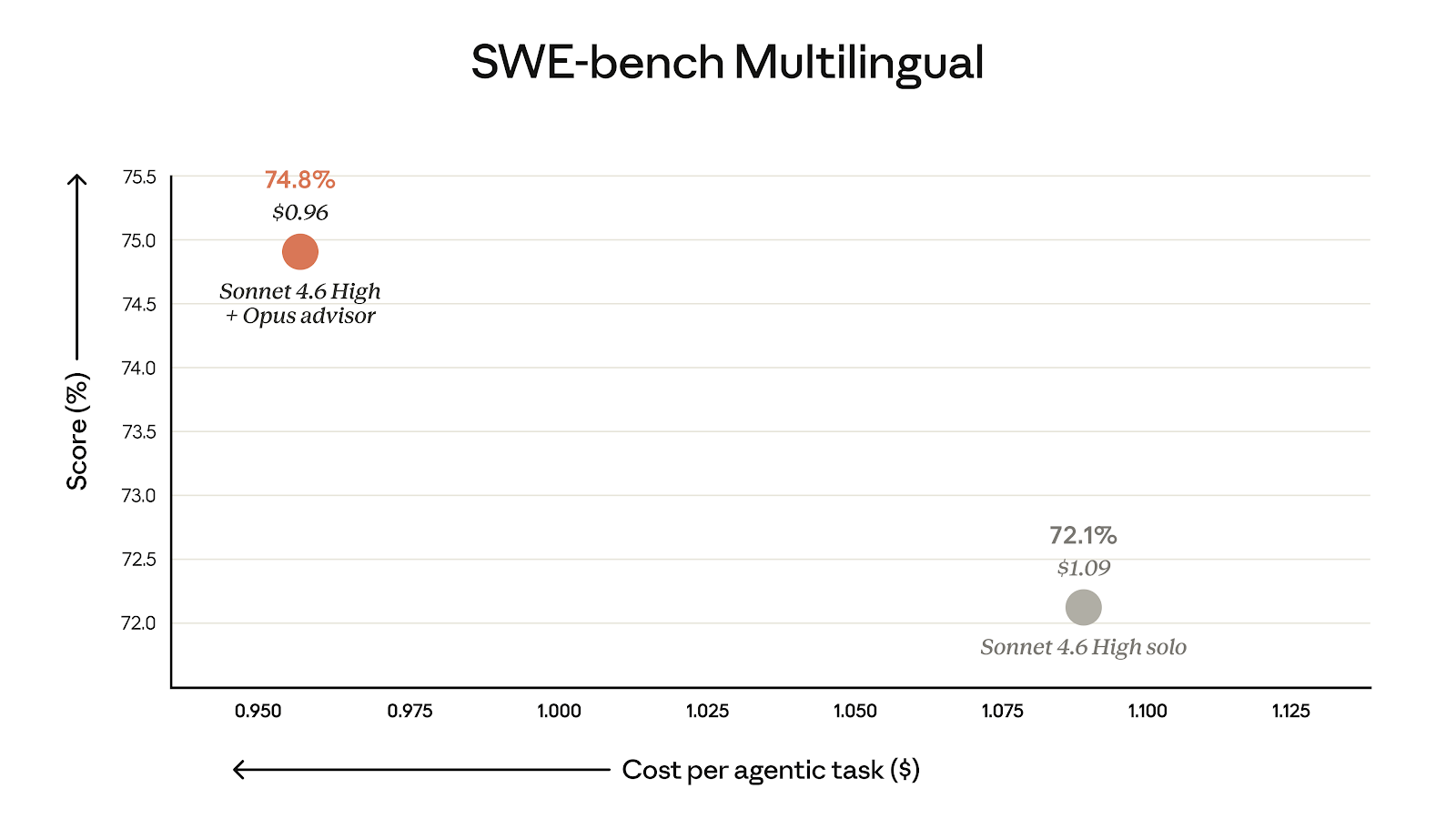
当社の評価では、Opusをアドバイザーとして使用したSonnetは、Sonnet単体と比較してSWE-bench Multilingual1で2.7パーセントポイントの向上を示し、エージェントタスクあたりのコストを11.9%削減しました。
アドバイザーツール
アドバイザー戦略をAPIに導入するため、アドバイザーツールを提供します。これはサーバーサイドツールであり、SonnetとHaikuはガイダンスや特定のタスクの支援が必要な場合にこれを呼び出すことを認識しています。
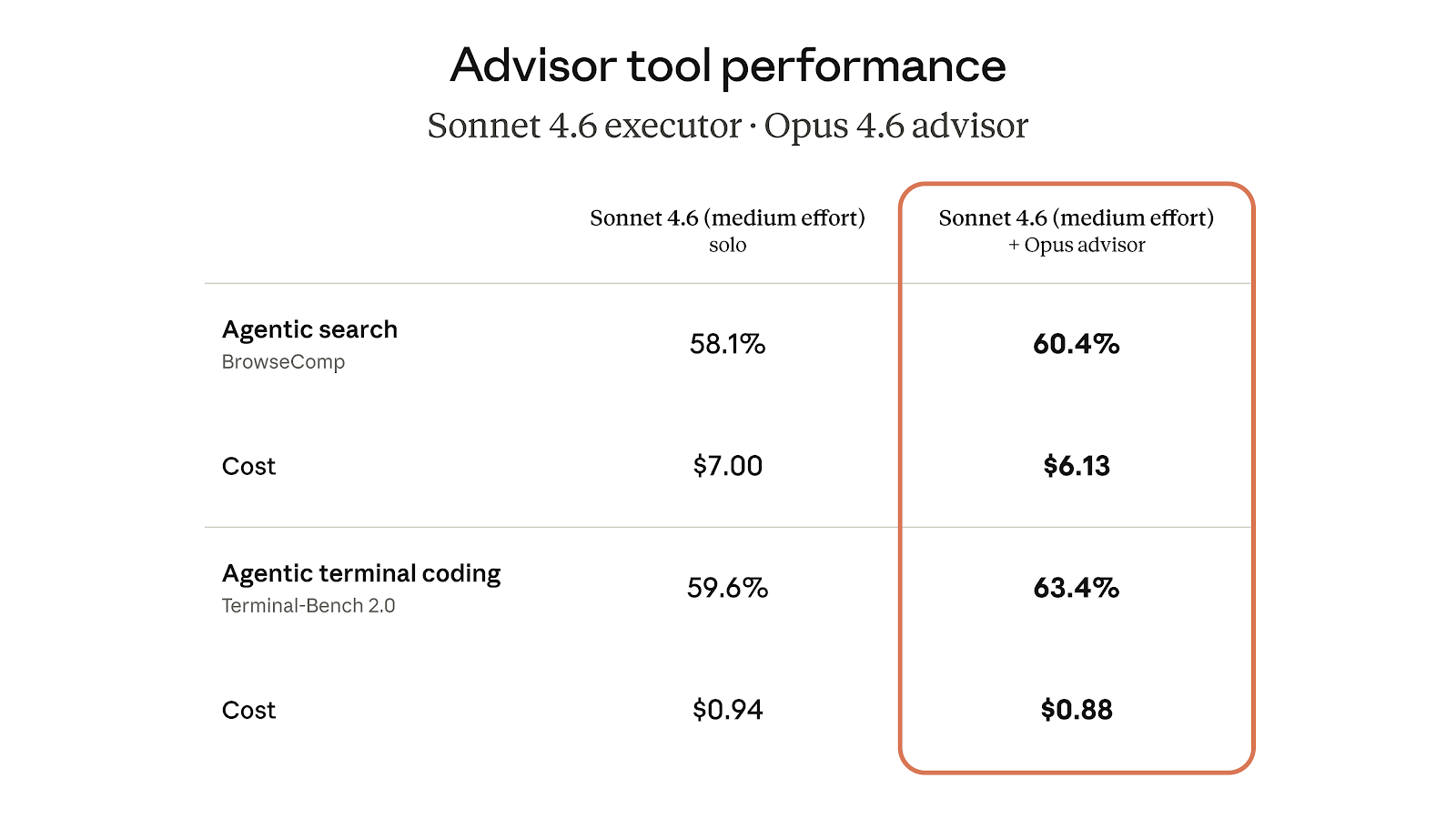
当社の評価では、Opusアドバイザーを備えたSonnetは、BrowseComp2とTerminal-Bench 2.03のベンチマーク全体でスコアを向上させるとともに、Sonnet単体よりもタスクあたりのコストを低く抑えました。
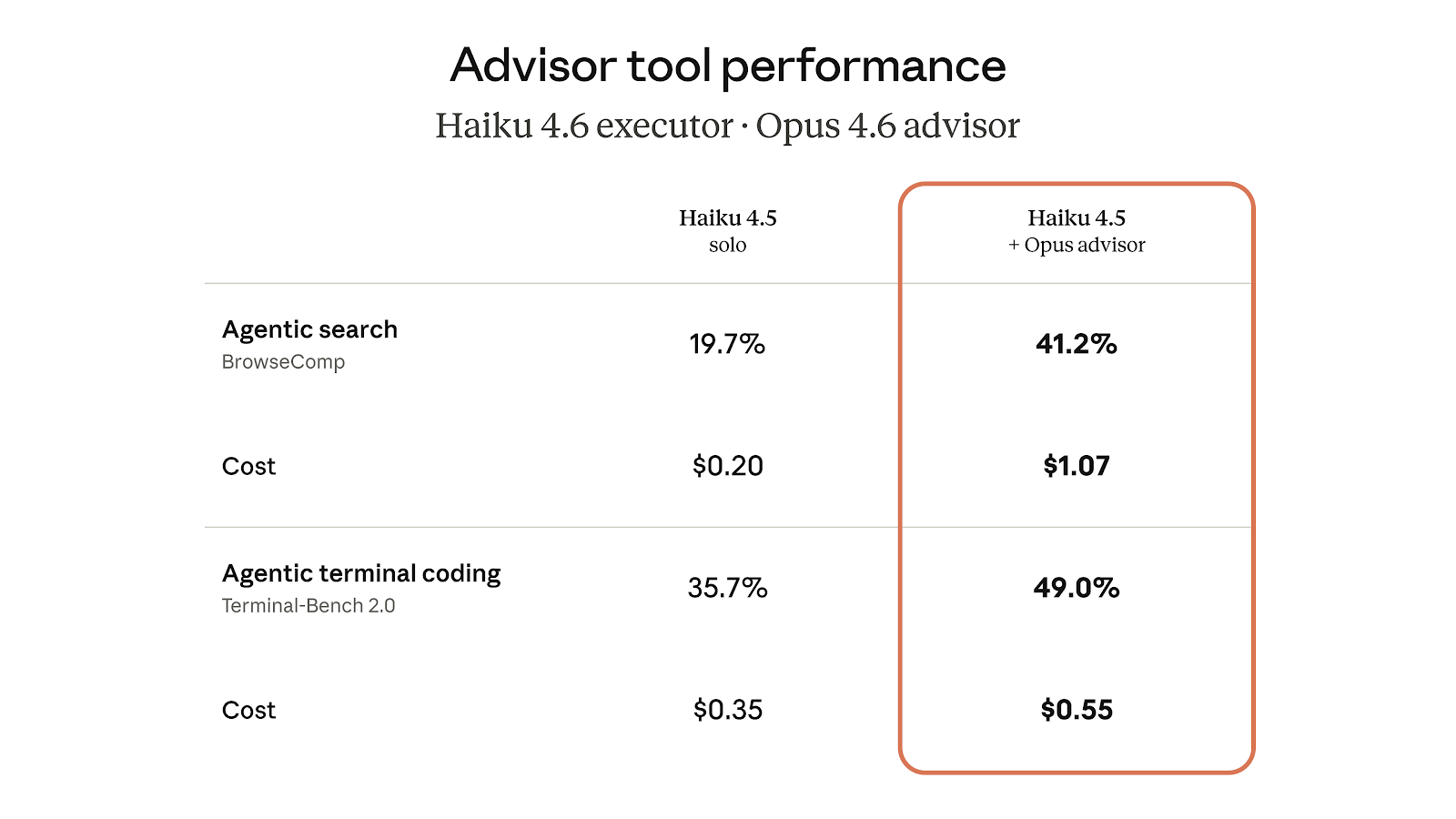
アドバイザー戦略は、エグゼキューターとしてHaikuを使用する場合にも有効です。BrowseCompでは、Opusアドバイザーを備えたHaikuは41.2%のスコアを記録し、単体スコア19.7%の2倍以上となりました。Opusアドバイザーを備えたHaikuは、スコアではSonnet単体に29%及びませんが、タスクあたりのコストは85%低くなります。アドバイザーはHaiku単体と比べてコストを上乗せしますが、組み合わせたコストは依然としてSonnetのコストの一部であり、知性とコストのバランスが求められる大規模タスクには有力な選択肢となります。
Messages APIリクエストでadvisor_20260301を宣言すれば、モデル間の引き継ぎは単一の/v1/messagesリクエスト内で完了します。追加の往復通信やコンテキスト管理は不要です。エグゼキューターモデルが呼び出すタイミングを決定します。呼び出しが行われると、精選されたコンテキストがアドバイザーモデルにルーティングされ、計画が返され、エグゼキューターが同じリクエスト内で処理を続行します。
response = client.messages.create(
    model="claude-sonnet-4-6", # エグゼキューター
    tools=[
        {
            "type": "advisor_20260301",
            "name": "advisor",
            "model": "claude-opus-4-6",
            "max_uses": 3,
        },
        # ... 他のツール
    ],
    messages=[...]
)
# アドバイザートークンは使用量ブロックで別途報告されます
価格設定。アドバイザートークンはアドバイザーモデルの料金で課金され、エグゼキュータートークンはエグゼキューターモデルの料金で課金されます。アドバイザーは短い計画のみを生成し(通常400-700テキストトークン)、エグゼキューターはより低い料金で完全な出力を処理するため、全体のコストはアドバイザーモデルをエンドツーエンドで実行するよりも大幅に低く抑えられます。組み込みのコスト管理。max_usesを設定して、リクエストごとのアドバイザー呼び出し回数を制限できます。アドバイザートークンは使用量ブロックで別途報告されるため、階層ごとの支出を追跡できます。
既存のツールと併用可能。アドバイザーツールはMessages APIリクエストの単なる追加エントリです。エージェントは同じループ内でウェブ検索、コード実行、Opusへの相談をすべて行えます。
「複雑なタスクではより優れたアーキテクチャ上の決定を行い、単純なタスクではオーバーヘッドを追加しません。計画とその軌跡は雲泥の差です。」
「エージェントのターン数、ツール呼び出し、総合スコアに明確な改善が見られました。自社で構築した計画ツールよりも優れた結果でした。」
「構造化ドキュメント抽出タスクでは、アドバイザーツールによりHaiku 4.5は複雑さに応じてOpus 4.6に相談することで知性を動的に拡張し、フロンティアモデルの品質を5分の1のコストで実現できます。」
PrevPrev0/5NextNexteBook
アドバイザーツールは現在、Claude Platformでネイティブにベータ版として利用可能です。開始するには:
- ベータ機能ヘッダーを追加:
anthropic-beta: advisor-tool-2026-03-01 - Messages APIリクエストに
advisor_20260301を追加 - ご利用のユースケースに基づいてシステムプロンプトを調整
既存の評価スイートを、Sonnet単体、Opusアドバイザーを備えたSonnetエグゼキューター、Opus単体に対して実行することをお勧めします。詳細についてはドキュメントをご覧ください。
SWE-bench Multilingual: Sonnet 4.6単体は適応的思考を使用。Sonnet 4.6 + アドバイザーは、思考をオフにしたコーディング用の推奨システムプロンプトを使用。両実行ともbashおよびファイル編集ツールを使用した高負荷設定。スコアは9言語にわたる300問題の5回試行の平均。全実行でアドバイザーモデルとしてOpus 4.6を使用。
BrowseComp: 全実行とも思考をオフに設定し、ウェブ検索およびウェブフェッチツールを使用。Sonnet 4.6実行は中負荷設定。Sonnet 4.6 + アドバイザーはコーディング用の推奨システムプロンプトを使用。Haiku 4.5 + アドバイザーは使用せず。プログラムによるツール呼び出しやコンテキスト圧縮はなし。スコアは1,266問題(問題あたり1回試行)に基づく。全実行でアドバイザーモデルとしてOpus 4.6を使用。
Terminal-Bench 2.0: 全実行とも思考をオフに設定し、bashおよびファイル編集ツールを使用。Sonnet 4.6実行は中負荷設定。いずれのアドバイザー実行もコーディング用の推奨システムプロンプトを使用せず。各タスクは3倍のリソース割り当てと1倍のタイムアウトで隔離されたポッドで実行。スコアは89タスク(タスクあたり5回試行)の平均。全実行でアドバイザーモデルとしてOpus 4.6を使用。
原文を表示
The advisor strategy: Give agents an intelligence boost
Pair Opus as an advisor with Sonnet or Haiku as an executor, and get near Opus-level intelligence in your agents at a fraction of the cost.
CategoryProduct announcements
ProductClaude Platform
DateApril 9, 2026
Reading time5min
ShareCopy linkhttps://claude.com/blog/the-advisor-strategy
Developers who want to better balance intelligence and cost have converged on what we call the advisor strategy: pair Opus as an advisor with Sonnet or Haiku as an executor. This brings near Opus-level intelligence to your agents while keeping costs near Sonnet levels.
Today we're introducing the advisor tool on the Claude Platform to make the advisor strategy a one-line change in your API call.
Build cost-effective agents with the advisor strategy
With the advisor strategy, Sonnet or Haiku runs the task end-to-end as the executor, calling tools, reading results, and iterating toward a solution. When the executor hits a decision it can't reasonably solve, it consults Opus for guidance as the advisor. Opus accesses the shared context and returns a plan, a correction, or a stop signal, and the executor resumes. The advisor never calls tools or produces user-facing output, and only provides guidance to the executor.
This inverts a common sub-agent pattern, where a larger orchestrator model decomposes work and delegates to smaller worker models. In the advisor strategy, a smaller, more cost-effective model drives and escalates without decomposition, a worker pool, or orchestration logic. Frontier-level reasoning applies only when the executor needs it, and the rest of the run stays at executor-level cost.
In our evaluations, Sonnet with Opus as an advisor showed a 2.7 percentage point increase on SWE-bench Multilingual1 over Sonnet alone, while reducing cost per agentic task by 11.9%.
The advisor tool
We’re bringing the advisor strategy to our API with the advisor tool, a server-side tool which Sonnet and Haiku know to invoke when they need guidance or help with a specific task.
In our evaluations, Sonnet with an Opus advisor improved scores across BrowseComp2 and Terminal-Bench 2.03 benchmarks while costing less per task than Sonnet alone.
The advisor strategy also works with Haiku as the executor. On BrowseComp, Haiku with an Opus advisor scored 41.2%, more than double its solo score of 19.7%. Haiku with an Opus advisor trails Sonnet solo by 29% in score but costs 85% less per task. The advisor adds cost relative to Haiku alone, but the combined price is still a fraction of what Sonnet costs, making it a strong option for high-volume tasks that require a balance of intelligence and cost.
Declare advisor_20260301 in your Messages API request, and the model handoff happens inside a single /v1/messages request—no extra round-trips or context management. The executor model decides when to invoke it. When it does, we route the curated context to the advisor model, return the plan, and the executor continues all within the same request.
response = client.messages.create( model="claude-sonnet-4-6", # executor tools=[ { "type": "advisor_20260301", "name": "advisor", "model": "claude-opus-4-6", "max_uses": 3, }, # ... your other tools ], messages=[...] ) # Advisor tokens reported separately # in the usage block.
Pricing. Advisor tokens are billed at the advisor model's rates; executor tokens are billed at the executor model's rates. Since the advisor only generates a short plan (typically 400-700 text tokens) while the executor handles the full output at its lower rate, the overall cost stays well below running the advisor model end-to-end. Built-in cost controls. Set max_uses to cap advisor calls per request. Advisor tokens are reported separately in the usage block so you can track spend per tier.
Works alongside your existing tools. The advisor tool is just another entry in your Messages API request. Your agent can search the web, execute code, and consult Opus in the same loop.
“It makes better architectural decisions on complex tasks while adding no overhead on simple ones. The plans and trajectories are night and day different.”
“We saw clear improvements in agent turns, tool calls, and overall score — better than a planning tool we built ourselves.”
“On structured document extraction tasks, the advisor tool enables Haiku 4.5 to dynamically scale intelligence by consulting Opus 4.6 as complexity demands, matching frontier-model quality at 5× lower cost.”
PrevPrev0/5NextNexteBook
The advisor tool is available now in beta natively on the Claude Platform. To get started:
Add the beta feature header: anthropic-beta: advisor-tool-2026-03-01
Add the advisor_20260301 to your Messages API request
Modify your system prompt based on your use case
We recommend running your existing eval suite against Sonnet solo, Sonnet executor with Opus advisor, and Opus solo. Explore the docs to learn more.
SWE-bench Multilingual: Sonnet 4.6 solo used adaptive thinking. Sonnet 4.6 + Advisor used our suggested system prompt for coding with thinking turned off. Both runs used high effort with bash and file editing tools. Scores are averaged over five trials of 300 problems across nine languages. Opus 4.6 was used as the advisor model in all runs.
BrowseComp: All runs used thinking turned off with web search and web fetch tools. Sonnet 4.6 runs used medium effort. Sonnet 4.6 + Advisor used our suggested system prompt for coding; Haiku 4.5 + Advisor did not. No programmatic tool calling or context compaction. Scores are based on 1,266 problems with one attempt per problem. Opus 4.6 was used as the advisor model in all runs.
Terminal-Bench 2.0: All runs used thinking turned off with bash and file editing tools. Sonnet 4.6 runs used medium effort. Neither advisor run used our suggested system prompt for coding. Each task ran in an isolated pod with 3x resource allocation and a 1x timeout. Scores are averaged over five attempts per task across 89 tasks. Opus 4.6 was used as the advisor model in all runs.
Explore more product news and best practices for teams building with Claude.
Turn ideas into interactive AI-powered apps
Product announcementsTurn ideas into interactive AI-powered appsTurn ideas into interactive AI-powered appsTurn ideas into interactive AI-powered appsTurn ideas into interactive AI-powered apps  Apr 9, 2026Making Claude Cowork ready for enterprise
Product announcementsMaking Claude Cowork ready for enterpriseMaking Claude Cowork ready for enterpriseMaking Claude Cowork ready for enterpriseMaking Claude Cowork ready for enterprise  Apr 8, 2026Claude Managed Agents: get to production 10x faster
Product announcementsClaude Managed Agents: get to production 10x fasterClaude Managed Agents: get to production 10x fasterClaude Managed Agents: get to production 10x fasterClaude Managed Agents: get to production 10x faster  Mar 23, 2026Put Claude to work on your computer
Product announcementsPut Claude to work on your computerPut Claude to work on your computerPut Claude to work on your computerPut Claude to work on your computerTransform how your organization operates with Claude
Get the developer newsletter
Product updates, how-tos, community spotlights, and more. Delivered monthly to your inbox.
SubscribeSubscribePlease provide your email address if you'd like to receive our monthly developer newsletter. You can unsubscribe at any time.
同じ出来事を6媒体で確認
同じ出来事を扱う別媒体の記事です。見出しと公開時刻を比較できます。
今日のまとめ
AIデイリーブリーフで今日の重要ニュースをまとめ読み