Amazon Bedrock に Web 検索機能追加、ファウンデーションモデルの最新情報取得を支援
本文の状態
日本語全文を表示中
詳細モードで約14分の本文を読めます。
同じ出来事の情報源
この情報源を基点に整理
AWS Machine Learning Blog
AWS は Amazon Bedrock に Web Search をネイティブ統合し、開発者がサードパーティ製検索プロバイダを別途接続する手間やデータ残存リスクを解消して、モデルの根拠となる最新ウェブ知識への接地を実現した。
AI深層分析を開く2026年8月5日 11:00
AI深層分析
キーポイント
ネイティブ機能としての統合
Web Search が Amazon Bedrock のサーバーサイドに組み込まれ、サードパーティベンダーのオンボーディングや外部 API のオーケストレーションが不要となった。
マルチソース接地アプローチ
Amazon が運営する数十億ドキュメントからなるウェブインデックスと、ドメイン内のエンティティを紐付ける知識グラフを組み合わせて回答の信頼性を高める。
文脈効率的な検索結果取得
検索対象ページからクエリに関連するセクションのみを抽出し、モデルのコンテキストウィンドウに最適化された形式で返すことでトークン使用量を削減する。
ハルシネーションの低減
学習データに含まれない最新の情報(直近の決算電話や規制変更など)に対して、モデルが推測するのではなく根拠に基づいて回答することで誤答を減らす。
文脈効率化された検索
Web Search はクエリに関連する部分だけを抽出してモデルに渡すため、不要なテキストを省き高速なレスポンスが可能になる。
重要な引用
Grounding the model in current web knowledge closes that gap – whether it's powering chatbots, coding assistants, CLI tools, or enterprise applications, grounding helps answer questions beyond the model's training and reduces hallucinations.
With Web Search, grounding becomes a native capability of Amazon Bedrock, with no third-party vendors to onboard, no external APIs to orchestrate, and no additional third party vendor security reviews to conduct.
Web Search performs semantic snippet extraction – pulling the passages from each web page that bear on the query and returning them in a form optimized for the model's context window.
There's no client-side tool-use loop to build, no external API responses to parse, and no retries or rate limits to manage – a single API call returns a grounded response.
編集コメントを表示
編集コメント
AWS は検索機能の外部依存を解消し、開発者の負担を減らす方向へ明確に舵を切っている。これは RAG パターンにおける実装のハードルを下げる重要な一歩であると言える。
Source Article
元記事を日本語で読む
本文に関係しない購読案内、埋め込み通知、サイト内プロモーションは除いています。
基盤モデルが先週の決算電話会議の内容や、昨日の規制変更、あるいは今朝の天気予報といった質問に答えるためには、学習データに含まれていない最新の知識が必要です。モデルを現在のウェブ情報と結びつける(グラウンディング)ことで、そのギャップを埋めることができます。チャットボット、コーディングアシスタント、CLI ツール、エンタープライズアプリケーションなど、あらゆる用途において、グラウンディングはモデルの学習範囲を超える質問への回答を可能にし、ハルシネーション(幻覚・誤答)を削減します。
従来、モデルにウェブ知識を接続するには、開発者がサードパーティ製の Web 検索プロバイダーを選定し、統合し、維持管理する必要がありました。このプロセスはプロジェクトのスケジュールを遅らせ、データの所在地に関するリスクや運用上のオーバーヘッドをもたらす要因となっていました。
AWS New York Summit 2026 で、私たちは AgentCore における Web Search の一般提供を開始しました。そして今日、その機能をさらに拡張し、Amazon Bedrock での Web Search の一般提供を開始します。これはサーバーサイドに組み込まれたツールであり、モデルの回答を現在のウェブ情報に基づいて補強するものです。Web Search を利用することで、グラウンディングは Amazon Bedrock のネイティブ機能となります。オンボーディングが必要なサードパーティベンダーも、調整すべき外部 API も、追加で実施すべきセキュリティ審査も不要です。
本稿では、Amazon Bedrock の Web Search 機能とは何か、その重要性、OpenAI Responses API を用いた有効化方法、および使い始め方について解説します。
Amazon Bedrock が提供する Web Search の特徴
Web Search は Amazon Bedrock モデルの推論用に設計されており、以下のような独自の特徴を備えています。
マルチソースによる根拠付けアプローチ: Web Search は、Amazon が運営するウェブインデックス(数十億件の文書から構成され、常時更新される)を基盤としています。これに組み込まれた知識グラフを組み合わせることで、ドメイン内のエンティティとそれらの相互関係を明確に紐づけます。質問が事実確認を目的とした場合(例:特定の書籍の著者は誰か、ある出来事がいつ起きたのか)、Web Search は抽出されたページテキストからモデルが推測するのではなく、知識グラフを活用して高い確信度で回答します。これにより、エージェントが断片的な情報を組み合わせて回答を作成する際に生じやすい、わずかな事実誤認を大幅に削減できます。
文脈効率の高い検索: モデルに生のページデータを渡して関連部分を探すという従来の手法ではなく、Web Search はセマンティック・スニペット抽出を実行します。これは、クエリに関連するウェブページの該当箇所を抽出し、モデルのコンテキストウィンドウに最適化された形式で返す処理です。これにより、モデルは重要な部分のみを確認でき、定型文などに費やされるトークン数を最小限に抑えられます。検索速度も速いため、根拠のある回答を最小限の遅延で提供することが可能です。
単一パラメータでの有効化。 Web Search は、既存の OpenAI 互換 API コール内で単一のパラメータとして扱われます。これにより、ベンダーへのオンボーディングや API キーの管理、オーケストレーション層の構築、別々の SDK の導入が不要になります。
エンタープライズグレードのコンプライアンスを標準でサポート。 デフォルトでは、Bedrock 上の Web Search はデータ流出ゼロを実現します。つまり、あなたのデータは AWS 環境の外へ一切出ません。今後新機能を追加する際にも、特定の機能についてはユーザーが明示的にリクエストした場合のみデータが外部に露出されるようになります。最新情報については、Amazon Bedrock のドキュメントをご参照ください。Web Search は Amazon Bedrock のインフラ内で完全に動作し、顧客のコンプライアンス要件に対応しています。
仕組み
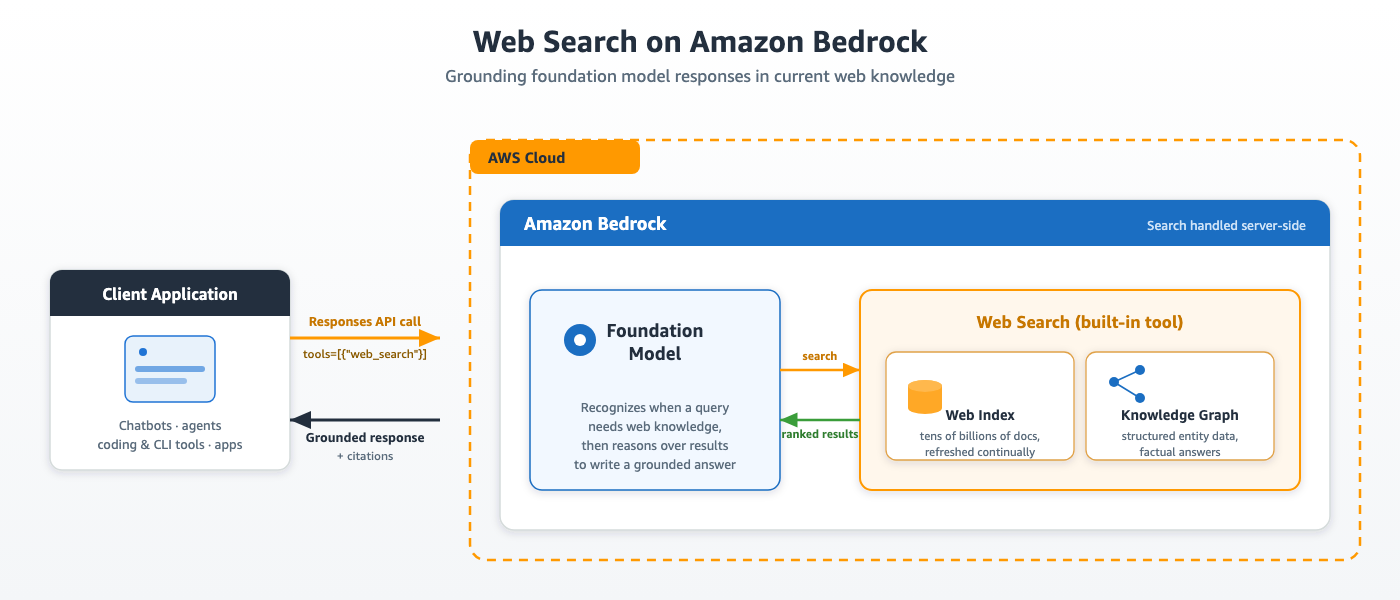
図注:Web Search リクエストのライフサイクル。モデルが知識のギャップを特定し、Bedrock がクエリを作成して Amazon のウェブインデックスおよびナレッジグラフからコンテンツを取得し、出典付きで根拠のある回答を返す様子。
API 呼び出しで Web 検索を有効化すると、Bedrock がサーバー側で検索のライフサイクル全体を処理します。まずモデルがクエリに最新の情報が必要だと判断し、次に Bedrock が検索クエリを生成して Amazon のウェブインデックスやナレッジグラフから関連コンテンツを取得します。取得した結果(関連スニペット、ソース URL、タイトルなど)はモデルのコンテキストウィンドウに注入されます。
モデルはこの取得したコンテンツに基づいて推論を行い、出典を示す根拠のある回答を生成します。API は最終的な回答とともに、参照された各ソースの URL とページタイトルを含む構造化された引用注釈を返します。クライアント側でツール使用ループを構築する必要も、外部 API 応答を解析する必要も、リトライやレート制限を管理する必要もありません。単一の API 呼び出しで根拠のある回答が得られます。
OpenAI Responses API の使い方
Responses API はネイティブに組み込みツールをサポートしているため、Web 検索は関数スキーマの定義やクライアント側ループの構築なしに呼び出すことができます。有効化には以下の 3 ステップが必要です。AWS 認証情報の設定、OpenAI クライアントを bedrock-mantle エンドポイントに向けること、そしてリクエストに Web Search ツールを追加することです。リリース時点では、Amazon Bedrock の次世代推論エンジンを通じて提供される OpenAI モデルで Web 検索が利用可能です。
ステップ 1: 認証と権限を設定します。Web Search では、既存の AWS 資格情報を使用するため、個別に API キーを準備する必要はありません。標準的な資格情報のチェーン(IAM ロール、AWS CLI プロファイル、または環境変数)を通じて AWS 資格情報が利用可能な環境である必要があります。これらは、bedrock-mantle エンドポイントへのリクエスト認証に使用されます。
呼び出し元には、以下の 2 つの権限セットが必要です。
- Amazon Bedrock での推論実行権限:モデル呼び出し自体を成功させるために必要です。AmazonBedrockMantleInferenceAccess マネージドポリシーをアタッチするか、呼び出しに必要な特定の推論アクションを付与してください。
- Web Search ツールの使用権限:リクエスト中にモデルがツールを呼び出せるようにするために必要です。最低限 bedrock-websearch:InvokeSearch を付与し、結果のページコンテンツ全体を読み取れるようにする場合は bedrock-websearch:InvokeFetch も追加してください。ライブ・ウェブ検索にはさらに bedrock-websearch:ExternalWebAccess が必要です。これはデフォルトのリクエスト動作ですが、資格情報にこの権限がない場合は、ツールの設定で external_web_access: false を指定してください。もし InvokeSearch が拒否された場合、Web Search は事実上無効となり、モデルは学習データに基づいて回答を生成します。
エンドポイントへのリクエストは、AWS が発行したベアラートークンで認証されます。このトークンは、既存の AWS 資格情報を使って aws-bedrock-token-generator パッケージから取得できます。これは個別の API キーではなく、SigV4 を介して既存の AWS IAM アイデンティティから派生する短期間(最大 12 時間)の有効期限付き資格情報です。OpenAI クライアントが期待する api_key パラメータの形式でパッケージ化されています。追加的なキー管理は不要です。
まずは標準的な呼び出しから始めましょう。グラウンディング機能なしの通常の Responses API の呼び出しは以下のようになります。
response = client.responses.create(
    model="openai.gpt-5.4",
    input="What were the key announcements at AWS re:Invent 2025?",
)
ステップ 2: Web Search を有効にする
同じ呼び出しをウェブ知識に基づいて実行するには、単一の tools エントリを追加します。
tools=[{"type": "web_search", "external_web_access": False}]オプションの external_web_access フィールドは、Web Search が参照するソースを選択します。Amazon の事前インデックス化されたウェブコーパスか、ウェブから直接取得したライブコンテンツかのどちらかです。現在はインデックス化されたウェブからの検索のみが利用可能です。ライブウェブからの検索機能は今後のアップデートで提供される予定ですが、すでに API にパラメータとして用意されているため、コードの変更は不要です。デフォルト値は true で、この場合 bedrock-websearch:ExternalWebAccess 権限が必要です。以下の例では false を設定しており、追加の権限は必要ありません。
ステップ 3: 引用付きでグラウンディングされた応答を読み取る
これらを組み合わせた完全なエンドツーエンドの例と、ソース引用の抽出方法を示します。
from openai import OpenAI
from aws_bedrock_token_generator import provide_token

REGION = "us-east-1"

client = OpenAI(
    base_url=f"https://bedrock-mantle.{REGION}.api.aws/openai/v1",
    api_key=provide_token(region=REGION),
)

response = client.responses.create(
    model="openai.gpt-5.4",
    input="What were the key announcements at AWS re:Invent 2025?",
    tools=[{"type": "web_search", "external_web_access": False}],
)

searches = [item for item in response.output if item.type == "web_search_call"]
print(f"Retrieval steps: {len(searches)}")
for call in searches:
    if call.action.type == "search":
        print(f"  search: {call.action.queries}")
    elif call.action.type == "open_page":
        print(f"  open_page: {call.action.url}")

for item in response.output:
    if item.type == "message":
        for content in item.content:
            if content.type == "output_text":
                print(content.text)
                for citation in content.annotations or []:
                    if citation.type == "url_citation":
                        print(f"  [{citation.title}] {citation.url}")
上記のコードが生成する出力は以下の通りです(一部省略)。
Retrieval steps: 2
  search: ['AWS re:Invent 2025 key announcements official AWS blog keynote recap']
  open_page: https://aws.amazon.com/blogs/aws/top-announcements-of-aws-reinvent-2025
The biggest AWS re:Invent 2025 announcements clustered around **AI agents, custom
silicon/infrastructure, and developer productivity**. ...
  [Top announcements of AWS re:Invent 2025 | AWS News Blog] https://aws.amazon.com/...
  [AWS re:Invent 2025: Amazon announces Nova 2, Trainium3, frontier agents] https://...
このサンプルでは、リクエストに含まれる tools 配列に Web Search エントリが含まれています。Bedrock はサーバー側で検索を実行し、 grounding されたレスポンスを単一のラウンドトリップで返します。関数スキーマの定義やクライアント側のループ管理は不要です。
各引用は、メッセージコンテンツ内の annotations 配列に含まれる url_citation オブジェクトです。そのワイヤー形状は以下の通りです。
{
    "type": "url_citation",
    "start_index": 120,
    "end_index": 303,
    "title": "Top announcements of AWS re:Invent 2025 | AWS News Blog",
    "url": "https://aws.amazon.com/blogs/aws/top-announcements-of-aws-reinvent-2025"
  }
start_index と end_index は、出力テキスト内での文字オフセットを示します。これにより、インラインの脚注をレンダリングしたり、各引用が裏付ける特定のテキスト範囲を強調表示したりすることが可能になります。
監査と観測性
Web Search は AWS CloudTrail と標準で連携しています。bedrock-websearch:InvokeSearch や bedrock-websearch:InvokeFetch への呼び出しはすべて管理イベントとして記録され、呼び出し元の ID、タイムスタンプ、アクション、ソース ID(フォワードアクセスセッションの生成元を含む)、およびリクエストのアカウントとリージョンコンテキストがキャプチャされます。アクセス拒否の結果も必ずログに記録され、各 AccessDeniedException イベントには拒否の原因となった特定の条件キーが含まれるため、追加でトレイルを有効にしなくても IAM の設定ミスを簡単に診断できます。
設計上、CloudTrail はクエリテキストや検索結果の URL、フェッチで取得した生ページコンテンツを記録しません。クエリテキストは推論プロンプトと同様に扱われ、トレイルイベントに露出されることはありません。これにリージョン内処理とデータ流出ゼロを組み合わせることで、セキュリティおよびコンプライアンスチームは「誰がいつツールを使用したか」の完全な監査証跡を得ながら、エンドユーザーが何を検索したかは開示されないという環境を実現できます。
結論
Amazon Bedrock の Web Search は、ファウンデーションモデルを最新のウェブ知識に接続するための面倒な作業を一掃します。低遅延で文脈効率的かつ複数ソースに根ざした結果を提供し、単一の API パラメータで簡単に機能を有効化できるため、開発者はベンダー管理、オーケストレーション、コンプライアンス審査を行うことなく、ウェブによる grounding(事実裏付け)をモデルに追加できます。
Web Search on Bedrock は米国リージョンで一般提供されています。クエリ処理は us-east-1、us-east-2、us-west-2 でリージョン内で行われます。料金詳細については Amazon Bedrock の価格ページ をご覧ください。利用開始には、API リファレンスとサンプルを含む完全なドキュメントである Web Search ドキュメント を参照してください。
執筆者について

Anuj Jauhari
Anuj は AWS のシニアプロダクトマーケティングマネージャー(技術担当)です。生成 AI を活用して顧客のビジネス成果の実現を支援しています。

Vadim Omeltchenko
Vadim は、クラウド上で顧客のイノベーションを支援することに情熱を注ぐシニア AI/ML ソリューションアーキテクトです。これまでの IT 経験は、主に現場での実務が中心でした。

Priya Holikatti
Priya は Amazon AGI のシニア・テクニカルプロダクトマネージャーです。AI エージェントやモデルが、リアルタイムで信頼性の高いウェブ知識とつながるための検索機能の開発を担当しています。

Rashim Gupta
Rashim Gupta は、AWS の Amazon Bedrock におけるテクニカルプロダクトマネジメントのシニアマネージャーです。Bedrock で本番環境のアプリケーションを開発・運用するために顧客が利用する機能の開発チームを率いています。

Omar Abdelwahab
Omar は、Amazon Web Services (AWS) のテクニカルプロダクトマーケティングマネージャーです。エージェント AI やウェブ検索を含む AI 製品に注力しています。コンピュータサイエンスの博士号を持ち、AI・技術・市場展開戦略の交差点で働くことを楽しんでいます。顧客が革新的なアプリケーションを構築できるよう支援しています。
原文を表示
When a foundation model needs to answer a question about last week’s earnings call, yesterday’s regulatory change, or this morning’s weather forecast, it needs knowledge it was never trained on. Grounding the model in current web knowledge closes that gap – whether it’s powering chatbots, coding assistants, CLI tools, or enterprise applications, grounding helps answer questions beyond the model’s training and reduces hallucinations. Traditionally, connecting a model to web knowledge required developers to identify, integrate, and maintain a third-party Web Search provider, a process that delays project timelines and introduces data residency risks and operational overhead.
At AWS New York Summit 2026, we announced the general availability of Web Search on AgentCore. Today, we are extending it further with the general availability of Web Search on Amazon Bedrock. It is a server-side built-in tool that grounds model responses in current web knowledge. With Web Search, grounding becomes a native capability of Amazon Bedrock, with no third-party vendors to onboard, no external APIs to orchestrate, and no additional third party vendor security reviews to conduct.
In this post, we walk through what Web Search on Amazon Bedrock is, why it matters, how to enable it using the OpenAI Responses API, and how to get started with the tool.
What Web Search on Amazon Bedrock provides
Web Search is designed for Amazon Bedrock model inference, with the following differentiators:
Multi-source grounding approach: Web Search is backed by a web index that Amazon operates, spanning billions of documents and refreshed continually. It combines this index with a built-in knowledge graph that anchors the entities in a domain along with the connections between them. When a question is factual in nature; say, who wrote a particular book or what year an event took place; Web Search uses the knowledge graph to answer with strong confidence, rather than leaving the model to infer the answer from extracted page text. That can help cut down on the small factual inaccuracies that tend to slip in whenever an agent assembles an answer from fragments on its own.
Context-efficient retrieval. Rather than handing the model a raw page and hoping it finds the relevant part, Web Search performs semantic snippet extraction – pulling the passages from each web page that bear on the query and returning them in a form optimized for the model’s context window. The model sees the parts that matter, with fewer tokens spent on boilerplate. Retrieval is fast, so grounded responses can be delivered with minimal latency.
Single-parameter enablement. Web Search becomes a single parameter in your existing OpenAI-compatible API call, removing the need for vendor onboarding, API keys, orchestration layers, and separate SDKs.
Helping with enterprise-grade compliance out of the box. By default, Web Search on Bedrock offers zero data egress, so your data never leaves your AWS environment. As we introduce new capabilities, some future features may expose data only at your explicit request. For the latest information, please refer to the Amazon Bedrock documentation . Web Search operates entirely within Amazon Bedrock’s infrastructure, supporting customers’ compliance requirements.
How it works
When Web Search is enabled in an API call, Bedrock handles the entire search lifecycle server-side. First, the model identifies that a query requires up-to-date web knowledge. Bedrock then formulates a search query, retrieves relevant content from Amazon’s web index and knowledge graph, and injects results – including relevant snippets, source URLs and titles – into the model’s context window. The model reasons over the retrieved content and generates a grounded response with source citations. The API returns the final response with structured citation annotations, including URL and page title for each referenced source. There’s no client-side tool-use loop to build, no external API responses to parse, and no retries or rate limits to manage – a single API call returns a grounded response.
Getting started with the OpenAI Responses API
The Responses API supports built-in tools natively, so Web Search can be called without defining a function schema or building a client-side loop. Enablement takes three steps: configure AWS credentials, point the OpenAI client at the bedrock-mantle endpoint, and add the Web Search tool to the request. At launch, Web Search is available for OpenAI models served through Amazon Bedrock’s next-generation inference engine.
Step 1: Configure authentication and permissions. Web Search uses your existing AWS credentials – there are no separate API keys to provision. The environment must have AWS credentials available through the standard credential chain (an IAM role, the AWS CLI profile, or environment variables), which are used to authenticate requests to the bedrock-mantle endpoint. The calling identity needs two sets of permissions:
- Inference permissions on Amazon Bedrock, so the model call itself succeeds. Attach the AmazonBedrockMantleInferenceAccess managed policy, or grant the specific inference actions your call requires.
- Web Search tool permissions, so the model can call the tool during the request. At minimum grant bedrock-websearch:InvokeSearch; add bedrock-websearch:InvokeFetch to let the model read a result’s full page content. Live-web retrieval additionally requires bedrock-websearch:ExternalWebAccess, which is the default request behavior — if your identity doesn’t have it, set external_web_access: false on the tool. If InvokeSearch is denied, Web Search is effectively disabled and the model answers from its training data instead.
Requests to the endpoint are authenticated with an AWS-issued bearer token, which you can mint from your existing AWS credentials using the aws-bedrock-token-generator package. This bearer token isn’t a separate API key; it’s a short-lived (up to 12 hours) credential derived from your existing AWS IAM identity via SigV4, packaged in the format the OpenAI client expects for its api_key parameter. No additional key management is required.
Start from a standard call. A normal Responses API call, without grounding, looks like this:
response = client.responses.create(
    model="openai.gpt-5.4",
    input="What were the key announcements at AWS re:Invent 2025?",
)
Step 2: Enable Web Search. To ground that same call in web knowledge, add a single tools entry:
tools=[{"type": "web_search", "external_web_access": False}]The optional external_web_access field selects where Web Search retrieves from: Amazon’s pre-indexed web corpus, or live content fetched directly from the web. Today only indexed-web retrieval is served; live-web retrieval will be enabled in a future update, and the parameter is already in the API so your code won’t need to change. The default is true, which requires the bedrock-websearch:ExternalWebAccess permission. The examples below set false, which needs no additional permission.
Step 3: Read the grounded response with citations. Putting it together, here’s the complete end-to-end example, including how to extract the source citations:
from openai import OpenAI
from aws_bedrock_token_generator import provide_token

REGION = "us-east-1"

client = OpenAI(
    base_url=f"https://bedrock-mantle.{REGION}.api.aws/openai/v1",
    api_key=provide_token(region=REGION),
)

response = client.responses.create(
    model="openai.gpt-5.4",
    input="What were the key announcements at AWS re:Invent 2025?",
    tools=[{"type": "web_search", "external_web_access": False}],
)

searches = [item for item in response.output if item.type == "web_search_call"]
print(f"Retrieval steps: {len(searches)}")
for call in searches:
    if call.action.type == "search":
        print(f"  search: {call.action.queries}")
    elif call.action.type == "open_page":
        print(f"  open_page: {call.action.url}")

for item in response.output:
    if item.type == "message":
        for content in item.content:
            if content.type == "output_text":
                print(content.text)
                for citation in content.annotations or []:
                    if citation.type == "url_citation":
                        print(f"  [{citation.title}] {citation.url}")
The above code produces the following output (abridged):
Retrieval steps: 2
  search: ['AWS re:Invent 2025 key announcements official AWS blog keynote recap']
  open_page: https://aws.amazon.com/blogs/aws/top-announcements-of-aws-reinvent-2025
The biggest AWS re:Invent 2025 announcements clustered around **AI agents, custom
silicon/infrastructure, and developer productivity**. ...
  [Top announcements of AWS re:Invent 2025 | AWS News Blog] https://aws.amazon.com/...
  [AWS re:Invent 2025: Amazon announces Nova 2, Trainium3, frontier agents] https://...
In this sample, the request includes a Web Search entry in the tools array. Bedrock executes the search server-side and returns the grounded response in a single round-trip – there is no function schema to define and no client-side loop to manage.
Each citation is a url_citation object in the message content’s annotations array. Its wire shape:
{
    "type": "url_citation",
    "start_index": 120,
    "end_index": 303,
    "title": "Top announcements of AWS re:Invent 2025 | AWS News Blog",
    "url": "https://aws.amazon.com/blogs/aws/top-announcements-of-aws-reinvent-2025"
  }
start_index and end_index are character offsets into output_text, letting you render inline footnotes or highlight the exact span each citation supports.
Auditing and observability
Web Search is integrated with AWS CloudTrail out of the box. Every call to bedrock-websearch:InvokeSearch and bedrock-websearch:InvokeFetch is recorded as a management event, capturing the calling identity, timestamp, action, source identity (including any forward-access-session originator), and the account and Region context of the request. Access-denied outcomes are always logged, and each AccessDeniedException event includes the specific condition key that caused the denial — which makes IAM misconfigurations easy to diagnose without turning on additional trails.
By design, CloudTrail does not record the query text, the URLs returned by search, or the raw page content retrieved by fetch. Query text is treated the same way as an inference prompt and is never exposed in trail events. Combined with in-Region processing and zero data egress, this gives security and compliance teams a full audit trail of who used the tool when, without exposing what end users searched for.
まとめ
Web Search on Amazon Bedrock removes the undifferentiated heavy lifting of connecting foundation models to up-to-date web knowledge. It delivers context-efficient, multi-source grounded results with low-latency, and simple enablement through a single API parameter – so developers can add web grounding without managing vendors, orchestration, or compliance reviews.
Web Search on Bedrock is generally available in US, with in-region query handling in us-east-1, us-east-2 and us-west-2. For pricing details, see the Amazon Bedrock pricing page. To get started, see the Web Search documentation for complete API references and examples.
About the authors
Anuj Jauhari
Anuj is a Senior Product Marketing Manager, Technical at AWS, helping customers realize business outcomes with generative AI.
Vadim Omeltchenko
Vadim is a Senior AI/ML Solutions Architect who is passionate about helping AWS customers innovate in the cloud. His prior IT experience was predominantly on the ground.
Priya Holikatti
Priya is a Senior Technical Product Manager at Amazon AGI, building web search capabilities that connect AI agents and models to real-time, trustworthy web knowledge.
Rashim Gupta
Rashim Gupta is a Senior Manager of Technical Product Management for Amazon Bedrock at AWS, where he leads the team building the features customers use to develop and run production applications on Bedrock.
Omar Abdelwahab
Omar is a Technical Product Marketing Manager at Amazon Web Services (AWS), Where he focuses on AI products including Agentic AI and Web Search. He holds a Ph.D. in Computer Science and enjoys working at the intersection of AI, technology, and go-to-market strategy to help customers build innovative applications.
今日のまとめ
AIデイリーブリーフで今日の重要ニュースをまとめ読み