敵対的検証によるAIのデバッグ
本文の状態
日本語全文を表示中
詳細モードで約5分の本文を読めます。
同じ出来事の情報源
この情報源を基点に整理
Hamel Husain
著者は、モデル入力や訓練データの急変(ドリフト)を検出する「敵対的検証」手法を推奨する。この簡易な方法は複雑なツール不要で、本番環境と評価データの不一致によるバグや、プロンプト更新時の問題を防止する。
Continue in AI NEW LAB
このニュースを、実務の判断につなげる
AI NEW LABで、試したことや先に確認したい条件を共有できます。まずはログインなしで読めます。
AI NEW LABで論点を見るSource Article
元記事を日本語で読む
本文に関係しない購読案内、埋め込み通知、サイト内プロモーションは除いています。
長年、モデルの入力やトレーニングデータにおける急激な変化(「ドリフト」と呼ばれる)を特定するために、私はシンプルかつ確実な手法に頼ってきました。この手法は敵対的検証 (Adversarial Validation) と呼ばれ、非常にシンプルでありながら効果的です。何より素晴らしい点は、複雑なツールやインフラストラクチャを必要としないことです。
ドリフトが原因で AI にバグが発生する例:
評価に使用するデータが、本番環境でモデルが受け取る入力と実質的に異なり、評価結果が誤った示唆を与える場合。
プロンプト、関数、RAG (Retrieval-Augmented Generation)、および同様の要素への更新が、ファインチューニングやトレーニングデータに反映されず、本番環境で予期せぬモデルの挙動を引き起こす場合。
どれだけ注意深くても、バグが隙間から漏れ出すことがあります。ドリフトについて AI/ML プロジェクトを定期的に監査することは、非常に高い ROI(投資対効果) をもたらす活動です。
仕組み
クールではない警告
この手法はあまりにもシンプルで、少し地味に思えるかもしれません。データサイエンティストを驚かせることはできないでしょう。しかし、その価値はあまりにも大きいため、無視することはできません。
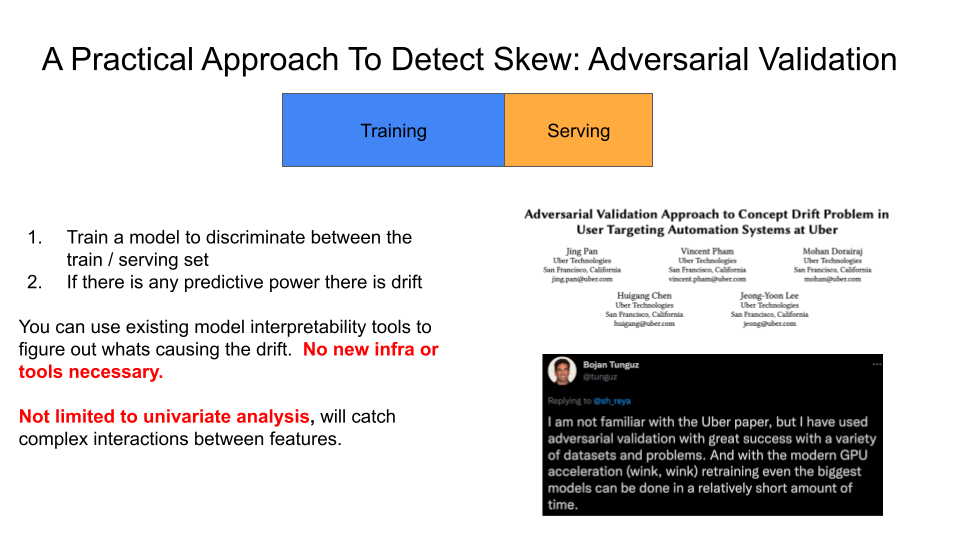
MLOps ツールに関する私の講演からのスライドが、敵対的検証 (Adversarial Validation) の背後にある技術を説明しています:
スライド
プロセスは以下の通りです:
比較する 2 つのデータセットを収集します。例としては以下があります:
異なるファインチューニング実行からのトレーニングデータ
トレーニングデータと評価データの対比
トレーニングデータと本番データ(同じ形式に整理したもの)の対比
異なる期間からのデータ
データセット#1 にラベル0を、データセット#2 にラベル1を付与します。
バイナリ分類器(ランダムフォレスト、ロジスティック回帰など)を学習させて、両データセットの区別を行います。
もし分類器が十分な予測力(例:AUC >= 0.60)を示す場合、ドリフトが存在することがわかります。
解釈可能なモデル(ロジスティック回帰、ランダムフォレストなど)を使用した場合は、特徴量重要度指標を確認してドリフトの根本原因を把握できます。より複雑なモデル(ニューラルネットワークなど)を使用する場合は、SHAP 値や他の手法を用いて、何がドリフトを引き起こしているかを理解できます。まずは単純で解釈可能なモデルから始めることをお勧めします。
警告
このプロセスでドリフトが検出されなかったとしても、ドリフトが存在しないわけではありません。単に、使用したモデルと特徴量では検出できなかったという意味です。
最小限の例:ft_drift
私は OpenAI API を用いてモデルのファインチューニングを行う多くの人々と仕事をしています。私は2つのマルチターンチャット形式の JSONL ファイル間のドリフトを検出する小さな CLI ツール「ft_drift」を作成しました。現在、ft_drift はプロンプトテンプレート、スキーマ、および他のトークンベースのドリフト(セマンティックドリフトとは対照的)のみを検出します。しかし、これは敵対的検証の一般的な概念を理解するための良い出発点となります。このツールの動作デモは以下の通りです:
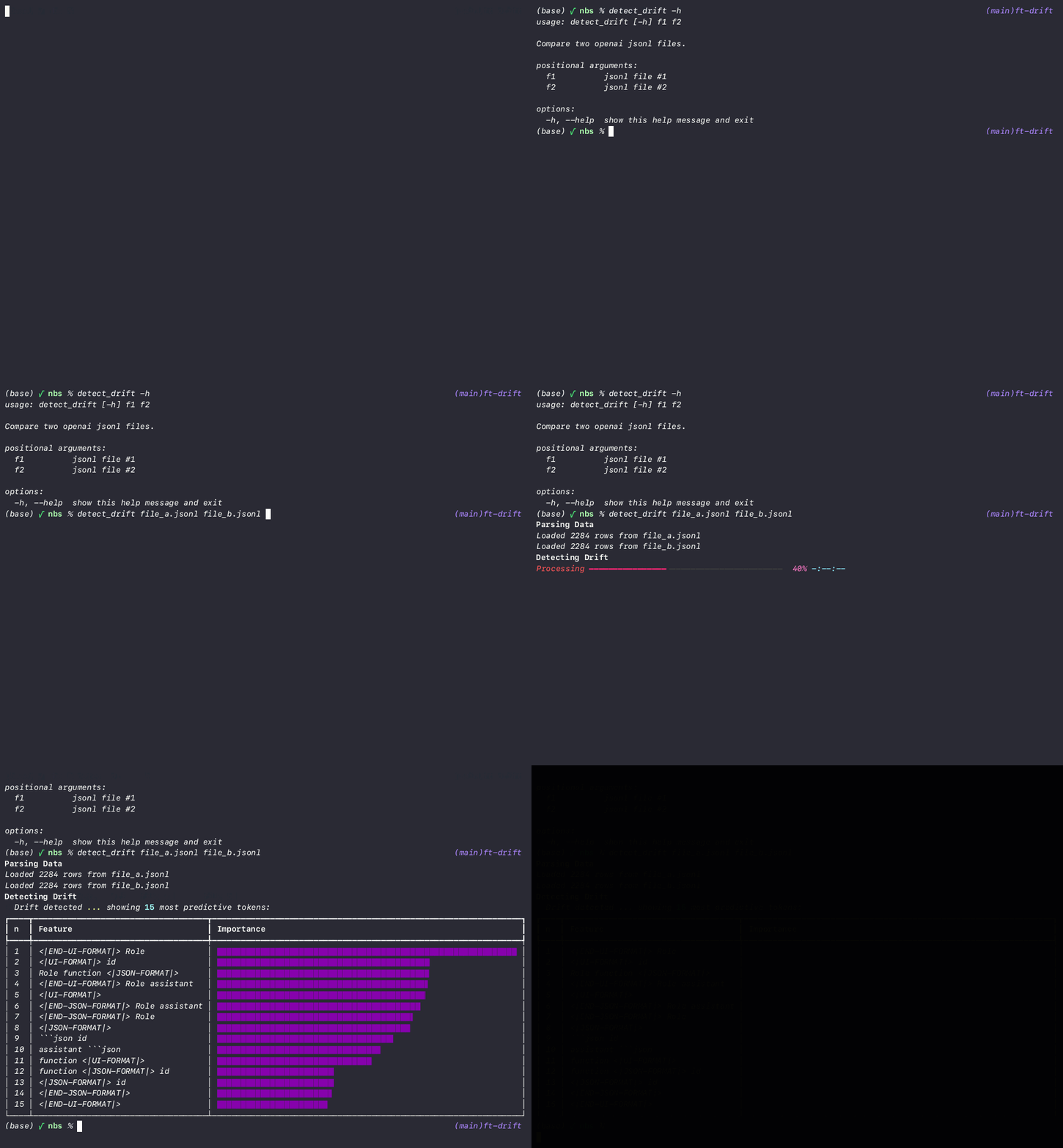
このデモは、プロンプトテンプレートにおける意図しない変更がモデルの予期せぬ動作を引き起こした実際の事例からのものです。このデモでは、ツールが file_a.jsonl と file_b.jsonl という 2 つのデータセット間の差異を検出している様子を示しています。その後、END-UI-FORMAT や UI-FORMAT など、ドリフトの原因となっている重要なトークン一覧が表示されます。私たちはこのツールを適用して問題の根本原因を迅速に特定することができました。モデル化コードは ft_drift/model.py にあり、非常にシンプルです。重要なのは、始めるために高度な技術が必要ないということです。その後、特徴量に埋め込みを追加することで意味的なドリフトも検出できるようにアプローチを拡張できます。同様に、会話のターン数やメッセージの長さなど、手動で追加の特徴量を導入することも可能です。
脚注
私はこの手法について 2016 年に Zygmunt Zając のブログ記事を通じて初めて学びました。長年の間、この手法はさまざまな文脈で使用されているのを見てきましたが、時には異なる名称で呼ばれています。↩︎
このスライドでは「skew」という言葉を使用していますが、この文脈では「drift」と言い換え可能です。↩︎
古典的な機械学習の場合、すでにこのデータでモデルをトレーニングしているなら、再利用できる特徴量エンジニアリングパイプラインを持っているはずです。↩︎
原文を表示
For years, I’ve relied on a straightforward method to identify sudden changes in model inputs or training data, known as “drift.” This method, Adversarial Validation1, is both simple and effective. The best part? It requires no complex tools or infrastructure.
Examples where drift can cause bugs in your AI:
Your data for evaluations are materially different from the inputs your model receives in production, causing your evaluations to be misleading.
Updates to prompts, functions, RAG, and similar elements aren’t incorporated into your fine-tuning or training data, leading to unexpected model behavior in production.
No matter how careful you are, bugs can still slip through the cracks. A a high ROI activity is to routinely audit all your AI/ML projects for drift.
How It Works
Uncool Warning
This method is so simple that it might seem uncool. You aren’t going to impress any data scientists. Despite this, it’s too valuable to ignore.
This slide from my talk on MLOps tools explains the technique behind Adversarial Validation2:
Slide
The process is as follows:
Collect two datasets to compare. For example:
Training data from two different fine-tuning runs
Training data vs. evaluation data
Training data vs. production data (organized into the same format)
Data from two different time-periods
Create features from the dataset. A basic example that creates features from tokens is illustrated here.3
Give dataset #1 a label of 0 and dataset #2 a label of 1.
Fit a binary classifier (random forest, logistic regression, etc) to discriminate between the two datasets.
If the classifier demonstrates sufficient predictive power (ex: AUC >=0.60), we know there is drift.
If you used an interpretable model (like logistic regression, random forest, etc.), you can inspect feature importance metrics to understand the root cause of the drift. If you use a more complex model (like a neural network), you can use SHAP values or other methods to understand what is causing the drift. I recommend starting with a simple interpretable model.
Warning
If this process doesn’t detect drift, it doesn’t mean there isn’t drift. It just means that we couldn’t detect it with the model and features we used.
Minimal Example: ft_drift
I work with lots of folks who are fine-tuning models using the OpenAI API. I’ve created a small CLI tool, ft_drift, that detects drift between two multi-turn chat formatted jsonl files. Currently, ft_drift only detects drift in prompt templates, schemas and other token-based drift (as opposed to semantic drift). However, this is a good starting point to understand the general concept of adversarial validation. Here is a demo of this tool at work:
The demo is from a real-world example where an unintentional change in a prompt template caused unexpected behavior in a model. The demo shows the tool detecting a difference between two datasets, file_a.jsonl and file_b.jsonl. Afterward, a table of important tokens that account for the drift are shown, such as END-UI-FORMAT, UI-FORMAT, etc. We were able to apply the tool and quickly find the root cause of the issue. The modeling code is embarrassingly simple and located at ft_drift/model.py. The point is you don’t need sophisticated techniques to get started. You can then take this approach further by adding embeddings to your features to also detect semantic drift. Similarly, you could add additional features by hand like the number of conversation turns, length of messages, etc.
Footnotes
I first learned of this technique in 2016 from this blog post by Zygmunt Zając. Throughout the years, I’ve seen this technique used in a variety of contexts, sometimes with different names.↩︎
This slide uses the word “skew” which is interchangeable with “drift” in this context.↩︎
For classic ML, if you are already training a model on this data, you likely have a feature engineering pipeline that you can reuse.↩︎
関連記事
今日のまとめ
AIデイリーブリーフで今日の重要ニュースをまとめ読み