Deep Agents、LangChain、LangGraphの役割と使い分けを解説
本文の状態
日本語全文を表示中
詳細モードで約14分の本文を読めます。
同じ出来事の情報源
この情報源を基点に整理
LangChain Blog
LangChain は Deep Agents、LangChain、LangGraph の 3 つのレイヤーからなるオープンソースエージェントスタックを定義し、各層が提供する制御性と抽象化レベルの違いを解説して使い分け方を提示した。
Continue in AI NEW LAB
このニュースを、実務の判断につなげる
AI NEW LABで、試したことや先に確認したい条件を共有できます。まずはログインなしで読めます。
AI NEW LABで論点を見るAI深層分析を開く2026年8月7日 03:17
AI深層分析
キーポイント
3 レイヤー構成の明確化
Deep Agents はエージェントハネス、LangChain はフレームワーク、LangGraph はランタイムとして位置づけられ、それぞれが異なる役割と制御レベルを提供する。
統一された設計哲学
3 つのレイヤーは同じ哲学に基づいて構築されており、開発者がモデル選択、コンテキスト管理、実行ハネスのすべてを完全に支配できることを目指している。
Deep Agents の機能特性
Deep Agents はすぐに使えるエージェントハネスであり、ファイルシステムやサブエージェント、スキルといったベストプラクティスを標準で提供してコンテキストエンジニアリングを支援する。
レイヤー間の可換性
3 つのレイヤーはすべて完全に組み合わせ可能であり、開発者は特定の 1 つに縛られることなく、必要に応じて層間を移動したり組み合わせたりできる。
Deep Agents の主要コンポーネント
ファイルシステム、サブエージェント、スキル、メモリといった機能により、コンテキストウィンドウの制限を克服し、専門的な作業や継続的な学習を実現する。
重要な引用
Deep Agents, LangChain, and LangGraph are the three layers of our open source agent stack
LangGraph is an agent runtime, LangChain is an agent framework, and Deep Agents is an agent harness.
All three are fully composable, so you can move between layers instead of picking one.
One of the benefits of using Deep Agents is that you can trust us to constantly be surveying the landscape and bringing best practices here.
編集コメントを表示
編集コメント
LangChain は自社の製品群を単なるツールの羅列ではなく、階層的なスタックとして再定義した。開発者がエージェントのどの部分を制御したいかによってツールを選べるようになり、学習コストと実装の柔軟性のバランスが改善されるだろう。
Source Article
元記事を日本語で読む
本文に関係しない購読案内、埋め込み通知、サイト内プロモーションは除いています。
Deep Agents、LangChain、そして LangGraph は、それぞれエージェント構築において異なるアプローチを提供します。この記事では、これらオープンソースフレームワークの主な違いと、それぞれのケースでどちらを選ぶべきかについて解説します。
Deep Agents、LangChain、LangGraph は、私たちのオープンソースなエージェントスタックを構成する 3 つのレイヤーです。これらはすべて「ビルダーが自らのエージェントのあらゆる部分をコントロールできる」という共通の哲学に基づいて構築されています。具体的には、使用するモデル、モデルが参照するコンテキスト、そしてそれを実行するハッチ(実行環境)まで、すべてを自分で管理できるように設計されています。
各レイヤーは異なる役割を持ち、提供される制御権限の範囲も異なります。LangGraph はエージェントランタイム、LangChain はエージェントフレームワーク、そして Deep Agents はエージェントハッチです。ランタイムは最も高い制御性と最小限の抽象化を提供し、逆にハッチはその逆のアプローチをとります。これら 3 つはすべて完全にコンポーザブル(組み合わせ可能)であり、特定のレイヤーに固定されることなく、必要に応じて層間を自由に移動できます。
各レイヤーが提供するもの
Deep Agents は、そのまま使えるエージェントハッチです。エージェントハッチの役割は、文脈工学(context engineering)を通じて、適切なタイミングでモデルに必要なコンテキストを提供することにあります。Deep Agents には、この目的のために標準で用意されたベストプラクティスが多数含まれています。具体的には以下のような機能があります:
__FENCE_0__
Deep Agents には、LLM のコンテキストウィンドウに直接含めたくない場合に、コンテキストの読み書きを行うための ファイルシステム や、メインのコンテキストウィンドウを肥大化させずに専門的な作業を行える サブエージェント、エージェントが必要に応じて読み込めるよう指示やスクリプトを提供する スキル、そして実行ごとに学習・改善できるための メモリ などが標準で用意されています。
これら以外にも、多くの機能がデフォルトで同梱されています。これらは当チームが絶えず見直し、更新しているコンテキスト管理のベストプラクティスに基づくものです。Deep Agents を利用する利点の一つは、私たちが常に状況を把握し、最新のベストプラクティスをここに反映させていることを信頼できることです。
`create_deep_agent:` を使うと、すぐに使い始めることができます。
__FENCE_0__
LangChain はエージェントフレームワークです。これは抽象化と統合のレイヤーであり、超最小限のエージェントハッチを同梱しています。Deep Agents がコンテキスト管理に関するベストプラクティスを提供する一方で、LangChain のエージェント抽象化は極めてミニマルで、特定の意見(オピニオン)を持たない設計となっています。
コアとなるエージェント抽象化は非常にシンプルです。ループ内で動作し、ツールを呼び出す LLM です。

)
このループは非常にシンプルですが、その分強力です。ただし、状況によってはこのループを修正したい場合もあるでしょう。通常、文脈が限界に近づいた際の要約や、最終段階での検証実行など、より決定論的なステップを追加するために修正が行われます。
LangChain エージェントの最も強力な点の一つは、こうした修正を容易に行える仕組みです。LangChain の ミドルウェア は、ループを多様な方法で変更できるフックのセットを提供します。
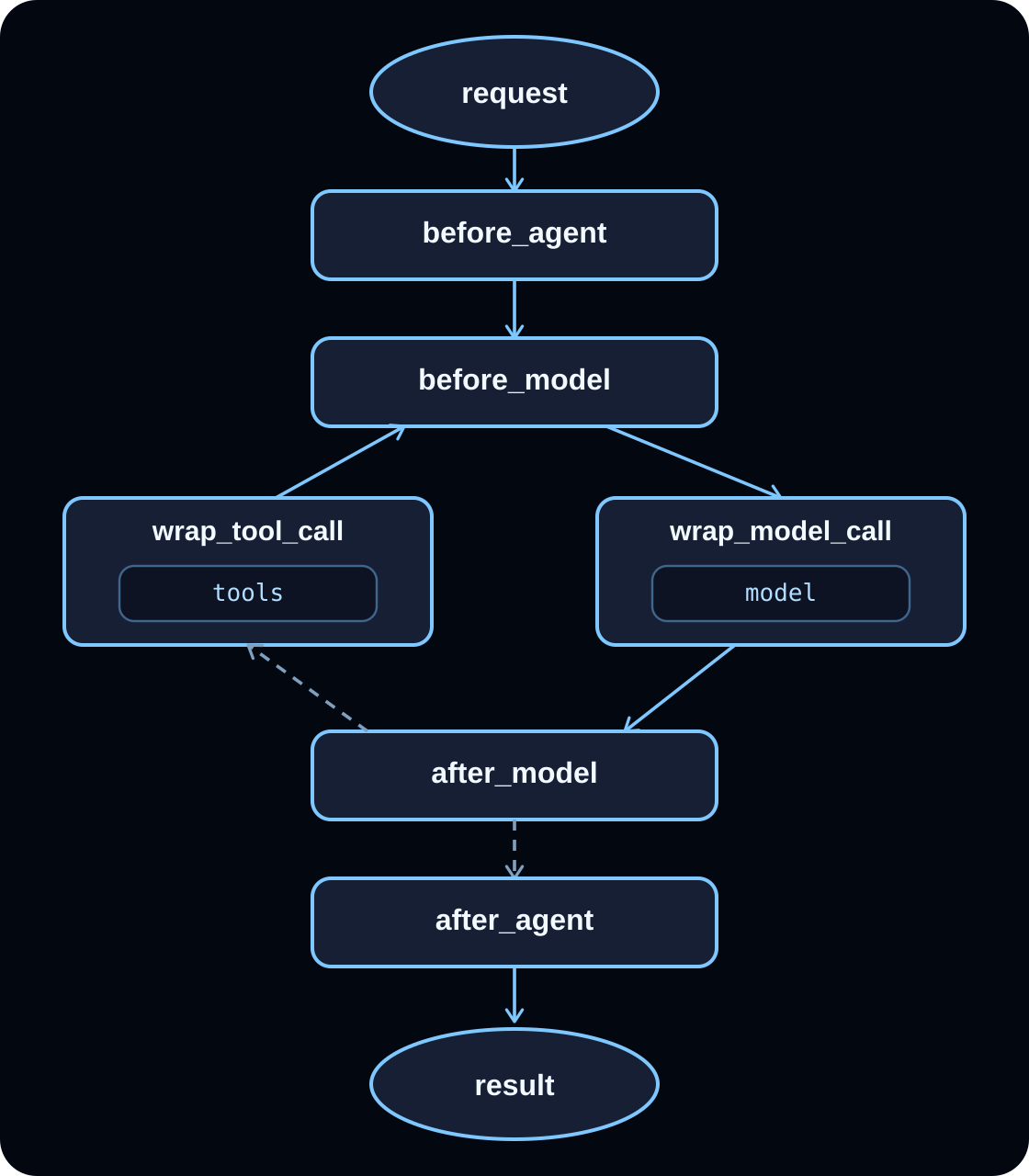
豆知識:Deep Agents は、コアとなる LangChain エージェントに 多数のミドルウェア を追加したものに過ぎません!
シンプルな `create_agent` 抽象化機能を使えば、LangChain エージェントをすぐに利用できます。
__FENCE_1__
LangGraph はエージェントのランタイムです。人間がループに参加できる human-in-the-loop、フォールトトレランス、そして各ステップでの観測性を備えた耐久性のあるエンジンによって支えられた、グラフベースのフレームワークです。エージェントを「グラフ」として捉えることの利点は、より多くの決定論的な要素を組み込み、発生するステップをより細かく制御できる点にあります。
Deep Agents は、LangChain と Deep Agents の両方でエージェントの抽象化(上記のグラフ表示)を実現する基盤です。
どちらを使うべきか
一般的な指針 まずは Deep Agents から始めましょう。これはあらゆる機能を備えた強力なエージェントハーンスです。複雑なワークフローをモデル化する必要がある場合や、すべてのステップを完全に制御したい場合は、LangChain と LangGraph を使いましょう。
Deep Agents
すぐに使える高性能なエージェントが必要なら、Deep Agents が最適です。多くのビルダーはここから始めるべきで、ハーンス自体に対するより細やかな制御が必要な場合にのみ、さらに下位のレイヤーへ降りていきます。
例えば GTM(Go-To-Market)エージェントを構築する場合を考えましょう。このエージェントには、営業担当ごとのメモリ機能(メールのスタイル設定や関係性の理解など)、QBR 準備のような反復ワークフロー用のスキル、および通話記録、ニュース、CRM の履歴にわたるアカウントの詳細調査を行うサブエージェントが必要です。
これは単なるお遊びの例ではありません。私たちは実際に GTM エージェントを `deepagents` で構築しました。現在、このエージェントは週に約 1 万リクエストという大量のトラフィックを処理しており、アクティブなユーザー数は 150 名を超えています。トラフィックの 26% はユーザーが手動で開始したもので、残りの 74% は背景で動作する自動的なエージェント作業によって発生しています。このデプロイには LangSmith のデプロイ機能 を利用しており、バースト性の高いトラフィックとスケジュール実行・イベントトリガー型の背景処理の両方をサポートしています。
LangChain
独自のハーンを構築するコアとなる部品が必要、あるいは独自に組み立てる計画がある場合、LangChain を選択しましょう。LangChain の統合機能と抽象化は、カスタムグラフ内でも create_agent や create_deep_agent を利用する場合でも、あらゆるレベルで役立ちます。また、各ステップでモデルに提供されるツールやコンテキストを細かく制御したい場合にも適しています。特に超低遅延が求められるアプリケーションでは、こうした細かい制御が必要になることが多いです。
例えば、RAG 機能を持つドキュメント Q&A ボットを構築する場合を考えましょう。ユーザーからの質問に対して、エージェントはベクトルストアを検索して関連ページを探します。このエージェントのループが、満足できる回答に到達したかどうかを判断し、クエリが完了するまでボットを制御します。このようなタイプのエージェントには、サブエージェントによる委任やファイルシステムによるコンテキスト管理は不要です。LangChain の統合機能を使えば、任意のベクトルストアをツールとして接続でき、好きなモデルを選択できます。さらに create_agent によって、これらを結びつけるループを提供してくれます。
LangGraph
標準的なループに収まらないエージェントや、同じワークフロー内で決定論的なステップとエージェントによる処理を組み合わせる必要がある場合に、LangGraph を使いましょう。
例えば、賃貸申請の処理パイプラインを構築する場合を考えます。このプロセスにはいくつかのステップがあります:
- 各申請から収入、信用情報、賃貸履歴を抽出する
- 家主が設定した基準に基づいてスコアリングを行う
- 明確な条件を満たす申請は自動承認し、明らかに不合格のものは却下し、境界線上のケースは人間にエスカレートする
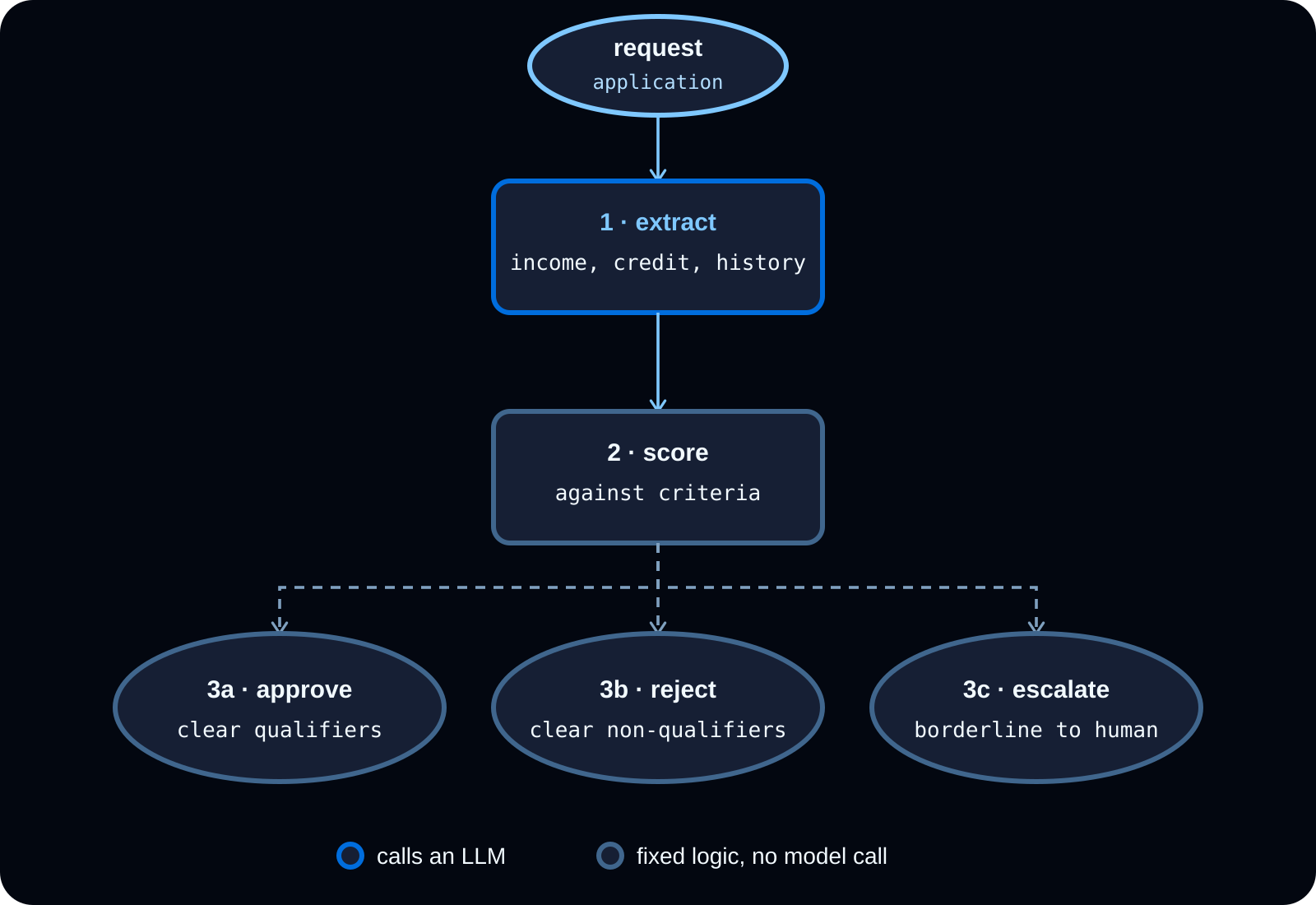
このワークフローでは、LLM に触れるのは 1 つ目のステップのみで、残りの工程は固定されたコードによって処理されます。この仕組みは LLM の能力を活用して文書から情報を抽出しますが、モデルが実際に行動を起こすためのツールは提供されていません。つまり、これは比較的決定論的なパイプラインです。
すでに LangGraph を使っている場合、その価値がグラフの構造と決定論的なステップにあるなら、そのまま使い続けるべきです。一方、LangGraph のフローが高度に自律的(アジェンティック)であるなら、Deep Agents への移行によって恩恵を受けられる可能性があります。
3 つの共通点
これら 3 つはすべてコンポーザブルです。create_agent または create_deep_agent をより大きな LangGraph ワークフローに組み込むか、カスタムの LangGraph ワークフローをそのまま取り込んで利用できます。
create_agent または create_deep_agent の内部で動作するサブエージェント。
どのようなパッケージで構築しても、LangSmith デプロイメント を利用してデプロイし、LangSmith 観測機能 で監視することが可能です。
決定性と自律性のバランス
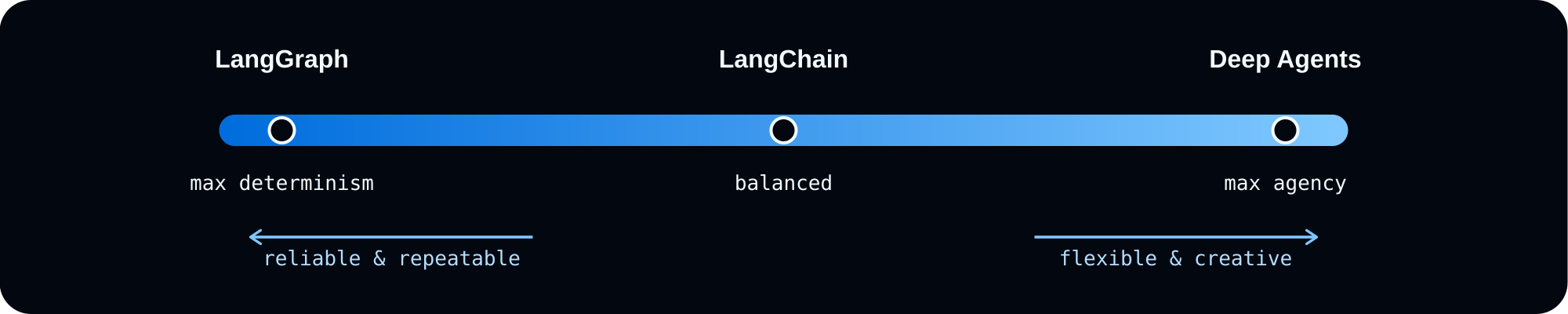
エージェントに与える自律性が高まれば、その潜在的な価値も増大しますが、その代償として信頼性が低下します。機密性の高いワークフローや事前設定されたプロセス、あるいは自律的な処理を必要としない反復タスクにおいては、決定性を重視するアプローチがより適切です。一方、エージェントの動的な性質が強まれば、その能力や創造性も高まります。
これらのトレードオフを実際の現場でどう扱っているかについては、チームがリアルなエージェントシステムをどのように設計・展開し、改善を重ねているかを掘り下げるポッドキャスト「Max Agency」Max Agency をぜひお聴きください。
この 3 つのレイヤーは、上記のスペクトラム上で異なる位置を占めています。LangGraph は決定性を最大化するアプローチです。ドメイン知識をモデルに委ねるのではなく、グラフのトポロジー(構造)そのものに直接組み込むことで制御します。LangChain は中間的な位置にあります。コアとなるエージェントループは本質的に非決定的であり、各ステップで何が起こるかを決めるのはモデル自身です。一方、Deep Agents は自律性を最大化するアプローチです。要約機能やサブエージェントといった内蔵機能を備えることで、より長い時間実行され、大規模に展開・分岐することのできるエージェントループを実現します。
最高のエージェントを構築するチームとの深い対話については、ポッドキャスト「Max Agency」**Max Agency** をぜひお聴きください。
多くのエージェントはコアループを基盤として動作しますが、承認ステップやコンプライアンスチェック、モデルに任せるべきではないビジネスルールなど、いくつかの決定的な手順を組み込む必要があります。ミドルウェアはこの課題を解決し、Deep Agents や LangChain において、コアループの周りにこれらの手順や人間が関与する瞬間を注入することを可能にします。
これらの組み込みフックを通じてミドルウェアが提供する以上の柔軟性や制御が必要であれば、LangGraph がその役割を果たします。これは完全にカスタムグラフを構築できる出口であり、上記の「ファンアウト&シンセサイズ」のような例のように、ワークフロー固有のロジックをグラフの形状に直接埋め込むことができます。
3 つのレイヤーが必要な理由
LangChain は 2022 年 10 月に、LLM アプリケーションを最速で立ち上げる手段として登場しました。エージェントが複雑化するにつれ、チェーンでは不十分な制御が必要となり、私たちは 2024 年 1 月に LangGraph を導入しました。これは、人間が関与する機能やストリーミング、永続的な実行といった機能を第一級プリミティブとして備えたグラフベースのランタイムです。
モデルの性能向上に伴い、計画を立ててツールを呼び出し、結果に応じて反応するコアエージェントループは、標準化できるほど強力になりました。これを受け、create_agent は LangChain の最小限のハネスとして定義されました。これは、生産環境のエージェントに必要な人間関与や観測性、フォールトトレランスなどの機能を備えた LangGraph を基盤に構築されています。
そして 2025 年 7 月、同じコアループを基盤としつつ、前述の機能(コンテキスト管理やサブエージェントなど)がデフォルトでバンドルされた「Deep Agents」へと一歩踏み出しました。Claude Code や Manus に着想を得て、開発者も自らのユースケースに同等のパワーを持つエージェントが必要だと感じていると考えた私たちは、汎用性の高いハネスとして deepagents を構築しました。
TL;DR
エージェントを新規構築するか既存のものを再設計する場合は、まず Deep Agents の `create_deep_agent` から始めてください。社内の GTM(市場投入)、コーディング、ドキュメント作成など、すべての内部エージェントでこれを使用しています。
組み込みのコンテキスト管理を減らし、エージェントループに対してより細かな制御を行いたい場合は、LangChain の `create_agent` を選択してください。
カスタムワークフローにおいてさらに高い制御性や決定性を求める場合は、LangGraph を活用しましょう。
謝辞
thoughtful なレビューを寄せてくれた Harrison Chase、Hunter Lovell、Morgan Curtis、そして Sean Roche に感謝します!
関連記事
Deep Agents
Open Source
Agent Architecture
Deep Agents v0.7

Sydney Runkle
2026 年 7 月 29 日
6 分

エージェントアーキテクチャ
LangChain のエージェントファーストデータスタックの構築方法

Emily Hawkins
2026 年 7 月 27 日
14 分

オープンソース
観測性と評価
Deep Agents のベンチマーク手法


N. Hollon,
H. Chase
2026 年 7 月 23 日
4 分
エージェントの本当の動作を確認する
エージェントエンジニアリングプラットフォーム「LangSmith」を使えば、開発者はすべてのエージェント判断をデバッグし、変更の評価を行い、ワンクリックでデプロイできます。
原文を表示
Deep Agents, LangChain, and LangGraph each offer distinct approaches to building agents. In this post, we cover the key distinctions between our open source frameworks and when you should reach for each one.
Deep Agents, LangChain, and LangGraph are the three layers of our open source agent stack, built on the same philosophy: builders should be able to own every part of their agent: the model they choose, the context it sees, and the harness that runs it.
Each layer plays a different role and offers a different amount of control. LangGraph is an agent runtime, LangChain is an agent framework, and Deep Agents is an agent harness. The runtime offers the most control and the least abstraction; the harness offers the inverse. All three are fully composable, so you can move between layers instead of picking one.
What each layer offers
Deep Agents is an off-the-shelf agent harness: The job of an agent harness is to get the right context to the model at the right time via context engineering. Deep Agents comes with a bunch of best practices for this out of the box. These include:
- A filesystem, used to read and write context from (when you don’t want it directly in the context window of an LLM)
- Subagents, useful for doing specialized work without bloating the main context window
- Skills, so you can provide instructions and scripts that an agent can load on demand
- Memory, so the agent can learn and improve across runs
There are many other pieces it ships with by default. These are opinionated context management best practices that our team constantly reviews and updates. One of the benefits of using Deep Agents is that you can trust us to *constantly* be surveying the landscape and bringing best practices here.
Getting started is simple with create_deep_agent:
from deepagents import create_deep_agent
agent = create_deep_agent(
model="anthropic:claude-sonnet-5",
tools=[web_search],
system_prompt="you are a research agent...",
skills path with citation-format, source-eval
skills=["./skills/"],
)
LangChain is the agent framework: the abstraction and integrations layer. It ships with a super minimal agent harness. Whereas Deep Agents ships with best practices around context management, the LangChain agent abstraction is incredibly minimal and un-opinionated.
The core agent abstraction is pretty simple: an LLM, running in a loop, calling tools.
This loop is incredibly simple, yet super powerful. There may, however, be times where you want to modify that loop. Usually this modifications are done to add more deterministic steps - like summarizing when context is close to full, or running a verifier at the end. One of the most powerful parts of LangChain’s agents is how we let you add these modifications. LangChain middleware provides a set of hooks that can modify this loop in variety of ways.
Fun fact: Deep Agents is actually just the core LangChain agent plus a bunch of middleware!
You can use LangChain agents with the simple create_agent abstraction:
from langchain.agents import create_agent
agent = create_agent(
model="anthropic:claude-sonnet-5",
tools=[send_email],
prompt="you are my email assistant...",
middleware=[...]
)
LangGraph is the agent runtime: a graph-based framework for custom agent workflows, backed by a durable engine with human-in-the-loop, fault tolerance, and observability at every step. One of the benefits of thinking of agents as graphs is that you can encode more determinism into them, and more closely control the steps that occur.
LangGraph powers the agent abstractions (seen above, displayed as graphs) in both LangChain and Deep Agents.
When to reach for each
Rule of thumbStart with Deep Agents. It’s a very powerful agent harness with all of the bells and whistles included. When you need to model a complex workflow or want complete control of every step, reach for LangChain and LangGraph.
Deep Agents
Reach for Deep Agents when you want a capable agent out of the box. This is where most builders should start, dropping down only if you need more control over the harness itself.
Say you're building a GTM agent. It needs memory per rep (with things like email style preferences and relationship understanding), skills for recurring workflows like QBR prep, and subagents to do deep research an account across call transcripts, news, and CRM history.
This isn’t just a toy example: we built our GTM agent on deepagents! It currently sees heavy traffic, almost 10k requests per week, and over 150 active users. 26% of the traffic is user initiated, and the remaining 74% is driven by ambient agent work. We deploy it with LangSmith deployments, which supports both the bursty traffic and the scheduled/event-triggered ambient runs.
LangChain
Reach for LangChain when you want the core building blocks and/or plan to assemble your own bespoke harness on top. LangChain's integrations and abstractions can be useful at any level: in custom graphs, with create_agent, and with create_deep_agent. It's a good fit too when you want fine-grained control over which tools and context reach the model at each step, ultra latency-sensitive apps often want this.
Say you're building a RAG docs Q&A bot: given a question, the agent searches your vector store for relevant pages. The agent loop governs whether or not a satisfactory answer has been reached, and drives the bot until the query is complete. This type of agent doesn’t need delegation via subagents or context management via a filesystem. LangChain's integrations let you plug in any vector store as a tool and pick whichever model you want, and create_agent gives you the loop that ties them together.
LangGraph
Reach for LangGraph when your agent doesn't fit a standard loop, or you need to mix deterministic and agentic steps in the same workflow.
Say you're building a rental application processing pipeline. It has a few steps:
- Extract income, credit, and rental history from each application
- Score it against the landlord's criteria
- Auto-approve clear qualifiers, reject clear non-qualifiers, or escalate borderline cases to a human.
Only step 1 touches an LLM, the rest is fixed code. This workflow uses the power of LLMs to extract information from documents, but it doesn't give the model any tools with which it can take action. It's a relatively deterministic pipeline.
Already on LangGraph? Stay if the value is in the graph's shape and its deterministic steps. If your LangGraph flow is highly agentic, you could benefit from a migration to Deep Agents.
All Three
All three are composable: drop create_agent or create_deep_agent into a larger LangGraph workflow, or drop a custom LangGraph workflow in as a subagent inside create_agent or create_deep_agent.
No matter which package you build with, you can deploy with LangSmith deployments and observe with LangSmith observability.
Balancing determinism and agency
More autonomy gives an agent more potential value, at the cost of reliability. Determinism is the better call for sensitive or preset workflows, and for repeatable tasks that don't need to be agentic at all. The more dynamic an agent is, the more capable and creative it can be. For more examples of these tradeoffs in production, listen to Max Agency, our podcast on how teams design, deploy, and iterate on real agent systems.
The three layers sit at different points on that spectrum. LangGraph offers maximal determinism: it lets you encode domain knowledge directly into the graph's topology instead of leaving that judgment to a model. LangChain sits in the middle: the core agent loop is inherently non-deterministic, the model decides what happens next at every step. Deep Agents offers maximal agency: an agent loop that can run for longer and fan out at scale because of builtin features like summarization and subagents.
For deeper conversations with teams building the best agents, listen to our podcast, Max Agency.
Many agents run on the core agent loop but still need a few deterministic steps built in: an approval step, a compliance check, a business rule that shouldn't be left to the model. Middleware solves this for Deep Agents and LangChain, letting you inject these steps and human-in-the-loop moments around the core loop.
If you need more flexibility or control than middleware offers through these builtin hooks, LangGraph is the escape hatch that lets you build a completely custom graph, encoding your workflow's specific logic directly into its shape, like the fan-out-and-synthesize example above.
Why three layers
LangChain launched in October 2022 as the fastest way to get an LLM app running. As agents got more complex, people needed more control than a chain could give them, so we introduced LangGraph in January 2024: a graph-based runtime with durable execution, streaming, and human-in-the-loop built in as first class primitives.
As models got better, the core agent loop, a model that plans, calls tools, and reacts to results, became powerful enough to standardize. create_agent became LangChain's minimal harness, which we built on top of LangGraph because production agents need its primitives (human-in-the-loop, observability, fault tolerance, etc).
Then in July 2025 we went a layer further with Deep Agents, built on the same core loop, but with the aforementioned components (context management, subagents, etc.) bundled by default. Inspired by Claude Code and Manus, we bet builders wanted equally powerful agents for their own use cases, so we built deepagents as a general-purpose harness.
TL;DR
Start with Deep Agents' create_deep_agent if you're building or reworking an agent, it's what we use for all of our internal agents: GTM, coding, docs writing, and more.
Pick up LangChain's create_agent instead when you want less built-in context management and more fine-grained control over your agent loop.
Reach for LangGraph when you need even more control or determinism in a custom workflow.
Acknowledgements
Thanks to Harrison Chase, Hunter Lovell, Morgan Curtis, and Sean Roche for their thoughtful reviews!
Related content
Deep Agents
Open Source
Agent Architecture
Deep Agents v0.7
Sydney Runkle
July 29, 2026
6
min
Agent Architecture
How we built LangChain’s agent-first data stack
Emily Hawkins
July 27, 2026
14
min
Open Source
Observability & Evals
How We Benchmark Deep Agents
N. Hollon,
H. Chase
July 23, 2026
4
min
See what your agent is really doing
LangSmith, our agent engineering platform, helps developers debug every agent decision, eval changes, and deploy in one click.
関連記事
今日のまとめ
AIデイリーブリーフで今日の重要ニュースをまとめ読み