Claude と GPT の知識カットオフと学習期間を調査する手法
本文の状態
日本語全文を表示中
詳細モードで約11分の本文を読めます。
同じ出来事の情報源
この情報源を基点に整理
TLDR AI
TLDR AI は、専門的な問い合わせを通じて最先端モデルの訓練データ構成やパラメータ規模、知識カットオフ時期を推定する「プローブ」手法を紹介し、その不確実性を強調している。
Continue in AI NEW LAB
このニュースを、実務の判断につなげる
AI NEW LABで、試したことや先に確認したい条件を共有できます。まずはログインなしで読めます。
AI NEW LABで論点を見るAI深層分析を開く2026年8月12日 22:32
AI深層分析
キーポイント
不可知性知識によるパラメータ推定
ニッチな事実に対するスコアリングを通じて、「Incompressible Knowledge Probes」という手法を用いて、GPT-5 や Opus のようなモデルのパラメータ数を近似する。
トークン分解によるデータミックス推測
モデルがトークンをどのように分解するかを測定することで、「Data Mixture Inference」を用いて、訓練に使用されたデータセットの混合比率やトークナイザーの特性を明らかにする。
日付・自己認識質問による訓練期間推定
日付や自己同一性に関する質問への回答スコアを分析することで、モデルの知識カットオフ時期や訓練タイムラインを推測することが可能である。
大規模言語モデルの3段階トレーニング
まず汎用データで事前学習を行い、次にドメイン固有の質の高いデータで基礎能力を強化する。最後にアシスタントとしての人格や推論能力を磨く調整を行う。
事前学習チェックポイントの重要性
計算資源とデータの多くが事前学習段階に投入されるため、このプロセスが最もコストのかかるステップとなる。
重要な引用
We can learn hidden facts about how frontier models were trained by "probing" them with carefully curated requests.
Everything here is an estimate. It's possible that some speculation in this post is totally incorrect given there's not a ton of publicly available ground truth to verify against.
how we train massive large language models has converaged into 3 stages
one of the most expensive and data-intensive steps is generating that pre-training checkpoint
編集コメントを表示
編集コメント
この手法は、企業の公式発表がない状況下で AI モデルの特性を把握するための重要な代替手段となる。ただし、推定結果には誤差が含まれる可能性が高いため、意思決定においては慎重な解釈が求められる。
Source Article
元記事を日本語で読む
本文に関係しない購読案内、埋め込み通知、サイト内プロモーションは除いています。
最先端モデルの訓練プロセスに関する隠された事実を、 carefully curated な問いかけを通じて「プローブ(探査)」することで知ることができます。
- 「圧縮不可能な知識プローブ」 を用いてニッチな事象への回答精度を評価すれば、GPT-5 や Opus といったモデルの推定パラメータ規模を概算できます。
- トークン化の破綻を測定することで、「データミックスチャート推論」 の手法を用いて、モデル(あるいはトークナイザー)訓練に用いられたデータセットの構成比率に関する事実を明らかにできます。
- 日付や自己認識に関する質問への回答精度を評価すれば、訓練期間の推定も可能です(本記事参照)。
ここで示される数値はすべて推定値です。検証可能な公開された正解データが限られているため、本記事内の一部の推測が完全に誤っている可能性もあります。
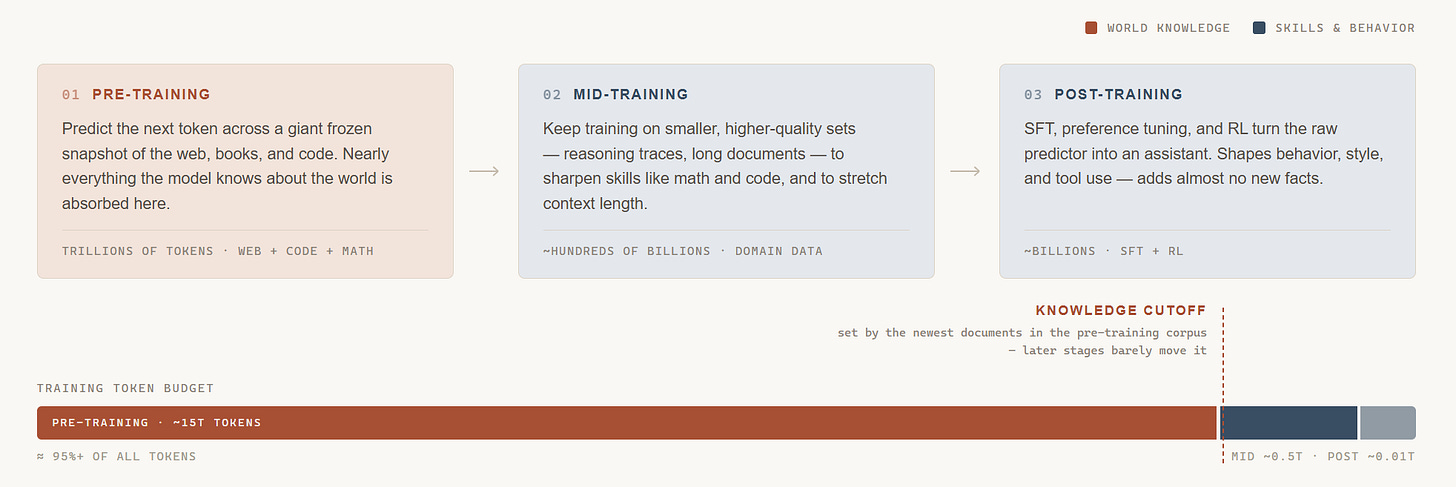
*モデル訓練の 3 つの主要段階。
簡易的な解説として(詳細は Alex Wa のブログ をご参照ください)、大規模言語モデルを訓練する手法はいくつかのステップを経て、現在では 3 つの主要段階に収束しています。
大量の汎用データ(つまりインターネットをスクレイピングしたデータ)を取得し、そのデータ上で大規模な自己完結型モデルを「事前学習」します。
ドメイン固有の「教科書レベル」のデータを用いてベースモデルを改善し、長文理解など特定の基礎能力を拡張します。
そして、このベースモデルを「アシスタント」という人格へと転換させ、その性格、推論能力、ツール呼び出し機能を磨き上げます。
モデルの推論や問題解決能力を高めるために、ポストトレーニングに割く計算資源は増え続けていますが、最もコストがかかり、データ集約度の高い工程は、その事前学習チェックポイント(「チェックポイント」とは、claude-super-secret-2026-11-01-base.cpkt といった巨大なファイルとイメージしてください)を生成するプロセスです。
すべてのラボで運用方法は若干異なりますが、一般的には以下のような工程が見られます(詳細は 44 ページ を参照)。
「事前学習」チームは、数ヶ月にわたる実行を監督してベースチェックポイントを取得することから始めます。これらの事前学習モデルは、必ずしもそうとは限りませんが、リリースされる主要バージョン(GPT-4 → GPT-5 など)と対応することが多いです。
その間、「能力」チームや「事後学習」チームは、最新のベースモデルをさらに改善する方法について実験を行います。事後学習と能力の向上は、しばしばマイナーバージョンとして現れます。これらのチームはまた、単一の事後学習済みモデルを小型化してモデルファミリー(Fable/Opus/Sonnet/Haiku や Sol/Terra/Luna など)へと変換する「蒸留」も行います。ラボによっては、バージョン N+1 のチェックポイントが 100% 完成したバージョン N のチェックポイントよりも x% 優れていると判断され次第、まだ中途半端な事前学習段階のチェックポイントを事後学習済みモデルとしてリリースすることもあります。
一般向けに公開されるモデルは、最新のチェックポイントから最も優れた能力セットと事後学習手法を適用して仕上げられたものです。
この背景を踏まえて、公式 API を通じてモデルをプローブするだけで、このプロセスのどの程度が見えるのか気になりました。
事前学習チェックポイントの日付を推定するため、私はウィキペディアの「その日の事実」からなるデータセット(例:2025 in the United States)を構築し、各モデルに対して特定の日付に何があったかを問う 8 択クイズを出題しました。その後、エラー率の推移を分析することで、モデルが学習データからの信号を失いつつあるおおよその時期を確認できます。
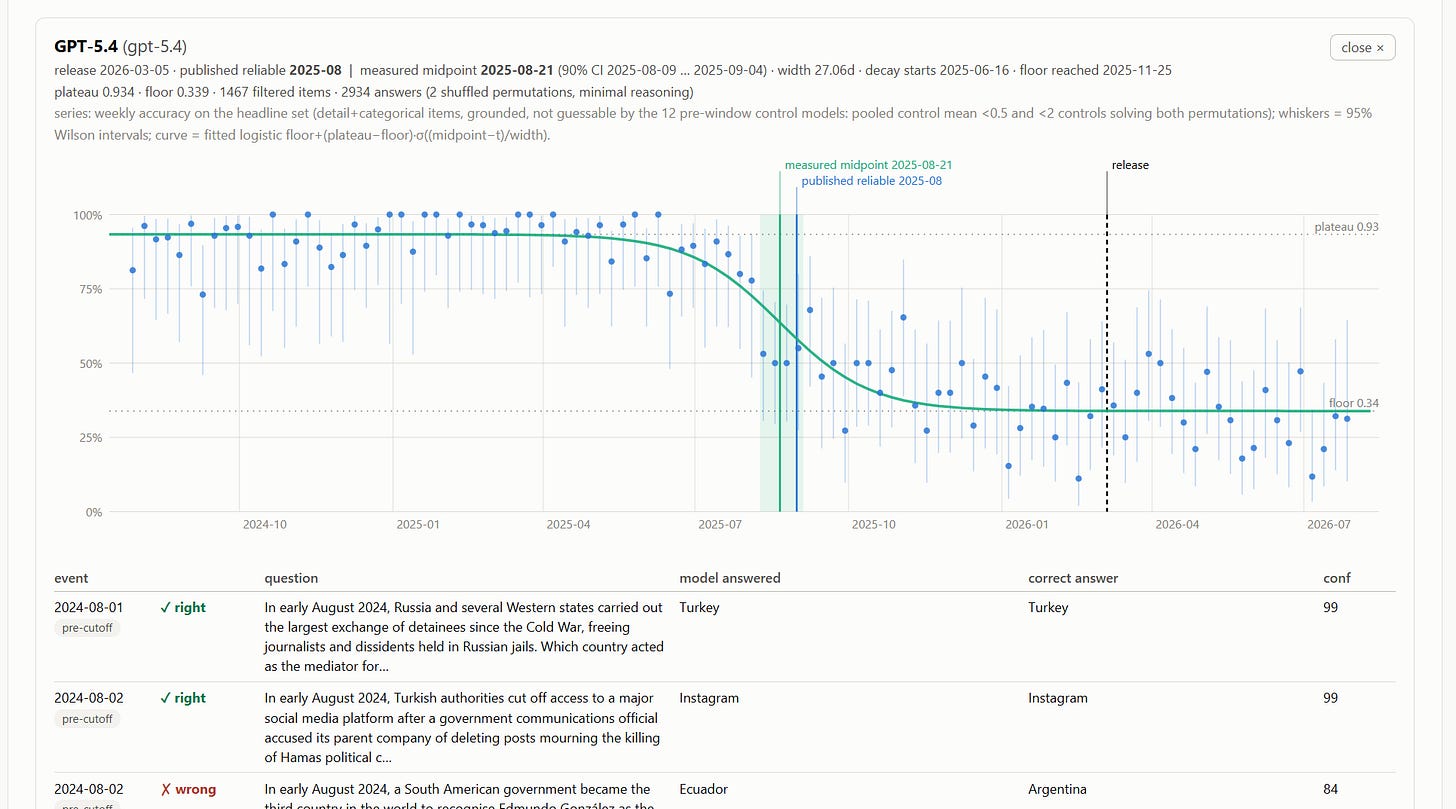
完全なデータセットはこちら をご覧ください。GPT-5.4 の場合、推定された知識のカットオフは OpenAI が公表した日付と一致しています。これは、モデルが将来の出来事やトレーニングデータに含まれる直近のイベントをより正確に予測できるようになったこと、あるいは最近のデータがトレーニング時に過小評価されていることの結果として生じた滑らかな曲線です。そのため、私はこの曲線の始点や終点ではなく、中央値を採用しています。
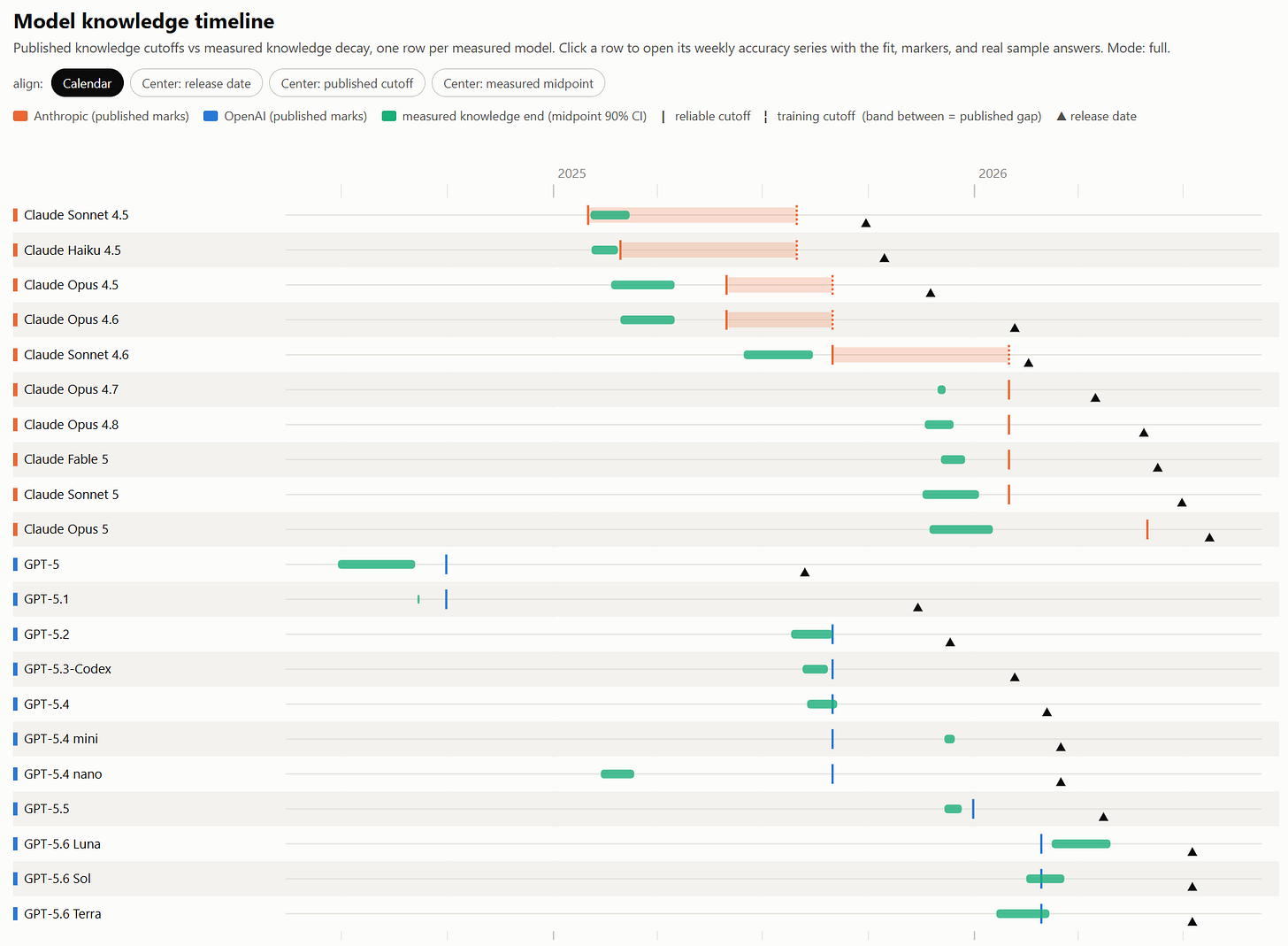
完全なデータセットはこちら をご覧ください。推定された知識のカットオフと公開日を示しています。フルビューアで各モデルの曲線を並べて比較すると、カットオフがいつ発生し、その勾配がどの程度急かどうかがより明確に把握できます。
これらのグラフをしばらく眺めた結果、私は以下のように推測しています:
Anthropic の Opus 4.7 以降のモデルは、すべて同じトレーニングランから生成されており、その知識のカットオフ日は 2025 年 12 月下旬頃です。これは、すべてのモデルが非常に類似した実効的な知識カットオフ(緑色で示されている)を共有していることから導き出された結論です。ここで私が仮定しているのは、事前学習ベースモデルの完成日と使用されるデータセットの時系列範囲には強い相関があるという点です。もしこの仮定が誤っていれば、結果は数ヶ月ずれる可能性があります(例えば実際のカットオフ日が 2026 年 1 月である場合など)。また興味深いことに、Opus 4.7 以降のモデルはすべて、公開されている信頼性が高く総合的な知識カットオフ日において完全に一致しています。これは新しいポストトレーニング技術が採用された結果なのでしょうか。
OpenAI の GPT-5.6 ファミリーは、GPT-5.5 とは異なるチェックポイントから派生しており、その完成日は 2026 年 2 月下旬頃です。これは、以前のモデルとは明確に異なる実効的な知識カットオフを持っていることから判断できます。Luna が未来を予測できるかのように見えるのは、実際には「低い」推論努力において全体的に誤差率が高いため生じたアーティファクトに過ぎません。
Opus 5 は少し特殊です。公開されている信頼性が高く総合的な知識カットオフ日は 2026 年 5 月ですが、実際には以前の 2026 年 1 月カットオフモデルよりも多くの情報を知らないようです。私は、使用したプロービング質問の種類によるアーティファクトではないかを確認するためにいくつかの検証実験を行いましたが、やはりそうではありませんでした。このカットオフは、コーディングパッケージのバージョンに関する記憶にも適用されます。
では、単に「今日は何日ですか?」とモデルに聞いてみるのはどうでしょうか?
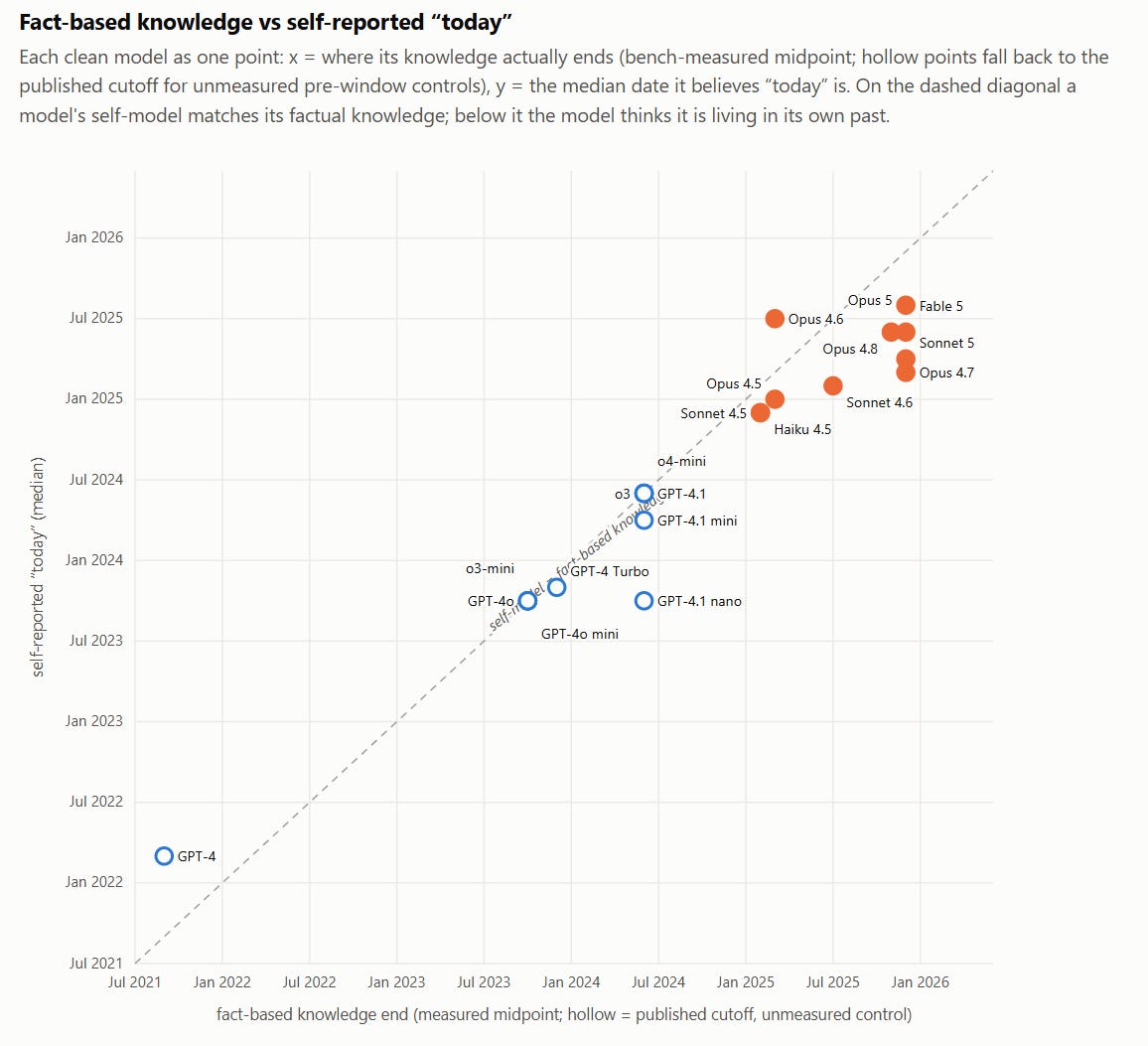
*完全なデータセットはこちら。破線の対角線上では、モデルの自己認識と事実知識が一致しています。その下側では、モデル自身が「過去の自分」の中にいると誤認している状態です。なお、API がすべてのリクエストに実際の日付を注入する機能を備えているため、最新の OpenAI モデルは除外されています(TIL! この機能は 多くの開発者を悩ませています)。
このグラフは事実ベースの推定値とかなり高い相関を示しています。よく見ると、いくつかのモデルファミリー内に縦線が確認できます。
- GPT-4.1 nano → GPT-4.1 mini → GPT-4.1
- Opus 4.7 → Sonnet 5 → Fable/Opus 5
このグラフを X 軸を「事前学習コーパス」、Y 軸を「事後学習後の振る舞い」として解釈すると、これらの縦帯(X は一定で Y が上昇)は、時系列に偏ったデータセットを用いた能動的な事後学習を可視化したものと言えます。一方、より小さなモデルが古い日付を自己報告する原因として考えられるのは、古いバージョンの教師モデルからの知識蒸留(ディストillation)です。
モデルが自分自身をどう認識しているかを分析することで、トレーニングのタイムラインやデータセットについても間接的な予測を立てることができます。事前学習データの中で「私は X である」という記述が多く含まれているほど、外部から問いかけられた際にその答えを繰り返す可能性が高まります。
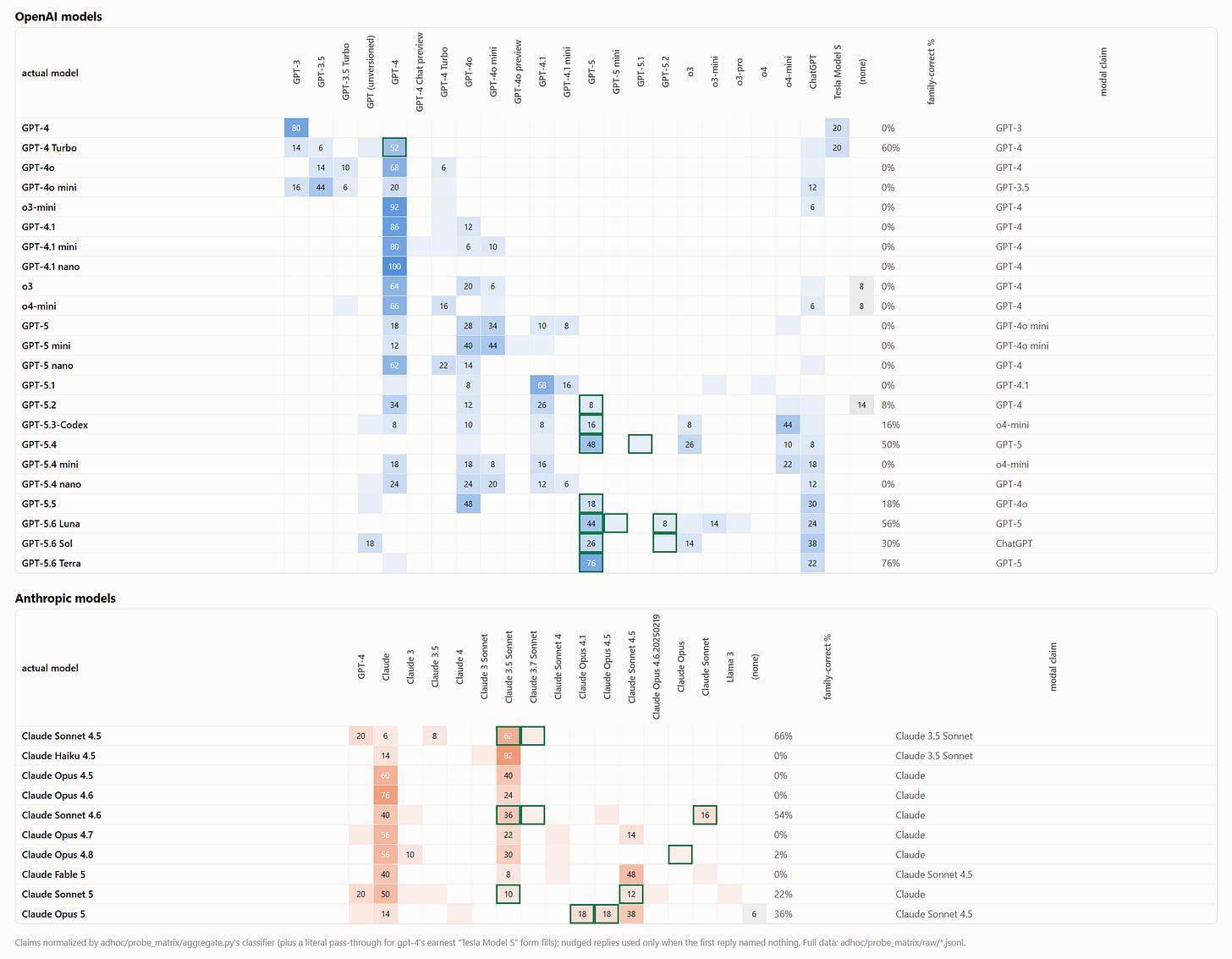
*完全なデータセットはこちら。 各行は実際のモデルを、各列は「あなたはどのモデルですか?」という質問に対する回答から抽出した自己主張するアイデンティティを表しています。このデータは 50 のプロbing(5 つの異なる表現×10 サンプル)に基づいており、推測を促す形でシステムプロンプトなしで実施されました。セルの色濃さは、その名前で答えた割合を示し、緑色の枠線はその主張がモデルの真のファミリーと一致していることを意味します(太い枠線は完全なバージョン名と一致した場合ですが、これは実際に起こりませんでした)。*さらに詳しいビジュアルはこちら。*
これらのチャートをしばらく眺めてみると:
垂直な帯には、過去のモデルの出力(ユーザーからのもの)を学習しているラボの明確なパターンが示されています。OpenAI の場合、GPT-4、GPT-4o、一時的に GPT-4.1、そして GPT-5 と「ChatGPT」が最近のトレンドです。Anthropic においては、3.5 Sonnet の後に、より新しいモデルは Sonnet 4.5 に切り替わっています。これは、それぞれ ChatGPT.com や Claude.ai でユーザーが最新モデルとチャットし、そのセッションがトレーニングデータ(直接的に、あるいはウェブ上の混入を通じて)となったこととよく一致しています。これらのデータが内部の合成データセットから来ているとは考えにくく、もしそうであれば、消費者向けチャットセッションでシステムプロンプトに埋め込まれるよりも、モデルの正体を隠す方がずっと容易だからです。チャットのデータを学習させる手法自体は新しいものではありませんが、このようなプロービングによって具体的に示されるのは興味深いことです。
OpenAI のモデルが他社のモデル(一時的なテスラ Model S の例を除く)を自認しないのに対し、Anthropic の Sonnet 5 は頻繁に GPT-4 と自己紹介する点は少し驚きです。意図的に GPT-4 を蒸留しているとは考えにくいが、古い ChatGPT のチャット履歴がまだ Claude のトレーニングデータに含まれている可能性はあります。あるいは、Sonnet 3.5 の系譜を通じて世代を超えて伝播しているのかもしれません(つまり、Sonnet 5 は Sonnet 3.5 のデータを学習しており、そのデータ自体が非常に GPT-4 偏重だった可能性がある)。
さらに、フォローアップ実験では、Claude に「モデル X として回答してほしい」と指示した際、Claude は OpenAI モデルの測定された特徴を 68% の確率で再現しました。一方、OpenAI モデルが Claude の特徴を再現したのは 8% にとどまりました。
以上です。少しでも興味を持っていただけたなら幸いです。データをさらに詳しく知りたい場合は、以下のリンクをご覧ください:
原文を表示
We can learn hidden facts about how frontier models were trained by “probing” them with carefully curated requests.
- By scoring them on niche facts we can approximate how many parameters models like GPT-5 and Opus have, using “Incompressible Knowledge Probes”
- By measuring how the models break down tokens we can reveal facts about the datasets mixtures they used to train the model (or at least the tokenizer) using “Data Mixture Inference”
- By scoring them on date or self-identification related questions you can also estimate training timelines (this post)
Everything here is an estimate. It’s possible that some speculation in this post is totally incorrect given there’s not a ton of publicly available ground truth to verify against.
As a brief primer (see Alex Wa’s blog for more), how we train massive large language models has converaged into 3 stages:
- Take a massive amount of general purpose data (aka scrape the internet) and “pre-train” a massive auto-complete model on that data.
- Use domain-specific “textbook quality” data to improve the base models and extend certain base capabilities like long-text understanding
- Turn the base model into the “assistant” persona, honing in on its personality, reasoning ability, and tool-calling.
While increasingly more compute is spent on post-training for boosting a model’s reasoning and problem solving, one of the most expensive and data-intensive steps is generating that pre-training checkpoint (by ‘checkpoint’ think of a massive claude-super-secret-2026-11-01-base.cpkt file).
While all labs operate slightly differently, what you might see (~page 44) is:
- The “pre-training” team kicks off and babysits a multi-month run to get a base checkpoint. These pre-training models often, but not always, imply major versions of released models (GPT-4 → GPT-5).
- While that’s happening, the “capability” and “post-training” teams will run experiments for how to improve on the most recent base model. Advancements in post-training and capabilities often manifest as minor versions of released models. These teams often also “distill” a single post-trained model into smaller variants that become model families (Fable/Opus/Sonnet/Haiku, Sol/Terra/Luna). Labs may also release post-trained models from half-baked pre-training checkpoints as soon as x% of the version N+1 checkpoint is better than the 100% baked version N checkpoint.
- The model released to the public is the culmination of the most recent checkpoint with the best set of capabilities and post-training techniques applied to it.
With this in mind, I was curious how much of this process you can “see” just by probing the model over the official APIs.
To estimate the pre-training checkpoint dates, I constructed a dataset of daily-facts from Wikipedia (e.g. 2025 in the United States) and gave every model an 8-way multiple choice quiz on what happened on a given day. Then, by analyzing the error rate timeline, you can see roughly when it loses signal from its training dataset.
You can then plot this for all models.
After staring at these charts for a bit, here’s what I’m speculating:
- Anthropic models Opus 4.7 onwards are all from the same training run that cuts off just around late December 2025. This is derived from how they all share a very similar effective knowledge cutoff (green). A core assumption I’m making here is that the pre-training base model completion date is highly correlated with the dataset timespan used, if that’s wrong these results could be off by some offset (e.g. it’s actually Jan 2026). It’s also interesting that Opus 4.7+ models all have a published reliable and overall knowledge cutoff that’s identical — maybe that’s due to a new post-training technique being used?
- OpenAI’s GPT-5.6 family comes from their own checkpoint, separate from GPT-5.5, that finished around late February 2026. This is derived from how they have a distinct effective knowledge cutoff from previous models. You’ll notice Luna looks like it can predict the future — that’s more of an artifact of it having a high error rate all around at a “low” reasoning effort.
- Opus 5 is a bit unusual. The published reliable and overall knowledge cutoffs are May 2026 and yet it seems to know nothing more than previous Jan 2026 cutoff models. I did several ablations to test whether it was an artifact of the types of probing questions I used, but not really — the cutoff applies to recall on coding package versions as well.
What if you just ask the model what today is?
It ends up being fairly correlated with fact-based estimates. If you look closely you can see some vertical lines within a few of the families of models.
- GPT-4.1 nano → GPT-4.1 mini → GPT-4.1
- Opus 4.7 → Sonnet 5 → Fable/Opus 5
Interpreting this graph as X = “pre-training corpus” and Y = “post-trained behavior”, these vertical strips (X constant, Y increasing) visualize active post-training on recency-biased datasets. Potentially distillation from old copies of teacher models is what causes smaller models to self-report older dates.
You can also make predictions on training timelines and datasets indirectly by looking at who the models think they are. The more a model sees “I am X” in its pre-training dataset, the more likely it is to repeat that when pushed and given no other grounding context.
After staring at these charts for a bit:
- Vertical bands show clear patterns of labs training on past-model outputs (from users). For OpenAI it’s GPT-4, GPT-4o, GPT-4.1 for a bit, GPT-5 and “ChatGPT” most recently. For Anthropic it’s 3.5 Sonnet then more recent models swap to Sonnet 4.5. This seems to align pretty well with training on chats from ChatGPT.com and Claude.ai respectively, where users chatted with the latest model and whose sessions became training material (directly or via web contamination). It seems unlikely to me these are coming from internal synthetic datasets given those would be much easier to suppress model identity (vs being embedded in the system prompt in the consumer chat sessions). Training-on-chats isn’t novel information but it is interesting to see expressed literally with probing like this.
- It’s a bit spicy that OpenAI models never identify as another lab’s model (besides briefly a Tesla Model S) yet Anthropic’s Sonnet 5 will regularly self-identify as GPT-4. It feels very unlikely that they are intentionally distilling GPT-4 but it’s possible a bunch of older ChatGPT chats are still making their way into the Claude training mixtures. It could also be carried through the generations via Sonnet 3.5 lineage (i.e. Sonnet 5 is trained on Sonnet 3.5 data which itself might have had a very GPT-4 heavy dataset). On top of this, in a follow-up experiment, when asked to answer identity questions “as model X would,” Claudes reproduce OpenAI models’ measured quirks at 68%; OpenAI models manage 8% on Claudes.
That’s it. Hope that was mildly interesting and if you want to explore the data a bit, here are the links:
- Model knowledge timeline
- What month does each model think it is?
- Does the model know its own name?
- Identity vintage: which era does each model think it is from?
関連記事
News to Guide
ニュースの次に確認する
発表内容を、現在の料金や仕様と照らし合わせられる関連ガイドです。
今日のまとめ
AIデイリーブリーフで今日の重要ニュースをまとめ読み