Amazon Nova基盤モデルで強力なコールセンター分析を実現
本文の状態
日本語全文を表示中
詳細モードで約13分の本文を読めます。
同じ出来事の情報源
5媒体で確認
404 Media · AI Business · AWS Machine Learning Blog · TechCrunch AI · InfoQ
各社の報じ方を比較 ↓Amazonは、コールセンターの分析と運用の質・効率を向上させるために、生成AIを活用した基盤モデル「Nova」を提供する。これにより、顧客サポート担当者や管理者は、より微妙な洞察を得て、コールセンターデータの活用方法を再定義できる。
Source Article
元記事を日本語で読む
本文に関係しない購読案内、埋め込み通知、サイト内プロモーションは除いています。
コールセンター分析は、顧客体験の向上と業務効率化において重要な役割を果たしています。基盤モデル(FMs)を活用すれば、コールセンターの運用および分析の質と効率をさらに高めることが可能です。組織では生成 AI を活用して、人間によるカスタマーサポート担当者やコンタクトセンターチームの管理者をサポートし、より細やかな洞察を得られるようにできます。これにより、コールセンターデータから何を問い、どのように問うべきかという考え方を再定義する機会が生まれます。
一方で、一部の組織は、生成 AI を業務に導入するためのターンキーソリューションとして Amazon Connect Contact Lens などを検討します。他方では、AWS のサービスを活用してマイクロサービスバックエンドを構築し、カスタマーサポートシステムを独自に開発するケースもあります。こうしたアプローチには、基盤モデル(FMs)をシステムに統合し、人間のカスタマーサポート担当者やその管理者に対して AI サポートを提供できるという機会が伴います。
これらの組織が直面する重要な判断の一つは、プラットフォーム上の AI サポートや分析機能を支えるためにどのモデルを採用するかです。この課題に対し、Generative AI Innovation Center は、Amazon の最新ファウンデーションモデル(FM)ファミリーである Amazon Nova を活用したデモアプリケーションを開発しました。本稿では、Amazon Nova がコンタクトセンターソリューションで頻繁に必要とされる会話分析や通話分類などの機能において、どのようにその能力を発揮するかを解説します。また、単一通話および複数通話にわたる分析ユースケースにおけるこれらの能力についても検証していきます。
スケーラビリティに対応する Amazon Nova FM
Amazon Nova FM は優れた価格性能比を提供し、大規模な生成 AI の活用に適しています。これらのモデルは膨大なデータで事前学習されているため、高い精度と効率性をもって多様な言語タスクを処理でき、大規模な需要にも柔軟に対応できます。コンタクトセンター分析の文脈では、Amazon Nova モデルは複雑な会話を理解し、重要な情報を抽出して、これまで大規模に取得が困難だった有益なインサイトを生成することが可能です。このデモアプリケーションでは、以下のような多様な分析タスクにおける Amazon Nova モデルの能力を実演しています:
感情分析
トピックの特定
脆弱な顧客の評価
プロトコル遵守の確認
対話型質問応答
Amazon Nova の基盤モデルが提供するこれらの高度な AI 機能を駆使すれば、企業は顧客とのやり取りをより深く理解できるようになります。その結果、データに基づいた判断でサービスの質向上や業務効率化を実現できるのです。
ソリューションの概要
本デモアプリケーション「Call Center Analytics」は、単一の通話から複数回の通話分析まで対応する包括的なコールセンター分析機能を提供するため、Amazon Bedrock と Amazon Nova をシームレスに統合したシンプルなアーキテクチャで構築されています。以下の図はこの構成を示しています。
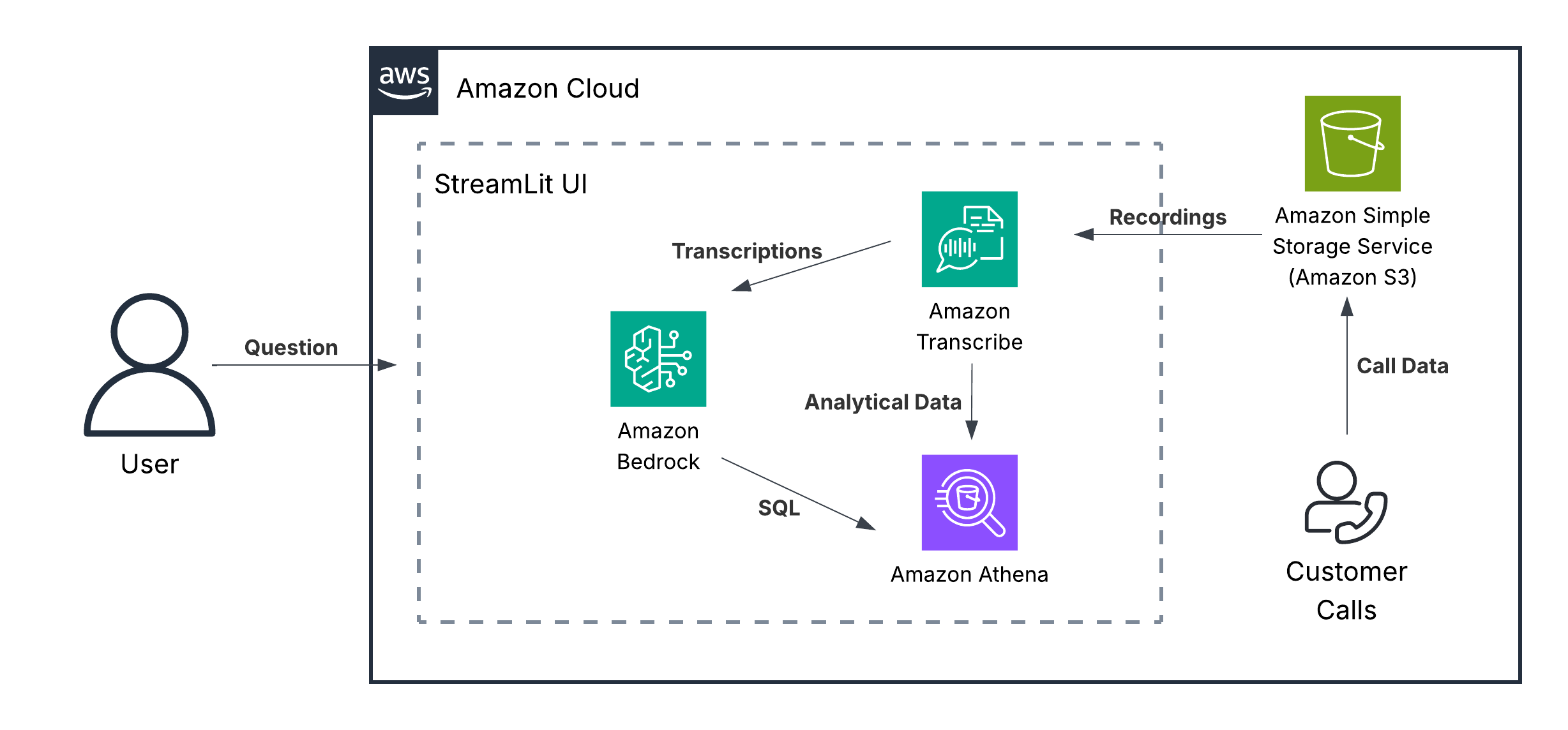
Amazon Bedrock を利用すれば、Amazon Nova 基盤モデルへのアクセスが可能となり、強力な自然言語処理機能を活用できます。
Amazon Athena は、構造化形式で保存された通話データをクエリするために使用され、効率的なデータ取得と分析を実現します。
Amazon Transcribe は、完全マネージド型の自動音声認識(ASR)サービスです。
Amazon Simple Storage Service (Amazon S3) は、業界をリードする拡張性、データ可用性、セキュリティ、パフォーマンスを備えたオブジェクトストレージサービスです。
Streamlit は Web ベースの UI を支え、ユーザーにとって直感的でインタラクティブな体験を提供します。
本アプリケーションは、「単一通話分析」と「複数通話分析」の 2 つの主要コンポーネントに分かれています。これらのスクリプトは連携して、通話後の分析と履歴データに基づく洞察を統合した包括的なソリューションを実現します。
単一通話分析
本アプリケーションの「単一通話分析」機能では、個別のカスタマーサポート通話を詳細に分析します。この機能は Single_Call_Analytics.py スクリプトで実装されています。ここでは主要な機能の一部をご紹介します。
感情分析と脆弱顧客の評価
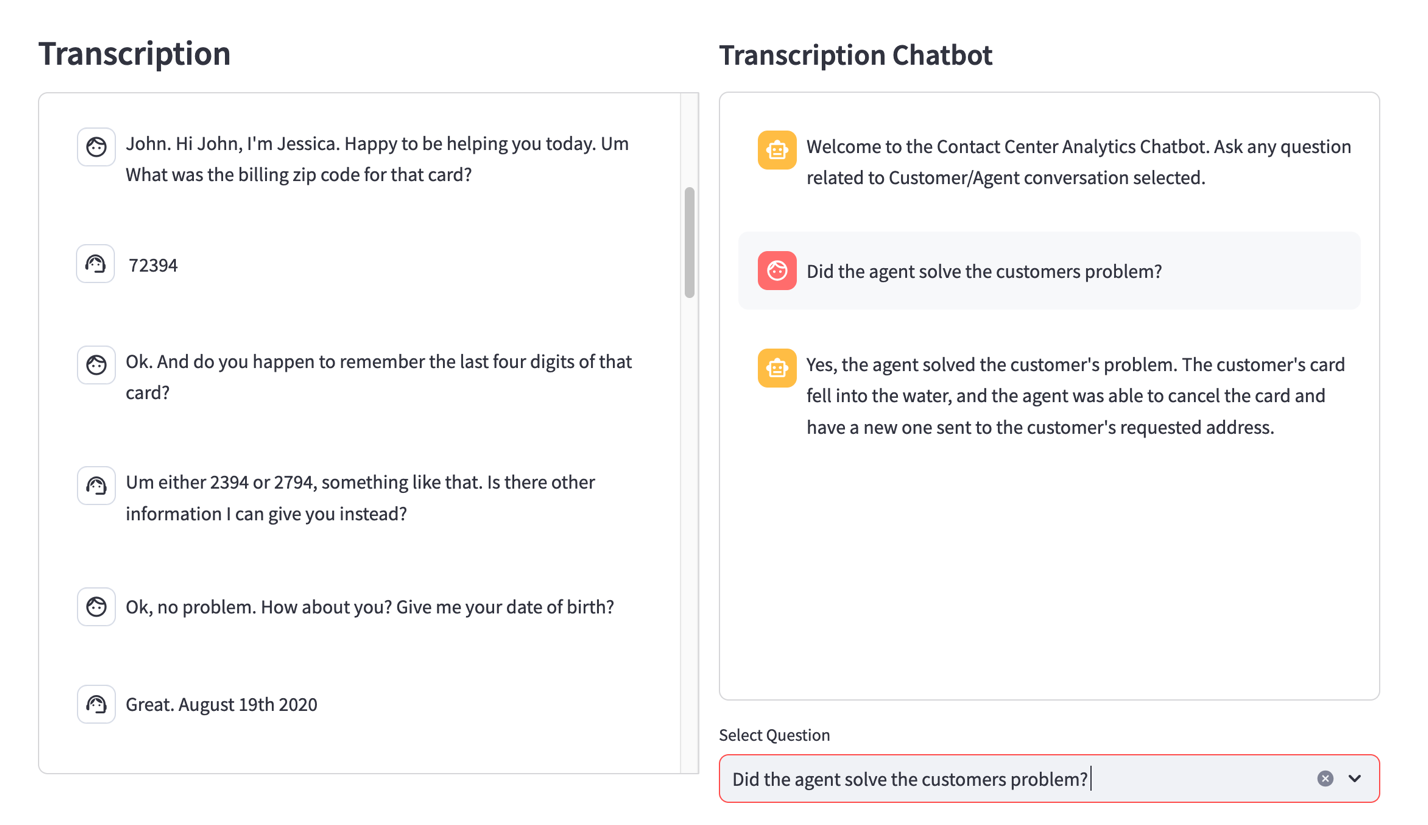
本ソリューションでは、Amazon Nova 基盤モデルを活用して、顧客とエージェント双方の感情に関する洞察を導き出します。以下のスクリーンショットをご覧ください。
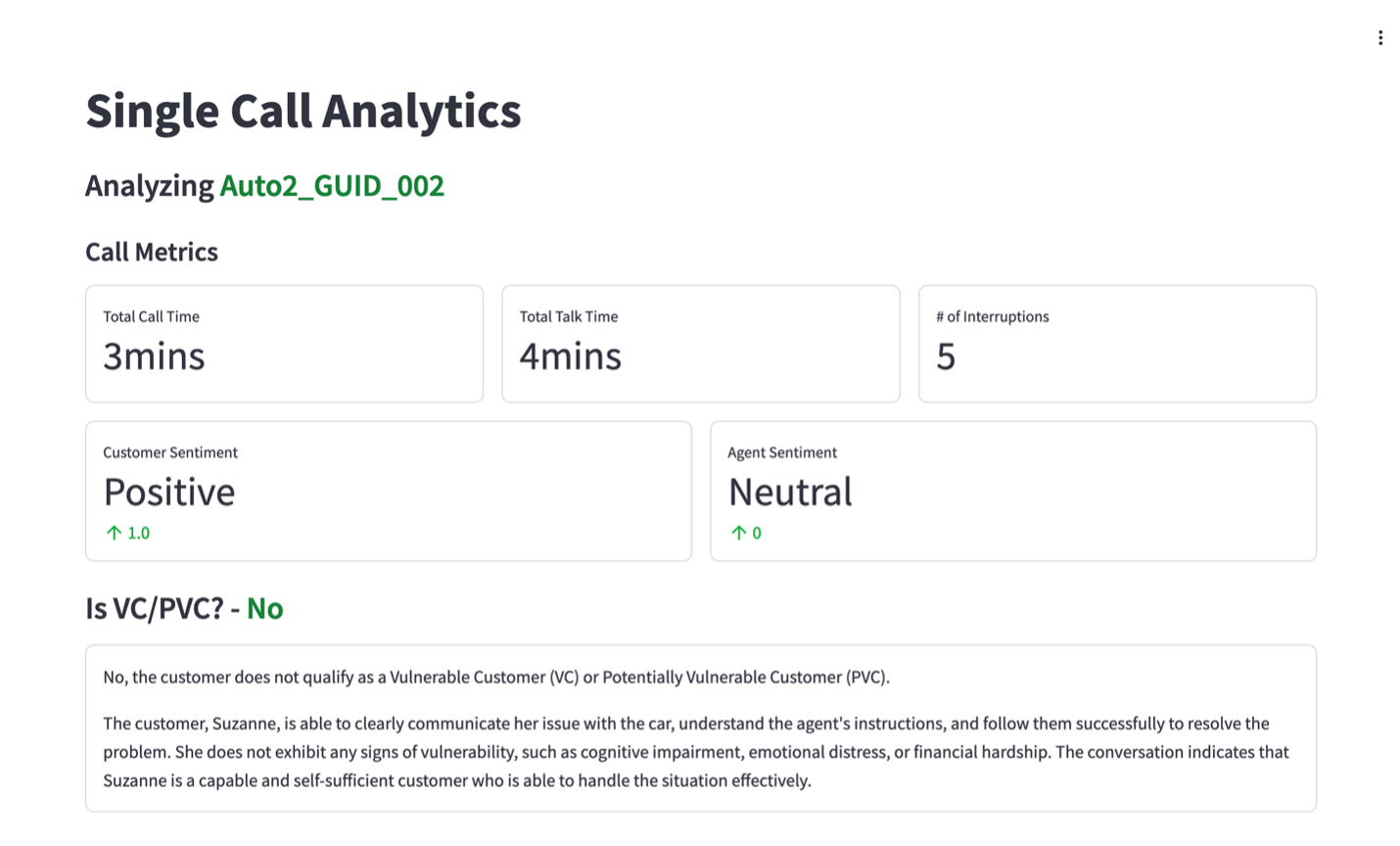
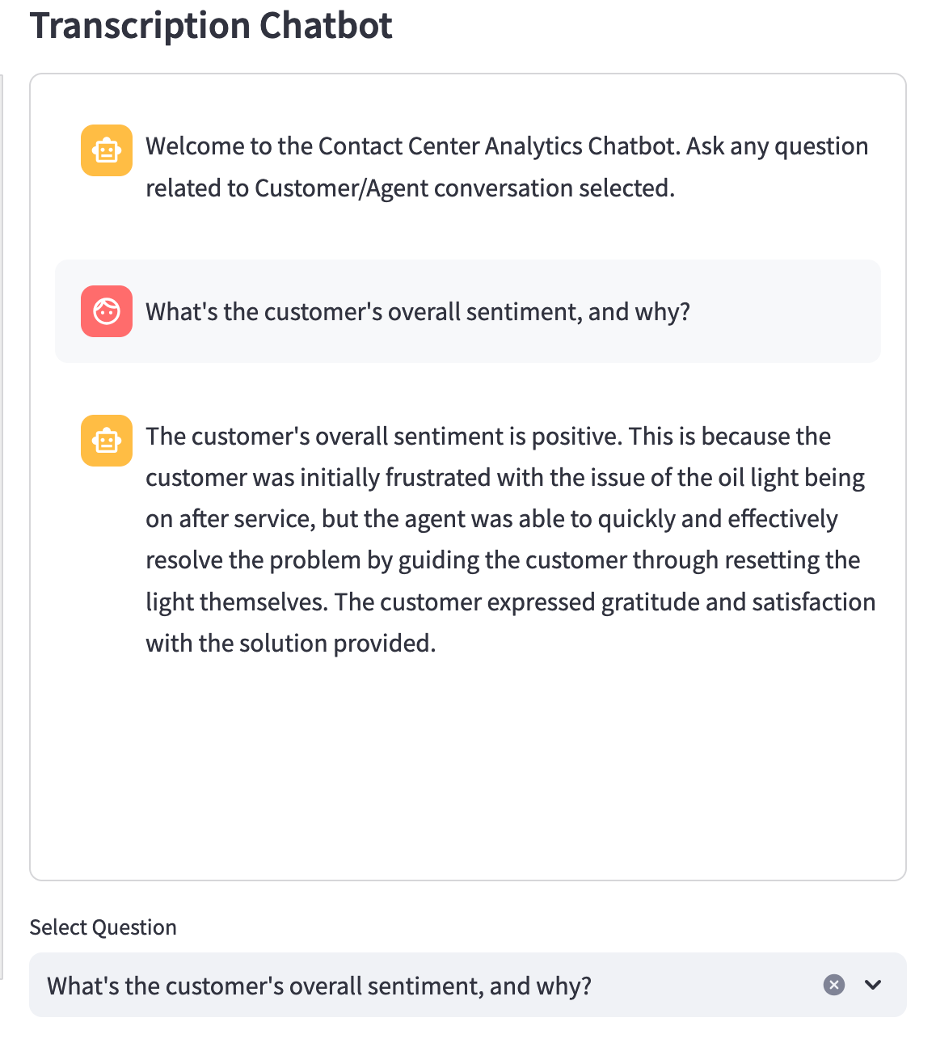
チャットボットの機能を使えば、ユーザーはなぜその感情が特定の分類に属したのかの説明を求めたり、通話記録からの根拠を示してもらうことができます。この機能により、通話記録から即座に関連するフレーズを検索して感情の分類を理解しやすくし、後の分析にも活用できるようになります。
脆弱な顧客、あるいは潜在的に脆弱な顧客とは、個人的な事情により経済的な損害を受けやすく、または金融サービスにおいて特別な配慮を必要とする方を指します。本アプリケーションは、通話記録に特定の指示文(プロンプト)を組み合わせて入力することで、電話で連絡してきた顧客が「脆弱な顧客」や「潜在的に脆弱な顧客」に該当するかどうかを判断します。
vc_prompt = f"""あなたは銀行のコールセンター向けAIアシスタントです。
あなたの目的は、以下の通話記録に基づき、顧客が「脆弱な顧客(VC)」または「潜在的に脆弱な顧客(PVC)」に該当するかを判定することです。
{speaker_texts}
顧客が VC または PVC に該当する場合は「Yes」とその理由を説明してください。
該当しない場合は「No」とその理由を説明してください。
"""
isVC = invoke_llm(vc_prompt, vc_model)
このプロンプトでは、Amazon Nova FM は「脆弱な顧客」または「潜在的に脆弱な顧客」の一般的な定義を用いて評価を行います。ただし、企業側で独自の脆弱性基準を定めている場合は、その定義に基づいて分類を行うようプロンプトを調整できます。この機能により、コールセンターの管理者は潜在的にセンシティブな状況を特定し、脆弱と判断された顧客に対して適切なケアと配慮を提供するとともに、なぜそのように判断されたのかという理由も説明することができます。
プロトコル支援と手順完了の確認
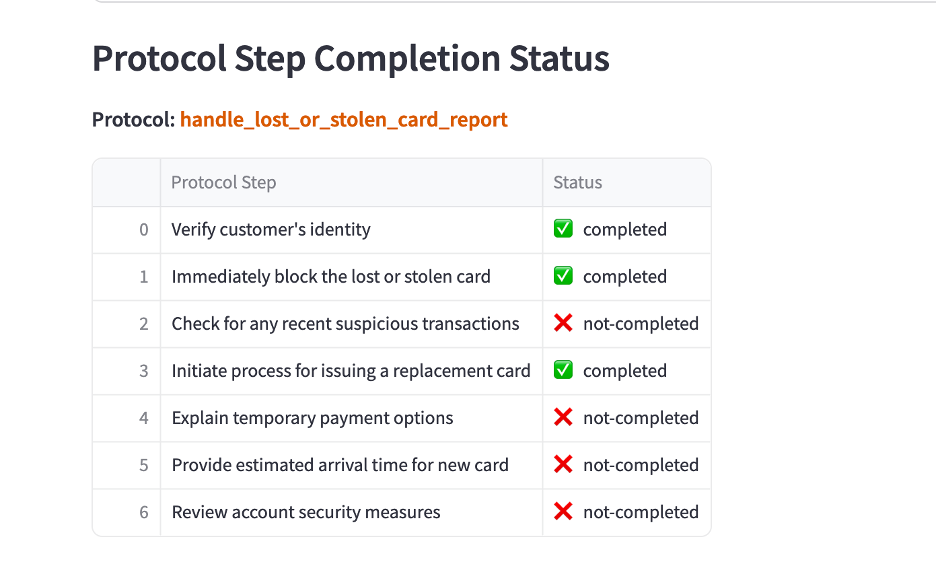
本アプリケーションでは Amazon Nova モデルを活用して、各通話に対応するプロトコルを特定し、オペレーターが規定の手順に従ったかを確認します。現在、プロトコルは JSON ファイルで定義されており、実行時にローカル環境から読み込まれます。以下にその実装例を示します。
protocol_identification_formatted = protocol_identification_prompt.format(transcript=context, protocols=protocols)
llm_protocol_key = invoke_llm(protocol_identification_formatted, protocol_model)
step_completion_formatted = step_completion_prompt.format(protocol_steps=protocol_list, context=context)
step_check = invoke_llm(step_completion_formatted, protocol_model)
このコードスニペットは、通話記録と利用可能なプロトコル一覧を基にまず関連するプロトコルを特定し、その後、そのプロトコルのステップがエージェントによって適切に完了したかを確認するために、通話記録と該当プロトコルの手順セットを併せて処理する様子を示しています。結果は管理者が素早くパフォーマンスやガイドライン遵守状況を把握できるよう、ユーザーフレンドリーな形式で表示されます。
対話型文字起こしビューと AI アシスタント
Single Call Analytics ページには、エージェントと顧客の会話を確認できる対話型の文字起こしビューが用意されています。さらに、通話に関する具体的な質問に答える AI アシスタント機能も搭載されており、以下のような処理が行われます。
user_message = call_prompt.format(query=prompt, context=context, chat_history=st.session_state.messages)
ans = invoke_llm(user_message, cb_model)
Amazon Nova モデルを基盤とするこのアシスタント機能により、通話記録を手動で検索する手間なく、通話の特定の側面について深い洞察を得ることが可能になります。
複数通話の分析機能
Multi_Call_Analytics.py スクリプトで実装されている「複数通話の分析」機能は、複数の通話を横断した集計分析を提供し、強力なビジネスインテリジェンス(BI)クエリを可能にします。
データ可視化と柔軟なモデル選択
この機能を使えば、ユーザーは複数の通話における傾向やパターンをすばやく可視化でき、改善すべき箇所や成功要因を明確に特定できます。
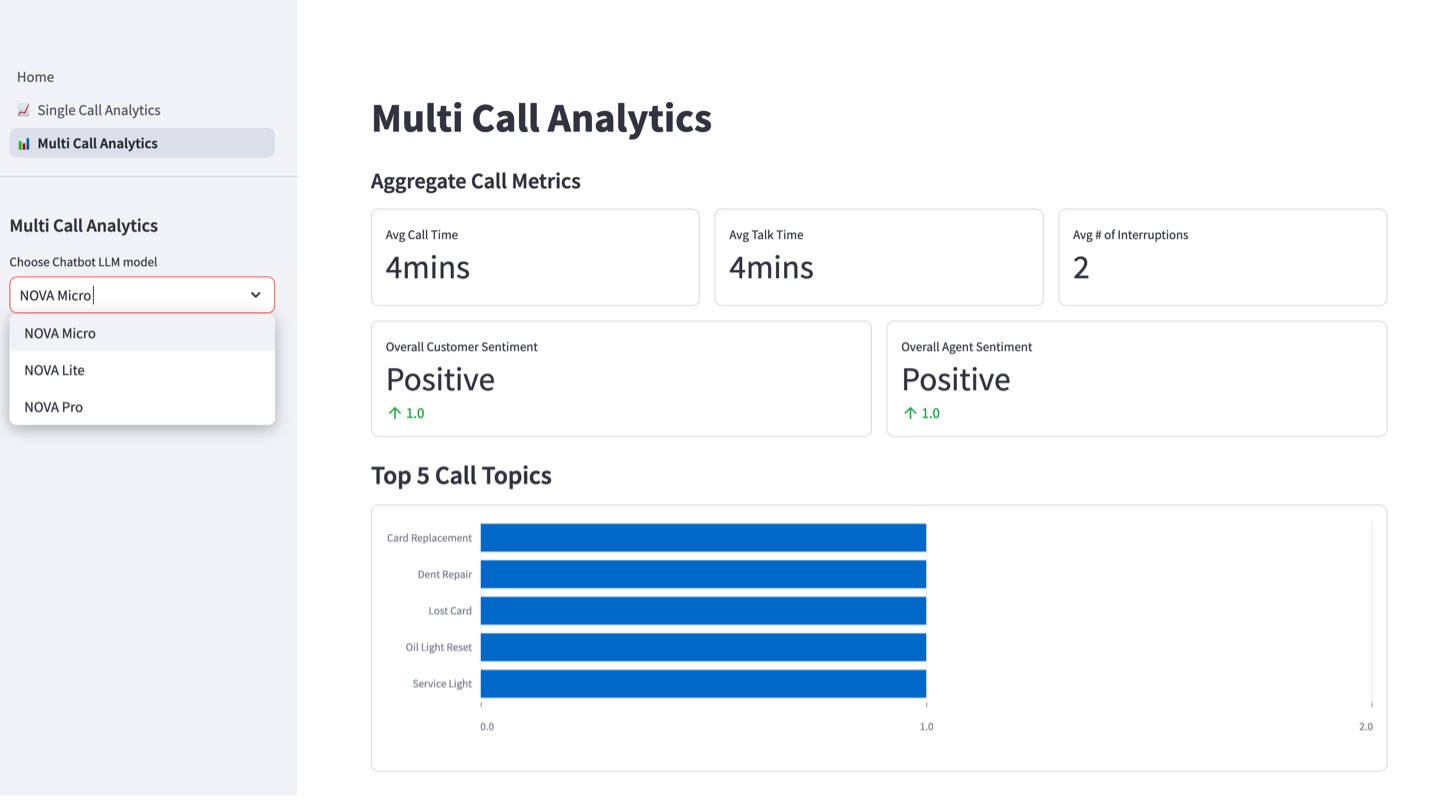
上記スクリーンショットの「通話トピック上位 5 つ」ビジュアルも、Amazon Nova モデルによって駆動されています。通話内容のテキスト(トランスクリプト)を入力するだけで、モデルが自動的に主要なトピックを判定し、分類を行います。この機能を使えば、ユーザーは通話をすばやく分類して、指定されたトピックカテゴリに振り分けることで、即座に可視化データを生成できます。顧客が電話をかけてくる主な理由を把握することで、企業はこれらのトピックカテゴリにおける通話件数削減に向けた戦略立案に集中できるようになります。
さらに、本アプリケーションでは柔軟なモデル選択オプションも提供しています。ユーザーは分析タスクに応じて、Amazon Nova の異なるモデル(Nova Pro、Nova Lite、Nova Micro など)から最適なものを自由に選べます。この柔軟性により、各ユースケースや具体的なニーズに最も適したモデルを選択し、活用することが可能になります。
分析用 AI アシスタント
「マルチコール分析」ページの主要機能の一つが、分析用 AI アシスタントです。このアシスタントは SQL を活用して複雑な BI(ビジネスインテリジェンス)クエリに対応できます。
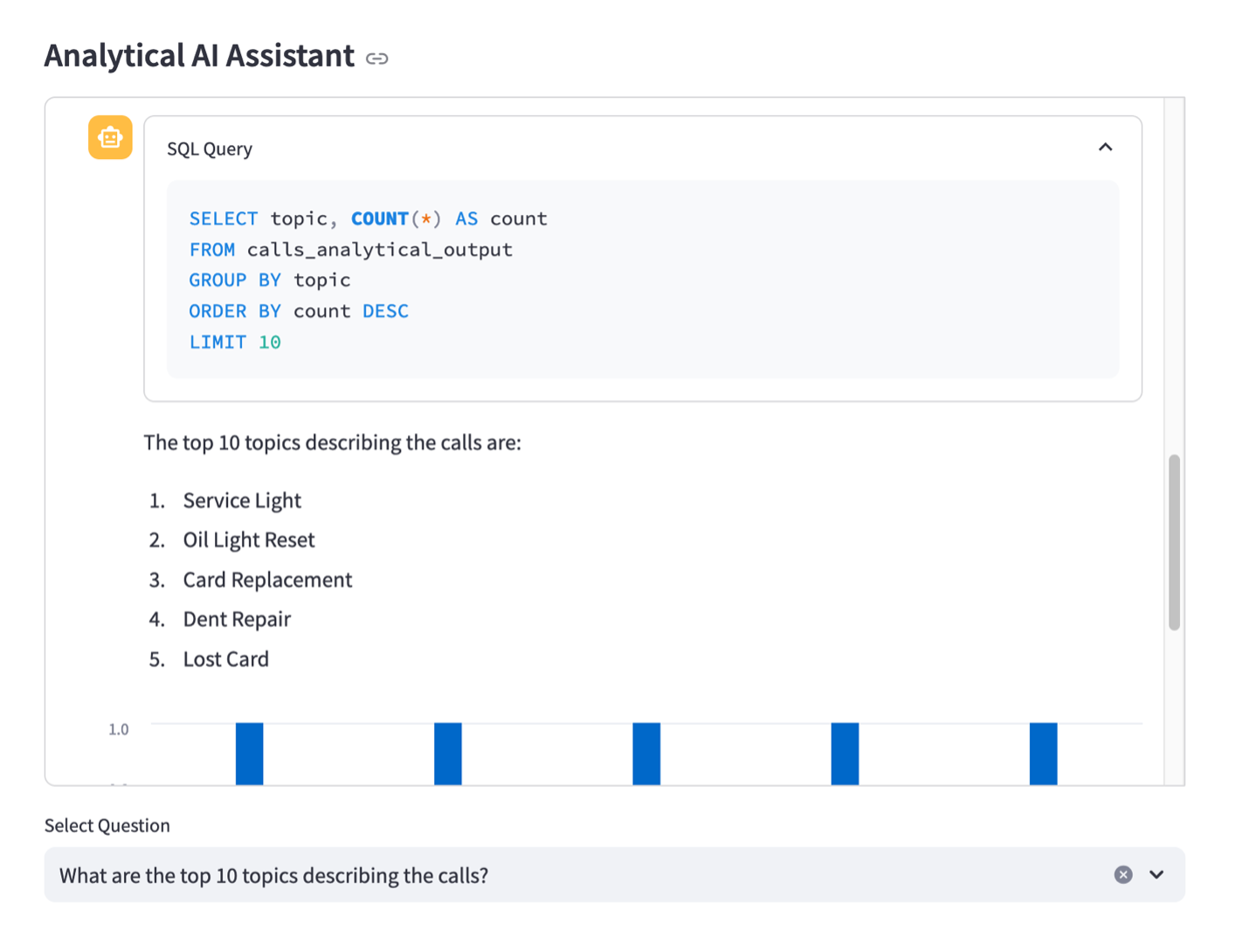
以下のコードは、アプリケーションが自然言語の質問に基づいて Amazon Nova モデルを用い SQL クエリを生成する仕組みを示しています。
user_prompt = """Given the following schema:
{schema}
and a user query, generate a SQL query which can be executed in AWS Athena.
The table name is {table_name}.
Give the SQL query as a JSON response.
"""
sql_query, chart = invoke_llm(final_prompt, cb_model, "sql")
このアシスタントは複雑なクエリを理解し、それを SQL に変換するだけでなく、結果を可視化するための適切なチャートタイプも提案します。生成された SQL クエリは Amazon Transcribe で処理されたデータ上で実行され、Athena によって照会されます。その結果は分析用 AI アシスタントに表示されます。
実装
本デモアプリケーションは、開発の迅速性と簡素化を実現するため、Streamlit UI を採用して構築されています。このアプリは、Amazon Nova モデルがコールセンター業務や分析ユースケースでどのような能力を発揮できるかを示すサンプルとして、特定のユースケースと AI タスクを組み合わせています。
本デモアプリケーションの実装詳細については、以下の GitHub リポジトリをご参照ください。
結論
本記事では、Amazon Nova のファウンデーションモデルがコールセンター分析デモアプリケーションをどのように支えているかについて解説しました。これは同分野における重要な進展を示すものです。
これらの高度な AI モデルの力を活用することで、企業は顧客とのやり取りに関する独自の洞察を得られ、エージェントのパフォーマンス向上や全体的な業務効率の改善が可能になります。感情分析、プロトコル遵守の確認、脆弱な顧客の評価、そして強力な BI 機能を備えた包括的な機能により、コールセンター管理者はデータに基づいた意思決定を下し、顧客サービス運営を継続的に改善するためのツールを手に入れることができます。
Amazon Nova ファウンデーションモデルは進化を続け、今後さらに強力かつ高度な分析機能が期待されます。本デモは、AI 活用によるコールセンター分析の可能性を探り、自社の環境で応用したいと考えている顧客にとって、優れた出発点となるでしょう。Amazon Nova モデルがアプリケーション内でどのように統合されているかについて詳しく知りたい方は、ぜひ Call Center Analytics デモをご覧ください。
執筆者紹介

Francisco Calderon Rodriguez
Francisco Calderon Rodriguez は、ジェネレーティブ AI イノベーションセンター (GAIIC) に所属するデータサイエンティストです。GAIIC のメンバーとして、AWS の顧客に対し、ジェネレーティブ AI 技術を活用した「実現可能な未来」の探求を支援しています。趣味は音楽やギター演奏、娘たちとのサッカー、そして家族と過ごす時間です。

Harpreet Cheema
Harpreet Cheema は、AWS ジェネレーティブ AI イノベーションセンターのディープラーニングアーキテクトです。機械学習分野に情熱を注ぎ、ML ドメインにおけるさまざまな課題解決に取り組んでいます。その役割では、実社会のアプリケーション向けに、ジェネレーティブ AI に特化したソリューションの開発と提供に注力しています。

ジャマル・サブーン
ジャマル・サブーン氏は、AWS 生成 AI イノベーションセンターの応用科学マネージャーです。現在、複数の業界で AWS の顧客が革新的かつスケーラブルな生成 AI プロダクトを構築できるよう支援するチームを率いています。フランスの INRIA ラボで人工知能とコンピュータビジョンの博士号を取得し、ユーザーに価値をもたらす AI ソリューションの設計・構築において長年の研究開発経験を持っています。
原文を表示
Call center analytics play a crucial role in improving customer experience and operational efficiency. With foundation models (FMs), you can improve the quality and efficiency of call center operations and analytics. Organizations can use generative AI to assist human customer support agents and managers of contact center teams, so they can gain insights that are more nuanced, helping redefine how and what questions can be asked from call center data.
Whereas some organizations look for turnkey solutions to introduce generative AI into their operations, such as Amazon Connect Contact Lens, others build custom customer support systems using AWS services for their microservices backend. With this comes the opportunity to integrate FMs into the system to provide AI support to human customer support agents and their managers.
One of the major decisions these organizations face is which model to use to power the AI support and analytics in their platform. For this, the Generative AI Innovation Center developed a demo application that features a collection of use cases powered by Amazon’s latest family of FMs, Amazon Nova. In this post, we discuss how Amazon Nova demonstrates capabilities in conversational analytics, call classification, and other use cases often relevant to contact center solutions. We examine these capabilities for both single-call and multi-call analytics use cases.
Amazon Nova FMs for scale
Amazon Nova FMs provide leading price-performance, making them suitable for generative AI at scale. These models are pre-trained on vast amounts of data, enabling them to perform a wide range of language tasks with remarkable accuracy and efficiency while effectively scaling to support large demand. In the context of call center analytics, Amazon Nova models can comprehend complex conversations, extract key information, and generate valuable insights that were previously difficult or impossible to obtain at scale. The demo application showcases the capabilities of Amazon Nova models for various analytical tasks, including:
- Sentiment analysis
- Topic identification
- Vulnerable customer assessment
- Protocol adherence checking
- Interactive question-answering
By using these advanced AI capabilities from Amazon Nova FMs, businesses can gain a deeper understanding of their customer interactions and make data-driven decisions to improve service quality and operational efficiency.
Solution overview
The Call Center Analytics demo application is built on a simple architecture that seamlessly integrates Amazon Bedrock and Amazon Nova to enable end-to-end call center analytics for both single-call and multi-call analytics. The following diagram illustrates this architecture.
- Amazon Bedrock – Provides access to the Amazon Nova FMs, enabling powerful natural language processing capabilities
- Amazon Athena – Used for querying the call data stored in a structured format, allowing for efficient data retrieval and analysis
- Amazon Transcribe – Fully managed, automatic speech recognition (ASR) service
- Amazon Simple Storage Service (Amazon S3) – Object storage service offering industry-leading scalability, data availability, security, and performance
- Streamlit – Powers the web-based UI, providing an intuitive and interactive experience for users
The application is divided into two main components: Single Call Analytics and Multi-Call Analytics. These scripts work together to provide a comprehensive solution that combines post-call analysis with historical data insights.
Single Call Analytics
The Single Call Analytics functionality of the application provides a detailed analysis of individual customer service calls. This feature is implemented in the Single_Call_Analytics.py script. In this section, we explore some of the key capabilities.
Sentiment analysis and vulnerable customer assessment
The solution uses Amazon Nova FMs to derive insights on both the customer and agent sentiment, as shown in the following screenshot.
By using the chatbot feature, users can ask for an explanation on why the sentiment was classified as such and also get references from the transcription. This feature gives more understanding on the sentiment class by quickly finding supporting phrases from the transcription itself, which later can be used for other analyses.
A vulnerable customer or potentially vulnerable customer is someone who, due to their personal circumstances, is particularly susceptible to financial harm or requires special consideration in financial services. The application assesses whether the customer calling in might be considered vulnerable or potentially vulnerable, by passing the call transcript of the selected call with the following prompt:
vc_prompt = f"""You are a AI Assistant for Banking Call Center.
Your goal is to determine if the customer in the  below
qualifies as Vulnerable Customer (VC) or Potentially Vulnerable Customer (PVC).

{speaker_texts}

If the customer qualifies as a VC or PVC, return Yes and explain why.
If the customer does not qualify as a VC or PVC, return No and explain why.
"""

isVC = invoke_llm(vc_prompt, vc_model)
In this prompt, the Amazon Nova FM uses a generic definition of a vulnerable or potentially vulnerable customer to make the assessment. However, if a business has its own definition of vulnerable or potentially vulnerable customers, they can engineer the prompt to have the FM make the classification using this custom definition. This feature helps call center managers identify potentially sensitive situations and make sure vulnerable customers receive appropriate care and attention along with an explanation on why the customer was identified as such.
Protocol assistance and step completion
The application uses Amazon Nova models to identify the relevant protocol for each call and check if the agent followed the prescribed steps. Protocols are currently defined in a JSON file that are ingested locally at runtime. The following code shows an example of how this is implemented:
protocol_identification_formatted = protocol_identification_prompt.format(transcript=context, protocols=protocols)
llm_protocol_key = invoke_llm(protocol_identification_formatted, protocol_model)

step_completion_formatted = step_completion_prompt.format(protocol_steps=protocol_list, context=context)
step_check = invoke_llm(step_completion_formatted, protocol_model)
This code snippet shows how the application first identifies the relevant protocol using the call transcript and a list of available protocols. After the protocol has been identified, the call transcript and protocol steps for the determined protocol are passed together to check if each step of the protocol was completed by the agent. The results are displayed in a user-friendly format, helping managers quickly assess agent performance and adherence to guidelines.
Interactive transcription view and AI assistant
The Single Call Analytics page provides an interactive transcription view, so users can read through the conversation between the agent and customer. Additionally, it includes an AI assistant feature so users can ask specific questions about the call:
user_message = call_prompt.format(query=prompt, context=context, chat_history=st.session_state.messages)
ans = invoke_llm(user_message, cb_model)
This assistant functionality, powered by Amazon Nova models, helps users gain deeper insights into specific aspects of the call without having to manually search through the transcript.
Multi-Call Analytics
The Multi-Call Analytics functionality, implemented in the Multi_Call_Analytics.py script, provides aggregate analysis across multiple calls and enables powerful business intelligence (BI) queries.
Data visualization and flexible model selection
This feature helps users quickly visualize trends and patterns across multiple calls, making it straightforward to identify areas for improvement or success.
The “Top 5 Call Topics” visual in the preceding screenshot is also powered by Amazon Nova models; users can classify the call’s topic from passing in the call transcript and then letting the model determine what the main topic of the call was. This feature can help users quickly classify calls and place them in the bucket of the determined topic to generate visuals. By seeing the top reasons customers are calling in, businesses can focus on devising strategies to reduce call volumes for these topic categories. Additionally, the application provides flexible model selection options, so users can choose between different Amazon Nova models (such as Nova Pro, Nova Lite, and Nova Micro) for various analytical tasks. This flexibility means users can select the most appropriate model for their specific needs and use cases.
Analytical AI Assistant
One of the key features of the Multi-Call Analytics page is the Analytical AI Assistant, which can handle complex BI queries using SQL.
The following code demonstrates how the application uses Amazon Nova models to generate SQL queries based on natural language questions:
user_prompt = """Given the following schema:
{schema}
and a user query, generate a SQL query which can be executed in AWS Athena.
The table name is {table_name}.

Give the SQL query as a JSON response.
"""

sql_query, chart = invoke_llm(final_prompt, cb_model, "sql")
The assistant can understand complex queries, translate them into SQL, and even suggest appropriate chart types for visualizing the results. The SQL queries are run on processed data from Amazon Transcribe and queried using Athena, which are then surfaced in the Analytical AI Assistant.
Implementation
The Call Analytics demo application is implemented using the Streamlit UI for speed and simplicity of development. The application is a mix of specific use cases and AI tasks to provide a sample of what Amazon Nova models can do for call center operations and analytics use cases. For more information about how this demo application is implemented, refer to the following GitHub repo.
まとめ
In this post, we discussed how Amazon Nova FMs power the Call Center Analytics demo application, representing significant advancements in the field of call center analytics. By using the power of these advanced AI models, businesses can gain unique insights into their customer interactions, improve agent performance, and enhance overall operational efficiency. The application’s comprehensive features, including sentiment analysis, protocol adherence checking, vulnerable customer assessment, and powerful BI capabilities, provide call center managers the tools they need to make data-driven decisions and continuously improve their customer service operations.
As Amazon Nova FMs continue to evolve and improve, we can expect even more powerful and sophisticated analytics capabilities in the future. This demo serves as an excellent starting point for customers looking to explore the potential of AI-powered call center analytics and applying it in their own environment. We encourage readers to explore the Call Center Analytics demo to learn more details of how Amazon Nova models are integrated in the application.
About the authors
Francisco Calderon Rodriguez
Francisco Calderon Rodriguez is a Data Scientist at the Generative AI Innovation Center (GAIIC). As a member of the GAIIC, he helps discover the art of the possible with AWS customers using generative AI technologies. In his spare time, Francisco likes playing music and guitar, playing soccer with his daughters, and enjoying time with his family.
Harpreet Cheema
Harpreet Cheema is a Deep Learning Architect at the AWS Generative AI Innovation Center. He is very passionate in the field of machine learning and in tackling different problems in the ML domain. In his role, he focuses on developing and delivering Generative AI focused solutions for real-world applications.
Jamal Saboune
Jamal Saboune is an Applied Science Manager with AWS Generative AI Innovation Center. He is currently leading a team focused on supporting AWS customers build innovative and scalable Generative AI products across several industries. Jamal holds a PhD in AI and Computer Vision from the INRIA Lab in France, and has a long R&D experience designing and building AI solutions that add value to users.
同じ出来事を5媒体で確認
同じ出来事を扱う別媒体の記事です。見出しと公開時刻を比較できます。
関連記事
News to Guide
ニュースの次に確認する
発表内容を、現在の料金や仕様と照らし合わせられる関連ガイドです。
今日のまとめ
AIデイリーブリーフで今日の重要ニュースをまとめ読み