Panasonic Avionics、AWS でエージェント AI を活用し機内エンタメ診断を加速
本文の状態
日本語全文を表示中
詳細モードで約17分の本文を読めます。
同じ出来事の情報源
この情報源を基点に整理
AWS Machine Learning Blog
パナソニック・アビオニクスはAWSと連携し、Agentic AI を活用した診断システムを構築して、航空機用机上エンタテインメントシステムの複雑な障害原因特定にかかる時間を大幅に短縮した。
AI深層分析を開く2026年8月22日 02:58
AI深層分析
キーポイント
Agentic AI システムの導入
パナソニック・アビオニクスは AWS と AWS ジェネレーティブ AI イノベーションセンターと連携し、Amazon Bedrock や SageMaker を活用した Agentic AI 診断システムを構築した。
手動分析の課題解消
従来、多様な機体構成におけるログやメトリックの手動相関分析には数時間を要し、深い専門知識が必要だったが、自動化によりこのボトルネックを解消した。
運用指標の改善
障害検出までの平均時間(MTTD)と解決までの平均時間(MTTR)が短縮され、ピーク時の反復的な調査タスクに対する自動化の可能性が開かれた。
知識の拡張とリソース最適化
AI を活用することで、深いシステム理解を要する手動相関プロセスをスケーリングし、エンジニアの時間を診断活動からイノベーションや信頼性向上へシフトできる。
多エージェントによる診断アーキテクチャ
トレンド分析、並列診断実行、LLM による要約という3層構成でデータを処理し、根本原因と推奨アクションを含む一貫した報告書を生成する。
重要な引用
Panasonic Avionics Corporation provides in-flight entertainment and connectivity (IFEC) systems across a large global fleet serving hundreds of airlines and billions of passengers annually.
Doing this manually, correlating logs, metrics, and ticketing data across diverse fleet variants, can take hours and requires deep institutional knowledge.
The solution uses Amazon Bedrock, Amazon SageMaker, and AWS Glue to significantly reduce diagnosis time while maintaining high accuracy.
The objective was to maintain analytical depth while significantly improving MTTD and MTTR, so engineers can focus more on solution design, optimization, and strategic reliability enhancements rather than investigative overhead.
編集コメントを表示
編集コメント
航空機という極めて高い信頼性が求められる分野で、生成 AI を実運用に組み込み診断時間を短縮した事例は貴重である。特に多様な構成に対応する大規模データ処理における Agentic AI の役割が明確になった点が高く評価される。
Source Article
元記事を日本語で読む
本文に関係しない購読案内、埋め込み通知、サイト内プロモーションは除いています。
パナソニック・アビオニクス社は、世界中の数百航空会社と年間数十億人の乗客にサービスを提供する大規模な機内エンターテインメントおよび接続(IFEC)システムを展開しています。この規模でシステム障害が発生し、乗客体験が損なわれた場合、エンジニアは数千もの異なる導入構成において迅速に根本原因を特定する必要があります。多様な機体バリアント間でログ、メトリクス、チケットデータを手動で関連付けると、数時間がかかり、深い組織的な知識が必要となります。
本記事では、パナソニック・アビオニクス社が AWS および AWS 生成 AI イノベーションセンターと協力し、アーキテクチャのガイダンスを受けながら構築したエージェント型 AI システムについて解説します。このソリューションは Amazon Bedrock、Amazon SageMaker、AWS Glue を活用し、高い精度を維持しながら診断時間を大幅に短縮しています。
課題:スケールする保守の進化
パナソニック・アビオニクス社の運用データは、機隊全体の IFEC 状態を監視するための重要な資産です。同社は AWS を基盤としたデータレイクおよびデータシステムを活用し、機隊全体から収集した運用データを保存・整理し、毎日大量のデータを処理しています。
この堅牢なデータ基盤があるにもかかわらず、生データを意味のある診断情報に変換し、運用規模で活用するには課題がありました。パナソニック・アビオニクス社は、各社の運用要件に合わせてカスタマイズされた設定でサービスを提供しています。そのため、各導入環境ごとに固有のログパターンが発生し、機隊全体の性能評価を複雑にしています。チームは手動でレビューを行い、複数の運用データソース間の指標を関連付けていました。
このプロセスには、運用効率とエンジニアリング生産性の向上に向けたいくつかの改善機会がありました。
- 手動分析の負担 – 多様な設定間での相関関係解析には、詳細な手動調査が必要でした。診断精度の向上に寄与しましたが、全体の分析サイクルは長期化しました。
- 検出までの平均時間(MTTD) – 検知は主にチケット発行と手動レビューに依存しており、新たなパターンの特定にかかる時間に影響を与えていました。
- 解決までの平均時間(MTTR) – 是正措置を実行する前に多大な調査作業が必要だったため、エンドツーエンドの解決サイクルが長期化していました。
- 自動化の可能性 – 反復的な調査タスクやログレビューには、特にピーク時の活動期間において、インテリジェントな自動化による大きな改善余地がありました。
知識の拡張 – 手動での相関分析には深いシステム理解が必要であり、AI を活用してエンジニアチーム全体で組織的な知見をより広く共有する機会が生まれました。
リソース最適化 – エンジニアは診断活動に繰り返し時間を費やしており、イノベーション、機能開発、長期的な信頼性向上に向けた時間が削られていました。
パナソニック・アビオニクス社は、診断の厳密性を保ちつつ、予防的な健康モニタリングと機隊全体のパターン認識へと進化させる明確な機会を特定しました。目標は分析の深さを維持しつつ、故障から復旧までの時間(MTTD)や平均修復時間(MTTR)を大幅に短縮し、エンジニアが調査作業よりも、解決策の設計、最適化、戦略的な信頼性向上に注力できるようにすることです。
ソリューション概要
パナソニック・アビオニクス社は AWS と AWS 生成 AI イノベーションセンターと連携し、機隊向け机上エンターテインメント(IFEC)運用における内部診断ワークフローを生成 AI でどう強化できるかを模索しました。この協業では、IFEC 運用に関する同社の深いドメイン知識と、AWS サービスで利用可能な生成 AI の能力、さらにシステム設計におけるアーキテクチャ指導を提供するイノベーションセンターの知見が組み合わされました。
アーキテクチャ
以下の図は、AWS 上の診断アーキテクチャを示しています。本ソリューションでは、3 つの層が協調して動作するマルチエージェント・ワークフローシステムを採用し、データを処理します。
*Trend Analyzer*(トレンド分析器)は、主要なパフォーマンス指標やサービス劣化メトリクスを分析することで異常を検出します。*Parallel Diagnostic Agents*(並列診断エージェント)は、相関分析、システムチェック、ログパターンのマッチングなど、特定の診断機能を担当します。また、大規模言語モデル (LLM) を活用した *Summarizer*(要約器)が、これらの出力を統合し、根本原因の特定と推奨アクションを含む一貫性のある診断レポートを生成します。
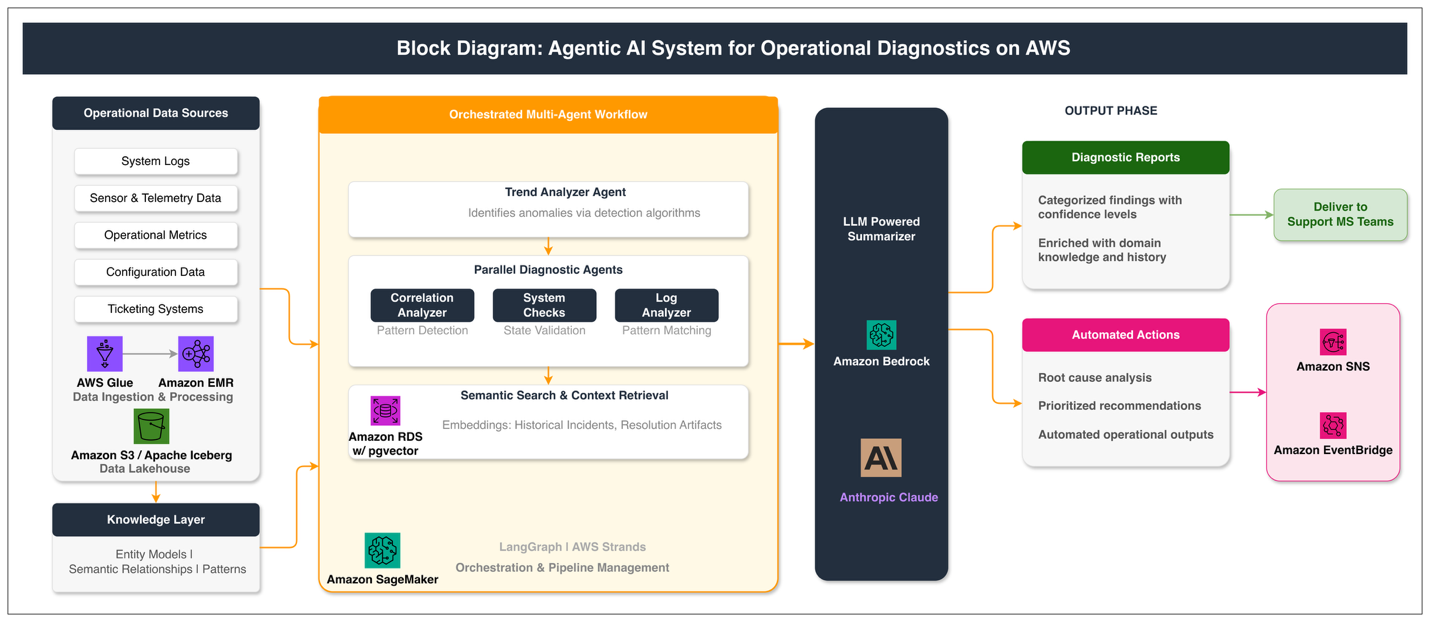
図 1: AWS 上のマルチエージェント IFEC 診断アーキテクチャ
ソリューションの概要
本システムは、以下の 5 つのフェーズを通じて運用データを処理します。
- データの取り込みと正規化
本システムは、運航データ全体から生データを収集し、標準化されたサービス指標へ変換した上で、Apache Iceberg を用いた Amazon S3 データレイクハウスに格納します。この抽出・変換・ロード(ETL)パイプラインの処理は AWS Glue と Amazon EMR が担当します。
ドメインオントロジーは、機体やその関係性を定義する共通語彙であり、異なる機体種間での用語を統一します。これにより、多様な構成を持つデータ同士を機隊全体規模で比較可能になります。また、オントロジーはパフォーマンス指標と構成メタデータ、さらにチケット情報を結びつけることで、機隊横断的な診断のための統合ビューを実現しています。
2. 検知(Detect)
トレンド解析エージェントは、主要なパフォーマンス指標、サービスレベルの遵守状況、および劣化指標を継続的に評価します。機隊全体の関係性モデルを用いることで、個別の展開を孤立して分析するだけでは見逃されるパターンも検出できます。例えば、特定の構成バリアントを共有する展開にのみ影響を与えるような漸進的な劣化などが該当します。
これにより、パナソニック・アビオニクス社は、チケット発行による事後対応から、問題が深刻化する前に発生兆候を事前に特定する予防的アプローチへと移行しています。
3. 診断(Diagnose)
トレンド解析エージェントが懸念事項を検知すると、並列して動作する複数の診断エージェントが異なる角度から同時に調査を開始します。
- 相関解析アナライザー: 共通構成を共有する展開間で繰り返し現れるパターンを検出し、問題が個別事象なのかシステム全体に波及する事象なのかを特定します。
システムチェックでは、チケット管理ワークフローに対してメタデータとサービスステータスを検証し、既知のメンテナンス活動が観測された挙動の説明となるかどうかを判断します。
ログアナライザーは、ルールベースおよびパターンベースの検出を用いて、現在のログパターンを以前に特定された故障モードのライブラリと比較照合します。
Amazon SageMaker は LangGraph を用いてこれらのエージェントをオーケストレーションします。LangGraph は状態保持型 AI ワークフローを管理するためのオープンソースフレームワークです。AI エージェント構築用のオープンソース Python フレームワークである Strands Agents SDK が、エージェントの実装と実行機能を提供しています。これらを組み合わせることで、両者は並列に動作し、パナソニック・アビオニクス社の内部テストでは、調査時間を手動レビューの数時間から自動化された分析の数分へと短縮しました。
4. 文脈化
システムは、Amazon Relational Database Service (Amazon RDS) にベクトル表現として保存された過去のインシデントと解決策アーティファクトを照会します。pgvector(ベクトル類似性検索用の PostgreSQL 拡張機能)を活用し、正確な症状が一致していなくても類似のパターンとその解決策を検索できます。これにより、エンジニア組織全体でスケーラブルな組織的記憶機能が実現されます。
5. 推奨と実行
Anthropic Claude を Amazon Bedrock で活用することで、相関解析ツール、システムチェック、ログ分析の結果を統合し、構造化された診断レポートを生成します。各レポートには根本原因の仮説、影響を受ける機体セグメントごとの影響分析、優先順位付けられた対策推奨事項が含まれます。
システムはレポートを重大度別に分類します。深刻な発見があった場合、システムは自動的にアラートを生成し、インシデントの優先度を決定し、推奨される解決アクションとともに適切なエンジニアリングチームへ転送します。これにより手動でのトリアージが軽減されつつも、対策決定におけるエンジニアの監督体制は維持されます。
AI が生成した推奨事項は、取得した運用データと過去のインシデントに基づいて裏付けられ、確定的なビジネスルールに照らして検証された上で、根拠となる証拠とともに提示されます。人間のエンジニアが診断結果を確認し、運用上重要なインシデントに対する対策アクションを承認します。また、システムはエージェントの判断や推奨事項の追跡可能性を維持し、監査対応と継続的な改善を支援します。
これら 5 つのフェーズを通じて、機体規模の診断システムを構築するには、需要に応じて拡張可能なインフラが必要でした。AWS Glue と Amazon EMR を活用したサーバーレスデータ処理、Amazon Bedrock の持つモデルの柔軟性、そして Amazon SageMaker が提供するガバナンスされたエージェントランタイムにより、パナソニック・アビオニクス社はインフラ構築よりも診断ロジックの開発に注力することができました。
概念から本番環境へ
パナソニック・アビオニクス社は、AWS 生成 AI イノベーションセンターのアドバイザリーチームから、イベント駆動型の設計パターンや並列処理戦略、本番環境でのスケーラビリティを確保するためのパフォーマンス最適化手法に関する指導を受けながら、このソリューションを検証しました。
早期に厳格な検証を実施する: パナソニック・アビオニクス社は、地上の真値データとの照合によるクロス参照検証を導入し、テストを通じて要件を常に上回る精度を実現しました。
モジュール性と透明性を設計に組み込む: 設計原則では、原子的なエージェント操作、プロンプトとロジックの透明性、そして人間が関与するレビュー機能を重視しました。このモジュラーアプローチにより、システム全体を変更することなく、個々のエージェントを独立して更新できるようになり、ソリューションのスケーリングが可能になりました。
AI コンポーネントを戦略的に最適化する: 指導では、決定論的な出力と焦点の絞られた応答を得るために、調整済みのパラメータ構成を使用することが強調されました。チームは LLM の利用を、生成能力が明確な価値をもたらす要約やエラー推論タスクに限定しました。
継続的なフィードバックで反復する: 自動化されたアクションが専門家の手動評価と一致した時点で本番環境への移行を行いました。これにより診断精度を維持しつつ、解決までの時間を短縮できました。現在、このシステムは運用中の機体全体を対象とした診断レポートを毎日生成しています。
結論
Panasonic Avionics Corporation が AWS 上で構築した AI ドライバーの診断システムは、主要な運用指標において明確な改善をもたらしました。手動での分析にかかる工数が大幅に削減され、検出までの平均時間(MTTD)と解決までの平均時間(MTTR)がともに短縮されました。
特定のユースケースでは、システムの導入により運用効率が 20〜40% 向上したことが実証されています。サポートチームからは、反復的な調査業務の負担が劇的に軽減されたという報告があり、これまで数時間を要していた作業をシステムが自動的に処理できるようになったとのことです。
エンジニアリング部門における独立した診断能力も飛躍的に向上し、以前はエスカレーションが必要だった事案についても、チーム内で迅速に診断・解決が可能になりました。これらの改善により、システムの規模拡大に伴う運用モデルそのものが根本から変化しています。AI エージェントを活用してスケーラビリティに対応しつつ、コストと運用リスクの両方を削減できる体制が整ったのです。
AWS Generative AI Innovation Center が貴社の組織で同様のソリューションを構築する際の支援について詳しく知りたい場合は、AWS Generative AI Innovation Center をご覧ください。本記事で使用されたサービスについては、それぞれ Amazon Bedrock、Amazon SageMaker、AWS Glue のページをご参照ください。航空業界に特化したユースケースについては、AWS for Aerospace and Satellite をご活用ください。
AWS におけるマルチエージェントのオーケストレーションに関する詳細は、以下の記事をご覧ください:
「SageMaker AI モデルと MLflow を活用したストランドエージェントの構築」や「Amazon SageMaker AI 上で LangGraph と管理型 MLflow を用いて Claude でサーバーレス会話型 AI エージェントを構築する」といった関連記事があります。
免責事項:本稿は、パナソニック・アビオニクス社と AWS が共同で行った内部プロジェクトについて記述したものです。ここに記載されたアーキテクチャやアプローチは特定の導入事例に基づくものであり、実際の結果はデータ特性、運用環境、システム構成によって異なる可能性があります。
執筆者について

Satyen Yadav
Satyen 氏はパナソニック・アビオニクス社の最高技術責任者(CTO)を務め、組織全体のエンジニアリング戦略を統括するとともに、AI、クラウド、デジタル、データ管理、データガバナンスの各領域におけるイノベーションを推進しています。

Ram Chintala
パナソニック・アビオニクス社でエンジニアリング担当シニアディレクターを務めるラム氏は、AI、クラウド、デジタル、データ管理、データガバナンスの各分野におけるエンジニアリング主導を統括し、スケーラブルなエンタープライズプラットフォームと技術ソリューションの実現に注力しています。

Rajesh Balakrishnan
ラジェシュ・バラクリシュナン氏は、同社でエンジニアリング担当ディレクター(機械学習)を務め、デジタル、データ管理、データガバナンスの領域において AI と機械学習ソリューションの開発を率いています。

Yifu Hu
イフー・フー氏は、AWS 生成 AI イノベーションセンターで応用科学者として活躍しています。多様な業界の企業顧客向けに機械学習および生成 AI ソリューションの開発と提供を主導しており、技術リーダーシップと創造的な問題解決に強みを持っています。特に、エージェント型 AI システム、大規模言語モデル(LLM)、AWS 上の AI アプリケーションに関する専門知識を有しています。

Nimish Radia
ニミッシュ氏は、AWS 生成 AI イノベーションセンターでシニア・ジェネレーティブ AI ストラテジストを務めています。同社最大手の顧客向けに、エンタープライズレベルの生成 AI、エージェント型 AI、そして物理 AI の戦略策定と価値創出を主導しています。C レベルの経営陣と連携し、本番環境で運用可能な AI ソリューションの設計・構築・スケーリングを行い、導入加速や業務効率化、新たな収益源の開拓を通じて企業の価値向上を実現しています。

Shubham Dhoka
シュバム氏は AWS のシニア・ソリューションズアーキテクトです。デジタルトランスフォーメーションを推進する企業顧客に対し、戦略的なアドバイザーとして支援しています。大規模かつ安全なクラウドソリューションの設計、開発、導入において豊富な経験を有しており、特にサーバーレスアプリケーション、エージェント型 AI、コンテナ技術、データセンター移行に専門知識を持っています。

Matt Backel
マット氏は AWS のシニア・アカウントエグゼクティブです。AWS の戦略的企業顧客の一部に対して、主要な窓口責任者として活動しています。ビジネスチームや技術チームと連携し、クラウドの導入を加速させ、デジタルトランスフォーメーションを推進する革新的なソリューションの実現に貢献しています。マット氏は、広範な AWS の AI サービスおよびコアサービス群を企業の全体的な目標と整合させることに特化しており、明確なビジネス成果の達成を目指しています。

Hardik Shah
AWS のシニア・テクニカルアカウントマネージャーを務めるハードィック・シャー氏。金融、旅行、小売業界での豊富な経験を活かし、顧客のクラウド移行を支援しています。テクノロジーとネットワークへの深い情熱を持ち、複雑な技術課題の解決や AWS インフラの最適化を通じて顧客をサポート。生成 AI や自律型 AI(アジェンティック AI)を活用したビジネス価値の創出にも注力しています。
原文を表示
Panasonic Avionics Corporation provides in-flight entertainment and connectivity (IFEC) systems across a large global fleet serving hundreds of airlines and billions of passengers annually. When a system issue affects passenger experience at this scale, engineers must diagnose the root cause quickly across thousands of unique deployment configurations. Doing this manually, correlating logs, metrics, and ticketing data across diverse fleet variants, can take hours and requires deep institutional knowledge.
In this post, you will learn how Panasonic Avionics Corporation worked with AWS and the AWS Generative AI Innovation Center for architectural guidance to build an agentic AI system. The solution uses Amazon Bedrock, Amazon SageMaker, and AWS Glue to significantly reduce diagnosis time while maintaining high accuracy.
Challenge: Evolving maintenance at scale
Panasonic Avionics Corporation’s operational data serves as a critical asset for monitoring fleet IFEC health. The company relies on a data lake and data system built on AWS to store and organize operational data gathered from across its fleet, processing large volumes of data daily.
Despite this robust data infrastructure, translating raw operational data into actionable diagnostics presented operational challenges at scale. Panasonic Avionics Corporation deploys services with configurations tailored to individual operational requirements. Each deployment generates unique log patterns, which complicates fleet-wide performance assessment. Teams performed manual reviews to correlate metrics across multiple operational data sources.
This process presented several opportunities for optimization across operational efficiency and engineering productivity:
- Manual analysis effort – Correlation across diverse configurations required detailed manual investigation. This facilitated diagnostic accuracy but extended the overall analysis cycle.
- Mean Time to Detect (MTTD) – Detection relied primarily on ticket generation and manual review, which influenced how quickly emerging patterns were identified.
- Mean Time to Resolve (MTTR) – Resolution timelines included significant investigative effort before corrective action could begin, contributing to longer end-to-end resolution cycles.
- Automation opportunities – Repetitive investigative tasks and log reviews created significant opportunities for intelligent automation, particularly during peak activity periods.
- Knowledge scaling – Manual correlation processes required deep system familiarity, creating opportunities to use AI to scale institutional knowledge more broadly across engineering teams.
- Resource optimization – Engineers spent recurring time on diagnostic activities, reducing bandwidth for innovation, feature development, and long-term reliability improvements.
Panasonic Avionics Corporation identified a clear opportunity to evolve toward proactive health monitoring and fleet-wide pattern recognition, while preserving diagnostic rigor. The objective was to maintain analytical depth while significantly improving MTTD and MTTR, so engineers can focus more on solution design, optimization, and strategic reliability enhancements rather than investigative overhead.
Solution overview
Panasonic Avionics Corporation partnered with AWS and the AWS Generative AI Innovation Center to explore how generative AI could enhance internal diagnostic workflows across its fleet IFEC operations. The collaboration combined Panasonic Avionics Corporation’s deep domain expertise in IFEC operations with generative AI capabilities available through AWS services and the Innovation Center’s architectural guidance on system design.
Architecture
The following diagram illustrates the diagnostic architecture on AWS. The solution uses a multi-agent workflow system that processes data through three distinct layers working in harmony. A *Trend Analyzer* identifies anomalies by analyzing key performance indicators and service degradation metrics. *Parallel Diagnostic Agents* execute specific diagnostic functions including correlation analysis, system checks, and log pattern matching. A *Summarizer* powered by a large language model (LLM) integrates outputs into coherent diagnostic reports with root cause analysis and recommended actions.
**Figure 1: Multi-agent IFEC diagnostic architecture on AWS
Solution walkthrough
The system processes operational data through the following five phases:
- Ingest and normalize**
The system ingests raw operational data from across the fleet, transforms it into standardized service metrics, and stores it in an Amazon Simple Storage Service (Amazon S3) data lakehouse using Apache Iceberg. AWS Glue and Amazon EMR handle this extract, transform, and load (ETL) pipeline. A domain ontology, a shared vocabulary that defines fleet entities and their relationships, normalizes terminology across fleet variants. This consistency lets data from diverse configurations be compared at fleet scale. The ontology also links performance metrics with configuration metadata and ticketing information, creating a unified view for cross-fleet diagnostics.
2. Detect
The Trend Analyzer agent continuously evaluates key performance indicators, service-level adherence, and degradation metrics. Fleet-wide relationship modeling detects patterns invisible when examining individual deployments in isolation, such as gradual degradation affecting only deployments sharing a specific configuration variant.
This moves Panasonic Avionics Corporation from reactive detection through ticket generation to proactive identification of emerging problems before they escalate.
3. Diagnose
When the Trend Analyzer flags a concern, parallel diagnostic agents investigate simultaneously from multiple angles:
- Correlation Analyzer: Detects recurring patterns across deployments that share configurations, identifying whether an issue is isolated or systemic.
- System Checks: Validates metadata and service status against ticketing workflows, determining whether known maintenance activities explain observed behavior.
- Log Analyzer: Matches current log patterns against a library of previously identified failure modes using rule-based and pattern-based detection.
Amazon SageMaker orchestrates these agents using LangGraph, an open source framework for managing stateful AI workflows. The Strands Agents SDK, an open source Python framework for building AI agents, provides the agent implementation and execution capabilities. Together, they run these agents in parallel, which reduces investigation from hours of manual review to minutes of automated analysis in Panasonic Avionics Corporation’s internal testing.
4. Contextualize
The system queries past incidents and resolution artifacts stored as vector representations in Amazon Relational Database Service (Amazon RDS) with pgvector (a PostgreSQL extension for vector similarity search). Semantic search retrieves similar patterns and their resolutions, even when exact symptoms differ, giving the system institutional memory that scales across the engineering organization.
5. Recommend and act
Anthropic Claude on Amazon Bedrock synthesizes findings from the Correlation Analyzer, System Checks, and Log Analyzer into structured diagnostic reports. Each report includes root cause hypotheses, impact analysis across affected fleet segments, and prioritized remediation recommendations.
The system categorizes reports by severity. For critical findings, the system automatically creates alerts, prioritizes incidents, and routes them to the appropriate engineering teams with recommended resolution actions, alleviating manual triage while preserving engineering oversight for remediation decisions.
AI-generated recommendations are grounded using retrieved operational data and historical incidents, validated against deterministic business rules, and presented with supporting evidence. Human engineers review diagnostic findings and approve remediation actions for operationally significant incidents. The system also maintains traceability of agent decisions and recommendations to support auditability and continuous improvement.
Across these five phases, building a fleet-scale diagnostic system required infrastructure that grows with demand. Serverless data processing through AWS Glue and Amazon EMR, the model flexibility of Amazon Bedrock, and the governed agent runtime of Amazon SageMaker let Panasonic Avionics Corporation focus on diagnostic logic rather than infrastructure.
From concept to production
Panasonic Avionics Corporation validated the solution with guidance from the AWS Generative AI Innovation Center advisory team on event-driven design patterns, parallel processing strategies, and performance optimization techniques for production scalability.
Establish rigorous validation early: Panasonic Avionics Corporation implemented cross-reference validation against ground truth data, achieving accuracy that consistently exceeded requirements throughout testing.
Design for modularity and transparency: Design principles emphasized atomic agent operations, transparency in prompts and logic, and human-in-the-loop review capabilities. This modular approach allowed for independent agent updates without requiring system-wide changes as the solution scales.
Optimize AI components strategically: Guidance emphasized using tuned parameter configurations for deterministic outputs and focused responses. The team limited LLM use to summarization and error reasoning tasks where generative capabilities add clear value.
Iterate with continuous feedback: The solution moved to production only when automated actions aligned with manual expert assessment, so the system maintained diagnostic accuracy while reducing time to resolution. The system now generates diagnostic reports daily covering the active fleet.
まとめ
Panasonic Avionics Corporation’s AI-driven diagnostic system on AWS delivers measurable improvements across key operational metrics. Manual analysis effort decreased significantly, while Mean Time to Detect (MTTD) and Mean Time to Resolve (MTTR) both improved. In targeted use cases, the system has demonstrated 20–40 percent improvements in operational efficiency. Support teams confirmed significant reduction in repetitive investigative burden, as the system now handles work that previously required hours of manual effort. Engineering capacity for independent diagnostics increased meaningfully, so the team can diagnose and resolve issues that previously required escalation. These improvements fundamentally shift the operational model as systems grow, so the team can handle increased scale through AI agents and reduce both costs and operational risk.
To explore how the AWS Generative AI Innovation Center can help your organization build similar solutions, visit the AWS Generative AI Innovation Center. For more on the services used in this post, refer to Amazon Bedrock, Amazon SageMaker, and AWS Glue. For aviation-specific use cases, visit AWS for Aerospace and Satellite.
For more information about multi-agent orchestration on AWS, refer to the following posts:
- Build Strands Agents with SageMaker AI models and MLflow.
- Build a serverless conversational AI agent using Claude with LangGraph and managed MLflow on Amazon SageMaker AI.
Disclaimer: This post describes an internal initiative by Panasonic Avionics Corporation in collaboration with AWS. The architecture and approach described reflect a specific implementation. Actual results might vary based on data characteristics, operational context, and system configuration.
About the authors
Satyen Yadav
Satyen is the Chief Technology Officer at Panasonic Avionics Corporation, leading the organization’s end-to-end engineering strategy and driving innovation across AI, Cloud, Digital, Data Management, and Data Governance.
Ram Chintala
Ram is the Senior Director of Engineering at Panasonic Avionics Corporation, leading engineering initiatives across AI, Cloud, Digital, Data Management, and Data Governance, with a focus on delivering scalable enterprise platforms and technology solutions.
Rajesh Balakrishnan
Rajesh is the Director of Engineering – Machine Learning at Panasonic Avionics Corporation, leading the development of AI and Machine Learning solutions across Digital, Data Management, and Data Governance.
Yifu Hu
Yifu is an Applied Scientist at the AWS Generative AI Innovation Center. He leads and delivers machine learning and generative AI solutions for enterprise customers across diverse industries. Yifu specializes in technical leadership and creative problem-solving, with expertise in agentic AI systems, large language models, and AI applications on AWS.
Nimish Radia
Nimish is a Senior Gen AI Strategist at AWS Generative AI Innovation Center, where he drives enterprise Generative AI, Agentic AI, and Physical AI strategy and value creation for AWS’s largest customers. He partners with C-suite executives to architect and scale production-grade AI solutions—driving value creation through accelerated adoption, operational efficiencies, and new revenue streams.
Shubham Dhoka
Shubham is a Senior Solutions Architect at AWS. He serves as a strategic advisor to enterprise customers driving digital transformation. He brings extensive experience in the design, development and delivery of secure cloud solutions at scale specializing in serverless applications, agentic AI, container technologies, and data center migrations.
Matt Backel
Matt is a Senior Account Executive at AWS. He serves as the primary relationship lead for some of AWS’s strategic enterprise accounts, partnering with business and technology teams to drive cloud adoption and innovative solutions that accelerate digital transformation. Matt specializes in aligning AWS’s broad suite of AI and core services with enterprise-wide objectives to deliver measurable business outcomes.
Hardik Shah
Hardik is a Sr. Technical Account Manager at AWS. He brings extensive experience from the finance, travel, and retail industries to support customers on their cloud journey. With a deep passion for technology and networking, Hardik enjoys solving complex technical challenges and helping customers optimize their AWS infrastructure. He works with customers to unlock business value through generative AI and agentic AI.
関連記事
今日のまとめ
AIデイリーブリーフで今日の重要ニュースをまとめ読み