LLM をジャッジとする強化学習微調整
本文の状態
原文本文あり
日本語全文が未生成の場合も、詳細モードで原文を確認できます。
大規模言語モデルの出力精度向上のため、自動報酬信号を用いた強化学習微調整手法が注目されている。この手法は手動ラベリングのコストを削減し、信頼性の高い対話システムの実現に寄与する。
Continue in AI NEW LAB
このニュースを、実務の判断につなげる
AI NEW LABで、試したことや先に確認したい条件を共有できます。まずはログインなしで読めます。
AI NEW LABで論点を見るSource Article
元記事を日本語で読む
本文に関係しない購読案内、埋め込み通知、サイト内プロモーションは除いています。
Large language models (LLMs) now drive the most advanced conversational agents, creative tools, and decision-support systems. However, their raw output often contains inaccuracies, policy misalignments, or unhelpful phrasing—issues that undermine trust and limit real-world utility. *Reinforcement Fine‑Tuning (RFT)* has emerged as the preferred method to align these models efficiently, using *automated reward signals* to replace costly manual labeling.
At the heart of modern RFT is reward functions. They’re built for each domain through verifiable reward functions that can score LLM generations through a piece of code (Reinforcement Learning with Verifiable Rewards or RLVR) or with LLM-as-a-judge, where a separate language model evaluates candidate responses to guide alignment (Reinforcement Learning with AI Feedback or RLAIF). Both these methods provide scores to the RL algorithm to nudge the model to solve the problem at hand. In this post, we take a deeper look at how RLAIF or RL with LLM-as-a-judge works with Amazon Nova models effectively.
Why RFT with LLM‑as‑a-judge compared to generic RFT?
Reinforcement Fine-Tuning can use any reward signal, straightforward hand‑crafted rules (RLVR), or an LLM that evaluates model outputs (LLM-as-a-judge or RLAIF). RLAIF makes alignment far more flexible and powerful, especially when reward signals are vague and hard to craft manually. Unlike generic RFT rewards that rely on blunt numeric scoring like substring matching, an LLM judge reasons across multiple dimensions—correctness, tone, safety, relevance—providing context-aware feedback that captures subtleties and domain-specific nuances without task-specific retraining. Additionally, LLM judges offer built-in explainability through rationales (for example, “Response A cites peer-reviewed studies”), providing diagnostics that accelerate iteration, pinpoint failure modes directly, and reduce hidden misalignments, something static reward functions can’t do.
Implementing LLM-as-a-judge: Six critical steps
This section covers the key steps involved in designing and deploying LLM-as-a-judge reward functions.
Select the judge architecture
The first critical decision is selecting your judge architecture. LLM-as-a-judge offers two primary evaluation modes: *Rubric-based (point- based) judging* and *Preference-based judging*, each suited to different alignment scenarios.
| Criteria | Rubric-based judging | Preference-based judging |
|---|---|---|
| Evaluation method | Assigns a numeric score to a single response using predefined criteria | Compares two candidate responses side-by-side and selects the superior one |
| Quality measurement | Absolute quality measurements | Relative quality through direct comparison |
| Preferred used when | Clear, quantifiable evaluation dimensions exist (accuracy, completeness, safety compliance) | Policy model should explore freely without reference data restrictions |
| Data requirements | Only requires careful prompt engineering to align the model to reward specifications | Requires at least one response sample for preference comparison |
| Generalizability | Better for out-of-distribution data, avoids data bias | Depends on quality of reference responses |
| Evaluation style | Mirrors absolute scoring systems | Mirrors natural human evaluation through comparison |
| Recommended starting point | Start here if preference data is unavailable and RLVR unsuitable | Use when comparative data is available |
Define your evaluation criteria
After you’ve selected your judge type, articulate the specific dimensions that you want to improve. Clear evaluation criteria are the foundation of effective RLAIF training.
For Preference-based judges:
Write clear prompts explaining what makes one response better than another. Be explicit about quality preferences with concrete examples. Example: *“Prefer responses that cite authoritative sources, use accessible language, and directly address the user’s question.”*
For Rubric-based judges:
We recommend using Boolean (pass/fail) scoring for rubric-based judges. Boolean scoring is more reliable and reduces judge variability compared to fine-grained 1–10 scales. Define clear pass/fail criteria for each evaluation dimension with specific, observable characteristics.
Select and configure your judge model
Choose an LLM with sufficient reasoning capability to evaluate your target domain, configured through Amazon Bedrock and called using a reward AWS Lambda function. For common domains like math, coding, and conversational capabilities, smaller models can work well with careful prompt engineering.
| Model tier | Preferred for | Cost | Reliability | Amazon Bedrock model |
|---|---|---|---|---|
| Large/Heavyweight | Complex reasoning, nuanced evaluation, multi-dimensional scoring | High | Very High | Amazon Nova Pro, Claude Opus, Claude Sonnet |
| Medium/Lightweight | General domains like math or coding, balanced cost-performance | Low-Medium | Moderate-High | Amazon Nova 2 Lite, Claude Haiku |
Refine your judge model prompt
Your judge prompt is the foundation of alignment quality. Design it to produce structured, parseable outputs with clear scoring dimensions:
- Structured output format – Specify JSON or parseable format for straightforward extraction
- Clear scoring rules – Define exactly how each dimension should be calculated
- Edge case handling – Address ambiguous scenarios (for example, “If response is empty, assign score 0”)
- Desired behaviors – Explicitly state behaviors to encourage or discourage
Align judge criteria with production evaluation metrics
Your reward function should mirror the metrics that you will use to evaluate the final model in production. Align your reward function with production success criteria to enable models designed for the correct objectives.
Alignment workflow:
- Define production success criteria (for example, accuracy, safety) with acceptable thresholds
- Map each criterion to specific judge scoring dimensions
- Validate that judge scores correlate with your evaluation metrics
- Test the judge on representative samples and edge cases
Building a robust reward Lambda function
Production RFT systems process thousands of reward evaluations per training step. Build a resilient reward Lambda function to help provide training stability, efficient compute usage, and reliable model behavior. This section covers how to build a reward Lambda function that’s resilient, efficient, and production ready.
Composite reward score structuring
Don’t rely solely on LLM judges. Combine them with fast, deterministic reward components that catch obvious failures before expensive judge evals:
Core components
| Component | Purpose | When to use |
|---|---|---|
| Format correctness | Verify JSON structure, required fields, schema compliance | Always – catches malformed outputs immediately. Cheap and instant feedback. |
| Length penalties | Discourage overly verbose or terse responses | When output length matters (for example, summaries) |
| Language consistency | Verify responses match input language | Critical for multilingual applications |
| Safety filters | Rule-based checks for prohibited content | Always – prevents unsafe content from reaching production |
Infrastructure readiness
- Implement exponential backoff: Handles Amazon Bedrock API rate limits and transient failures gracefully
- Parallelization strategy: Use ThreadPoolExecutor or async patterns to parallelize judge calls across rollouts to reduce latency
- Avoid Lambda cold start delays: Set an appropriate Lambda timeout (15 minutes recommended) and provisioned concurrency (~100 for typical setups)
- Error handling: Add comprehensive error handling that returns neutral/noisy rewards (0.5) rather than failing the entire training step
Test your reward Lambda function for resilience
Validate judge consistency and calibration:
- Consistency: Test judge on the same samples multiple times to measure score variance (should be low for deterministic evaluation)
- Cross-judge comparison: Compare scores across different judge models to identify evaluation blind spots
- Human calibration: Periodically sample rollouts for human review to catch judge drift or systematic errors
- Regression testing: Create a “judge test suite” with known good/bad examples to regression test judge behavior
RFT with LLM-as-a-judge – Training workflow
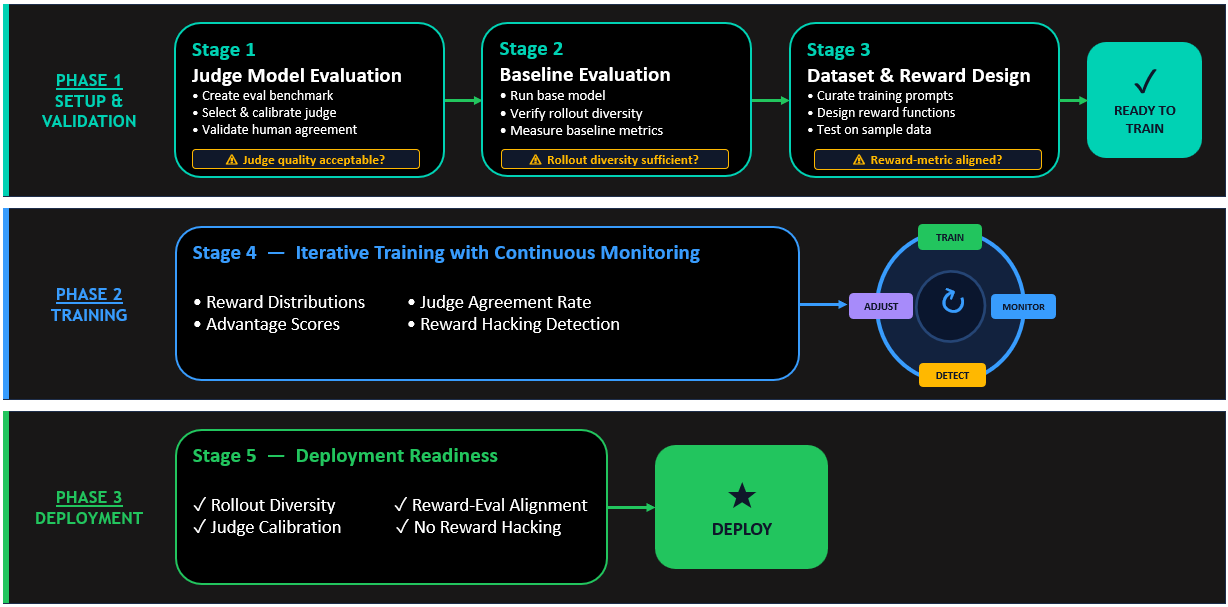
The following diagram illustrates the complete end-to-end training process, from baseline evaluation through judge validation to production deployment. Each step builds upon the previous one, creating a resilient pipeline that balances alignment quality with computational efficiency while actively preventing reward hacking and supporting production-ready model behavior.
Real-world case study: Automating legal contract review
In this section, we refer to a real-world use case with a leading legal industry partner. The task is to generate comments on risks, assessments, and actions on legal documentation with respect to the policies and previous contracts as reference documents.
Challenge
Partner was interested in solving the problem of automating the process of reviewing, assessing, and flagging risks in legal contract documents. Specifically, they wanted to evaluate potential new contracts against internal guidelines and regulations, past contracts, and laws of the country pertaining to the contract.
Solution
We formulated this problem as one where we are providing a target document (the “contract” that needs evaluation), and a reference document (the grounding document and context) and expect the LLM to generate a JSON with multiple comments, comment types, and recommended actions to take based on the assessment. The original dataset available for this use case was relatively small that included complete contracts along with annotations and comments from legal experts. We used LLM as a judge using GPT OSS 120b model as the judge and a custom system prompt during RFT.
RFT workflow
In the following section we cover details of the key aspects in the RFT workflow for this use case.
Reward Lambda function for LLM-as-a-judge
The following code snippets present the key components of the reward Lambda function.
Note: name of Lambda function should have “SageMaker”, for example, "arn:aws:lambda:us-east-1:123456789012:function:MyRewardFunction**SageMaker**"
a) Start with defining a high-level objective
# Contract Review Evaluation - Unweighted Scoring
You are an expert contract reviewer evaluating AI-generated comments. Your PRIMARY objective is to assess how well each predicted comment identifies issues in the TargetDocument contract clauses and whether those issues are justified by the Reference guidelines.
b) Define the evaluation approach
## Evaluation Approach
For each sample, you receive:
- **TargetDocument**: The contract text being reviewed (the document under evaluation)
- **Reference**: Reference guidelines/standards used for the review (the evaluation criteria)
- **Prediction**: One or more comments from the AI model
**Important**: The SystemPrompt shows what instructions the model received. Consider whether the model followed these instructions when evaluating the prediction quality.
**CRITICAL**: Each comment must identify a specific issue, gap, or concern IN THE TARGETDOCUMENT CONTRACT TEXT ITSELF. The comment's text_excerpt field should quote problematic contract language from the TargetDocument, NOT quote text from the Reference guidelines. The Reference justifies WHY the contract clause is problematic, but the issue must exist IN the contract.
Evaluate EACH predicted comment independently. Comments should flag problems in the contract clauses, not merely cite Reference requirements.
c) Describe the scoring dimensions with clear specifications on how a particular score should be calculated
## Scoring Dimensions (Per Comment)
**EVALUATION ORDER**: Evaluate in this sequence: (1) TargetDocument_Grounding, (2) Reference_Consistency, (3) Actionability
### 1. TargetDocument_Grounding
**Evaluates**: (a) Whether text_excerpt quotes from TargetDocument contract text, and (b) Whether the comment is relevant to the quoted text_excerpt
**MANDATORY**: text_excerpt must quote from TargetDocument contract text. If text_excerpt quotes from Reference instead, score MUST be 1.
- **5**: text_excerpt correctly quotes TargetDocument contract text AND comment identifies a highly relevant, valid, and notable issue in that quoted text
- **4**: text_excerpt correctly quotes TargetDocument contract text AND comment identifies a valid and relevant issue in that quoted text
- **3**: text_excerpt correctly quotes TargetDocument contract text AND comment is somewhat relevant to that quoted text, but concern has moderate validity
- **2**: text_excerpt correctly quotes TargetDocument contract text BUT comment has weak relevance to that quoted text, or concern is questionable
- **1**: text_excerpt does NOT quote TargetDocument contract text (quotes Reference instead, or no actual quote), OR comment is irrelevant to the quoted text
### 2. Reference_Consistency
...
...
d) Clearly define the final output format to parse
Scoring Calculation
Comment_Score = Simple average of the three dimensions:
- Comment_Score = (TargetDocument_Grounding + Reference_Consistency + Actionability) / 3
Aggregate_Score = Average of all Comment_Score values for the sample
Output Format
For each sample, evaluate ALL predicted comments and provide:
{ "comments": [
{ "comment_id": "...",
"TargetDocument_Grounding": {"score": X, "justification": "...", "supporting_evidence": "Verify text_excerpt quotes actual TargetDocument contract text and comment is relevant to it"},
"Reference_Consistency": {"score": X, "justification": "...", "supporting_reference": "Quote from Reference that justifies the concern OR explain meaningful reasoning"},
"Actionability": {"score": X, "justification": "Assess if action is clear, grounded in TargetDocument and Reference, and relevant to comment"},
"Comment_Score": X.XX
} ],
"Aggregat同じ出来事を2媒体で確認
同じ出来事を扱う別媒体の記事です。見出しと公開時刻を比較できます。
関連記事
今日のまとめ
AIデイリーブリーフで今日の重要ニュースをまとめ読み