ケンショがLangGraphで信頼できる金融データ検索を解決するマルチエージェントフレームワークを構築した方法
本文の状態
日本語全文を表示中
詳細モードで約8分の本文を読めます。
ケンショのエンジニアチームが、S&Pグローバルの膨大なデータ資産から効率的に検索するため、LangGraphを使用したマルチエージェントフレームワークを開発した。このフレームワークは、AIが業界を変革する中で、信頼できるデータに基づいた出力を保証することを目的としている。
Source Article
元記事を日本語で読む
本文に関係しない購読案内、埋め込み通知、サイト内プロモーションは除いています。
 imageゲストブログ投稿: Ilya YudkovichおよびNick Roshdieh
AIエージェントの時代において、S&P Globalの膨大なデータ資産を効率的に検索することは、独特の課題を伴います。S&P GlobalのAI革新と変革の原動力として、Kenshoの目標は、AIが産業を変革する中でも、その出力が信頼できるデータに基づいていることを保証することです。顧客がそのデータをどのように、どこで利用する場合でも変わりません。
Kenshoのエンジニア、研究者、開発者から成るチームは、S&P Globalの豊富なデータセットに対して高度なAIと機械学習を適用し、データ検索プロセスを統一することに注力しています。これにより、顧客は単一のインターフェースを通じて、この知見をAIアプリケーションやエージェント型ワークフローに組み込むことが可能になります。
多くのウェブベース検索アプリケーションで典型的なテキスト情報とは異なり、S&P Globalのデータは高度に構造化され、複雑なニュアンスを含んでいます。このため、当社のデータを最先端の生成AI(GenAI)アプリケーションと効果的に統合するには、高度なデータ検索技術の採用が求められます。この課題を解決するため、我々は「Grounding」というマルチエージェントフレームワークを開発しました。これはS&P Globalデータへのコアなアクセス層として機能します。
Groundingは、あらゆる洞察が検証済みデータセットから直接導き出されることを保証します。いくつかのLangGraphツールを用いて開発されたこのフレームワークは、複数のビジネスユニットからのデータを統合し、それらのデータをAIエージェント、LLM(大規模言語モデル)、GenAIアプリケーションと連携させるための基盤ソリューションです。同時に、高い信頼性、有効性、コンプライアンスを維持します。
課題: 断片化された金融データ検索
金融の専門家は、断片化されたシステムにまたがるデータ検索にしばしば苦労し、収益分析、財務指標の取得、市場調査などに必要な情報を探し出して検証するのに何時間も費やしています。KenshoのGroundingシステムは、S&P Globalの検証済み金融データセットに対する自然言語クエリ用の単一エントリーポイントを構築することで、このプロセスを簡素化します。これにより、複雑なデータベーススキーマを把握したり、専門的なクエリ言語を習得する必要がなくなります。Groundingを通じて、クライアントは正確なリアルタイムの金融情報にアクセスでき、検証済みのS&P Globalデータソースに裏付けられた引用付きの回答を得られます。これにより、すべての結果において高い信頼性と有効性、透明性、追跡可能性を伴うコンプライアンスが保証されます。この仕組みにより、ユーザーはデータアクセスの探索やソース検証ではなく、分析そのものに集中できるようになります。
LangGraphによるマルチエージェントフレームワークの設計
我々は、Groundingシステムを、AIエージェント群にまたがるデータアクセスのための集中化されたエントリーポイントとして設計しました。これらのエージェントは、様々なデータリポジトリに由来する部門横断的なS&P Globalデータソース群からデータを取得します。自然言語解析ロジックを個々のエージェントに組み込むのではなく、我々のルーターは、クエリを専門的なデータ検索エージェント(DRA)へとインテリジェントに振り分けます。これらのDRAは、株式調査、固定収入、マクロ経済学など、様々な領域の異なるデータチームによって所有されています。これにより、データルーティング層とデータ検索層の関心が分離され、各層の並行した所有・開発が可能になります。
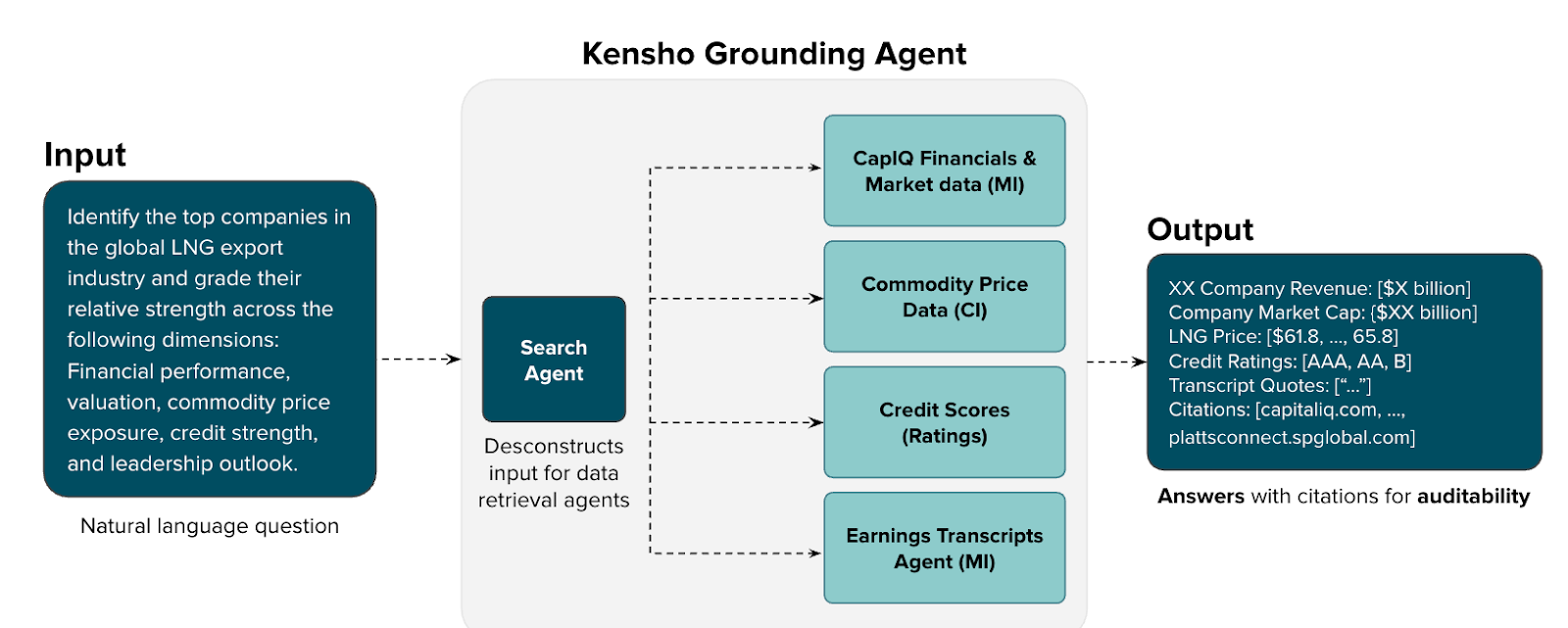 imageGrounding検索エージェントには、S&P GlobalのDRAを呼び出すルーターコンポーネントが含まれています。DRAは単一責任の垂直的な機能を提供することを目的としており、そのデータセットを用いたクエリの信号対雑音比を高めます。ルーター内の集約層は、マップリデュースの問題を解決します。つまり、複数のDRAからの分散した応答を受け取り、それらをインテリジェントに結合して、正確性と文脈の両方を保ちつつ、首尾一貫した実践可能な洞察へとまとめ上げます。
LangGraphは、Groundingルーターを支えるエンジンです。その中核的な責務には、ユーザークエリの関連文脈に基づいて多様なエージェントへのアクセスを提供すること、クエリをより小さなDRA固有のサブクエリに分解すること、応答をユーザーへと集約して返すことが含まれます。LangGraphの設計により、ルーターのローカルでの反復開発とテストが容易になり、単一エントリーポイントを提供するとともに、スムーズな開発者体験を確保できました。
カスタムデータ検索プロトコルの確立
分散データシステムとAIシステムは、一貫性のない通信インターフェースに悩まされることがよくあります。これはエージェント間の信頼性の低い相互作用を招き、個々のエージェントごとに複雑なデータ処理ニーズを生み出す可能性があります。我々のチームによる初期の内部実験を通じて、一貫したデータアクセスパターンを確保するため、カスタムDRAプロトコルを開発しました。
このプロトコルは、構造化データと非構造化データの両方を含む、すべての返却データに対する共通のデータ形式を確立しました。これにより、S&P Global全体でGroundingに接続されたDRAを開発・展開する過程において、マルチエージェントエコシステム全体での協業と一貫したデータ交換が加速しました。
このように、我々のGroundingシステムを通じて集中化されたプロトコルを設計したことで、Kenshoは複数の専門的な金融AI製品(すなわちエージェントとAPI)を迅速に展開することが可能になりました。それぞれが同じ堅牢なデータ基盤を活用しています。アナリストがセクターのパフォーマンスを比較するのを支援する株式調査アシスタントから、持続可能性指標を追跡するESG(環境、社会、ガバナンス)コンプライアンスエージェントまで、すべてのアプリケーションが同じ信頼性の高いデータアクセス層を共有しています。一貫したシステムの上にエージェントと製品を構築することで、我々の市場投入までの時間を短縮し、新しく作成されたエージェントがデータパイプラインを再構築することなく、S&P Globalデータの全幅に即座にアクセスできるようにしています。
進化するエージェント型エコシステムからの主要な学び
マルチエージェントフレームワークを構築し洗練させるプロセスを通じて、Kenshoチームはいくつかの重要な知見を得ました。これらのベストプラクティスが、複雑なマルチエージェントアーキテクチャを開発する他の組織の一助となることを願っています:
- 可観測性: 包括的なトレーシングと綿密に設計されたメタデータ要件は、エージェントの動作に対する可視性を維持し、効果的なデバッグと大規模な最適化を可能にするために不可欠です。我々のカスタムプロトコルにより、分散マルチエージェントシステム全体で必要な情報をパッケージ化することができます。LangGraphとのネイティブな統合は、分散システムを維持し、開発者向けのエンドツーエンドの追跡可能性とデバッグを確保するための重要なコンポーネントです。
- 多段階評価: 金融業界では、金融データ検索に対する高い信頼性と確実性が要求されます。我々の連合エージェントシステムを評価するには、マルチエージェント検索の各段階において、ルーティング決定、データ品質、回答の完全性を評価する多面的なマトリックスが必要です。評価スイートは、LangGraphベースのRouterGraphを通じてテストクエリを実行します。我々は、選択されたエージェントと様々なデータエージェントに対する正確性を測定し、完全一致(正しいエージェントを選択し、期待される応答を得たか)とツール呼び出し(ルーターが正しいツールを選択したか、ただし異なる応答を得たか)に焦点を当てます。これにより、正確性を評価し、システム内のギャップを特定することができました。
- プロトコル研究と最適化: 我々はユーザーとエージェントの相互作用パターンを継続的に分析しており、これによりKenshoのカスタムプロトコルの反復的な改良が可能になります。これは、システム効率を大幅に改善し、直接的なLLMの文脈理解とプログラム処理の両方のための出力形式を最適化しました。すべては、金融サービスが要求する信頼性を維持しながら行われています。
原文を表示
imageGuest blog post by Ilya Yudkovich and Nick Roshdieh
In the era of AI agents, searching efficiently through S&P Global's vast data estate presents a unique set of challenges. As S&P Global’s engine for AI innovation and transformation, Kensho’s goal is to ensure that as AI transforms industries, its outputs remain grounded in trusted data–however and wherever customers choose to use it.
Kensho’s team of engineers, researchers, and builders are focused on applying advanced AI and machine learning across S&P Global’s rich datasets to unify the data retrieval process, providing customers a single interface to bring this intelligence into AI applications and agentic workflows.
Unlike the textual information typical of many web-based search applications, S&P Global data is highly structured and nuanced. This requires employing advanced data retrieval techniques to effectively integrate our data with cutting-edge generative AI applications. To solve this challenge, we developed Grounding, a multi-agent framework that serves as a core access layer for S&P Global data.
Grounding ensures that every insight is derived directly from verified datasets. The framework, developed using several LangGraph tools, is a foundational solution for unifying data from multiple business units and integrating that data with AI agents, LLMs, and GenAI applications while maintaining high-trust validity and compliance.
The Challenge: Fragmented Financial Data Retrieval
Financial professionals often struggle with data retrieval across fragmented systems, spending hours locating and verifying information that they need to analyze earnings, retrieve financial metrics, perform market research, and more. Kensho’s Grounding system simplifies this process by creating a single entry point for natural language queries against S&P Global's verified financial datasets. This eliminates the need to navigate complex database schemas or learn specialized query languages. Through Grounding, clients can access accurate real-time financial information with citation-backed responses to verified S&P Global data sources, ensuring high-trust validity and compliance with transparency and traceability in every result. This pattern enables users to focus on analysis rather than data access hunting and source validation.
Designing a Multi-Agent Framework with LangGraph
We architected our Grounding system as a centralized entry point for data access across our AI agents, which retrieve data from an array of cross-divisional S&P Global data sources stemming from various data repositories. Rather than embedding natural language parsing logic into individual agents, our router intelligently directs queries to specialized Data Retrieval Agents (DRAs) owned by different data teams such as equity research, fixed income, macroeconomics to name a few domains. This provides a separation of concern between data routing and data retrieval layers, supporting parallel ownership of each.
imageThe Grounding search agent includes a router component that calls S&P Global DRAs.The DRAs are meant to provide a single responsibility vertical, increasing the signal-to-noise ratio for queries using that dataset. The aggregation layer within the router then solves the map-reduce problem: taking distributed responses from multiple DRAs and intelligently combining them into coherent, actionable insights that maintain both accuracy and context.
LangGraph is the engine behind the Grounding router. Its core responsibilities include providing access to the diverse agents based on relevant context from the user query, breaking down a query into smaller DRA-specific sub-queries, and aggregating the responses back to the user. LangGraph’s design made it easy to iterate and test the router locally, providing that single entry point and ensuring a smooth developer experience.
Establishing a Custom Data Retrieval Protocol
Distributed data and AI systems often suffer from inconsistent communication interfaces. These can lead to unreliable agent interactions and create complex data processing needs for each individual agent. Through our team’s early internal experimentation, we developed a custom DRA protocol to ensure consistent data access patterns.
The protocol established a common data format for all returned data, including both structured and unstructured data. This has accelerated collaboration and consistent data exchange across our entire multi-agent ecosystem as we work across S&P Global to develop and deploy DRAs connected to Grounding.
Architecting the protocol in this way, centralized through our Grounding system, has enabled Kensho to rapidly deploy multiple specialized financial AI products ( i.e. agents and APIs), each leveraging the same robust data foundation. From our equity research assistant–which helps analysts compare sector performance–to our ESG (Environmental, Social, and Governance) compliance agent that tracks sustainability metrics, all applications share the same reliable data access layer. Building agents and products atop a consistent system accelerates our time-to-market giving newly created agents immediate access to the full breadth of S&P Global data without rebuilding data pipelines.
Key Learnings for an Evolving Agentic Ecosystem
The process of building and refining our multi-agent framework left the Kensho team with a few key insights. We hope these best practices will help guide other organizations when developing complex multi-agent architectures:
- Observability: Comprehensive tracing and deliberate metadata requirements are essential for maintaining visibility into agent behavior and enabling effective debugging and optimization at scale. Our custom protocol allows us to package the necessary information across our distributed multi-agent system. Native embedded LangGraph integration is a critical component for maintaining our distributed systems and ensuring end-to-end traceability and debugging for developers.
- Multi-stage evaluation: The financial industry requires high trust and certainty in financial data retrieval. Evaluating our federated agent system requires multi-faceted matrices evaluating routing decisions, data quality, and answer completeness at each step of the multi-agent retrieval. The evaluation suite executes test queries through the LangGraph-based RouterGraph. We measure accuracy against selected agents and various data agents, focusing on exact-match (selected the correct agents and retrieved expected responses) and tool-calling (whether the router selected the right tools, but got various responses). This allowed us to evaluate accuracy and identify gaps within our system.
- Protocol studies and optimization: We continuously analyze user and agent interaction patterns, which enables iterative refinement of Kensho’s custom protocol. This has significantly improved system efficiency, maximizing the output format for both direct LLM contextual understanding as well as programmatic processing–all while maintaining the reliability that financial services demand.
同じ出来事を2媒体で確認
同じ出来事を扱う別媒体の記事です。見出しと公開時刻を比較できます。
関連記事
今日のまとめ
AIデイリーブリーフで今日の重要ニュースをまとめ読み